
2 Kings 18:33

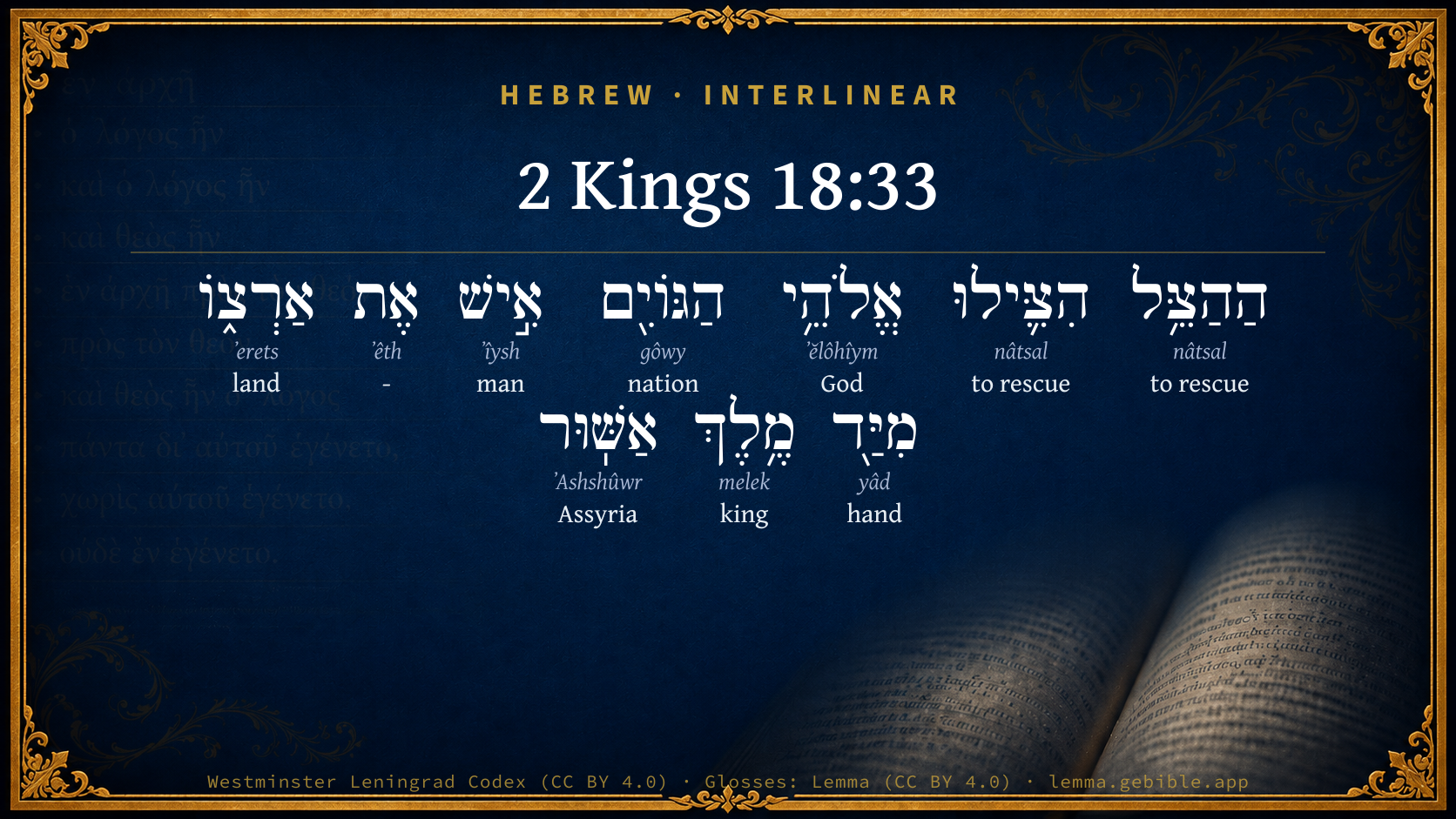
Hebrew (Westminster Leningrad Codex) 2 Kings 18:33 appears in the Hebrew Old Testament. The text above is from the Westminster Leningrad Codex. Each word links to its Strong’s number, a concise gloss, and parsing drawn from the Open Scriptures Hebrew Bible morphology. Click any word for its full Brown-Driver-Briggs (BDB) entry.
Download image
Cite this verse

2 Kings 18:33 (World English Bible). Public Domain. Lemma interlinear Bible study tool, https://lemma.gebible.app/v/2-kings/18/33.

Show BibTeX & RIS
BibTeX
RIS
English Translation
Has any of the gods of the nations ever delivered his land out of the hand of the king of Assyria?
World English Bible · Public Domain
Download a study sheet

One document with this verse’s original text, its word-by-word gloss line, the meaning frame, cross-references with their text, attributed commentary, and full source and license credits — printable, and it pastes into notes with its structure intact.

This verse Autodidact and up

Study sheet (.html) Plain text (.txt)

A passage Seminary Student

Up to 50 verses in one chapter. A passage sheet keeps up to 6 commentary sources and 12 cross-references per verse, in the order this page ranks them, and says so on the sheet whenever that leaves anything out. Ask for a single verse and you get the Autodidact verse sheet above.

Everything on this page stays free to read, with no account — the sheet is a download of what is already on screen, not access to it.

Want to remove ads? Support Godless Engineer
Compare translations 3

The same verse in 3 English versions, stacked beneath the original-language interlinear above. Click any original word for its lexicon entry.

Each is an independent rendering of the whole verse — the interlinear is not word-aligned to these translations.

Highlighted words mark where these versions differ — a whole-verse word diff, not a word-by-word alignment.

  • World English Bible Public Domain
    Has any of the gods of the nations ever delivered his land out of the hand of the king of Assyria?
  • King James Version Public Domain
    Hath any of the gods of the nations delivered at all his land out of the hand of the king of Assyria?
  • unfoldingWord Literal Text CC BY-SA 4.0
    Delivering, did the gods of the nations deliver, a man his land from the hand of the king of Assyria?

unfoldingWord Literal Text — © unfoldingWord, licensed CC BY-SA 4.0. Word-aligned USFM3 via Door43 (git.door43.org/unfoldingWord/en_ult).

Versions to compare (up to 4)

3 of 4 selected

Show all 18 translations

Every available English version of this verse, each an independent rendering of the whole verse.

  • World English Bible Public Domain
    Has any of the gods of the nations ever delivered his land out of the hand of the king of Assyria?
  • Berean Standard Bible Public Domain
    Has the god of any nation ever delivered his land from the hand of the king of Assyria?
  • Majority Standard Bible Public Domain
    Has the god of any nation ever delivered his land from the hand of the king of Assyria?
  • King James Version Public Domain
    Hath any of the gods of the nations delivered at all his land out of the hand of the king of Assyria?
  • American Standard Version (1901) Public Domain
    Hath any of the gods of the nations ever delivered his land out of the hand of the king of Assyria?
  • Revised Version (1885) Public Domain
    Hath any of the gods of the nations ever delivered his land out of the hand of the king of Assyria?
  • Geneva Bible (1599) Public Domain
    Hath any of the gods of the nations deliuered his lande out of the hand of the King of Asshur?
  • Douay-Rheims (1899) Public Domain
    Have any of the gods of the nations delivered their land from the hand of the king of Assyria?
  • Young's Literal Translation Public Domain
    `Have the gods of the nations delivered at all each his land out of the hand of the king of Asshur?
  • Literal Standard Version CC BY-SA 4.0
    Have each of the gods of the nations ever delivered his land out of the hand of the king of Asshur?
  • Unlocked Literal Bible CC BY-SA 4.0
    Has any of the gods of the peoples rescued them out of the hand of the king of Assyria?
  • unfoldingWord Literal Text CC BY-SA 4.0
    Delivering, did the gods of the nations deliver, a man his land from the hand of the king of Assyria?
  • Darby Bible Public Domain
    Have any of the gods of the nations delivered at all his land out of the hand of the king of Assyria?
  • World Messianic Bible Public Domain
    Has any of the gods of the nations ever delivered his land out of the hand of the king of Assyria?
  • Webster's Bible Public Domain
    Hath any of the gods of the nations delivered at all his land out of the hand of the king of Assyria?
  • Free Bible Version CC BY-SA 4.0
    Have any of the gods of any nation ever saved their land from the power of the king of Assyria?
  • Bible in Basic English Public Domain
    Has any one of the gods of the nations kept his land from falling into the hands of the king of Assyria?
  • JPS Tanakh (1917) Public Domain
    Hath any of the gods of the nations ever delivered his land out of the hand of the king of Assyria?

Literal Standard Version (2020), Covenant Press — licensed CC BY-SA 4.0. Text via the HelloAO Bible API (eBible.org). Unlocked Literal Bible (unfoldingWord) — licensed CC BY-SA 4.0. Text via the HelloAO Bible API (eBible.org). unfoldingWord Literal Text — © unfoldingWord, licensed CC BY-SA 4.0. Word-aligned USFM3 via Door43 (git.door43.org/unfoldingWord/en_ult). Free Bible Version, Dr. Jonathan Gallagher — licensed CC BY-SA 4.0. Text via the HelloAO Bible API (eBible.org).

Word by word

More ways to search: Search by grammar → Find every occurrence → Compare this word →

Practice this passage: Drill this verse → Learn its vocabulary →

אַשּֽׁוּר
ʼAshshûwr
H804
“Assyria”
Noun, Proper
Part of Speech
Noun
Type
Proper
Full BDB Definition

Origin: apparently from H833 (in the sense of successful)

TWOT: 176

Asshur or Assyria = "a step" - the second son of Shem, eponymous ancestor of the Assyrians (noun proper masculine) - the people of Assyria (noun proper masculine) - the nation, Assyria (noun proper locative) - the land, Assyria or Asshur (noun proper locative)
  1. הַהַצֵּ֥ל nâtsal H5337 “to rescue” Particle, Interrogative + Verb, Hiphil, Infinitive Absolute
  2. הִצִּ֛ילוּ nâtsal H5337 “to rescue” Verb, Hiphil, Perfect, 3rd Person, Common, Plural
  3. אֱלֹהֵ֥י ʼĕlôhîym H430 “God(s) of” Noun, Common, Masculine, Plural, Construct
  4. הַגּוֹיִ֖ם gôwy H1471 “the · nations” Particle, Definite Article + Noun, Common, Masculine, Plural, Absolute
  5. אִ֣ישׁ ʼîysh H376 “man” Noun, Common, Masculine, Singular, Absolute
  6. אֶת ʼêth H853 “-” Particle, Direct Object
  7. אַרְצ֑וֹ ʼerets H776 “land · his” Noun, Common, Both, Singular, Construct + Suffix, Personal, 3rd Person, Masculine, Singular
  8. מִיַּ֖ד yâd H3027 “from · hand of” Preposition + Noun, Common, Both, Singular, Construct
  9. מֶ֥לֶךְ melek H4428 “king of” Noun, Common, Masculine, Singular, Construct

About this verse

These counts appear in no published source. They are computed here, from the morphology-tagged text and Lemma’s own curated glosses. What Lemma adds →

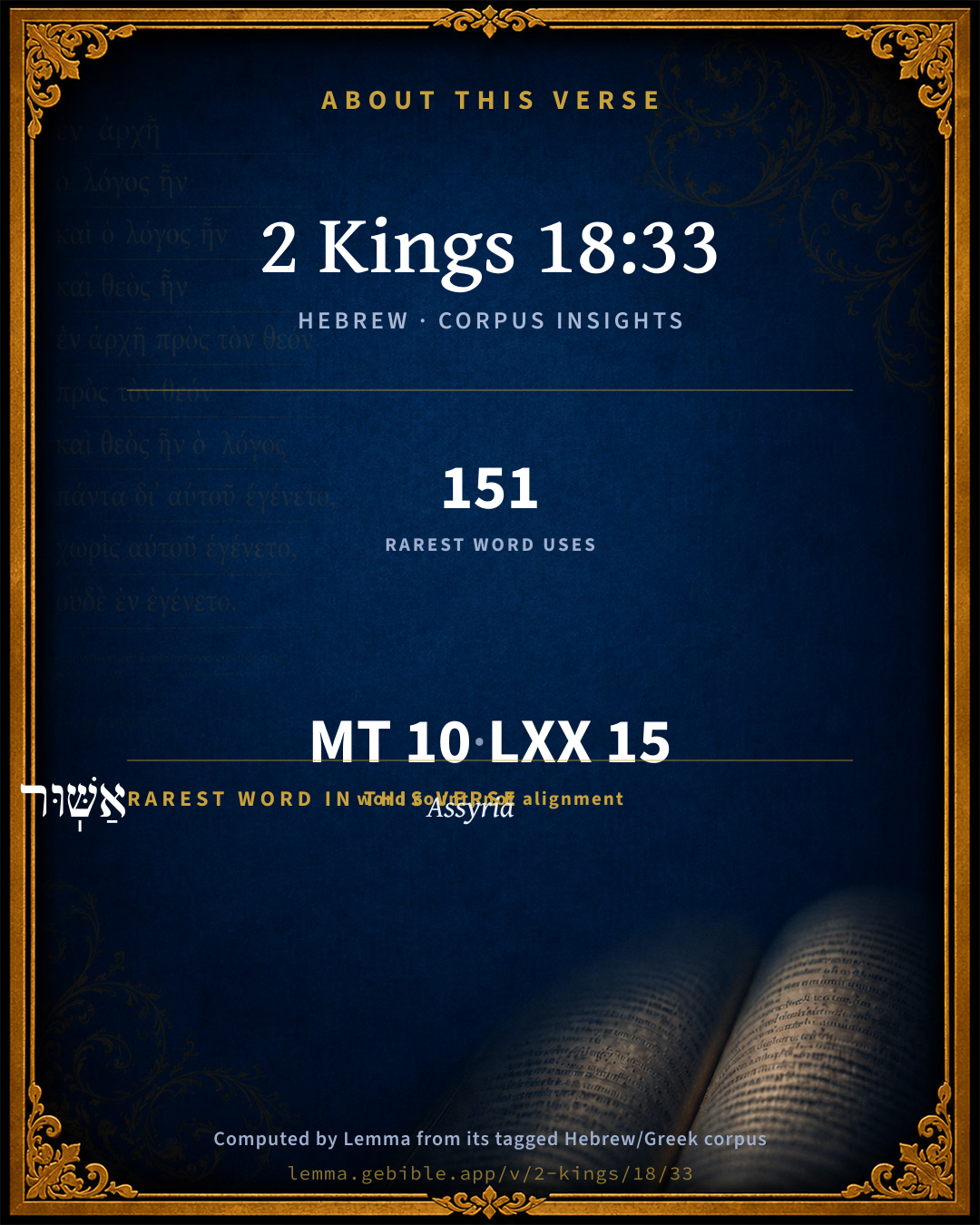
10
words
9
distinct lemmas
Historical
section

Grammatical profile

  • 2 verbs
  • 7 nouns
  • 1 particle

Verb forms

  • הַהַצֵּ֥ל Hiphil · Infinitive Absolute
  • הִצִּ֛ילוּ Hiphil · Perfect

Repetition

A word recurs within this verse — often emphatic in Hebrew:

  • הַהַצֵּ֥ל to rescue H5337 ×2

Hebrew & Septuagint length

In English translation the verse runs 21 words from the Hebrew and 23 from the Septuagint (LXX English) — closely comparable.

A rough comparison of the two English renderings, which tokenize alike — not a word-level alignment.

Word counts can differ between the Hebrew and the Greek without any difference in meaning — e.g. the Hebrew direct-object marker אֵת has no separate Greek word, and Greek often adds the article ὁ.

In the original languages it is 10 Hebrew tokens and 15 Greek tokens — but the two are counted differently (Hebrew bundles its prefixes and suffixes into one token; the Greek is in lemma form), so that isn’t a like-for-like length.

Cross-references

6

Topical passages linked to 2 Kings 18:33 in the Treasury of Scripture Knowledge — connected by theme and wording, ordered by reader-vote popularity; previews shown in the World English Bible.

  • Isaiah 10:10–11 As my hand has found the kingdoms of the idols, whose engraved images did excel them of Jerusalem and of Samaria;
  • 2 Kings 19:12–13 Have the gods of the nations delivered them, which my fathers have destroyed, Gozan, and Haran, and Rezeph, and the children of Eden that were in Telassar?
  • 2 Kings 19:17–18 Of a truth, Yahweh, the kings of Assyria have laid waste the nations and their lands,
  • 2 Chronicles 32:14–17 Who was there among all the gods of those nations which my fathers utterly destroyed, that could deliver his people out of my hand, that your God should be able to deliver you out of my hand?
  • 2 Chronicles 32:19 They spoke of the God of Jerusalem, as of the gods of the peoples of the earth, which are the work of men's hands.
  • Isaiah 36:18–20 Beware lest Hezekiah persuade you, saying, Yahweh will deliver us. Has any of the gods of the nations delivered his land out of the hand of the king of Assyria?

Cross-references courtesy of OpenBible.info (CC BY 4.0).

Hebrew and Greek witnesses Masoretic Hebrew ↔ Greek Septuagint

The same verse in the two great witnesses to the Old Testament, shown verse-for-verse.

These are two independent witnesses, not word-aligned to each other, and the Septuagint is shown in lemma (dictionary) form.

Hebrew 2 Kings 18:33 Masoretic · Westminster Leningrad Codex

הַהַצֵּ֥ל הִצִּ֛ילוּ אֱלֹהֵ֥י הַגּוֹיִ֖ם אִ֣ישׁ אֶת אַרְצ֑וֹ מִיַּ֖ד מֶ֥לֶךְ אַשּֽׁוּר

Has any of the gods of the nations ever delivered his land out of the hand of the king of Assyria?

World English Bible · Public Domain

Greek LXX 2 Kings 18:33 Septuagint · lemma form

μή ῥύομαι ῥύομαι ὁ θεός ὁ ἔθνος ἕκαστος ὁ ἑαυτοῦ χώρα ἐκ χείρ βασιλεύς ἀσσύριος

Have the Gods of the nations at all delivered each their own land out of the hand of the king of the Assyrians?

LXX2012 (modern English Septuagint) · Public Domain

Hebrew: Westminster Leningrad Codex (CC BY 4.0). Greek: Septuagint (public domain); English from LXX2012 (modern English Septuagint) (Public Domain). How the Septuagint differs from the Hebrew →

Targum (Aramaic paraphrase)

1

The Targum is the ancient Jewish Aramaic paraphrase of the Hebrew Scriptures — an interpretive translation, not the Hebrew text itself. Onkelos (literal) and Pseudo-Jonathan (expansive) render the Torah, and Jonathan the Prophets. Coverage is partial: where no permissively-licensed English translation exists for a verse, only the Aramaic is shown. This is verse-level text, not a word-by-word alignment to the Hebrew.

  1. Targum Jonathan Prophets (Joshua–Malachi)
    הֲשֵׁיזָבָא שֵׁיזִיבָא דַחֲלַת עַמְמַיָא גְבַר יַת אַרְעֵיהּ מִיַד מַלְכָּא דְאַתּוּר:

    (no public-domain English translation for this verse)

    Targum Jonathan — Aramaic: “Mikraot Gedolot” (public domain). English: “Sefaria Community Translation” (CC0 1.0 (public-domain dedication)); “London "Chaldee Paraphrase," 1871” (public domain). Text via Sefaria.

Commentary

Notes on 2 Kings 18:33 from classic Christian and Jewish commentators (each source and its license shown beneath its notes). The classic Christian expositions comment on the surrounding passage and are grouped to its opening verse, so a note may address several verses; the Jewish commentaries on the Tanakh (Rashi and others) are per-verse, so they appear only where the commentator wrote on this verse.

Lemma curates 59 commentaries, every one of them public domain or Creative Commons licensed, each selected and text-cleaned for this edition rather than reprinted as found. About our sources →

Trapp's Complete Commentary

John Trapp

2Ki 18:33 Hath any of the gods of the nations delivered at all his land out of the hand of the king of Assyria?

Ver. 33. Hath any of the gods of the nations.] These were no gods, and Hezekiah might better say than that heathen once did, Contemno minutulos istos deos, modo, Iovem (Iehovam) mihi propitium habeam; Let the Lord arise, and his enemies shall be scattered.

John Trapp, A Commentary or Exposition upon All the Books of the Old and New Testament (1647–1656) — public domain. Text from a community e-Sword module.

Ellicott's Commentary for English Readers

(33) Hath any . . . his land.—Literally, have the gods of the nations at all delivered every one his own Land? If this is to be consistent with 2Ki_18:25, we must suppose the thought to be that the god of each conquered nation had favoured the Assyrian cause, as Jehovah is here alleged to be doing. But, as 2Ki_18:34-35 seem to imply the impotence of the foreign deities when opposed to the might of Assyria, a verbal inconsistency may be admitted. (See Note on 2Ch_32:15.)

The rab-sak would hardly be very particular about what he said in an extemporised address, the sole aim of which was to work on the fears of the Jews. The connection of thought in his mind may have been somewhat as follows: “Jehovah, instead of opposing, manifestly favours our arms; and even if that be otherwise, as you may believe, no matter! He is not likely to prove mightier than the gods of all the other nations that have fallen before us.”

Out of the hand of the king of Assyria.—Sennacherib, or his spokesman, thinks of his predecessors as well as of himself, as is evident from 2Ki_19:12-13. (Comp. 2Ch_32:13-14.)

A Bible Commentary for English Readers, edited by Charles John Ellicott (1878–1897) — public domain. Text from a community e-Sword module.

The Cambridge Bible for Schools and Colleges

gen. ed. J. J. S. Perowne

33. Hath any of the gods of the nations delivered at all] R.V. ever delivered. So that it is clear that Rab-shakeh, in spite of his language in verse 25, counted Jehovah as but one among the many local deities which were supposed specially to belong to one city or one country.

The Cambridge Bible for Schools and Colleges (gen. ed. J. J. S. Perowne; Cambridge University Press, 1878–1918) — public domain. Text from a community e-Sword module.

Albert Barnes' Notes on the Bible

The boast is natural. The Assyrians had had an uninterrupted career of success, and might well believe that their gods were more powerful than those of the nations with whom they had warred. It is not surprising that they did not understand that their successes hitherto had been allowed by the very God, Yahweh, against whom they were now boasting themselves.

Albert Barnes' Notes on the Bible (1834–1885) — public domain. Text from a community e-Sword/MySword module.

Whedon's Commentary on the Bible

Daniel D. Whedon

33. Hath any of the gods — Skillfully and powerfully does the orator close his speech by claiming that none of the gods had thus far been able to resist the power of Assyria. He probably does not mean to imply that the gods of the conquered nation had actually fought against the king of Assyria and been destroyed in the conflict, but rather, that they had not opposed his march. He does not mean to contradict what he says in 2Ki_18:25, but would, perhaps, have it inferred that the gods of some of these countries, if not all, invited his coming, and favoured his conquests. At least none of them resisted his arms, but the images of some of them he cast into the fire and destroyed. 2Ki_19:18.

Daniel D. Whedon (gen. ed.), Commentary on the Old and New Testaments (1874–1909) — public domain. Text from a community e-Sword module.

The Pulpit Commentary

Hath any of the gods of the nations delivered at all his land out of the hand of the King of Assyria? To Rabshakeh, and the Assyrians generally, this seemed a crushing and convincing, absolutely unanswerable, argument. It had all the force of what appeared to them a complete induction. As far back as they could remember, they had always been contending with different tribes and nations, each and all of whom had had gods in whom they trusted, and the result had been uniform the gods had been unequal to the task of protecting their votaries against Assyria: how could it be imagined that Jehovah would prove an exception? If he was not exactly, as Knobel calls him, "the insignificant god of an insignificant people," yet how was he better or stronger than the others than Chemosh, or Moloch, or Rim-moll, or Baal, or Ashima, or Khaldi, or Bel, or Merodach? What had he done for the Jews hitherto? Nothing remarkable, so far as the Assyrians knew; for their memories did not reach back so far as the time of Asa and the deliverance from Zerah, much less to the conquest of Canaan or the Exodus. He had not "saved the trans Jordanic tribes from Tiglath-pileser, or Samaria from his successors. Was it not madness to suppose that he would save Judaea from Sennacherib? A heathen reasoner could not see, could not be expected to see, the momentous difference; that the gods of the other countries were "no gods", (2Ki_19:18) while Jehovah was "the Lord of the whole earth."

The Pulpit Commentary (1880–1919), ed. H.D.M. Spence-Jones & Joseph S. Exell — public domain. Text from a community e-Sword module.

unfoldingWord translationNotes

Door43 World Missions Community

General Information:

Rabshakeh continues telling the message from the king of Assyria to King Hezekiah's men.

Has any of the gods ... Assyria?

He asks this question for emphasis because they know the answer. AT: "None the gods of the peoples have rescued them ... Assyria." (See: Rhetorical Question)

Where are the gods of ... Arpad?

He asks this question for emphasis because they know the answer. AT: "I have destroyed the gods of ... Arpad!" (See: Rhetorical Question)

Hamath ... Arpad ... Sepharvaim ... Hena ... Ivvah ... Samaria

These are the names of places that represent the people living there. (See: How to Translate Names)

out of my hand

"Hand" is metonymy for control, power, or authority. AT: "out from my control" (See: Metonymy)

is there any god who has rescued his land from my power?

He asks this question for emphasis because they know the answer. AT: "No god has rescued his land from my power." (See: Rhetorical Question)

from my power

"My power" is metonymy for the person whose has the power. AT: "from me" (See: Metonymy)

How could Yahweh save Jerusalem from my might?

He asks this question for emphasis because they know the answer. AT: "There is no way Yahweh can save Jerusalem from my might!" (See: Rhetorical Question)

translationWords

false god

king

Assyria

Samaria

hand

save

Jerusalem

might

unfoldingWord translationNotes — © Distant Shores Media and the Door43 World Missions Community, licensed CC BY-SA 4.0. Source: git.door43.org/Door43/en_tn.

Lesson kit

Teaching starters — assembled from the data on this page, not authored interpretation. Every prompt links to the verse data it draws on. Edit before teaching.

2 Kings, in the Historical, opens this verse with 10 words (9 distinct Hebrew lemmas). Its most distinctive word is ʼAshshûwr (“Assyria”). A historical commentator’s framing appears above. Read the whole chapter for the surrounding context.

Discussion questions

  1. How does “Assyria” (ʼAshshûwr) shape what this verse is saying?
  2. How does Isaiah 10:10–11, which shares this passage’s theme, read alongside this verse?
  3. What does the repetition of “to rescue” (2× in this one verse) do in this verse?
  4. These translations render this verse differently; the difference is in the English rendering, not the original. What questions does that raise?
  5. «הַהַצֵּ֥ל» is a Hiphil Infinitive Absolute verb. How does that grammatical form shape the action described?
  6. Compare how Trapp's Complete Commentary and Ellicott's Commentary for English Readers read this verse. Where do they agree or differ?

Things to notice

Reading settings

Reading text

Shown beneath each verse's original-language words.

Old Testament
Old Testament edition

Read the OT as the Masoretic Hebrew (MT) or the Greek Septuagint (LXX).

English shown for the Greek Septuagint (in the Hebrew ↔ Greek comparison).

Comparing translations? Open the Compare panel on any verse page to stack up to four side by side.