
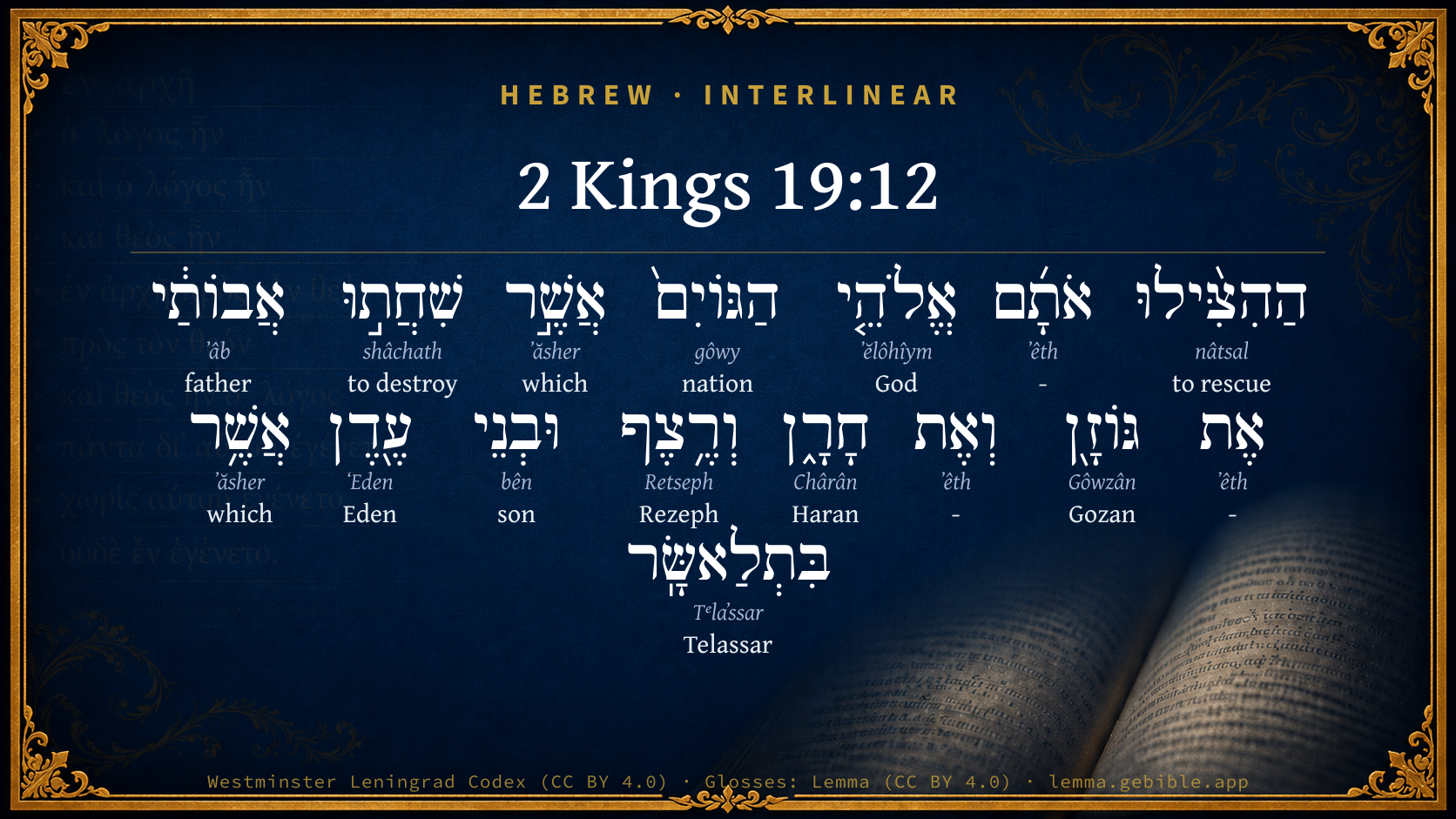
2 Kings 19:12

Hebrew (Westminster Leningrad Codex) 2 Kings 19:12 appears in the Hebrew Old Testament. The text above is from the Westminster Leningrad Codex. Each word links to its Strong’s number, a concise gloss, and parsing drawn from the Open Scriptures Hebrew Bible morphology. Click any word for its full Brown-Driver-Briggs (BDB) entry.
Download image
Cite this verse

2 Kings 19:12 (World English Bible). Public Domain. Lemma interlinear Bible study tool, https://lemma.gebible.app/v/2-kings/19/12.

Show BibTeX & RIS
BibTeX
RIS
English Translation
Have the gods of the nations delivered them, which my fathers have destroyed, Gozan, and Haran, and Rezeph, and the children of Eden that were in Telassar?
World English Bible · Public Domain
Highlights
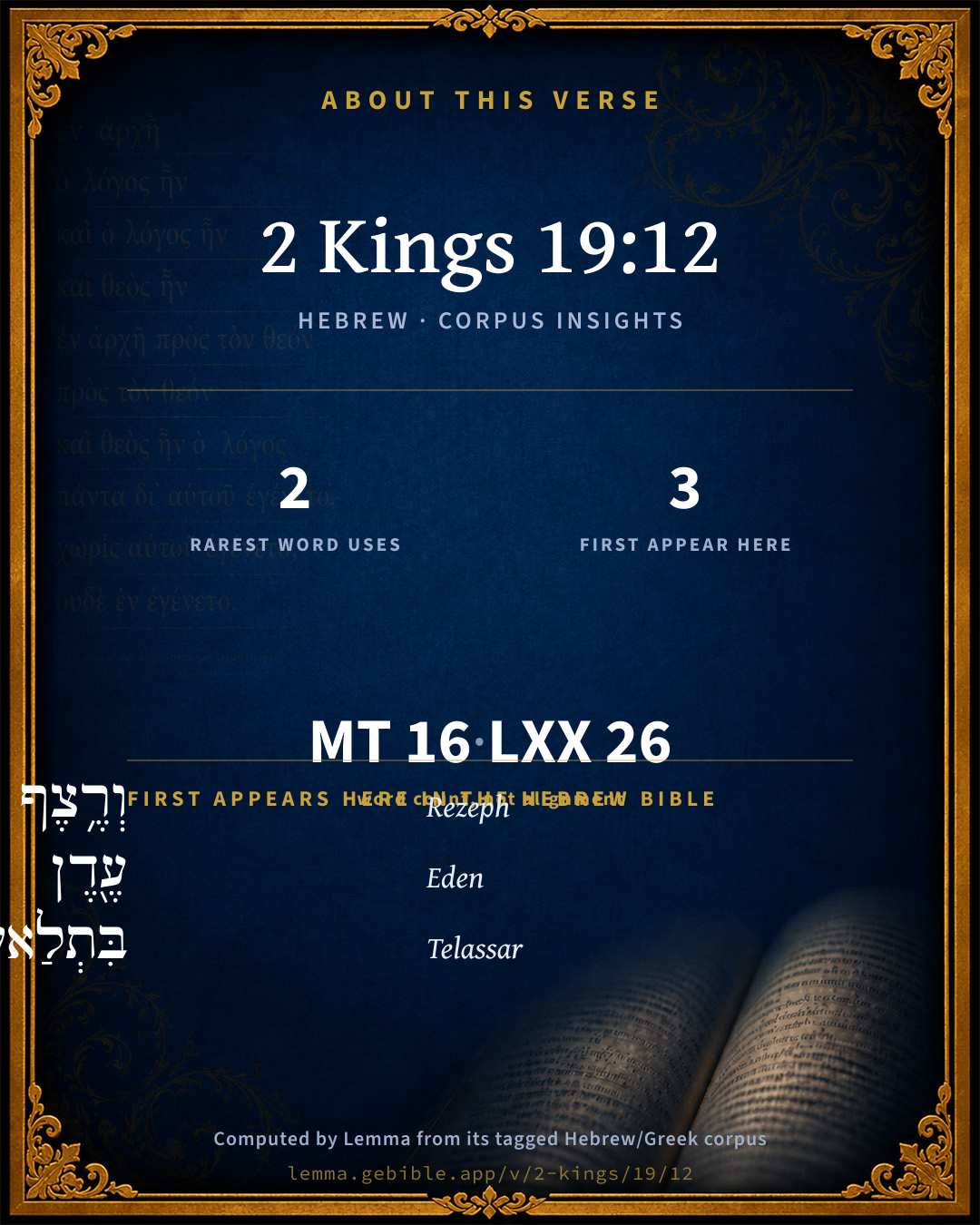
  • 3 first appearances in the Hebrew Bible
Full analysis ↓
Download a study sheet

One document with this verse’s original text, its word-by-word gloss line, the meaning frame, cross-references with their text, attributed commentary, and full source and license credits — printable, and it pastes into notes with its structure intact.

This verse Autodidact and up

Study sheet (.html) Plain text (.txt)

A passage Seminary Student

Up to 50 verses in one chapter. A passage sheet keeps up to 6 commentary sources and 12 cross-references per verse, in the order this page ranks them, and says so on the sheet whenever that leaves anything out. Ask for a single verse and you get the Autodidact verse sheet above.

Everything on this page stays free to read, with no account — the sheet is a download of what is already on screen, not access to it.

Want to remove ads? Support Godless Engineer
Compare translations 3

The same verse in 3 English versions, stacked beneath the original-language interlinear above. Click any original word for its lexicon entry.

Each is an independent rendering of the whole verse — the interlinear is not word-aligned to these translations.

Highlighted words mark where these versions differ — a whole-verse word diff, not a word-by-word alignment.

  • World English Bible Public Domain
    Have the gods of the nations delivered them, which my fathers have destroyed, Gozan, and Haran, and Rezeph, and the children of Eden that were in Telassar?
  • King James Version Public Domain
    Have the gods of the nations delivered them which my fathers have destroyed; as Gozan, and Haran, and Rezeph, and the children of Eden which were in Thelasar?
  • unfoldingWord Literal Text CC BY-SA 4.0
    Did the gods of the nations that my fathers destroyed deliver them, Gozan or Haran or Rezeph or the sons of Eden who in Tel Assar?

unfoldingWord Literal Text — © unfoldingWord, licensed CC BY-SA 4.0. Word-aligned USFM3 via Door43 (git.door43.org/unfoldingWord/en_ult).

Versions to compare (up to 4)

3 of 4 selected

Show all 18 translations

Every available English version of this verse, each an independent rendering of the whole verse.

  • World English Bible Public Domain
    Have the gods of the nations delivered them, which my fathers have destroyed, Gozan, and Haran, and Rezeph, and the children of Eden that were in Telassar?
  • Berean Standard Bible Public Domain
    Did the gods of the nations destroyed by my fathers rescue those nations—the gods of Gozan, Haran, and Rezeph, and of the people of Eden in Telassar?
  • Majority Standard Bible Public Domain
    Did the gods of the nations destroyed by my fathers rescue those nations—the gods of Gozan, Haran, and Rezeph, and of the people of Eden in Telassar?
  • King James Version Public Domain
    Have the gods of the nations delivered them which my fathers have destroyed; as Gozan, and Haran, and Rezeph, and the children of Eden which were in Thelasar?
  • American Standard Version (1901) Public Domain
    Have the gods of the nations delivered them, which my fathers have destroyed, Gozan, and Haran, and Rezeph, and the children of Eden that were in Telassar?
  • Revised Version (1885) Public Domain
    Have the gods of the nations delivered them, which my fathers have destroyed, Gozan, and Haran, and Rezeph, and the children of Edom which were in Telassar?
  • Geneva Bible (1599) Public Domain
    Haue the gods of the heathen deliuered them which my fathers haue destroyed? as Gozan, and Haran, and Rezeph, and the children of Eden, which were in Thelasar?
  • Douay-Rheims (1899) Public Domain
    Have the gods of the nations delivered any of them, whom my fathers have destroyed, to wit, Gozan, and Haran, and Reseph, and the children of Eden that were in Thelassar?
  • Young's Literal Translation Public Domain
    did the gods of the nations deliver them whom my fathers destroyed -- Gozan, and Haran, and Rezeph, and the sons of Eden, who `are' in Thelassar?
  • Literal Standard Version CC BY-SA 4.0
    Did the gods of the nations deliver them whom my fathers destroyed—Gozan, and Haran, and Rezeph, and the sons of Eden, who [are] in Thelassar?
  • Unlocked Literal Bible CC BY-SA 4.0
    Have the gods of the nations rescued them, the nations that my fathers destroyed: Gozan, Haran, Rezeph, and the people of Eden in Tel Assar?
  • unfoldingWord Literal Text CC BY-SA 4.0
    Did the gods of the nations that my fathers destroyed deliver them, Gozan or Haran or Rezeph or the sons of Eden who in Tel Assar?
  • Darby Bible Public Domain
    Have the gods of the nations which my fathers have destroyed delivered them: Gozan, and Haran, and Rezeph, and the children of Eden that were in Thelassar?
  • World Messianic Bible Public Domain
    Have the gods of the nations delivered them, which my fathers have destroyed—Gozan, Haran, Rezeph, and the children of Eden who were in Telassar?
  • Webster's Bible Public Domain
    Have the gods of the nations delivered them which my fathers have destroyed; as Gozan and Haran, and Rezeph, and the children of Eden who were in Thelasar?
  • Free Bible Version CC BY-SA 4.0
    Did the gods of the nations my forefathers destroyed save them—the gods of Gozan, Haran, Rezeph, and the people of Eden who lived in Telassar?
  • Bible in Basic English Public Domain
    Did the gods of the nations keep safe those on whom my fathers sent destruction, Gozan and Haran and Rezeph and the children of Eden who were in Telassar?
  • JPS Tanakh (1917) Public Domain
    Have the gods of the nations delivered them, which my fathers have destroyed, Gozan, and Haran, and Rezeph, and the children of Eden that were in Telassar?

Literal Standard Version (2020), Covenant Press — licensed CC BY-SA 4.0. Text via the HelloAO Bible API (eBible.org). Unlocked Literal Bible (unfoldingWord) — licensed CC BY-SA 4.0. Text via the HelloAO Bible API (eBible.org). unfoldingWord Literal Text — © unfoldingWord, licensed CC BY-SA 4.0. Word-aligned USFM3 via Door43 (git.door43.org/unfoldingWord/en_ult). Free Bible Version, Dr. Jonathan Gallagher — licensed CC BY-SA 4.0. Text via the HelloAO Bible API (eBible.org).

Word by word

More ways to search: Search by grammar → Find every occurrence → Compare this word →

Practice this passage: Drill this verse → Learn its vocabulary →

וְרֶ֥צֶף
Retseph
H7530
“and · Rezeph”
Conjunction + Noun, Proper
Part of Speech
Conjunction + Noun
Type
Proper
Full BDB Definition

Origin: the same as H7529

TWOT: None

Rezeph = "a hot stone" - a place conquered by Assyria
  1. הַהִצִּ֨ילוּ nâtsal H5337 “to rescue” Particle, Interrogative + Verb, Hiphil, Perfect, 3rd Person, Common, Plural
  2. אֹתָ֜ם ʼêth H853 “- · them” Particle, Direct Object + Suffix, Personal, 3rd Person, Masculine, Plural
  3. אֱלֹהֵ֤י ʼĕlôhîym H430 “God(s) of” Noun, Common, Masculine, Plural, Construct
  4. הַגּוֹיִם֙ gôwy H1471 “the · nations” Particle, Definite Article + Noun, Common, Masculine, Plural, Absolute
  5. אֲשֶׁ֣ר ʼăsher H834 “which” Particle, Relative
  6. שִׁחֲת֣וּ shâchath H7843 “to destroy” Verb, Piel, Perfect, 3rd Person, Common, Plural
  7. אֲבוֹתַ֔י ʼâb H1 “fathers · my” Noun, Common, Masculine, Plural, Construct + Suffix, Personal, 1st Person, Common, Singular
  8. אֶת ʼêth H853 “-” Particle, Direct Object
  9. גּוֹזָ֖ן Gôwzân H1470 “Gozan” Noun, Proper
  10. וְאֶת ʼêth H853 “and · -” Conjunction + Particle, Direct Object
  11. חָרָ֑ן Chârân H2771 “Haran” Noun, Proper
  12. וּבְנֵי bên H1121 “and · sons of” Conjunction + Noun, Common, Masculine, Plural, Construct
  13. עֶ֖דֶן ʻEden H5729 “Eden” Noun, Proper
  14. אֲשֶׁ֥ר ʼăsher H834 “which” Particle, Relative
  15. בִּתְלַאשָּֽׂר Tᵉlaʼssar H8515 “in/at · Telassar” Preposition + Noun, Proper

About this verse

These counts appear in no published source. They are computed here, from the morphology-tagged text and Lemma’s own curated glosses. What Lemma adds →

16
words
13
distinct lemmas
Historical
section

Notable vocabulary

The rarest word here is וְרֶ֥צֶף Rezeph H7530 — appearing just 2 times in the whole Hebrew Bible.

First appearance in Scripture

These words make their first canonical appearance in the Hebrew Bible here:

  • וְרֶ֥צֶף Rezeph H7530
  • עֶ֖דֶן Eden H5729
  • בִּתְלַאשָּֽׂר Telassar H8515

Shared distinctive vocabulary

וְרֶ֥צֶף Rezeph H7530 occurs in 2 verses of the Hebrew Bible. Also found in:

Grammatical profile

  • 2 verbs
  • 9 nouns
  • 5 particles

Verb forms

  • הַהִצִּ֨ילוּ Hiphil · Perfect
  • שִׁחֲת֣וּ Piel · Perfect

Repetition

A word recurs within this verse — often emphatic in Hebrew:

  • אֲשֶׁ֣ר which H834 ×2

Hebrew & Septuagint length

In English translation the verse runs 27 words from the Hebrew and 29 from the Septuagint (LXX English) — closely comparable.

A rough comparison of the two English renderings, which tokenize alike — not a word-level alignment.

Word counts can differ between the Hebrew and the Greek without any difference in meaning — e.g. the Hebrew direct-object marker אֵת has no separate Greek word, and Greek often adds the article ὁ.

In the original languages it is 16 Hebrew tokens and 26 Greek tokens — but the two are counted differently (Hebrew bundles its prefixes and suffixes into one token; the Greek is in lemma form), so that isn’t a like-for-like length.

Cross-references

9

Topical passages linked to 2 Kings 19:12 in the Treasury of Scripture Knowledge — connected by theme and wording, ordered by reader-vote popularity; previews shown in the World English Bible.

  • 2 Kings 17:6 In the ninth year of Hoshea the king of Assyria took Samaria, and carried Israel away to Assyria, and placed them in Halah, and on the Habor, the river of Gozan, and in the cities of the Medes.
  • Genesis 11:31 Terah took Abram his son, Lot the son of Haran, his son's son, and Sarai his daughter-in-law, his son Abram's wife. They went forth from Ur of the Chaldees, to go into the land of Canaan. They came to Haran, and lived there.
  • Ezekiel 27:23 Haran and Canneh and Eden, the traffickers of Sheba, Asshur [and] Chilmad, were your traffickers.
  • Isaiah 37:12 Have the gods of the nations delivered them, which my fathers have destroyed, Gozan, and Haran, and Rezeph, and the children of Eden who were in Telassar?
  • Genesis 2:8 Yahweh God planted a garden eastward, in Eden, and there he put the man whom he had formed.
  • Genesis 29:4 Jacob said to them, "My relatives, where are you from?" They said, "We are from Haran."
  • 2 Kings 18:33–34 Has any of the gods of the nations ever delivered his land out of the hand of the king of Assyria?
  • 1 Chronicles 5:26 The God of Israel stirred up the spirit of Pul king of Assyria, and the spirit of Tilgath Pilneser king of Assyria, and he carried them away, even the Reubenites, and the Gadites, and the half-tribe of Manasseh, and brought them to Halah, and Habor, and Hara, and to the river of Gozan, to this day.
  • Acts 7:4 Then he came out of the land of the Chaldaeans, and lived in Haran. From there, when his father was dead, God moved him into this land, where you are now living.

Cross-references courtesy of OpenBible.info (CC BY 4.0).

Hebrew and Greek witnesses Masoretic Hebrew ↔ Greek Septuagint

The same verse in the two great witnesses to the Old Testament, shown verse-for-verse.

These are two independent witnesses, not word-aligned to each other, and the Septuagint is shown in lemma (dictionary) form.

Hebrew 2 Kings 19:12 Masoretic · Westminster Leningrad Codex

הַהִצִּ֨ילוּ אֹתָ֜ם אֱלֹהֵ֤י הַגּוֹיִם֙ אֲשֶׁ֣ר שִׁחֲת֣וּ אֲבוֹתַ֔י אֶת גּוֹזָ֖ן וְאֶת חָרָ֑ן וְרֶ֥צֶף וּבְנֵי עֶ֖דֶן אֲשֶׁ֥ר בִּתְלַאשָּֽׂר

Have the gods of the nations delivered them, which my fathers have destroyed, Gozan, and Haran, and Rezeph, and the children of Eden that were in Telassar?

World English Bible · Public Domain

Greek LXX 2 Kings 19:12 Septuagint · lemma form

μή ἐκαἱρέω αὐτός ὁ θεός ὁ ἔθνος ὅς διαφθείρω ὁ πατήρ ἐγώ ὁ τε γωζαν καί ὁ χαρραν καί ραφες καί υἱός εδεμ ὁ ἐν θαεσθεν

Have the gods of the nations at all delivered them, whom my fathers destroyed; both Gozan, and Charran, and Raphis, and the sons of Edem who were in Thaesthen?

LXX2012 (modern English Septuagint) · Public Domain

On this verse, The Cambridge Bible for Schools and Colleges discusses the Septuagint’s reading. Read the note in Commentary ↓

Hebrew: Westminster Leningrad Codex (CC BY 4.0). Greek: Septuagint (public domain); English from LXX2012 (modern English Septuagint) (Public Domain). How the Septuagint differs from the Hebrew →

Targum (Aramaic paraphrase)

1

The Targum is the ancient Jewish Aramaic paraphrase of the Hebrew Scriptures — an interpretive translation, not the Hebrew text itself. Onkelos (literal) and Pseudo-Jonathan (expansive) render the Torah, and Jonathan the Prophets. Coverage is partial: where no permissively-licensed English translation exists for a verse, only the Aramaic is shown. This is verse-level text, not a word-by-word alignment to the Hebrew.

  1. Targum Jonathan Prophets (Joshua–Malachi)
    הֲשֵׁיזָבָא יַתְהוֹן דַחֲלַת עַמְמַיָא דְחַבִּילוּ אֲבָהָתַי יַת גוֹזָן וְיַת חָרָן וְרֶצֶף וּבְנֵי עֶדֶן דְבִתְלַסָר:

    (no public-domain English translation for this verse)

    Targum Jonathan — Aramaic: “Mikraot Gedolot” (public domain). English: “Sefaria Community Translation” (CC0 1.0 (public-domain dedication)); “London "Chaldee Paraphrase," 1871” (public domain). Text via Sefaria.

Commentary

Notes on 2 Kings 19:12 from classic Christian and Jewish commentators (each source and its license shown beneath its notes). The classic Christian expositions comment on the surrounding passage and are grouped to its opening verse, so a note may address several verses; the Jewish commentaries on the Tanakh (Rashi and others) are per-verse, so they appear only where the commentator wrote on this verse.

Lemma curates 59 commentaries, every one of them public domain or Creative Commons licensed, each selected and text-cleaned for this edition rather than reprinted as found. About our sources →

Trapp's Complete Commentary

John Trapp

2Ki 19:12 Have the gods of the nations delivered them which my fathers have destroyed; [as] Gozan, and Haran, and Rezeph, and the children of Eden which [were] in Thelasar?

Ver. 12. Have the gods of the nations, &c.] See on 2Ki 19:10.

Which my fathers have destroyed.] God was not in all this man’s thoughts. Hic Deus nihil fecit; but he should have known that he and his fathers or predecessors, those scourges of mankind, were but as rods in God’s hand, which, when worn to the stump, he cast into the fire.

John Trapp, A Commentary or Exposition upon All the Books of the Old and New Testament (1647–1656) — public domain. Text from a community e-Sword module.

Ellicott's Commentary for English Readers

(12) My fathers.—Sargon his father founded the dynasty; but he speaks of his predecessors generally as his “fathers.”

Gozan.—2Ki_17:6.

Haran.—Also a west Aramean town, mentioned by Tiglath Pileser I. (circ. 1120 B.C. ) Shalmaneser II. speaks of its conquest. It had a famous sanctuary of the moon god Sin. (See Gen_11:31.)

Rezeph.—The Assyrian Raçappa, a town of Mesopotamia, often mentioned in the inscriptions.

The children of Eden.—Schrader identifies this community with Bît-Adini (“the house of Eden”), often mentioned by Assurnâçirpal and Shalmaneser II. The latter records his defeat of Ahuni, “son of Eden,” a phrase which exactly corresponds to “the children (sons) of Eden” here. It lay on both banks of the middle Euphrates, between the present Bâlis and Birejik.

Thelasar.—Heb., Tĕlassar, the Assyrian Tul-Assuri (“Mound of Assur”). More than one place bore the name.

A Bible Commentary for English Readers, edited by Charles John Ellicott (1878–1897) — public domain. Text from a community e-Sword module.

The Cambridge Bible for Schools and Colleges

gen. ed. J. J. S. Perowne

12. as Gozan] The R.V. omits the italic ‘as’ both here and in the parallel place in Isaiah. On Gozan see above 2Ki_17:6 note.

and Haran] The LXX. gives for this place Χαῤῥὰν, as in Gen_27:43, thus identifying it with the place where Abraham dwelt after leaving Ur of the Chaldees. The town of Haran [still called Harran] is in the midst of the district which lies under Mt. Masius between the Khabour and the Euphrates.

and Rezeph] This name is found in several places in the neighbourhood of the Euphrates, where from the situation of the other cities mentioned with it, this Rezeph most likely was situated. Two places, one on the west and one on the east of the Euphrates have been put forward as the city here mentioned but we have no means of deciding more than that the place was not far distant from the others named along with it.

the children of Eden which were in Thelasar] R.V. Telassar. This latter form is the orthography of A.V. in the parallel verse in Isaiah. Of the position of this Eden it is impossible to say more than that it was probably somewhere in the north west of Mesopotamia, whither Assyrian conquest had spread in the times just preceding Sennacherib, and to which he would intend now to call attention. The LXX. omits this name in the parallel place in Isaiah. Telassar must have been the chief seat of these children of Eden, the capture of which broke down the people. In Eze_27:23, Eden is again joined with Haran, and with Asshur. Hence some confirmation may be drawn for placing the people in the upper Mesopotamian plain.

All the places above named are additional to those given by Rab-shakeh in his recital of Assyrian victories (2Ki_17:34).

The Cambridge Bible for Schools and Colleges (gen. ed. J. J. S. Perowne; Cambridge University Press, 1878–1918) — public domain. Text from a community e-Sword module.

Albert Barnes' Notes on the Bible

Haran - Harran, the Carrhae of the Greeks and Romans Gen 11:31, was among the earliest conquests of the Assyrians; being subject to them from the 12th century. Its conquest would have naturally followed that of Gozan (Gauzanitis, 2Ki 17:6), which lay between it and Assyria proper.

Rezeph - Probably the Rozappa of the Assyrian inscriptions, a city in the neighborhood of Haran.

The children of Eden - Or, “the Beni-Eden,” who appear from the Assyrian inscriptions to have inhabited the country on the east bank of the Euphrates, about the modern Balis. Here they had a city called Beth-Adina, taken by the Assyrians about 880 B.C. This is probably the “Eden” of marginal reference.

Thelasar - Or Telassar. Probably a city on the Euphrates, near Beth-Adina, called after the name of the god Asshur. The name would signify “the Hill of Asshur.”

Albert Barnes' Notes on the Bible (1834–1885) — public domain. Text from a community e-Sword/MySword module.

Haydock's Catholic Bible Commentary

Gozan, in Less Armenia; Haran and Reseph in Palmerene Syria. Thelassar, or Syria. They were nations not very remote. See chap. xviii. 34. (Calmet)

George Leo Haydock (1774–1849), Haydock's Catholic Family Bible and Commentary, 1859 edition — public domain. Excludes Psalms (Douay-Rheims chapter numbering differs from Protestant) and Deuterocanonical books (Catholic canon only).

Matthew Poole's English Annotations

Several places about or beyond Euphrates. See Gen 11:31; Eze 27:23.

Matthew Poole's English Annotations on the Holy Bible (1683–1685) — public domain. Text from a community e-Sword/MySword module.

Whedon's Commentary on the Bible

Daniel D. Whedon

12. Gozan — The district on the upper Habor. See note on 2Ki_17:6.

Haran — Also in Mesopotamia, but lying some distance northwest of Gozan. Here Abraham abode for a time after leaving Ur of the Chaldees, (Gen_11:31,) and here a Roman army under Crassus was defeated by the Parthians. It is called Carrae, by the classical writers, and Charran in Act_7:4. It is doubtless identical with the modern Haran, which is situated on the river Belik, one of the branches of the upper Euphrates. Rezeph is still a common name in the East, and applied to a number of cities. Most interpreters incline to identify this Rezeph with a place in eastern Syria which Ptolemy calls Resapha. It is about a day’s journey west of the Euphrates.

Children of Eden which were in Thelasar — This last name should be written Telassar, and may signify the hill of Asshur; so called, perhaps, from some shrine which the Assyrians had there erected to Asshur. Eden would seem to be a district of which Telassar was a chief city, but no trace of either has been found.

Daniel D. Whedon (gen. ed.), Commentary on the Old and New Testaments (1874–1909) — public domain. Text from a community e-Sword module.

The Pulpit Commentary

Have the gods of the nations delivered them which my fathers have destroyed? The Assyrian kings always speak of all their predecessors as their ancestors. In point of fact, Sennacherib bad had only one "father" among the previous kings, viz. Sargon. As Gozan. (see the comment on 2Ki_17:6) It is uncertain at what time Gozan was finally conquered and absorbed. It was frequently overrun by the Assyrians from the reign of Tiglath-pileser I (about B.C. 1100); but it was probably not absorbed until about B.C. 809. The Prefect of Gozan first appears in the list of Assyrian Eponyms in B.C. 794. And Haran. "Haran" is generally admitted to be the city of Terah, (Gen_11:32) and indeed there is no rival claimant of the name. Its position was in the western part of the Gauzanitis region, on the Belik, about lat. 36 50" N. It was probably conquered by Assyria about the same time as Gozan. And Reseph. A town called "Razappa," probably "Rezeph," appears in the Assyrian inscriptions from an early date. It is thought to have been in the near vicinity of Haran, but had been conquered and absorbed as early as B.C. 818. Whether it is identical with the Resapha of Ptolemy ("Geograph.," 5:15) is doubtful. And the children of Eden. Probably the inhabitants of a city called "Bit-Adini" in the Assyrian inscriptions, which was on the Middle Euphrates, not far from Carchemish, on the left bank ("Records of the Past," vol. 3. pp. 69, 71, etc.). This place was conquered by Asshur-nazir-pal, about B.C. 877. Which were in Thelasar. "Thelasar" is probably the Hebrew equivalent of "Tel-Asshur," "the hill or fort of Asshur," which may have been the Assyrian name of Bit-Adini, or of a city dependent on it. Asshur-nazir-pal gave Assyrian names to several cities on the Middle Euphrates (see "Records of the Past," vol. 3. p. 55, line 48; p. 69, line 50).

The Pulpit Commentary (1880–1919), ed. H.D.M. Spence-Jones & Joseph S. Exell — public domain. Text from a community e-Sword module.

unfoldingWord translationNotes

Door43 World Missions Community

General Information:

King Sennacharib's message to King Hezekiah continues.

Have the gods of the nations rescued them, the nations ... Assar?

This question assumes Hezekiah knows the answer and provides emphasis. AT: "The gods of the nations certainly did not rescue them, the nations ... Assar!" (See: Rhetorical Question)

my fathers

"the previous kings of Assyria" or "the armies of the previous kings of Assyria"

Gozan ... Haran ... Rezeph ... Eden ... Tel Assar ... Hamath ... Arpad ... Sepharvaim ... Hena ... Ivvah

These are all place names. (See: How to Translate Names)

translationWords

false god

nation

ancestor

Haran

Hamath

unfoldingWord translationNotes — © Distant Shores Media and the Door43 World Missions Community, licensed CC BY-SA 4.0. Source: git.door43.org/Door43/en_tn.

Rashi

Rabbi Shlomo Yitzchaki (Rashi)

Eden. The name of a province.

Rashi on the Tanakh — English translations: “The Judaica Press complete Tanach with Rashi, translated by A. J. Rosenberg” (CC BY 4.0); “Pentateuch with Rashi's commentary by M. Rosenbaum and A.M. Silbermann, 1929-1934” (public domain); “The Metsudah Tanach series, Lakewood, N.J” (CC BY 4.0); and “The Book of Joshua, Metsudah Publications, 1997” (CC BY 4.0). Text via Sefaria.

Lesson kit

Teaching starters — assembled from the data on this page, not authored interpretation. Every prompt links to the verse data it draws on. Edit before teaching.

2 Kings, in the Historical, opens this verse with 16 words (13 distinct Hebrew lemmas). Its most distinctive word is Retseph (“Rezeph”). A historical commentator’s framing appears above. Read the whole chapter for the surrounding context.

Discussion questions

  1. How does “Rezeph” (Retseph) shape what this verse is saying?
  2. 3 words make their first appearance in Scripture here. What does this debut establish?
  3. How does Isaiah 37:12, which shares the word «Rezeph», read alongside this verse?
  4. What does the repetition of “which” (2× in this one verse) do in this verse?
  5. These translations render this verse differently; the difference is in the English rendering, not the original. What questions does that raise?
  6. «הַהִצִּ֨ילוּ» is a Hiphil Perfect verb. How does that grammatical form shape the action described?
  7. Compare how Trapp's Complete Commentary and Ellicott's Commentary for English Readers read this verse. Where do they agree or differ?

Things to notice

Reading settings

Reading text

Shown beneath each verse's original-language words.

Old Testament
Old Testament edition

Read the OT as the Masoretic Hebrew (MT) or the Greek Septuagint (LXX).

English shown for the Greek Septuagint (in the Hebrew ↔ Greek comparison).

Comparing translations? Open the Compare panel on any verse page to stack up to four side by side.