
2 Chronicles 28:3

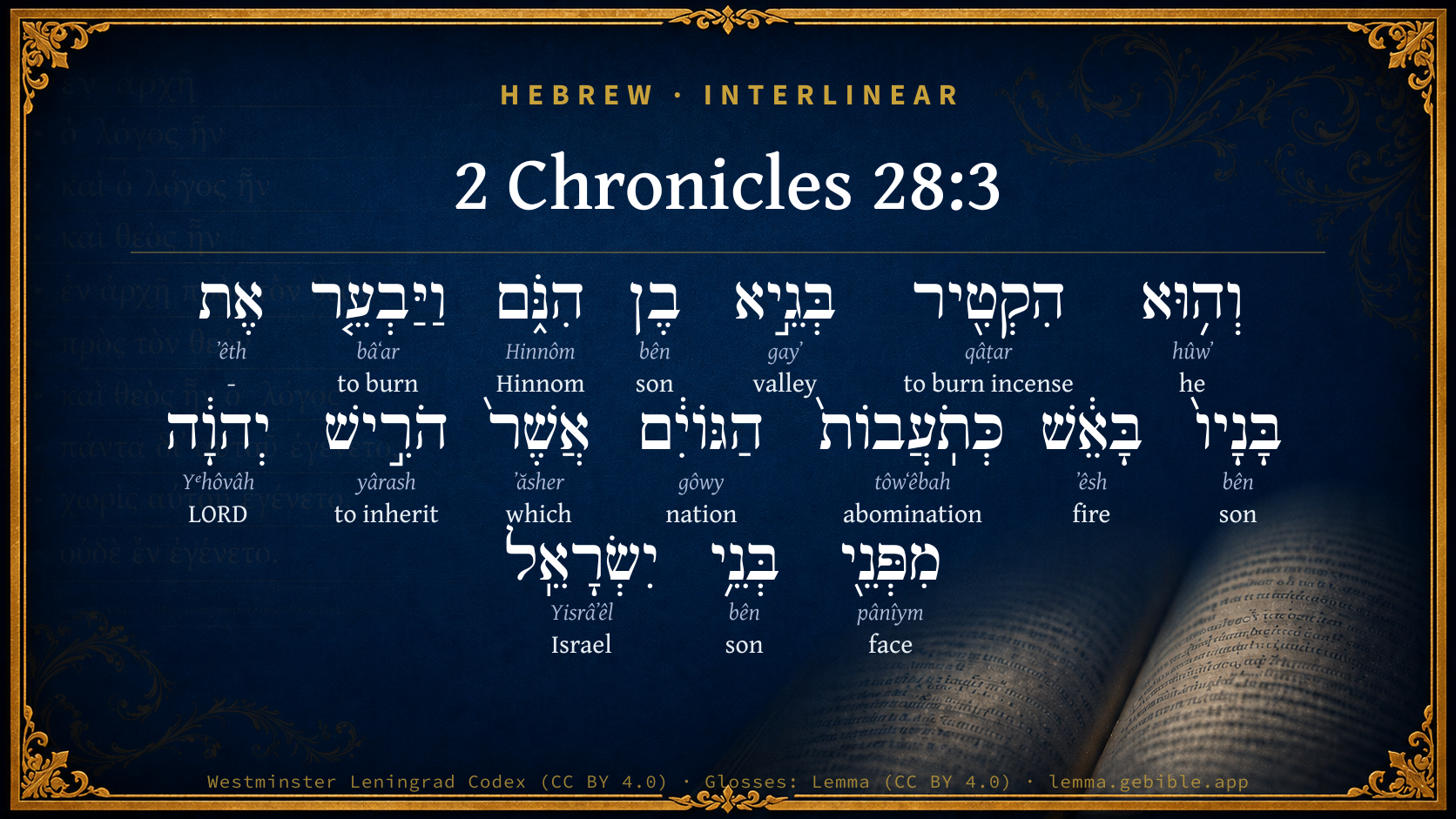
Hebrew (Westminster Leningrad Codex) 2 Chronicles 28:3 appears in the Hebrew Old Testament. The text above is from the Westminster Leningrad Codex. Each word links to its Strong’s number, a concise gloss, and parsing drawn from the Open Scriptures Hebrew Bible morphology. Click any word for its full Brown-Driver-Briggs (BDB) entry.
Download image
Cite this verse

2 Chronicles 28:3 (World English Bible). Public Domain. Lemma interlinear Bible study tool, https://lemma.gebible.app/v/2-chronicles/28/3.

Show BibTeX & RIS
BibTeX
RIS
English Translation
Moreover he burnt incense in the valley of the son of Hinnom, and burnt his children in the fire, according to the abominations of the nations whom Yahweh cast out before the children of Israel.
World English Bible · Public Domain
Download a study sheet

One document with this verse’s original text, its word-by-word gloss line, the meaning frame, cross-references with their text, attributed commentary, and full source and license credits — printable, and it pastes into notes with its structure intact.

This verse Autodidact and up

Study sheet (.html) Plain text (.txt)

A passage Seminary Student

Up to 50 verses in one chapter. A passage sheet keeps up to 6 commentary sources and 12 cross-references per verse, in the order this page ranks them, and says so on the sheet whenever that leaves anything out. Ask for a single verse and you get the Autodidact verse sheet above.

Everything on this page stays free to read, with no account — the sheet is a download of what is already on screen, not access to it.

Want to remove ads? Support Godless Engineer
Compare translations 3

The same verse in 3 English versions, stacked beneath the original-language interlinear above. Click any original word for its lexicon entry.

Each is an independent rendering of the whole verse — the interlinear is not word-aligned to these translations.

Highlighted words mark where these versions differ — a whole-verse word diff, not a word-by-word alignment.

  • World English Bible Public Domain
    Moreover he burnt incense in the valley of the son of Hinnom, and burnt his children in the fire, according to the abominations of the nations whom Yahweh cast out before the children of Israel.
  • King James Version Public Domain
    Moreover he burnt incense in the valley of the son of Hinnom, and burnt his children in the fire, after the abominations of the heathen whom the LORD had cast out before the children of Israel.
  • unfoldingWord Literal Text CC BY-SA 4.0
    And he himself offered incense in the Valley of Ben Hinnom. And he caused his sons to burn in fire, according to the abominations of the nations that Yahweh drove away from before the sons of Israel.

unfoldingWord Literal Text — © unfoldingWord, licensed CC BY-SA 4.0. Word-aligned USFM3 via Door43 (git.door43.org/unfoldingWord/en_ult).

Versions to compare (up to 4)

3 of 4 selected

Show all 18 translations

Every available English version of this verse, each an independent rendering of the whole verse.

  • World English Bible Public Domain
    Moreover he burnt incense in the valley of the son of Hinnom, and burnt his children in the fire, according to the abominations of the nations whom Yahweh cast out before the children of Israel.
  • Berean Standard Bible Public Domain
    Moreover, Ahaz burned incense in the Valley of Hinnom and sacrificed his sons in the fire, according to the abominations of the nations that the LORD had driven out before the Israelites.
  • Majority Standard Bible Public Domain
    Moreover, Ahaz burned incense in the Valley of Ben-hinnom and sacrificed his sons in the fire, according to the abominations of the nations that the LORD had driven out before the Israelites.
  • King James Version Public Domain
    Moreover he burnt incense in the valley of the son of Hinnom, and burnt his children in the fire, after the abominations of the heathen whom the LORD had cast out before the children of Israel.
  • American Standard Version (1901) Public Domain
    Moreover he burnt incense in the valley of the son of Hinnom, and burnt his children in the fire, according to the abominations of the nations whom Jehovah cast out before the children of Israel.
  • Revised Version (1885) Public Domain
    Moreover he burnt incense in the valley of the son of Hinnom, and burnt his children in the fire, according to the abominations of the heathen, whom the LORD cast out before the children of Israel.
  • Geneva Bible (1599) Public Domain
    Moreouer he burnt incense in the valley of Ben-hinnom, and burnt his sonnes with fire, after the abominations of the heathen whom the Lord had cast out before the children of Israel.
  • Douay-Rheims (1899) Public Domain
    It was he that burnt incense in the valley of Benennom, and consecrated his sons in the fire according to the manner of the nations, which the Lord slew at the coming of the children of Israel.
  • Young's Literal Translation Public Domain
    and himself hath made perfume in the valley of the son of Hinnom, and burneth his sons with fire according to the abominations of the nations that Jehovah dispossessed from the presence of the sons of Israel,
  • Literal Standard Version CC BY-SA 4.0
    and has made incense himself in the Valley of the Son of Hinnom, and burns his sons with fire according to the abominations of the nations that YHWH dispossessed from the presence of the sons of Israel,
  • Unlocked Literal Bible CC BY-SA 4.0
    In addition, he burned incense in the Valley of Ben Hinnom and he caused his children to pass through the fire, according to the idolatrous practices of the people that Yahweh forced out of their land before the people of Israel.
  • unfoldingWord Literal Text CC BY-SA 4.0
    And he himself offered incense in the Valley of Ben Hinnom. And he caused his sons to burn in fire, according to the abominations of the nations that Yahweh drove away from before the sons of Israel.
  • Darby Bible Public Domain
    and he burned incense in the valley of the son of Hinnom, and burned his sons in the fire, according to the abominations of the nations that Jehovah had dispossessed from before the children of Israel.
  • World Messianic Bible Public Domain
    Moreover he burned incense in the valley of the son of Hinnom, and burned his children in the fire, according to the abominations of the nations whom the LORD cast out before the children of Israel.
  • Webster's Bible Public Domain
    Moreover, he burnt incense in the valley of the son of Hinnom, and burnt his children in the fire, after the abominations of the heathen whom the LORD had cast out before the children of Israel.
  • Free Bible Version CC BY-SA 4.0
    He burned sacrifices in the Valley of Ben-hinnom, and sacrificed his children in the fire, following the disgusting practices of the peoples the Lord had driven out before the Israelites.
  • Bible in Basic English Public Domain
    More than this, he had offerings burned in the valley of the son of Hinnom, and made his children go through fire, copying the disgusting ways of the nations whom the Lord had sent out of the land before the children of Israel.
  • JPS Tanakh (1917) Public Domain
    Moreover he offered in the valley of the son of Hinnom, and burnt his children in the fire, according to the abominations of the heathen, whom the LORD cast out before the children of Israel.

Literal Standard Version (2020), Covenant Press — licensed CC BY-SA 4.0. Text via the HelloAO Bible API (eBible.org). Unlocked Literal Bible (unfoldingWord) — licensed CC BY-SA 4.0. Text via the HelloAO Bible API (eBible.org). unfoldingWord Literal Text — © unfoldingWord, licensed CC BY-SA 4.0. Word-aligned USFM3 via Door43 (git.door43.org/unfoldingWord/en_ult). Free Bible Version, Dr. Jonathan Gallagher — licensed CC BY-SA 4.0. Text via the HelloAO Bible API (eBible.org).

Word by word

More ways to search: Search by grammar → Find every occurrence → Compare this word →

Practice this passage: Drill this verse → Learn its vocabulary →

הִנֹּ֑ם
Hinnôm
H2011
“Hinnom”
Noun, Proper
Part of Speech
Noun
Type
Proper
Full BDB Definition

Origin: probably of foreign origin

TWOT: None

Hinnom = "lamentation" - a valley (deep and narrow ravine) with steep, rocky sides located southwest of Jerusalem, separating Mount Zion to the north from the hill of evil counsel' and the sloping rocky plateau of the 'plain of Rephaim' to the south
  1. וְה֥וּא hûwʼ H1931 “and · he” Conjunction + Pronoun, Personal, 3rd Person, Masculine, Singular
  2. הִקְטִ֖יר qâṭar H6999 “to burn incense” Verb, Hiphil, Perfect, 3rd Person, Masculine, Singular
  3. בְּגֵ֣יא gayʼ H1516 “in/at · valley of” Preposition + Noun, Common, Both, Singular, Construct
  4. בֶן bên H1121 “son” Noun, Proper
  5. וַיַּבְעֵ֤ר bâʻar H1197 “and · to burn” Conjunction + Verb, Hiphil, Sequential Imperfect, 3rd Person, Masculine, Singular
  6. אֶת ʼêth H853 “-” Particle, Direct Object
  7. בָּנָיו֙ bên H1121 “sons · his” Noun, Common, Masculine, Plural, Construct + Suffix, Personal, 3rd Person, Masculine, Singular
  8. בָּאֵ֔שׁ ʼêsh H784 “in/at the · fire” Preposition, Determined + Noun, Common, Both, Singular, Absolute
  9. כְּתֹֽעֲבוֹת֙ tôwʻêbah H8441 “like/as · abominations of” Preposition + Noun, Common, Feminine, Plural, Construct
  10. הַגּוֹיִ֔ם gôwy H1471 “the · nations” Particle, Definite Article + Noun, Common, Masculine, Plural, Absolute
  11. אֲשֶׁר֙ ʼăsher H834 “which” Particle, Relative
  12. הֹרִ֣ישׁ yârash H3423 “to inherit” Verb, Hiphil, Perfect, 3rd Person, Masculine, Singular
  13. יְהוָ֔ה Yᵉhôvâh H3068 “LORD” Noun, Proper
  14. מִפְּנֵ֖י pânîym H6440 “from · face(s) of” Preposition + Noun, Common, Both, Plural, Construct
  15. בְּנֵ֥י bên H1121 “sons of” Noun, Common, Masculine, Plural, Construct
  16. יִשְׂרָאֵֽל Yisrâʼêl H3478 “Israel” Noun, Proper

About this verse

These counts appear in no published source. They are computed here, from the morphology-tagged text and Lemma’s own curated glosses. What Lemma adds →

17
words
15
distinct lemmas
Historical
section

Notable vocabulary

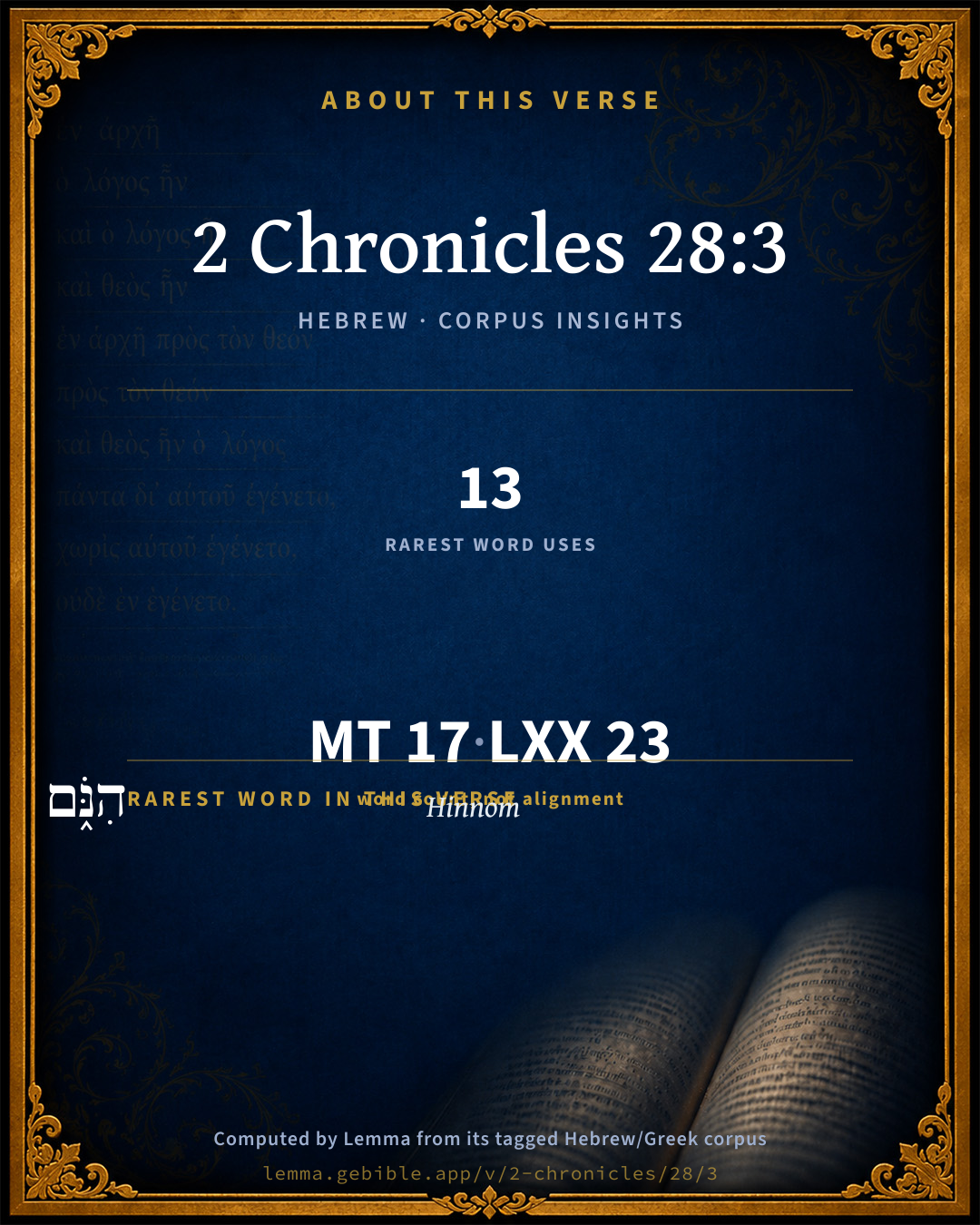
The rarest word here is הִנֹּ֑ם Hinnom H2011 — appearing just 13 times in the whole Hebrew Bible.

Shared distinctive vocabulary

הִנֹּ֑ם Hinnom H2011 occurs in 11 verses of the Hebrew Bible. Also found in:

Grammatical profile

  • 3 verbs
  • 11 nouns
  • 1 pronoun
  • 2 particles

Verb forms

  • הִקְטִ֖יר Hiphil · Perfect
  • וַיַּבְעֵ֤ר Hiphil · Sequential Imperfect
  • הֹרִ֣ישׁ Hiphil · Perfect

Repetition

A word recurs within this verse — often emphatic in Hebrew:

Hebrew & Septuagint length

In English translation the verse runs 35 words from the Hebrew and 36 from the Septuagint (LXX English) — closely comparable.

A rough comparison of the two English renderings, which tokenize alike — not a word-level alignment.

Word counts can differ between the Hebrew and the Greek without any difference in meaning — e.g. the Hebrew direct-object marker אֵת has no separate Greek word, and Greek often adds the article ὁ.

In the original languages it is 17 Hebrew tokens and 23 Greek tokens — but the two are counted differently (Hebrew bundles its prefixes and suffixes into one token; the Greek is in lemma form), so that isn’t a like-for-like length.

Cross-references

16

Topical passages linked to 2 Chronicles 28:3 in the Treasury of Scripture Knowledge — connected by theme and wording, ordered by reader-vote popularity; previews shown in the World English Bible.

  • 2 Chronicles 33:2 He did that which was evil in the sight of Yahweh, after the abominations of the nations whom Yahweh cast out before the children of Israel.
  • 2 Chronicles 33:6 He also made his children to pass through the fire in the valley of the son of Hinnom; and he practiced sorcery, and used enchantments, and practiced sorcery, and dealt with those who had familiar spirits, and with wizards: he worked much evil in the sight of Yahweh, to provoke him to anger.
  • Leviticus 18:21 "'You shall not give any of your children to sacrifice to Molech; neither shall you profane the name of your God: I am Yahweh.
  • Joshua 15:8 and the border went up by the valley of the son of Hinnom to the side of the Jebusite southward (the same is Jerusalem); and the border went up to the top of the mountain that lies before the valley of Hinnom westward, which is at the uttermost part of the valley of Rephaim northward;
  • 2 Kings 23:10 He defiled Topheth, which is in the valley of the children of Hinnom, that no man might make his son or his daughter to pass through the fire to Molech.
  • Deuteronomy 12:31 You shall not do so to Yahweh your God: for every abomination to Yahweh, which he hates, have they done to their gods; for even their sons and their daughters do they burn in the fire to their gods.
  • Deuteronomy 18:9 When you are come into the land which Yahweh your God gives you, you shall not learn to do after the abominations of those nations.
  • 2 Kings 16:3 But he walked in the way of the kings of Israel, yes, and made his son to pass through the fire, according to the abominations of the nations, whom Yahweh cast out from before the children of Israel.
  • Psalms 106:37–38 Yes, they sacrificed their sons and their daughters to demons.
  • Jeremiah 2:34 Also in your skirts is found the blood of the souls of the innocent poor: you did not find them breaking in; but it is because of all these things.
  • Jeremiah 7:31–32 They have built the high places of Topheth, which is in the valley of the son of Hinnom, to burn their sons and their daughters in the fire; which I didn't command, neither came it into my mind.
  • Jeremiah 19:2–6 and go forth to the valley of the son of Hinnom, which is by the entry of the gate Harsith, and proclaim there the words that I shall tell you;
  • Jeremiah 19:13 and the houses of Jerusalem, and the houses of the kings of Judah, which are defiled, shall be as the place of Topheth, even all the houses on whose roofs they have burned incense to all the host of the sky, and have poured out drink-offerings to other gods.
  • Jeremiah 32:35 They built the high places of Baal, which are in the valley of the son of Hinnom, to cause their sons and their daughters to pass through [the fire] to Molech; which I didn't command them, neither did it come into my mind, that they should do this abomination, to cause Judah to sin.
  • Ezekiel 16:20–21 Moreover you have taken your sons and your daughters, whom you have borne to me, and these have you sacrificed to them to be devoured. Were your prostitution a small matter,
  • Micah 6:7 Will Yahweh be pleased with thousands of rams? With tens of thousands of rivers of oil? Shall I give my firstborn for my disobedience? The fruit of my body for the sin of my soul?

Cross-references courtesy of OpenBible.info (CC BY 4.0).

Hebrew and Greek witnesses Masoretic Hebrew ↔ Greek Septuagint

The same verse in the two great witnesses to the Old Testament, shown verse-for-verse.

These are two independent witnesses, not word-aligned to each other, and the Septuagint is shown in lemma (dictionary) form.

Hebrew 2 Chronicles 28:3 Masoretic · Westminster Leningrad Codex

וְה֥וּא הִקְטִ֖יר בְּגֵ֣יא בֶן הִנֹּ֑ם וַיַּבְעֵ֤ר אֶת בָּנָיו֙ בָּאֵ֔שׁ כְּתֹֽעֲבוֹת֙ הַגּוֹיִ֔ם אֲשֶׁר֙ הֹרִ֣ישׁ יְהוָ֔ה מִפְּנֵ֖י בְּנֵ֥י יִשְׂרָאֵֽל

Moreover he burnt incense in the valley of the son of Hinnom, and burnt his children in the fire, according to the abominations of the nations whom Yahweh cast out before the children of Israel.

World English Bible · Public Domain

Greek LXX 2 Chronicles 28:3 Septuagint · lemma form

καί θύω ἐν γαιβενενομ καί διαἄγω ὁ τέκνον αὐτός διά πῦρ κατά ὁ βδέλυγμα ὁ ἔθνος ὅς ἐκὀλεθρεύω κύριος ἀπό πρόσωπον υἱός ἰσραήλ

And he sacrificed to their idols in the valley of Benennom, and passed his children through the fire, according to the abominations of the heathen, whom the Lord cast out from before the children of Israel.

LXX2012 (modern English Septuagint) · Public Domain

Hebrew: Westminster Leningrad Codex (CC BY 4.0). Greek: Septuagint (public domain); English from LXX2012 (modern English Septuagint) (Public Domain). How the Septuagint differs from the Hebrew →

Commentary

Notes on 2 Chronicles 28:3 from classic Christian and Jewish commentators (each source and its license shown beneath its notes). The classic Christian expositions comment on the surrounding passage and are grouped to its opening verse, so a note may address several verses; the Jewish commentaries on the Tanakh (Rashi and others) are per-verse, so they appear only where the commentator wrote on this verse.

Lemma curates 59 commentaries, every one of them public domain or Creative Commons licensed, each selected and text-cleaned for this edition rather than reprinted as found. About our sources →

Trapp's Complete Commentary

John Trapp

2Ch 28:3 Moreover he burnt incense in the valley of the son of Hinnom, and burnt his children in the fire, after the abominations of the heathen whom the LORD had cast out before the children of Israel.

Ver. 3. And burnt his children in the fire.] Some he burnt outright, in honour of Moloch, or Saturn (indeed the devil), and others he caused to pass through the fire, with the safeguard of their lives, though not haply of their hair; believing that thereby they were purged from their spiritual filthiness. The Tartars do the like at this day: the Papists also, in their supposed purgatory, dream of such a like purgation. The king of Spain put his eldest son into the hands of the bloody Inquisitors, to be murdered by them, that he might approve himself an obedient son to the Pope, who thereupon blasphemously applied unto him that saying of the apostle, He spared not his own son, but gave him for us. See 2Ki 16:3. {a}

{a} Jerome. Caten.

John Trapp, A Commentary or Exposition upon All the Books of the Old and New Testament (1647–1656) — public domain. Text from a community e-Sword module.

Tyndale Open Study Notes

Tyndale Open Resources

28:3-4 even sacrificing his own sons in the fire: Ahaz was imitating the abominable conduct of the Canaanites (see Deut 12:31; 18:9-10; Jer 7:31; 19:5; 32:35).

Tyndale Open Study Notes — © Tyndale Open Resources, licensed CC BY-SA 4.0. Text via the HelloAO Bible API.

Geneva Bible (1599)

Geneva Bible translators

Or, made them pass through the fire, as 2 Chron. 33:6; Lev. 13:21.

Geneva Bible (1599) marginal notes — public domain. Text via Bolls.life.

Adam Clarke's Commentary

Verse 3. Burnt his children in the fire] There is a most remarkable addition here in the Chaldee which I shall give at length: "Ahaz burnt his children in the fire; but the WORD of the Lord snatched Hezekiah from among them; for it was manifest before the Lord that the three righteous men, Hananiah, Mishael, and Azariah, were to proceed from him; who should deliver up their bodies that they might be cast into a burning fiery furnace, on account of the great and glorious NAME, (יהוה) and from which they should escape. First, Abram escaped from the furnace of fire among the Chaldeans, into which he had been cast by Nimrod, because he would not worship their idols. Secondly, Tamar escaped burning in the house of judgment of Judah, who had said, Bring her out, that she may be burnt. Thirdly, Hezekiah the son of Ahaz escaped from the burning, when Ahaz his father cast him into the valley of the son of Hinnom, on the altars of Tophet. Fourthly, Hananiah, Mishael, and Azariah, escaped from the burning fiery furnace of Nebuchadnezzar king of Babylon. Fifthly, Joshua, the son of Josedek the high priest, escaped, when the impious Nebuchadnezzar had cast him into a burning fiery furnace, with Achaab the son of Kolia, and Zedekiah the son of Maaseiah, the false prophet. They were consumed by fire; but Joshua the son of Josedek escaped because of his righteousness."

Adam Clarke's Commentary on the Bible (1810–1826) — public domain. Text from a community e-Sword/MySword module.

Ellicott's Commentary for English Readers

(3) Moreover he.—“And he (emphatic) burnt incense” to Moloch, the god of Ammon, for whom Solomon had built a high place (1Ki_11:5-8), which was still in existence.

In the valley of the son of Hinnom.—Also called simply the valley of Hinnom (Jos_15:8), on the west and south of Jerusalem (Jos_18:16), the scene of the cruel rites in honour of

“Moloch, horrid king, besmeared with blood.”

MILTON.

(Jer_7:31-32; Jer_19:2-6, where “the Baal” is named as the object of this worship, Moloch being a Baal.) In later times, the term “valley of Hinnom,” spelt as one word, and with modified vowels, Gĕhinnâm, became the appellation of hell, “the house of woe and pain.” It is so used in the Targums, and later in the Talmud, and appears in the New Testament under the Græcised form Γέεννα, whence the Latin Gehenna.

Burnt his children in the fire.—Kings, “And even his own son he made to pass through the fire.” The chronicler has paraphrased by transposing two Hebrew letters (ba‘ar for ‘abar). “His children is simply a generalised expression, as we might say, “he burnt his own offspring or posterity.” (Comp. Psa_106:37.) Thenius accuses the chronicler of exaggerating the fact. But this peculiar use of the plural is one of the marks of his style. (Comp. 1Ch_6:57; 1Ch_6:67; and 2Ch_28:16, infra.)

A Bible Commentary for English Readers, edited by Charles John Ellicott (1878–1897) — public domain. Text from a community e-Sword module.

The Cambridge Bible for Schools and Colleges

gen. ed. J. J. S. Perowne

3. the valley of the son of Hinnom] This name was of harmless signification at first (Jer_7:31-32), but its Heb. form Gê-hinnôm was afterwards corrupted into “Gehenna” (Mat_5:22, R.V. mg.) and it gained an evil reputation from its connexion with the worship of Molech. It was S. and S.W. of Jerusalem.

burnt … in the fire] In Kings “made … to pass through, the fire.” The latter phrase lends support to the theory that at least in later times children were “passed through the fire” in order to signify their dedication to Molech, yet in such a way as to escape permanent injury. It is probable however that the original significance of the custom is preserved in the phrase used by the Chronicler, and that children offered to Molech were really burnt. Of course such a sacrifice would be resorted to only in extremities; cp. 2Ki_3:27.

his children] In Kings, “his son” (sing.), a better reading. It is possible that the sacrifice was intended to avert the danger threatened by the Syro-Ephraimite alliance.

after] R.V. according to (cp. 2Ch_34:21).

The Cambridge Bible for Schools and Colleges (gen. ed. J. J. S. Perowne; Cambridge University Press, 1878–1918) — public domain. Text from a community e-Sword module.

Albert Barnes' Notes on the Bible

Compare the 2Ki 16:3 note.

Albert Barnes' Notes on the Bible (1834–1885) — public domain. Text from a community e-Sword/MySword module.

Haydock's Catholic Bible Commentary

Benennon, "the son of Ennom," 4 K. xvi. --- Consecrated. Heb. "burnt." H.

George Leo Haydock (1774–1849), Haydock's Catholic Family Bible and Commentary, 1859 edition — public domain. Excludes Psalms (Douay-Rheims chapter numbering differs from Protestant) and Deuterocanonical books (Catholic canon only).

The Pulpit Commentary

Burnt incense Hinnom. The sin of Solomon (1Ki_11:7, 1Ki_11:8) is reproduced. For the valley of the son of Hinnom, which curved round the south-west and west of Jerusalem (Ge Ben-Hinnom), see Conder"s "Handbook," ch. 7. pp. 330-332. Burnt his children; (see Lev_18:21) but there cannot be any doubt that Ahaz"s practice here stated was an incident of the Moloch-superstition and horrible cruelty (see the parallel in its vers. 3, 4).

The Pulpit Commentary (1880–1919), ed. H.D.M. Spence-Jones & Joseph S. Exell — public domain. Text from a community e-Sword module.

unfoldingWord translationNotes

Door43 World Missions Community

the Valley of Ben Hinnom

This is a valley in Jerusalem. (See: How to Translate Names)

before the people of Israel

The people of those nations fled as the people of Israel moved into the land. The full meaning of this statement can be made explicit. AT: "before the people of Israel who moved into the land" or "as the people of Israel moved into the land" (See: Assumed Knowledge and Implicit Information)

the high places and on the hills and under every green tree

These are places where the people of the other nations worshiped their false gods.

under every green tree

God wanted his people to offer sacrifices to him in Jerusalem. The word "every" here is an exaggeration to show how determined King Ahaz was to disobey God by offering sacrifices in many other places instead. AT: "under many green trees" or "under many green trees around the country" (See: Hyperbole and Generalization)

translationWords

incense

burnt offering

people group

Israel

sacrifice

high place

unfoldingWord translationNotes — © Distant Shores Media and the Door43 World Missions Community, licensed CC BY-SA 4.0. Source: git.door43.org/Door43/en_tn.

Lesson kit

Teaching starters — assembled from the data on this page, not authored interpretation. Every prompt links to the verse data it draws on. Edit before teaching.

2 Chronicles, in the Historical, opens this verse with 17 words (15 distinct Hebrew lemmas). Its most distinctive word is Hinnôm (“Hinnom”). A historical commentator’s framing appears above. Read the whole chapter for the surrounding context.

Discussion questions

  1. What does “Hinnom” (Hinnôm) contribute to the verse as a whole?
  2. How does Joshua 15:8, which shares the word «Hinnom», read alongside this verse?
  3. What does the repetition of “son” (3× in this one verse) do in this verse?
  4. The translations on this page render this verse differently — a whole-verse word diff, not a word-by-word alignment. What might account for the different wordings?
  5. «הִקְטִ֖יר» is a Hiphil Perfect verb. How does that grammatical form shape the action described?
  6. Compare how Trapp's Complete Commentary and Tyndale Open Study Notes read this verse. Where do they agree or differ?

Things to notice

Reading settings

Reading text

Shown beneath each verse's original-language words.

Old Testament
Old Testament edition

Read the OT as the Masoretic Hebrew (MT) or the Greek Septuagint (LXX).

English shown for the Greek Septuagint (in the Hebrew ↔ Greek comparison).

Comparing translations? Open the Compare panel on any verse page to stack up to four side by side.