
Deuteronomy 28:12

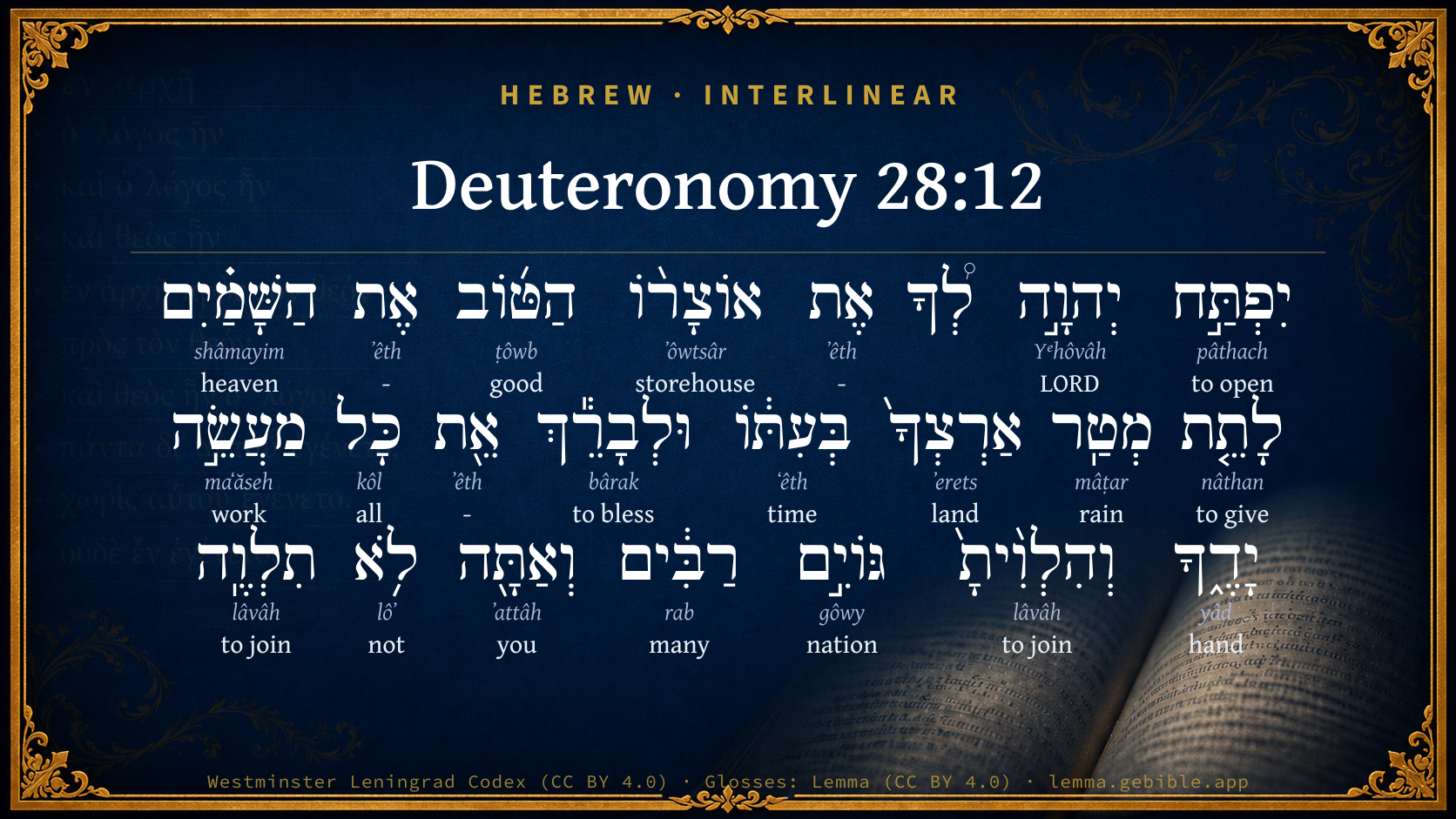
Hebrew (Westminster Leningrad Codex) Deuteronomy 28:12 appears in the Hebrew Old Testament. The text above is from the Westminster Leningrad Codex. Each word links to its Strong’s number, a concise gloss, and parsing drawn from the Open Scriptures Hebrew Bible morphology. Click any word for its full Brown-Driver-Briggs (BDB) entry.
Download image
Cite this verse

Deuteronomy 28:12 (World English Bible). Public Domain. Lemma interlinear Bible study tool, https://lemma.gebible.app/v/deuteronomy/28/12.

Show BibTeX & RIS
BibTeX
RIS
English Translation
Yahweh will open to you his good treasure in the sky, to give the rain of your land in its season, and to bless all the work of your hand: and you shall lend to many nations, and you shall not borrow.
World English Bible · Public Domain
Highlights
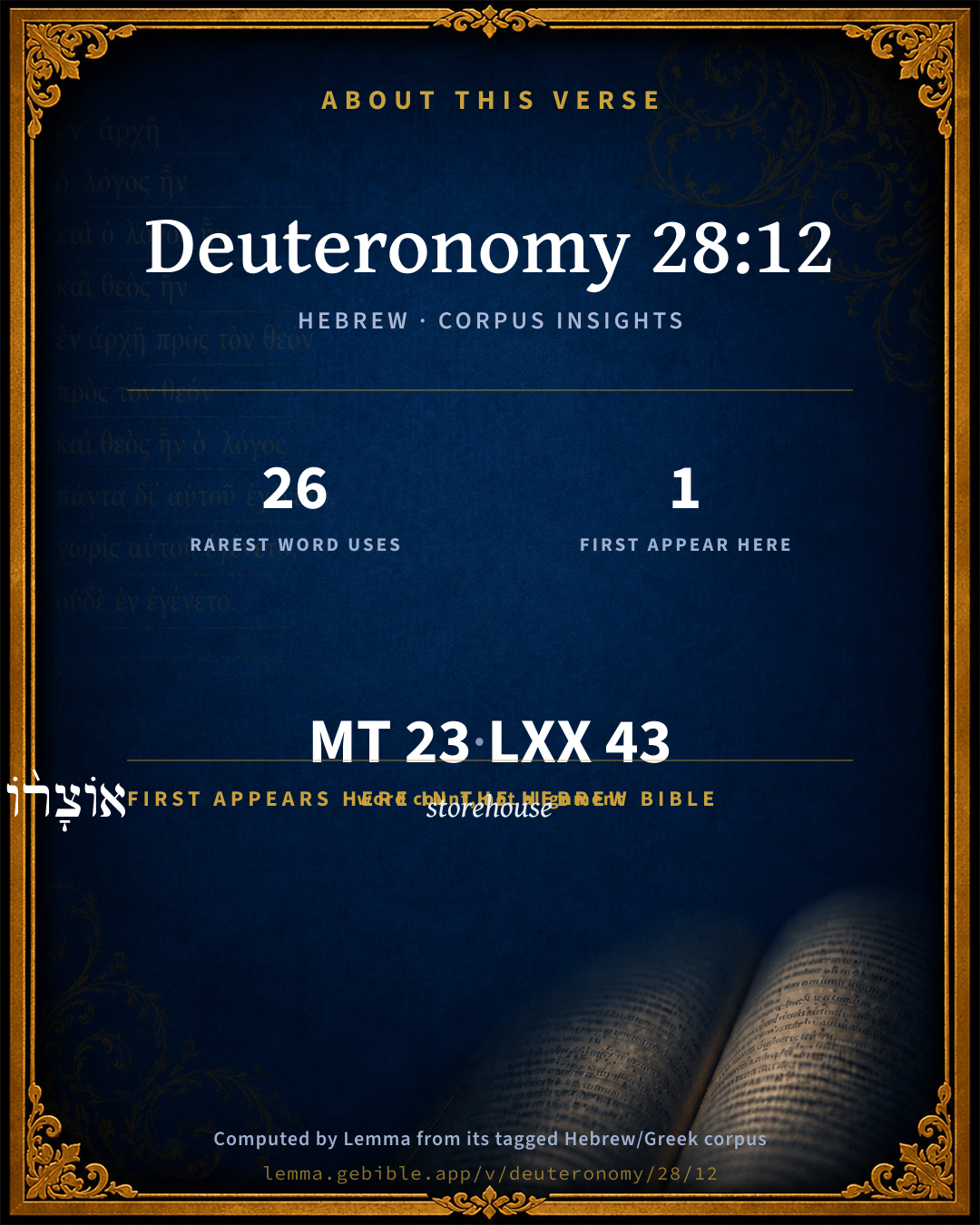
  • 1 first appearance in the Hebrew Bible
Full analysis ↓
Download a study sheet

One document with this verse’s original text, its word-by-word gloss line, the meaning frame, cross-references with their text, attributed commentary, and full source and license credits — printable, and it pastes into notes with its structure intact.

This verse Autodidact and up

Study sheet (.html) Plain text (.txt)

A passage Seminary Student

Up to 50 verses in one chapter. A passage sheet keeps up to 6 commentary sources and 12 cross-references per verse, in the order this page ranks them, and says so on the sheet whenever that leaves anything out. Ask for a single verse and you get the Autodidact verse sheet above.

Everything on this page stays free to read, with no account — the sheet is a download of what is already on screen, not access to it.

Want to remove ads? Support Godless Engineer
Compare translations 3

The same verse in 3 English versions, stacked beneath the original-language interlinear above. Click any original word for its lexicon entry.

Each is an independent rendering of the whole verse — the interlinear is not word-aligned to these translations.

Highlighted words mark where these versions differ — a whole-verse word diff, not a word-by-word alignment.

  • World English Bible Public Domain
    Yahweh will open to you his good treasure in the sky, to give the rain of your land in its season, and to bless all the work of your hand: and you shall lend to many nations, and you shall not borrow.
  • King James Version Public Domain
    The LORD shall open unto thee his good treasure, the heaven to give the rain unto thy land in his season, and to bless all the work of thine hand: and thou shalt lend unto many nations, and thou shalt not borrow.
  • unfoldingWord Literal Text CC BY-SA 4.0
    Yahweh will open to you his treasure, the good of the heavens, to give rain your land at the appointed time, and to bless all the work of your hand, and you will lend to many nations, but you, you will not borrow.

unfoldingWord Literal Text — © unfoldingWord, licensed CC BY-SA 4.0. Word-aligned USFM3 via Door43 (git.door43.org/unfoldingWord/en_ult).

Versions to compare (up to 4)

3 of 4 selected

Show all 18 translations

Every available English version of this verse, each an independent rendering of the whole verse.

  • World English Bible Public Domain
    Yahweh will open to you his good treasure in the sky, to give the rain of your land in its season, and to bless all the work of your hand: and you shall lend to many nations, and you shall not borrow.
  • Berean Standard Bible Public Domain
    The LORD will open the heavens, His abundant storehouse, to send rain on your land in season and to bless all the work of your hands. You will lend to many nations, but borrow from none.
  • Majority Standard Bible Public Domain
    The LORD will open the heavens, His abundant storehouse, to send rain on your land in season and to bless all the work of your hands. You will lend to many nations, but borrow from none.
  • King James Version Public Domain
    The LORD shall open unto thee his good treasure, the heaven to give the rain unto thy land in his season, and to bless all the work of thine hand: and thou shalt lend unto many nations, and thou shalt not borrow.
  • American Standard Version (1901) Public Domain
    Jehovah will open unto thee his good treasure the heavens, to give the rain of thy land in its season, and to bless all the work of thy hand: and thou shalt lend unto many nations, and thou shalt not borrow.
  • Revised Version (1885) Public Domain
    The LORD shall open unto thee his good treasure the heaven to give the rain of thy land in its season, and to bless all the work of thine hand: and thou shalt lend unto many nations, and thou shalt not borrow.
  • Geneva Bible (1599) Public Domain
    The Lord shall open vnto thee his good treasure, euen the heauen to giue rayne vnto thy kind in due season, and to blesse all the worke of thine handes: and thou shalt lende vnto many nations, but shalt not borow thy selfe.
  • Douay-Rheims (1899) Public Domain
    The Lord will open his excellent treasure, the heaven, that it may give rain in due season: and he will bless all the works of thy hands. And thou shalt lend to many nations, and shalt not borrow of any one.
  • Young's Literal Translation Public Domain
    `Jehovah doth open to thee his good treasure -- the heavens -- to give the rain of thy land in its season, and to bless all the work of thy hand, and thou hast lent to many nations, and thou -- thou dost not borrow.
  • Literal Standard Version CC BY-SA 4.0
    YHWH opens his good treasure to you—the heavens—to give the rain of your land in its season, and to bless all the work of your hand, and you have lent to many nations, and you do not borrow.
  • Unlocked Literal Bible CC BY-SA 4.0
    Yahweh will open to you his storehouse of the heavens to give the rain for your land at the right time, and to bless all the work of your hand; you will lend to many nations, but you will not borrow.
  • unfoldingWord Literal Text CC BY-SA 4.0
    Yahweh will open to you his treasure, the good of the heavens, to give rain your land at the appointed time, and to bless all the work of your hand, and you will lend to many nations, but you, you will not borrow.
  • Darby Bible Public Domain
    Jehovah will open to thee his good treasure, the heavens, to give rain unto thy land in its season, and to bless all the work of thy hand; and thou shalt lend unto many nations, but thou shalt not borrow.
  • World Messianic Bible Public Domain
    The LORD will open to you his good treasure in the sky, to give the rain of your land in its season, and to bless all the work of your hand. You will lend to many nations, and you will not borrow.
  • Webster's Bible Public Domain
    The LORD shall open to thee his good treasure, the heaven to give rain to thy land in its season, and to bless all the work of thy hand: and thou shalt lend to many nations, and thou shalt not borrow.
  • Free Bible Version CC BY-SA 4.0
    The Lord will provide rain for your land at the right time from his heavenly storehouse to bless all your work growing crops. You will lend money to many nations but you won't need to borrow from any of them.
  • Bible in Basic English Public Domain
    Opening his store-house in heaven, the Lord will send rain on your land at the right time, blessing all the work of your hands: other nations will make use of your wealth, and you will have no need of theirs.
  • JPS Tanakh (1917) Public Domain
    The LORD will open unto thee His good treasure the heaven to give the rain of thy land in its season, and to bless all the work of thy hand; and thou shalt lend unto many nations, but thou shalt not borrow.

Literal Standard Version (2020), Covenant Press — licensed CC BY-SA 4.0. Text via the HelloAO Bible API (eBible.org). Unlocked Literal Bible (unfoldingWord) — licensed CC BY-SA 4.0. Text via the HelloAO Bible API (eBible.org). unfoldingWord Literal Text — © unfoldingWord, licensed CC BY-SA 4.0. Word-aligned USFM3 via Door43 (git.door43.org/unfoldingWord/en_ult). Free Bible Version, Dr. Jonathan Gallagher — licensed CC BY-SA 4.0. Text via the HelloAO Bible API (eBible.org).

Word by word

More ways to search: Search by grammar → Find every occurrence → Compare this word →

Practice this passage: Drill this verse → Learn its vocabulary →

וְהִלְוִ֨יתָ֙
lâvâh
H3867
“and · to join”
Conjunction + Verb, Hiphil, Sequential Perfect, 2nd Person, Masculine, Singular
Part of Speech
Conjunction + Verb
Stem
Hiphil
Form
Sequential Perfect
Person
2nd Person
Gender
Masculine
Number
Singular
Full BDB Definition

Origin: a primitive root

TWOT: 1087 , 1088

to join, be joined - (Qal) to join, be joined, attend - (Niphal) to join oneself to, be joined unto - to borrow, lend - (Qal) to borrow - (Hiphil) to cause to borrow, lend to
  1. יִפְתַּ֣ח pâthach H6605 “to open” Verb, Qal, Imperfect, 3rd Person, Masculine, Singular
  2. יְהוָ֣ה Yᵉhôvâh H3068 “LORD” Noun, Proper
  3. אֶת ʼêth H853 “-” Particle, Direct Object
  4. אוֹצָר֨וֹ ʼôwtsâr H214 “storehouse · his” Noun, Common, Masculine, Singular, Construct + Suffix, Personal, 3rd Person, Masculine, Singular
  5. הַטּ֜וֹב ṭôwb H2896 “the · good” Particle, Definite Article + Adjective, Adjective, Masculine, Singular, Absolute
  6. אֶת ʼêth H853 “-” Particle, Direct Object
  7. הַשָּׁמַ֗יִם shâmayim H8064 “the · heaven(s)” Particle, Definite Article + Noun, Common, Masculine, Plural, Absolute
  8. לָתֵ֤ת nâthan H5414 “to give” Preposition + Verb, Qal, Infinitive Construct
  9. מְטַֽר mâṭar H4306 “rain of” Noun, Common, Masculine, Singular, Construct
  10. אַרְצְךָ֙ ʼerets H776 “land · your” Noun, Common, Both, Singular, Construct + Suffix, Personal, 2nd Person, Masculine, Singular
  11. בְּעִתּ֔וֹ ʻêth H6256 “in/at · time · his” Preposition + Noun, Common, Both, Singular, Construct + Suffix, Personal, 3rd Person, Masculine, Singular
  12. וּלְבָרֵ֕ךְ bârak H1288 “and · to bless” Conjunction + Preposition + Verb, Piel, Infinitive Construct
  13. אֵ֖ת ʼêth H853 “-” Particle, Direct Object
  14. כָּל kôl H3605 “all of” Noun, Common, Masculine, Singular, Construct
  15. מַעֲשֵׂ֣ה maʻăseh H4639 “work of” Noun, Common, Masculine, Singular, Construct
  16. יָדֶ֑ךָ yâd H3027 “hand · your” Noun, Common, Both, Singular, Construct + Suffix, Personal, 2nd Person, Masculine, Singular
  17. גּוֹיִ֣ם gôwy H1471 “nations” Noun, Common, Masculine, Plural, Absolute
  18. רַבִּ֔ים rab H7227 “many” Adjective, Adjective, Masculine, Plural, Absolute
  19. וְאַתָּ֖ה ʼattâh H859 “and · you” Conjunction + Pronoun, Personal, 2nd Person, Masculine, Singular
  20. לֹ֥א lôʼ H3808 “not” Particle, Negative
  21. תִלְוֶֽה lâvâh H3867 “to join” Verb, Qal, Imperfect, 2nd Person, Masculine, Singular

About this verse

These counts appear in no published source. They are computed here, from the morphology-tagged text and Lemma’s own curated glosses. What Lemma adds →

23
words
19
distinct lemmas
Pentateuch
section

First appearance in Scripture

This word makes its first canonical appearance in the Hebrew Bible here:

  • אוֹצָר֨וֹ storehouse H214

Shared distinctive vocabulary

וְהִלְוִ֨יתָ֙ to join H3867 occurs in 22 verses of the Hebrew Bible. Also found in:

Grammatical profile

  • 5 verbs
  • 10 nouns
  • 2 adjectives
  • 1 pronoun
  • 1 preposition
  • 4 particles

Verb forms

  • יִפְתַּ֣ח Qal · Imperfect
  • לָתֵ֤ת Qal · Infinitive Construct
  • וּלְבָרֵ֕ךְ Piel · Infinitive Construct
  • וְהִלְוִ֨יתָ֙ Hiphil · Sequential Perfect
  • תִלְוֶֽה Qal · Imperfect

Repetition

A word recurs within this verse — often emphatic in Hebrew:

  • וְהִלְוִ֨יתָ֙ to join H3867 ×2

Hebrew & Septuagint length

In English translation the verse runs 42 words from the Hebrew and 54 from the Septuagint (LXX English) — closely comparable.

A rough comparison of the two English renderings, which tokenize alike — not a word-level alignment.

Word counts can differ between the Hebrew and the Greek without any difference in meaning — e.g. the Hebrew direct-object marker אֵת has no separate Greek word, and Greek often adds the article ὁ.

In the original languages it is 23 Hebrew tokens and 43 Greek tokens — but the two are counted differently (Hebrew bundles its prefixes and suffixes into one token; the Greek is in lemma form), so that isn’t a like-for-like length.

Cross-references

11

Topical passages linked to Deuteronomy 28:12 in the Treasury of Scripture Knowledge — connected by theme and wording, ordered by reader-vote popularity; previews shown in the World English Bible.

  • Deuteronomy 15:6 For Yahweh your God will bless you, as he promised you: and you shall lend to many nations, but you shall not borrow; and you shall rule over many nations, but they shall not rule over you.
  • Joel 2:23–24 "Be glad then, you children of Zion, And rejoice in Yahweh, your God; For he gives you the former rain in just measure, And he causes the rain to come down for you, The former rain and the latter rain, As before.
  • Deuteronomy 11:14 that I will give the rain of your land in its season, the former rain and the latter rain, that you may gather in your grain, and your new wine, and your oil.
  • Leviticus 26:4 then I will give you your rains in their season, and the land shall yield its increase, and the trees of the field shall yield their fruit.
  • Deuteronomy 15:10 You shall surely give him, and your heart shall not be grieved when you give to him; because that for this thing Yahweh your God will bless you in all your work, and in all that you put your hand to.
  • Proverbs 22:7 The rich rule over the poor. The borrower is servant to the lender.
  • Deuteronomy 14:29 and the Levite, because he has no portion nor inheritance with you, and the foreigner living among you, and the fatherless, and the widow, who are within your gates, shall come, and shall eat and be satisfied; that Yahweh your God may bless you in all the work of your hand which you do.
  • Psalms 135:7 Who causes the clouds to rise from the ends of the earth; Who makes lightnings with the rain; Who brings forth the wind out of his treasuries;
  • Psalms 65:9–13 You visit the earth, and water it. You greatly enrich it. The river of God is full of water. You provide them grain, for so you have ordained it.
  • Deuteronomy 28:44 He shall lend to you, and you shall not lend to him: he shall be the head, and you shall be the tail.
  • Job 38:22 Have you entered the treasuries of the snow, Or have you seen the treasures of the hail,

Cross-references courtesy of OpenBible.info (CC BY 4.0).

Hebrew and Greek witnesses Masoretic Hebrew ↔ Greek Septuagint

The same verse in the two great witnesses to the Old Testament, shown verse-for-verse.

These are two independent witnesses, not word-aligned to each other, and the Septuagint is shown in lemma (dictionary) form.

Hebrew Deuteronomy 28:12 Masoretic · Westminster Leningrad Codex

יִפְתַּ֣ח יְהוָ֣ה לְ֠ךָ אֶת אוֹצָר֨וֹ הַטּ֜וֹב אֶת הַשָּׁמַ֗יִם לָתֵ֤ת מְטַֽר אַרְצְךָ֙ בְּעִתּ֔וֹ וּלְבָרֵ֕ךְ אֵ֖ת כָּל מַעֲשֵׂ֣ה יָדֶ֑ךָ וְהִלְוִ֨יתָ֙ גּוֹיִ֣ם רַבִּ֔ים וְאַתָּ֖ה לֹ֥א תִלְוֶֽה

Yahweh will open to you his good treasure in the sky, to give the rain of your land in its season, and to bless all the work of your hand: and you shall lend to many nations, and you shall not borrow.

World English Bible · Public Domain

Greek LXX Deuteronomy 28:12 Septuagint · lemma form

ἀναοἴγω σύ κύριος ὁ θησαυρός αὐτός ὁ ἀγαθός ὁ οὐρανός δίδωμι ὁ ὑετός ὁ γῆ σύ ἐπί καιρός αὐτός εὐλογέω πᾶς ὁ ἔργον ὁ χείρ σύ καί δανείζω ἔθνος πολύς σύ δέ οὐ δανείζω καί ἄρχω σύ ἔθνος πολύς σύ δέ οὐ ἄρχω

May the Lord open to you his good treasure, the heaven, to give rain to your land in season: may he bless all the works of your hands: so shall you lend to many nations, but you shall not borrow; and you shall rule over many nations, but they shall not rule over you.

LXX2012 (modern English Septuagint) · Public Domain

Hebrew: Westminster Leningrad Codex (CC BY 4.0). Greek: Septuagint (public domain); English from LXX2012 (modern English Septuagint) (Public Domain). How the Septuagint differs from the Hebrew →

Targum (Aramaic paraphrase)

2

The Targum is the ancient Jewish Aramaic paraphrase of the Hebrew Scriptures — an interpretive translation, not the Hebrew text itself. Onkelos (literal) and Pseudo-Jonathan (expansive) render the Torah, and Jonathan the Prophets. Coverage is partial: where no permissively-licensed English translation exists for a verse, only the Aramaic is shown. This is verse-level text, not a word-by-word alignment to the Hebrew.

  1. Targum Onkelos Torah (Genesis–Deuteronomy)
    יִפְתַּח יְיָ לָךְ יָת אוֹצָרֵהּ טָבָא יָת שְׁמַיָא לְמִתַּן מְטַר אַרְעָךְ בְּעִדָנֵהּ וּלְבָרָכָא יָת כָּל עוֹבָדֵי יְדָךְ וְתוֹזֵף לְעַמְמִין סַגִיאִין וְאַתְּ לָא תְזוּף

    (no public-domain English translation for this verse)

    Targum Onkelos — Aramaic: “Onkelos Genesis” (public domain); “Onkelos Exodus” (public domain); “Onkelos Leviticus” (public domain); “Onkelos Numbers” (public domain); “Onkelos Deuteronomy” (public domain). English: “Sefaria Community Translation” (CC0 1.0 (public-domain dedication)); “J.W. Etheridge. The Targums of Onkelos and Jonathan Ben Uzziel on the Pentateuch. London: Longmans, Green, 1862” (public domain). Text via Sefaria.

  2. Targum Pseudo-Jonathan Torah (Genesis–Deuteronomy)
    אַרְבְּעָא מַפְתְּחִין בִּידֵי דְמָארֵי עַלְמָא דְלָא מְסָרִינוּן בִּידָא דְטַפְסְרָא מַפְתְּחָא דְחַיְיתָא וּדְקִבְרַיָא וְדִמְזוֹנֵי וּדְמִטְרָא וְכֵן אָמַר משֶׁה נְבִיָא הָכָא יִפְתַּח יְיָ לְכוֹן יַת אוֹצָרֵיהּ טַב דְעִמֵיהּ בִּשְׁמַיָא לְמִתַּן מְטַר אַרְעֲכוֹן בְּזִמְנֵיהּ בַּכִּיר בְּמַרְחֶשְׁוָן וְלָקִישׁ בְּנִיסָן וּלְבָרְכָא יַת כָּל עוֹבָדֵי יְדֵיכוֹן וְתוֹזְפוּן לְעַמְמִין סַגִיאִין וְאַתּוּן לָא תִצְטַרְכוּן לְמֵיזִיף

    Four keys are in the hand of the Lord of all the world, which He hath not delivered into the hands of any secondary power: the key of life, and of the tombs, and of food, and of rain; and thus did Mosheh the prophet speak: The Lord will open to you His good treasure which is with Him in the heavens, and will give you the rain of your land in its season; the early in Marchesvan, and the latter in Nisan; and will bless you in all the works of your hands; and you will lend to many peoples, but shall have no need to borrow.

    Targum Pseudo-Jonathan — Aramaic: “Targum Jonathan on Genesis” (public domain); “Targum Jonathan on Exodus” (public domain); “Targum Jonathan on Leviticus” (public domain); “Targum Jonathan on Numbers” (public domain); “Targum Jonathan on Deuteronomy” (public domain). English: “The Targum of Jonathan ben Uzziel, trans. J. W. Etheridge, London, 1862” (public domain). Text via Sefaria.

Commentary

Notes on Deuteronomy 28:12 from classic Christian and Jewish commentators (each source and its license shown beneath its notes). The classic Christian expositions comment on the surrounding passage and are grouped to its opening verse, so a note may address several verses; the Jewish commentaries on the Tanakh (Rashi and others) are per-verse, so they appear only where the commentator wrote on this verse.

Lemma curates 59 commentaries, every one of them public domain or Creative Commons licensed, each selected and text-cleaned for this edition rather than reprinted as found. About our sources →

Ellicott's Commentary for English Readers

(12) The Lord shall open unto thee his good treasure, the heaven to give the rain.—The Jews have a saying that, “There are three keys in the hand of the Holy One, blessed be He! which He hath not intrusted to the hand of a messenger, and they are these, the key of the rains, the key of birth, and the key of the resurrection of the dead.” The key of the rain, as it is written (Deu_28:12), “Jehovah shall open to thee His good treasure,” &c. (from the Talmudic treatise, Ta’anith, p. 20, b).

A Bible Commentary for English Readers, edited by Charles John Ellicott (1878–1897) — public domain. Text from a community e-Sword module.

Trapp's Complete Commentary

John Trapp

Deu 28:12 The LORD shall open unto thee his good treasure, the heaven to give the rain unto thy land in his season, and to bless all the work of thine hand: and thou shalt lend unto many nations, and thou shalt not borrow.

Ver. 12. And thou shalt lend.] This was our condition in the happy days of that incomparable Elizabeth, not to be passed over slightly without one sigh breathed forth, now after forty years, in her sacred memory. What a deal both of men and moneys did she lend the French, the Hollanders, &c.

John Trapp, A Commentary or Exposition upon All the Books of the Old and New Testament (1647–1656) — public domain. Text from a community e-Sword module.

The Biblical Illustrator

Joseph S. Exell

Deu_28:12

The Lord shall open unto thee His good treasure.

The Lords treasure

This refers first to the rain. The Lord will give this in its season. Rain is the emblem of all those celestial refreshings which the Lord is ready to bestow upon His people. Oh, for a copious shower to refresh the Lords heritage! We seem to think that Gods treasury can only be opened by a great prophet like Elijah, but it is not so, for this promise is to all the faithful in Israel, and, indeed, to each one of them. O believing friend, the Lord shall open unto thee His good treasure. Thou, too, mayest see heaven opened, and thrust in thy hand and take out thy portion, yea, and a portion for all thy brethren round about thee. Ask what thou wilt, and thou shalt not be denied, if thou abidest in Christ, and His words abide in thee. As yet thou hast not known all thy Lords treasures, but He shall open them up to thy understanding. Certainly thou hast not yet enjoyed the fulness of His covenant riches, but He will direct thy heart into His love, and reveal Jesus in thee. Only the Lord Himself can do this for thee; but here is His promise, and if thou wilt hearken diligently unto His voice, and obey His will, His riches in glory by Christ Jesus shall be thine. (C. H. Spurgeon.)

The Biblical Illustrator, edited by Joseph S. Exell (c. 1880s–1900s) — public domain. Text from a community e-Sword module.

Tyndale Open Study Notes

Tyndale Open Resources

28:12 his rich treasury in the heavens: This metaphor describes the clouds that provide life-giving rain to the earth.

Tyndale Open Study Notes — © Tyndale Open Resources, licensed CC BY-SA 4.0. Text via the HelloAO Bible API.

Geneva Bible (1599)

Geneva Bible translators

For nothing in the earth is profitable but when God sendeth his blessings from heaven.

Geneva Bible (1599) marginal notes — public domain. Text via Bolls.life.

Jamieson, Fausset & Brown

Robert Jamieson, A. R. Fausset & David Brown

The Lord shall open unto thee his good treasure--The seasonable supply of the early and latter rain was one of the principal means by which their land was so uncommonly fruitful.

thou shalt lend unto many nations, and thou shalt not borrow--that is, thou shalt be in such affluent circumstances, as to be capable, out of thy superfluous wealth, to give aid to thy poorer neighbors.

Jamieson, Fausset & Brown — Commentary Critical and Explanatory on the Whole Bible (1871) — public domain (CC PDM 1.0). Text via the HelloAO Bible API.

Adam Clarke's Commentary

Verse 12. The Lord shall open unto thee his good treasure] The clouds, so that a sufficiency of fructifying showers should descend at all requisite times, and the vegetative principle in the earth should unfold and exert itself, so that their crops should be abundant.

Adam Clarke's Commentary on the Bible (1810–1826) — public domain. Text from a community e-Sword/MySword module.

The Cambridge Bible for Schools and Colleges

gen. ed. J. J. S. Perowne

12. his good treasury the heaven] As in R.V. marg. Cp. Gen_1:7; Gen_7:11; Gen_8:2; Job_38:22 (treasuries of snow and hail); Jer_10:13; Book of Enoch, 60:11–22. On the rain see Deu_11:11; Deu_11:17; on the work of thine hand, i.e. in the field, see Deu_14:29.

and thou shalt lend, etc.] See on Deu_15:6.

The Cambridge Bible for Schools and Colleges (gen. ed. J. J. S. Perowne; Cambridge University Press, 1878–1918) — public domain. Text from a community e-Sword module.

John Gill's Exposition

And the Lord shall make thee the head, and not the tail,.... Give them dominion over others, and not make them subject to them; the head signifies rulers and governors, and the tail the common people that are subjects; or the one such that are honourable and in high esteem, and the other such that are mean and base; see Isa 9:14; the Targum of Jonathan is,"the Word of the Lord shall make thee, &c."

and thou shalt be above only, and thou shall not be beneath; which explains what is meant by head and tail, being uppermost and lowermost, as the head is the upper part, and the tail the lower part of a creature; the one is more honourable, the other vile: the sense is, that they should be superior to other people in honour and dignity, and not below them, or vassals to them:

if that thou hearken to the commandments of the Lord thy God, which I command thee this day to observe and to do them; which is the condition on which all this happiness depended.

John Gill's Exposition of the Whole Bible (1746–1763) — public domain (CC PDM 1.0). Text via the HelloAO Bible API.

Haydock's Catholic Bible Commentary

Lend. To do this with usury, is far from being a blessing; but to be able to assist those who are in distress, is a happiness; particularly for that nation which as yet does not know the merit of evangelical poverty. (Calmet)

George Leo Haydock (1774–1849), Haydock's Catholic Family Bible and Commentary, 1859 edition — public domain. Excludes Psalms (Douay-Rheims chapter numbering differs from Protestant) and Deuterocanonical books (Catholic canon only).

Matthew Poole's English Annotations

His good treasure, to wit, the heaven or the air, as it here follows, which is God’s storehouse, where he treasures up rain or wind or other things for man’s use. See Job 38:22; Psa 33:7.

Matthew Poole's English Annotations on the Holy Bible (1683–1685) — public domain. Text from a community e-Sword/MySword module.

The Pulpit Commentary

His good treasure; equivalent to his treasure-house, i.e. heaven, whence blessing should be poured out upon them. (cf. Deu_11:14; Lev_26:4, Lev_26:5) He would so fructify their ground, and so bless their toil in cultivating it, that they should become rich, and be able to lend to other nations, and not need to borrow.

The Pulpit Commentary (1880–1919), ed. H.D.M. Spence-Jones & Joseph S. Exell — public domain. Text from a community e-Sword module.

John Wesley's Explanatory Notes

His treasure - The heaven or the air, which is God's storehouse, where he treasures up rain or wind for man's use.

John Wesley, Explanatory Notes Upon the Whole Bible (1754–1765) — public domain. Text via the GEBible commentary corpus.

Lesson kit

Teaching starters — assembled from the data on this page, not authored interpretation. Every prompt links to the verse data it draws on. Edit before teaching.

Deuteronomy, in the Pentateuch, opens this verse with 23 words (19 distinct Hebrew lemmas). Its most distinctive word is lâvâh (“to join”). A historical commentator’s framing appears above. Read the whole chapter for the surrounding context.

Discussion questions

  1. The word lâvâh carries the sense “to join.” How does it shape the verse?
  2. The word “storehouse” first appears here in Scripture. What is being introduced at this debut?
  3. Genesis 29:34 shares the word «to join» with this verse. How do the two illuminate each other?
  4. “to join” occurs 2× in this one verse. What is the effect of the repetition?
  5. These translations render this verse differently. What is at stake in choosing one wording over another?
  6. The verb «יִפְתַּ֣ח» is Qal Imperfect. How does its form color the action?
  7. Reading how Ellicott's Commentary for English Readers and Trapp's Complete Commentary read this verse, where do the two commentators agree and where do they part?

Things to notice

Reading settings

Reading text

Shown beneath each verse's original-language words.

Old Testament
Old Testament edition

Read the OT as the Masoretic Hebrew (MT) or the Greek Septuagint (LXX).

English shown for the Greek Septuagint (in the Hebrew ↔ Greek comparison).

Comparing translations? Open the Compare panel on any verse page to stack up to four side by side.