

Deuteronomy 7:22

Hebrew (Westminster Leningrad Codex) Deuteronomy 7:22 appears in the Hebrew Old Testament. The text above is from the Westminster Leningrad Codex. Each word links to its Strong’s number, a concise gloss, and parsing drawn from the Open Scriptures Hebrew Bible morphology. Click any word for its full Brown-Driver-Briggs (BDB) entry.
Download image
Cite this verse

Deuteronomy 7:22 (World English Bible). Public Domain. Lemma interlinear Bible study tool, https://lemma.gebible.app/v/deuteronomy/7/22.

Show BibTeX & RIS
BibTeX
RIS
English Translation
Yahweh your God will cast out those nations before you by little and little: you may not consume them at once, lest the animals of the field increase on you.
World English Bible · Public Domain
Download a study sheet

One document with this verse’s original text, its word-by-word gloss line, the meaning frame, cross-references with their text, attributed commentary, and full source and license credits — printable, and it pastes into notes with its structure intact.

This verse Autodidact and up

Study sheet (.html) Plain text (.txt)

A passage Seminary Student

Up to 50 verses in one chapter. A passage sheet keeps up to 6 commentary sources and 12 cross-references per verse, in the order this page ranks them, and says so on the sheet whenever that leaves anything out. Ask for a single verse and you get the Autodidact verse sheet above.

Everything on this page stays free to read, with no account — the sheet is a download of what is already on screen, not access to it.

Want to remove ads? Support Godless Engineer
Compare translations 3

The same verse in 3 English versions, stacked beneath the original-language interlinear above. Click any original word for its lexicon entry.

Each is an independent rendering of the whole verse — the interlinear is not word-aligned to these translations.

Highlighted words mark where these versions differ — a whole-verse word diff, not a word-by-word alignment.

  • World English Bible Public Domain
    Yahweh your God will cast out those nations before you by little and little: you may not consume them at once, lest the animals of the field increase on you.
  • King James Version Public Domain
    And the LORD thy God will put out those nations before thee by little and little: thou mayest not consume them at once, lest the beasts of the field increase upon thee.
  • unfoldingWord Literal Text CC BY-SA 4.0
    And Yahweh your God will drive out those nations from your face little little. You will not be able to finish them quickly, lest the animals of the field multiply against you.

unfoldingWord Literal Text — © unfoldingWord, licensed CC BY-SA 4.0. Word-aligned USFM3 via Door43 (git.door43.org/unfoldingWord/en_ult).

Versions to compare (up to 4)

3 of 4 selected

Show all 18 translations

Every available English version of this verse, each an independent rendering of the whole verse.

  • World English Bible Public Domain
    Yahweh your God will cast out those nations before you by little and little: you may not consume them at once, lest the animals of the field increase on you.
  • Berean Standard Bible Public Domain
    The LORD your God will drive out these nations before you little by little. You will not be enabled to eliminate them all at once, or the wild animals would multiply around you.
  • Majority Standard Bible Public Domain
    The LORD your God will drive out these nations before you little by little. You will not be enabled to eliminate them all at once, or the wild animals would multiply around you.
  • King James Version Public Domain
    And the LORD thy God will put out those nations before thee by little and little: thou mayest not consume them at once, lest the beasts of the field increase upon thee.
  • American Standard Version (1901) Public Domain
    And Jehovah thy God will cast out those nations before thee by little and little: thou mayest not consume them at once, lest the beasts of the field increase upon thee.
  • Revised Version (1885) Public Domain
    And the LORD thy God will cast out those nations before thee by little and little: thou mayest not consume them at once, lest the beasts of the field increase upon thee.
  • Geneva Bible (1599) Public Domain
    And the Lord thy God wil roote out these nations before thee by little and little: thou mayest not consume them at once, least the beasts of the fielde increase vpon thee.
  • Douay-Rheims (1899) Public Domain
    He will consume these nations in thy sight by little and little and by degrees. Thou wilt not be able to destroy them altogether: lest perhaps the beasts of the earth should increase upon thee.
  • Young's Literal Translation Public Domain
    `And Jehovah thy God hath cast out these nations from thy presence little `by' little, (thou art not able to consume them hastily, lest the beast of the field multiply against thee),
  • Literal Standard Version CC BY-SA 4.0
    And your God YHWH has cast out these nations from your presence little [by] little (you are not able to consume them quickly, lest the beast of the field multiplies against you),
  • Unlocked Literal Bible CC BY-SA 4.0
    Yahweh your God will drive out those nations before you little by little. You will not defeat them all at once, or the wild animals would become very many around you.
  • unfoldingWord Literal Text CC BY-SA 4.0
    And Yahweh your God will drive out those nations from your face little little. You will not be able to finish them quickly, lest the animals of the field multiply against you.
  • Darby Bible Public Domain
    And Jehovah thy God will cast out those nations from before thee by little and little; thou shalt not be able to make an end of them at once, lest the beasts of the field increase upon thee.
  • World Messianic Bible Public Domain
    The LORD your God will cast out those nations before you little by little. You may not consume them at once, lest the animals of the field increase on you.
  • Webster's Bible Public Domain
    And the LORD thy God will drive out those nations before thee by little and little: thou mayest not consume them at once, lest the beasts of the field increase upon thee.
  • Free Bible Version CC BY-SA 4.0
    The Lord your God will drive out these nations ahead of you in stages. You won't be able to get rid of them all at the same time, or you'd be overwhelmed by wild animals.
  • Bible in Basic English Public Domain
    The Lord your God will send out the nations before you little by little; they are not to be rooted out quickly, for fear that the beasts of the field may be increased overmuch against you.
  • JPS Tanakh (1917) Public Domain
    And the LORD thy God will cast out those nations before thee by little and little; thou mayest not consume them quickly, lest the beasts of the field increase upon thee.

Literal Standard Version (2020), Covenant Press — licensed CC BY-SA 4.0. Text via the HelloAO Bible API (eBible.org). Unlocked Literal Bible (unfoldingWord) — licensed CC BY-SA 4.0. Text via the HelloAO Bible API (eBible.org). unfoldingWord Literal Text — © unfoldingWord, licensed CC BY-SA 4.0. Word-aligned USFM3 via Door43 (git.door43.org/unfoldingWord/en_ult). Free Bible Version, Dr. Jonathan Gallagher — licensed CC BY-SA 4.0. Text via the HelloAO Bible API (eBible.org).

Word by word

More ways to search: Search by grammar → Find every occurrence → Compare this word →

Practice this passage: Drill this verse → Learn its vocabulary →

וְנָשַׁל֩
nâshal
H5394
“and · to slip off”
Conjunction + Verb, Qal, Sequential Perfect, 3rd Person, Masculine, Singular
Part of Speech
Conjunction + Verb
Stem
Qal
Form
Sequential Perfect
Person
3rd Person
Gender
Masculine
Number
Singular
Full BDB Definition

Origin: a primitive root

TWOT: 1432

to slip off, drop off, clear away, draw off - (Qal) - to slip or drop off - to draw off - to clear away - (Piel) to clear out completely, clear entirely
  1. יְהוָ֨ה Yᵉhôvâh H3068 “LORD” Noun, Proper
  2. אֱלֹהֶ֜יךָ ʼĕlôhîym H430 “God(s) · your” Noun, Common, Masculine, Plural, Construct + Suffix, Personal, 2nd Person, Masculine, Singular
  3. אֶת ʼêth H853 “-” Particle, Direct Object
  4. הַגּוֹיִ֥ם gôwy H1471 “the · nations” Particle, Definite Article + Noun, Common, Masculine, Plural, Absolute
  5. הָאֵ֛ל ʼêl H411 “the · these” Particle, Definite Article + Pronoun, Demonstrative, Common, Plural
  6. מִפָּנֶ֖יךָ pânîym H6440 “from · face(s) · your” Preposition + Noun, Common, Both, Plural, Construct + Suffix, Personal, 2nd Person, Masculine, Singular
  7. מְעַ֣ט mᵉʻaṭ H4592 “few” Adverb
  8. מְעָ֑ט mᵉʻaṭ H4592 “few” Adverb
  9. לֹ֤א lôʼ H3808 “not” Particle, Negative
  10. תוּכַל֙ yâkôl H3201 “to prevail” Verb, Qal, Imperfect, 2nd Person, Masculine, Singular
  11. כַּלֹּתָ֣ם kâlâh H3615 “to finish · them” Verb, Piel, Infinitive Construct + Suffix, Personal, 3rd Person, Masculine, Plural
  12. מַהֵ֔ר mahêr H4118 “swift” Verb, Piel, Infinitive Absolute
  13. פֶּן pên H6435 “lest” Conjunction
  14. תִּרְבֶּ֥ה râbâh H7235 “to multiply” Verb, Qal, Imperfect, 3rd Person, Feminine, Singular
  15. עָלֶ֖יךָ ʻal H5921 “upon · you” Preposition + Suffix, Personal, 2nd Person, Masculine, Singular
  16. חַיַּ֥ת chay H2416 “living of” Noun, Common, Feminine, Singular, Construct
  17. הַשָּׂדֶֽה sâdeh H7704 “the · field” Particle, Definite Article + Noun, Common, Masculine, Singular, Absolute

About this verse

These counts appear in no published source. They are computed here, from the morphology-tagged text and Lemma’s own curated glosses. What Lemma adds →

18
words
17
distinct lemmas
Pentateuch
section

Notable vocabulary

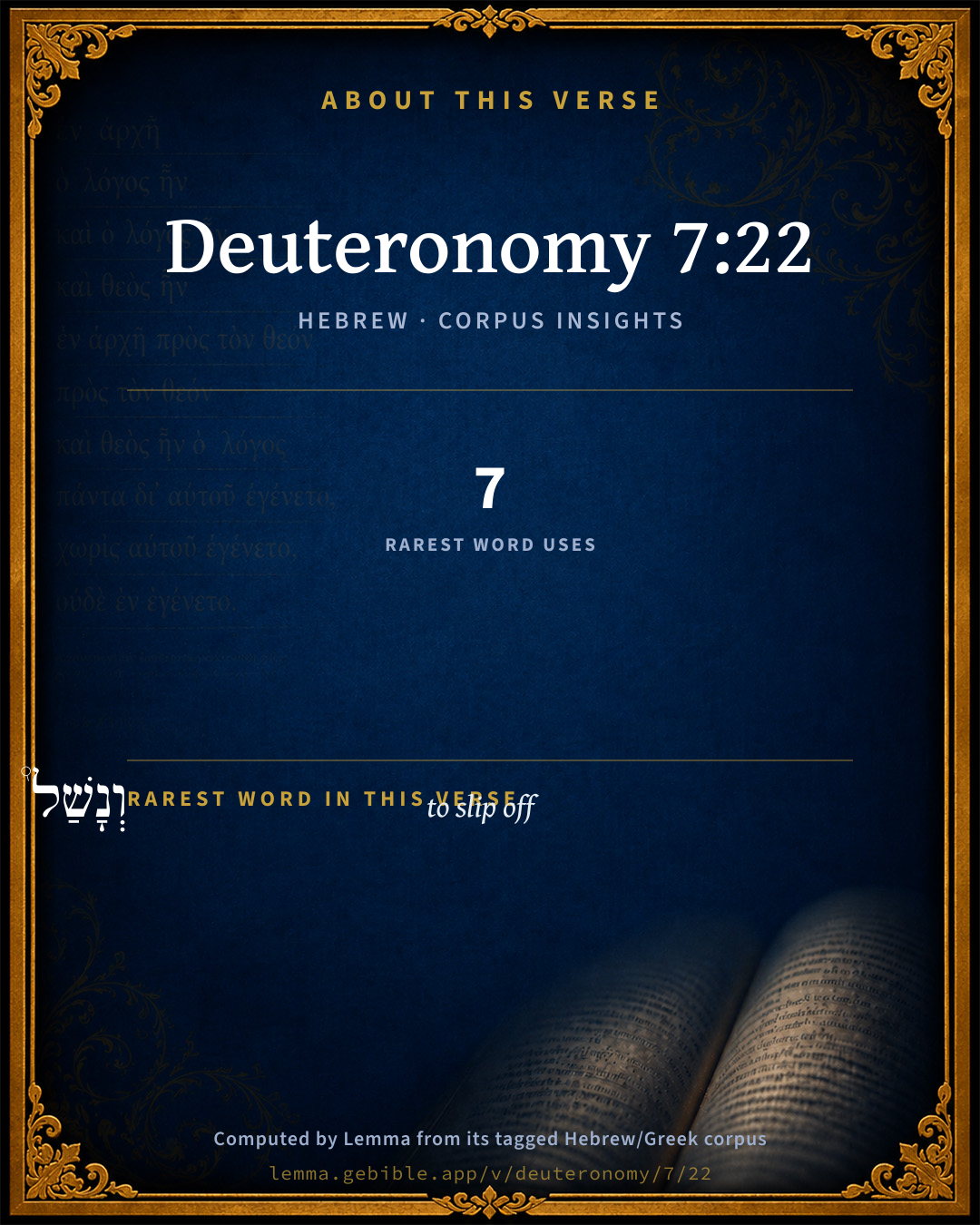
The rarest word here is וְנָשַׁל֩ to slip off H5394 — appearing just 7 times in the whole Hebrew Bible.

Shared distinctive vocabulary

וְנָשַׁל֩ to slip off H5394 occurs in 7 verses of the Hebrew Bible. Also found in:

Grammatical profile

  • 5 verbs
  • 6 nouns
  • 1 pronoun
  • 1 preposition
  • 1 conjunction
  • 2 adverbs
  • 2 particles

Verb forms

  • וְנָשַׁל֩ Qal · Sequential Perfect
  • תוּכַל֙ Qal · Imperfect
  • כַּלֹּתָ֣ם Piel · Infinitive Construct
  • מַהֵ֔ר Piel · Infinitive Absolute
  • תִּרְבֶּ֥ה Qal · Imperfect

Repetition

A word recurs within this verse — often emphatic in Hebrew:

  • מְעַ֣ט few H4592 ×2

Hebrew & Septuagint length

In English translation the verse runs 30 words from the Hebrew and 40 from the Septuagint (LXX English) — closely comparable.

A rough comparison of the two English renderings, which tokenize alike — not a word-level alignment.

Word counts can differ between the Hebrew and the Greek without any difference in meaning — e.g. the Hebrew direct-object marker אֵת has no separate Greek word, and Greek often adds the article ὁ.

Cross-references

2

Topical passages linked to Deuteronomy 7:22 in the Treasury of Scripture Knowledge — connected by theme and wording, ordered by reader-vote popularity; previews shown in the World English Bible.

  • Exodus 23:29–30 I will not drive them out from before you in one year, lest the land become desolate, and the animals of the field multiply against you.
  • Joshua 15:63 As for the Jebusites, the inhabitants of Jerusalem, the children of Judah couldn't drive them out: but the Jebusites dwell with the children of Judah at Jerusalem to this day.

Cross-references courtesy of OpenBible.info (CC BY 4.0).

Hebrew and Greek witnesses Masoretic Hebrew ↔ Greek Septuagint

The same verse in the two great witnesses to the Old Testament, shown verse-for-verse.

These are two independent witnesses, not word-aligned to each other, and the Septuagint is shown in lemma (dictionary) form.

Hebrew Deuteronomy 7:22 Masoretic · Westminster Leningrad Codex

וְנָשַׁל֩ יְהוָ֨ה אֱלֹהֶ֜יךָ אֶת הַגּוֹיִ֥ם הָאֵ֛ל מִפָּנֶ֖יךָ מְעַ֣ט מְעָ֑ט לֹ֤א תוּכַל֙ כַּלֹּתָ֣ם מַהֵ֔ר פֶּן תִּרְבֶּ֥ה עָלֶ֖יךָ חַיַּ֥ת הַשָּׂדֶֽה

Yahweh your God will cast out those nations before you by little and little: you may not consume them at once, lest the animals of the field increase on you.

World English Bible · Public Domain

Greek LXX Deuteronomy 7:22 Septuagint · lemma form

καί κατα ἀναἁλίσκω κύριος ὁ θεός σύ ὁ ἔθνος οὗτος ἀπό πρόσωπον σύ κατά μικρός μικρός οὐ δύναμαι ἐκ ἀναἁλίσκω αὐτός ὁ τάχος ἵνα μή γίγνομαι ὁ γῆ ἔρημος καί πληθύνω ἐπί σύ ὁ θηρίον ὁ ἄγριος

And the Lord your God shall consume these nations before you by little and little: you shall not be able to consume them speedily, lest the land become desert, and the wild beasts of the field be multiplied against you.

LXX2012 (modern English Septuagint) · Public Domain

Hebrew: Westminster Leningrad Codex (CC BY 4.0). Greek: Septuagint (public domain); English from LXX2012 (modern English Septuagint) (Public Domain). How the Septuagint differs from the Hebrew →

Targum (Aramaic paraphrase)

2

The Targum is the ancient Jewish Aramaic paraphrase of the Hebrew Scriptures — an interpretive translation, not the Hebrew text itself. Onkelos (literal) and Pseudo-Jonathan (expansive) render the Torah, and Jonathan the Prophets. Coverage is partial: where no permissively-licensed English translation exists for a verse, only the Aramaic is shown. This is verse-level text, not a word-by-word alignment to the Hebrew.

  1. Targum Onkelos Torah (Genesis–Deuteronomy)
    וִיתָרַךְ יְיָ אֱלָהָךְ יָת עַמְמַיָא הָאִלֵין מִקֳדָמָךְ זְעֵר זְעֵר לָא תִכּוּל לְשֵׁצָיוּתְהוֹן בִּפְרִיעַ דִילְמָא תִסְגֵּי עֲלָךְ חֵיוַת בָּרָא

    (no public-domain English translation for this verse)

    Targum Onkelos — Aramaic: “Onkelos Genesis” (public domain); “Onkelos Exodus” (public domain); “Onkelos Leviticus” (public domain); “Onkelos Numbers” (public domain); “Onkelos Deuteronomy” (public domain). English: “Sefaria Community Translation” (CC0 1.0 (public-domain dedication)); “J.W. Etheridge. The Targums of Onkelos and Jonathan Ben Uzziel on the Pentateuch. London: Longmans, Green, 1862” (public domain). Text via Sefaria.

  2. Targum Pseudo-Jonathan Torah (Genesis–Deuteronomy)
    וְיִגְלֵי יְיָ אֱלָהָכוֹן יַת עַמְמַיָא הָאִלֵּין מִן קֳדָמֵיכוֹן קָלִיל לָא תֵיכוּל לְשֵׁיצֵיוּתְהוֹן בִּפְרִיעַ דִּלְמָא יַסְגֵי עֲלֵיכוֹן חֵיוַת בָּרָא כַּד יֵיתוּן לְמֵיכוֹל גּוּשְׁמֵיהוֹן

    But the Lord your God will make these nations depart from before thee by little and little. You may not destroy them at once, lest the beasts of the field multiply against you, when they have come to devour their carcases.

    Targum Pseudo-Jonathan — Aramaic: “Targum Jonathan on Genesis” (public domain); “Targum Jonathan on Exodus” (public domain); “Targum Jonathan on Leviticus” (public domain); “Targum Jonathan on Numbers” (public domain); “Targum Jonathan on Deuteronomy” (public domain). English: “The Targum of Jonathan ben Uzziel, trans. J. W. Etheridge, London, 1862” (public domain). Text via Sefaria.

Commentary

Notes on Deuteronomy 7:22 from classic Christian and Jewish commentators (each source and its license shown beneath its notes). The classic Christian expositions comment on the surrounding passage and are grouped to its opening verse, so a note may address several verses; the Jewish commentaries on the Tanakh (Rashi and others) are per-verse, so they appear only where the commentator wrote on this verse.

Lemma curates 59 commentaries, every one of them public domain or Creative Commons licensed, each selected and text-cleaned for this edition rather than reprinted as found. About our sources →

The Biblical Illustrator

Joseph S. Exell

Deu_7:22

The Lord thy God will put out those nations.

Gods expulsion of evil

As you read this Scripture you will instantly remember the position occupied by the Jews at the time these words of promise were spoken to them. The forty years of wilderness wandering had run their round. The narrow stream of Jordan was all that lay between them and the land of promise, and in a few days they would cross the swollen flood, and take possession of the goodly country in the name and for the glory of that God who had given it to them for a heritage forever. In prospect of the work, the warfare they would have to carry on in their conquest of Canaan, these words of exhortation were addressed to them, teaching them a two-fold truth. First, God would be with them; God would work for them. Therefore they might cherish the utmost confidence of ultimate success. Secondly, God would be with them, but not to complete the work for them at a single stroke. He would do it surely; but He would do it slowly also. Therefore they might have quiet contentment as well as unfaltering hope. They must rest in the Lord, arid wait patiently for Him. This was no new arrangement on the part of God; it was no new revelation to the Jewish people. The Lord had spoken to them forty years before in the self-same strain, As in the words of the text, so in those of the twenty-third chapter of Exodus, He impressed this truth upon them, that they must both labour and wait, The words then set before us: Work done at Gods command, work done with Gods help, work done successfully, and yet work progressing slowly towards its promised perfection; the slow progress not because of human indolence and faithlessness, but because of Divine ordinance. Why did He not do it all at once? How easily with the breath of His mouth He could have swept the land clear of the last polluting remnant of the Canaanites and their idolatries! The reason for the delay God gives. It was no use for the people to gain the country faster than they could fully occupy and properly cultivate it. This was one reason, though doubtless there were others which God has not made known to us. Let us now turn from Jewish history to our own Christian circumstances, and to our own work. This ancient story throws light on the principles and processes of Divine providence in all ages. It is one practical proof of the truth that, even in the destruction of wrong and the re-establishment of right, our God often works with what seems to us a strange slowness. In His warfare against the power of evil which is so alien to His heart, so hurtful to His creatures, so contrary to His will, the All-holy One does not annihilate it with a word, but He gradually crumbles it to fragments, and He casts it away little by little. There is the work of individual sanctification. A Christian man does not find his nature a blank sheet, on which he can at once write all manner of holy sentences. Nay, but it has already been written upon. There are unholy words, which to deface is his work, and which to entirely remove requires more than human skill. He finds that his nature is anything but an empty country, in which he has just to plant his standard of heaven, and of which he has just to take possession in the name of God. It is full of inhabitants--evil passions, thoughts, desires, habits--and they have all to be cast out, that their place may be taken by thoughts and desires and habits, pure and holy, God-pleasing and God-like. And this expulsion of the Philistines, this filling of the land with the children of God, is in every ease a lifelong work. It is only done by little and little. This is one of the mysteries of our present position. The false is often so much, and the true is often so little; the wrong is often so easy, and the right is often so difficult. The evil, the worldly, and the devilish, is often just yielding to nature, just floating with the tide. The good, the heavenly, the God-like--to follow it is often to go against tide and tempest, against flesh and blood, against all manner of opposing forces. Why are we taught to see the beauty and to appreciate the blessings of wellness, and yet are left to wrestle so continually with sins and doubts and fears? Could not our God come, and at once sweep every defiling thing out of our heart forever? We know that our God could do this if He saw it to be wise and best; and this must be our comfort under the fact that He does not do it. He does not abstain because of His weakness. He does not abstain because of His unwillingness. He sees that the discipline of weakness and tears, and not unfrequent failures, and success only partially secured--He sees that His discipline is good for us. He knows how it will prepare us for higher service and for holier joys in heaven; and so, while we are sighing for instant redemption, He grants us only gradual deliverance. (C. Vince.)

By little and little.

Victory sure but gradual

The victory over our enemies, that is, over our sins, will, in general, not be sudden, but gradual. Final success is promised: the first attempt to resist is a pledge of that final success; continued resistance is a continued pledge of that result; it needs only to persevere in the struggle, and the victory is ours--ours already in prospect. We must be prepared, therefore, for a continuous warfare. Sometimes we shall prevail over the temptation of the day--then we shall be encouraged; the next day, perhaps, we shall be defeated by it, and then we shall be humbled. Sometimes we shall look back, and feel that we have advanced. At other times we shall be conscious of a loss of ground, and we shall betake ourselves afresh to humiliation and prayer. But, on the whole, there will be no doubt so long as we continue to struggle, by faith not in ourselves but in Christ, that we are making progress. Things which once seemed impossible will have become easy; things which once seemed irresistible will have been found conquerable in the name of Christ. By little and little our foes are giving way before us. Yet a little while, and He that shall come will come, and find us with His armour on, maintaining the post which He has assigned. Nor is this an arbitrary arrangement, but one calculated for our good. Thou mayest not destroy them at once, lest the beasts of the field increase upon thee. The sudden and final discomfiture of our foes at the moment of our first onset would not, in all probability, promote but defeat our ultimate good. There is a lesson to be learned, without which virtue itself might be a curse and not a blessing. That lesson is humility. He who would see God must be a humble man; and humility is a grace of gradual attainment. It comes by difficulty, sorrow, conflict, often by defeat. Worse than any fall is that pride which precedes it--that pride which, without a fall, would never be humbled. Was there danger lest the beasts of the field should increase upon Israel, if their enemies should fall before them at once? So the heart abruptly cleared from the assaults of other sins--of ambition, and vanity, and selfishness, and lust--might fall an easy prey to the ravenings of spiritual pride; and the last end of that man would be worse than the first. (Dean Vaughan.)

By little and little

The rule of heaven, earth, and hell is--By little and little! Whether you look to the outward and visible, or to the inward and invisible; to the world of matter, or to the world of spirit; to the kingdom of nature, or the kingdom of grace,--you will surely find this rule to hold good. First the blade, etc. Look at the history of yon giant oak. There is a little bird, and in his beak he bears a tiny acorn along. Away he wings his flight, over hedge and ditch, brier and brake, until, frightened by a hawk, he lets his little acorn fall in yon pasture field. Oxen are grazing there. The ox comes by, and beneath his hoof the tiny acorn is trodden deep down into the soil. The ox passes on his way. The acorn remains, uncared for and forgotten; but by little and little it bursts its shell; by little and little it takes root downwards and bears fruit upwards; by little and little the tender twigs peep out amid the surrounding blades of grass, and thus slowly but surely it rises higher and higher, and grows broader and broader, until at length a sturdy oak marks now the spot where years before the little acorn fell. My object, however, is to point you rather to the world of spirit than to that of nature. Just as the ancient Israelites were sure of the Promised Land as their inheritance ultimately, but still could not secure it without a struggle, or rather a series of struggles, even by little and little; just so with the child of God, although from the moment that he believes in Jesus, as the only Saviour of his soul, he by that very act secures to himself the right to enter heaven; nevertheless his meetness for heaven is a work which will require years of stern struggling with his spiritual enemies. Now we may rest assured that the Masters reasons for not destroying our spiritual enemies at once, but enabling us to overcome by little and little, are both wise and all-sufficient. That we cannot overcome these enemies at once, will, I take it, be acknowledged to the full if I appeal to the experience of any Christian man or woman. Have ye never been harassed by those enemies of the Christians peace, even by the nation of worldly cares? This nation is compared by the Master to briers and thorns, which spring up, and unless the greatest and most constant care be taken will choke the good seed. I know of none other nation, perhaps, more to be dreaded than these worldly cares, and this is especially the case in these days, when many causes, such as the great competition in trade, the high price of provisions, and an ever-increasing population, give to Satan a terrible vantage ground wherefrom to attack. Ye have tried to shake them off once and forever, as unworthy of the child of God, but they will not be shaken off at once. Still strive on, and the Lord thy God will put them out before you by little and little. Again, the true Israelite is worried by a nation of idle and wandering thoughts. Now ye must not be discouraged at this state of things; ye must not incline to despair because unable to be rid of these vain thoughts at once. Continue to strive against them, and God will put them out before thee by little and little. Thus might I enumerate enemy after enemy that will harass and impede us by the way. I might remind you of the sickening doubts and fears, of the lurking treachery of that poor heart, of the seducing friends and the too frail flesh. These cause you frequent and fearful pain, and ever and again break in upon your peace. Still in any moment of despair I would point you to the truths of the text, and entreat that you will not forget how that God has all-wisely willed that we should not conquer at once, not become perfect at once, but conquer one foe after another, and become perfect only by little and little. And as this is the rule of heaven, so alas! is it also the rule of hell. In Gen_3:1-24, we read that the serpent was more subtle than any beast of the field, and surely in nothing has he manifested his cunning more than in the cruel way wherewith he has imitated God in dealing with mens souls. I see that in saving souls, he would seem to say, Jehovah takes not the sinner out of his sin so as at once to transform him into a perfect saint. I see that in winning souls to glory He woos them gradually away from earth, and by little and little makes them meet to be forever with the Lord. I will go and do likewise. In seeking the eternal ruin of souls, my principle of action shall be the same. I will not try to make a man a tenant meet for hell at once, but step by step I will lead him down. I will first coax him till he gives up some one good habit; I will then tempt him till he indulges in some one sin, and again I will blunt his conscience by tempting him to repeat that sin, until by little and little I shall be able to sap the very foundations of his character, and gradually make him fit for the abode of the lost. I adjure you, then, as you value your happiness in time and in eternity, beware of the very first little tendency to sin. It is here the danger lies. This is the rule of hews attack. (D. P. Morgan, M. A.)

Every day a little

1. Every day a little knowledge. One fact in a day. How small is one fact! Only one. Ten years pass by. Three thousand six hundred and fifty facts are not a small thing.

2. Every day a little self-denial. The thing that is difficult to do today will be an easy thing to do three hundred and sixty days hence, if each day it shall have been repeated. What power of self-mastery shall he enjoy who, looking to God for grace, seeks every day to practise the grace he prays for!

3. Every day a little helpfulness. We live for the good of others, if our living be in any sense a true living. It is not in great deeds of kindness only that the blessing is found. In little deeds of kindness, repeated every day, we find true happiness. (Anon.)

Theory of graduality

My text is representing the gradual process by which God will exterminate the Canaanites and give the land into the possession of the Israelites. It will not be by one fell blow, or instantaneously, but by little and little. Indeed, that is Gods usual way. Gradually the world was peopled. Gradually the rocks wear away. Gradually great changes occur. The world ages in being built. The world ages in being redeemed. Eternity is the lifetime of God. We hasten and worry and die, but God waits, and His stupendous projects go on gradually, slowly, inch by inch, by little and little. This theory of graduality has its illustration in the achievement of spiritual knowledge and character and the driving out of Canaanitish ignorance and Canaanitish sin from the heart. The most accomplished rhetorician or poet who has filled a whole shelf with admirable books of his own began by learning the alphabet. The mightiest mental toil in which we ever engaged was the learning of our a-b-cs. The swiftest reportorial pen failed once in attempting to make a perpendicular stroke on the boys copy book. The printer, whose fingers move with electric speed, once pulled out from the case slowly, cautiously, studiously, type by type. The boy, who bounds over the playground with so much celerity that he does not seem to touch it, once poised himself cautiously against the wall, and could not be tempted to cross the floor until he saw his mothers arms out ready to catch him if he fell. So in all spiritual knowledge, it is by little and little that we advance. We went on from one attainment to another. Each of the attainments, perhaps, seemed to be very small indeed, but they came on--now a resolution added to a resolution, hope added to hope, experience added to experience, joy to joy, struggle to struggle, victory to victory. They did not come up on this great mount of Christian excellency by one great athletic stride, but inch by inch, step by step, by little and little. Paul came to his great attainments in piety gradually. He had to take a course of mobs, of shipwrecks, of scourgings, of imprisonments, of execrations before he came to the rounding out of his character, and every Christian now must come through ups and downs, and losses, and slights, and blunders, and abuse, and struggles to that rounding out of his character. A merchant tailor takes down the goods, he unrolls them, he makes the line of chalk mark, with his scissors he follows the chalk mark until the garment is cut out, and though there may be many pieces, the whole garment is made out of one cloth. But it is not so in the putting together of a Christian character. It is a little of this to make the robe of character, and a little of that, a little of the bright coloured prosperity, and a little of the dark-shadowed calamity. It is a sort of patchwork. Little by little. Conversion is an instantaneous work. Believing is becoming a Christian. But there is a great difference between conversion and sanctification. Conversion is turning around from the wrong direction and starting in the right direction; but sanctification is keeping on in the right direction after you have started. After conversion, oh! how much work. And your greatest battles with the world, the flesh, and the devil will be after you have declared against them. Men think after they are converted the work is done. They suppose that in some way there will be heaved up in their souls a grand Christian character as an earthquake heaves up a beautiful island in the midst of the sea. No. No. By little and little. Troubles will help you. There is no such thing as wrought iron without passing through the fire. The seniors in Christs college, of course, know more than the freshmen. But be accumulative every day. A handful of acorns will make a forest of oaks. By little and little. Again, this theory of graduality has its illustration in the formation of bad habits. Look at that habit of falsifying. The man began with what is called a white lie, or a fib. He can stand in his store, behind his counter, and unblushingly, deliberately, calmly say that which he knows to be false, and which you know to be false. There are hundreds of men in this house today who would confess that the habit is injurious to them, but somehow they cannot stop. How, my brother, did you get this bondage on you? In one day? In one hour? No. By little and little. Again, this theory of gradually is illustrated in the right kind of domestic discipline, and the driving out of Canaanitish evil from the childs heart. Family government is by fits and starts, but it is worth less than nothing unless it be calm, deliberate, continuous all through boyhood and girlhood. Your children by this process are making character noble or degraded. By little and little. To the nursery story and the picture book of the first four years must be added the influence of a Christian fireside, proper improvement of anniversaries, line upon line, precept upon precept, here a little, there a little there a smile, there a look, here a frown, here a walk, here a ride, here a flower plucking, here this, here that. By little and little. Once more, this theory of graduality has its illustration in the conquest of the world for God and the extermination of the Canaanites forever. Would it not be pleasant if in one day all the race could be evangelised, and the Atlantic cable could thrill with the news that Europe, Asia, and Africa are converted? Because it is not done rapidly, Christian people get discouraged. They say: Nineteen centuries since Christ came, and yet the world not saved. O, you cavillers; you do not realise the way God does things. God is not in a hurry. Many generations are to have joy in this work; you shall not monopolise it. Your children and your childrens children and their successors innumerable, shall help to draw on this Gospel chariot. Let God control the great affairs of the universe. Let us each one do his own little work. The hands that made the curtains in the ancient tabernacle did their work. And you will favour the work in one way, and I will favour the work in another way. Each one doing his own work, in his own way, according to his own capacity. By little and little. Then God will at the last gather up all these fragments of work, and in the great day of eternity we shall see it, and under arches of light and in bowers of beauty, and amid the battle flags of Gods great host of the redeemed, and amid the blast of all heavens trumpets, we shall see the consummation. Amid that great multitude that no man can number, God will not be ashamed to announce that all this grandeur and glory and triumph were achieved by little and little. (T. De Witt Talmage, D. D.)

Tick by tick

In listening to the sound by which a clock or watch marks the passing of the diminutive portions of time, one might almost fancy that deductions so extremely small would never wear away the whole duration of a long life. But it has been by such minute lapses in never ceasing succession that the vast series of ages since the creation has passed away; it has been by this succession of instants that all our ancestors have completed their sojourn on earth, and by this it will be that we shall one day have arrived at the end of our mortal existence. Each passing moment, then, may be regarded as having a relation to the end, and everything which hints to us that moments are passing, may be a monition to us to be habitually at the great work which ought to be accomplished against the period when the last of them shall come. (J. Foster.)

The progress of our truest life

We have watched, on a summers day, the tide coming in upon the shore. How slow and scarcely perceptible its advance! Now a strong onrush; then a temporary ebb; presently a further advance; so, inch by inch, the ground is gained. Such should be the progress of our truest life. Steadily the tide of purer, stronger feeling, of nobler and more strenuous endeavour should ripple in, until life flows to its height, musical as the sound of many waters!

The concentration of the little

The weakest living creature, by concentrating his powers on a single object, can accomplish something; the strongest, by dispersing his over many, may fail to accomplish anything. The drop, by continued falling, bores its passage through the hardest rock the hasty torrent rushes over it with a hideous uproar, and leaves no trace behind.

The conquest of character

The boundary line between legitimate aspiration and a reasonable content is sometimes hard to find. Contentment may be construed by some as lack of enterprise, and so more or less ignoble, while aspiration may, and often does, become mere restlessness and discontent. But all depends on what we aspire to and what we are content with. The man who wants to be a little better, a little wiser, a little richer than he is, whose aspiration takes the form of gradual growth by littles, will probably realise his desires. And if he refuses to fight the inevitable and the immutable limitations that are set about him, even while constantly bettering his condition, be may yet be content and happy. Great estates are built up by slow and gradual accretion running through the years. Great scholarship is the result of constant aspiration, unflagging industry, and tireless diligence. So fine character is the result of innumerable conquests over self and selfishness and ease, and evil and vicious tendency. It is built up as the coral animal builds the reefs, one act at a time, and a great many of them going to the erection of the lofty structure.

Little things done well

Young men in beginning life are apt to be impatient of the first little steps that apparently make no advance, forgetting that seeming trifles make up the sum of life, just as in building, the little bricks, laid carefully one at a time, side by side, and securely cemented together, make at last the great, strong structure. A young man, having exhausted his patrimony in obtaining a professional education, settled himself in a town already filled with successful lawyers, to practise law. One day one of these older lawyers asked him how, under such circumstances, he expected to make a living. I hope I may get a little practice, was the modest reply. It will be very little, said the lawyer. Then I will do that little well, answered the young mall decidedly. He carried out his determination. The little things well done brought larger ones, and ill time he became one of the most distinguished jurists of his State. Again, a certain old bishop, who was fond of finding odd characters in out-of-the-way places, was visiting in a quiet neighbourhood. One day, in a walk with a friend, he came across a crossroads settlement of a few houses. Among them was a snug little shoe shop, kept by an old negro man, which showed signs of prosperity. Interested in the old cobbler, the bishop stopped for a chat. My friend, he said, I would not think so small a business as mending shoes would pay so well. Ah, said the gentleman with him, old Cato has the monopoly of shoe mending in this region. No one else gets a job. How is that, Cato? asked the bishop. Just so, master, replied Cato. It is only little patches put on with little stitches or tiny pegs. But when I takes a stitch it is a stitch, and when I drive a peg it holds. Little things well done! The good bishop used that reply as a text for many a sermon afterwards. (Christian Age.)

The Biblical Illustrator, edited by Joseph S. Exell (c. 1880s–1900s) — public domain. Text from a community e-Sword module.

Joseph Benson's Commentary

Deu 7:22. Thou mayest not consume them at once — Thou shalt not be able; I will not assist thee with my omnipotence, to crush them at one run of success and victory; for you are not yet numerous enough to people the whole country at once. But I will bless thee in the use of ordinary means, and thou shalt destroy them by degrees, in several battles, that thou mayest learn by experience to put thy trust in me.

Joseph Benson's Commentary on the Old and New Testaments (1811–1818) — public domain. Text from a community e-Sword module.

Geneva Bible (1599)

Geneva Bible translators

So that it is your commodity that God accomplish not his promise so soon as you would wish.

Geneva Bible (1599) marginal notes — public domain. Text via Bolls.life.

Jamieson, Fausset & Brown

Robert Jamieson, A. R. Fausset & David Brown

lest the beasts of the field increase upon thee--(See on Exo 23:29). The omnipotence of their Almighty Ruler could have given them possession of the promised land at once. But, the unburied corpses of the enemy and the portions of the country that might have been left desolate for a while, would have drawn an influx of dangerous beasts. This evil would be prevented by a progressive conquest and by the use of ordinary means, which God would bless.

Next: Deuteronomy Chapter 8

Jamieson, Fausset & Brown — Commentary Critical and Explanatory on the Whole Bible (1871) — public domain (CC PDM 1.0). Text via the HelloAO Bible API.

Adam Clarke's Commentary

Verse 22. Put out those nations - by little and little] The Israelites were not as yet sufficiently numerous to fill the whole land occupied by the seven nations mentioned De 7:1. And as wild and ferocious animals might be expected to multiply where either there are no inhabitants, or the place is but thinly peopled, therefore God tells them that, though at present, by force of arms, they might be able to expel them, it would be impolitic so to do, lest the beasts of the field should multiply upon them.

Adam Clarke's Commentary on the Bible (1810–1826) — public domain. Text from a community e-Sword/MySword module.

Ellicott's Commentary for English Readers

(22) The Lord thy God will put out.—The word for “putting out” is illustrated by its use in Deu_19:5, of the axe-head flying off from the handle in the midst of a blow, and of the olive “casting” his fruit in Deu_28:40. (Comp. also 2Ki_16:6, and 1Sa_25:29, for a similar thought.)

By little and little.—This confirms the view already expressed, that the expulsion of each particular nation was contingent upon the Divine decree, and that none were to be attacked by Israel except when the Lord should deliver them into Israel’s hand.

A Bible Commentary for English Readers, edited by Charles John Ellicott (1878–1897) — public domain. Text from a community e-Sword module.

The Cambridge Bible for Schools and Colleges

gen. ed. J. J. S. Perowne

22. cast out] See on Deu_7:1.

little and little] So, with the same reason attached, E, Exo_23:29-30, on which see the note. This is a good instance of D’s redaction, and more fluent expression, of earlier statements. That D should repeat the fact is strange. Though in harmony with and explanatory of the actual delay in Israel’s extermination of the peoples of the land, as recorded in the older documents (Jos_13:13; Jos_15:63; Jos_16:10; Jos_17:11-18; Jdg_1:19; Jdg_1:21 ff., Jdg_2:20 to Jdg_3:4; most probably all J), it is against the conception conveyed by the deuteronomic sections of Joshua, that Israel’s conquest of the peoples was rapid and complete (Jos_10:28-43; Jos_11:16-23; Jos_21:43-45, etc.). This, however, is no reason for supposing the verse to be an intrusion as Steuern. does; in any case it is deuteronomic.

lest the beasts of the field increase upon thee] Field, here in its earlier sense of uncultivated territory; beasts of the field are therefore wild beasts. That this danger was real and great in partly depopulated lands is illustrated in 2Ki_17:24 f. How constant the war of man against wild animals was in ancient Palestine may be felt from the promise of their being tamed as one of the elements of the Messianic age, Isa_11:6-9. See the present writer’s Isaiah i.–xxxix. 189 f.

The Cambridge Bible for Schools and Colleges (gen. ed. J. J. S. Perowne; Cambridge University Press, 1878–1918) — public domain. Text from a community e-Sword module.

John Gill's Exposition

And the Lord thy God will put out those nations before thee by little and little,.... Which is observed for their encouragement, who seeing that all were not destroyed at once, might fear the work would never be thoroughly accomplished; see Exo 23:30,

thou mayest not consume them at once; though it was in the power of their hands to do it, there being some wise reasons for sparing them awhile, at least for not cutting them off all at once, and one follows:

lest the beasts of the field increase upon thee; through so many places being waste without inhabitants, and there being none to destroy these creatures; and who therefore in course would become more numerous, and so more troublesome and distressing to the Israelites. The Targum of Jonathan adds, by way of explanation,"when they shall come to devour their carcasses,''the carcasses of the slain Canaanites; who, if destroyed at once, would be so many, that they would lie unburied, which would invite the beasts of the field to come out of their lurking places to feed upon them, and which might lead them on to mischief among the Israelites.

John Gill's Exposition of the Whole Bible (1746–1763) — public domain (CC PDM 1.0). Text via the HelloAO Bible API.

Haydock's Catholic Bible Commentary

Thee. Three millions of people not being sufficient to cultivate the land, Exodus xxiii. 29. (Menochius) --- God could easily have destroyed those mighty nations at once; but he would not give the Israelites any occasion of boasting. (Du Hamel) --- If they never succeeded to expel them entirely out of the country, they might attribute it to their own negligence and other sins. (Haydock)

George Leo Haydock (1774–1849), Haydock's Catholic Family Bible and Commentary, 1859 edition — public domain. Excludes Psalms (Douay-Rheims chapter numbering differs from Protestant) and Deuterocanonical books (Catholic canon only).

Matthew Poole's English Annotations

Or, thou shalt not be able to consume them at once, i.e. in an instant. I will not assist thee with my omnipotency, to crush them in a moment, but will bless thee in the use of ordinary means, and destroy them successively by several battles.

Matthew Poole's English Annotations on the Holy Bible (1683–1685) — public domain. Text from a community e-Sword/MySword module.

The Pulpit Commentary

Cf. Exo_23:30

The Pulpit Commentary (1880–1919), ed. H.D.M. Spence-Jones & Joseph S. Exell — public domain. Text from a community e-Sword module.

Rashi

Rabbi Shlomo Yitzchaki (Rashi)

פן תרבה עליך חית השדה LEST THE BEASTS OF THE FIELD INCREASE UPON THEE — But is it not a fact that if people perform the will of the Omnipresent they will not have to fear the beasts, as it is said, (Job 5:23) “And the beasts of the field shall be at peace with thee”?! But it states this because it was manifest before Him that they would in future sin.

Rashi on the Tanakh — English translations: “The Judaica Press complete Tanach with Rashi, translated by A. J. Rosenberg” (CC BY 4.0); “Pentateuch with Rashi's commentary by M. Rosenbaum and A.M. Silbermann, 1929-1934” (public domain); “The Metsudah Tanach series, Lakewood, N.J” (CC BY 4.0); and “The Book of Joshua, Metsudah Publications, 1997” (CC BY 4.0). Text via Sefaria.

Ramban (Nachmanides)

Rabbi Moshe ben Nachman (Ramban / Nachmanides)

THOU MAYEST NOT BE ABLE TO CONSUME THEM SPEEDILY. He is assuring them that G-d will destroy them all and send the hornet among them to destroy they that are left and they that hide themselves, and thus they will all [ultimately] perish. He states, however, that He will not completely destroy them in war in one day, nor will He drive them out of the Land in one year, lest the Land become desolate, and the beasts of the field multiply against thee. And He assured them further that those [of the peoples] that are left, will not be the majority, but that G-d shall confound them with a great confusion and most of them will be destroyed by the hand of Israel. And so he said, He will destroy them, and He will bring them down before thee; so shalt thou drive them out, and make them to perish quickly, [meaning] that you will destroy most of them quickly, but they will not be completely vanquished until thou be increased, and inherit the Land.

Ramban (Nachmanides) on the Tanakh — English translation: “Commentary on the Torah by Ramban (Nachmanides). Translated and annotated by Charles B. Chavel. New York, Shilo Pub. House, 1971-1976” (CC BY 4.0). Text via Sefaria.

Lesson kit

Teaching starters — assembled from the data on this page, not authored interpretation. Every prompt links to the verse data it draws on. Edit before teaching.

Deuteronomy, in the Pentateuch, opens this verse with 18 words (17 distinct Hebrew lemmas). Its most distinctive word is nâshal (“to slip off”). A historical commentator’s framing appears above. Read the whole chapter for the surrounding context.

Discussion questions

  1. How does “to slip off” (nâshal) shape what this verse is saying?
  2. Exodus 3:5 shares the word «to slip off» with this verse. How do the two illuminate each other?
  3. “few” occurs 2× in this one verse. What is the effect of the repetition?
  4. The translations on this page render this verse differently — a whole-verse word diff, not a word-by-word alignment. What might account for the different wordings?
  5. The verb «וְנָשַׁל֩» is Qal Sequential Perfect. How does its form color the action?
  6. Reading how The Biblical Illustrator and Joseph Benson's Commentary read this verse, where do the two commentators agree and where do they part?

Things to notice

Reading settings

Reading text

Shown beneath each verse's original-language words.

Old Testament
Old Testament edition

Read the OT as the Masoretic Hebrew (MT) or the Greek Septuagint (LXX).

English shown for the Greek Septuagint (in the Hebrew ↔ Greek comparison).

Comparing translations? Open the Compare panel on any verse page to stack up to four side by side.