Exodus 19:6

Hebrew (Westminster Leningrad Codex) Exodus 19:6 appears in the Hebrew Old Testament. The text above is from the Westminster Leningrad Codex. Each word links to its Strong’s number, a concise gloss, and parsing drawn from the Open Scriptures Hebrew Bible morphology. Click any word for its full Brown-Driver-Briggs (BDB) entry.
Download image
Cite this verse

Exodus 19:6 (World English Bible). Public Domain. Lemma interlinear Bible study tool, https://lemma.gebible.app/v/exodus/19/6.

Show BibTeX & RIS
BibTeX
RIS
English Translation
and you shall be to me a kingdom of priests, and a holy nation.' These are the words which you shall speak to the children of Israel."
World English Bible · Public Domain
Highlights
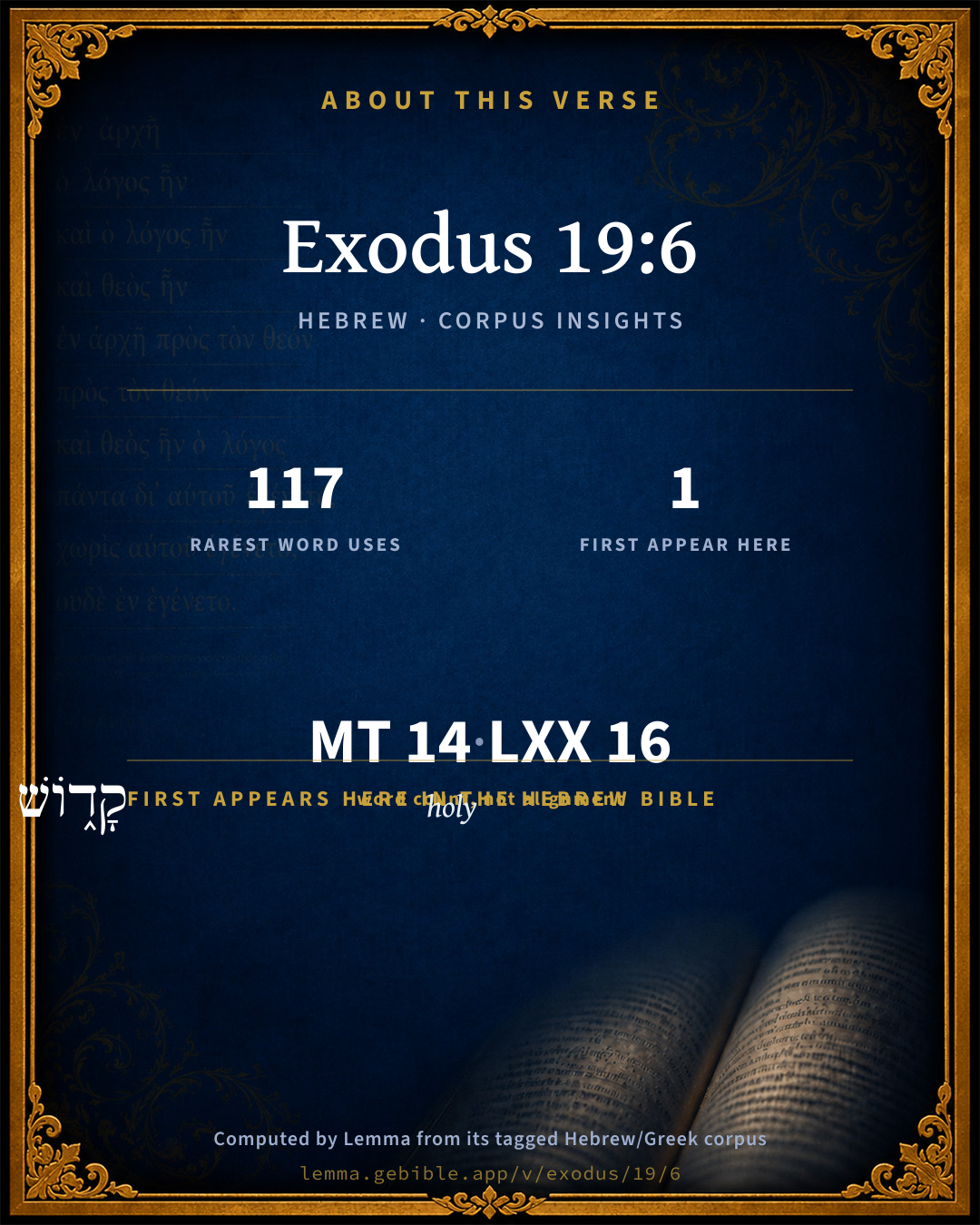
  • 1 first appearance in the Hebrew Bible
Full analysis ↓
Download a study sheet

One document with this verse’s original text, its word-by-word gloss line, the meaning frame, cross-references with their text, attributed commentary, and full source and license credits — printable, and it pastes into notes with its structure intact.

This verse Autodidact and up

Study sheet (.html) Plain text (.txt)

A passage Seminary Student

Up to 50 verses in one chapter. A passage sheet keeps up to 6 commentary sources and 12 cross-references per verse, in the order this page ranks them, and says so on the sheet whenever that leaves anything out. Ask for a single verse and you get the Autodidact verse sheet above.

Everything on this page stays free to read, with no account — the sheet is a download of what is already on screen, not access to it.

Want to remove ads? Support Godless Engineer
Compare translations 3

The same verse in 3 English versions, stacked beneath the original-language interlinear above. Click any original word for its lexicon entry.

Each is an independent rendering of the whole verse — the interlinear is not word-aligned to these translations.

Highlighted words mark where these versions differ — a whole-verse word diff, not a word-by-word alignment.

  • World English Bible Public Domain
    and you shall be to me a kingdom of priests, and a holy nation.' These are the words which you shall speak to the children of Israel."
  • King James Version Public Domain
    And ye shall be unto me a kingdom of priests, and an holy nation. These are the words which thou shalt speak unto the children of Israel.
  • unfoldingWord Literal Text CC BY-SA 4.0
    and you yourselves will be my kingdom of priests and holy nation.’ These are the words that you shall speak to the sons of Israel.”

unfoldingWord Literal Text — © unfoldingWord, licensed CC BY-SA 4.0. Word-aligned USFM3 via Door43 (git.door43.org/unfoldingWord/en_ult).

Versions to compare (up to 4)

3 of 4 selected

Show all 18 translations

Every available English version of this verse, each an independent rendering of the whole verse.

  • World English Bible Public Domain
    and you shall be to me a kingdom of priests, and a holy nation.' These are the words which you shall speak to the children of Israel."
  • Berean Standard Bible Public Domain
    And unto Me you shall be a kingdom of priests and a holy nation.’ These are the words that you are to speak to the Israelites.”
  • Majority Standard Bible Public Domain
    And unto Me you shall be a kingdom of priests and a holy nation.’ These are the words that you are to speak to the Israelites.”
  • King James Version Public Domain
    And ye shall be unto me a kingdom of priests, and an holy nation. These are the words which thou shalt speak unto the children of Israel.
  • American Standard Version (1901) Public Domain
    and ye shall be unto me a kingdom of priests, and a holy nation. These are the words which thou shalt speak unto the children of Israel.
  • Revised Version (1885) Public Domain
    and ye shall be unto me a kingdom of priests, and an holy nation. These are the words which thou shalt speak unto the children of Israel.
  • Geneva Bible (1599) Public Domain
    Yee shall be vnto mee also a kingdome of Priestes, and an holy nation. These are the words which thou shalt speake vnto the children of Israel.
  • Douay-Rheims (1899) Public Domain
    And you shall be to me a priestly kingdom, and a holy nation. Those are the words thou shalt speak to the children of Israel.
  • Young's Literal Translation Public Domain
    and ye -- ye are to Me a kingdom of priests and a holy nation: these `are' the words which thou dost speak unto the sons of Israel.'
  • Literal Standard Version CC BY-SA 4.0
    and you are to Me a kingdom of priests and a holy nation: these [are] the words which you speak to the sons of Israel.”
  • Unlocked Literal Bible CC BY-SA 4.0
    You will be a kingdom of priests and a holy nation for me. These are the words that you must speak to the people of Israel.”
  • unfoldingWord Literal Text CC BY-SA 4.0
    and you yourselves will be my kingdom of priests and holy nation.’ These are the words that you shall speak to the sons of Israel.”
  • Darby Bible Public Domain
    and ye shall be to me a kingdom of priests, and a holy nation. These are the words which thou shalt speak to the children of Israel.
  • World Messianic Bible Public Domain
    and you shall be to me a kingdom of priests and a holy nation.’ These are the words which you shall speak to the children of Israel.”
  • Webster's Bible Public Domain
    And ye shall be to me a kingdom of priests, and a holy nation. These are the words which thou shalt speak to the children of Israel.
  • Free Bible Version CC BY-SA 4.0
    for me you will be a kingdom of priests, a holy nation.’ This is what you are to tell the Israelites.”
  • Bible in Basic English Public Domain
    And you will be a kingdom of priests to me, and a holy nation. These are the words which you are to say to the children of Israel.
  • JPS Tanakh (1917) Public Domain
    and ye shall be unto Me a kingdom of priests, and a holy nation. These are the words which thou shalt speak unto the children of Israel.'

Literal Standard Version (2020), Covenant Press — licensed CC BY-SA 4.0. Text via the HelloAO Bible API (eBible.org). Unlocked Literal Bible (unfoldingWord) — licensed CC BY-SA 4.0. Text via the HelloAO Bible API (eBible.org). unfoldingWord Literal Text — © unfoldingWord, licensed CC BY-SA 4.0. Word-aligned USFM3 via Door43 (git.door43.org/unfoldingWord/en_ult). Free Bible Version, Dr. Jonathan Gallagher — licensed CC BY-SA 4.0. Text via the HelloAO Bible API (eBible.org).

Word by word

More ways to search: Search by grammar → Find every occurrence → Compare this word →

Practice this passage: Drill this verse → Learn its vocabulary →

מַמְלֶ֥כֶת
mamlâkâh
H4467
“kingdom of”
Noun, Common, Feminine, Singular, Construct
Part of Speech
Noun
Type
Common
Gender
Feminine
Number
Singular
State
Construct
Full BDB Definition

Origin: from H4427

TWOT: 1199f

kingdom, dominion, reign, sovereignty - kingdom, realm - sovereignty, dominion - reign
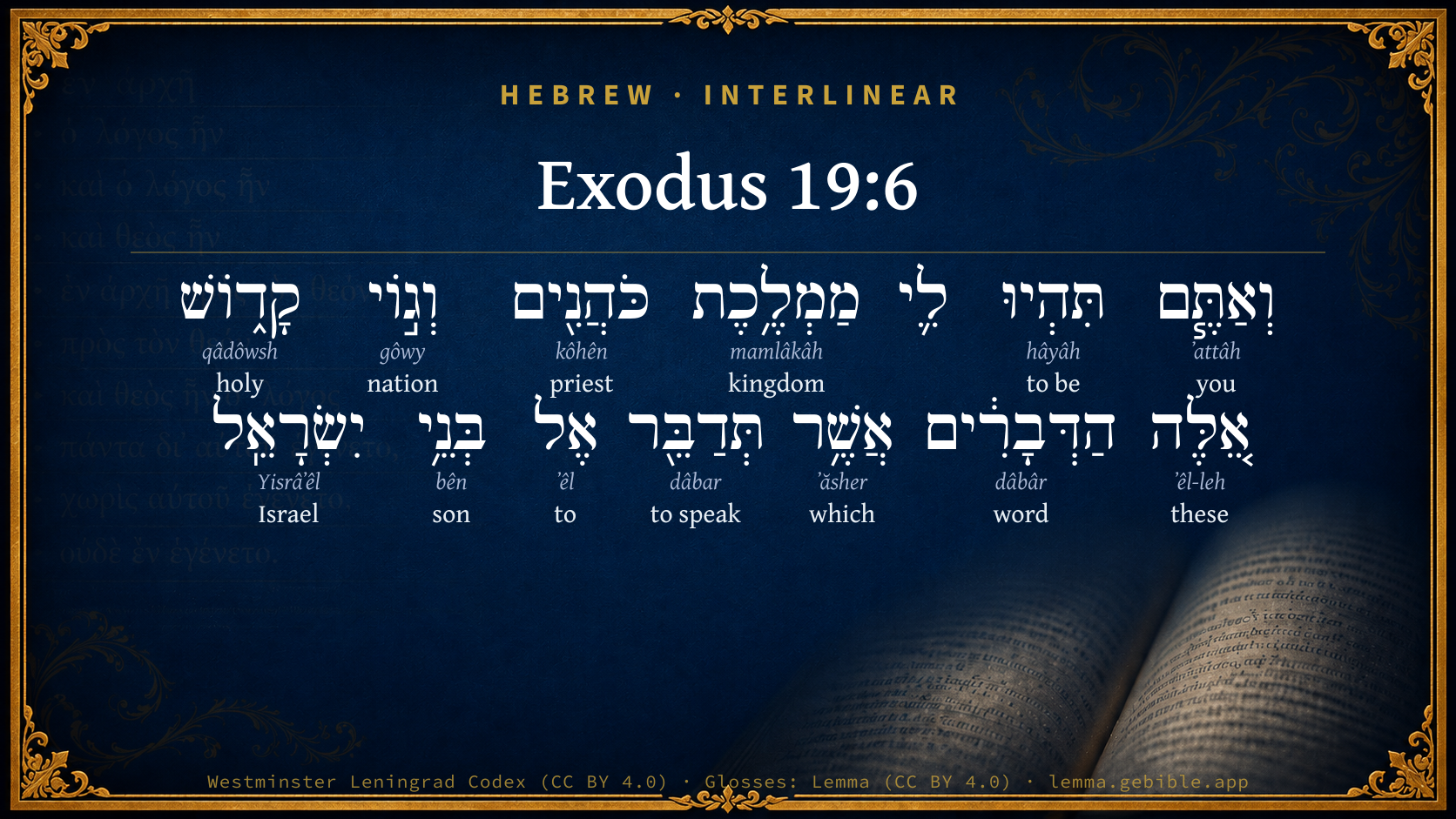
  1. וְאַתֶּ֧ם ʼattâh H859 “and · you” Conjunction + Pronoun, Personal, 2nd Person, Masculine, Plural
  2. תִּהְיוּ hâyâh H1961 “to be” Verb, Qal, Imperfect, 2nd Person, Masculine, Plural
  3. כֹּהֲנִ֖ים kôhên H3548 “priests” Noun, Common, Masculine, Plural, Absolute
  4. וְג֣וֹי gôwy H1471 “and · nation” Conjunction + Noun, Common, Masculine, Singular, Absolute
  5. קָד֑וֹשׁ qâdôwsh H6918 “holy” Adjective, Adjective, Masculine, Singular, Absolute
  6. אֵ֚לֶּה ʼêl-leh H428 “these” Pronoun, Demonstrative, Common, Plural
  7. הַדְּבָרִ֔ים dâbâr H1697 “the · words” Particle, Definite Article + Noun, Common, Masculine, Plural, Absolute
  8. אֲשֶׁ֥ר ʼăsher H834 “which” Particle, Relative
  9. תְּדַבֵּ֖ר dâbar H1696 “to speak” Verb, Piel, Imperfect, 2nd Person, Masculine, Singular
  10. אֶל ʼêl H413 “to” Preposition
  11. בְּנֵ֥י bên H1121 “sons of” Noun, Common, Masculine, Plural, Construct
  12. יִשְׂרָאֵֽל Yisrâʼêl H3478 “Israel” Noun, Proper

About this verse

These counts appear in no published source. They are computed here, from the morphology-tagged text and Lemma’s own curated glosses. What Lemma adds →

14
words
13
distinct lemmas
Pentateuch
section

First appearance in Scripture

This word makes its first canonical appearance in the Hebrew Bible here:

  • קָד֑וֹשׁ holy H6918

Grammatical profile

  • 2 verbs
  • 6 nouns
  • 1 adjective
  • 2 pronouns
  • 2 prepositions
  • 1 particle

Verb forms

  • תִּהְיוּ Qal · Imperfect
  • תְּדַבֵּ֖ר Piel · Imperfect

Hebrew & Septuagint length

In English translation the verse runs 27 words from the Hebrew and 23 from the Septuagint (LXX English) — closely comparable.

A rough comparison of the two English renderings, which tokenize alike — not a word-level alignment.

Word counts can differ between the Hebrew and the Greek without any difference in meaning — e.g. the Hebrew direct-object marker אֵת has no separate Greek word, and Greek often adds the article ὁ.

In the original languages it is 14 Hebrew tokens and 16 Greek tokens — but the two are counted differently (Hebrew bundles its prefixes and suffixes into one token; the Greek is in lemma form), so that isn’t a like-for-like length.

Cross-references

21

Topical passages linked to Exodus 19:6 in the Treasury of Scripture Knowledge — connected by theme and wording, ordered by reader-vote popularity; previews shown in the World English Bible.

  • Revelation 5:10 And made them kings and priests to our God, And they reign on earth."
  • 1 Peter 2:9 But you are a chosen race, a royal priesthood, a holy nation, a people for God's own possession, that you may show forth the excellencies of him who called you out of darkness into his marvelous light:
  • 1 Peter 2:5 You also, as living stones, are built up as a spiritual house, to be a holy priesthood, to offer up spiritual sacrifices, acceptable to God through Jesus Christ.
  • Deuteronomy 7:6 For you are a holy people to Yahweh your God: Yahweh your God has chosen you to be a people for his own possession, above all peoples who are on the face of the earth.
  • Revelation 1:6 and he made us to be a Kingdom, priests to his God and Father; to him be the glory and the dominion forever and ever. Amen.
  • Deuteronomy 28:9 Yahweh will establish you for a holy people to himself, as he has sworn to you; if you shall keep the commandments of Yahweh your God, and walk in his ways.
  • Isaiah 62:12 They shall call them The holy people, The redeemed of Yahweh: and you shall be called Sought out, A city not forsaken.
  • Deuteronomy 26:19 and to make you high above all nations that he has made, in praise, and in name, and in honor; and that you may be a holy people to Yahweh your God, as he has spoken.
  • Leviticus 11:44–45 For I am Yahweh your God. Sanctify yourselves therefore, and be holy; for I am holy: neither shall you defile yourselves with any kind of creeping thing that moves on the earth.
  • Leviticus 19:2 "Speak to all the congregation of the children of Israel, and tell them, 'You shall be holy; for I Yahweh your God am holy.
  • Romans 12:1 Therefore I urge you, brothers, by the mercies of God, to present your bodies a living sacrifice, holy, acceptable to God, which is your spiritual service.
  • 1 Corinthians 3:17 If anyone destroys the temple of God, God will destroy him; for God's temple is holy, which you are.
  • Leviticus 20:26 You shall be holy to me: for I, Yahweh, am holy, and have set you apart from the peoples, that you should be mine.
  • Isaiah 61:6 But you shall be named the priests of Yahweh; men shall call you the ministers of our God: you shall eat the wealth of the nations, and in their glory shall you boast yourselves.
  • 1 Peter 1:15–16 but just as he who called you is holy, you yourselves also be holy in all of your behavior;
  • Revelation 20:6 Blessed and holy is he who has part in the first resurrection. Over these, the second death has no power, but they will be priests of God and of Christ, and will reign with him one thousand years.
  • Deuteronomy 33:2–4 He said, Yahweh came from Sinai, Rose from Seir to them; He shined forth from Mount Paran, He came from the ten thousands of holy ones: At his right hand was a fiery law for them.
  • Leviticus 20:24 But I have said to you, "You shall inherit their land, and I will give it to you to possess it, a land flowing with milk and honey." I am Yahweh your God, who has separated you from the peoples.
  • Leviticus 21:7–8 "'They shall not marry a woman who is a prostitute, or profane; neither shall they marry a woman divorced from her husband: for he is holy to his God.
  • Leviticus 21:23 He shall not come near to the veil, nor come near to the altar, because he has a blemish; that he may not profane my sanctuaries, for I am Yahweh who sanctifies them.'"
  • Deuteronomy 14:21 You shall not eat of anything that dies of itself: you may give it to the foreigner living among you who is within your gates, that he may eat it; or you may sell it to a foreigner: for you are a holy people to Yahweh your God. You shall not boil a kid in its mother's milk.

Cross-references courtesy of OpenBible.info (CC BY 4.0).

Hebrew and Greek witnesses Masoretic Hebrew ↔ Greek Septuagint

The same verse in the two great witnesses to the Old Testament, shown verse-for-verse.

These are two independent witnesses, not word-aligned to each other, and the Septuagint is shown in lemma (dictionary) form.

Hebrew Exodus 19:6 Masoretic · Westminster Leningrad Codex

וְאַתֶּ֧ם תִּהְיוּ לִ֛י מַמְלֶ֥כֶת כֹּהֲנִ֖ים וְג֣וֹי קָד֑וֹשׁ אֵ֚לֶּה הַדְּבָרִ֔ים אֲשֶׁ֥ר תְּדַבֵּ֖ר אֶל בְּנֵ֥י יִשְׂרָאֵֽל

and you shall be to me a kingdom of priests, and a holy nation.' These are the words which you shall speak to the children of Israel."

World English Bible · Public Domain

Greek LXX Exodus 19:6 Septuagint · lemma form

σύ δέ εἰμί ἐγώ βασίλειος ἱεράτευμα καί ἔθνος ἅγιος οὗτος ὁ ῥῆμα εἶπον ὁ υἱός ἰσραήλ

And you⌃ shall be to me a royal priesthood and a holy nation: these words shall you speak to the children of Israel.

LXX2012 (modern English Septuagint) · Public Domain

On this verse, Whedon's Commentary on the Bible discusses the Septuagint’s reading. Read the note in Commentary ↓

Hebrew: Westminster Leningrad Codex (CC BY 4.0). Greek: Septuagint (public domain); English from LXX2012 (modern English Septuagint) (Public Domain). How the Septuagint differs from the Hebrew →

Targum (Aramaic paraphrase)

2

The Targum is the ancient Jewish Aramaic paraphrase of the Hebrew Scriptures — an interpretive translation, not the Hebrew text itself. Onkelos (literal) and Pseudo-Jonathan (expansive) render the Torah, and Jonathan the Prophets. Coverage is partial: where no permissively-licensed English translation exists for a verse, only the Aramaic is shown. This is verse-level text, not a word-by-word alignment to the Hebrew.

  1. Targum Onkelos Torah (Genesis–Deuteronomy)
    וְאַתּוּן תְּהוֹן קֳדָמַי מַלְכִין כָּהֲנִין וְעַם קַדִישׁ אִלֵין פִּתְגָמַיָא דִי תְמַלֵל עִם בְּנֵי יִשְׂרָאֵל:

    (no public-domain English translation for this verse)

    Targum Onkelos — Aramaic: “Onkelos Genesis” (public domain); “Onkelos Exodus” (public domain); “Onkelos Leviticus” (public domain); “Onkelos Numbers” (public domain); “Onkelos Deuteronomy” (public domain). English: “Sefaria Community Translation” (CC0 1.0 (public-domain dedication)); “J.W. Etheridge. The Targums of Onkelos and Jonathan Ben Uzziel on the Pentateuch. London: Longmans, Green, 1862” (public domain). Text via Sefaria.

  2. Targum Pseudo-Jonathan Torah (Genesis–Deuteronomy)
    וְאַתּוּן תְּהוֹן קֳדָמַי מַלְכִין קְטִירֵי כְּלִילָא וְכַהֲנִין מְשַׁמְשִׁין וְעַם קַדִּישׁ אִלֵין פִּתְגָמַיָא דִּתְמַלֵּיל עִם בְּנֵי יִשְרָאֵל

    And before Me you shall be crowned kings, and sanctified priests, and a holy people. These are the words thou shalt speak to the sons of Israel.

    Targum Pseudo-Jonathan — Aramaic: “Targum Jonathan on Genesis” (public domain); “Targum Jonathan on Exodus” (public domain); “Targum Jonathan on Leviticus” (public domain); “Targum Jonathan on Numbers” (public domain); “Targum Jonathan on Deuteronomy” (public domain). English: “The Targum of Jonathan ben Uzziel, trans. J. W. Etheridge, London, 1862” (public domain). Text via Sefaria.

Commentary

Notes on Exodus 19:6 from classic Christian and Jewish commentators (each source and its license shown beneath its notes). The classic Christian expositions comment on the surrounding passage and are grouped to its opening verse, so a note may address several verses; the Jewish commentaries on the Tanakh (Rashi and others) are per-verse, so they appear only where the commentator wrote on this verse.

Lemma curates 59 commentaries, every one of them public domain or Creative Commons licensed, each selected and text-cleaned for this edition rather than reprinted as found. About our sources →

Trapp's Complete Commentary

John Trapp

Exo 19:6 And ye shall be unto me a kingdom of priests, and an holy nation. These [are] the words which thou shalt speak unto the children of Israel.

Ver. 6. A kingdom of priests.] A holy state, such as shall be all satiated with fatness. {Jer 31:14} {See Trapp on "1Pe 2:9"} {See Trapp on "Rev 1:6"}

John Trapp, A Commentary or Exposition upon All the Books of the Old and New Testament (1647–1656) — public domain. Text from a community e-Sword module.

Joseph Benson's Commentary

Exo 19:6. A kingdom of priests, a holy nation — All the Israelites, if compared with other people, were priests unto God, so near were they to him, so much employed in his immediate service, and such intimate communion they had with him. The tendency of the laws given them was to distinguish them from others, and engage them for God as a holy nation. Thus all believers are, through Christ, made to our God kings and priests, (Rev 1:6,) “a chosen generation, a royal priesthood,” 1Pe 2:9.

Joseph Benson's Commentary on the Old and New Testaments (1811–1818) — public domain. Text from a community e-Sword module.

Jamieson, Fausset & Brown

Robert Jamieson, A. R. Fausset & David Brown

ye shall be unto me a kingdom of priests--As the priestly order was set apart from the common mass, so the Israelites, compared with other people, were to sustain the same near relation to God; a community of spiritual sovreigns.

an holy nation--set apart to preserve the knowledge and worship of God.

Jamieson, Fausset & Brown — Commentary Critical and Explanatory on the Whole Bible (1871) — public domain (CC PDM 1.0). Text via the HelloAO Bible API.

Adam Clarke's Commentary

Verse 6. And a holy nation.] They should be a nation, one people; firmly united among themselves, living under their own laws; and powerful, because united, and acting under the direction and blessing of God. They should be a holy nation, saved from their sins, righteous in their conduct, holy in their hearts; every external rite being not only a significant ceremony, but also a means of conveying light and life, grace and peace, to every person who conscientiously used it. Thus they should be both a kingdom, having God for their governor; and a nation, a multitude of peoples connected together; not a scattered, disordered, and disorganized people, but a royal nation, using their own rites, living under their own laws, subject in religious matters only to God, and in things civil, to every ordinance of man for God's sake.

This was the spirit and design of this wonderful institution, which could not receive its perfection but under the Gospel, and has its full accomplishment in every member of the mystical body of Christ.

Adam Clarke's Commentary on the Bible (1810–1826) — public domain. Text from a community e-Sword/MySword module.

Ellicott's Commentary for English Readers

(6) A kingdom of priests.—All of them both “kings and priests unto God”—kings as lords over themselves, equals one to another, owing allegiance to God only—priests, as entitled to draw near to God in prayer without an intermediary, to bring Him their offerings, pay Him their vows, and hold communion with Him in heart and soul. The same privileges are declared by St. Peter (1Pe_2:9) and St. John (Rev_1:6) to belong to all Christians, who in this respect, as in so many others, are now “the Israel of God” (Gal_6:16).

An holy nation.—It is not the duty of personal, but the privilege of official, holiness that is here intended. Each Israelite was to be as near to God, as fully entitled to approach Him, as the priests of other nations either were or thought themselves. Personal holiness was the natural and fitting outcome from this official holiness; but it is not here spoken of. God has, however, previously required it of Israel by the words “If ye will obey my voice indeed, and keep my covenant” (Exo_19:5).

A Bible Commentary for English Readers, edited by Charles John Ellicott (1878–1897) — public domain. Text from a community e-Sword module.

The Cambridge Bible for Schools and Colleges

gen. ed. J. J. S. Perowne

6. And ye (emph.)] in contrast to the other nations.

a kingdom of priests] i.e. a kingdom whose citizens are all priests, living wholly in God’s service, and ever enjoying the right of access to Him. Comp., of the ideal future, Isa_61:6; and in the NT., of Christians, 1Pe_2:5; 1Pe_2:9, Rev_1:6; Rev_5:10; Rev_20:6.

an holy nation] separated from other nations, and holy to Jehovah. The expression implies not a promised privilege only, but also a duty: Israel, enjoying this privilege, is also (as is developed more fully in Dt.) under the obligation to make it a reality, to keep itself free from everything heathen, and fulfil the ideal of a holy nation upon earth. The expression is taken up in Dt. in the form ‘a holy people,’ Deu_7:6; Deu_14:2; Deu_14:21; Deu_26:19; cf. Isa_62:12 (the ideal of the future), 1Pe_2:9.

The Cambridge Bible for Schools and Colleges (gen. ed. J. J. S. Perowne; Cambridge University Press, 1878–1918) — public domain. Text from a community e-Sword module.

John Gill's Exposition

And ye shall be unto me a kingdom of priests,.... Instead of being in a state of servitude and bondage, as they had been in Egypt, they should be erected into a kingdom, become a body politic, a free state, a commonwealth governed by its own laws, and those laws of God's making; yea, they should be a kingdom to him, and he be more immediately the king of them, as he was not of others, the government of Israel being a Theocracy; and this kingdom should consist of men that were priests, who had access to God, served him, and offered sacrifice to him; or of men greatly esteemed and honoured, as priests were in those times. Jarchi interprets it, a kingdom of princes, as the word sometimes signifies: the subjects of this kingdom were princes, men of a princely spirit, and these princes, like those of the king of Babylon, who boasted they were altogether kings; and like the Roman senators, of whom the ambassador of Pyrrhus said, that he saw at Rome as many kings as he saw senators. And so here all the Targums render it, "kings and priests": to which reference seems to be had not only in Pe1 2:9 but in Rev 1:6, they were kings when they got the victory, as in the times of Joshua, over the several kings of Canaan, and had their kingdoms divided among them; and before the priesthood was settled in the family of Aaron, every head of a family in Israel was a priest; and they were all priests at the passover, as Philo (i) observes: and so the spiritual Israel of God are kings and priests; they are kings, having the power and riches of kings; having got through Christ the victory over sin, Satan, and the world; and being possessed of the kingdom of grace, and heirs of the kingdom of glory; and priests, being allowed to draw nigh to God, to present themselves, souls and bodies, a holy and living sacrifice, to offer to him the sacrifices of prayer and praise through Christ, by whom they become acceptable to him: "and an holy nation"; being separated from all others, and devoted to the worship and service of God, having holy laws, and holy ordinances, and a holy service, and a holy place to perform it in, and holy persons to attend unto it, as they afterwards had. In allusion to this, the spiritual Israel, or people of God, are also called so, Pe1 2:9 being chosen unto holiness, redeemed from all iniquity, called with an holy calling, sanctified by the blood of Christ, and made holy by the Spirit of God, and under the influence of his grace live holy lives and conversations:

these are the words thou shalt speak unto the children of Israel: what he would have them do, and they were bound to do in a way of duty to him, and what he in a way of grace would do for them, and they should be unto him,

(i) De Vita Mosis, l. 3. p. 686.

John Gill's Exposition of the Whole Bible (1746–1763) — public domain (CC PDM 1.0). Text via the HelloAO Bible API.

Albert Barnes' Notes on the Bible

A kingdom of priests - Israel collectively is a royal and priestly race: a dynasty of priests, each true member uniting in himself the attributes of a king and priest. Compare 1Pe 2:5; Rev 1:6.

An holy nation - The holiness of Israel consisted in its special consecration to God: it was a sacred nation, sacred by adoption, by covenant, and by participation in all means of grace. Compare Deu 7:6; Deu 26:19; Deu 28:9; 1Co 3:17; 1Th 5:27.

Albert Barnes' Notes on the Bible (1834–1885) — public domain. Text from a community e-Sword/MySword module.

Haydock's Catholic Bible Commentary

Priestly kingdom. "Priests and kings," Chaldean. You shall rule over the Chanaanites, &c., and you shall offer sacrifice to me, at least, by slaying the paschal lamb. This kingdom shall not be merely of a civil nature; it shall be also sacred. The whole nation shall be holy, separated from the pagans, and consecrated to me. (Menochius)

George Leo Haydock (1774–1849), Haydock's Catholic Family Bible and Commentary, 1859 edition — public domain. Excludes Psalms (Douay-Rheims chapter numbering differs from Protestant) and Deuterocanonical books (Catholic canon only).

Matthew Poole's English Annotations

A kingdom of priests; so they are called in regard,

1. Of their exemption and separation from all the people of the world, as priests are taken out of the multitude of men.

2. Of their consecration to the worship and service of God, every subject of this kingdom being in some sort a priest to offer some kind of sacrifices to God,

3. Of their privileges, because God conferred upon them singular honour, safety, and immunity, and liberty of coming near to him, as priests among all nations have been esteemed privileged persons. An holy nation, purged from the idolatry and other abominations of the heathen world, and separated from them by a avail of partition; allied to me by a holy covenant, and consecrated to my use and service.

Matthew Poole's English Annotations on the Holy Bible (1683–1685) — public domain. Text from a community e-Sword/MySword module.

Whedon's Commentary on the Bible

Daniel D. Whedon

6. A kingdom of priests — The Septuagint renders, a royal priesthood, and the Vulgate, a sacerdotal kingdom, and both these ideas seem to inhere in the phrase. Jehovah proposes to make his chosen people a royal and priestly race. They will be royal, or regal, in character, because sons of the living God, and conceived as reigning with him; they will be priestly, because, like a dynasty of priests, they will be the representatives and teachers of religion. To fulfil this lofty destiny it was necessary that they also be a holy nation, pure and clean in character and life; not merely set apart, or consecrated to God, but also cleansed from all moral pollution.

Daniel D. Whedon (gen. ed.), Commentary on the Old and New Testaments (1874–1909) — public domain. Text from a community e-Sword module.

The Pulpit Commentary

Ye shall be unto me a kingdom of priests. Or "a royalty of priests at once a royal and a priestly race all of you at once both priests and kings. (So the LXX render, basileion iJerateuma; the Targums of Onkelos and Jerusalem, "kings and priests;" that of Jonathan, "crowned kings and ministering priests.") They would be "kings," not only as "lords over death, the devil, hell, and all evil" (Luther), but also partly as having no earthly king set over them, but designed to live under a theocracy, (1Sa_12:12) and partly as intended to exercise lordship over the heathen. Their unfaithfulness and disobedience soon forfeited both privileges. They would be "priests," as entitled each one of them to draw near to God directly in prayer and praise, though not in sacrifice, and also as intermediaries between God and the heathen world, to whom they were to be examples, instructors, prophets. And an holy nation. A nation unlike other nations a nation consecrated to God"s service, outwardly marked as his by the symbol of circumcision, his (if they chose) inwardly by the purity and holiness whereto they could attain. These are the words. Much speaking was not needed. The question was a very simple one. Would they accept the covenant or no, upon the conditions offered? It was not likely that they would reject such gracious proposals.

The Pulpit Commentary (1880–1919), ed. H.D.M. Spence-Jones & Joseph S. Exell — public domain. Text from a community e-Sword module.

John Wesley's Explanatory Notes

A kingdom of priests, a holy nation - All the Israelites, if compared with other people, were priests unto God, so near were they to him, so much employed in his immediate service, and such intimate communion they had with him. The tendency of the laws given them was to distinguish them from others, and engage them for God as a holy nation. Thus all believers are, through Christ, made to our God kings and priests, Rev. i, 6, a chosen generation, a royal priesthood, 1 Pet. ii, 9.

John Wesley, Explanatory Notes Upon the Whole Bible (1754–1765) — public domain. Text via the GEBible commentary corpus.

Rashi

Rabbi Shlomo Yitzchaki (Rashi)

ואתם תהיו לי ממלכת כהנים AND YE SHALL BE UNTO ME A KINGDOM OF כהנים — i. e. princes, just as you say, (II Samuel 8:18) “And the sons of David were princes (כהנים)”, which cannot denote priests since his sons were of the tribe of Judah and not of Levi, the priestly tribe.

אלה הדברים THESE ARE THE WORDS — these neither fewer nor more (Mekhilta).

Rashi on the Tanakh — English translations: “The Judaica Press complete Tanach with Rashi, translated by A. J. Rosenberg” (CC BY 4.0); “Pentateuch with Rashi's commentary by M. Rosenbaum and A.M. Silbermann, 1929-1934” (public domain); “The Metsudah Tanach series, Lakewood, N.J” (CC BY 4.0); and “The Book of Joshua, Metsudah Publications, 1997” (CC BY 4.0). Text via Sefaria.

Ramban (Nachmanides)

Rabbi Moshe ben Nachman (Ramban / Nachmanides)

A KINGDOM OF PRIESTS. This means that you shall be a kingdom of My servants.

AND A HOLY NATION. I.e., to cleave unto the Holy G-d, just as He said, Ye shall be holy, for I the Eternal your G-d am Holy. Thus He has assured them [of life] in this world and in the World to Come., Note 346.

Ramban (Nachmanides) on the Tanakh — English translation: “Commentary on the Torah by Ramban (Nachmanides). Translated and annotated by Charles B. Chavel. New York, Shilo Pub. House, 1971-1976” (CC BY 4.0). Text via Sefaria.

Lesson kit

Teaching starters — assembled from the data on this page, not authored interpretation. Every prompt links to the verse data it draws on. Edit before teaching.

Exodus, in the Pentateuch, opens this verse with 14 words (13 distinct Hebrew lemmas). Its most distinctive word is mamlâkâh (“kingdom”). A historical commentator’s framing appears above. Read the whole chapter for the surrounding context.

Discussion questions

  1. The word mamlâkâh carries the sense “kingdom.” How does it shape the verse?
  2. The word “holy” first appears here in Scripture. What is being introduced at this debut?
  3. Revelation 5:10 shares this passage’s theme. How do the two illuminate each other?
  4. These translations render this verse differently; the difference is in the English rendering, not the original. What questions does that raise?
  5. The verb «תִּהְיוּ» is Qal Imperfect. How does its form color the action?
  6. Reading how Trapp's Complete Commentary and Joseph Benson's Commentary read this verse, where do the two commentators agree and where do they part?

Things to notice

Reading settings

Reading text

Shown beneath each verse's original-language words.

Old Testament
Old Testament edition

Read the OT as the Masoretic Hebrew (MT) or the Greek Septuagint (LXX).

English shown for the Greek Septuagint (in the Hebrew ↔ Greek comparison).

Comparing translations? Open the Compare panel on any verse page to stack up to four side by side.