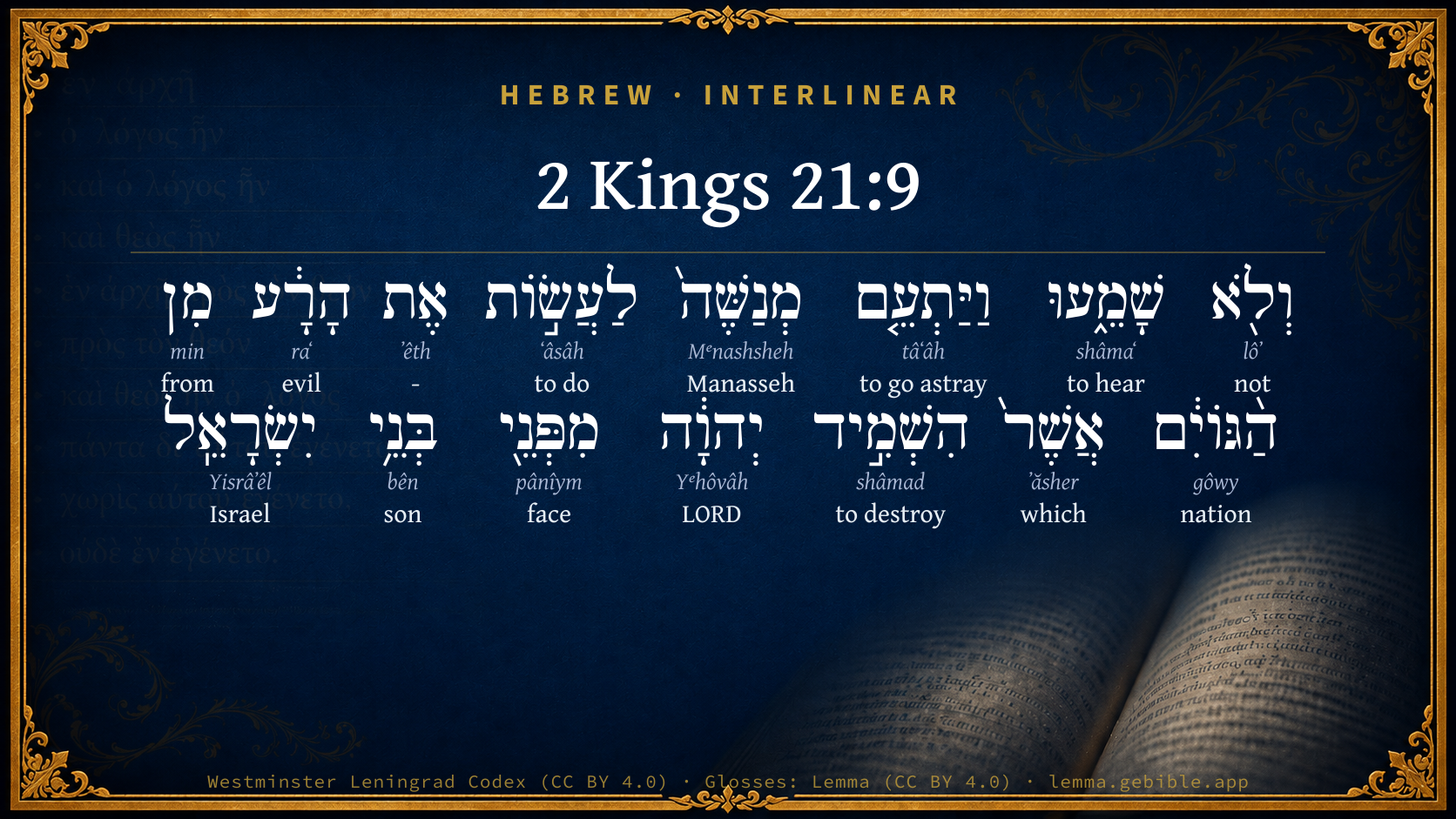
2 Kings 21:9

Hebrew (Westminster Leningrad Codex) 2 Kings 21:9 appears in the Hebrew Old Testament. The text above is from the Westminster Leningrad Codex. Each word links to its Strong’s number, a concise gloss, and parsing drawn from the Open Scriptures Hebrew Bible morphology. Click any word for its full Brown-Driver-Briggs (BDB) entry.
Download image
Cite this verse

2 Kings 21:9 (World English Bible). Public Domain. Lemma interlinear Bible study tool, https://lemma.gebible.app/v/2-kings/21/9.

Show BibTeX & RIS
BibTeX
RIS
English Translation
But they didn't listen: and Manasseh seduced them to do that which is evil more than did the nations whom Yahweh destroyed before the children of Israel.
World English Bible · Public Domain
Download a study sheet

One document with this verse’s original text, its word-by-word gloss line, the meaning frame, cross-references with their text, attributed commentary, and full source and license credits — printable, and it pastes into notes with its structure intact.

This verse Autodidact and up

Study sheet (.html) Plain text (.txt)

A passage Seminary Student

Up to 50 verses in one chapter. A passage sheet keeps up to 6 commentary sources and 12 cross-references per verse, in the order this page ranks them, and says so on the sheet whenever that leaves anything out. Ask for a single verse and you get the Autodidact verse sheet above.

Everything on this page stays free to read, with no account — the sheet is a download of what is already on screen, not access to it.

Want to remove ads? Support Godless Engineer
Compare translations 3

The same verse in 3 English versions, stacked beneath the original-language interlinear above. Click any original word for its lexicon entry.

Each is an independent rendering of the whole verse — the interlinear is not word-aligned to these translations.

Highlighted words mark where these versions differ — a whole-verse word diff, not a word-by-word alignment.

  • World English Bible Public Domain
    But they didn't listen: and Manasseh seduced them to do that which is evil more than did the nations whom Yahweh destroyed before the children of Israel.
  • King James Version Public Domain
    But they hearkened not: and Manasseh seduced them to do more evil than did the nations whom the LORD destroyed before the children of Israel.
  • unfoldingWord Literal Text CC BY-SA 4.0
    But they were not careful, and Manasseh misled them to do more evil than the nations that Yahweh had destroyed from the face of the sons of Israel.

unfoldingWord Literal Text — © unfoldingWord, licensed CC BY-SA 4.0. Word-aligned USFM3 via Door43 (git.door43.org/unfoldingWord/en_ult).

Versions to compare (up to 4)

3 of 4 selected

Show all 18 translations

Every available English version of this verse, each an independent rendering of the whole verse.

  • World English Bible Public Domain
    But they didn't listen: and Manasseh seduced them to do that which is evil more than did the nations whom Yahweh destroyed before the children of Israel.
  • Berean Standard Bible Public Domain
    But the people did not listen and Manasseh led them astray, so that they did greater evil than the nations that the LORD had destroyed before the Israelites.
  • Majority Standard Bible Public Domain
    But the people did not listen and Manasseh led them astray, so that they did greater evil than the nations that the LORD had destroyed before the Israelites.
  • King James Version Public Domain
    But they hearkened not: and Manasseh seduced them to do more evil than did the nations whom the LORD destroyed before the children of Israel.
  • American Standard Version (1901) Public Domain
    But they hearkened not: and Manasseh seduced them to do that which is evil more than did the nations whom Jehovah destroyed before the children of Israel.
  • Revised Version (1885) Public Domain
    But they hearkened not: and Manasseh seduced them to do that which is evil more than did the nations, whom the LORD destroyed before the children of Israel.
  • Geneva Bible (1599) Public Domain
    Yet they obeyed not, but Manasseh ledde them out of the way, to doe more wickedly then did the heathen people, whom the Lord destroyed before the children of Israel.
  • Douay-Rheims (1899) Public Domain
    But they hearkened not: but were seduced by Manasses, to do evil more than the nations which the Lord destroyed before the children of Israel.
  • Young's Literal Translation Public Domain
    And they have not hearkened, and Manasseh causeth them to err, to do the evil thing above the nations that Jehovah destroyed from the presence of the sons of Israel.
  • Literal Standard Version CC BY-SA 4.0
    And they have not listened, and Manasseh causes them to err, to do evil above the nations that YHWH destroyed from the presence of the sons of Israel.
  • Unlocked Literal Bible CC BY-SA 4.0
    But the people did not listen, and Manasseh led them to do evil even more than the nations that Yahweh had destroyed before the people of Israel.
  • unfoldingWord Literal Text CC BY-SA 4.0
    But they were not careful, and Manasseh misled them to do more evil than the nations that Yahweh had destroyed from the face of the sons of Israel.
  • Darby Bible Public Domain
    But they would not hearken, and Manasseh led them astray to do more evil than the nations that Jehovah had destroyed from before the children of Israel.
  • World Messianic Bible Public Domain
    But they didn’t listen, and Manasseh seduced them to do that which is evil more than the nations did whom the LORD destroyed before the children of Israel.
  • Webster's Bible Public Domain
    But they hearkened not: and Manasseh seduced them to do more evil than did the nations whom the LORD destroyed before the children of Israel.
  • Free Bible Version CC BY-SA 4.0
    The people refused to listen and Manasseh led them to sin so that the evil they did was even worse than the nations the Lord had destroyed before the Israelites.
  • Bible in Basic English Public Domain
    But they did not give ear; and Manasseh made them do more evil than those nations did, whom the Lord gave up to destruction before the children of Israel.
  • JPS Tanakh (1917) Public Domain
    But they hearkened not; and Manasseh seduced them to do that which is evil more than did the nations, whom the LORD destroyed before the children of Israel.

Literal Standard Version (2020), Covenant Press — licensed CC BY-SA 4.0. Text via the HelloAO Bible API (eBible.org). Unlocked Literal Bible (unfoldingWord) — licensed CC BY-SA 4.0. Text via the HelloAO Bible API (eBible.org). unfoldingWord Literal Text — © unfoldingWord, licensed CC BY-SA 4.0. Word-aligned USFM3 via Door43 (git.door43.org/unfoldingWord/en_ult). Free Bible Version, Dr. Jonathan Gallagher — licensed CC BY-SA 4.0. Text via the HelloAO Bible API (eBible.org).

Word by word

More ways to search: Search by grammar → Find every occurrence → Compare this word →

Practice this passage: Drill this verse → Learn its vocabulary →

וַיַּתְעֵ֤ם
tâʻâh
H8582
“and · to go astray · them”
Conjunction + Verb, Hiphil, Sequential Imperfect, 3rd Person, Masculine, Singular + Suffix, Personal, 3rd Person, Masculine, Plural
Part of Speech
Conjunction + Verb
Stem
Hiphil
Form
Sequential Imperfect
Person
3rd Person
Gender
Masculine
Number
Singular
Full BDB Definition

Origin: a primitive root

TWOT: 2531

to err, wander, go astray, stagger - (Qal) to err - to wander about (physically) - of intoxication - of sin (ethically) - wandering (of the mind) - (Niphal) - to be made to wander about, be made to stagger (drunkard) - to be led astray (ethically) - (Hiphil) to cause to wander - to cause to wander about (physically) - to cause to wander (of intoxication) - to cause to err, mislead (mentally and morally)
  1. וְלֹ֖א lôʼ H3808 “and · not” Conjunction + Particle, Negative
  2. שָׁמֵ֑עוּ shâmaʻ H8085 “to hear” Verb, Qal, Perfect, 3rd Person, Common, Plural
  3. מְנַשֶּׁה֙ Mᵉnashsheh H4519 “Manasseh” Noun, Proper
  4. לַעֲשׂ֣וֹת ʻâsâh H6213 “to do” Preposition + Verb, Qal, Infinitive Construct
  5. אֶת ʼêth H853 “-” Particle, Direct Object
  6. הָרָ֔ע raʻ H7451 “the · evil” Particle, Definite Article + Adjective, Adjective, Masculine, Singular, Absolute
  7. מִן min H4480 “from” Preposition
  8. הַ֨גּוֹיִ֔ם gôwy H1471 “the · nations” Particle, Definite Article + Noun, Common, Masculine, Plural, Absolute
  9. אֲשֶׁר֙ ʼăsher H834 “which” Particle, Relative
  10. הִשְׁמִ֣יד shâmad H8045 “to destroy” Verb, Hiphil, Perfect, 3rd Person, Masculine, Singular
  11. יְהוָ֔ה Yᵉhôvâh H3068 “LORD” Noun, Proper
  12. מִפְּנֵ֖י pânîym H6440 “from · face(s) of” Preposition + Noun, Common, Both, Plural, Construct
  13. בְּנֵ֥י bên H1121 “sons of” Noun, Common, Masculine, Plural, Construct
  14. יִשְׂרָאֵֽל Yisrâʼêl H3478 “Israel” Noun, Proper

About this verse

These counts appear in no published source. They are computed here, from the morphology-tagged text and Lemma’s own curated glosses. What Lemma adds →

15
words
15
distinct lemmas
Historical
section

Shared distinctive vocabulary

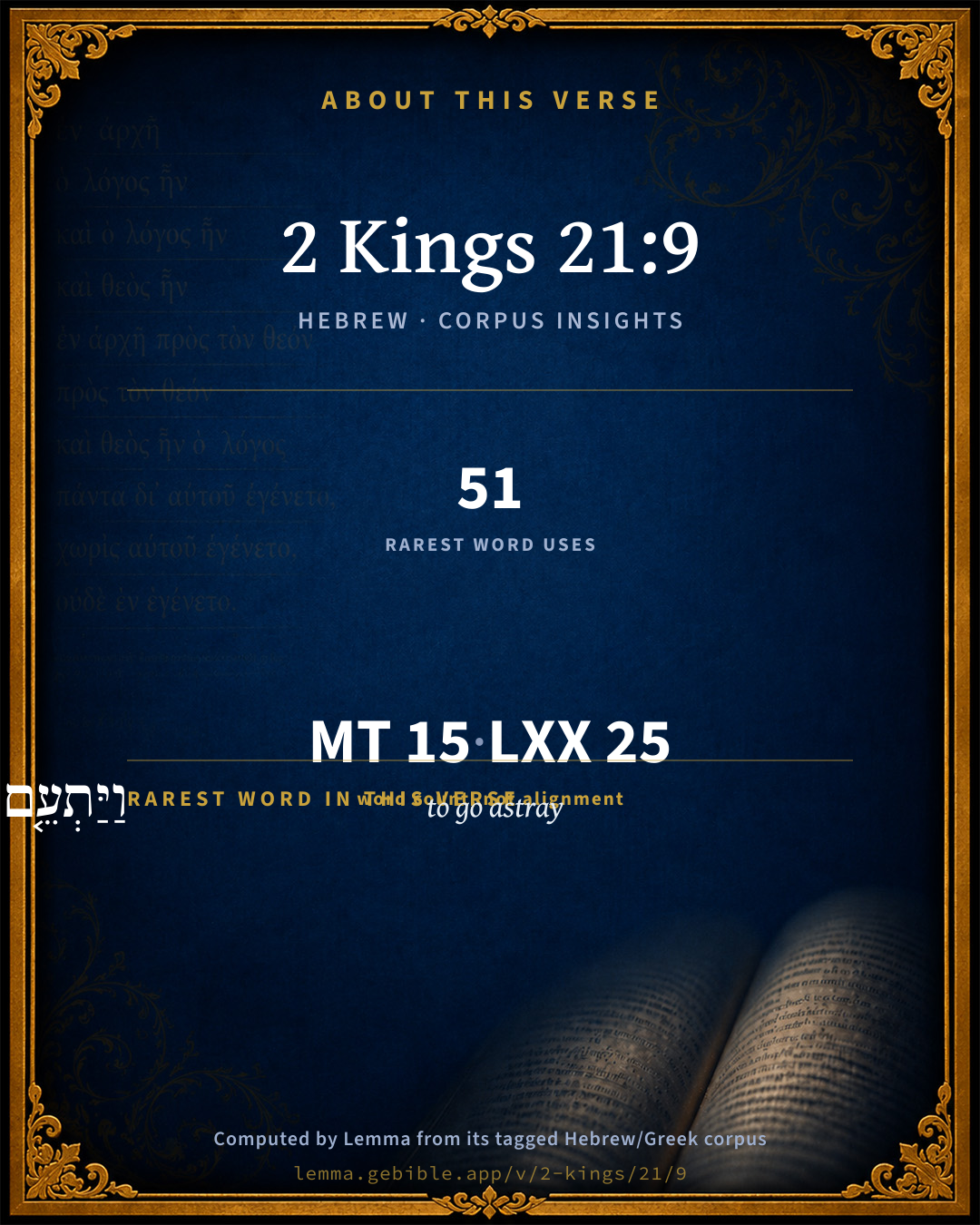
וַיַּתְעֵ֤ם to go astray H8582 occurs in 45 verses of the Hebrew Bible. Also found in:

Grammatical profile

  • 4 verbs
  • 6 nouns
  • 1 adjective
  • 1 preposition
  • 3 particles

Verb forms

  • שָׁמֵ֑עוּ Qal · Perfect
  • וַיַּתְעֵ֤ם Hiphil · Sequential Imperfect
  • לַעֲשׂ֣וֹת Qal · Infinitive Construct
  • הִשְׁמִ֣יד Hiphil · Perfect

Hebrew & Septuagint length

In English translation the verse runs 27 words from the Hebrew and 32 from the Septuagint (LXX English) — closely comparable.

A rough comparison of the two English renderings, which tokenize alike — not a word-level alignment.

Word counts can differ between the Hebrew and the Greek without any difference in meaning — e.g. the Hebrew direct-object marker אֵת has no separate Greek word, and Greek often adds the article ὁ.

In the original languages it is 15 Hebrew tokens and 25 Greek tokens — but the two are counted differently (Hebrew bundles its prefixes and suffixes into one token; the Greek is in lemma form), so that isn’t a like-for-like length.

Cross-references

18

Topical passages linked to 2 Kings 21:9 in the Treasury of Scripture Knowledge — connected by theme and wording, ordered by reader-vote popularity; previews shown in the World English Bible.

  • Proverbs 29:12 If a ruler listens to lies, All of his officials are wicked.
  • 1 Kings 14:16 He will give Israel up because of the sins of Jeroboam, which he has sinned, and with which he has made Israel to sin.
  • 2 Chronicles 33:9 Manasseh seduced Judah and the inhabitants of Jerusalem, so that they did evil more than did the nations whom Yahweh destroyed before the children of Israel.
  • 2 Chronicles 36:16 but they mocked the messengers of God, and despised his words, and scoffed at his prophets, until the wrath of Yahweh arose against his people, until there was no remedy.
  • Nehemiah 9:26 Nevertheless they were disobedient, and rebelled against you, and cast your law behind their back, and killed your prophets that testified against them to turn them again to you, and they committed awful blasphemies.
  • Nehemiah 9:29–30 and testified against them, that you might bring them again to your law. Yet they dealt proudly, and didn't listen to your commandments, but sinned against your ordinances, (which if a man do, he shall live in them), and withdrew the shoulder, and hardened their neck, and would not hear.
  • Ezekiel 16:51–52 Neither has Samaria committed half of your sins; but you have multiplied your abominations more than they, and have justified your sisters by all your abominations which you have done.
  • Daniel 9:6 neither have we listened to your servants the prophets, who spoke in your name to our kings, our princes, and our fathers, and to all the people of the land.
  • Daniel 9:10–11 neither have we obeyed the voice of Yahweh our God, to walk in his laws, which he set before us by his servants the prophets.
  • Hosea 5:11 Ephraim is oppressed, He is crushed in judgment; Because he is intent in his pursuit of idols.
  • Luke 13:34 "Jerusalem, Jerusalem, that kills the prophets, and stones those who are sent to her! How often I wanted to gather your children together, like a hen gathers her own brood under her wings, and you refused!
  • John 15:22 If I had not come and spoken to them, they would not have had sin; but now they have no excuse for their sin.
  • James 4:17 To him therefore who knows to do good, and doesn't do it, to him it is sin.
  • Revelation 2:20 But I have this against you, that you tolerate your woman, Jezebel, who calls herself a prophetess. She teaches and seduces my servants to commit sexual immorality, and to eat things sacrificed to idols.
  • Ezra 9:10–11 Now, our God, what shall we say after this? for we have forsaken your commandments,
  • Psalms 12:8 The wicked walk on every side, When what is vile is exalted among the sons of men.
  • Psalms 81:10 I am Yahweh, your God, Who brought you up out of the land of Egypt. Open your mouth wide, and I will fill it.
  • Ezekiel 16:47 Yet have you not walked in their ways, nor done after their abominations; but, as [if that were] a very little [thing], you were more corrupt than they in all your ways.

Cross-references courtesy of OpenBible.info (CC BY 4.0).

Hebrew and Greek witnesses Masoretic Hebrew ↔ Greek Septuagint

The same verse in the two great witnesses to the Old Testament, shown verse-for-verse.

These are two independent witnesses, not word-aligned to each other, and the Septuagint is shown in lemma (dictionary) form.

Hebrew 2 Kings 21:9 Masoretic · Westminster Leningrad Codex

וְלֹ֖א שָׁמֵ֑עוּ וַיַּתְעֵ֤ם מְנַשֶּׁה֙ לַעֲשׂ֣וֹת אֶת הָרָ֔ע מִן הַ֨גּוֹיִ֔ם אֲשֶׁר֙ הִשְׁמִ֣יד יְהוָ֔ה מִפְּנֵ֖י בְּנֵ֥י יִשְׂרָאֵֽל

But they didn't listen: and Manasseh seduced them to do that which is evil more than did the nations whom Yahweh destroyed before the children of Israel.

World English Bible · Public Domain

Greek LXX 2 Kings 21:9 Septuagint · lemma form

καί οὐ ἀκούω καί πλανάω αὐτός μανασσῆς ὁ ποιέω ὁ πονηρός ἐν ὀφθαλμός κύριος ὑπέρ ὁ ἔθνος ὅς ἀπο ἀναἵζω κύριος ἐκ πρόσωπον υἱός ἰσραήλ

But they listened not; and Manasses led them astray to do evil in the sight of the Lord, beyond the nations whom the Lord utterly destroyed from before the children of Israel.

LXX2012 (modern English Septuagint) · Public Domain

On this verse, Ellicott's Commentary for English Readers discusses the Septuagint’s reading. Read the note in Commentary ↓

Hebrew: Westminster Leningrad Codex (CC BY 4.0). Greek: Septuagint (public domain); English from LXX2012 (modern English Septuagint) (Public Domain). How the Septuagint differs from the Hebrew →

Targum (Aramaic paraphrase)

1

The Targum is the ancient Jewish Aramaic paraphrase of the Hebrew Scriptures — an interpretive translation, not the Hebrew text itself. Onkelos (literal) and Pseudo-Jonathan (expansive) render the Torah, and Jonathan the Prophets. Coverage is partial: where no permissively-licensed English translation exists for a verse, only the Aramaic is shown. This is verse-level text, not a word-by-word alignment to the Hebrew.

  1. Targum Jonathan Prophets (Joshua–Malachi)
    וְלָא קַבִּילוּ וְאַטְעִינוּן מְנַשֶׁה לְמֶעְבַּד יַת דְבִישׁ מִן עַמְמַיָא דְשֵׁיצֵי יְיָ מִן קֳדָם בְּנֵי יִשְׂרָאֵל:

    (no public-domain English translation for this verse)

    Targum Jonathan — Aramaic: “Mikraot Gedolot” (public domain). English: “Sefaria Community Translation” (CC0 1.0 (public-domain dedication)); “London "Chaldee Paraphrase," 1871” (public domain). Text via Sefaria.

Commentary

Notes on 2 Kings 21:9 from classic Christian and Jewish commentators (each source and its license shown beneath its notes). The classic Christian expositions comment on the surrounding passage and are grouped to its opening verse, so a note may address several verses; the Jewish commentaries on the Tanakh (Rashi and others) are per-verse, so they appear only where the commentator wrote on this verse.

Lemma curates 59 commentaries, every one of them public domain or Creative Commons licensed, each selected and text-cleaned for this edition rather than reprinted as found. About our sources →

Trapp's Complete Commentary

John Trapp

2Ki 21:9 But they hearkened not: and Manasseh seduced them to do more evil than did the nations whom the LORD destroyed before the children of Israel.

Ver. 9. But they hearkened not.] Nothing is more stupid than idolaters; they have ears but hear not, &c.

To do more evil than did the nations.] Whom they out-sinned: and were therefore worse than heathens, because they should have been better.

John Trapp, A Commentary or Exposition upon All the Books of the Old and New Testament (1647–1656) — public domain. Text from a community e-Sword module.

Joseph Benson's Commentary

2Ki 21:9-10. Manasseh seduced them to do more evil than the nations, &c. — Partly, because they were not contented with those idols which the Canaanites worshipped, but either invented, or borrowed from other nations, many new idols; and partly, because as their light was far more clear, their obligations to God infinitely higher, and their helps against idolatry much stronger than the Canaanites had; so that their sins, though the same in kind, were unspeakably worse in respect of these dreadful aggravations. The Lord spake by his servants the prophets — Abarbinel says, that Hosea, Joel, Nahum, and Habakkuk, all prophesied in his days: and some think Obadiah also, and Isaiah.

Joseph Benson's Commentary on the Old and New Testaments (1811–1818) — public domain. Text from a community e-Sword module.

Adam Clarke's Commentary

Verse 9. Seduced them to do more evil] He did all he could to pervert the national character, and totally destroy the worship of the true God; and he succeeded.

Adam Clarke's Commentary on the Bible (1810–1826) — public domain. Text from a community e-Sword/MySword module.

Ellicott's Commentary for English Readers

(9) Seduced them.—Led them astray. Chronicles renders the same verb made them to err.

To do more evil.—To do the evil more . . . The LXX. adds: “in the eyes of Jehovah.” The idolatry of Judah was worse than that of the Canaanites, because they worshipped only their national gods, whereas Judah forsook its own God and was ready to adopt almost any foreign cultus with which it was brought into contact (Jer_2:11).

A Bible Commentary for English Readers, edited by Charles John Ellicott (1878–1897) — public domain. Text from a community e-Sword module.

The Cambridge Bible for Schools and Colleges

gen. ed. J. J. S. Perowne

9. Manasseh seduced them to do more evil than &c.] R.V. to do that which is evil more than, &c. The R.V. represents the Hebrew more closely. The phrase in Chronicles is ‘to err and to do worse than the heathen’. For Judah sinned against light and knowledge.

The Cambridge Bible for Schools and Colleges (gen. ed. J. J. S. Perowne; Cambridge University Press, 1878–1918) — public domain. Text from a community e-Sword module.

John Gill's Exposition

But they hearkened not,.... To the voice of God in his law by Moses, and were not obedient to it:

and Manasseh seduced them to do more evil than did the nations whom the Lord destroyed before the children of Israel: he set up more idols, and drew the people into more and greater idolatries, than the old Canaanites; and these were the more aggravated by having a law given to them, and prophets sent to instruct them in it, and by the benefits and blessings bestowed upon them by the lawgiver, which laid them under greater obligations to him; see Jer 2:11.

John Gill's Exposition of the Whole Bible (1746–1763) — public domain (CC PDM 1.0). Text via the HelloAO Bible API.

Albert Barnes' Notes on the Bible

During the long reign of Manasseh idolatry in all manner of varied forms took a hold upon the Jewish people such as had never been known before. Compare Jer 7:18, Jer 7:31; Eze 23:37; Zep 1:5. The corruption of morals kept pace with the degradation of religion. Compare 2Ki 23:7; Zep 3:1-3; Jer 2:8; Jer 5:1.

Albert Barnes' Notes on the Bible (1834–1885) — public domain. Text from a community e-Sword/MySword module.

Haydock's Catholic Bible Commentary

More, because they had received more favours and instructions from above. (Worthington)

George Leo Haydock (1774–1849), Haydock's Catholic Family Bible and Commentary, 1859 edition — public domain. Excludes Psalms (Douay-Rheims chapter numbering differs from Protestant) and Deuterocanonical books (Catholic canon only).

Matthew Poole's English Annotations

Partly because they were not contented with those idols which the Canaanites worshipped, but either themselves invented, or they borrowed from other nations, many new idols and kinds of idolatry; and partly because as their light was far more clear, their obligations to God infinitely higher, and their helps and antidotes against idolatry much stronger than the Canaanites had; so their sins, though the same in kind, were unspeakably worse in respect of these dreadful aggravations.

Matthew Poole's English Annotations on the Holy Bible (1683–1685) — public domain. Text from a community e-Sword/MySword module.

Whedon's Commentary on the Bible

Daniel D. Whedon

9. More evil than did the nations — Because the worship of their own false gods by nations who knew not the true God, was far less condemnatory than for Israel, who had received so many revelations of Jehovah, to turn aside to the worship of idols.

Daniel D. Whedon (gen. ed.), Commentary on the Old and New Testaments (1874–1909) — public domain. Text from a community e-Sword module.

The Pulpit Commentary

But they hearkened not. The people, and not Manasseh alone, were disobedient. Had they remained faithful, Manasseh"s sin would not have affected their future. And Manasseh seduced them. The influence of a young and gay king, always great, is in the East immense. When such a king succeeds one of strict and rind principles, he easily carries away the multitude with him, and leads them on to any excess of profligacy and irreligion. The beginnings of sin are delightful, and the votaries of pleasure, readily beguiled into evil courses, know not where to stop. Manasseh seduced them, we are told, to do more evil than did the nations whom the Lord destroyed before the children of Israel; that is, than the Hivites, Hittites, Amorites, Canaanites, Perizzites, Gergashites, and Jebusites. (Deu_7:1, etc.) The sin of Israel exceeded that of the Canaanitish nations, not so much in any outward and tangible features, as in the fact that it was committed against light, in spite of the Law, and against all the warnings and denunciations of the prophets. (comp. 2Ki_17:13, 2Ki_17:14)

The Pulpit Commentary (1880–1919), ed. H.D.M. Spence-Jones & Joseph S. Exell — public domain. Text from a community e-Sword module.

John Wesley's Explanatory Notes

More evil - Partly, because they were not contented with those idols which the Canaanites worshipped, but either invented, or borrowed from other nations many new idols, and partly, because as their light was far more clear, their obligations to God infinitely higher, and their helps against idolatry much stronger than the Canaanites had; so their sins, though the same in kind, were unspeakably worse in respect of these dreadful aggravations.

John Wesley, Explanatory Notes Upon the Whole Bible (1754–1765) — public domain. Text via the GEBible commentary corpus.

Lesson kit

Teaching starters — assembled from the data on this page, not authored interpretation. Every prompt links to the verse data it draws on. Edit before teaching.

2 Kings, in the Historical, opens this verse with 15 words (15 distinct Hebrew lemmas). Its most distinctive word is tâʻâh (“to go astray”). A historical commentator’s framing appears above. Read the whole chapter for the surrounding context.

Discussion questions

  1. How does “to go astray” (tâʻâh) shape what this verse is saying?
  2. Genesis 20:13 shares the word «to go astray» with this verse. How do the two illuminate each other?
  3. These translations render this verse differently. What is at stake in choosing one wording over another?
  4. The verb «שָׁמֵ֑עוּ» is Qal Perfect. How does its form color the action?
  5. Reading how Trapp's Complete Commentary and Joseph Benson's Commentary read this verse, where do the two commentators agree and where do they part?

Things to notice

Reading settings

Reading text

Shown beneath each verse's original-language words.

Old Testament
Old Testament edition

Read the OT as the Masoretic Hebrew (MT) or the Greek Septuagint (LXX).

English shown for the Greek Septuagint (in the Hebrew ↔ Greek comparison).

Comparing translations? Open the Compare panel on any verse page to stack up to four side by side.