
Psalms 106:35

Hebrew (Westminster Leningrad Codex) Psalms 106:35 appears in the Hebrew Old Testament. The text above is from the Westminster Leningrad Codex. Each word links to its Strong’s number, a concise gloss, and parsing drawn from the Open Scriptures Hebrew Bible morphology. Click any word for its full Brown-Driver-Briggs (BDB) entry.
Download image
Cite this verse

Psalms 106:35 (World English Bible). Public Domain. Lemma interlinear Bible study tool, https://lemma.gebible.app/v/psalms/106/35.

Show BibTeX & RIS
BibTeX
RIS
English Translation
But mixed themselves with the nations, And learned their works.
World English Bible · Public Domain
Download a study sheet

One document with this verse’s original text, its word-by-word gloss line, the meaning frame, cross-references with their text, attributed commentary, and full source and license credits — printable, and it pastes into notes with its structure intact.

This verse Autodidact and up

Study sheet (.html) Plain text (.txt)

A passage Seminary Student

Up to 50 verses in one chapter. A passage sheet keeps up to 6 commentary sources and 12 cross-references per verse, in the order this page ranks them, and says so on the sheet whenever that leaves anything out. Ask for a single verse and you get the Autodidact verse sheet above.

Everything on this page stays free to read, with no account — the sheet is a download of what is already on screen, not access to it.

Want to remove ads? Support Godless Engineer
Compare translations 3

The same verse in 3 English versions, stacked beneath the original-language interlinear above. Click any original word for its lexicon entry.

Each is an independent rendering of the whole verse — the interlinear is not word-aligned to these translations.

Highlighted words mark where these versions differ — a whole-verse word diff, not a word-by-word alignment.

  • World English Bible Public Domain
    But mixed themselves with the nations, And learned their works.
  • King James Version Public Domain
    But were mingled among the heathen, and learned their works.
  • unfoldingWord Literal Text CC BY-SA 4.0
    but they mingled with the nations and learned their ways

unfoldingWord Literal Text — © unfoldingWord, licensed CC BY-SA 4.0. Word-aligned USFM3 via Door43 (git.door43.org/unfoldingWord/en_ult).

Versions to compare (up to 4)

3 of 4 selected

Show all 18 translations

Every available English version of this verse, each an independent rendering of the whole verse.

  • World English Bible Public Domain
    But mixed themselves with the nations, And learned their works.
  • Berean Standard Bible Public Domain
    but they mingled with the nations and adopted their customs.
  • Majority Standard Bible Public Domain
    but they mingled with the nations and adopted their customs.
  • King James Version Public Domain
    But were mingled among the heathen, and learned their works.
  • American Standard Version (1901) Public Domain
    But mingled themselves with the nations, And learned their works,
  • Revised Version (1885) Public Domain
    But mingled themselves with the nations, and learned their works:
  • Geneva Bible (1599) Public Domain
    But were mingled among the heathen, and learned their workes,
  • Douay-Rheims (1899) Public Domain
    And they were mingled among the heathens, and learned their works:
  • Young's Literal Translation Public Domain
    And mix themselves among nations, and learn their works,
  • Literal Standard Version CC BY-SA 4.0
    And mix themselves among nations, and learn their works,
  • Unlocked Literal Bible CC BY-SA 4.0
    but they mingled with the nations and learned their ways
  • unfoldingWord Literal Text CC BY-SA 4.0
    but they mingled with the nations and learned their ways
  • Darby Bible Public Domain
    But they mingled with the nations, and learned their works;
  • World Messianic Bible Public Domain
    but mixed themselves with the nations, and learned their works.
  • Webster's Bible Public Domain
    But were mingled among the heathen, and learned their works.
  • Free Bible Version CC BY-SA 4.0
    but instead they joined in with them and adopted their way of life.
  • Bible in Basic English Public Domain
    But they were joined to the nations, learning their works.
  • JPS Tanakh (1917) Public Domain
    But mingled themselves with the nations, and learned their works;

Literal Standard Version (2020), Covenant Press — licensed CC BY-SA 4.0. Text via the HelloAO Bible API (eBible.org). Unlocked Literal Bible (unfoldingWord) — licensed CC BY-SA 4.0. Text via the HelloAO Bible API (eBible.org). unfoldingWord Literal Text — © unfoldingWord, licensed CC BY-SA 4.0. Word-aligned USFM3 via Door43 (git.door43.org/unfoldingWord/en_ult). Free Bible Version, Dr. Jonathan Gallagher — licensed CC BY-SA 4.0. Text via the HelloAO Bible API (eBible.org).

Word by word

More ways to search: Search by grammar → Find every occurrence → Compare this word →

Practice this passage: Drill this verse → Learn its vocabulary →

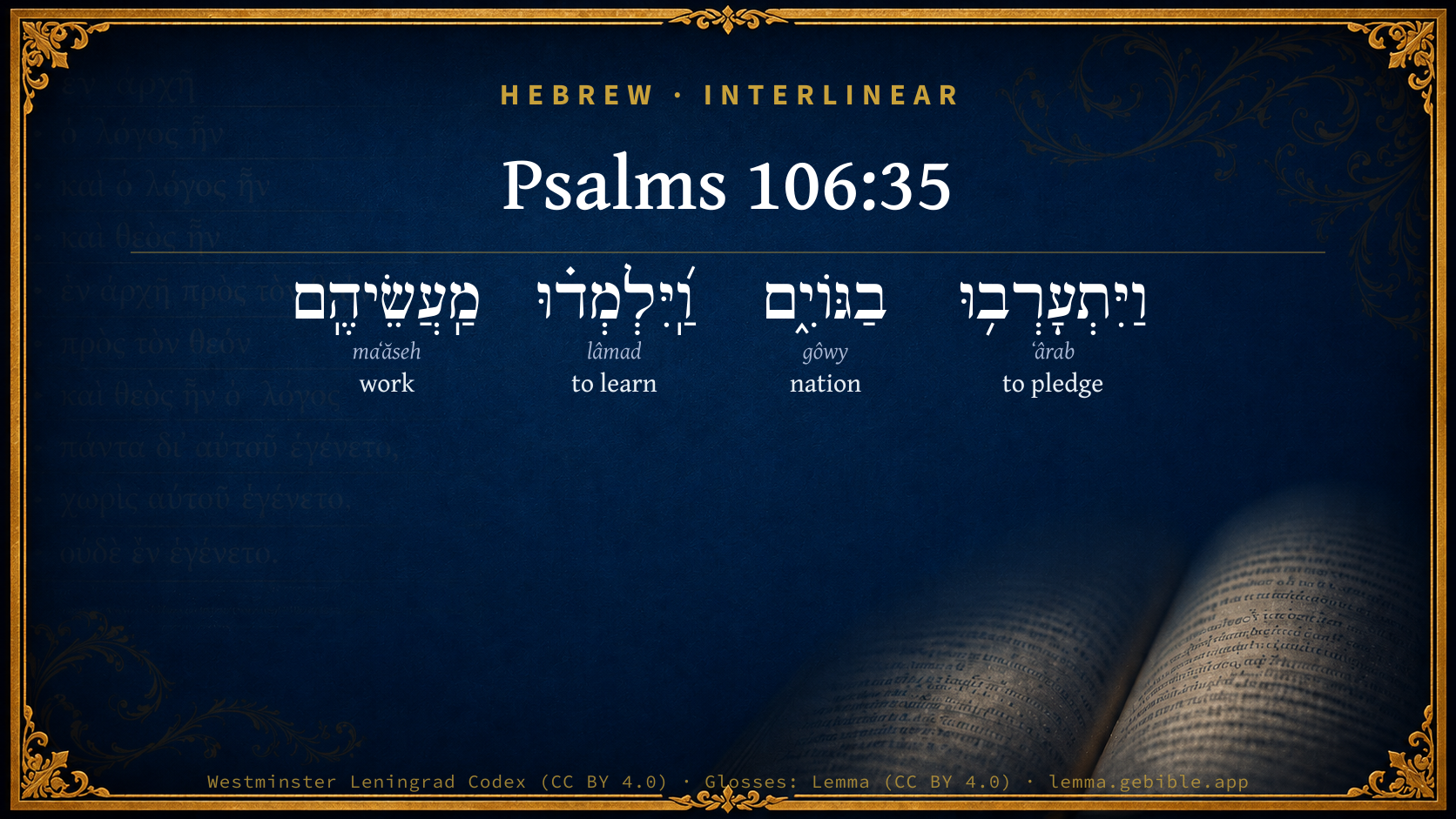
וַיִּתְעָרְב֥וּ
ʻârab
H6148
“and · to pledge”
Conjunction + Verb, Hithpael, Sequential Imperfect, 3rd Person, Masculine, Plural
Part of Speech
Conjunction + Verb
Stem
Hithpael
Form
Sequential Imperfect
Person
3rd Person
Gender
Masculine
Number
Plural
Full BDB Definition

Origin: a primitive root

TWOT: 1686

to pledge, exchange, mortgage, engage, occupy, undertake for, give pledges, be or become surety, take on pledge, give in pledge - (Qal) - to take on pledge, go surety for - to give in pledge - to exchange - to pledge - (Hithpael) - to exchange pledges - to have fellowship with, share
  1. בַגּוֹיִ֑ם gôwy H1471 “in/at the · nations” Preposition, Determined + Noun, Common, Masculine, Plural, Absolute
  2. וַֽ֝יִּלְמְד֗וּ lâmad H3925 “and · to learn” Conjunction + Verb, Qal, Sequential Imperfect, 3rd Person, Masculine, Plural
  3. מַֽעֲשֵׂיהֶֽם maʻăseh H4639 “works · their” Noun, Common, Masculine, Plural, Construct + Suffix, Personal, 3rd Person, Masculine, Plural

About this verse

These counts appear in no published source. They are computed here, from the morphology-tagged text and Lemma’s own curated glosses. What Lemma adds →

4
words
4
distinct lemmas
Wisdom
section

Notable vocabulary

The rarest word here is וַיִּתְעָרְב֥וּ to pledge H6148 — appearing just 23 times in the whole Hebrew Bible.

Shared distinctive vocabulary

וַיִּתְעָרְב֥וּ to pledge H6148 occurs in 23 verses of the Hebrew Bible. Also found in:

Grammatical profile

  • 2 verbs
  • 2 nouns

Verb forms

  • וַיִּתְעָרְב֥וּ Hithpael · Sequential Imperfect
  • וַֽ֝יִּלְמְד֗וּ Qal · Sequential Imperfect

Hebrew & Septuagint length

In English translation the verse runs 10 words from the Hebrew and 10 from the Septuagint (LXX English) — the same length.

A rough comparison of the two English renderings, which tokenize alike — not a word-level alignment.

Word counts can differ between the Hebrew and the Greek without any difference in meaning — e.g. the Hebrew direct-object marker אֵת has no separate Greek word, and Greek often adds the article ὁ.

Cross-references

7

Topical passages linked to Psalms 106:35 in the Treasury of Scripture Knowledge — connected by theme and wording, ordered by reader-vote popularity; previews shown in the World English Bible.

  • Judges 3:5–6 The children of Israel lived among the Canaanites, the Hittites, and the Amorites, and the Perizzites, and the Hivites, and the Jebusites:
  • 1 Corinthians 15:33 Don't be deceived! "Evil companionships corrupt good morals."
  • 1 Corinthians 5:6 Your boasting is not good. Don't you know that a little yeast leavens the whole lump?
  • Judges 1:27–36 Manasseh did not drive out [the inhabitants of] Beth-shean and its towns, nor [of] Taanach and its towns, nor the inhabitants of Dor and its towns, nor the inhabitants of Ibleam and its towns, nor the inhabitants of Megiddo and its towns; but the Canaanites would dwell in that land.
  • Judges 2:2–3 and you shall make no covenant with the inhabitants of this land; you shall break down their altars. But you have not listened to my voice: why have you done this?
  • Isaiah 2:6 For you have forsaken your people, the house of Jacob, Because they are filled from the east, With those who practice divination like the Philistines, And they clasp hands with the children of foreigners.
  • Joshua 15:63 As for the Jebusites, the inhabitants of Jerusalem, the children of Judah couldn't drive them out: but the Jebusites dwell with the children of Judah at Jerusalem to this day.

Cross-references courtesy of OpenBible.info (CC BY 4.0).

Hebrew and Greek witnesses Masoretic Hebrew ↔ Greek Septuagint

The same verse in the two great witnesses to the Old Testament, shown verse-for-verse.

You’re reading Greek Psalm 105 (Hebrew Psalm 106). The Septuagint counts the superscription, so verse numbers can differ from the Hebrew — chapter-level alignment, not verse-by-verse. Numbering follows Rahlfs.

These are two independent witnesses, not word-aligned to each other, and the Septuagint is shown in lemma (dictionary) form.

Hebrew Psalms 106:35 Masoretic · Westminster Leningrad Codex

וַיִּתְעָרְב֥וּ בַגּוֹיִ֑ם וַֽ֝יִּלְמְד֗וּ מַֽעֲשֵׂיהֶֽם

But mixed themselves with the nations, And learned their works.

World English Bible · Public Domain

Greek LXX Greek Psalm 105:35 Septuagint · lemma form

καί μίγνυμι ἐν ὁ ἔθνος καί μανθάνω ὁ ἔργον αὐτός

but were mingled with the heathen, and learned their works.

LXX2012 (modern English Septuagint) · Public Domain

Hebrew: Westminster Leningrad Codex (CC BY 4.0). Greek: Septuagint (public domain); English from LXX2012 (modern English Septuagint) (Public Domain). How the Septuagint differs from the Hebrew →

Commentary

Notes on Psalms 106:35 from classic Christian and Jewish commentators (each source and its license shown beneath its notes). The classic Christian expositions comment on the surrounding passage and are grouped to its opening verse, so a note may address several verses; the Jewish commentaries on the Tanakh (Rashi and others) are per-verse, so they appear only where the commentator wrote on this verse.

Lemma curates 59 commentaries, every one of them public domain or Creative Commons licensed, each selected and text-cleaned for this edition rather than reprinted as found. About our sources →

Trapp's Complete Commentary

John Trapp

Psa 106:35 But were mingled among the heathen, and learned their works.

Ver. 35. But were mingled among the heathen] With whom they made leagues and marriages, Jdg 1:3, and so were soon corrupted by them. It is dangerous to converse with graceless people, their very example is a compulsion; see Gal 2:14; how much more their evil counsel!

John Trapp, A Commentary or Exposition upon All the Books of the Old and New Testament (1647–1656) — public domain. Text from a community e-Sword module.

J. A. Alexander on Psalms

Joseph Addison Alexander

35. (Psa 106:35) And they mixed themselves with the nations and learned their doings. The reflexive verb at the beginning indicates an active and deliberate amal- gamation, as distinguished from a passive and involuntary one. The nations of the Canaanites, and those which inhabited surrounding countries. The primary idea is not that of gentiles or heathen, in the religious sense. Learned their doings or practices, learned to do as they did. With the first clause compare Jos 23:12-13, Jdg 3:6; with the second, Deu 18:9; Deu 20:18.

Joseph Addison Alexander, The Psalms Translated and Explained (1850) — public domain. Text from a community e-Sword module.

John Calvin's Commentaries

35 But were mingled He describes what was the result of this foolish humanity; namely, that they were defiled with the pollutions of the nations whom they had spared. Had they exclusively inhabited the land of Canaan, they would have more easily retained the pure worship of God. Allured by the influence of such neighbors, it is not wonderful that they soon degenerated from the footsteps of their fathers, for we are more inclined to follow the example of the bad than of the good. And now he speaks of the descendants of those who had so frequently provoked God’s anger in the wilderness, and declares, that as the same unbelief, rebellion, and ingratitude, were rampant in the succeeding race, they were no better than their fathers.

In mingling with the heathens they openly rejected the distinguishing loving-kindness of God, who adopted them as his children, under the express condition that they should be separated from these profane nations. Therefore, in associating with them indiscriminately, they render this holy covenant of no effect. When he adds, that they learned their works, he warns us, that nothing is more dangerous than associating with the ungodly; because, being more prone to follow vice than virtue, it cannot but be, that the more conversant we are with corruption, the more widely will it spread. In such circumstances, the utmost care and caution are requisite, lest the wicked, with whom we come into contact, infect us by their vitiated morals; and particularly where there is danger of relapsing into idolatry, to which we are all naturally prone. What, then, will be the effect produced upon us when instigated by others to commit sin, but to add sin to sin? The prophet, therefore, declares that the Jews were already so much under the tuition of the heathen as to abandon themselves to the practice of their idolatrous rites. In employing the word to serve, he confutes the contemptible evasion of the Papists, who pretend that they do not give to images the worship that is due to God alone, but only a sort of honorary adoration. But if the worshipping of images be lawful, the prophet had no sufficient cause to condemn his own nation for serving strange gods. Despicable, therefore, is the distinction, that Divine homage is to be paid to God alone, and that a kind of honorary adoration is to be given to images. He adds, that this issued in their overthrow, in order that their obstinate attachment to their follies, and their despising the chastisements of God, may more palpably appear.

John Calvin's Commentaries (1540-1563) — public domain. Text from the Calvin Translation Society English edition (1840s-50s) via the Christian Classics Ethereal Library (ccel.org). Calvin's coverage is partial (roughly two-thirds of the Bible); uncommented books and verses are honest gaps, never fabricated. The 19th-century editor's footnotes and remarks are omitted so the notes are faithfully Calvin's own voice.

The Cambridge Bible for Schools and Colleges

gen. ed. J. J. S. Perowne

35. But mingled themselves with the nations (R.V.), by matrimonial alliances (Ezr_9:2) and intercourse generally (Jdg_3:5-6).

The Cambridge Bible for Schools and Colleges (gen. ed. J. J. S. Perowne; Cambridge University Press, 1878–1918) — public domain. Text from a community e-Sword module.

John Gill's Exposition

But were mingled among the Heathen,.... Not only dwelt among them, but made covenants and contracts, carried on trade and commerce, and intermarried with them, contrary to the express law of God, Deu 7:2. Nor should saints have communion with wicked men, especially in things sinful and superstitious, Co2 6:14.

And learned their works; not their civil works and actions, their trades and business, but their idolatrous works; of which a detail is given in the following verses: "evil communications corrupt good manners", Co1 15:33.

John Gill's Exposition of the Whole Bible (1746–1763) — public domain (CC PDM 1.0). Text via the HelloAO Bible API.

Albert Barnes' Notes on the Bible

But were mingled among the heathen - Among the nations; by intermarriage, and by commerce. They suffered them to remain in the land, contrary to the command of God, and thus greatly exposed and endangered the purity of their religion and their own morals. See Jdg 2:2; Jdg 3:5-6.

And learned their works - Their practices; their customs and habits: learned to live as they did. This was an illustration of the danger of contact with the wicked and the worldly. What occurred in their case has often occurred since in the history of the people of God, that by “mingling” with the world they have learned to practice their “works;” have become conformed to their manner of living, and have thus lost their spirituality, and brought dishonor on the cause of religion. There is some proper sense in which the people of God are not to be conformed to the world; in which, though living among them, they are to be separate from them; in which, though they are parts of the same nation, and live under the same government and laws, they are to be a distinct and special people, ruled supremely by higher laws, and having higher and nobler ends of life. Rom 12:2; 2Co 6:14-17.

Albert Barnes' Notes on the Bible (1834–1885) — public domain. Text from a community e-Sword/MySword module.

Matthew Poole's English Annotations

Mingled in their habits and negotiations, as also in marriages.

Matthew Poole's English Annotations on the Holy Bible (1683–1685) — public domain. Text from a community e-Sword/MySword module.

The Treasury of David

Charles H. Spurgeon

Ver. 35. But were mingled among the heathen, and learned their works. It was not the wilderness which caused Israel's sins; they were just as disobedient when settled in the land of promise. They found evil company, and delighted in it. Those whom they should have destroyed they made their friends. Having enough faults of their own, they were yet ready to go to school to the filthy Canaanites, and educate themselves still more in the arts of iniquity. It was certain that they could learn no good from men whom the Lord had condemned to utter destruction. Few would wish to go to the condemned cell for learning, yet Israel sat at the feet of accursed Canaan, and rose up proficient in every abomination. This, too, is a grievous but common error among professors: they court worldly company and copy worldly fashions, and yet it is their calling to bear witness against these things. None can tell what evil has come of the folly of worldly conformity.

Psalms 106:36*

Charles H. Spurgeon's The Treasury of David (1869–1885) — public domain. Psalms only. Text from a community e-Sword/MySword module.

The Pulpit Commentary

But were mingled among the heathen, and learned their works. This was the effect of the continuous contact. "Evil communications corrupted good manners." The command to exterminate, which to moderns seems so terribly severe, and almost cruel, was undoubtedly based upon God"s foreknowledge of the fact, that otherwise there would be contact, and if contact, then contamination. (For the actual fact, see Jud 2:11-13, 19 3:6, 7 6:25 10:6, etc.)

The Pulpit Commentary (1880–1919), ed. H.D.M. Spence-Jones & Joseph S. Exell — public domain. Text from a community e-Sword module.

Lesson kit

Teaching starters — assembled from the data on this page, not authored interpretation. Every prompt links to the verse data it draws on. Edit before teaching.

Psalms, in the Wisdom, opens this verse with 4 words (4 distinct Hebrew lemmas). Its most distinctive word is ʻârab (“to pledge”). A historical commentator’s framing appears above. Read the whole chapter for the surrounding context.

Discussion questions

  1. How does “to pledge” (ʻârab) shape what this verse is saying?
  2. How does Genesis 43:9, which shares the word «to pledge», read alongside this verse?
  3. The translations on this page render this verse differently — a whole-verse word diff, not a word-by-word alignment. What might account for the different wordings?
  4. «וַיִּתְעָרְב֥וּ» is a Hithpael Sequential Imperfect verb. How does that grammatical form shape the action described?
  5. Compare how Trapp's Complete Commentary and J. A. Alexander on Psalms read this verse. Where do they agree or differ?

Things to notice

Reading settings

Reading text

Shown beneath each verse's original-language words.

Old Testament
Old Testament edition

Read the OT as the Masoretic Hebrew (MT) or the Greek Septuagint (LXX).

English shown for the Greek Septuagint (in the Hebrew ↔ Greek comparison).

Comparing translations? Open the Compare panel on any verse page to stack up to four side by side.