2 Kings 17:8

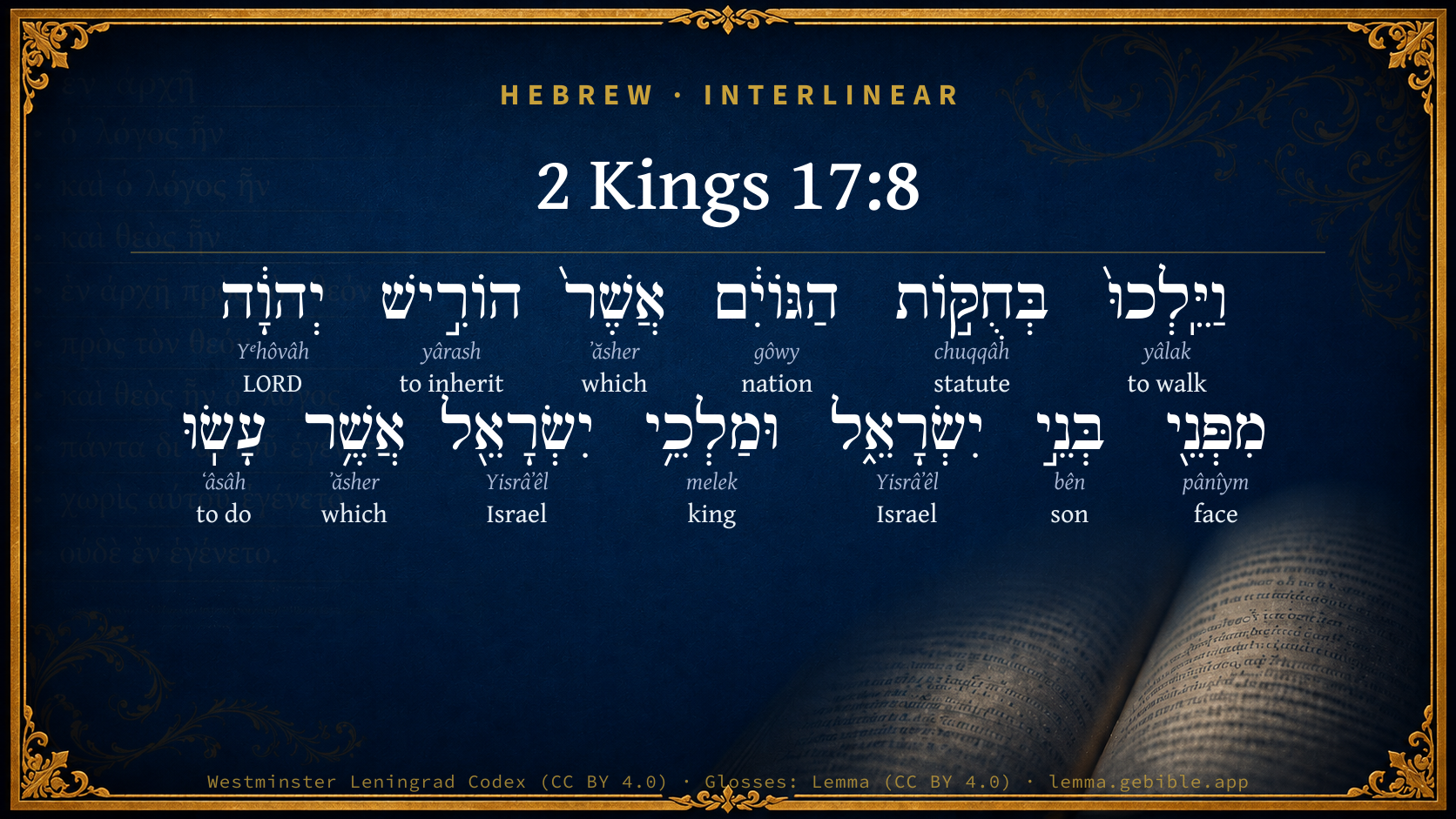
Hebrew (Westminster Leningrad Codex) 2 Kings 17:8 appears in the Hebrew Old Testament. The text above is from the Westminster Leningrad Codex. Each word links to its Strong’s number, a concise gloss, and parsing drawn from the Open Scriptures Hebrew Bible morphology. Click any word for its full Brown-Driver-Briggs (BDB) entry.
Download image
Cite this verse

2 Kings 17:8 (World English Bible). Public Domain. Lemma interlinear Bible study tool, https://lemma.gebible.app/v/2-kings/17/8.

Show BibTeX & RIS
BibTeX
RIS
English Translation
and walked in the statutes of the nations, whom Yahweh cast out from before the children of Israel, and of the kings of Israel, which they made.
World English Bible · Public Domain
Download a study sheet

One document with this verse’s original text, its word-by-word gloss line, the meaning frame, cross-references with their text, attributed commentary, and full source and license credits — printable, and it pastes into notes with its structure intact.

This verse Autodidact and up

Study sheet (.html) Plain text (.txt)

A passage Seminary Student

Up to 50 verses in one chapter. A passage sheet keeps up to 6 commentary sources and 12 cross-references per verse, in the order this page ranks them, and says so on the sheet whenever that leaves anything out. Ask for a single verse and you get the Autodidact verse sheet above.

Everything on this page stays free to read, with no account — the sheet is a download of what is already on screen, not access to it.

Want to remove ads? Support Godless Engineer
Compare translations 3

The same verse in 3 English versions, stacked beneath the original-language interlinear above. Click any original word for its lexicon entry.

Each is an independent rendering of the whole verse — the interlinear is not word-aligned to these translations.

Highlighted words mark where these versions differ — a whole-verse word diff, not a word-by-word alignment.

  • World English Bible Public Domain
    and walked in the statutes of the nations, whom Yahweh cast out from before the children of Israel, and of the kings of Israel, which they made.
  • King James Version Public Domain
    And walked in the statutes of the heathen, whom the LORD cast out from before the children of Israel, and of the kings of Israel, which they had made.
  • unfoldingWord Literal Text CC BY-SA 4.0
    and they walked in the statutes of the nations that Yahweh drove out from the face of the sons of Israel, and the kings of Israel that they did.

unfoldingWord Literal Text — © unfoldingWord, licensed CC BY-SA 4.0. Word-aligned USFM3 via Door43 (git.door43.org/unfoldingWord/en_ult).

Versions to compare (up to 4)

3 of 4 selected

Show all 18 translations

Every available English version of this verse, each an independent rendering of the whole verse.

  • World English Bible Public Domain
    and walked in the statutes of the nations, whom Yahweh cast out from before the children of Israel, and of the kings of Israel, which they made.
  • Berean Standard Bible Public Domain
    and walked in the customs of the nations that the LORD had driven out before the Israelites, as well as in the practices introduced by the kings of Israel.
  • Majority Standard Bible Public Domain
    and walked in the customs of the nations that the LORD had driven out before the Israelites, as well as in the practices introduced by the kings of Israel.
  • King James Version Public Domain
    And walked in the statutes of the heathen, whom the LORD cast out from before the children of Israel, and of the kings of Israel, which they had made.
  • American Standard Version (1901) Public Domain
    and walked in the statutes of the nations, whom Jehovah cast out from before the children of Israel, and of the kings of Israel, which they made.
  • Revised Version (1885) Public Domain
    and walked in the statutes of the nations, whom the LORD cast out from before the children of Israel, and of the kings of Israel, which they made.
  • Geneva Bible (1599) Public Domain
    And walked according to the facions of the Heathen, whom the Lord had cast out before the children of Israel, and after the maners of the Kings of Israel, which they vsed,
  • Douay-Rheims (1899) Public Domain
    And they walked according to the way of the nations which the Lord had destroyed in the sight of the children of Israel and of the kings of Israel: because they had done in like manner.
  • Young's Literal Translation Public Domain
    and walk in the statutes of the nations that Jehovah dispossessed from the presence of the sons of Israel, and of the kings of Israel that they made;
  • Literal Standard Version CC BY-SA 4.0
    and walk in the statutes of the nations that YHWH dispossessed from the presence of the sons of Israel, and of the kings of Israel that they made;
  • Unlocked Literal Bible CC BY-SA 4.0
    and walking in the practices of the nations whom Yahweh had driven out before the people of Israel, and in the practices of the kings of Israel that they had done.
  • unfoldingWord Literal Text CC BY-SA 4.0
    and they walked in the statutes of the nations that Yahweh drove out from the face of the sons of Israel, and the kings of Israel that they did.
  • Darby Bible Public Domain
    and they walked in the statutes of the nations that Jehovah had dispossessed from before the children of Israel, and of the kings of Israel, which they had made.
  • World Messianic Bible Public Domain
    and walked in the statutes of the nations whom the LORD cast out from before the children of Israel, and of the kings of Israel, which they made.
  • Webster's Bible Public Domain
    And walked in the statutes of the heathen, whom the LORD cast out from before the children of Israel, and of the kings of Israel which they had made.
  • Free Bible Version CC BY-SA 4.0
    adopting the ways of the nations the Lord had driven out before the Israelites, and the pagan practices introduced by the kings of Israel.
  • Bible in Basic English Public Domain
    Living by the rules of the nations whom the Lord had sent out from before the children of Israel.
  • JPS Tanakh (1917) Public Domain
    and walked in the statutes of the nations, whom the LORD cast out from before the children of Israel, and of the kings of Israel, which they practised;

Literal Standard Version (2020), Covenant Press — licensed CC BY-SA 4.0. Text via the HelloAO Bible API (eBible.org). Unlocked Literal Bible (unfoldingWord) — licensed CC BY-SA 4.0. Text via the HelloAO Bible API (eBible.org). unfoldingWord Literal Text — © unfoldingWord, licensed CC BY-SA 4.0. Word-aligned USFM3 via Door43 (git.door43.org/unfoldingWord/en_ult). Free Bible Version, Dr. Jonathan Gallagher — licensed CC BY-SA 4.0. Text via the HelloAO Bible API (eBible.org).

Word by word

More ways to search: Search by grammar → Find every occurrence → Compare this word →

Practice this passage: Drill this verse → Learn its vocabulary →

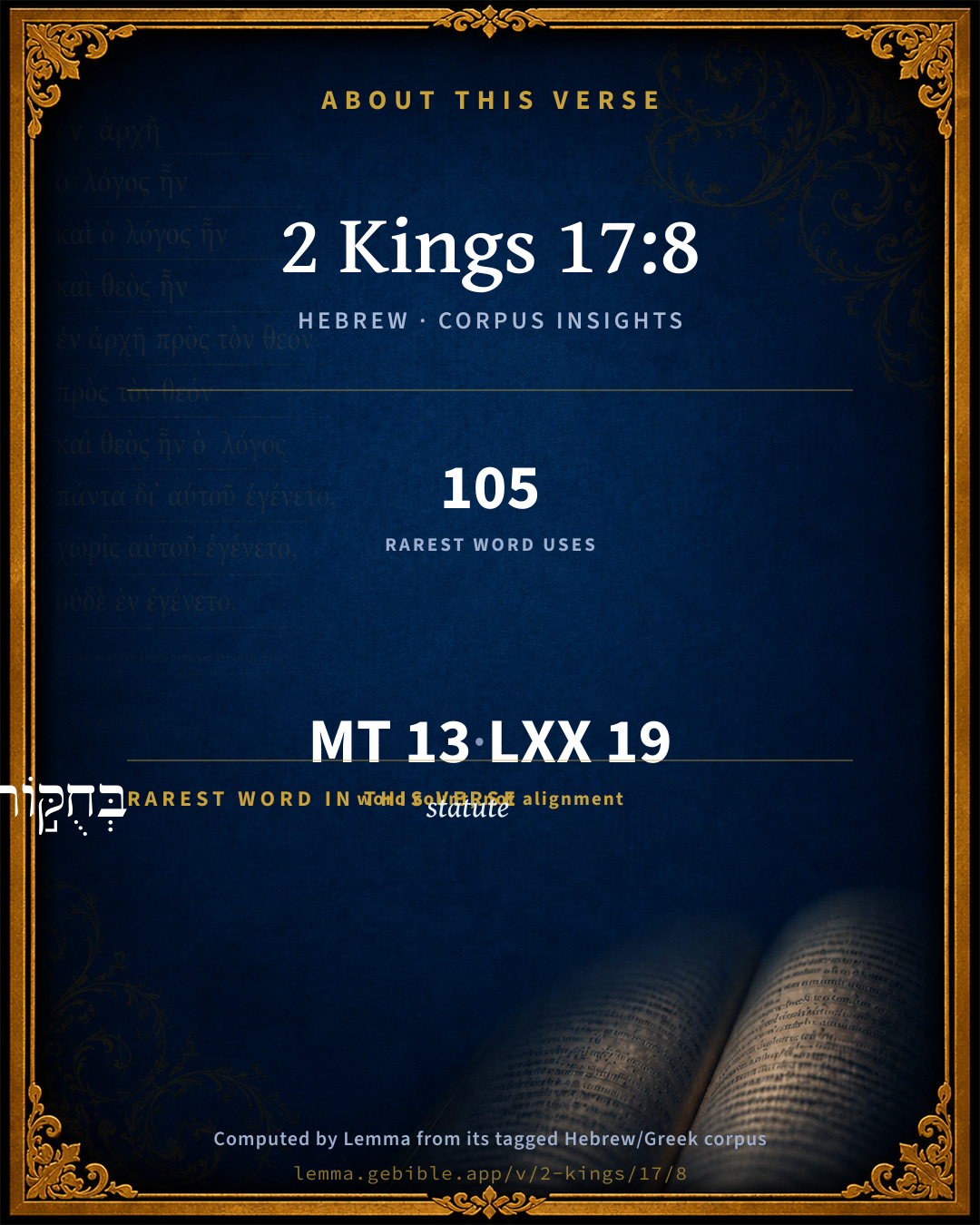
בְּחֻקּ֣וֹת
chuqqâh
H2708
“in/at · statutes of”
Preposition + Noun, Common, Both, Plural, Construct
Part of Speech
Preposition + Noun
Type
Common
Gender
Both
Number
Plural
State
Construct
Full BDB Definition

Origin: from H2706

TWOT: 728b

statute, ordinance, limit, enactment, something prescribed - statute
  1. וַיֵּֽלְכוּ֙ yâlak H3212 “and · to walk” Conjunction + Verb, Qal, Sequential Imperfect, 3rd Person, Masculine, Plural
  2. הַגּוֹיִ֔ם gôwy H1471 “the · nations” Particle, Definite Article + Noun, Common, Masculine, Plural, Absolute
  3. אֲשֶׁר֙ ʼăsher H834 “which” Particle, Relative
  4. הוֹרִ֣ישׁ yârash H3423 “to inherit” Verb, Hiphil, Perfect, 3rd Person, Masculine, Singular
  5. יְהוָ֔ה Yᵉhôvâh H3068 “LORD” Noun, Proper
  6. מִפְּנֵ֖י pânîym H6440 “from · face(s) of” Preposition + Noun, Common, Both, Plural, Construct
  7. בְּנֵ֣י bên H1121 “sons of” Noun, Common, Masculine, Plural, Construct
  8. יִשְׂרָאֵ֑ל Yisrâʼêl H3478 “Israel” Noun, Proper
  9. וּמַלְכֵ֥י melek H4428 “and · kings of” Conjunction + Noun, Common, Masculine, Plural, Construct
  10. יִשְׂרָאֵ֖ל Yisrâʼêl H3478 “Israel” Noun, Proper
  11. אֲשֶׁ֥ר ʼăsher H834 “which” Particle, Relative
  12. עָשֽׂוּ ʻâsâh H6213 “to do” Verb, Qal, Perfect, 3rd Person, Common, Plural

About this verse

These counts appear in no published source. They are computed here, from the morphology-tagged text and Lemma’s own curated glosses. What Lemma adds →

13
words
11
distinct lemmas
Historical
section

Grammatical profile

  • 3 verbs
  • 8 nouns
  • 2 particles

Verb forms

  • וַיֵּֽלְכוּ֙ Qal · Sequential Imperfect
  • הוֹרִ֣ישׁ Hiphil · Perfect
  • עָשֽׂוּ Qal · Perfect

Repetition

Words recur within this verse — often emphatic in Hebrew:

  • יִשְׂרָאֵ֑ל Israel H3478 ×2
  • אֲשֶׁר֙ which H834 ×2

Hebrew & Septuagint length

In English translation the verse runs 27 words from the Hebrew and 33 from the Septuagint (LXX English) — closely comparable.

A rough comparison of the two English renderings, which tokenize alike — not a word-level alignment.

Word counts can differ between the Hebrew and the Greek without any difference in meaning — e.g. the Hebrew direct-object marker אֵת has no separate Greek word, and Greek often adds the article ὁ.

In the original languages it is 13 Hebrew tokens and 19 Greek tokens — but the two are counted differently (Hebrew bundles its prefixes and suffixes into one token; the Greek is in lemma form), so that isn’t a like-for-like length.

Cross-references

15

Topical passages linked to 2 Kings 17:8 in the Treasury of Scripture Knowledge — connected by theme and wording, ordered by reader-vote popularity; previews shown in the World English Bible.

  • Leviticus 18:3 You shall not do as they do in the land of Egypt, where you lived: and you shall not do as they do in the land of Canaan, where I am bringing you; neither shall you walk in their statutes.
  • Deuteronomy 18:9 When you are come into the land which Yahweh your God gives you, you shall not learn to do after the abominations of those nations.
  • 2 Kings 16:3 But he walked in the way of the kings of Israel, yes, and made his son to pass through the fire, according to the abominations of the nations, whom Yahweh cast out from before the children of Israel.
  • Leviticus 18:27–30 (for all these abominations have the men of the land done, that were before you, and the land became defiled);
  • Deuteronomy 12:30–31 take heed to yourself that you not be ensnared to follow them, after that they are destroyed from before you; and that you not inquire after their gods, saying, How do these nations serve their gods? even so will I do likewise.
  • 1 Kings 12:28 Whereupon the king took counsel, and made two calves of gold; and he said to them, It is too much for you to go up to Jerusalem: see your gods, Israel, which brought you up out of the land of Egypt.
  • 1 Kings 16:31–33 It happened, as if it had been a light thing for him to walk in the sins of Jeroboam the son of Nebat, that he took as wife Jezebel the daughter of Ethbaal king of the Sidonians, and went and served Baal, and worshiped him.
  • 1 Kings 21:26 He did very abominably in following idols, according to all that the Amorites did, whom Yahweh cast out before the children of Israel.)
  • 2 Kings 16:10 King Ahaz went to Damascus to meet Tiglath Pileser king of Assyria, and saw the altar that was at Damascus; and king Ahaz sent to Urijah the priest the fashion of the altar, and the pattern of it, according to all the workmanship of it.
  • 2 Kings 17:19 Also Judah didn't keep the commandments of Yahweh their God, but walked in the statutes of Israel which they made.
  • 2 Kings 21:2 He did that which was evil in the sight of Yahweh, after the abominations of the nations whom Yahweh cast out before the children of Israel.
  • Psalms 106:35 But mixed themselves with the nations, And learned their works.
  • Jeremiah 10:2 Thus says Yahweh, "Don't learn the way of the nations, and don't be dismayed at the signs of the sky; for the nations are dismayed at them.
  • Hosea 5:11 Ephraim is oppressed, He is crushed in judgment; Because he is intent in his pursuit of idols.
  • Micah 6:16 For the statutes of Omri are kept, And all the works of the house of Ahab. You walk in their counsels, That I may make you a ruin, And her inhabitants a hissing; And you will bear the reproach of my people."

Cross-references courtesy of OpenBible.info (CC BY 4.0).

Hebrew and Greek witnesses Masoretic Hebrew ↔ Greek Septuagint

The same verse in the two great witnesses to the Old Testament, shown verse-for-verse.

These are two independent witnesses, not word-aligned to each other, and the Septuagint is shown in lemma (dictionary) form.

Hebrew 2 Kings 17:8 Masoretic · Westminster Leningrad Codex

וַיֵּֽלְכוּ֙ בְּחֻקּ֣וֹת הַגּוֹיִ֔ם אֲשֶׁר֙ הוֹרִ֣ישׁ יְהוָ֔ה מִפְּנֵ֖י בְּנֵ֣י יִשְׂרָאֵ֑ל וּמַלְכֵ֥י יִשְׂרָאֵ֖ל אֲשֶׁ֥ר עָשֽׂוּ

and walked in the statutes of the nations, whom Yahweh cast out from before the children of Israel, and of the kings of Israel, which they made.

World English Bible · Public Domain

Greek LXX 2 Kings 17:8 Septuagint · lemma form

καί πορεύομαι ὁ δικαίωμα ὁ ἔθνος ὅς ἐκαἴρω κύριος ἀπό πρόσωπον υἱός ἰσραήλ καί ὁ βασιλεύς ἰσραήλ ὅσος ποιέω

and walked in the statutes of the nations which the Lord cast out before the face of the children of Israel, and of the kings of Israel as many as did such things,

LXX2012 (modern English Septuagint) · Public Domain

Hebrew: Westminster Leningrad Codex (CC BY 4.0). Greek: Septuagint (public domain); English from LXX2012 (modern English Septuagint) (Public Domain). How the Septuagint differs from the Hebrew →

Targum (Aramaic paraphrase)

1

The Targum is the ancient Jewish Aramaic paraphrase of the Hebrew Scriptures — an interpretive translation, not the Hebrew text itself. Onkelos (literal) and Pseudo-Jonathan (expansive) render the Torah, and Jonathan the Prophets. Coverage is partial: where no permissively-licensed English translation exists for a verse, only the Aramaic is shown. This is verse-level text, not a word-by-word alignment to the Hebrew.

  1. Targum Jonathan Prophets (Joshua–Malachi)
    וַאֲזַלוּ בִגְזֵירַת עַמְמַיָא דְתָרִיךְ יְיָ מִן קֳדָם בְּנֵי יִשְׂרָאֵל וּמַלְכֵי יִשְׂרָאֵל דַעֲבָדוּ:

    (no public-domain English translation for this verse)

    Targum Jonathan — Aramaic: “Mikraot Gedolot” (public domain). English: “Sefaria Community Translation” (CC0 1.0 (public-domain dedication)); “London "Chaldee Paraphrase," 1871” (public domain). Text via Sefaria.

Commentary

Notes on 2 Kings 17:8 from classic Christian and Jewish commentators (each source and its license shown beneath its notes). The classic Christian expositions comment on the surrounding passage and are grouped to its opening verse, so a note may address several verses; the Jewish commentaries on the Tanakh (Rashi and others) are per-verse, so they appear only where the commentator wrote on this verse.

Lemma curates 59 commentaries, every one of them public domain or Creative Commons licensed, each selected and text-cleaned for this edition rather than reprinted as found. About our sources →

Trapp's Complete Commentary

John Trapp

2Ki 17:8 And walked in the statutes of the heathen, whom the LORD cast out from before the children of Israel, and of the kings of Israel, which they had made.

Ver. 8. And of the kings of Israel.] They made them kings, and those kings made statutes of their own devising, without God’s approbation, {Mic 6:16} and the people loved to have it so.

John Trapp, A Commentary or Exposition upon All the Books of the Old and New Testament (1647–1656) — public domain. Text from a community e-Sword module.

Joseph Benson's Commentary

2Ki 17:8-9. And walked in the statutes of the heathen — According to their laws and customs in the worship of their Baals, and other of their sins. And of the kings of Israel, which statutes they had made — Had ordained concerning the worship of the calves, and against their going up to Jerusalem to worship. And the children of Israel did secretly, &c. — This belongs, either, 1st, To their gross idolatries, and other abominable practices, which they were ashamed to own before others; or, 2d, To the worship of the calves, and so the words are otherwise rendered, They covered things that were not right toward the Lord: they covered their idolatrous worship of the calves with fair pretences of necessity, the two kingdoms being now divided, and at enmity; and of their honest intention of serving the true God, and retaining the substance of the Jewish religion. From the tower of the watchmen to the fenced city — In all parts and places, both in cities and in the country; yea, in the most uninhabited parts, where few or none dwelt besides the watch-men, who were left there in towers, to preserve the cattle and fruits of the earth, or to give notice of the approach of enemies.

Joseph Benson's Commentary on the Old and New Testaments (1811–1818) — public domain. Text from a community e-Sword module.

Tyndale Open Study Notes

Tyndale Open Resources

17:8-13 The catalog of Israel’s sins includes numerous pagan rites and practices. Whether done in the open or secretly, God was aware of them all. Many were even initiated by Israel’s kings who built pagan shrines, sacred pillars, and Asherah poles and emulated heathen sacrifices and idolatry (10:29; 15:18, 28; 1 Kgs 12:28-33; 15:34; 16:30-33). All levels of Israelite society, royalty and commoner alike, persisted in such sins despite denunciation and warning by God’s prophets, which included the writings of Isaiah, Hosea, Amos, and Micah.

Tyndale Open Study Notes — © Tyndale Open Resources, licensed CC BY-SA 4.0. Text via the HelloAO Bible API.

Ellicott's Commentary for English Readers

(8) Statutes of the heathen . . . and of the kings of Israel.—The national guilt was twofold. It comprised: (1) idolatry in the strict sense—i.e., worship of other gods than Jehovah; (2) a heathenish mode of worshipping Jehovah Himself—namely, under the form of a bullock, as Jeroboam I. had ordained. The term “statutes” means religious rules or ordinances. (Comp. Exo_12:14, “statutes;” Lev_20:23, “manners;” 1Ki_3:3, “ordinance.”)

Which they had made—i.e., the statutes which the kings of Israel had made. (Comp. 2Ki_17:19 b.)

A Bible Commentary for English Readers, edited by Charles John Ellicott (1878–1897) — public domain. Text from a community e-Sword module.

The Cambridge Bible for Schools and Colleges

gen. ed. J. J. S. Perowne

8. and walked in the statutes of the heathen] The book of Judges is full of instances of the way in which the people again and again fell away to the practices of the Canaanites (cf. Jdg_2:11-13).

and of the kings of Israel, which they had [R.V. omits had] made] i.e. In the statutes of the kings of Israel. Such are the ordinances of Jeroboam the son of Nebat about the calves in Dan and Bethel, and the worship of Baal, which Ahab and Jezebel introduced.

The Cambridge Bible for Schools and Colleges (gen. ed. J. J. S. Perowne; Cambridge University Press, 1878–1918) — public domain. Text from a community e-Sword module.

John Gill's Exposition

And walked in the statutes of the heathen, whom the Lord cast out from before the children of Israel,.... Meaning the Canaanites, in whose idolatrous ways they walked, and whom they imitated; though their ejection out of the land should have been a warning to them, and they were the more inexcusable, as they were particularly cautioned against walking in them, Lev 18:3.

and of the kings of Israel, which they had made; their laws and statutes, to worship the golden calves, and not go up to Jerusalem to worship.

John Gill's Exposition of the Whole Bible (1746–1763) — public domain (CC PDM 1.0). Text via the HelloAO Bible API.

Albert Barnes' Notes on the Bible

Idolatry was worse in the Israelites than in other nations, since it argued not merely folly and a gross carnal spirit, but also black ingratitude Exo 20:2-3. The writer subdivides the idolatries of the Israelites into two classes, pagan and native - those which they adopted from the nations whom they drove out, and those which their own kings imposed on them. Under the former head would come the great mass of the idolatrous usages described in 2Ki 17:9-11, 2Ki 17:17; “the high places” 2Ki 17:9, 2Ki 17:11; the “images” and “groves” 2Ki 17:10; the causing of their children to “pass through the fire” 2Ki 17:17; and the “worship of the host of heaven” 2Ki 17:16 : under the latter would fall the principal points in 2Ki 17:12, 2Ki 17:16, 2Ki 17:21.

Which they had made - “Which” refers to “statutes.” The lsraelites had “walked in the statutes of the pagan, and in those of the kings of Israel, which (statutes) they (the kings) had made.”

Albert Barnes' Notes on the Bible (1834–1885) — public domain. Text from a community e-Sword/MySword module.

Matthew Poole's English Annotations

In the statutes of the heathen, i.e. according to the laws and customs of the heathen, in the worship of their Baals, and other of their sins. Which they had made, i.e. which the kings of Israel had ordained concerning the worship of the calves, and against their going up to Jerusalem to worship.

Matthew Poole's English Annotations on the Holy Bible (1683–1685) — public domain. Text from a community e-Sword/MySword module.

Whedon's Commentary on the Bible

Daniel D. Whedon

8. Walked in the statutes — Observed the religions customs and ordinances.

Whom the Lord cast out — To adopt the religions and worship of peoples whom Jehovah had so signally defeated and cast out from the Land of Promise was the height of idolatrous infatuation.

Of the kings of Israel, which they had made — That is, in addition to walking in the statutes of the heathen they also observed statutes of their kings, that is, religious ordinances which their kings had made. The allusion is to the calf worship established at Beth-el and at Dan. See 1Ki_12:26-27, notes.

Daniel D. Whedon (gen. ed.), Commentary on the Old and New Testaments (1874–1909) — public domain. Text from a community e-Sword module.

The Pulpit Commentary

And walked in the statutes of the heathen. The" statutes of the heathen" are their customs and observances, especially in matters of religion. The Israelites had been repeatedly warned not to follow these (see Lev_18:3, Lev_18:30; Deu_12:29-31 Deu_18:9-14, etc.) Whom the Lord east out from before the children of Israeli.e. the Canaanitish nations, whose idolatries and other abominations" were particularly hateful to God (see Lev_18:26-29; Deu_20:18 Deu_29:17 Deu_32:16, etc.) and of the kings of Israel. The sins and idolatries of Israel had a double origin. The great majority were derived from the heathen nations with whom they were brought into contact, and were adopted voluntarily by the people themselves. Of this kind were the worship at high places" (ver. 9), the images" and "groves" (ver. 10), the causing of their children to "pass through the fire" (ver. 17), the employment of divination and enchantments (ver. 17), and perhaps the worship of the host of heaven" (ver. 16). A certain number, however, came in from a different source, being imposed upon the people by their kings. To this class belong the desertion of the temple-worship, enforced by Jeroboam (vex. 21), the setting up of the calves at Dan and Bethel (ver. 16) by the same, and the Baal and Astarte worship (ver. 16), introduced by Ahab. This last and worst idolatry was not established without a good deal of persecution, as we learn from 1Ki_18:4. Which they had made.

The Pulpit Commentary (1880–1919), ed. H.D.M. Spence-Jones & Joseph S. Exell — public domain. Text from a community e-Sword module.

Lesson kit

Teaching starters — assembled from the data on this page, not authored interpretation. Every prompt links to the verse data it draws on. Edit before teaching.

2 Kings, in the Historical, opens this verse with 13 words (11 distinct Hebrew lemmas). Its most distinctive word is chuqqâh (“statute”). A historical commentator’s framing appears above. Read the whole chapter for the surrounding context.

Discussion questions

  1. How does “statute” (chuqqâh) shape what this verse is saying?
  2. Leviticus 18:3 shares this passage’s theme. How do the two illuminate each other?
  3. “Israel” occurs 2× in this one verse. What is the effect of the repetition?
  4. These translations render this verse differently. What is at stake in choosing one wording over another?
  5. The verb «וַיֵּֽלְכוּ֙» is Qal Sequential Imperfect. How does its form color the action?
  6. Reading how Trapp's Complete Commentary and Joseph Benson's Commentary read this verse, where do the two commentators agree and where do they part?

Things to notice

Reading settings

Reading text

Shown beneath each verse's original-language words.

Old Testament
Old Testament edition

Read the OT as the Masoretic Hebrew (MT) or the Greek Septuagint (LXX).

English shown for the Greek Septuagint (in the Hebrew ↔ Greek comparison).

Comparing translations? Open the Compare panel on any verse page to stack up to four side by side.