
Nehemiah 5:8

Hebrew (Westminster Leningrad Codex) Nehemiah 5:8 appears in the Hebrew Old Testament. The text above is from the Westminster Leningrad Codex. Each word links to its Strong’s number, a concise gloss, and parsing drawn from the Open Scriptures Hebrew Bible morphology. Click any word for its full Brown-Driver-Briggs (BDB) entry.
Download image
Cite this verse

Nehemiah 5:8 (World English Bible). Public Domain. Lemma interlinear Bible study tool, https://lemma.gebible.app/v/nehemiah/5/8.

Show BibTeX & RIS
BibTeX
RIS
English Translation
I said to them, We after our ability have redeemed our brothers the Jews, that were sold to the nations; and would you even sell your brothers, and should they be sold to us? Then held they their peace, and found never a word.
World English Bible · Public Domain
Download a study sheet

One document with this verse’s original text, its word-by-word gloss line, the meaning frame, cross-references with their text, attributed commentary, and full source and license credits — printable, and it pastes into notes with its structure intact.

This verse Autodidact and up

Study sheet (.html) Plain text (.txt)

A passage Seminary Student

Up to 50 verses in one chapter. A passage sheet keeps up to 6 commentary sources and 12 cross-references per verse, in the order this page ranks them, and says so on the sheet whenever that leaves anything out. Ask for a single verse and you get the Autodidact verse sheet above.

Everything on this page stays free to read, with no account — the sheet is a download of what is already on screen, not access to it.

Want to remove ads? Support Godless Engineer
Compare translations 3

The same verse in 3 English versions, stacked beneath the original-language interlinear above. Click any original word for its lexicon entry.

Each is an independent rendering of the whole verse — the interlinear is not word-aligned to these translations.

Highlighted words mark where these versions differ — a whole-verse word diff, not a word-by-word alignment.

  • World English Bible Public Domain
    I said to them, We after our ability have redeemed our brothers the Jews, that were sold to the nations; and would you even sell your brothers, and should they be sold to us? Then held they their peace, and found never a word.
  • King James Version Public Domain
    And I said unto them, We after our ability have redeemed our brethren the Jews, which were sold unto the heathen; and will ye even sell your brethren? or shall they be sold unto us? Then held they their peace, and found nothing to answer.
  • unfoldingWord Literal Text CC BY-SA 4.0
    And I said to them, “We ourselves, according to our ability, have bought back our brothers, the Jews, the ones who were sold to the nations. But even you yourselves are selling your brothers, and they are being bought back by us!” Then they were silent, and they did not find a word.

unfoldingWord Literal Text — © unfoldingWord, licensed CC BY-SA 4.0. Word-aligned USFM3 via Door43 (git.door43.org/unfoldingWord/en_ult).

Versions to compare (up to 4)

3 of 4 selected

Show all 18 translations

Every available English version of this verse, each an independent rendering of the whole verse.

  • World English Bible Public Domain
    I said to them, We after our ability have redeemed our brothers the Jews, that were sold to the nations; and would you even sell your brothers, and should they be sold to us? Then held they their peace, and found never a word.
  • Berean Standard Bible Public Domain
    and said, “We have done our best to buy back our Jewish brothers who were sold to foreigners, but now you are selling your own brothers, that they may be sold back to us!” But they remained silent, for they could find nothing to say.
  • Majority Standard Bible Public Domain
    and said, “We have done our best to buy back our Jewish brothers who were sold to foreigners, but now you are selling your own brothers, that they may be sold back to us!” But they remained silent, for they could find nothing to say.
  • King James Version Public Domain
    And I said unto them, We after our ability have redeemed our brethren the Jews, which were sold unto the heathen; and will ye even sell your brethren? or shall they be sold unto us? Then held they their peace, and found nothing to answer.
  • American Standard Version (1901) Public Domain
    And I said unto them, We after our ability have redeemed our brethren the Jews, that were sold unto the nations; and would ye even sell your brethren, and should they be sold unto us? Then held they their peace, and found never a word.
  • Revised Version (1885) Public Domain
    And I said unto them, We after our ability have redeemed our brethren the Jews, which were sold unto the heathen; and would ye even sell your brethren, and should they be sold unto us? Then held they their peace, and found never a word.
  • Geneva Bible (1599) Public Domain
    And I said vnto them, We (according to our abilitie) haue redeemed our brethren the Iewes, which were solde vnto the heathen: and will you sell your brethren againe, or shall they be solde vnto vs? Then helde they their peace, and could not answere.
  • Douay-Rheims (1899) Public Domain
    And I said to them: We, as you know, have redeemed according to our ability our brethren the Jews, that were sold to the Gentiles: and will you then sell your brethren, for us to redeem them? And they held their peace, and found not what to answer.
  • Young's Literal Translation Public Domain
    and say to them, `We have acquired our brethren the Jews, those sold to the nations, according to the ability that `is' in us, and ye also sell your brethren, and they have been sold to us!' and they are silent, and have not found a word.
  • Literal Standard Version CC BY-SA 4.0
    and say to them, “We have acquired our brothers the Jews, those sold to the nations, according to the ability that [is] in us, and you also sell your brothers, and they have been sold to us!” And they are silent, and have not found a word.
  • Unlocked Literal Bible CC BY-SA 4.0
    and said to them, “We, as much as we are able, have bought back from slavery our Jewish brothers who had been sold to the nations, but you even sell your brothers and sisters that they may be sold back to us!” They were silent and never found a word to say.
  • unfoldingWord Literal Text CC BY-SA 4.0
    And I said to them, “We ourselves, according to our ability, have bought back our brothers, the Jews, the ones who were sold to the nations. But even you yourselves are selling your brothers, and they are being bought back by us!” Then they were silent, and they did not find a word.
  • Darby Bible Public Domain
    And I said to them, We, according to our ability, have redeemed our brethren the Jews, who were sold to the nations; and will ye even sell your brethren? or shall they be sold unto us? And they were silent and found no answer.
  • World Messianic Bible Public Domain
    I said to them, “We, after our ability, have redeemed our brothers the Jews that were sold to the nations; and would you even sell your brothers, and should they be sold to us?” Then they held their peace, and found not a word to say.
  • Webster's Bible Public Domain
    And I said to them, We after our ability have redeemed our brethren the Jews, who were sold to the heathen; and will ye even sell your brethren? or shall they be sold to us? Then they held their peace, and found nothing to answer.
  • Free Bible Version CC BY-SA 4.0
    There I told them, “We have done as much as we can to buy back our Jewish brothers who were sold to foreigners, but now you are selling your own brothers as slaves! Are you expecting to sell them back to us?” They kept quiet because they couldn't think of anything to say.
  • Bible in Basic English Public Domain
    And I said to them, We have given whatever we were able to give, to make our brothers the Jews free, who were servants and prisoners of the nations: and would you now give up your brothers for a price, and are they to become our property? Then they said nothing, answering not a word.
  • JPS Tanakh (1917) Public Domain
    And I said unto them: 'We after our ability have redeemed our brethren the Jews, that sold themselves unto the heathen; and would ye nevertheless sell your brethren, and should they sell themselves unto us?' Then held they their peace, and found never a word.

Literal Standard Version (2020), Covenant Press — licensed CC BY-SA 4.0. Text via the HelloAO Bible API (eBible.org). Unlocked Literal Bible (unfoldingWord) — licensed CC BY-SA 4.0. Text via the HelloAO Bible API (eBible.org). unfoldingWord Literal Text — © unfoldingWord, licensed CC BY-SA 4.0. Word-aligned USFM3 via Door43 (git.door43.org/unfoldingWord/en_ult). Free Bible Version, Dr. Jonathan Gallagher — licensed CC BY-SA 4.0. Text via the HelloAO Bible API (eBible.org).

Word by word

More ways to search: Search by grammar → Find every occurrence → Compare this word →

Practice this passage: Drill this verse → Learn its vocabulary →

כְּדֵ֣י
day
H1767
“like/as · enough of”
Preposition + Noun, Common, Masculine, Singular, Construct
Part of Speech
Preposition + Noun
Type
Common
Gender
Masculine
Number
Singular
State
Construct
Full BDB Definition

Origin: of uncertain derivation

TWOT: 425

sufficiency, enough - enough - for, according to the abundance of, out of the abundance of, as often as
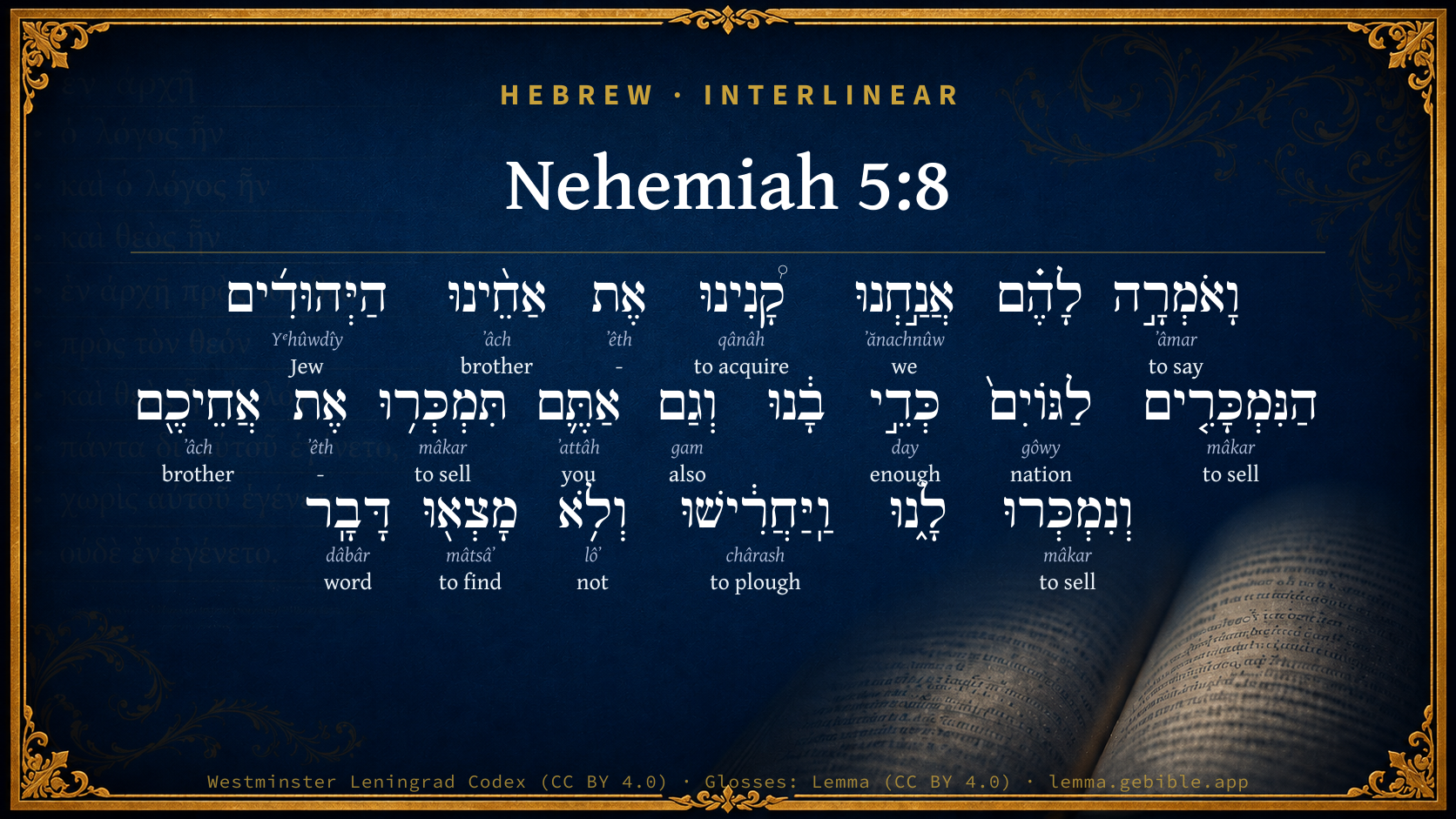
  1. וָאֹמְרָ֣ה ʼâmar H559 “and · to say” Conjunction + Verb, Qal, Sequential Imperfect, 1st Person, Common, Singular + Suffix, h
  2. אֲנַ֣חְנוּ ʼănachnûw H587 “we” Pronoun, Personal, 1st Person, Common, Plural
  3. קָ֠נִינוּ qânâh H7069 “to acquire” Verb, Qal, Perfect, 1st Person, Common, Plural
  4. אֶת ʼêth H853 “-” Particle, Direct Object
  5. אַחֵ֨ינוּ ʼâch H251 “brothers · our” Noun, Common, Masculine, Plural, Construct + Suffix, Personal, 1st Person, Common, Plural
  6. הַיְּהוּדִ֜ים Yᵉhûwdîy H3064 “the · Jews” Particle, Definite Article + Noun, Gentilic, Masculine, Plural, Absolute
  7. הַנִּמְכָּרִ֤ים mâkar H4376 “the · sold” Particle, Definite Article + Verb, Niphal, Participle Passive, Masculine, Plural, Absolute
  8. לַגּוֹיִם֙ gôwy H1471 “to/for the · nations” Preposition, Determined + Noun, Common, Masculine, Plural, Absolute
  9. וְגַם gam H1571 “and · also” Conjunction + Particle, Accusative
  10. אַתֶּ֛ם ʼattâh H859 “you” Pronoun, Personal, 2nd Person, Masculine, Plural
  11. תִּמְכְּר֥וּ mâkar H4376 “to sell” Verb, Qal, Imperfect, 2nd Person, Masculine, Plural
  12. אֶת ʼêth H853 “-” Particle, Direct Object
  13. אֲחֵיכֶ֖ם ʼâch H251 “brothers · your” Noun, Common, Masculine, Plural, Construct + Suffix, Personal, 2nd Person, Masculine, Plural
  14. וְנִמְכְּרוּ mâkar H4376 “and · to sell” Conjunction + Verb, Niphal, Sequential Perfect, 3rd Person, Common, Plural
  15. וַֽיַּחֲרִ֔ישׁוּ chârash H2790 “and · to plough” Conjunction + Verb, Hiphil, Sequential Imperfect, 3rd Person, Masculine, Plural
  16. וְלֹ֥א lôʼ H3808 “and · not” Conjunction + Particle, Negative
  17. מָצְא֖וּ mâtsâʼ H4672 “to find” Verb, Qal, Perfect, 3rd Person, Common, Plural
  18. דָּבָֽר dâbâr H1697 “word” Noun, Common, Masculine, Singular, Absolute

About this verse

These counts appear in no published source. They are computed here, from the morphology-tagged text and Lemma’s own curated glosses. What Lemma adds →

22
words
15
distinct lemmas
Historical
section

Shared distinctive vocabulary

כְּדֵ֣י enough H1767 occurs in 35 verses of the Hebrew Bible. Also found in:

Grammatical profile

  • 7 verbs
  • 6 nouns
  • 2 pronouns
  • 3 prepositions
  • 4 particles

Verb forms

  • וָאֹמְרָ֣ה Qal · Sequential Imperfect
  • קָ֠נִינוּ Qal · Perfect
  • הַנִּמְכָּרִ֤ים Niphal · Participle Passive
  • תִּמְכְּר֥וּ Qal · Imperfect
  • וְנִמְכְּרוּ Niphal · Sequential Perfect
  • וַֽיַּחֲרִ֔ישׁוּ Hiphil · Sequential Imperfect
  • מָצְא֖וּ Qal · Perfect

Repetition

Words recur within this verse — often emphatic in Hebrew:

  • הַנִּמְכָּרִ֤ים to sell H4376 ×3
  • אַחֵ֨ינוּ brother H251 ×2

Cross-references

13

Topical passages linked to Nehemiah 5:8 in the Treasury of Scripture Knowledge — connected by theme and wording, ordered by reader-vote popularity; previews shown in the World English Bible.

  • Leviticus 25:47–49 "'If a stranger or sojourner with you becomes rich, and your brother beside him has grown poor, and sells himself to the stranger or foreigner living among you, or to a member of the stranger's family;
  • Exodus 21:16 "Anyone who kidnaps someone and sells him, or if he is found in his hand, he shall surely be put to death.
  • Deuteronomy 24:7 If a man be found stealing any of his brothers of the children of Israel, and he deal with him as a slave, or sell him; then that thief shall die: so shall you put away the evil from the midst of you.
  • Job 29:10 The voice of the nobles was hushed, And their tongue stuck to the roof of their mouth.
  • Job 32:15 "They are amazed. They answer no more. They don't have a word to say.
  • Matthew 22:12 and he said to him, 'Friend, how did you come in here not wearing wedding clothing?' He was speechless.
  • Matthew 25:15 To one he gave five talents, to another two, to another one; to each according to his own ability. Then he went on his journey.
  • Matthew 25:29 For to everyone who has will be given, and he will have abundance, but from him who has not, even that which he has will be taken away.
  • Romans 3:19 Now we know that whatever things the law says, it speaks to those who are under the law, that every mouth may be closed, and all the world may be brought under the judgment of God.
  • Romans 14:15 Yet if because of food your brother is grieved, you walk no longer in love. Don't destroy with your food him for whom Christ died.
  • 1 Corinthians 8:11 And through your knowledge, he who is weak perishes, the brother for whose sake Christ died.
  • 2 Corinthians 8:12 For if the readiness is there, it is acceptable according to what you have, not according to what you don't have.
  • Galatians 6:10 So then, as we have opportunity, let's do what is good toward all men, and especially toward those who are of the household of the faith.

Cross-references courtesy of OpenBible.info (CC BY 4.0).

Hebrew and Greek witnesses Masoretic Hebrew ↔ Greek Septuagint

The same verse in the two great witnesses to the Old Testament, shown verse-for-verse.

These are two independent witnesses, not word-aligned to each other, and the Septuagint is shown in lemma (dictionary) form.

Hebrew Nehemiah 5:8 Masoretic · Westminster Leningrad Codex

וָאֹמְרָ֣ה לָהֶ֗ם אֲנַ֣חְנוּ קָ֠נִינוּ אֶת אַחֵ֨ינוּ הַיְּהוּדִ֜ים הַנִּמְכָּרִ֤ים לַגּוֹיִם֙ כְּדֵ֣י בָ֔נוּ וְגַם אַתֶּ֛ם תִּמְכְּר֥וּ אֶת אֲחֵיכֶ֖ם וְנִמְכְּרוּ לָ֑נוּ וַֽיַּחֲרִ֔ישׁוּ וְלֹ֥א מָצְא֖וּ דָּבָֽר

I said to them, We after our ability have redeemed our brothers the Jews, that were sold to the nations; and would you even sell your brothers, and should they be sold to us? Then held they their peace, and found never a word.

World English Bible · Public Domain

Greek LXX Structure differs

The Septuagint has no separate book of Nehemiah. Its Greek text is the second half of Esdras B (2 Esdras), chapters 11–23; Ezra is the first half (1–10).

A verse-for-verse comparison isn’t shown here because the chapters and verses don’t line up. Switch to the LXX edition with the MT / LXX toggle above to read the Greek directly.

On this verse, The Cambridge Bible for Schools and Colleges discusses the Septuagint’s reading. Read the note in Commentary ↓

Hebrew: Westminster Leningrad Codex (CC BY 4.0). Greek: Septuagint (public domain); English from a public-domain English Septuagint. How the Septuagint differs from the Hebrew →

Commentary

Notes on Nehemiah 5:8 from classic Christian and Jewish commentators (each source and its license shown beneath its notes). The classic Christian expositions comment on the surrounding passage and are grouped to its opening verse, so a note may address several verses; the Jewish commentaries on the Tanakh (Rashi and others) are per-verse, so they appear only where the commentator wrote on this verse.

Lemma curates 59 commentaries, every one of them public domain or Creative Commons licensed, each selected and text-cleaned for this edition rather than reprinted as found. About our sources →

Trapp's Complete Commentary

John Trapp

Neh 5:8 And I said unto them, We after our ability have redeemed our brethren the Jews, which were sold unto the heathen; and will ye even sell your brethren? or shall they be sold unto us? Then held they their peace, and found nothing [to answer].

8. And I said unto them, We after our ability] This he speaketh, not in a vain glorious vaunting way, or to curry favour with the people; but to convince the contrary minded of their inhumanity to their poor brethren. Good works, saith Chrysostom, are unanswerable syllogisms, invincible demonstrations to confute and convert those that do otherwise. "Let your works so shine before men," &c.

Which were sold unto the heathen] This they did in obedience to the law, Deu 28:47-48.

And will ye even sell your brethren?] There was no resisting of such a rational reproof, no whit imbittered (as the manner is) with wrath or spite; but carried on with so much modesty and moderation.

Or shall they be sold unto us?] He makes himself a party, because of the same body politic.

Then held they their peace, and found nothing to answer] Such is the majesty of a reproof rightly administered; it even gags the offender, as Mat 22:12, and renders him self condemned, Tit 3:11. Scipio, with his countenance only, quelled and quieted his seditious soldiers. Alexander the Great, and after him Augustus Caesar, and Severus the emperor, did the same, with a few quick words. Adrianus Boxsehafius, preacher of the word at Antwerp, hearing a certain monk railing at Luther out of the pulpit, Tell me, said he, thou perverse monk, and that openly before all this people, where, and when, and in what points Luther hath erred? The monk thus accosted, answered not a word, but got out of the pulpit, and fled away as fast as he could, and never came again into that country (Scultet. Annal.).

John Trapp, A Commentary or Exposition upon All the Books of the Old and New Testament (1647–1656) — public domain. Text from a community e-Sword module.

Joseph Benson's Commentary

Neh 5:8. We, after our ability, have redeemed our brethren — Nehemiah and his predecessors had used their utmost interest and power with the kings of Persia, that their brethren might be redeemed from bondage, whereby they had been restored both to their liberty and to their own country. And it is probable they had, with their money, procured the freedom of such as were slaves to some of the Babylonians, who would not part with them without a price paid for them. Shall they be sold unto us? — Do you expect that we should pay you a price for them, as we did to the Babylonians? Or must we use as much importunity to solicit you for their redemption as we used with their enemies? Then held they their peace — They made no reply, because they could neither deny the fact nor justify it, an express law of God being against them.

Joseph Benson's Commentary on the Old and New Testaments (1811–1818) — public domain. Text from a community e-Sword module.

Geneva Bible (1599)

Geneva Bible translators

Seeing God hath once delivered them from the bondage of the heathen, shall we make them our slaves?

Geneva Bible (1599) marginal notes — public domain. Text via Bolls.life.

Ellicott's Commentary for English Readers

(8) Will ye even sell your brethren?—The appeal is a strong one. Nehemiah and his friends had redeemed Jews from the heathen with money; these men had caused Jews to be sold to Jews.

Nothing to answer.—They might have replied had the letter of the law been urged; but this argument puts them to shame.

A Bible Commentary for English Readers, edited by Charles John Ellicott (1878–1897) — public domain. Text from a community e-Sword module.

The Cambridge Bible for Schools and Colleges

gen. ed. J. J. S. Perowne

8. We] ‘We’ and ‘ye’ in this verse are in emphatic antithesis.

after our ability] So Vulg. ‘secundum possibilitatem nostram.’ LXX. ἐν ἑκουσίῳ ἡμῶν. Another rendering is ‘according to the number of those that were among us.’

have redeemed] R.V. marg. ‘Heb. bought’, i.e. as many as were put up to sale we redeemed. Nehemiah apparently refers to what had been the merciful custom of himself and his countrymen when they were in exile; but possibly also to his action in Jerusalem since his arrival. The word for ‘redeemed’ here would be literally rendered ‘acquired’ or ‘bought.’ The word is used here presumably because the stress of the clause rests not so much on the slavery from which the Jews were delivered, but upon the price that Nehemiah and his companions willingly paid for them.

unto the heathen] Lit. ‘unto the nations.’

and will you even sell your brethren] R.V. and would ye, &c.

or shall they] R.V. and should they. Nehemiah’s indignant question contrasts the conduct of the wealthy money-lenders with his own practice and that of his friends. He in a foreign land redeemed every Jew he could that was being sold to the heathen, and here in Jerusalem itself he finds Jews selling their own flesh and blood, and the market in which they barter their brethren is within the walls of the Holy City. They not only sold Jews as slaves, but bought them as such. They were ready to buy them, not to redeem but to enslave them.

found nothing to answer] R.V. found never a word. There was no justification either in law or equity for their conduct, in making money out of their brethren’s misfortunes at a time of national danger.

The Cambridge Bible for Schools and Colleges (gen. ed. J. J. S. Perowne; Cambridge University Press, 1878–1918) — public domain. Text from a community e-Sword module.

John Gill's Exposition

Also I said, it is not good that ye do,.... The meaning is, that it was very bad; it is a "meiosis", by which more is intended than is expressed:

ought ye not to walk in the fear of our God; in reverence of him and his law, and according to that:

because of the reproach of the Heathen our enemies? whose mouths will be open to reproach the true religion, and the good ways of God; and say, these are the men that pretend to fear God, and serve him, and yet break his law, and use their brethren ill, see Rom 2:24.

John Gill's Exposition of the Whole Bible (1746–1763) — public domain (CC PDM 1.0). Text via the HelloAO Bible API.

Albert Barnes' Notes on the Bible

Nehemiah contrasts his own example with that of the rich Jews. He had spent money in redeeming some countrymen in servitude among the pagan; they were causing others to be sold into slavery among the Jews.

Albert Barnes' Notes on the Bible (1834–1885) — public domain. Text from a community e-Sword/MySword module.

Haydock's Catholic Bible Commentary

Redeemed, by paying the ransom to the Babylonians, or by using all our endeavours to procure the releasement of our brethren. (Calmet) --- For us. Protestants, "or shall they be sold unto us?" (Haydock) --- A true pastor practises what he preaches to others. (Worthington)

George Leo Haydock (1774–1849), Haydock's Catholic Family Bible and Commentary, 1859 edition — public domain. Excludes Psalms (Douay-Rheims chapter numbering differs from Protestant) and Deuterocanonical books (Catholic canon only).

Matthew Poole's English Annotations

We after our ability have redeemed our brethren the Jews, which were sold unto the heathen: I, and my, brethren, and predecessors, have used our utmost interest and power, both with the kings of Persia, that our brethren might be redeemed from that bondage into which God had sold them for their sins; and with particular persons in Babylon and Persia, and the adjacent parts, whose bond-slaves the Jews were, and who would not part with them without a price, which we paid for them.

Will ye even sell your brethren? or shall they be sold unto us? do you expect that we should pay you a price for them, as we did to the Babylonians? or must we use as much importunity to solicit you for their redemption as we did to their enemies?

Matthew Poole's English Annotations on the Holy Bible (1683–1685) — public domain. Text from a community e-Sword/MySword module.

Whedon's Commentary on the Bible

Daniel D. Whedon

8. We — Nehemiah and other nobles and influential Jews before him, who had been instrumental in procuring the release of the Jews from captivity and permission for them to return to Judea and restore their fallen state.

After our ability — Literally, according to the sufficiency in us. Nehemiah and others had used official position and personal influence, which they held with the kings of Persia, to secure the deliverance of their brethren the Jews from their exile among the heathen.

Will ye even sell your brethren — Will ye now take advantage of their poverty to involve them into slavery among their own nation and race?

Daniel D. Whedon (gen. ed.), Commentary on the Old and New Testaments (1874–1909) — public domain. Text from a community e-Sword module.

The Pulpit Commentary

We after our ability have redeemed our brethren. "We," here, may be either "we Jews of the captivity," in contrast with "you who have long returned from it," or "we of my house and household" (equivalent to the "I, my brethren, and my servants" of ver. 10), in contrast with "you rich Jews not of my household." Nehemiah must appeal to a well-known fact, that he and others had been in the habit of redeeming enslaved Jews among the heathen. Will ye even sell your brethren? An argumenturn ad verecundiam. Will ye do the exact opposite? Cause your brethren to be sold into slavery? And not to heathen masters, but to men of their own nation, unto us? Roman creditors, if they sold their debtor slaves, were required by law to sell them across the Tiber to men of a different race. It was felt to add to the indignity of the slave condition that one should have to serve one"s own countryman, recently one"s equal and (perhaps) acquaintance. They held their peace, and found nothing to answer. Or, "found never a word. The argument told. It admitted of no reply. The nobles were ashamed, and had not a word to say.

The Pulpit Commentary (1880–1919), ed. H.D.M. Spence-Jones & Joseph S. Exell — public domain. Text from a community e-Sword module.

John Wesley's Explanatory Notes

We - I, and my brethren, and predecessors, have used our utmost interest and power, both with the kings of Persia, that our brethren might be redeemed from bondage, and with particular persons in Babylon, and Persia, whose bond-slaves the Jews were, and who would not part with them without a price. Be sold - Do you expect that we should pay you a price for them, as we did to the Babylonians?. Or, must we use as much importunity to solicit you for their redemption, as we did to their enemies?

John Wesley, Explanatory Notes Upon the Whole Bible (1754–1765) — public domain. Text via the GEBible commentary corpus.

Scofield Reference Notes

C. I. Scofield

redeemed

(See Scofield "Exo 14:30").

The Scofield Reference Bible (1917 edition), notes by C. I. Scofield — public domain. Text from a community e-Sword module.

Rashi

Rabbi Shlomo Yitzchaki (Rashi)

And I said to them And so I said to them: We already bought our Jewish brethren who were in captivity from the heathens to whom they were sold.

with as much as we could afford with as much money as was in our hands.

and you too And you too will sell to the heathens your brethren who are subjected to you as slaves?

and they will be sold to us And the result will be that they will be sold to us by the heathens (and if so, why should you sell them, since we will be compelled to redeem them? This is found in certain editions).

and they remained silent They were silent and ashamed, and they did not know what to answer.

Rashi on the Tanakh — English translations: “The Judaica Press complete Tanach with Rashi, translated by A. J. Rosenberg” (CC BY 4.0); “Pentateuch with Rashi's commentary by M. Rosenbaum and A.M. Silbermann, 1929-1934” (public domain); “The Metsudah Tanach series, Lakewood, N.J” (CC BY 4.0); and “The Book of Joshua, Metsudah Publications, 1997” (CC BY 4.0). Text via Sefaria.

Lesson kit

Teaching starters — assembled from the data on this page, not authored interpretation. Every prompt links to the verse data it draws on. Edit before teaching.

Nehemiah, in the Historical, opens this verse with 22 words (15 distinct Hebrew lemmas). Its most distinctive word is day (“enough”). A historical commentator’s framing appears above. Read the whole chapter for the surrounding context.

Discussion questions

  1. What does “enough” (day) contribute to the verse as a whole?
  2. Exodus 36:5 shares the word «enough» with this verse. How do the two illuminate each other?
  3. “to sell” occurs 3× in this one verse. What is the effect of the repetition?
  4. The translations on this page render this verse differently — a whole-verse word diff, not a word-by-word alignment. What might account for the different wordings?
  5. The verb «וָאֹמְרָ֣ה» is Qal Sequential Imperfect. How does its form color the action?
  6. Reading how Trapp's Complete Commentary and Joseph Benson's Commentary read this verse, where do the two commentators agree and where do they part?

Things to notice

Reading settings

Reading text

Shown beneath each verse's original-language words.

Old Testament
Old Testament edition

Read the OT as the Masoretic Hebrew (MT) or the Greek Septuagint (LXX).

English shown for the Greek Septuagint (in the Hebrew ↔ Greek comparison).

Comparing translations? Open the Compare panel on any verse page to stack up to four side by side.