
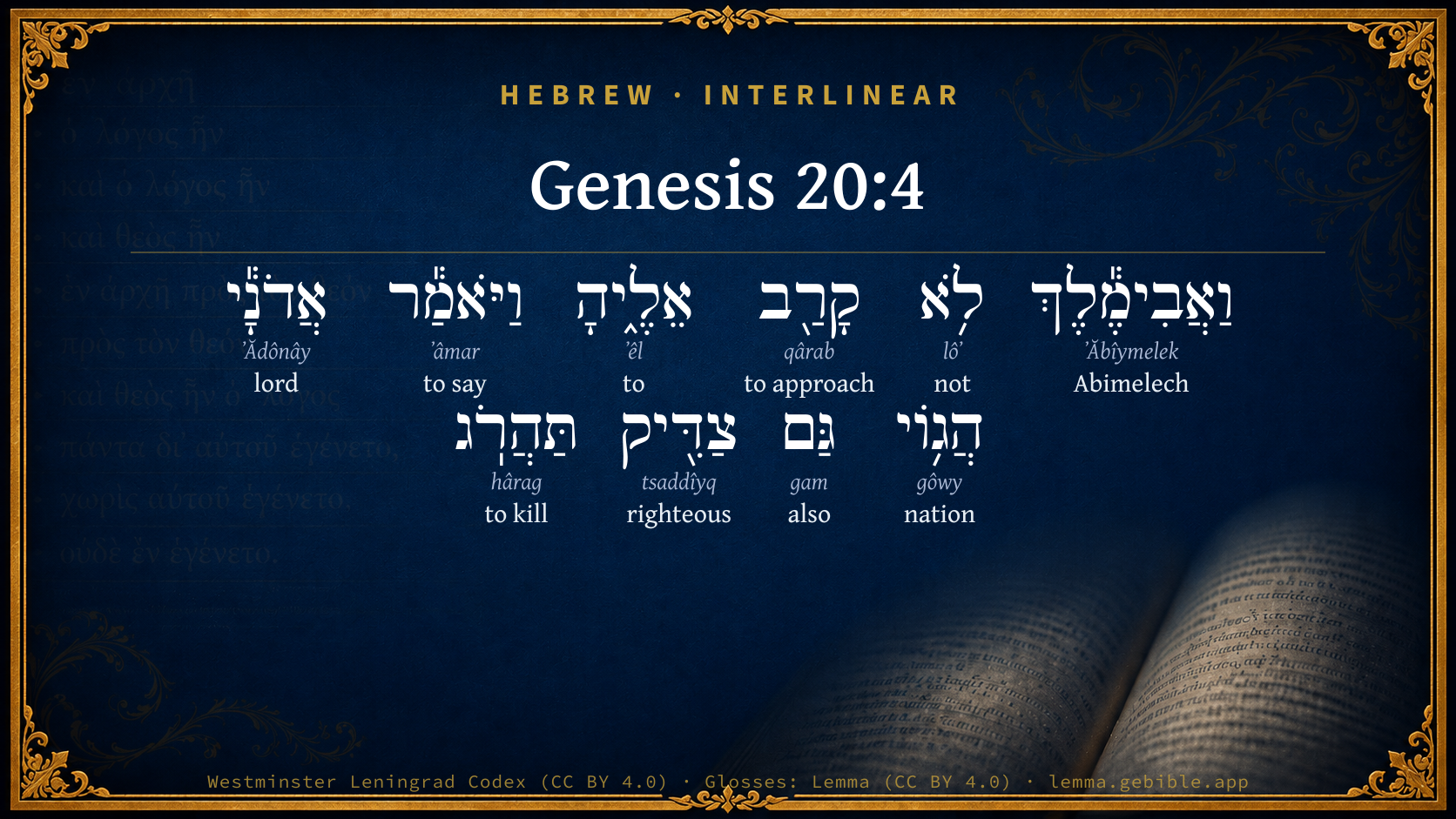
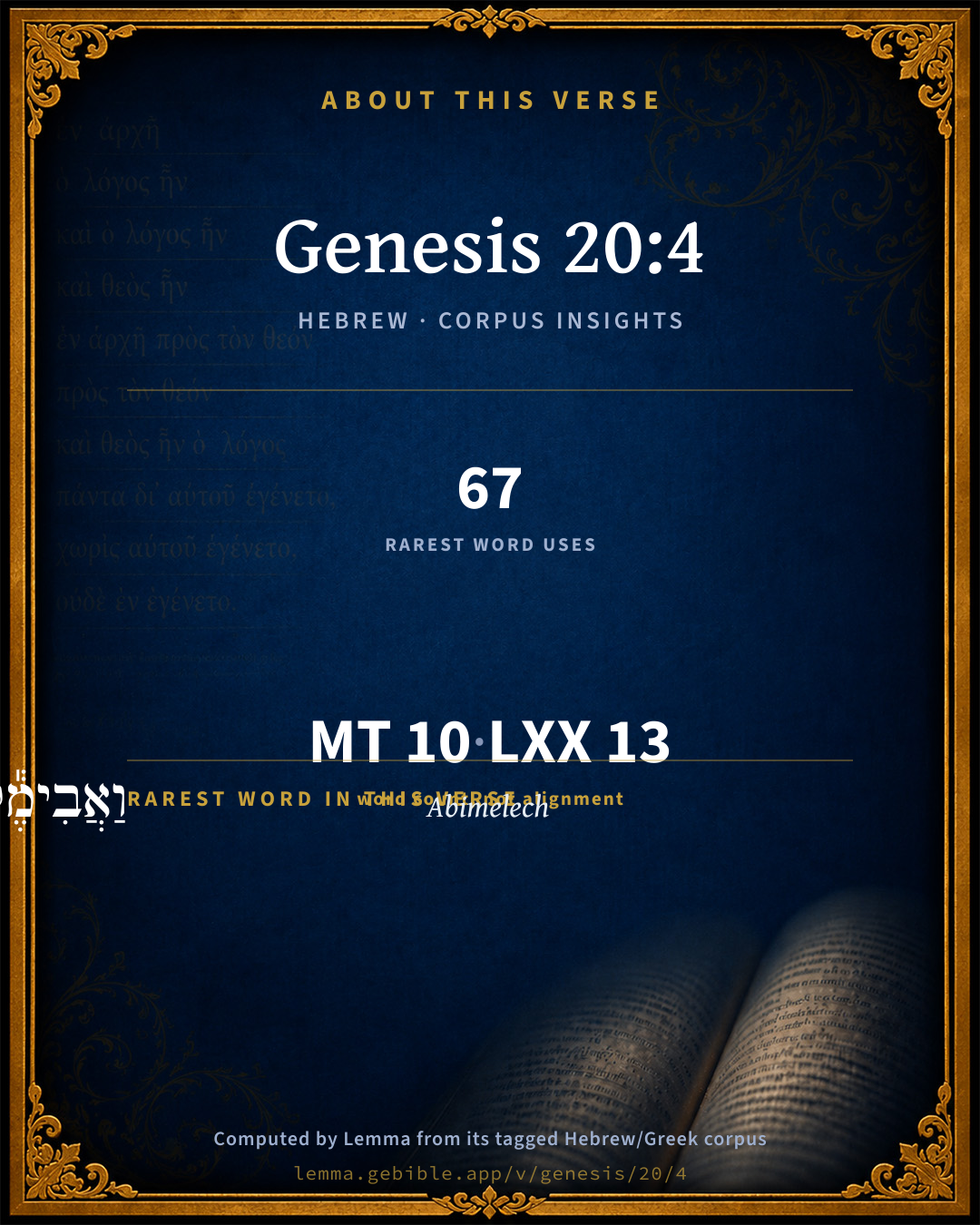
Genesis 20:4

Hebrew (Westminster Leningrad Codex) Genesis 20:4 appears in the Hebrew Old Testament. The text above is from the Westminster Leningrad Codex. Each word links to its Strong’s number, a concise gloss, and parsing drawn from the Open Scriptures Hebrew Bible morphology. Click any word for its full Brown-Driver-Briggs (BDB) entry.
Download image
Cite this verse

Genesis 20:4 (World English Bible). Public Domain. Lemma interlinear Bible study tool, https://lemma.gebible.app/v/genesis/20/4.

Show BibTeX & RIS
BibTeX
RIS
English Translation
Now Abimelech had not come near her. He said, "Lord, will you kill even a righteous nation?
World English Bible · Public Domain
Download a study sheet

One document with this verse’s original text, its word-by-word gloss line, the meaning frame, cross-references with their text, attributed commentary, and full source and license credits — printable, and it pastes into notes with its structure intact.

This verse Autodidact and up

Study sheet (.html) Plain text (.txt)

A passage Seminary Student

Up to 50 verses in one chapter. A passage sheet keeps up to 6 commentary sources and 12 cross-references per verse, in the order this page ranks them, and says so on the sheet whenever that leaves anything out. Ask for a single verse and you get the Autodidact verse sheet above.

Everything on this page stays free to read, with no account — the sheet is a download of what is already on screen, not access to it.

Want to remove ads? Support Godless Engineer
Compare translations 3

The same verse in 3 English versions, stacked beneath the original-language interlinear above. Click any original word for its lexicon entry.

Each is an independent rendering of the whole verse — the interlinear is not word-aligned to these translations.

Highlighted words mark where these versions differ — a whole-verse word diff, not a word-by-word alignment.

  • World English Bible Public Domain
    Now Abimelech had not come near her. He said, "Lord, will you kill even a righteous nation?
  • King James Version Public Domain
    But Abimelech had not come near her: and he said, LORD, wilt thou slay also a righteous nation?
  • unfoldingWord Literal Text CC BY-SA 4.0
    Now Abimelech had not gone near to her, so he said, “My Lord, will you kill even a righteous nation?

unfoldingWord Literal Text — © unfoldingWord, licensed CC BY-SA 4.0. Word-aligned USFM3 via Door43 (git.door43.org/unfoldingWord/en_ult).

Versions to compare (up to 4)

3 of 4 selected

Show all 18 translations

Every available English version of this verse, each an independent rendering of the whole verse.

  • World English Bible Public Domain
    Now Abimelech had not come near her. He said, "Lord, will you kill even a righteous nation?
  • Berean Standard Bible Public Domain
    Now Abimelech had not gone near her, so he replied, “Lord, would You destroy a nation even though it is innocent?
  • Majority Standard Bible Public Domain
    Now Abimelech had not gone near her, so he replied, “Lord, would You destroy a nation even though it is innocent?
  • King James Version Public Domain
    But Abimelech had not come near her: and he said, LORD, wilt thou slay also a righteous nation?
  • American Standard Version (1901) Public Domain
    Now Abimelech had not come near her. And he said, Lord, wilt thou slay even a righteous nation?
  • Revised Version (1885) Public Domain
    Now Abimelech had not come near her: and he said, Lord, wilt thou slay even a righteous nation?
  • Geneva Bible (1599) Public Domain
    (Notwithstanding Abimelech had not yet come neere her) And he said, Lord, wilt thou slay euen the righteous nation?
  • Douay-Rheims (1899) Public Domain
    Now Abimelech had not touched her, and he said: Lord, wilt thou slay a nation, that is ignorant and justl
  • Young's Literal Translation Public Domain
    And Abimelech hath not drawn near unto her, and he saith, `Lord, also a righteous nation dost thou slay?
  • Literal Standard Version CC BY-SA 4.0
    And Abimelech has not drawn near to her, and he says, “Lord, do you also slay a righteous nation?
  • Unlocked Literal Bible CC BY-SA 4.0
    Now Abimelech had not come near her and he said, “Lord, would you kill even a righteous nation?
  • unfoldingWord Literal Text CC BY-SA 4.0
    Now Abimelech had not gone near to her, so he said, “My Lord, will you kill even a righteous nation?
  • Darby Bible Public Domain
    But Abimelech had not come near her. And he said, Lord, wilt thou also kill a righteous nation?
  • World Messianic Bible Public Domain
    Now Abimelech had not come near her. He said, “Lord, will you kill even a righteous nation?
  • Webster's Bible Public Domain
    But Abimelech had not come near her: and he said, Lord, wilt thou also slay a righteous nation?
  • Free Bible Version CC BY-SA 4.0
    Abimelech hadn't touched Sarah, and he asked, “Lord, do you kill good people?
  • Bible in Basic English Public Domain
    Now Abimelech had not come near her; and he said, Lord, will you put to death an upright nation?
  • JPS Tanakh (1917) Public Domain
    Now Abimelech had not come near her; and he said: 'Lord, wilt Thou slay even a righteous nation?

Literal Standard Version (2020), Covenant Press — licensed CC BY-SA 4.0. Text via the HelloAO Bible API (eBible.org). Unlocked Literal Bible (unfoldingWord) — licensed CC BY-SA 4.0. Text via the HelloAO Bible API (eBible.org). unfoldingWord Literal Text — © unfoldingWord, licensed CC BY-SA 4.0. Word-aligned USFM3 via Door43 (git.door43.org/unfoldingWord/en_ult). Free Bible Version, Dr. Jonathan Gallagher — licensed CC BY-SA 4.0. Text via the HelloAO Bible API (eBible.org).

Word by word

More ways to search: Search by grammar → Find every occurrence → Compare this word →

Practice this passage: Drill this verse → Learn its vocabulary →

וַאֲבִימֶ֕לֶךְ
ʼĂbîymelek
H40
“and · Abimelech”
Conjunction + Noun, Proper
Part of Speech
Conjunction + Noun
Type
Proper
Full BDB Definition

Origin: from H1 and H4428

TWOT: None

Abimelech = "Melek is father" or " my father is king" - king of Gerar in Abraham's time - king of Gath in David's time; maybe title of Philistine kings - son of Gideon by a concubine - priest, son of Abiathar
  1. לֹ֥א lôʼ H3808 “not” Particle, Negative
  2. קָרַ֖ב qârab H7126 “to approach” Verb, Qal, Perfect, 3rd Person, Masculine, Singular
  3. אֵלֶ֑יהָ ʼêl H413 “to · her” Preposition + Suffix, Personal, 3rd Person, Feminine, Singular
  4. וַיֹּאמַ֕ר ʼâmar H559 “and · to say” Conjunction + Verb, Qal, Sequential Imperfect, 3rd Person, Masculine, Singular
  5. אֲדֹנָ֕י ʼĂdônây H136 “Lord · my” Noun, Common, Masculine, Plural, Construct + Suffix, Personal, 1st Person, Common, Singular
  6. הֲג֥וֹי gôwy H1471 “nation” Particle, Interrogative + Noun, Common, Masculine, Singular, Absolute
  7. גַּם gam H1571 “also” Particle, Accusative
  8. צַדִּ֖יק tsaddîyq H6662 “righteous” Adjective, Adjective, Masculine, Singular, Absolute
  9. תַּהֲרֹֽג hârag H2026 “to kill” Verb, Qal, Imperfect, 2nd Person, Masculine, Singular

About this verse

These counts appear in no published source. They are computed here, from the morphology-tagged text and Lemma’s own curated glosses. What Lemma adds →

10
words
10
distinct lemmas
Pentateuch
section

Grammatical profile

  • 3 verbs
  • 3 nouns
  • 1 adjective
  • 1 preposition
  • 2 particles

Verb forms

  • קָרַ֖ב Qal · Perfect
  • וַיֹּאמַ֕ר Qal · Sequential Imperfect
  • תַּהֲרֹֽג Qal · Imperfect

Hebrew & Septuagint length

In English translation the verse runs 17 words from the Hebrew and 19 from the Septuagint (LXX English) — closely comparable.

A rough comparison of the two English renderings, which tokenize alike — not a word-level alignment.

Word counts can differ between the Hebrew and the Greek without any difference in meaning — e.g. the Hebrew direct-object marker אֵת has no separate Greek word, and Greek often adds the article ὁ.

In the original languages it is 10 Hebrew tokens and 13 Greek tokens — but the two are counted differently (Hebrew bundles its prefixes and suffixes into one token; the Greek is in lemma form), so that isn’t a like-for-like length.

Cross-references

6

Topical passages linked to Genesis 20:4 in the Treasury of Scripture Knowledge — connected by theme and wording, ordered by reader-vote popularity; previews shown in the World English Bible.

  • Genesis 18:23–25 Abraham drew near, and said, "Will you consume the righteous with the wicked?
  • 2 Samuel 4:11 How much more, when wicked men have slain a righteous person in his own house on his bed, shall I not now require his blood of your hand, and take you away from the earth?
  • 1 Chronicles 21:17 David said to God, Isn't it I who commanded the people to be numbered? It is even I who have sinned and done very wickedly; but these sheep, what have they done? Please let your hand, O Yahweh my God, be against me, and against my father's house; but not against your people, that they should be plagued.
  • Genesis 19:24 Then Yahweh rained on Sodom and on Gomorrah sulfur and fire from Yahweh out of the sky.
  • Genesis 20:6 God said to him in the dream, "Yes, I know that in the integrity of your heart you have done this, and I also withheld you from sinning against me. Therefore I didn't allow you to touch her.
  • Genesis 20:17–18 Abraham prayed to God. God healed Abimelech, and his wife, and his maid-servants, and they bore children.

Cross-references courtesy of OpenBible.info (CC BY 4.0).

Hebrew and Greek witnesses Masoretic Hebrew ↔ Greek Septuagint

The same verse in the two great witnesses to the Old Testament, shown verse-for-verse.

These are two independent witnesses, not word-aligned to each other, and the Septuagint is shown in lemma (dictionary) form.

Hebrew Genesis 20:4 Masoretic · Westminster Leningrad Codex

וַאֲבִימֶ֕לֶךְ לֹ֥א קָרַ֖ב אֵלֶ֑יהָ וַיֹּאמַ֕ר אֲדֹנָ֕י הֲג֥וֹי גַּם צַדִּ֖יק תַּהֲרֹֽג

Now Abimelech had not come near her. He said, "Lord, will you kill even a righteous nation?

World English Bible · Public Domain

Greek LXX Genesis 20:4 Septuagint · lemma form

αβιμελεχ δέ οὐ ἅπτομαι αὐτός καί εἶπον κύριος ἔθνος ἀγνοέω καί δίκαιος ἀποὀλλύω

But Abimelech had not touched her, and he said, Lord, will you destroy an ignorantly sinning and just nation?

LXX2012 (modern English Septuagint) · Public Domain

On this verse, John Gill's Exposition discusses the Septuagint’s reading. Read the note in Commentary ↓

Hebrew: Westminster Leningrad Codex (CC BY 4.0). Greek: Septuagint (public domain); English from LXX2012 (modern English Septuagint) (Public Domain). How the Septuagint differs from the Hebrew →

Targum (Aramaic paraphrase)

2

The Targum is the ancient Jewish Aramaic paraphrase of the Hebrew Scriptures — an interpretive translation, not the Hebrew text itself. Onkelos (literal) and Pseudo-Jonathan (expansive) render the Torah, and Jonathan the Prophets. Coverage is partial: where no permissively-licensed English translation exists for a verse, only the Aramaic is shown. This is verse-level text, not a word-by-word alignment to the Hebrew.

  1. Targum Onkelos Torah (Genesis–Deuteronomy)
    וַאֲבִימֶלֶךְ לָא קְרֵב לְוָתַהּ וַאֲמַר יְיָ הָעָם אַף זַכַּאי תִּקְטוֹל

    (no public-domain English translation for this verse)

    Targum Onkelos — Aramaic: “Onkelos Genesis” (public domain); “Onkelos Exodus” (public domain); “Onkelos Leviticus” (public domain); “Onkelos Numbers” (public domain); “Onkelos Deuteronomy” (public domain). English: “Sefaria Community Translation” (CC0 1.0 (public-domain dedication)); “J.W. Etheridge. The Targums of Onkelos and Jonathan Ben Uzziel on the Pentateuch. London: Longmans, Green, 1862” (public domain). Text via Sefaria.

  2. Targum Pseudo-Jonathan Torah (Genesis–Deuteronomy)
    וַאֲבִימֶלֶךְ לָא קָרִיב לְגַבָּה לִמְסַאֲבָהּ וְאָמַר יְיָ הֲבַר עַמְמִין דְלָא חַב אוּף חָמֵי לֵיהּ לְמִזְכֵּי בְּדִינָא אִתְקְטֵיל

    But Abimelek had not come nigh to defile her; and he said, Lord, shall the son of a people who hath not sinned, and whom it is right to absolve in the judgment, be killed?

    Targum Pseudo-Jonathan — Aramaic: “Targum Jonathan on Genesis” (public domain); “Targum Jonathan on Exodus” (public domain); “Targum Jonathan on Leviticus” (public domain); “Targum Jonathan on Numbers” (public domain); “Targum Jonathan on Deuteronomy” (public domain). English: “The Targum of Jonathan ben Uzziel, trans. J. W. Etheridge, London, 1862” (public domain). Text via Sefaria.

Commentary

Notes on Genesis 20:4 from classic Christian and Jewish commentators (each source and its license shown beneath its notes). The classic Christian expositions comment on the surrounding passage and are grouped to its opening verse, so a note may address several verses; the Jewish commentaries on the Tanakh (Rashi and others) are per-verse, so they appear only where the commentator wrote on this verse.

Lemma curates 59 commentaries, every one of them public domain or Creative Commons licensed, each selected and text-cleaned for this edition rather than reprinted as found. About our sources →

Trapp's Complete Commentary

John Trapp

Gen 20:4 But Abimelech had not come near her: and he said, Lord, wilt thou slay also a righteous nation?

Ver. 4. But Abimelech had not come near her.] Being hindered by sickness. {Gen 20:17} Well might St Ambrose call sickness the shop of virtues. {a} When men are fastened to their beds, and their bones made to rattle in their skin, lust will be laid asleep, and little leisure left for luxury. {b} This made King Alfred pray God to send him always some sickness, whereby his body might be tamed, and he the better disposed and affectioned to Godward. If it be painful to the vine to bleed, it is worse to wither. Better be pruned to grow, than cut up to burn. Otho tertius, Imperator, dictus miraculum mundi, amoribus periit .{ c} How much happier he that sang, Periissem nisi Periissem .

Lord, wilt thou slay also a righteous nation?] For he knew that whole nations had smarted for the sins of their rulers; this sin of adultery especially, as we read of Shechem, Troy, &c. How were the Greeks plagued for the rape of Chrysis! and the Lacedemonian commonwealth utterly overturned by Epaminondas in the battle of Leuctra, for a rape committed upon the two daughters of Scedasus by a couple of Spartan gentlemen, travelling to Delphi! This might make Abimelech afraid lest, for his fault, wrath should fall upon his people also.

{a} Morbos virtutum officians vocat Ambros .

{b} Nuper me amici cuiusdam languor admonuit opimos esse nos dum infirmi sumus . - Plin., epist. xxvi. lib. vii.

{c} Manl., loc. com., p. 667.

John Trapp, A Commentary or Exposition upon All the Books of the Old and New Testament (1647–1656) — public domain. Text from a community e-Sword module.

Joseph Benson's Commentary

Gen 20:4. Wilt thou also slay a righteous nation? — He probably referred to the late destruction of Sodom and the cities of the plain, which, no doubt, must have caused great consternation, if not also some degree of reformation, in that neighbourhood. As Abimelech’s plea was not rejected by the Lord, there is reason to hope that both he and his subjects were not only free from the abominations of Sodom, and from the reigning idolatries of Canaan, but that the fear of God, and some remains of true religion, were found among them.

Joseph Benson's Commentary on the Old and New Testaments (1811–1818) — public domain. Text from a community e-Sword module.

Keil & Delitzsch

C. F. Keil & F. Delitzsch

Abimelech, who had not yet come near her, because God had hindered him by illness (Gen 20:6 and Gen 20:17), excused himself on the ground that he had done no wrong, since he had supposed Sarah to be Abraham's sister, according to both her husband's statement and her own. This plea was admitted by God, who told him that He had kept him from sinning through touching Sarah, and commanded him to restore the woman immediately to her husband, who was a prophet, that he might pray for him and save his life, and threatened him with certain death to himself and all belonging to him in case he should refuse. That Abimelech, when taking the supposed sister of Abraham into his harem, should have thought that he was acting "in innocence of heart and purity of hands," i.e., in perfect innocence, is to be fully accounted for, from his undeveloped moral and religious standpoint, by considering the customs of that day. But that God should have admitted that he had acted "in innocence of heart," and yet should have proceeded at once to tell him that he could only remain alive through the intercession of Abraham, that is to say, through his obtaining forgiveness of a sin that was deserving of death, is a proof that God treated him as capable of deeper moral discernment and piety. The history itself indicates this in the very characteristic variation in the names of God. First of all (Gen 20:3), Elohim (without the article, i.e., Deity generally) appears to him in a dream; but Abimelech recognises the Lord, Adonai, i.e., God (Gen 20:4); whereupon the historian represents האלהים (Elohim with the article), the personal and true God, as speaking to him. The address of God, too, also shows his susceptibility of divine truth. Without further pointing out to him the wrong which he had done in simplicity of heart, in taking the sister of the stranger who had come into his land, for the purpose of increasing his own harem, since he must have been conscious of this himself, God described Abraham as a prophet, whose intercession alone could remove his guilt, to show him the way of salvation. A prophet: lit., the God-addressed or inspired, since the "inward speaking" (Ein-sprache) or inspiration of God constitutes the essence of prophecy. Abraham was προφήτης as the recipient of divine revelation, and was thereby placed in so confidential a relation to God, that he could intercede for sinners, and atone for sins of infirmity through his intercession.

Keil & Delitzsch — Biblical Commentary on the Old Testament (1861–1891) — public domain (CC PDM 1.0). Text via the HelloAO Bible API. (Old Testament only.)

Tyndale Open Study Notes

Tyndale Open Resources

20:4-5 Abimelech was innocent (20:6); his conscience was clear. Nonetheless, he was about to commit adultery, and ignorance does not excuse guilt (Lev 4:13-14). • will you destroy an innocent nation? Abimelech’s appeal to God echoes Abraham’s earlier words (cp. 18:23-32) and rebukes Abraham’s lack of faith on this occasion.

Tyndale Open Study Notes — © Tyndale Open Resources, licensed CC BY-SA 4.0. Text via the HelloAO Bible API.

Geneva Bible (1599)

Geneva Bible translators

The infidels confessed that God would not punish but for just occasion: therefore, whensoever he punisheth, the occasion is just.

Geneva Bible (1599) marginal notes — public domain. Text via Bolls.life.

John Calvin's Commentaries

4. But Abimelech had not come near her. Though Abraham had deprived himself of his wife, the Lord interposed in time to preserve her uninjured. When Moses previously relates, that she was taken away by Pharaoh, he does not say whether her chastity was assailed or not; but since the Lord then also declared himself the vindicator of her whom he now saved from dishonor, we ought not to doubt that her integrity was preserved both times. For why did he now forbid the king of Gerar to touch her, if he had previously suffered her to be corrupted in Egypt? We see, however, that when the Lord so defers his aid as not to stretch out his hand to the faithful, till they are in extreme peril, he shows the more clearly how admirable is his Providence.

Wilt thou slay also a righteous nation? The explanation given by some, that Abimelech here compares himself with the men of Sodom, is perhaps too refined. The following meaning appears to me more simple; namely ‘O Lord, although thou dost severely punish adultery, shall thy wrath pour itself out on unoffending men, who have rather fallen into error, than sinned knowingly and willingly?’ Moreover, Abimelech seems so to clear himself, as if he were entirely free from blame: and yet the Lord both admits and approves his excuse. We must, however, mark in what way, and to what extent he boasts that his heart and hands are guiltless. For he does not arrogate to himself a purity which is altogether spotless; but only denies that he was led by lust, either tyrannically or purposely, to abuse another man’s wife. We know how great is the difference between a crime and a fault ; thus Abimelech does not exempt himself from every kind of charge, but only shows that he had been conscious of no such wickedness as required this severe punishment. The ‘simplicity of heart,’ of which he speaks, is nothing else than that ignorance which stands opposed to consciousness of guilt; and ‘the righteousness of his hands,’ is nothing but that selfgovernment, by which men abstain from force and acts of injustice. Besides, the interrogation which Abimelech used proceeded from a common feeling of religion. For nature itself dictates, that God preserves a just discrimination in inflicting punishments.

John Calvin's Commentaries (1540-1563) — public domain. Text from the Calvin Translation Society English edition (1840s-50s) via the Christian Classics Ethereal Library (ccel.org). Calvin's coverage is partial (roughly two-thirds of the Bible); uncommented books and verses are honest gaps, never fabricated. The 19th-century editor's footnotes and remarks are omitted so the notes are faithfully Calvin's own voice.

Ellicott's Commentary for English Readers

(4) A righteous nation.—Knobel has pointed out that there is an allusion here to the fate of Sodom. Though the malady was confined to Abimelech and his household, yet he sees destruction threatening his whole people, who, compared with the inhabitants of the Ciccar cities, were righteous. There is indirect proof: of the truth of Abimelech’s assertion in the fact that death (see Gen_20:3) is acquiesced in as the fitting punishment for adultery.

A Bible Commentary for English Readers, edited by Charles John Ellicott (1878–1897) — public domain. Text from a community e-Sword module.

The Cambridge Bible for Schools and Colleges

gen. ed. J. J. S. Perowne

4. a righteous nation] Abimelech appeals to the instinct of justice, that God will not punish the innocent, as if they were guilty. Cf. Gen_18:23.

The Cambridge Bible for Schools and Colleges (gen. ed. J. J. S. Perowne; Cambridge University Press, 1878–1918) — public domain. Text from a community e-Sword module.

John Gill's Exposition

But Abimelech had not come near her,.... Sarah had been put into an apartment in his palace, and not yet admitted into his company, not at least to his bed; he had not lain with her, which is the design of the expression: the Septuagint version is, "had not touched her", as in Gen 20:6; which is another phrase expressive of the same thing:

and he said, Lord, wilt thou slay also a righteous nation? meaning either his family, the greater part of which were not accessory to this affair; or rather his kingdom, as Aben Ezra, see Gen 20:9; which though not a nation of righteous men, in a strict sense, see Gen 20:11; yet with regard to this business of Sarah were no ways criminal: either God had threatened to destroy his people, as well as himself, if he did not return Sarah to her husband, or committed iniquity with her; or he knew that this had been usual for people to suffer for the crimes of their governors, and like a true father of his country shows an affectionate concern for their welfare in the first place; for this may be the sense of the word "also", on which an emphasis is put; wilt thou not only slay me, but also a whole nation for my sake, a nation free from all fault and blame in this matter? though some think he has reference to the destruction of Sodom and Gomorrah, a recent action, and fresh in his mind; as if he should say, thou hast justly destroyed a wicked people for their sins, and wilt thou also destroy a nation that at least, in comparison of them, is a just and righteous one?

John Gill's Exposition of the Whole Bible (1746–1763) — public domain (CC PDM 1.0). Text via the HelloAO Bible API.

Matthew Poole's English Annotations

Abimelech had not come near her, i.e. had not yet lain with her. A modest expression, like that of knowing a woman, Gen 4:1, or going in to her, Gen 6:4, or touching her, Pro 6:29; 1Co 7:1, by which we are taught to use modesty in our speeches, and not, with the rude cynics, to express all things by their proper names. This clause and history was necessary to be added here for Sarah’s vindication, and especially for the demonstration of Isaac’s original from Abraham and Sarah, according to God’s promise.

Wilt thou slay also a righteous nation? i.e. innocent as to this matter. Compare 2Sa 4:11. He knew it was just and usual for God to punish a nation for their king’s sins; and therefore, as became a good prince, he is solicitous, and prays for the safety of his nation: or else by nation he may mean his family, for some of them were not involved in the guilt of this fact.

Matthew Poole's English Annotations on the Holy Bible (1683–1685) — public domain. Text from a community e-Sword/MySword module.

Whedon's Commentary on the Bible

Daniel D. Whedon

4. Had not come near her — He and his house had apparently been smitten with some judgment (Gen_20:6; Gen_20:18) which restrained him from Sarah, and hindered his wife and maidservants from conception. From which it would seem that Sarah was removed some time from Abraham.

Also a righteous nation — There seems to be in these words an allusion to the destruction of the Sodomites. The fame of that fearful judgment had probably spread through all the adjacent lands, and made a profound impression; and now, when God speaks in a dream to this king, Abimelech asks, in amazement, if his people are in danger of a judgment like those wicked sinners. In his emotion his language rises almost to a poetic strain:

O Lord, a nation also righteous wilt thou slay?

Did not he say to me,

My sister is she?

And she, she also, said,

My brother is he.

In the integrity of my heart,

And in the innocency of my hands,

Have I done this.

In this king we may recognise an exceptional example of heathen uprightness. His ideas of righteousness, integrity, and innocence do not forbid polygamy, so that he has no compunction in adding Sarah to his harem. But he pleads sincerity and personal honour. Though lamentably low, he is far above the moral level of the Sodomites; and yet he needs the prayers and help of Abraham, who himself is far from the highest idea of innocence. Behold here the necessity of divine revelation. Without the word of the Lord, how could simple man come to know righteousness, or integrity, or purity?

Daniel D. Whedon (gen. ed.), Commentary on the Old and New Testaments (1874–1909) — public domain. Text from a community e-Sword module.

The Pulpit Commentary

But Abimelech had not come near her. Apparently withheld by the peculiar disease which had overtaken him. The statement of the present verse (a similar one to which is not made with reference to Pharaoh) was clearly rendered necessary by the approaching birth of Isaac, who might otherwise have been said to be the child not of Abraham, but of the Philistine king. And he said, Lord, Adonai (vide Gen_15:2) wilt thou slay also a righteous nation? Anticipating that the stroke of Divine judgment was about to fall upon his people as well as on himself, with allusion to the fate of Sodom (Knobel), which he deprecates for his people at least on the ground that they are innocent of the offence charged against him (cf. 2Sa_24:17) That Abimelech and his people, like Melchisedeck and his subjects, had some knowledge of the true God, and that the Canaanites generally at this period had not reached the depth of moral degradation into which the cities of the Jordan circle had sunk before their overthrow, is apparent from the narrative. The comparative virtue, therefore, of these tribes was a proof that the hour had not arrived for the infliction on them of the doom of extermination.

The Pulpit Commentary (1880–1919), ed. H.D.M. Spence-Jones & Joseph S. Exell — public domain. Text from a community e-Sword module.

John Wesley's Explanatory Notes

Wilt thou slay also a righteous nation - Not such a nation as Sodom.

John Wesley, Explanatory Notes Upon the Whole Bible (1754–1765) — public domain. Text via the GEBible commentary corpus.

unfoldingWord translationNotes

Door43 World Missions Community

Now ... her

This word is used here to mark a change from the story to information about Abimelech. (See: Background Information)

Abimelech had not come near her

This is a polite way of saying he did not have sex with her. AT: "Abimelech had not slept with Sarah" or "Abimelech had not touched Sarah" (See: Euphemism)

even a righteous nation

Here "nation" stands for the people. Abimelech is worried that God will punish not only him, but his people also. AT: "even a people who are innocent" (See: Metonymy)

Did he not himself say to me, 'She is my sister?' Even she herself said, 'He is my brother.'

This has quotations within a quotation. They can be stated as indirect quotations. AT: "Did he himself not tell me that she is his sister? Even she herself told me that he is her brother." (See: Quotes Within Quotes and Direct and Indirect Quotations)

Did he not himself say to me, 'She is my sister?'

Abimelech used this rhetorical question to remind God of something God already knew. This can be translated as a statement. AT: "Abraham himself told me, 'She is my sister.'" or "Abraham said that she is his sister." (See: Rhetorical Question)

Did he not himself say ... Even she herself

The words "he himself" and "she herself" are used for emphasis to bring attention to Abraham and Sarah and to blame them for what happened. (See: Reflexive Pronouns)

I have done this in the integrity of my heart and the innocence of my hands

Here "heart" stands for his thoughts or intentions. Also "hands" stands for his actions. AT: "I have done this with good intentions and actions" or "I have done this with no evil thoughts or actions" (See: Metonymy)

translationWords

Abimelech

lord

righteous

nation

heart

innocent

unfoldingWord translationNotes — © Distant Shores Media and the Door43 World Missions Community, licensed CC BY-SA 4.0. Source: git.door43.org/Door43/en_tn.

Rashi

Rabbi Shlomo Yitzchaki (Rashi)

לא קרב אליה HE HAD NOT COME NEAR HER — The Angel prevented him, as it is said (v. 6) “I have not permitted thee to touch her” (cf. Genesis Rabbah 52).

הגוי גם צדיק תהרוג WILT THOU SLAY ALSO A RIGHTEOUS NATION? — Even though it be righteous will you slay it? Is such perhaps Your usual way— to destroy nations without cause? That is what you did to the generation of the Flood and to the generation of the Dispersal. I may indeed say that you slew them without proper cause, just as you think to kill me without cause (Genesis Rabbah 52:6).

Rashi on the Tanakh — English translations: “The Judaica Press complete Tanach with Rashi, translated by A. J. Rosenberg” (CC BY 4.0); “Pentateuch with Rashi's commentary by M. Rosenbaum and A.M. Silbermann, 1929-1934” (public domain); “The Metsudah Tanach series, Lakewood, N.J” (CC BY 4.0); and “The Book of Joshua, Metsudah Publications, 1997” (CC BY 4.0). Text via Sefaria.

Radak

Rabbi David Kimhi (Radak)

ואבימלך לא קרב אליה, the reason was that G’d had restricted his lust. This is why G’d said to him in his dream in response to the accusation that He would kill the innocent, that the only reason Avimelech had not touched her had been that He, G’d, had made him temporarily impotent.

?הגוי גם צדיק תהרוג, if You were to kill me just as you would kill my people. I am a leader and practice law and justice in my country. I am not on the same level as my common people. This explains also verse 9 where Avimelech distinguishes between himself and his Kingdom (subjects) by saying to Avraham “that you have brought on me and my kingdom (people) this great sin?” Furthermore, he argued that he considered himself righteous, having had reason to believe that Sarah was unattached.

Radak on the Tanakh — English translations: “Sefaria Community Translation” (CC0 1.0 (public-domain dedication)); “Eliyahu Munk, HaChut Hameshulash” (CC BY 4.0); “Rabbi Mike Feuer, Jerusalem Anthology” (CC BY 4.0); and “R. David Kimhi on the first book of Psalms, Translated by R.G. Finch, London, 1919” (public domain). Text via Sefaria.

Ibn Ezra

Rabbi Abraham ibn Ezra

Will You also kill an innocent nation. He prayed on behalf of his entire nation.

Ibn Ezra on the Tanakh — English translations: “Sefaria Community Translation” (CC0 1.0 (public-domain dedication)); “Yalkut, Sifsei Chachomim Chumash, Metsudah Publications, 2009” (CC BY 4.0); and “Commentary of Ibn Ezra on Isaiah - trans. by M. Friedlander, 1873” (public domain). Text via Sefaria.

Lesson kit

Teaching starters — assembled from the data on this page, not authored interpretation. Every prompt links to the verse data it draws on. Edit before teaching.

Genesis, in the Pentateuch, opens this verse with 10 words (10 distinct Hebrew lemmas). Its most distinctive word is ʼĂbîymelek (“Abimelech”). A historical commentator’s framing appears above. Read the whole chapter for the surrounding context.

Discussion questions

  1. What does “Abimelech” (ʼĂbîymelek) contribute to the verse as a whole?
  2. Genesis 18:23–25 shares this passage’s theme. How do the two illuminate each other?
  3. The translations on this page render this verse differently — a whole-verse word diff, not a word-by-word alignment. What might account for the different wordings?
  4. The verb «קָרַ֖ב» is Qal Perfect. How does its form color the action?
  5. Reading how Trapp's Complete Commentary and Joseph Benson's Commentary read this verse, where do the two commentators agree and where do they part?

Things to notice

Reading settings

Reading text

Shown beneath each verse's original-language words.

Old Testament
Old Testament edition

Read the OT as the Masoretic Hebrew (MT) or the Greek Septuagint (LXX).

English shown for the Greek Septuagint (in the Hebrew ↔ Greek comparison).

Comparing translations? Open the Compare panel on any verse page to stack up to four side by side.