
2 Chronicles 32:17

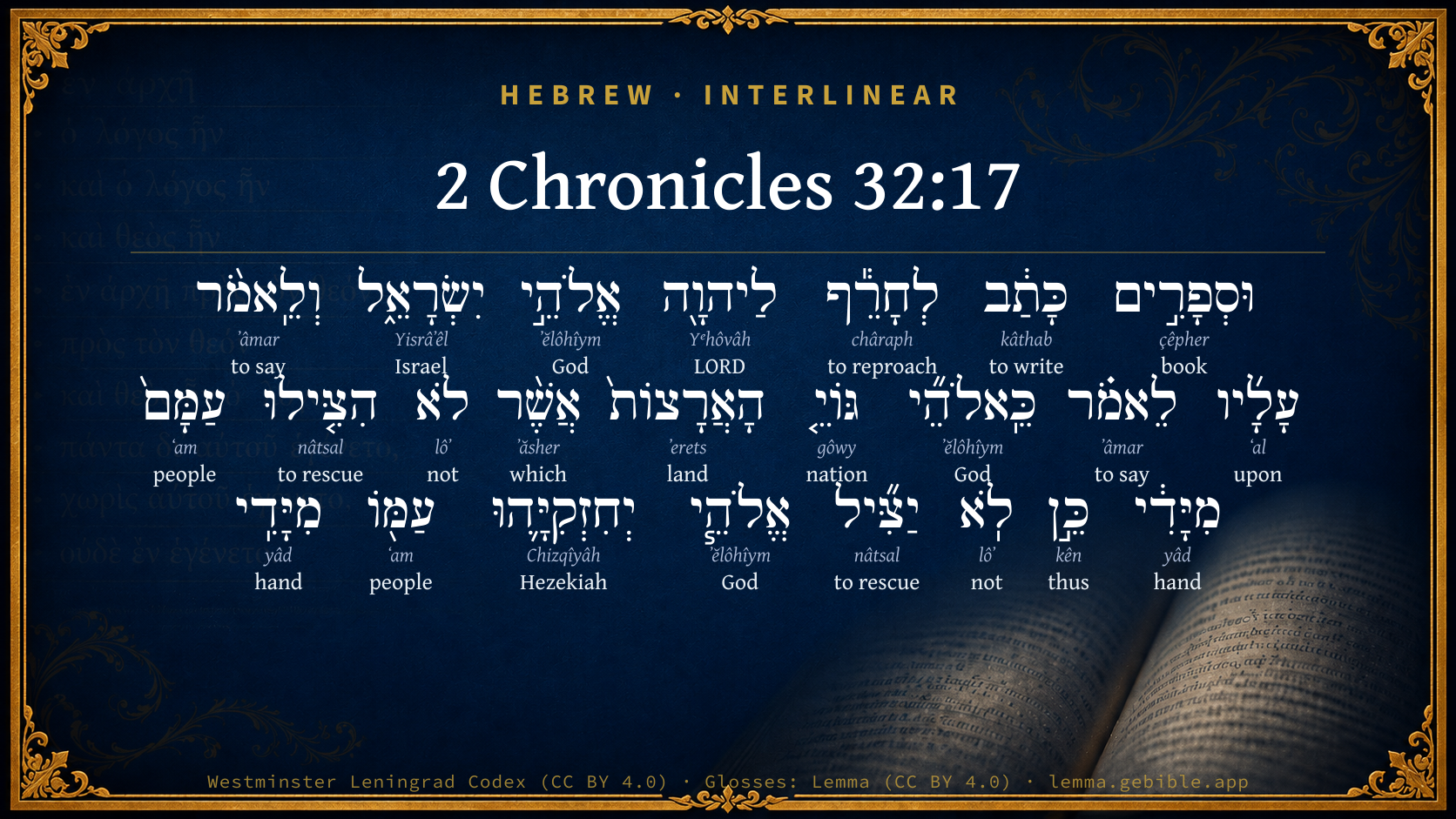
Hebrew (Westminster Leningrad Codex) 2 Chronicles 32:17 appears in the Hebrew Old Testament. The text above is from the Westminster Leningrad Codex. Each word links to its Strong’s number, a concise gloss, and parsing drawn from the Open Scriptures Hebrew Bible morphology. Click any word for its full Brown-Driver-Briggs (BDB) entry.
Download image
Cite this verse

2 Chronicles 32:17 (World English Bible). Public Domain. Lemma interlinear Bible study tool, https://lemma.gebible.app/v/2-chronicles/32/17.

Show BibTeX & RIS
BibTeX
RIS
English Translation
He wrote also letters, to rail on Yahweh, the God of Israel, and to speak against him, saying, As the gods of the nations of the lands, which have not delivered their people out of my hand, so shall the God of Hezekiah not deliver his people out of my hand.
World English Bible · Public Domain
Download a study sheet

One document with this verse’s original text, its word-by-word gloss line, the meaning frame, cross-references with their text, attributed commentary, and full source and license credits — printable, and it pastes into notes with its structure intact.

This verse Autodidact and up

Study sheet (.html) Plain text (.txt)

A passage Seminary Student

Up to 50 verses in one chapter. A passage sheet keeps up to 6 commentary sources and 12 cross-references per verse, in the order this page ranks them, and says so on the sheet whenever that leaves anything out. Ask for a single verse and you get the Autodidact verse sheet above.

Everything on this page stays free to read, with no account — the sheet is a download of what is already on screen, not access to it.

Want to remove ads? Support Godless Engineer
Compare translations 3

The same verse in 3 English versions, stacked beneath the original-language interlinear above. Click any original word for its lexicon entry.

Each is an independent rendering of the whole verse — the interlinear is not word-aligned to these translations.

Highlighted words mark where these versions differ — a whole-verse word diff, not a word-by-word alignment.

  • World English Bible Public Domain
    He wrote also letters, to rail on Yahweh, the God of Israel, and to speak against him, saying, As the gods of the nations of the lands, which have not delivered their people out of my hand, so shall the God of Hezekiah not deliver his people out of my hand.
  • King James Version Public Domain
    He wrote also letters to rail on the LORD God of Israel, and to speak against him, saying, As the gods of the nations of other lands have not delivered their people out of mine hand, so shall not the God of Hezekiah deliver his people out of mine hand.
  • unfoldingWord Literal Text CC BY-SA 4.0
    And letters he wrote to taunt Yahweh, the God of Israel, and to speak against him, saying, “Like the gods of the nations of the lands who did not deliver their people from my hand, thus the God of Hezekiah will not deliver his people from my hand.”

unfoldingWord Literal Text — © unfoldingWord, licensed CC BY-SA 4.0. Word-aligned USFM3 via Door43 (git.door43.org/unfoldingWord/en_ult).

Versions to compare (up to 4)

3 of 4 selected

Show all 18 translations

Every available English version of this verse, each an independent rendering of the whole verse.

  • World English Bible Public Domain
    He wrote also letters, to rail on Yahweh, the God of Israel, and to speak against him, saying, As the gods of the nations of the lands, which have not delivered their people out of my hand, so shall the God of Hezekiah not deliver his people out of my hand.
  • Berean Standard Bible Public Domain
    He also wrote letters mocking the LORD, the God of Israel, and saying against Him: “Just as the gods of the nations did not deliver their people from my hand, so the God of Hezekiah will not deliver His people from my hand.”
  • Majority Standard Bible Public Domain
    He also wrote letters mocking the LORD, the God of Israel, and saying against Him: “Just as the gods of the nations did not deliver their people from my hand, so the God of Hezekiah will not deliver His people from my hand.”
  • King James Version Public Domain
    He wrote also letters to rail on the LORD God of Israel, and to speak against him, saying, As the gods of the nations of other lands have not delivered their people out of mine hand, so shall not the God of Hezekiah deliver his people out of mine hand.
  • American Standard Version (1901) Public Domain
    He wrote also letters, to rail on Jehovah, the God of Israel, and to speak against him, saying, As the gods of the nations of the lands, which have not delivered their people out of my hand, so shall not the God of Hezekiah deliver his people out of my hand.
  • Revised Version (1885) Public Domain
    He wrote also letters, to rail on the LORD, the God of Israel, and to speak against him, saying, As the gods of the nations of the lands which have not delivered their people out of mine hand, so shall not the God of Hezekiah deliver his people out of mine hand.
  • Geneva Bible (1599) Public Domain
    He wrote also letters, blaspheming the Lord God of Israel and speaking against him, saying, As the gods of the nations of other countreies could not deliuer their people out of mine hand, so shall not the God of Hezekiah deliuer his people out of mine hande.
  • Douay-Rheims (1899) Public Domain
    He wrote also letters full of blasphemy against the Lord the God of Israel, and he spoke against him: As the gods of other nations could not deliver their people out of my hand, so neither can the God of Ezechias deliver his people out of this hand.
  • Young's Literal Translation Public Domain
    and letters he hath written to give reproach to Jehovah, God of Israel, and to speak against Him, saying, `As the gods of the nations of the lands that have not delivered their people from my hand, so the God of Hezekiah doth not deliver His people from my hand.'
  • Literal Standard Version CC BY-SA 4.0
    and he has written letters to give reproach to YHWH, God of Israel, and to speak against Him, saying, “As the gods of the nations of the lands that have not delivered their people from my hand, so the God of Hezekiah does not deliver His people from my hand.”
  • Unlocked Literal Bible CC BY-SA 4.0
    Sennacherib also wrote letters in order to mock Yahweh, the God of Israel, and to speak against him. He said, “As the gods of the nations of the lands have not rescued their people out of my hand, so the God of Hezekiah will not rescue his people out of my hand.”
  • unfoldingWord Literal Text CC BY-SA 4.0
    And letters he wrote to taunt Yahweh, the God of Israel, and to speak against him, saying, “Like the gods of the nations of the lands who did not deliver their people from my hand, thus the God of Hezekiah will not deliver his people from my hand.”
  • Darby Bible Public Domain
    And he wrote a letter to rail at Jehovah the God of Israel, and to speak against him saying, As the gods of the nations of the countries have not delivered their people out of my hand, so shall not the God of Hezekiah deliver his people out of my hand.
  • World Messianic Bible Public Domain
    He also wrote letters insulting the LORD, the God of Israel, and speaking against him, saying, “As the gods of the nations of the lands, which have not delivered their people out of my hand, so shall the God of Hezekiah not deliver his people out of my hand.”
  • Webster's Bible Public Domain
    He wrote also letters to rail at the LORD God of Israel, and to speak against him, saying, As the gods of the nations of other lands have not delivered their people out of my hand, so shall not the God of Hezekiah deliver his people out of my hand.
  • Free Bible Version CC BY-SA 4.0
    Sennacherib also wrote letters insulting the Lord, the God of Israel, taunting him by saying, “In the same way the gods of the nations did not save their people from me, so the god of Hezekiah will not save his people from me either.”
  • Bible in Basic English Public Domain
    And he sent letters, in addition, to put shame on the Lord, the God of Israel, and to say evil against him, saying, As the gods of the nations of other lands have not been able to keep their people safe from my hands, no more will the God of Hezekiah keep his people safe from my hands.
  • JPS Tanakh (1917) Public Domain
    He wrote also a letter, to taunt the LORD, the God of Israel, and to speak against Him, saying: 'As the gods of the nations of the lands, which have not delivered their people out of my hand, so shall not the God of Hezekiah deliver His people out of my hand.'

Literal Standard Version (2020), Covenant Press — licensed CC BY-SA 4.0. Text via the HelloAO Bible API (eBible.org). Unlocked Literal Bible (unfoldingWord) — licensed CC BY-SA 4.0. Text via the HelloAO Bible API (eBible.org). unfoldingWord Literal Text — © unfoldingWord, licensed CC BY-SA 4.0. Word-aligned USFM3 via Door43 (git.door43.org/unfoldingWord/en_ult). Free Bible Version, Dr. Jonathan Gallagher — licensed CC BY-SA 4.0. Text via the HelloAO Bible API (eBible.org).

Word by word

More ways to search: Search by grammar → Find every occurrence → Compare this word →

Practice this passage: Drill this verse → Learn its vocabulary →

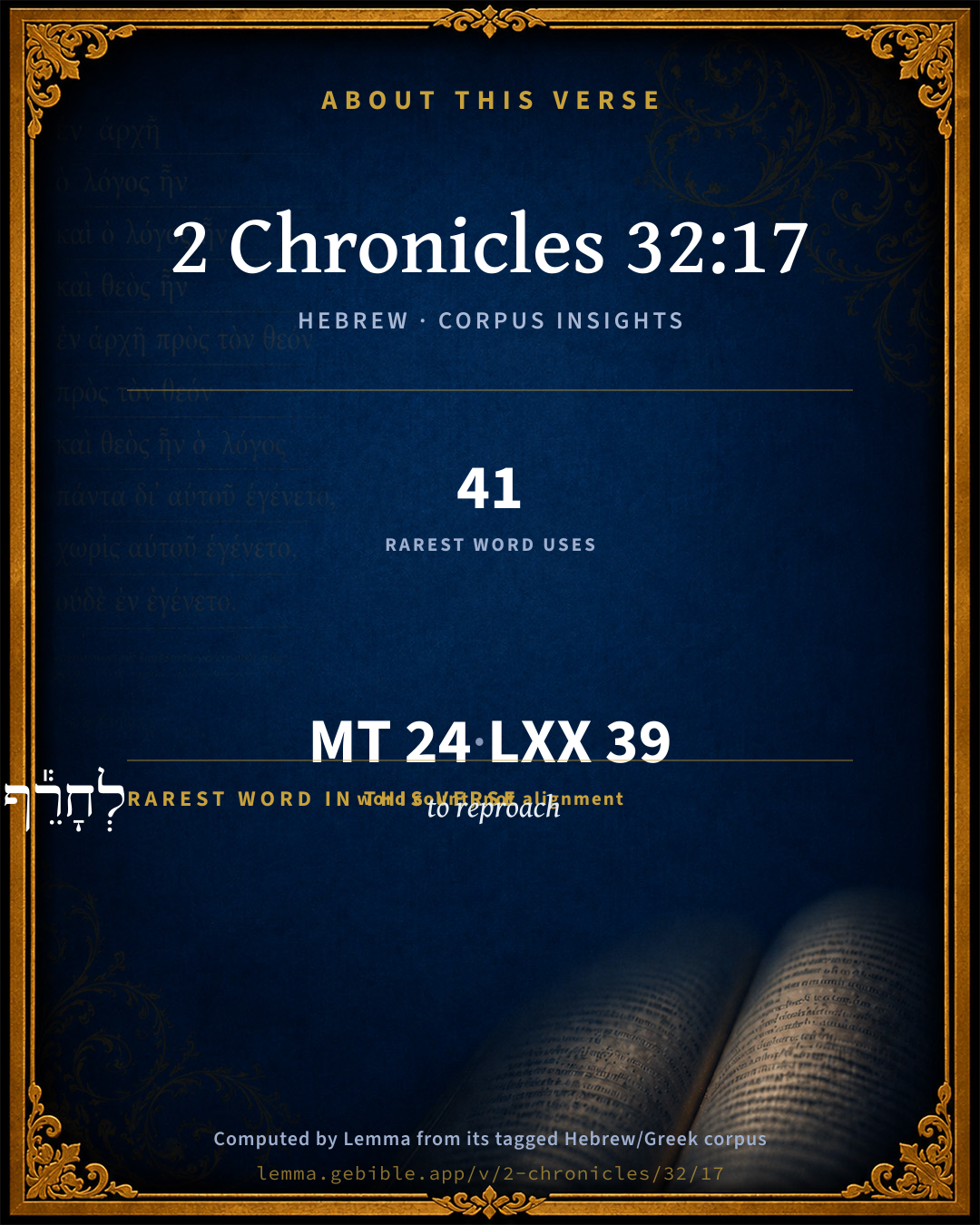
לְחָרֵ֕ף
châraph
H2778
“to reproach”
Preposition + Verb, Piel, Infinitive Construct
Part of Speech
Preposition + Verb
Stem
Piel
Form
Infinitive Construct
Full BDB Definition

Origin: a primitive root

TWOT: 749 , 750 , 751

to reproach, taunt, blaspheme, defy, jeopardise, rail, upbraid - (Qal) to reproach - (Piel) to reproach, defy, taunt - (Qal) to winter, spend harvest time, remain in harvest time - (Niphal) to acquire, be betrothed
  1. וּסְפָרִ֣ים çêpher H5612 “and · books” Conjunction + Noun, Common, Masculine, Plural, Absolute
  2. כָּתַ֔ב kâthab H3789 “to write” Verb, Qal, Perfect, 3rd Person, Masculine, Singular
  3. לַיהוָ֖ה Yᵉhôvâh H3068 “to/for · LORD” Preposition + Noun, Proper
  4. אֱלֹהֵ֣י ʼĕlôhîym H430 “God(s) of” Noun, Common, Masculine, Plural, Construct
  5. יִשְׂרָאֵ֑ל Yisrâʼêl H3478 “Israel” Noun, Proper
  6. וְלֵֽאמֹ֨ר ʼâmar H559 “and · to say” Conjunction + Preposition + Verb, Qal, Infinitive Construct
  7. עָלָ֜יו ʻal H5921 “upon · him” Preposition + Suffix, Personal, 3rd Person, Masculine, Singular
  8. לֵאמֹ֗ר ʼâmar H559 “to say” Preposition + Verb, Qal, Infinitive Construct
  9. כֵּֽאלֹהֵ֞י ʼĕlôhîym H430 “like/as · God(s) of” Preposition + Noun, Common, Masculine, Plural, Construct
  10. גּוֹיֵ֤ gôwy H1471 “nations of” Noun, Common, Masculine, Plural, Construct
  11. הָאֲרָצוֹת֙ ʼerets H776 “the · lands” Particle, Definite Article + Noun, Common, Both, Plural, Absolute
  12. אֲשֶׁ֨ר ʼăsher H834 “which” Particle, Relative
  13. לֹא lôʼ H3808 “not” Particle, Negative
  14. הִצִּ֤ילוּ nâtsal H5337 “to rescue” Verb, Hiphil, Perfect, 3rd Person, Common, Plural
  15. עַמָּם֙ ʻam H5971 “people · their” Noun, Common, Masculine, Singular, Construct + Suffix, Personal, 3rd Person, Masculine, Plural
  16. מִיָּדִ֔י yâd H3027 “from · hand · my” Preposition + Noun, Common, Both, Singular, Construct + Suffix, Personal, 1st Person, Common, Singular
  17. כֵּ֣ן kên H3651 “thus” Particle, Demonstrative
  18. לֹֽא lôʼ H3808 “not” Particle, Negative
  19. יַצִּ֞יל nâtsal H5337 “to rescue” Verb, Hiphil, Imperfect, 3rd Person, Masculine, Singular
  20. אֱלֹהֵ֧י ʼĕlôhîym H430 “God(s) of” Noun, Common, Masculine, Plural, Construct
  21. יְחִזְקִיָּ֛הוּ Chizqîyâh H2396 “Hezekiah” Noun, Proper
  22. עַמּ֖וֹ ʻam H5971 “people · his” Noun, Common, Masculine, Singular, Construct + Suffix, Personal, 3rd Person, Masculine, Singular
  23. מִיָּדִֽי yâd H3027 “from · hand · my” Preposition + Noun, Common, Both, Singular, Construct + Suffix, Personal, 1st Person, Common, Singular

About this verse

These counts appear in no published source. They are computed here, from the morphology-tagged text and Lemma’s own curated glosses. What Lemma adds →

24
words
17
distinct lemmas
Historical
section

Shared distinctive vocabulary

לְחָרֵ֕ף to reproach H2778 occurs in 40 verses of the Hebrew Bible. Also found in:

Grammatical profile

  • 6 verbs
  • 13 nouns
  • 1 preposition
  • 4 particles

Verb forms

  • כָּתַ֔ב Qal · Perfect
  • לְחָרֵ֕ף Piel · Infinitive Construct
  • וְלֵֽאמֹ֨ר Qal · Infinitive Construct
  • לֵאמֹ֗ר Qal · Infinitive Construct
  • הִצִּ֤ילוּ Hiphil · Perfect
  • יַצִּ֞יל Hiphil · Imperfect

Repetition

Words recur within this verse — often emphatic in Hebrew:

  • אֱלֹהֵ֣י God H430 ×3
  • וְלֵֽאמֹ֨ר to say H559 ×2
  • הִצִּ֤ילוּ to rescue H5337 ×2
  • עַמָּם֙ people H5971 ×2
  • מִיָּדִ֔י hand H3027 ×2
  • לֹא not H3808 ×2

Hebrew & Septuagint length

In English translation the verse runs 51 words from the Hebrew and 51 from the Septuagint (LXX English) — the same length.

A rough comparison of the two English renderings, which tokenize alike — not a word-level alignment.

Word counts can differ between the Hebrew and the Greek without any difference in meaning — e.g. the Hebrew direct-object marker אֵת has no separate Greek word, and Greek often adds the article ὁ.

In the original languages it is 24 Hebrew tokens and 39 Greek tokens — but the two are counted differently (Hebrew bundles its prefixes and suffixes into one token; the Greek is in lemma form), so that isn’t a like-for-like length.

Cross-references

11

Topical passages linked to 2 Chronicles 32:17 in the Treasury of Scripture Knowledge — connected by theme and wording, ordered by reader-vote popularity; previews shown in the World English Bible.

  • 2 Kings 19:12 Have the gods of the nations delivered them, which my fathers have destroyed, Gozan, and Haran, and Rezeph, and the children of Eden that were in Telassar?
  • Isaiah 37:14 Hezekiah received the letter from the hand of the messengers, and read it; and Hezekiah went up to the house of Yahweh, and spread it before Yahweh.
  • Isaiah 37:28–29 But I know your sitting down, and your going out, and your coming in, and your raging against me.
  • 2 Kings 19:9 When he heard say of Tirhakah king of Ethiopia, Behold, he is come out to fight against you, he sent messengers again to Hezekiah, saying,
  • 2 Kings 19:14 Hezekiah received the letter from the hand of the messengers, and read it; and Hezekiah went up to the house of Yahweh, and spread it before Yahweh.
  • 2 Kings 19:22 Whom have you defied and blasphemed? and against whom have you exalted your voice and lifted up your eyes on high? [even] against the Holy One of Israel.
  • 2 Kings 19:28 Because of your raging against me, and because your arrogance is come up into my ears, therefore will I put my hook in your nose, and my bridle in your lips, and I will turn you back by the way by which you came.
  • Nehemiah 6:5 Then sent Sanballat his servant to me in like manner the fifth time with an open letter in his hand,
  • Isaiah 10:15 Shall the axe boast itself against him who hews therewith? Shall the saw magnify itself against him who wields it? as if a rod should wield those who lift it up, [or] as if a staff should lift up [him who is] not wood.
  • Isaiah 37:23–24 Whom have you defied and blasphemed? and against whom have you exalted your voice and lifted up your eyes on high? [even] against the Holy One of Israel.
  • Revelation 13:6 He opened his mouth for blasphemy against God, to blaspheme his name, and his dwelling, those who dwell in heaven.

Cross-references courtesy of OpenBible.info (CC BY 4.0).

Hebrew and Greek witnesses Masoretic Hebrew ↔ Greek Septuagint

The same verse in the two great witnesses to the Old Testament, shown verse-for-verse.

These are two independent witnesses, not word-aligned to each other, and the Septuagint is shown in lemma (dictionary) form.

Hebrew 2 Chronicles 32:17 Masoretic · Westminster Leningrad Codex

וּסְפָרִ֣ים כָּתַ֔ב לְחָרֵ֕ף לַיהוָ֖ה אֱלֹהֵ֣י יִשְׂרָאֵ֑ל וְלֵֽאמֹ֨ר עָלָ֜יו לֵאמֹ֗ר כֵּֽאלֹהֵ֞י גּוֹיֵ֤ הָאֲרָצוֹת֙ אֲשֶׁ֨ר לֹא הִצִּ֤ילוּ עַמָּם֙ מִיָּדִ֔י כֵּ֣ן לֹֽא יַצִּ֞יל אֱלֹהֵ֧י יְחִזְקִיָּ֛הוּ עַמּ֖וֹ מִיָּדִֽי

He wrote also letters, to rail on Yahweh, the God of Israel, and to speak against him, saying, As the gods of the nations of the lands, which have not delivered their people out of my hand, so shall the God of Hezekiah not deliver his people out of my hand.

World English Bible · Public Domain

Greek LXX 2 Chronicles 32:17 Septuagint · lemma form

καί βιβλίον γράφω ὀνειδίζω ὁ κύριος θεός ἰσραήλ καί εἶπον περί αὐτός λέγω ὡς θεός ὁ ἔθνος ὁ γῆ οὐ ἐκαἱρέω ὁ λαός αὐτός ἐκ χείρ ἐγώ οὕτως οὐ μή ἐκαἱρέω ὁ θεός εζεκιας λαός αὐτός ἐκ χείρ ἐγώ

And he wrote a letter to reproach the Lord God of Israel, and spoke concerning him, saying, As the gods of the nations of the earth have not delivered their people out of my hand, so the God of Ezekias shall by no means deliver his people out of my hand.

LXX2012 (modern English Septuagint) · Public Domain

Hebrew: Westminster Leningrad Codex (CC BY 4.0). Greek: Septuagint (public domain); English from LXX2012 (modern English Septuagint) (Public Domain). How the Septuagint differs from the Hebrew →

Commentary

Notes on 2 Chronicles 32:17 from classic Christian and Jewish commentators (each source and its license shown beneath its notes). The classic Christian expositions comment on the surrounding passage and are grouped to its opening verse, so a note may address several verses; the Jewish commentaries on the Tanakh (Rashi and others) are per-verse, so they appear only where the commentator wrote on this verse.

Lemma curates 59 commentaries, every one of them public domain or Creative Commons licensed, each selected and text-cleaned for this edition rather than reprinted as found. About our sources →

Trapp's Complete Commentary

John Trapp

2Ch 32:17 He wrote also letters to rail on the LORD God of Israel, and to speak against him, saying, As the gods of the nations of [other] lands have not delivered their people out of mine hand, so shall not the God of Hezekiah deliver his people out of mine hand.

Ver. 17. He wrote also letters.] See 2Ki 19:9; 2Ki 19:14.

John Trapp, A Commentary or Exposition upon All the Books of the Old and New Testament (1647–1656) — public domain. Text from a community e-Sword module.

Adam Clarke's Commentary

Verse 17. Wrote also letters] See 2Kg 19:9; 2Kg 19:14.

Adam Clarke's Commentary on the Bible (1810–1826) — public domain. Text from a community e-Sword/MySword module.

Ellicott's Commentary for English Readers

(17) He wrote also letters to rail on.—And letters wrote he to reproach (Isa_37:23). Sennacherib wrote to Hezekiah demanding submission, after the failure of the mission of the Tartan and his companions (2Ki_19:8-14). If, therefore, the chronicler had been careful about the strictly chronological sequence of events, this verse would have followed rather than preceded 18, 19. As it is, the remark is thrown in here as a parenthesis, in the middle of the account of the behaviour of the Assyrian envoys. Something must be allowed for the necessities of abbreviation, which the author has studied in the entire narrative.

As the gods . . . have not delivered.—Literally, Like the gods of the nations of the countries, which have not delivered. (Comp. 2Ki_19:10; 2Ki_19:12 : “Let not thy God in whom thou trustest deceive thee,” &c.) “Have the gods of the nations delivered them,” &c.

A Bible Commentary for English Readers, edited by Charles John Ellicott (1878–1897) — public domain. Text from a community e-Sword module.

The Cambridge Bible for Schools and Colleges

gen. ed. J. J. S. Perowne

17. to rail on] Or, to defy (the same Heb. word as in 2Sa_23:9).

of other lands have not delivered] R.V. of the lands, which have not delivered.

The Cambridge Bible for Schools and Colleges (gen. ed. J. J. S. Perowne; Cambridge University Press, 1878–1918) — public domain. Text from a community e-Sword module.

John Gill's Exposition

And for this cause Hezekiah the king, and the prophet Isaiah, the son of Amoz, prayed and cried to heaven. To God in heaven; of the prayer of Hezekiah on this account, see Isa 37:15, and the notes there; See Gill on Isa 37:15, Isa 37:16, Isa 37:17, Isa 37:18, Isa 37:19, Isa 37:20 and though we read not of the prayer of Isaiah, no doubt he made one, as Hezekiah desired, and since he received a message from the Lord, which he sent to Hezekiah, Isa 37:4.

.

2 Chronicles 32:21

ch2 32:21

ch2 32:21

ch2 32:21And the Lord sent an angel,.... The Targum is,"the Word of the Lord sent Gabriel;''Josephus (a) takes this angel, or messenger sent of God, to be the pestilence; and others suppose it to be a hot pestilential wind, common in the eastern countries, called "Samiel", or the poison wind, by which multitudes are sometimes destroyed at once; of which Thevenot and other travellers make mention; see Gill on Job 27:21; see Gill on Psa 91:6, but be it as it may, it was sent of God, was under his direction, and by his power and providence did the execution according to his prediction:

which cut off all the mighty men of valour, and the leaders and captains in the camp of the king of Assyria; the generals and officers of his army, with the common soldiers, to the number of 185,000, Isa 36:1, among these, no doubt, were the three generals sent with railing letters to Hezekiah, particularly Rabshakeh; see Gill on Isa 37:36.

so he returned with shame of face to his own land; Assyria, particularly to Nineveh, the metropolis of it, Isa 37:37.

and when he was come into the house of his god; the temple of his idol, whose name was Nisroch:

they that came forth of his own bowels slew him there with the sword; his sons Adrammelech and Sharezer, Isa 37:38.

(a) Antiqu. l. 10. c. 1. sect. 5.

John Gill's Exposition of the Whole Bible (1746–1763) — public domain (CC PDM 1.0). Text via the HelloAO Bible API.

Haydock's Catholic Bible Commentary

He (Sennacherib) wrote, when he was going towards Egypt. Both master and servant employed the same fallacious argument; as if the true God and idols were all upon a level, and as if past success were a sure proof of future victories, v. 19. H.

George Leo Haydock (1774–1849), Haydock's Catholic Family Bible and Commentary, 1859 edition — public domain. Excludes Psalms (Douay-Rheims chapter numbering differs from Protestant) and Deuterocanonical books (Catholic canon only).

The Pulpit Commentary

Letters to rail on the Lord God of Israel. (so 2Ki_19:8-14) The rumour of the approach of "Tirhakah King of Ethiopia" (ver. 9) quickened Sennacherib"s anxiety to make short work with the conflict at Jerusalem, by intimidating the people to an early collapse of their resistance.

The Pulpit Commentary (1880–1919), ed. H.D.M. Spence-Jones & Joseph S. Exell — public domain. Text from a community e-Sword module.

Rashi

Rabbi Shlomo Yitzchaki (Rashi)

And he wrote letters to blaspheme the Lord, the God of Israel And in II Kings (19:14) and in Isaiah (37:14) it is written: “And Hezekiah took the letters from the hand of the messengers and read it; he went up to the House of the Lord, and Hezekiah spread it out before the Lord.”

Rashi on the Tanakh — English translations: “The Judaica Press complete Tanach with Rashi, translated by A. J. Rosenberg” (CC BY 4.0); “Pentateuch with Rashi's commentary by M. Rosenbaum and A.M. Silbermann, 1929-1934” (public domain); “The Metsudah Tanach series, Lakewood, N.J” (CC BY 4.0); and “The Book of Joshua, Metsudah Publications, 1997” (CC BY 4.0). Text via Sefaria.

Lesson kit

Teaching starters — assembled from the data on this page, not authored interpretation. Every prompt links to the verse data it draws on. Edit before teaching.

2 Chronicles, in the Historical, opens this verse with 24 words (17 distinct Hebrew lemmas). Its most distinctive word is châraph (“to reproach”). A historical commentator’s framing appears above. Read the whole chapter for the surrounding context.

Discussion questions

  1. How does “to reproach” (châraph) shape what this verse is saying?
  2. How does Leviticus 19:20, which shares the word «to reproach», read alongside this verse?
  3. What does the repetition of “God” (3× in this one verse) do in this verse?
  4. These translations render this verse differently. What is at stake in choosing one wording over another?
  5. «כָּתַ֔ב» is a Qal Perfect verb. How does that grammatical form shape the action described?
  6. Compare how Trapp's Complete Commentary and Adam Clarke's Commentary read this verse. Where do they agree or differ?

Things to notice

Reading settings

Reading text

Shown beneath each verse's original-language words.

Old Testament
Old Testament edition

Read the OT as the Masoretic Hebrew (MT) or the Greek Septuagint (LXX).

English shown for the Greek Septuagint (in the Hebrew ↔ Greek comparison).

Comparing translations? Open the Compare panel on any verse page to stack up to four side by side.