
Deuteronomy 7:17

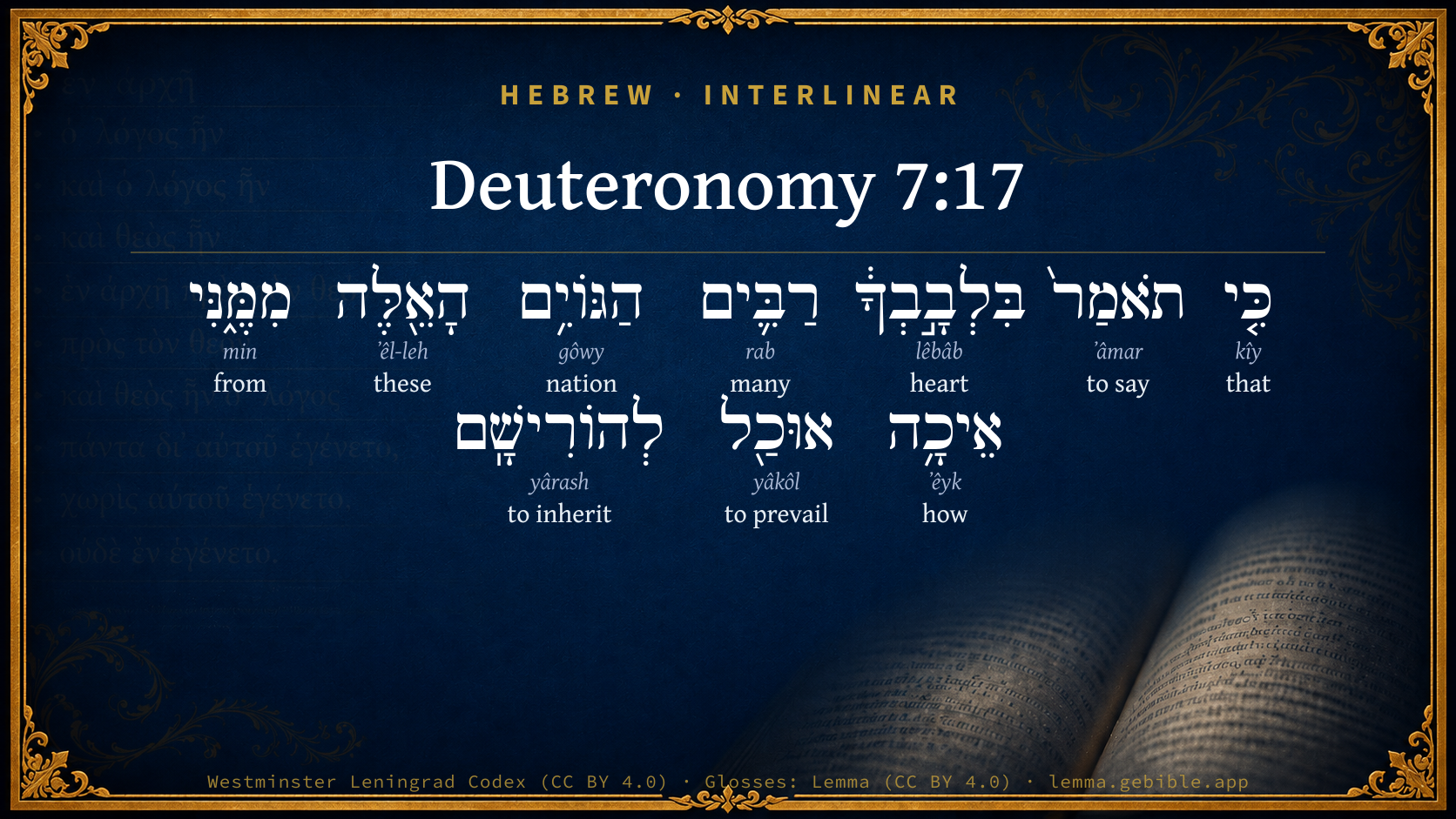
Hebrew (Westminster Leningrad Codex) Deuteronomy 7:17 appears in the Hebrew Old Testament. The text above is from the Westminster Leningrad Codex. Each word links to its Strong’s number, a concise gloss, and parsing drawn from the Open Scriptures Hebrew Bible morphology. Click any word for its full Brown-Driver-Briggs (BDB) entry.
Download image
Cite this verse

Deuteronomy 7:17 (World English Bible). Public Domain. Lemma interlinear Bible study tool, https://lemma.gebible.app/v/deuteronomy/7/17.

Show BibTeX & RIS
BibTeX
RIS
English Translation
If you shall say in your heart, These nations are more than I; how can I dispossess them?
World English Bible · Public Domain
Download a study sheet

One document with this verse’s original text, its word-by-word gloss line, the meaning frame, cross-references with their text, attributed commentary, and full source and license credits — printable, and it pastes into notes with its structure intact.

This verse Autodidact and up

Study sheet (.html) Plain text (.txt)

A passage Seminary Student

Up to 50 verses in one chapter. A passage sheet keeps up to 6 commentary sources and 12 cross-references per verse, in the order this page ranks them, and says so on the sheet whenever that leaves anything out. Ask for a single verse and you get the Autodidact verse sheet above.

Everything on this page stays free to read, with no account — the sheet is a download of what is already on screen, not access to it.

Want to remove ads? Support Godless Engineer
Compare translations 3

The same verse in 3 English versions, stacked beneath the original-language interlinear above. Click any original word for its lexicon entry.

Each is an independent rendering of the whole verse — the interlinear is not word-aligned to these translations.

Highlighted words mark where these versions differ — a whole-verse word diff, not a word-by-word alignment.

  • World English Bible Public Domain
    If you shall say in your heart, These nations are more than I; how can I dispossess them?
  • King James Version Public Domain
    If thou shalt say in thine heart, These nations are more than I; how can I dispossess them?
  • unfoldingWord Literal Text CC BY-SA 4.0
    If you say in your heart, ‘These nations are more numerous than I; how can I dispossess them?’—

unfoldingWord Literal Text — © unfoldingWord, licensed CC BY-SA 4.0. Word-aligned USFM3 via Door43 (git.door43.org/unfoldingWord/en_ult).

Versions to compare (up to 4)

3 of 4 selected

Show all 18 translations

Every available English version of this verse, each an independent rendering of the whole verse.

  • World English Bible Public Domain
    If you shall say in your heart, These nations are more than I; how can I dispossess them?
  • Berean Standard Bible Public Domain
    You may say in your heart, “These nations are greater than we are; how can we drive them out?”
  • Majority Standard Bible Public Domain
    You may say in your heart, “These nations are greater than we are; how can we drive them out?”
  • King James Version Public Domain
    If thou shalt say in thine heart, These nations are more than I; how can I dispossess them?
  • American Standard Version (1901) Public Domain
    If thou shalt say in thy heart, These nations are more than I; how can I dispossess them?
  • Revised Version (1885) Public Domain
    If thou shalt say in thine heart, These nations are more than I; how can I dispossess them?
  • Geneva Bible (1599) Public Domain
    If thou say in thine heart, These nations are moe then I, how can I cast them out?
  • Douay-Rheims (1899) Public Domain
    If thou say in thy heart: These nations are more than I, how shall I be able to destroy them?
  • Young's Literal Translation Public Domain
    `When thou sayest in thine heart, These nations `are' more numerous than I, how am I able to dispossess them? --
  • Literal Standard Version CC BY-SA 4.0
    When you say in your heart, These nations [are] more numerous than I, how am I able to dispossess them?
  • Unlocked Literal Bible CC BY-SA 4.0
    If you say in your heart, 'These nations are more numerous than I; how can I dispossess them?'—
  • unfoldingWord Literal Text CC BY-SA 4.0
    If you say in your heart, ‘These nations are more numerous than I; how can I dispossess them?’—
  • Darby Bible Public Domain
    If thou shouldest say in thy heart, These nations are greater than I; how can I dispossess them?
  • World Messianic Bible Public Domain
    If you shall say in your heart, “These nations are more than I; how can I dispossess them?”
  • Webster's Bible Public Domain
    If thou shalt say in thy heart, These nations are more than I, how can I dispossess them?
  • Free Bible Version CC BY-SA 4.0
    You may say to yourselves, “These nations are stronger than us. How on earth can we drive them out?”
  • Bible in Basic English Public Domain
    If you say in your hearts, These nations are greater in number than we are: how are we to take their land from them?
  • JPS Tanakh (1917) Public Domain
    If thou shalt say in thy heart: 'These nations are more than I; how can I dispossess them?'

Literal Standard Version (2020), Covenant Press — licensed CC BY-SA 4.0. Text via the HelloAO Bible API (eBible.org). Unlocked Literal Bible (unfoldingWord) — licensed CC BY-SA 4.0. Text via the HelloAO Bible API (eBible.org). unfoldingWord Literal Text — © unfoldingWord, licensed CC BY-SA 4.0. Word-aligned USFM3 via Door43 (git.door43.org/unfoldingWord/en_ult). Free Bible Version, Dr. Jonathan Gallagher — licensed CC BY-SA 4.0. Text via the HelloAO Bible API (eBible.org).

Word by word

More ways to search: Search by grammar → Find every occurrence → Compare this word →

Practice this passage: Drill this verse → Learn its vocabulary →

אֵיכָ֥ה
ʼêyk
H349
“how”
Particle, Interrogative
Part of Speech
Particle
Type
Interrogative
Full BDB Definition

Origin: prolonged from H335

TWOT: 75

how? (interrogative adverb) - how! (in lamentation) (interjection) - expression of satisfaction (interjection)
  1. כִּ֤י kîy H3588 “that” Conjunction
  2. תֹאמַר֙ ʼâmar H559 “to say” Verb, Qal, Imperfect, 2nd Person, Masculine, Singular
  3. בִּלְבָ֣בְךָ֔ lêbâb H3824 “in/at · heart · your” Preposition + Noun, Common, Masculine, Singular, Construct + Suffix, Personal, 2nd Person, Masculine, Singular
  4. רַבִּ֛ים rab H7227 “many” Adjective, Adjective, Masculine, Plural, Absolute
  5. הַגּוֹיִ֥ם gôwy H1471 “the · nations” Particle, Definite Article + Noun, Common, Masculine, Plural, Absolute
  6. הָאֵ֖לֶּה ʼêl-leh H428 “the · these” Particle, Definite Article + Pronoun, Demonstrative, Common, Plural
  7. מִמֶּ֑נִּי min H4480 “from · me” Preposition + Suffix, Personal, 1st Person, Common, Singular
  8. אוּכַ֖ל yâkôl H3201 “to prevail” Verb, Qal, Imperfect, 1st Person, Common, Singular
  9. לְהוֹרִישָֽׁם yârash H3423 “to inherit · them” Preposition + Verb, Hiphil, Infinitive Construct + Suffix, Personal, 3rd Person, Masculine, Plural

About this verse

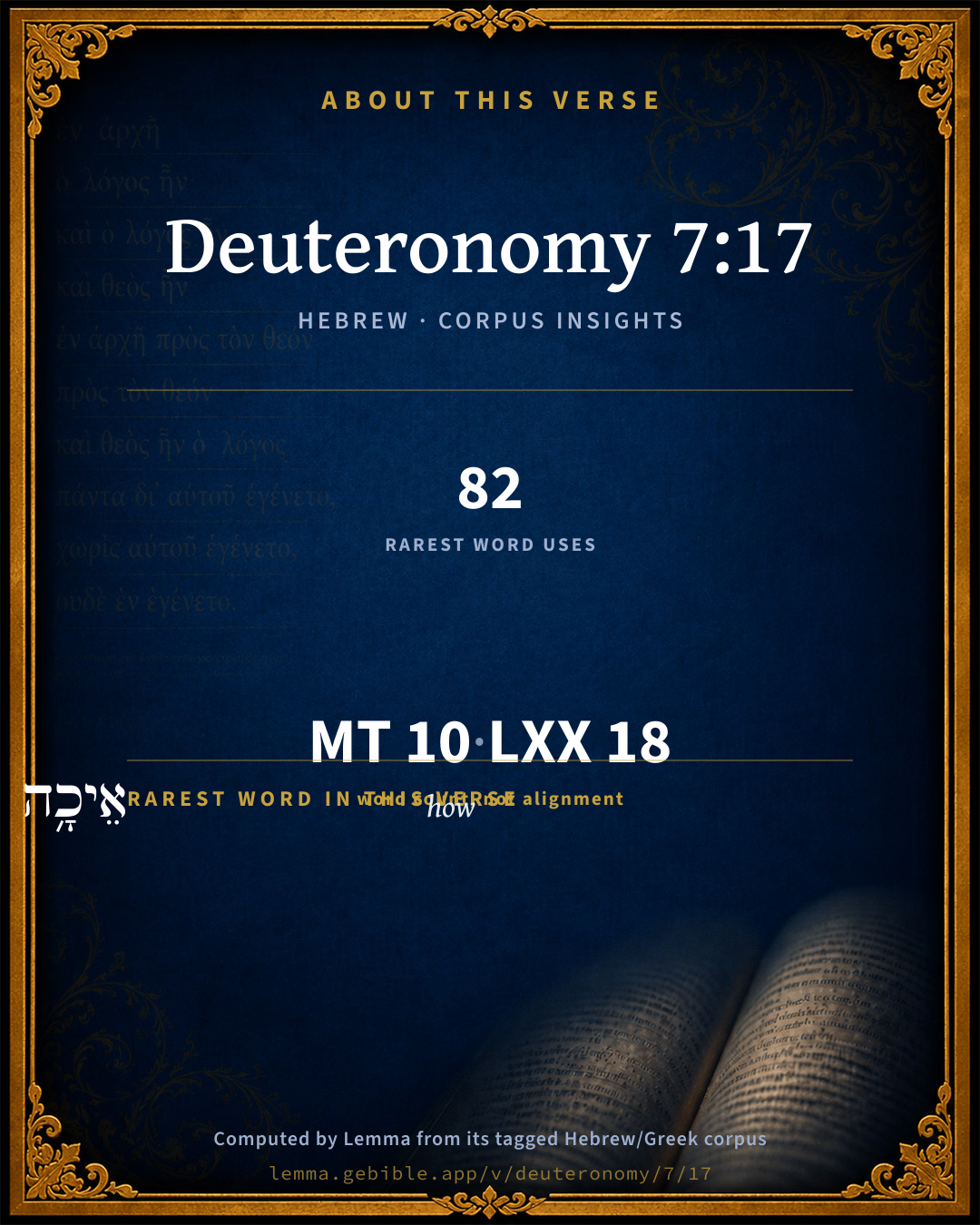
These counts appear in no published source. They are computed here, from the morphology-tagged text and Lemma’s own curated glosses. What Lemma adds →

10
words
10
distinct lemmas
Pentateuch
section

Grammatical profile

  • 3 verbs
  • 2 nouns
  • 1 adjective
  • 1 pronoun
  • 1 preposition
  • 1 conjunction
  • 1 particle

Verb forms

  • תֹאמַר֙ Qal · Imperfect
  • אוּכַ֖ל Qal · Imperfect
  • לְהוֹרִישָֽׁם Hiphil · Infinitive Construct

Hebrew & Septuagint length

In English translation the verse runs 18 words from the Hebrew and 23 from the Septuagint (LXX English) — closely comparable.

A rough comparison of the two English renderings, which tokenize alike — not a word-level alignment.

Word counts can differ between the Hebrew and the Greek without any difference in meaning — e.g. the Hebrew direct-object marker אֵת has no separate Greek word, and Greek often adds the article ὁ.

In the original languages it is 10 Hebrew tokens and 18 Greek tokens — but the two are counted differently (Hebrew bundles its prefixes and suffixes into one token; the Greek is in lemma form), so that isn’t a like-for-like length.

Cross-references

11

Topical passages linked to Deuteronomy 7:17 in the Treasury of Scripture Knowledge — connected by theme and wording, ordered by reader-vote popularity; previews shown in the World English Bible.

  • Numbers 13:32 They brought up an evil report of the land which they had spied out to the children of Israel, saying, The land, through which we have gone to spy it out, is a land that eats up the inhabitants of it; and all the people who we saw in it are men of great stature.
  • Numbers 33:53 and you shall take possession of the land, and dwell therein; for to you have I given the land to possess it.
  • Deuteronomy 8:17 and [lest] you say in your heart, My power and the might of my hand has gotten me this wealth.
  • Deuteronomy 15:9 Beware that there not be a base thought in your heart, saying, The seventh year, the year of release, is at hand; and your eye be evil against your poor brother, and you give him nothing; and he cry to Yahweh against you, and it be sin to you.
  • Deuteronomy 18:21 If you say in your heart, How shall we know the word which Yahweh has not spoken?
  • Joshua 17:16–18 The children of Joseph said, The hill-country is not enough for us: and all the Canaanites who dwell in the land of the valley have chariots of iron, both they who are in Beth-shean and its towns, and they who are in the valley of Jezreel.
  • Isaiah 14:13 You said in your heart, I will ascend into heaven, I will exalt my throne above the stars of God; and I will sit on the mountain of congregation, in the uttermost parts of the north;
  • Isaiah 47:8 Now therefore hear this, you who are given to pleasures, who sit securely, who say in your heart, I am, and there is none else besides me; I shall not sit as a widow, neither shall I know the loss of children:
  • Isaiah 49:21 Then shall you say in your heart, Who has conceived these for me, seeing I have been bereaved of my children, and am solitary, an exile, and wandering back and forth? and who has brought up these? Behold, I was left alone; these, where were they?
  • Luke 9:47 Jesus, perceiving the reasoning of their hearts, took a little child, and set him by his side,
  • Jeremiah 13:22 If you say in your heart, Why are these things come on me? for the greatness of your iniquity are your skirts uncovered, and your heels suffer violence.

Cross-references courtesy of OpenBible.info (CC BY 4.0).

Hebrew and Greek witnesses Masoretic Hebrew ↔ Greek Septuagint

The same verse in the two great witnesses to the Old Testament, shown verse-for-verse.

These are two independent witnesses, not word-aligned to each other, and the Septuagint is shown in lemma (dictionary) form.

Hebrew Deuteronomy 7:17 Masoretic · Westminster Leningrad Codex

כִּ֤י תֹאמַר֙ בִּלְבָ֣בְךָ֔ רַבִּ֛ים הַגּוֹיִ֥ם הָאֵ֖לֶּה מִמֶּ֑נִּי אֵיכָ֥ה אוּכַ֖ל לְהוֹרִישָֽׁם

If you shall say in your heart, These nations are more than I; how can I dispossess them?

World English Bible · Public Domain

Greek LXX Deuteronomy 7:17 Septuagint · lemma form

ἐάν δέ λέγω ἐν ὁ διάνοια σύ ὅτι πολύς ὁ ἔθνος οὗτος ἤ ἐγώ πῶς δύναμαι ἐκὀλεθρεύω αὐτός

But if you should say in your heart, This nation is greater than I, how shall I be able to destroy them utterly?

LXX2012 (modern English Septuagint) · Public Domain

Hebrew: Westminster Leningrad Codex (CC BY 4.0). Greek: Septuagint (public domain); English from LXX2012 (modern English Septuagint) (Public Domain). How the Septuagint differs from the Hebrew →

Targum (Aramaic paraphrase)

2

The Targum is the ancient Jewish Aramaic paraphrase of the Hebrew Scriptures — an interpretive translation, not the Hebrew text itself. Onkelos (literal) and Pseudo-Jonathan (expansive) render the Torah, and Jonathan the Prophets. Coverage is partial: where no permissively-licensed English translation exists for a verse, only the Aramaic is shown. This is verse-level text, not a word-by-word alignment to the Hebrew.

  1. Targum Onkelos Torah (Genesis–Deuteronomy)
    דִילְמָא תֵימַר בְּלִבָּךְ סַגִיאִין עַמְמַיָא הָאִלֵין מִנִי אֶכְדֵין אִכּוּל לְתָרָכוּתְהוֹן

    (no public-domain English translation for this verse)

    Targum Onkelos — Aramaic: “Onkelos Genesis” (public domain); “Onkelos Exodus” (public domain); “Onkelos Leviticus” (public domain); “Onkelos Numbers” (public domain); “Onkelos Deuteronomy” (public domain). English: “Sefaria Community Translation” (CC0 1.0 (public-domain dedication)); “J.W. Etheridge. The Targums of Onkelos and Jonathan Ben Uzziel on the Pentateuch. London: Longmans, Green, 1862” (public domain). Text via Sefaria.

  2. Targum Pseudo-Jonathan Torah (Genesis–Deuteronomy)
    דִּלְמָא תֵימַר בְּלִבָּךְ סַגִּיאִין עַמְמַיָא הָאִלֵּין מִנִּי הֵיכְדֵין אִית לִי יוּכְלָא לְתַרְכוּתְהוֹן

    Neither say in thy heart, These nations are greater and stronger than I am: how shall I be able to drive them out?

    Targum Pseudo-Jonathan — Aramaic: “Targum Jonathan on Genesis” (public domain); “Targum Jonathan on Exodus” (public domain); “Targum Jonathan on Leviticus” (public domain); “Targum Jonathan on Numbers” (public domain); “Targum Jonathan on Deuteronomy” (public domain). English: “The Targum of Jonathan ben Uzziel, trans. J. W. Etheridge, London, 1862” (public domain). Text via Sefaria.

Commentary

Notes on Deuteronomy 7:17 from classic Christian and Jewish commentators (each source and its license shown beneath its notes). The classic Christian expositions comment on the surrounding passage and are grouped to its opening verse, so a note may address several verses; the Jewish commentaries on the Tanakh (Rashi and others) are per-verse, so they appear only where the commentator wrote on this verse.

Lemma curates 59 commentaries, every one of them public domain or Creative Commons licensed, each selected and text-cleaned for this edition rather than reprinted as found. About our sources →

The Biblical Illustrator

Joseph S. Exell

Deu_7:17-18

Thou shalt not be afraid of them: but shalt well remember what the Lord thy God did unto Pharaoh.

Encouragement for the Christian warrior

To a man about to journey into a strange country nothing gives more comfort or confidence than if there be put into his hand, by way of guide through it, a book written by someone who has travelled that country before him. He will read that book not for entertainment, but instruction; that he may learn beforehand how to make his way, what to take with him, what to beware of, and whither to betake himself for rest and refreshment on the way. In like manner the Bible has been given us to make us acquainted with the way itself, with the difficulties and the dangers of it, with the enemies that we shall meet with in it, and our only way of overcoming them.

I. The spiritual state here represented. The Jewish Church in the wilderness may be here regarded as a type or figure of the Church of Christ in the world, and the case of each member of the one as prefiguring in some particulars the condition of each believer in the other. But like as Israel, though free from Egypt and from all fear of being carried thither again, notwithstanding, had not overcome all enemies, but was to fight his way against them and never give them quarter, but fight on till they were utterly destroyed; so now is the believer in Christ called to fight the good fight of faith, and lay hold upon eternal life. We may perceive, then, that the situation of Israel when Moses addressed them in the words of the text, represents to us the present state of the follower of Christ, and the warfare which he has to war under Christ as his captain against the enemies of his salvation.

II. The fears which commonly attend this state. The strength and number of the enemies whom Israel had to fight was well known to that people; but the Lord Himself had repeatedly put them in mind of it, saying continually, after He had numbered them over, that they were seven nations greater and mightier than Israel. But why did God say so? Was it to make them afraid of these nations? No; but to enliven their faith and exercise their dependence upon God. It was quite true, and a notorious truth, that those nations were in point of strength and number quite an overmatch for Israel; so that it was impossible for him in his own strength to dispossess them. It was also true that, till they were dispossessed, the land of promise could not be enjoyed; so that these two considerations, the strength end number of the enemies of Israel and his own weakness, were the more immediate causes of his fears. The fears often felt by the Christian are much of the same kind. His enemies are of three kinds--the world, the flesh, and the devil: mighty all of them, and many; for the world and the flesh and the devil have marshalled under them whole hosts of enemies, of whom anyone, encountered by the Christian in his own strength, would be too strong. And oh I should he compare himself with them, what painful cause has he for the acknowledgment, These are more than I! It is in such a ease too natural for him to look within himself, and, pausing upon what he finds there, ask, almost in despair, How can I dispossess them? But mark how graciously the Lord anticipates, prevents such fears: If thou shalt say in thine heart (He too well knows His people will say so), These nations am more than I: how can I dispossess them?--this is their--

III. Encouragement. Thou shalt not be afraid of them: but shalt well remember, etc. What God had done to Egypt and her king, Israel had seen and knew: it was because of this that they were then where they were, and that they were not in Egypt now; and God calls upon them to remember, for encouragement, what they had been in time past, Pharaohs bondmen in Egypt; and what had been done for their deliverance, and who had been the doer of it, Himself, the Lord their God: thus every word appears to have an emphasis intended to encourage them against their fears. Now, this encouragement, which God addressed to them, may serve as a figure of that which forms the encouragement of every Christian; for it is now the privilege of every Christian to look, for his encouragement, at the redemption wrought for him by Christ. Under all his fears he should remember what a wretched, lost condition Christ redeemed His people from, and how and why He did it. That state is thus described in Eph_2:1. This was the state of every one of us by nature. And how were they set free from it? By no less an act of love than the death of Gods own Son in His dead peoples stead (Rom_5:6). We see, then, that the encouragement of a true Christian, under all his fears and against all the enemies of his soul, is in that sure covenant and rich provision of all things his soul can need, through that redemption which is in Christ Jesus. Does he find the world too strong for him; does he dread the rage and malice of its children who are set against him, or the snares and perils which the God of this world sets about his path? Or does he tremble at that overwhelming crowd of cares which comes upon him daily with his first waking thought? Let him not be afraid of these things, but let him well remember what Christ did for him when he was dead in trespasses and sins; and thus strong in the Lord, and in the power of His might, let him cast all his care on God. Does he dread the power of his own corruptions, and ask, How can I dispossess them? Who shall deliver me from the body of this death? Let him faithfully remember the encouragement suggested by the text, and he shall soon say also with the apostle, I thank God through Jesus Christ our Lord. Or lastly, is he troubled by the fear of death, the last enemy that shall be destroyed? Christ, his Redeemer, through His own death, hath abolished death by destroying him that had the power of death--that is, the devil. In short, the Christians life is hid, and so kept safe from every enemy, with Christ in God. (F. F. Clark, B. A.)

The Biblical Illustrator, edited by Joseph S. Exell (c. 1880s–1900s) — public domain. Text from a community e-Sword module.

The Cambridge Bible for Schools and Colleges

gen. ed. J. J. S. Perowne

17. say in thine heart] say to thyself, or think, or imagine; but with the force of really think, Deu_9:4, Deu_18:21.

The Cambridge Bible for Schools and Colleges (gen. ed. J. J. S. Perowne; Cambridge University Press, 1878–1918) — public domain. Text from a community e-Sword module.

John Gill's Exposition

If thou shall say in thine heart,.... Should have secret thoughts arise in the heart, misgivings of heart, fears and doubts there, which, though not outwardly expressed, might be inwardly retained:

these nations are more than I; seven to one, and perhaps anyone of them as powerful as Israel:

how can I dispossess them? of the land they inherit, and take possession of it.

John Gill's Exposition of the Whole Bible (1746–1763) — public domain (CC PDM 1.0). Text via the HelloAO Bible API.

Whedon's Commentary on the Bible

Daniel D. Whedon

17. How can I dispossess them — The people might again become faint-hearted as they had been years before on the return of the spies. They might ask, How is it possible for us to overcome the seven nations of the land? To encourage them they are once more reminded of what Jehovah did for them in their deliverance from Egypt. The same mighty power would aid them in dispossessing and destroying the nations with whom they are soon to wage war.

Daniel D. Whedon (gen. ed.), Commentary on the Old and New Testaments (1874–1909) — public domain. Text from a community e-Sword module.

The Pulpit Commentary

Vers. 17, 18. If thou shalt say in thine heart. The thought might rise in their minds, How can we ever compete with nations so much more powerful than we? But such thoughts they must repress, remembering what God had done for them to Pharaoh and the Egyptians, and resting assured that the same would he do to the Canaanites.

Verbs. 17-25. An anxious question, or dreading difficulties.

In this paragraph there are some verses which are in the main a repetition of the enforcement of the policy of separation and extrusion which Israel was to adopt towards the Canaanites. But there is one distinctive feature in it which presents several points altogether new, the historical side of which we may first look at, that we may there see how peculiarly full this passage is of bright and gladsome teaching for us.

Here is a question (ver. 18), which Israel would not be unlikely to ask, at least occasionally. Doubtless, just at the time when they were in the flush of joy at the destruction of Pharaoh and his hosts, or when they had experienced some great deliverance from pressing want, their hearts would be brave and strong. But, like some others since have been, they were largely the creatures of circumstance. Now up, now down. Now so elated that they think they can get through anything, now so depressed that they dread everything: The time would come when in view of the possible struggles which the possession of Canaan might involve, many an Israelite would say, "These nations are mightier than I; how can I dispossess them?" and they must have been more than human if the heart did not now and then give way. For there were seven nations to supplant; and over and above the numerical force against which Israel would have to contend, there would be the fact that they were strangers to the land; they had been kept in serfdom; they were unskilled in the art and practice of war; so that, on the human side, the advantage was very greatly with the Canaanites, while Israel incurred a very serious risk. Now, though Jehovah was very wroth with the people when in their guilty unbelief they proposed to turn back at the evil report of the spies, he sees a great difference between a deeply rooted distrust, and an occasional cloud that may shade the spirit; and while in his holy wrath he condemns the first, in his tender compassion he anticipates and guards against the second. Hence, from vers. 18 to 24, we have the cheering voice of the great lawgiver, grandly uttering, in his hundred and twentieth year, words to empower the heart, and showing Israel, in the Name of the Lord of hosts, how much more there is to animate them than there can possibly be to discourage and depress. He

(1) reminds them no fewer than eight times of the Name of the Lord their God;

(2) bids them look back to past miracles and wonders, and to see in them pledges of future help;

(3) shows them how the providential action of God, which" was for them, would be against their foes;

(4) assures them that God would be among them as an ever-present Helper and Friend; and

(5) points out that, though the process of driving out the Canaanites might be slow, yet if it were done more rapidly, it would be attended with great peril from other and unexpected quarters; that both tribes of men and herds of beasts would be kept in abeyance for their sakes; so that though they were led by a tedious route, it would be the safest way! Now, surely we ought not to pass over a passage so full of interest and instruction for our everyday life as this, presenting to us, as it does, two distinct lines of thought.

I THE DIFFICULTIES OF LIFE AS ANXIOUSLY DREADED BY US. "These nations are more than I; how can I dispossess them?" These Israelites were not the only people who have cast glances ahead, and who, foreseeing, as they thought, difficulties in the distance, have exclaimed, "How shall we get through them?" We do not refer now to such as have no living faith in God, and who are perpetually giving way to dark and sinful unbelief; nor have we mainly in view those who have never yet been led out of "the house of bondage." But, keeping as closely as we can to the cases suggested by the paragraph, we refer to those who, through mercy, know what a great deliverance has been wrought for man in Christ; to whom that redemption has become a living power through the energy of the Holy Ghost; and who yet, notwithstanding all, have their moments of despondency, when looking or trying to look far ahead, they see innumerable obstructions confronting them, and ask in anxious sadness, "How can we meet them all?" This main inquiry may take one or more of the following forms:

1. The special ends and aims even of my earthly life; how can I accomplish them?

2. The difficulties in the way of my much-loved work for Christ; how can I overcome them?

3. The hardships to be met in running the Christian race; how can I encounter them?

4. The many hindrances which oppose themselves to the advance of the cause of God; how can the Church overcome them?

5. All the foes, without and within, which threaten the possession of Canaan; how can we vanquish them? Say, is there to be found any believer in whose spirit such questions as these do not now and then arise, and who does not occasionally shiver from the chili of a doubting forecast? Therefore let us see in this passage

II THE DIFFICULTIES OF LIFE GRACIOUSLY ANTICIPATED AND PROVIDED FOR BY GOD. The following points will be found, explicitly or implicitly, in the paragraph:

1. The Lord thy God." That Name is a guarantee of all you want by the way. Greater is he that is for you than all they which can be against you." There is more meaning in that one Name than in all other names besides. If God be for us, who can be against us?

2. God will go before you to clear the way (ver. 20). All nature waits on him. Fire, thunder, lightning, hail; flies, worms, locusts, hornets; ay, men, devils, angels, must do his work when he calls.

3. God will be with you, to empower you in the way (ver. 21). If God is not on our side, there is but weakness, whatever the seeming power. If God is on our side, there is power, whatever the seeming weakness.

4. God will choose his own best methods of helping you in the way (ver. 22). Little by little." A more rapid clearance would have brought other dangers. God "gently clears our way.

5. God"s past deliverances are pledges that he will not forsake you by the way. (vers. 18, 19; see Psa_63:7; Rom_8:32 Rom_5:10)

6. It is one of "the secrets of the Lord," to cause us to meet and grapple with things and beings mightier than we are, that we may cease to rely on ourselves, and be flung upon him, the Almighty One, for strength. The tendency to self-trust and self-laudation is very strong (see. (Deu_8:17, Deu_8:18) Study the history of Gideon, and his band of three hundred men. This education in trust is also an education in holiness. We have, by meeting difficulties which are beyond us, to learn how much we want God. And yet God will not be with us except as we are loyal to him. (see Jos 7) Ah! it is by these difficulties in life, by our manner of meeting them, and by God"s dealing with us under them, that we are to be educated for eternity! Oh! if all were smooth, if we had no complications to meet, no trials to bear, how might we go on drifting down the stream, slumberously calm, dangerously secure, till we awoke, perhaps, too late, to find ourselves a wreck and a ruin! It is by these breaks in our peace, by these cares and hard struggles, which fling us on our God, that we are taught how much we want him, and how ill we could do without him! On the journey of life we have all entered, and the supreme question for us is not, "Will it be smooth or rough?" but "How will it end?

Vers. 17-25. God for us.

The numbers, strength, and fortified security of the seven nations made the conquest of Palestine a task of difficulty, and might naturally produce a disheartening effect on the invaders.

I A NATURAL FEAR. (Ver. 17.) Like disheartening feelings may assail ourselves in presence of the strong spiritual opposition to be encountered in seeking to win the world for Christ. Our enemies are neither weak nor few; we will do well not to underrate them. The larger part of the globe is yet unoccupied by Christianity. Heathen systems are in possession, supported by the combined influences of tradition, custom, prejudice, and superstition, and presenting an apparently impregnable front to the thin ranks of their assailants. At home, how much of the Christianity is merely nominal! and how much of it is corrupted! We live in days of intense worldliness. The skeptical spirit, likewise, is pronounced and active. Brain and pen power of the highest order is enlisted in its service. Unbelieving science, infidel philosophy, rationalism in the Church. The press is a tower of strength to anti-Christian views of life and duty. While, at the other end of the social scale, the multitudes are sunk in indifference and vice. How are all these enemies to be overcome? May we not fear that, work as we will, we cannot succeed? The fears are groundless; but they are not without their use, if they make us feel that the conquest of the world is not to be achieved without much hard fighting.

II A GROUND OF ENCOURAGEMENT. (Vers. 18-22.) This encouragement resolves itself into the simple truth that God is for us. He is mightier than our enemies, and will work on our behalf to secure their overthrow.

1. With supernatural power. In the past he had shown "signs and wonders," and had brought forth his people with a mighty hand (vers. 18, 19). The same power would help them still. It is encouraging to recall the supernatural strength for conquest which the gospel has already displayed. Think of our own land penetrated by a faith which sprang up 1800 years ago in remote, despised Judaea, with churches for Christ"s worship dotting almost every street of every city, town, village, hamlet, throughout its length and breadth! How Utopian would such a work of conquest have seemed at the beginning a dream of insanity! And this Divine energy for conquest inheres in the gospel today as truly as it did of old.

2. With providential aids (ver. 20). Hornets types of secret, providential allies working under God"s direction. The forces of providence are on the side of those who are working for the advancement of his kingdom. There are such secret allies in men"s own hearts. We may compare to the hornets the secret thoughts and feelings the stings of conscience, guilty fears, feelings of dissatisfaction, etc. which, operating within, drive men out to join issue with the Spirit in his truth. God has his "hornets" also for arousing his own children out of their sloth and self-indulgence and forgetfulness of duty sharp trials, vexations, griefs, etc.

III A METHOD OF CONQUEST. "Little by little" (ver. 22). A law of providence and grace. Little by little God gives a man conquest over the evil in self, and his nature is sanctified. Little by little the world is conquered for Christ. The reason of the law is obvious. There is no advantage in having more than can be rightly used; e.g. a man who has more money than he can turn to good account, who has a larger estate than he can manage, who reads more books than he can mentally digest. The best method is "little by little mastering, consolidating, using what we have, before hasting to get more. J.O.

Vers. 17-26. Canaan gradually won.

The winning of the whole land seemed a great task too great for sense and sight. But the Divine programs, though comprehensive, are taken in detail. The Israelites are to win the country little by little, and remove the people gradually. In this patient work they may expect the co-operation of God.

I THE WORK BEFORE US SEEMS OF OVERPOWERING DIMENSIONS. MUST we win a victory over all the evil within us? and then contemplate a victory over all the evil around us? Both problems are vast. The more we know our own hearts, the greater seems the extent to be won. The more we know of the world around us, the more appalling seems the proposal of God. It is a great work we are asked to do certainly.

II BUT BY PAST DELIVERANCES OF GOD ARE INTENDED TO REINFORCE OUR FAITH. Just as the mighty deliverance from Egypt was set before the Israelites to encourage them in their invasion, so our individual conversion should reinforce our faith in the power of God. The God who can conquer such hearts as ours can surely help us in further conquests. We hope for victory because of victory already won.

III VICTORY IN DETAIL IS BETTER THAN VICTORY WHOLESALE. We imagine that victory at once over all internal and external enemies would be better than victory covering long years and entering into vast details. But, if Israel had been able to smite all the Canaanites dead at a blow, the beasts of the field would have so overrun the land that it would have been reduced to wilderness, instead of being a land of promise. It is better, therefore, to overcome the Canaanites gradually. They will protect the inheritance from the wild beasts till the heirs arrive. In like manner, it is better

1. To beat our sins in detail. We are better acquainted with our own nature and God"s grace when we have to deal with our sins in detail. We get gradually better and purer and more humble. This is better than a leap into perfection out of sin.

2. It is better to win the world in detail. God is not going to give the earth to his people some fine morning, and save us the trouble of winning it. It is better for us to plod on, winning country after country, and individual after individual, and the whole world at last.

3. The Promised Land is to be made a holy land. The Israelites were to remove, the Canaanites and their abominable modes of life and worship, to make of Palestine a holy land. Jerusalem Elkoods the holy city, is to be the expression of the Divine idea.

Let us conform our hopes to God"s magnificent designs, believing that the gradual is generally the best, the microscopic work the most beautiful in the end. R.M.E.

The Pulpit Commentary (1880–1919), ed. H.D.M. Spence-Jones & Joseph S. Exell — public domain. Text from a community e-Sword module.

unfoldingWord translationNotes

Door43 World Missions Community

General Information:

Moses continues to tell the people of Israel Yahweh's words as if the Israelites are one person. (See: Forms of You)

If you say in your heart ... do not be afraid

The people should not be afraid even if they notice that the nations are stronger than they are. AT: "Even if you say in your heart" (See: Idiom)

say in your heart

This is an idiom. AT: "think" (See: Idiom)

how can I dispossess them?

Moses uses a question to emphasize that the people may feel afraid of the other nations. This question can be translated as a statement. AT: "I cannot defeat them" (See: Rhetorical Question)

you will call to mind

This is an idiom. AT: "you must remember" (See: Idiom)

that your eyes saw

Here "eyes" represent the whole person. AT: "that you saw" (See: Synecdoche)

the mighty hand, and the outstretched arm

Here "a mighty hand" and "an outstretched arm" are metaphors for Yahweh's power. See how you translated this in Deuteronomy 4:34. AT: "and the mighty power" (See: Metaphor)

translationWords

heart

nation

fear

mind

Pharaoh

Egypt

suffer

miracle

might

hand

power

people group

unfoldingWord translationNotes — © Distant Shores Media and the Door43 World Missions Community, licensed CC BY-SA 4.0. Source: git.door43.org/Door43/en_tn.

Rashi

Rabbi Shlomo Yitzchaki (Rashi)

כי תאמר בלבבך — You must admit that the word כי here denotes “perhaps": perhaps thou wilt say in thy heart, “Because they are many, I shall be unable to dispossess them". Do not speak thus, לא תירא מהם THOU SHALT NOT BE AFRAID OF THEM. — For it is not possible to explain it in one of the three other meanings of כי so that the words לא תירא מהם will then appropriately fit in with it.

Rashi on the Tanakh — English translations: “The Judaica Press complete Tanach with Rashi, translated by A. J. Rosenberg” (CC BY 4.0); “Pentateuch with Rashi's commentary by M. Rosenbaum and A.M. Silbermann, 1929-1934” (public domain); “The Metsudah Tanach series, Lakewood, N.J” (CC BY 4.0); and “The Book of Joshua, Metsudah Publications, 1997” (CC BY 4.0). Text via Sefaria.

Lesson kit

Teaching starters — assembled from the data on this page, not authored interpretation. Every prompt links to the verse data it draws on. Edit before teaching.

Deuteronomy, in the Pentateuch, opens this verse with 10 words (10 distinct Hebrew lemmas). Its most distinctive word is ʼêyk (“how”). A historical commentator’s framing appears above. Read the whole chapter for the surrounding context.

Discussion questions

  1. The word ʼêyk carries the sense “how.” How does it shape the verse?
  2. Numbers 13:32 shares this passage’s theme. How do the two illuminate each other?
  3. These translations render this verse differently. What is at stake in choosing one wording over another?
  4. The verb «תֹאמַר֙» is Qal Imperfect. How does its form color the action?
  5. Reading how The Biblical Illustrator and The Cambridge Bible for Schools and Colleges read this verse, where do the two commentators agree and where do they part?

Things to notice

Reading settings

Reading text

Shown beneath each verse's original-language words.

Old Testament
Old Testament edition

Read the OT as the Masoretic Hebrew (MT) or the Greek Septuagint (LXX).

English shown for the Greek Septuagint (in the Hebrew ↔ Greek comparison).

Comparing translations? Open the Compare panel on any verse page to stack up to four side by side.