
Deuteronomy 28:36

Hebrew (Westminster Leningrad Codex) Deuteronomy 28:36 appears in the Hebrew Old Testament. The text above is from the Westminster Leningrad Codex. Each word links to its Strong’s number, a concise gloss, and parsing drawn from the Open Scriptures Hebrew Bible morphology. Click any word for its full Brown-Driver-Briggs (BDB) entry.
Download image
Cite this verse

Deuteronomy 28:36 (World English Bible). Public Domain. Lemma interlinear Bible study tool, https://lemma.gebible.app/v/deuteronomy/28/36.

Show BibTeX & RIS
BibTeX
RIS
English Translation
Yahweh will bring you, and your king whom you shall set over you, to a nation that you have not known, you nor your fathers; and there shall you serve other gods, wood and stone.
World English Bible · Public Domain
Download a study sheet

One document with this verse’s original text, its word-by-word gloss line, the meaning frame, cross-references with their text, attributed commentary, and full source and license credits — printable, and it pastes into notes with its structure intact.

This verse Autodidact and up

Study sheet (.html) Plain text (.txt)

A passage Seminary Student

Up to 50 verses in one chapter. A passage sheet keeps up to 6 commentary sources and 12 cross-references per verse, in the order this page ranks them, and says so on the sheet whenever that leaves anything out. Ask for a single verse and you get the Autodidact verse sheet above.

Everything on this page stays free to read, with no account — the sheet is a download of what is already on screen, not access to it.

Want to remove ads? Support Godless Engineer
Compare translations 3

The same verse in 3 English versions, stacked beneath the original-language interlinear above. Click any original word for its lexicon entry.

Each is an independent rendering of the whole verse — the interlinear is not word-aligned to these translations.

Highlighted words mark where these versions differ — a whole-verse word diff, not a word-by-word alignment.

  • World English Bible Public Domain
    Yahweh will bring you, and your king whom you shall set over you, to a nation that you have not known, you nor your fathers; and there shall you serve other gods, wood and stone.
  • King James Version Public Domain
    The LORD shall bring thee, and thy king which thou shalt set over thee, unto a nation which neither thou nor thy fathers have known; and there shalt thou serve other gods, wood and stone.
  • unfoldingWord Literal Text CC BY-SA 4.0
    Yahweh will lead you and your king that you will raise up over yourself to a nation that you have not known, you nor your fathers, and there you will serve other gods, wood and stone.

unfoldingWord Literal Text — © unfoldingWord, licensed CC BY-SA 4.0. Word-aligned USFM3 via Door43 (git.door43.org/unfoldingWord/en_ult).

Versions to compare (up to 4)

3 of 4 selected

Show all 18 translations

Every available English version of this verse, each an independent rendering of the whole verse.

  • World English Bible Public Domain
    Yahweh will bring you, and your king whom you shall set over you, to a nation that you have not known, you nor your fathers; and there shall you serve other gods, wood and stone.
  • Berean Standard Bible Public Domain
    The LORD will bring you and the king you appoint to a nation neither you nor your fathers have known, and there you will worship other gods—gods of wood and stone.
  • Majority Standard Bible Public Domain
    The LORD will bring you and the king you appoint to a nation neither you nor your fathers have known, and there you will worship other gods—gods of wood and stone.
  • King James Version Public Domain
    The LORD shall bring thee, and thy king which thou shalt set over thee, unto a nation which neither thou nor thy fathers have known; and there shalt thou serve other gods, wood and stone.
  • American Standard Version (1901) Public Domain
    Jehovah will bring thee, and thy king whom thou shalt set over thee, unto a nation that thou hast not known, thou nor thy fathers; and there shalt thou serve other gods, wood and stone.
  • Revised Version (1885) Public Domain
    The LORD shall bring thee, and thy king which thou shalt set over thee, unto a nation which thou hast not known, thou nor thy fathers; and there shalt thou serve other gods, wood and stone.
  • Geneva Bible (1599) Public Domain
    The Lord shall bring thee and thy King (which thou shalt set ouer thee) vnto a nation, which neither thou nor thy fathers haue knowen, and there thou shalt serue other gods: euen wood and stone,
  • Douay-Rheims (1899) Public Domain
    The Lord shall bring thee, and thy king, whom thou shalt have appointed over thee, into a nation which thou and thy fathers know not: and there thou shalt serve strange gods, wood and stone.
  • Young's Literal Translation Public Domain
    `Jehovah doth cause thee to go, and thy king whom thou raisest up over thee, unto a nation which thou hast not known, thou and thy fathers, and thou hast served there other gods, wood and stone;
  • Literal Standard Version CC BY-SA 4.0
    YHWH causes you and your king whom you raise up over you to go to a nation which you have not known, you and your fathers, and you have served other gods there—wood and stone;
  • Unlocked Literal Bible CC BY-SA 4.0
    Yahweh will take you and the king whom you will place over yourself to a nation that you have not known, neither you nor your ancestors; there you will worship other gods of wood and stone.
  • unfoldingWord Literal Text CC BY-SA 4.0
    Yahweh will lead you and your king that you will raise up over yourself to a nation that you have not known, you nor your fathers, and there you will serve other gods, wood and stone.
  • Darby Bible Public Domain
    Jehovah will bring thee, and thy king whom thou shalt set over thee, unto a nation that neither thou nor thy fathers have known, and there shalt thou serve other gods, wood and stone.
  • World Messianic Bible Public Domain
    The LORD will bring you, and your king whom you will set over yourselves, to a nation that you have not known, you nor your fathers. There you will serve other gods of wood and stone.
  • Webster's Bible Public Domain
    The LORD shall bring thee, and thy king which thou shalt set over thee, to a nation which neither thou nor thy fathers have known; and there shalt thou serve other gods, wood and stone.
  • Free Bible Version CC BY-SA 4.0
    The Lord will exile you and your chosen king to a foreign nation that neither you nor your forefathers have ever heard of. There you will worship other gods, idols made of wood and stone.
  • Bible in Basic English Public Domain
    And you, and the king whom you have put over you, will the Lord take away to a nation strange to you and to your fathers; there you will be servants to other gods of wood and stone.
  • JPS Tanakh (1917) Public Domain
    The LORD will bring thee, and thy king whom thou shalt set over thee, unto a nation that thou hast not known, thou nor thy fathers; and there shalt thou serve other gods, wood and stone.

Literal Standard Version (2020), Covenant Press — licensed CC BY-SA 4.0. Text via the HelloAO Bible API (eBible.org). Unlocked Literal Bible (unfoldingWord) — licensed CC BY-SA 4.0. Text via the HelloAO Bible API (eBible.org). unfoldingWord Literal Text — © unfoldingWord, licensed CC BY-SA 4.0. Word-aligned USFM3 via Door43 (git.door43.org/unfoldingWord/en_ult). Free Bible Version, Dr. Jonathan Gallagher — licensed CC BY-SA 4.0. Text via the HelloAO Bible API (eBible.org).

Word by word

More ways to search: Search by grammar → Find every occurrence → Compare this word →

Practice this passage: Drill this verse → Learn its vocabulary →

אֲחֵרִ֖ים
ʼachêr
H312
“other”
Adjective, Adjective, Masculine, Plural, Absolute
Part of Speech
Adjective
Type
Adjective
Gender
Masculine
Number
Plural
State
Absolute
Full BDB Definition

Origin: from H309

TWOT: 68a

another, other, following - following, further - other, different
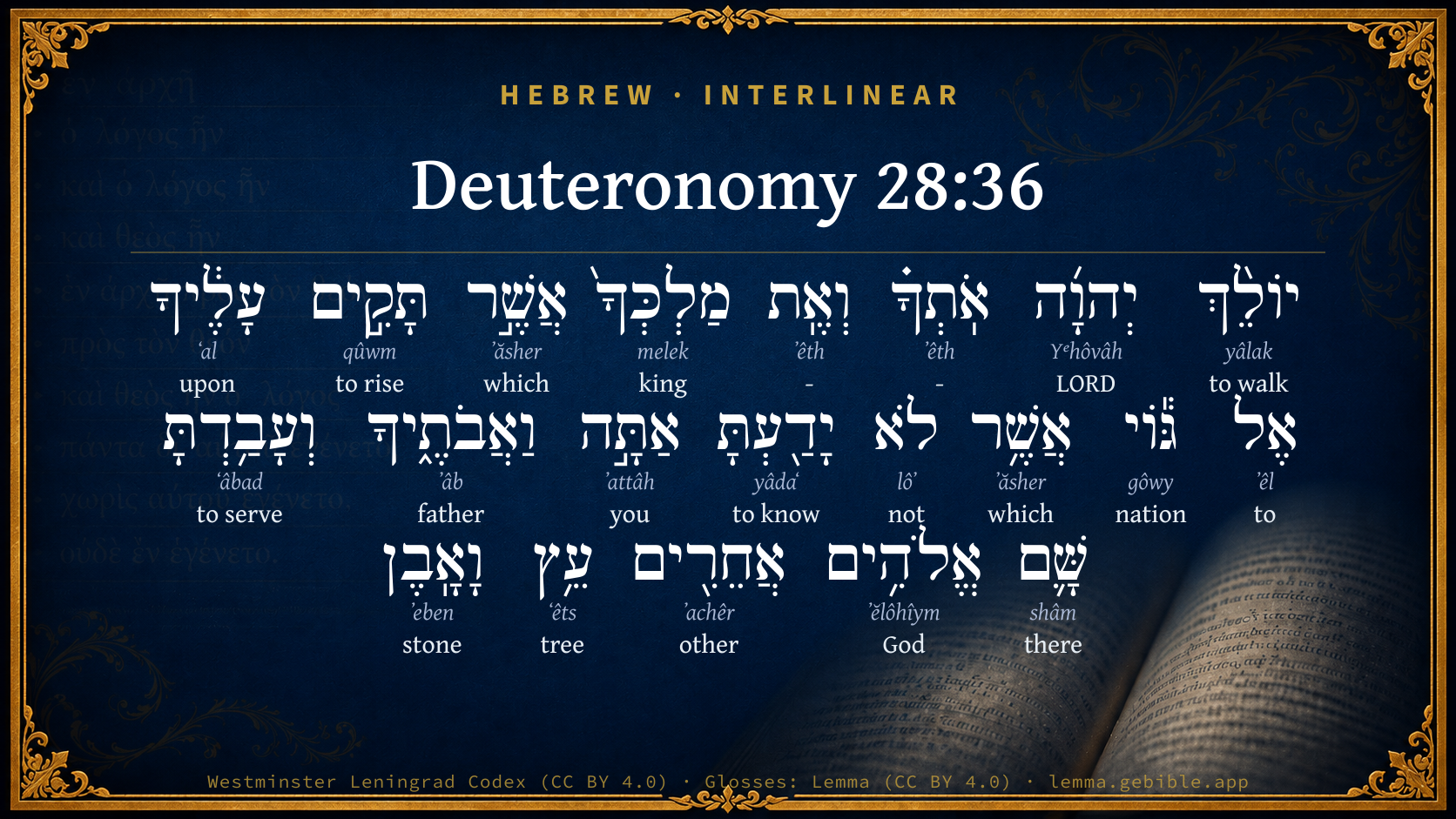
  1. יוֹלֵ֨ךְ yâlak H3212 “to walk” Verb, Hiphil, Imperfect, 3rd Person, Masculine, Singular
  2. יְהוָ֜ה Yᵉhôvâh H3068 “LORD” Noun, Proper
  3. אֹֽתְךָ֗ ʼêth H853 “- · you” Particle, Direct Object + Suffix, Personal, 2nd Person, Masculine, Singular
  4. וְאֶֽת ʼêth H853 “and · -” Conjunction + Particle, Direct Object
  5. מַלְכְּךָ֙ melek H4428 “king · your” Noun, Common, Masculine, Singular, Construct + Suffix, Personal, 2nd Person, Masculine, Singular
  6. אֲשֶׁ֣ר ʼăsher H834 “which” Particle, Relative
  7. תָּקִ֣ים qûwm H6965 “to rise” Verb, Hiphil, Imperfect, 2nd Person, Masculine, Singular
  8. עָלֶ֔יךָ ʻal H5921 “upon · you” Preposition + Suffix, Personal, 2nd Person, Masculine, Singular
  9. אֶל ʼêl H413 “to” Preposition
  10. גּ֕וֹי gôwy H1471 “nation” Noun, Common, Masculine, Singular, Absolute
  11. אֲשֶׁ֥ר ʼăsher H834 “which” Particle, Relative
  12. לֹא lôʼ H3808 “not” Particle, Negative
  13. יָדַ֖עְתָּ yâdaʻ H3045 “to know” Verb, Qal, Perfect, 2nd Person, Masculine, Singular
  14. אַתָּ֣ה ʼattâh H859 “you” Pronoun, Personal, 2nd Person, Masculine, Singular
  15. וַאֲבֹתֶ֑יךָ ʼâb H1 “and · fathers · your” Conjunction + Noun, Common, Masculine, Plural, Construct + Suffix, Personal, 2nd Person, Masculine, Singular
  16. וְעָבַ֥דְתָּ ʻâbad H5647 “and · to serve” Conjunction + Verb, Qal, Sequential Perfect, 2nd Person, Masculine, Singular
  17. שָּׁ֛ם shâm H8033 “there” Adverb
  18. אֱלֹהִ֥ים ʼĕlôhîym H430 “God(s)” Noun, Common, Masculine, Plural, Absolute
  19. עֵ֥ץ ʻêts H6086 “tree” Noun, Common, Masculine, Singular, Absolute
  20. וָאָֽבֶן ʼeben H68 “and · stone” Conjunction + Noun, Common, Feminine, Singular, Absolute

About this verse

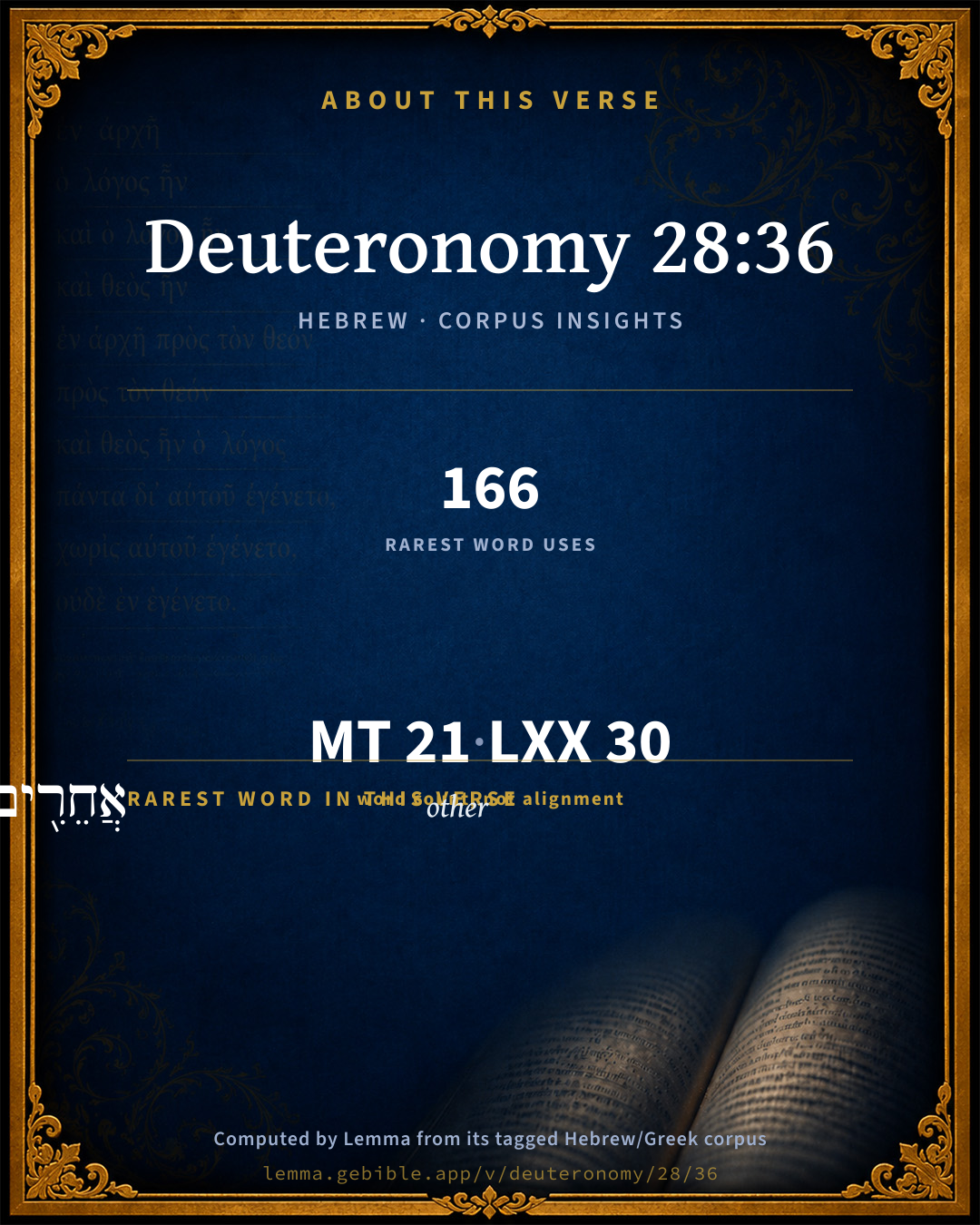
These counts appear in no published source. They are computed here, from the morphology-tagged text and Lemma’s own curated glosses. What Lemma adds →

21
words
19
distinct lemmas
Pentateuch
section

Grammatical profile

  • 4 verbs
  • 7 nouns
  • 1 adjective
  • 1 pronoun
  • 2 prepositions
  • 1 adverb
  • 5 particles

Verb forms

  • יוֹלֵ֨ךְ Hiphil · Imperfect
  • תָּקִ֣ים Hiphil · Imperfect
  • יָדַ֖עְתָּ Qal · Perfect
  • וְעָבַ֥דְתָּ Qal · Sequential Perfect

Repetition

A word recurs within this verse — often emphatic in Hebrew:

  • אֲשֶׁ֣ר which H834 ×2

Hebrew & Septuagint length

In English translation the verse runs 35 words from the Hebrew and 34 from the Septuagint (LXX English) — closely comparable.

A rough comparison of the two English renderings, which tokenize alike — not a word-level alignment.

Word counts can differ between the Hebrew and the Greek without any difference in meaning — e.g. the Hebrew direct-object marker אֵת has no separate Greek word, and Greek often adds the article ὁ.

In the original languages it is 21 Hebrew tokens and 30 Greek tokens — but the two are counted differently (Hebrew bundles its prefixes and suffixes into one token; the Greek is in lemma form), so that isn’t a like-for-like length.

Cross-references

21

Topical passages linked to Deuteronomy 28:36 in the Treasury of Scripture Knowledge — connected by theme and wording, ordered by reader-vote popularity; previews shown in the World English Bible.

  • Deuteronomy 4:28 There you shall serve gods, the work of men's hands, wood and stone, which neither see, nor hear, nor eat, nor smell.
  • 2 Kings 25:11 The residue of the people who were left in the city, and those who fell away, who fell to the king of Babylon, and the residue of the multitude, did Nebuzaradan the captain of the guard carry away captive.
  • Jeremiah 16:13 therefore will I cast you forth out of this land into the land that you have not known, neither you nor your fathers; and there shall you serve other gods day and night; for I will show you no favor.
  • 2 Chronicles 36:6 Against him came up Nebuchadnezzar king of Babylon, and bound him in fetters, to carry him to Babylon.
  • 2 Chronicles 36:20 Those who had escaped from the sword carried he away to Babylon; and they were servants to him and his sons until the reign of the kingdom of Persia:
  • Deuteronomy 28:64 Yahweh will scatter you among all peoples, from the one end of the earth even to the other end of the earth; and there you shall serve other gods, which you have not known, you nor your fathers, even wood and stone.
  • 2 Chronicles 33:11 Therefore Yahweh brought on them the captains of the host of the king of Assyria, who took Manasseh in chains, and bound him with fetters, and carried him to Babylon.
  • 2 Chronicles 36:17 Therefore he brought on them the king of the Chaldeans, who killed their young men with the sword in the house of their sanctuary, and had no compassion on young man or virgin, old man or gray-headed: he gave them all into his hand.
  • Jeremiah 39:5–7 But the army of the Chaldeans pursued after them, and overtook Zedekiah in the plains of Jericho: and when they had taken him, they brought him up to Nebuchadrezzar king of Babylon to Riblah in the land of Hamath; and he gave judgment on him.
  • 2 Kings 17:4–6 The king of Assyria found conspiracy in Hoshea; for he had sent messengers to So king of Egypt, and offered no tribute to the king of Assyria, as he had done year by year: therefore the king of Assyria shut him up, and bound him in prison.
  • 2 Kings 24:12–15 and Jehoiachin the king of Judah went out to the king of Babylon, he, and his mother, and his servants, and his princes, and his officers: and the king of Babylon took him in the eighth year of his reign.
  • 2 Kings 25:6–7 Then they took the king, and carried him up to the king of Babylon to Riblah; and they gave judgment on him.
  • Isaiah 39:7 Of your sons who shall issue from you, whom you shall father, shall they take away; and they shall be eunuchs in the palace of the king of Babylon.
  • Jeremiah 22:11–12 For thus says Yahweh touching Shallum the son of Josiah, king of Judah, who reigned instead of Josiah his father, [and] who went forth out of this place: He shall not return there any more.
  • Jeremiah 22:24–27 As I live, says Yahweh, though Coniah the son of Jehoiakim king of Judah were the signet on my right hand, yet would I pluck you there;
  • Jeremiah 24:8–10 As the bad figs, which can't be eaten, they are so bad, surely thus says Yahweh, So will I give up Zedekiah the king of Judah, and his princes, and the residue of Jerusalem, who remain in this land, and those who dwell in the land of Egypt,
  • Jeremiah 52:8–11 But the army of the Chaldeans pursued after the king, and overtook Zedekiah in the plains of Jericho; and all his army was scattered from him.
  • Lamentations 4:20 The breath of our nostrils, the anointed of Yahweh, was taken in their pits; Of whom we said, Under his shadow we shall live among the nations.
  • Ezekiel 12:12–13 The prince who is among them shall bear on his shoulder in the dark, and shall go forth: they shall dig through the wall to carry out thereby: he shall cover his face, because he shall not see the land with his eyes.
  • Ezekiel 20:32–33 and that which comes into your mind shall not be at all, in that you say, We will be as the nations, as the families of the countries, to serve wood and stone.
  • Ezekiel 20:39 As for you, house of Israel, thus says the Lord Yahweh: Go you, serve everyone his idols, and hereafter also, if you will not listen to me; but my holy name shall you no more profane with your gifts, and with your idols.

Cross-references courtesy of OpenBible.info (CC BY 4.0).

Hebrew and Greek witnesses Masoretic Hebrew ↔ Greek Septuagint

The same verse in the two great witnesses to the Old Testament, shown verse-for-verse.

These are two independent witnesses, not word-aligned to each other, and the Septuagint is shown in lemma (dictionary) form.

Hebrew Deuteronomy 28:36 Masoretic · Westminster Leningrad Codex

יוֹלֵ֨ךְ יְהוָ֜ה אֹֽתְךָ֗ וְאֶֽת מַלְכְּךָ֙ אֲשֶׁ֣ר תָּקִ֣ים עָלֶ֔יךָ אֶל גּ֕וֹי אֲשֶׁ֥ר לֹא יָדַ֖עְתָּ אַתָּ֣ה וַאֲבֹתֶ֑יךָ וְעָבַ֥דְתָּ שָּׁ֛ם אֱלֹהִ֥ים אֲחֵרִ֖ים עֵ֥ץ וָאָֽבֶן

Yahweh will bring you, and your king whom you shall set over you, to a nation that you have not known, you nor your fathers; and there shall you serve other gods, wood and stone.

World English Bible · Public Domain

Greek LXX Deuteronomy 28:36 Septuagint · lemma form

ἀποἄγω κύριος σύ καί ὁ ἄρχων σύ ὅς ἐάν καταἵστημι ἐπί σεαυτοῦ εἰς ἔθνος ὅς οὐ ἐπίσταμαι σύ καί ὁ πατήρ σύ καί λατρεύω ἐκεῖ θεός ἕτερος ξύλον καί λίθος

The Lord carry away you and your princes, whom you shall set over you, to a nation which neither you nor your fathers know; and you shall there serve other gods, wood and stone.

LXX2012 (modern English Septuagint) · Public Domain

Hebrew: Westminster Leningrad Codex (CC BY 4.0). Greek: Septuagint (public domain); English from LXX2012 (modern English Septuagint) (Public Domain). How the Septuagint differs from the Hebrew →

Targum (Aramaic paraphrase)

2

The Targum is the ancient Jewish Aramaic paraphrase of the Hebrew Scriptures — an interpretive translation, not the Hebrew text itself. Onkelos (literal) and Pseudo-Jonathan (expansive) render the Torah, and Jonathan the Prophets. Coverage is partial: where no permissively-licensed English translation exists for a verse, only the Aramaic is shown. This is verse-level text, not a word-by-word alignment to the Hebrew.

  1. Targum Onkelos Torah (Genesis–Deuteronomy)
    יַגְלֵי יְיָ יָתָךְ וְיָת מַלְכָּךְ דִי תְקִים עֲלָךְ לְעַם דִי לָא יְדַעַתְּ אַתְּ וְאַבָהָתָיךְ וְתִפְלַח תַּמָן לְעַמְמַיָא פָּלְחֵי טַעֲוָתָא אָעָא וְאַבְנָא

    (no public-domain English translation for this verse)

    Targum Onkelos — Aramaic: “Onkelos Genesis” (public domain); “Onkelos Exodus” (public domain); “Onkelos Leviticus” (public domain); “Onkelos Numbers” (public domain); “Onkelos Deuteronomy” (public domain). English: “Sefaria Community Translation” (CC0 1.0 (public-domain dedication)); “J.W. Etheridge. The Targums of Onkelos and Jonathan Ben Uzziel on the Pentateuch. London: Longmans, Green, 1862” (public domain). Text via Sefaria.

  2. Targum Pseudo-Jonathan Torah (Genesis–Deuteronomy)
    יַגְלֵי יְיָ יַתְכוֹן וְיַת מַלְכְּכוֹן דְתִמְנוּן עֲלֵיכוֹן לְאוּמָא דְלָא חַכִּימְתּוּן אַתּוּן וְאַבְהַתְכוֹן וְתֶהֱווֹן מַסְקֵי אַרְנוּנִין לְפַלְחֵי טַעֲוָון דְקַיְסִין וְאַבְנִין

    The Lord will make you and your king whom you may set over you to go away among a people that neither you nor your fathers have known; and you will carry tribute to peoples who worship idols of wood and stone.

    Targum Pseudo-Jonathan — Aramaic: “Targum Jonathan on Genesis” (public domain); “Targum Jonathan on Exodus” (public domain); “Targum Jonathan on Leviticus” (public domain); “Targum Jonathan on Numbers” (public domain); “Targum Jonathan on Deuteronomy” (public domain). English: “The Targum of Jonathan ben Uzziel, trans. J. W. Etheridge, London, 1862” (public domain). Text via Sefaria.

Commentary

Notes on Deuteronomy 28:36 from classic Christian and Jewish commentators (each source and its license shown beneath its notes). The classic Christian expositions comment on the surrounding passage and are grouped to its opening verse, so a note may address several verses; the Jewish commentaries on the Tanakh (Rashi and others) are per-verse, so they appear only where the commentator wrote on this verse.

Lemma curates 59 commentaries, every one of them public domain or Creative Commons licensed, each selected and text-cleaned for this edition rather than reprinted as found. About our sources →

Trapp's Complete Commentary

John Trapp

Deu 28:36 The LORD shall bring thee, and thy king which thou shalt set over thee, unto a nation which neither thou nor thy fathers have known; and there shalt thou serve other gods, wood and stone.

Ver. 36. Thee and thy king.] As he did Joachim, Manasseh, Zedekiah, &c. Our Edward III had the king of Scots and the French king both prisoners together here in England.

John Trapp, A Commentary or Exposition upon All the Books of the Old and New Testament (1647–1656) — public domain. Text from a community e-Sword module.

Joseph Benson's Commentary

Deu 28:36. The Lord shall bring thee and thy king — The calamity shall be universal; even thy king shall not be able to avoid it, much less his subjects, who have far less advantage and opportunity for escape; he who should protect or rescue them shall be lost with them. This was partly fulfilled when Jehoiachin was carried captive to Babylon, with his mother, wives, officers, and the mighty of the land, 2Ki 24:15; and afterward Zedekiah, 2Ki 25:7; Jer 52:11. For the Assyrians were a people, though not quite unknown to the Jews, in Moses’s time, yet with whom they had but little intercourse. But it was more especially accomplished in their last dispersion by the Romans, a nation which neither they nor their fathers knew. There thou shalt serve other gods, wood and stone — So that what formerly was their choice and delight should now become their plague and misery. And this, doubtless, was the condition of many Israelites under the Assyrian and Babylonish captivities, being either influenced by the example and counsels of their conquerors, or compelled by their tyranny to practise this idolatry. And Bishop Newton on this passage proves, by authentic testimonies, that “it has been common for Jews in Popish countries to comply with the idolatrous worship of the Church of Rome, and to bow down to stocks and stones, rather than that their effects should be seized and confiscated.”

Joseph Benson's Commentary on the Old and New Testaments (1811–1818) — public domain. Text from a community e-Sword module.

Tyndale Open Study Notes

Tyndale Open Resources

28:36 exile you: This prediction had two major fulfillments in Old Testament times—the Assyrian exile of Samaria in 722 BC and the Babylonian conquest and exile of Jerusalem in 586 BC.

Tyndale Open Study Notes — © Tyndale Open Resources, licensed CC BY-SA 4.0. Text via the HelloAO Bible API.

Geneva Bible (1599)

Geneva Bible translators

As he did Manasseh, Jehoiakim, Zedekiah and others.

Geneva Bible (1599) marginal notes — public domain. Text via Bolls.life.

Jamieson, Fausset & Brown

Robert Jamieson, A. R. Fausset & David Brown

The Lord shall bring thee, and thy king, &c.--This shows how widespread would be the national calamity; and at the same time how hopeless, when he who should have been their defender shared the captive fate of his subjects.

there shalt thou serve other gods, wood and stone--The Hebrew exiles, with some honorable exceptions, were seduced or compelled into idolatry in the Assyrian and Babylonish captivities (Jer 44:17-19). Thus, the sin to which they had too often betrayed a perverse fondness, a deep-rooted propensity, became their punishment and their misery.

Jamieson, Fausset & Brown — Commentary Critical and Explanatory on the Whole Bible (1871) — public domain (CC PDM 1.0). Text via the HelloAO Bible API.

Adam Clarke's Commentary

Verse 36. - 45. Can any thing be conceived more dreadful than the calamities threatened in these verses?

Adam Clarke's Commentary on the Bible (1810–1826) — public domain. Text from a community e-Sword/MySword module.

Ellicott's Commentary for English Readers

(36) Thee, and thy king that thou shalt set over thee.—Comp. Deu_17:14. The former passage is not the only one in which Moses shows his fore knowledge that Israel would have a king. But could any later writer have concealed his knowledge that there were two kingdoms, or have avoided all allusion to the throne of David in passages like these?

Several kings went into captivity. Jehoahaz was taken to Egypt; Jeconiah and Zedekiah to Babylon. Hoshea’s fate is not recorded in Scripture; but he was taken (apparently) with Samaria by the Assyrians.

Shalt thou serve other gods, wood and stone.—See Note on Deu_4:28.

A Bible Commentary for English Readers, edited by Charles John Ellicott (1878–1897) — public domain. Text from a community e-Sword module.

The Cambridge Bible for Schools and Colleges

gen. ed. J. J. S. Perowne

36. The Lord bring thee] The Heb. vb. is a jussive.

thy king] The first Jewish king to be deported seems to have been Jehoiakin in 597 b.c., 2Ki_24:8 ff. But cp. 2Ch_33:10-13 on Manasseh; and for the probable fact underlying this statement see Jerusalem, ii. 184.

there shalt thou serve other gods] See Deu_28:64, and Deu_4:28.

The Cambridge Bible for Schools and Colleges (gen. ed. J. J. S. Perowne; Cambridge University Press, 1878–1918) — public domain. Text from a community e-Sword module.

John Gill's Exposition

Thou shalt plant vineyards, and dress them,.... Plant them and prune them, in expectation of much fruit from them:

but shall neither drink of the wine nor gather the grapes; so far from drinking of the wine of them, that they should not be able to gather any grapes from them:

for the worms shall eat them; a sort of worms pernicious to vines, which the Greeks call "ipes", or "ikes" (o); and the Latins "convolvuli" and "volvoces", as Pliny (p).

(o) See Bochart. Hierozoic. par. 2. l. 4. c. 27. col. 622, 623. (p) Nat. Hist. l. 17. c. 28.

John Gill's Exposition of the Whole Bible (1746–1763) — public domain (CC PDM 1.0). Text via the HelloAO Bible API.

Haydock's Catholic Bible Commentary

Thy king. Nabuchodonosor thus led Joachin and Sedecias, with almost all their people, captives to Babylon, 4 Kings xxiv., and xxv. 7. --- Stone. The ten tribes mixed with other nations, (Calmet) and for the most part followed their idolatrous worship. Only some few returned with the tribes of Juda, Benjamin, and Levi, and became more careful than before not to irritate God by that hateful sin. (Haydock)

George Leo Haydock (1774–1849), Haydock's Catholic Family Bible and Commentary, 1859 edition — public domain. Excludes Psalms (Douay-Rheims chapter numbering differs from Protestant) and Deuterocanonical books (Catholic canon only).

Matthew Poole's English Annotations

Thee and thy king: the calamity shall be both universal, which even thy king shall not be able to avoid, much less the subjects, who have far less advantage and opportunity for escape; and irrecoverable, because he who should protect or rescue them is lost with them. See Lam 4:20.

There shalt thou serve other gods; either being corrupted by their examples and counsels, or compelled to it by their tyranny. So what formerly was their choice and delight now becomes their plague and misery. And this doubtless was the condition of many Israelites under the Assyrian and Babylonish captivities, as we may gather from Jer 44:17-19, and other places, though many of them kept themselves free from that infection.

Matthew Poole's English Annotations on the Holy Bible (1683–1685) — public domain. Text from a community e-Sword/MySword module.

Whedon's Commentary on the Bible

Daniel D. Whedon

36. The Lord shall bring thee, and thy king — Comp. 2Ki_17:6, where it is recorded that Israel was carried away into Assyria, and 2Ch_32:11, where the account of the capture and captivity of Manasseh are given.

Daniel D. Whedon (gen. ed.), Commentary on the Old and New Testaments (1874–1909) — public domain. Text from a community e-Sword module.

The Pulpit Commentary

Vers. 36, 37. As a consequence, God would bring them under subjection to a foreign power, and they should be made to serve other gods, wood and stone, (Deu_4:28) and would become an object of horror, a proverb, and a byword among the nations. (cf. 1Ki_9:7; Jer_24:9)

The Pulpit Commentary (1880–1919), ed. H.D.M. Spence-Jones & Joseph S. Exell — public domain. Text from a community e-Sword module.

John Wesley's Explanatory Notes

Thy king - The calamity shall be both universal, which even thy king shall not be able to avoid, much less the subjects, who have far less advantage and opportunity for escape; and irrecoverable, because he who should protect or rescue them is lost with them, Lam. iv, 10. Wood and stone - So what formerly was their choice and delight now becomes their plague and misery. And this doubtless was the condition of many Israelites under the Assyrian and Balylonish captivities.

John Wesley, Explanatory Notes Upon the Whole Bible (1754–1765) — public domain. Text via the GEBible commentary corpus.

unfoldingWord translationNotes

Door43 World Missions Community

General Information:

Moses speaks to the Israelites as if they were one man, so the words "you" and "your" here are singular. (See: Forms of You)

of horror, a proverb, and a byword, among all the peoples where Yahweh will lead you away

Here the words "proverb" and "byword" mean basically the same thing. This can be translated as a new sentence. AT: "of horror. The people, in the places where Yahweh will send you, will make up proverbs and bywords about you" or "of horror. Yahweh will send you to peoples who will laugh at you and ridicule you" (See: Doublet)

byword

a word or phrase that people use to shame others

translationWords

Yahweh

king

nation

worship

false god

horror

proverb

people group

unfoldingWord translationNotes — © Distant Shores Media and the Door43 World Missions Community, licensed CC BY-SA 4.0. Source: git.door43.org/Door43/en_tn.

Lesson kit

Teaching starters — assembled from the data on this page, not authored interpretation. Every prompt links to the verse data it draws on. Edit before teaching.

Deuteronomy, in the Pentateuch, opens this verse with 21 words (19 distinct Hebrew lemmas). Its most distinctive word is ʼachêr (“other”). A historical commentator’s framing appears above. Read the whole chapter for the surrounding context.

Discussion questions

  1. How does “other” (ʼachêr) shape what this verse is saying?
  2. Deuteronomy 4:28 shares this passage’s theme. How do the two illuminate each other?
  3. “which” occurs 2× in this one verse. What is the effect of the repetition?
  4. These translations render this verse differently; the difference is in the English rendering, not the original. What questions does that raise?
  5. The verb «יוֹלֵ֨ךְ» is Hiphil Imperfect. How does its form color the action?
  6. Reading how Trapp's Complete Commentary and Joseph Benson's Commentary read this verse, where do the two commentators agree and where do they part?

Things to notice

Reading settings

Reading text

Shown beneath each verse's original-language words.

Old Testament
Old Testament edition

Read the OT as the Masoretic Hebrew (MT) or the Greek Septuagint (LXX).

English shown for the Greek Septuagint (in the Hebrew ↔ Greek comparison).

Comparing translations? Open the Compare panel on any verse page to stack up to four side by side.