
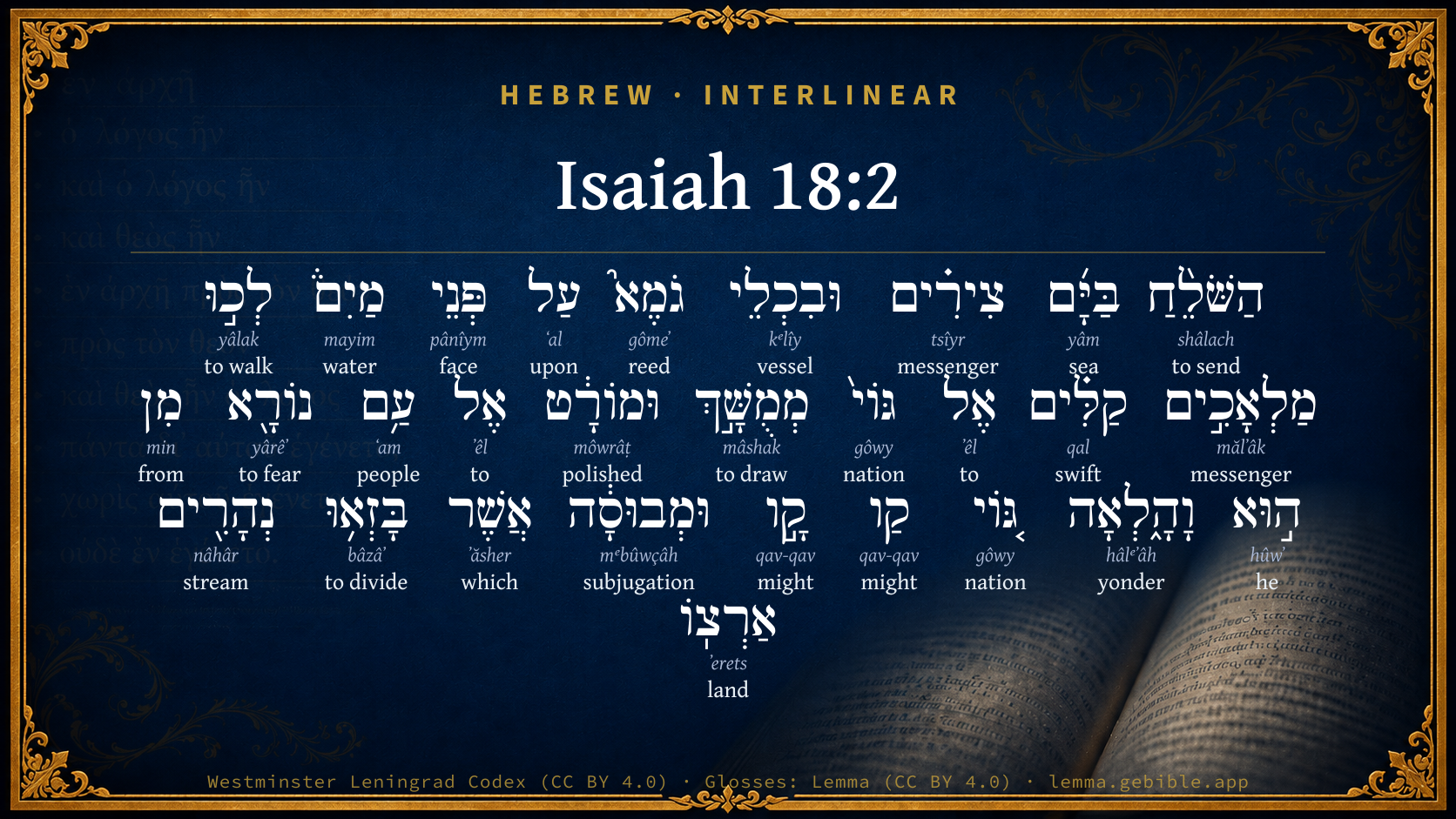
Isaiah 18:2

Hebrew (Westminster Leningrad Codex) Isaiah 18:2 appears in the Hebrew Old Testament. The text above is from the Westminster Leningrad Codex. Each word links to its Strong’s number, a concise gloss, and parsing drawn from the Open Scriptures Hebrew Bible morphology. Click any word for its full Brown-Driver-Briggs (BDB) entry.
Download image
Cite this verse

Isaiah 18:2 (World English Bible). Public Domain. Lemma interlinear Bible study tool, https://lemma.gebible.app/v/isaiah/18/2.

Show BibTeX & RIS
BibTeX
RIS
English Translation
that sends ambassadors by the sea, even in vessels of papyrus on the waters, [saying], Go, you swift messengers, to a nation tall and smooth, to a people awesome from their beginning onward, a nation that measures out and treads down, whose land the rivers divide!
World English Bible · Public Domain
Highlights
  • 4 first appearances in the Hebrew Bible
Full analysis ↓
Download a study sheet

One document with this verse’s original text, its word-by-word gloss line, the meaning frame, cross-references with their text, attributed commentary, and full source and license credits — printable, and it pastes into notes with its structure intact.

This verse Autodidact and up

Study sheet (.html) Plain text (.txt)

A passage Seminary Student

Up to 50 verses in one chapter. A passage sheet keeps up to 6 commentary sources and 12 cross-references per verse, in the order this page ranks them, and says so on the sheet whenever that leaves anything out. Ask for a single verse and you get the Autodidact verse sheet above.

Everything on this page stays free to read, with no account — the sheet is a download of what is already on screen, not access to it.

Want to remove ads? Support Godless Engineer
Compare translations 3

The same verse in 3 English versions, stacked beneath the original-language interlinear above. Click any original word for its lexicon entry.

Each is an independent rendering of the whole verse — the interlinear is not word-aligned to these translations.

Highlighted words mark where these versions differ — a whole-verse word diff, not a word-by-word alignment.

  • World English Bible Public Domain
    that sends ambassadors by the sea, even in vessels of papyrus on the waters, [saying], Go, you swift messengers, to a nation tall and smooth, to a people awesome from their beginning onward, a nation that measures out and treads down, whose land the rivers divide!
  • King James Version Public Domain
    That sendeth ambassadors by the sea, even in vessels of bulrushes upon the waters, saying, Go, ye swift messengers, to a nation scattered and peeled, to a people terrible from their beginning hitherto; a nation meted out and trodden down, whose land the rivers have spoiled!
  • unfoldingWord Literal Text CC BY-SA 4.0
    the one sending envoys by sea and in vessels of papyrus on the face of the waters! Go, swift messengers, to a nation heightened and shaved, to a people feared from it and beyond, a nation line, line and trampling, whose land rivers divide.

unfoldingWord Literal Text — © unfoldingWord, licensed CC BY-SA 4.0. Word-aligned USFM3 via Door43 (git.door43.org/unfoldingWord/en_ult).

Versions to compare (up to 4)

3 of 4 selected

Show all 18 translations

Every available English version of this verse, each an independent rendering of the whole verse.

  • World English Bible Public Domain
    that sends ambassadors by the sea, even in vessels of papyrus on the waters, [saying], Go, you swift messengers, to a nation tall and smooth, to a people awesome from their beginning onward, a nation that measures out and treads down, whose land the rivers divide!
  • Berean Standard Bible Public Domain
    which sends couriers by sea, in papyrus vessels on the waters. Go, swift messengers, to a people tall and smooth-skinned, to a people widely feared, to a powerful nation of strange speech, whose land is divided by rivers.
  • Majority Standard Bible Public Domain
    which sends couriers by sea, in papyrus vessels on the waters. Go, swift messengers, to a people tall and smooth-skinned, to a people widely feared, to a powerful nation of strange speech, whose land is divided by rivers.
  • King James Version Public Domain
    That sendeth ambassadors by the sea, even in vessels of bulrushes upon the waters, saying, Go, ye swift messengers, to a nation scattered and peeled, to a people terrible from their beginning hitherto; a nation meted out and trodden down, whose land the rivers have spoiled!
  • American Standard Version (1901) Public Domain
    that sendeth ambassadors by the sea, even in vessels of papyrus upon the waters, `saying', Go, ye swift messengers, to a nation tall and smooth, to a people terrible from their beginning onward, a nation that meteth out and treadeth down, whose land the rivers divide!
  • Revised Version (1885) Public Domain
    that sendeth ambassadors by the sea, even in vessels of papyrus upon the waters, saying, Go, ye swift messengers, to a nation tall and smooth, to a people terrible from their beginning onward; a nation that meteth out and treadeth down, whose land the rivers divide!
  • Geneva Bible (1599) Public Domain
    Sending ambassadours by the Sea, euen in vessels of reedes vpon the waters, saying, Go, ye swift messengers, to a nation that is scattered abroade, and spoyled, vnto a terrible people from their beginning euen hitherto: a nation by litle and litle, euen troden vnder foote, whose land the floods haue spoyled.
  • Douay-Rheims (1899) Public Domain
    That sendeth ambassadors by the sea, and in vessels of bulrushes upon the waters. Go, ye swift angels, to a nation rent and torn in pieces: to a terrible people, after which there is no other: to a nation expecting and trodden under foot, whose land the rivers have spoiled.
  • Young's Literal Translation Public Domain
    That is sending by sea ambassadors, Even with implements of reed on the face of the waters, -- Go, ye light messengers, Unto a nation drawn out and peeled, Unto a people fearful from its beginning and onwards, A nation meeting out by line, and treading down, Whose land floods have spoiled.
  • Literal Standard Version CC BY-SA 4.0
    That is sending ambassadors by sea, || Even with implements of reed on the face of the waters—Go, swift messengers, || To a nation drawn out and peeled, || To a people fearful from its beginning and onward, || A nation meeting out by line, and treading down, || Whose land floods have spoiled.
  • Unlocked Literal Bible CC BY-SA 4.0
    who send ambassadors by the sea, in vessels of papyrus on the waters. Go, you swift messengers, to a nation tall and smooth, to a people feared far and near, a nation strong and trampling down, whose land the rivers divide.
  • unfoldingWord Literal Text CC BY-SA 4.0
    the one sending envoys by sea and in vessels of papyrus on the face of the waters! Go, swift messengers, to a nation heightened and shaved, to a people feared from it and beyond, a nation line, line and trampling, whose land rivers divide.
  • Darby Bible Public Domain
    that sendest ambassadors over the sea, and in vessels of papyrus upon the waters, [saying,] Go, swift messengers, to a nation scattered and ravaged, to a people terrible from their existence and thenceforth; to a nation of continued waiting and of treading down, whose land the rivers have spoiled!
  • World Messianic Bible Public Domain
    that sends ambassadors by the sea, even in vessels of papyrus on the waters, saying, “Go, you swift messengers, to a nation tall and smooth, to a people awesome from their beginning onward, a nation that measures out and treads down, whose land the rivers divide!”
  • Webster's Bible Public Domain
    That sendeth embassadors by the sea, even in vessels of bulrushes upon the waters, saying, Go, ye swift messengers to a nation scattered and peeled, to a people terrible from their beginning hitherto; a nation measured by line and trodden down, whose land the rivers have laid waste.
  • Free Bible Version CC BY-SA 4.0
    They send messengers downriver in papyrus boats. Swift messengers, go and take a message to a tall and smooth-skinned people, to a people feared by everyone, to a very powerful nation of conquerors, whose land is washed away by rivers.
  • Bible in Basic English Public Domain
    Which sends its representatives by the sea, even in ships of papyrus on the waters. Go back quickly, O representatives, to a nation tall and smooth, to a people causing fear through all their history; a strong nation, crushing down its haters, whose land is cut through by rivers.
  • JPS Tanakh (1917) Public Domain
    That sendeth ambassadors by the sea, even in vessels of papyrus upon the waters! Go, ye swift messengers, to a nation tall and of glossy skin, to a people terrible from their beginning onward; a nation that is sturdy and treadeth down, whose land the rivers divide!

Literal Standard Version (2020), Covenant Press — licensed CC BY-SA 4.0. Text via the HelloAO Bible API (eBible.org). Unlocked Literal Bible (unfoldingWord) — licensed CC BY-SA 4.0. Text via the HelloAO Bible API (eBible.org). unfoldingWord Literal Text — © unfoldingWord, licensed CC BY-SA 4.0. Word-aligned USFM3 via Door43 (git.door43.org/unfoldingWord/en_ult). Free Bible Version, Dr. Jonathan Gallagher — licensed CC BY-SA 4.0. Text via the HelloAO Bible API (eBible.org).

Word by word

More ways to search: Search by grammar → Find every occurrence → Compare this word →

Practice this passage: Drill this verse → Learn its vocabulary →

וּמוֹרָ֔ט
môwrâṭ
H4178
“and · polished”
Conjunction + Verb, Pual, Participle Passive, Masculine, Singular, Absolute
Part of Speech
Conjunction + Verb
Stem
Pual
Form
Participle Passive
Gender
Masculine
Number
Singular
State
Absolute
Full BDB Definition

Origin: from H3399

TWOT: 1244

(Pual) scoured, polished, smooth
  1. הַשֹּׁלֵ֨חַ shâlach H7971 “the · sending” Particle, Definite Article + Verb, Qal, Participle Active, Masculine, Singular, Absolute
  2. בַּיָּ֜ם yâm H3220 “in/at the · sea” Preposition, Determined + Noun, Common, Masculine, Singular, Absolute
  3. צִירִ֗ים tsîyr H6735 “messengers” Noun, Common, Masculine, Plural, Absolute
  4. וּבִכְלֵי kᵉlîy H3627 “and · in/at · vessels of” Conjunction + Preposition + Noun, Common, Masculine, Plural, Construct
  5. גֹמֶא֮ gômeʼ H1573 “reed” Noun, Common, Masculine, Singular, Absolute
  6. עַל ʻal H5921 “upon” Preposition
  7. פְּנֵי pânîym H6440 “face(s) of” Noun, Common, Both, Plural, Construct
  8. מַיִם֒ mayim H4325 “water(s)” Noun, Common, Masculine, Plural, Absolute
  9. לְכ֣וּ yâlak H3212 “walk” Verb, Qal, Imperative, 2nd Person, Masculine, Plural
  10. מַלְאָכִ֣ים mălʼâk H4397 “messengers” Noun, Common, Masculine, Plural, Absolute
  11. קַלִּ֗ים qal H7031 “swift” Adjective, Adjective, Masculine, Plural, Absolute
  12. אֶל ʼêl H413 “to” Preposition
  13. גּוֹי֙ gôwy H1471 “nation” Noun, Common, Masculine, Singular, Absolute
  14. מְמֻשָּׁ֣ךְ mâshak H4900 “drawn” Verb, Pual, Participle Passive, Masculine, Singular, Absolute
  15. אֶל ʼêl H413 “to” Preposition
  16. עַ֥ם ʻam H5971 “people” Noun, Common, Masculine, Singular, Absolute
  17. נוֹרָ֖א yârêʼ H3372 “fearing” Verb, Niphal, Participle Active, Masculine, Singular, Absolute
  18. מִן min H4480 “from” Preposition
  19. ה֣וּא hûwʼ H1931 “he” Pronoun, Personal, 3rd Person, Masculine, Singular
  20. וָהָ֑לְאָה hâlᵉʼâh H1973 “and · yonder” Conjunction + Adverb
  21. גּ֚וֹי gôwy H1471 “nation” Noun, Common, Masculine, Singular, Absolute
  22. קַו qav-qav H6978 “might” Noun, Common, Masculine, Singular, Absolute
  23. קָ֣ו qav-qav H6978 “might” Noun, Common, Masculine, Singular, Absolute
  24. וּמְבוּסָ֔ה mᵉbûwçâh H4001 “and · subjugation” Conjunction + Noun, Common, Feminine, Singular, Absolute
  25. אֲשֶׁר ʼăsher H834 “which” Particle, Relative
  26. בָּזְא֥וּ bâzâʼ H958 “to divide” Verb, Qal, Perfect, 3rd Person, Common, Plural
  27. נְהָרִ֖ים nâhâr H5104 “streams” Noun, Common, Masculine, Plural, Absolute
  28. אַרְצֽוֹ ʼerets H776 “land · his” Noun, Common, Both, Singular, Construct + Suffix, Personal, 3rd Person, Masculine, Singular

About this verse

These counts appear in no published source. They are computed here, from the morphology-tagged text and Lemma’s own curated glosses. What Lemma adds →

29
words
26
distinct lemmas
Prophets
section

Notable vocabulary

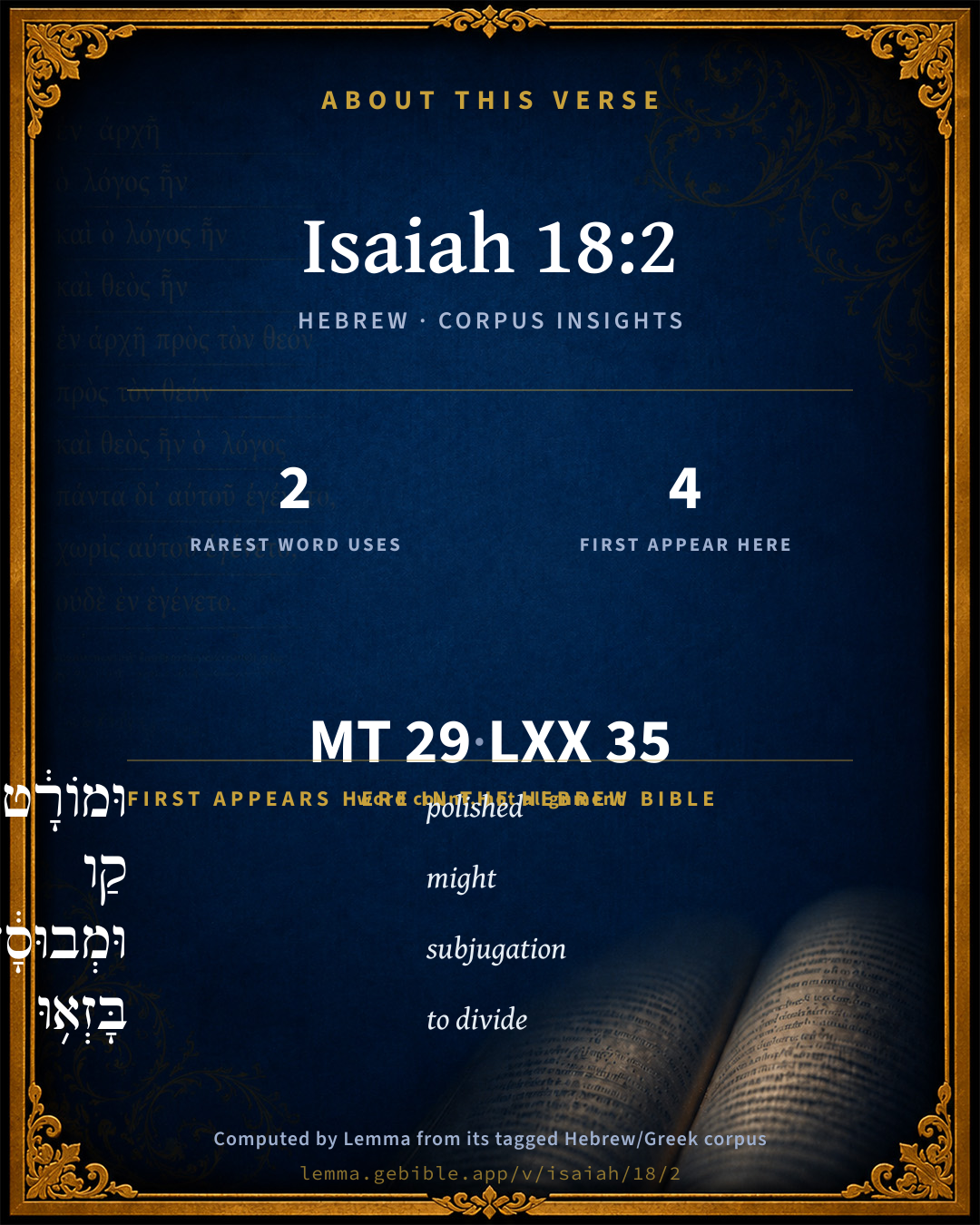
The rarest word here is וּמוֹרָ֔ט polished H4178 — appearing just 2 times in the whole Hebrew Bible.

First appearance in Scripture

These words make their first canonical appearance in the Hebrew Bible here:

  • וּמוֹרָ֔ט polished H4178
  • קַו might H6978
  • וּמְבוּסָ֔ה subjugation H4001
  • בָּזְא֥וּ to divide H958

Shared distinctive vocabulary

וּמוֹרָ֔ט polished H4178 occurs in 2 verses of the Hebrew Bible. Also found in:

Grammatical profile

  • 6 verbs
  • 15 nouns
  • 1 adjective
  • 1 pronoun
  • 4 prepositions
  • 1 adverb
  • 1 particle

Verb forms

  • הַשֹּׁלֵ֨חַ Qal · Participle Active
  • לְכ֣וּ Qal · Imperative
  • מְמֻשָּׁ֣ךְ Pual · Participle Passive
  • וּמוֹרָ֔ט Pual · Participle Passive
  • נוֹרָ֖א Niphal · Participle Active
  • בָּזְא֥וּ Qal · Perfect

Repetition

Words recur within this verse — often emphatic in Hebrew:

  • גּוֹי֙ nation H1471 ×2
  • קַו might H6978 ×2
  • אֶל to H413 ×2

Hebrew & Septuagint length

In English translation the verse runs 46 words from the Hebrew and 40 from the Septuagint (LXX English) — closely comparable.

A rough comparison of the two English renderings, which tokenize alike — not a word-level alignment.

Word counts can differ between the Hebrew and the Greek without any difference in meaning — e.g. the Hebrew direct-object marker אֵת has no separate Greek word, and Greek often adds the article ὁ.

In the original languages it is 29 Hebrew tokens and 35 Greek tokens — but the two are counted differently (Hebrew bundles its prefixes and suffixes into one token; the Greek is in lemma form), so that isn’t a like-for-like length.

Cross-references

9

Topical passages linked to Isaiah 18:2 in the Treasury of Scripture Knowledge — connected by theme and wording, ordered by reader-vote popularity; previews shown in the World English Bible.

  • Genesis 10:8–9 Cush became the father of Nimrod: he began to be a mighty one in the earth.
  • Isaiah 18:7 In that time shall a present be brought to Yahweh of Hosts [from] a people tall and smooth, even from a people awesome from their beginning onward, a nation that measures out and treads down, whose land the rivers divide, to the place of the name of Yahweh of Hosts, Mount Zion.
  • 2 Chronicles 12:2–4 It happened in the fifth year of king Rehoboam, that Shishak king of Egypt came up against Jerusalem, because they had trespassed against Yahweh,
  • 2 Chronicles 14:9 There came out against them Zerah the Ethiopian with an army of a million troops, and three hundred chariots; and he came to Mareshah.
  • 2 Chronicles 16:8 Weren't the Ethiopians and the Lubim a huge host, with chariots and horsemen exceeding many? yet, because you did rely on Yahweh, he delivered them into your hand.
  • Exodus 2:3 When she could no longer hide him, she took a papyrus basket for him, and coated it with tar and with pitch. She put the child in it, and laid it in the reeds by the river's bank.
  • Isaiah 19:5–7 The waters shall fail from the sea, and the river shall be wasted and become dry.
  • Isaiah 30:2–4 that set out to go down into Egypt, and have not asked at my mouth; to strengthen themselves in the strength of Pharaoh, and to take refuge in the shadow of Egypt!
  • Ezekiel 30:9 In that day shall messengers go forth from before me in ships to make the careless Ethiopians afraid; and there shall be anguish on them, as in the day of Egypt; for, behold, it comes.

Cross-references courtesy of OpenBible.info (CC BY 4.0).

Hebrew and Greek witnesses Masoretic Hebrew ↔ Greek Septuagint

The same verse in the two great witnesses to the Old Testament, shown verse-for-verse.

These are two independent witnesses, not word-aligned to each other, and the Septuagint is shown in lemma (dictionary) form.

Hebrew Isaiah 18:2 Masoretic · Westminster Leningrad Codex

הַשֹּׁלֵ֨חַ בַּיָּ֜ם צִירִ֗ים וּבִכְלֵי גֹמֶא֮ עַל פְּנֵי מַיִם֒ לְכ֣וּ מַלְאָכִ֣ים קַלִּ֗ים אֶל גּוֹי֙ מְמֻשָּׁ֣ךְ וּמוֹרָ֔ט אֶל עַ֥ם נוֹרָ֖א מִן ה֣וּא וָהָ֑לְאָה גּ֚וֹי קַו קָ֣ו וּמְבוּסָ֔ה אֲשֶׁר בָּזְא֥וּ נְהָרִ֖ים אַרְצֽוֹ

that sends ambassadors by the sea, even in vessels of papyrus on the waters, [saying], Go, you swift messengers, to a nation tall and smooth, to a people awesome from their beginning onward, a nation that measures out and treads down, whose land the rivers divide!

World English Bible · Public Domain

Greek LXX Isaiah 18:2 Septuagint · lemma form

ὁ ἀποστέλλω ἐν θάλασσα ὅμηρος καί ἐπιστολή βύβλινος ἐπάνω ὁ ὕδωρ πορεύομαι γάρ ἄγγελος κοῦφος πρός ἔθνος μετέωρος καί ξένος λαός καί χαλεπός τίς αὐτός ἐπέκεινα ἔθνος ἀνέλπιστος καί καταπατέω νῦν ὁ ποταμός ὁ γῆ

He sends messengers by the sea, and paper letters on the water: for swift messengers shall go to a lofty nation, and to a strange and harsh people. Who is beyond it? a nation not looked for, and trodden down.

LXX2012 (modern English Septuagint) · Public Domain

On this verse, Albert Barnes' Notes on the Bible discusses the Septuagint’s reading. Read the note in Commentary ↓

Hebrew: Westminster Leningrad Codex (CC BY 4.0). Greek: Septuagint (public domain); English from LXX2012 (modern English Septuagint) (Public Domain). How the Septuagint differs from the Hebrew →

Targum (Aramaic paraphrase)

1

The Targum is the ancient Jewish Aramaic paraphrase of the Hebrew Scriptures — an interpretive translation, not the Hebrew text itself. Onkelos (literal) and Pseudo-Jonathan (expansive) render the Torah, and Jonathan the Prophets. Coverage is partial: where no permissively-licensed English translation exists for a verse, only the Aramaic is shown. This is verse-level text, not a word-by-word alignment to the Hebrew.

  1. Targum Jonathan Prophets (Joshua–Malachi)
    דִמְשַׁלַח בְּיַמָא אִזְגַדִין וּבִדְגוּגִין עַל אַפֵּי מַיָא אֱזִילוּ אִזְגַדִין קַלִילִין לְוַת עַמָא אֲנִיסָא וּבְזִיזָא לְוַת עַמָא דִתְקַיף מִבְּכֵין וּלְהַלָא עַמָא אֲנִיסָא וּבְזִיזָא דְבָזוּ עַמְמַיָא אַרְעֵיהּ:

    That sendeth ambassadors by the sea, even in ships on the face of the waters, saying, Go, ye swift messengers, unto a people oppressed and plundered, unto a people that was mighty in times past, and shall be so in time to come: a people oppressed and robbed, whose land the nations have spoiled.

    Targum Jonathan — Aramaic: “Mikraot Gedolot” (public domain). English: “Sefaria Community Translation” (CC0 1.0 (public-domain dedication)); “London "Chaldee Paraphrase," 1871” (public domain). Text via Sefaria.

Commentary

Notes on Isaiah 18:2 from classic Christian and Jewish commentators (each source and its license shown beneath its notes). The classic Christian expositions comment on the surrounding passage and are grouped to its opening verse, so a note may address several verses; the Jewish commentaries on the Tanakh (Rashi and others) are per-verse, so they appear only where the commentator wrote on this verse.

Lemma curates 59 commentaries, every one of them public domain or Creative Commons licensed, each selected and text-cleaned for this edition rather than reprinted as found. About our sources →

Trapp's Complete Commentary

John Trapp

Isa 18:2 That sendeth ambassadors by the sea, even in vessels of bulrushes upon the waters, [saying], Go, ye swift messengers, to a nation scattered and peeled, to a people terrible from their beginning hitherto; a nation meted out and trodden down, whose land the rivers have spoiled!

Ver. 2. That sendeth ambassadors by the sea.] Heralds to defy the Assyrian, and to bid him battle, to their own ruin.

Even in the vessels of bulrushes.] Or, In paper barques well pitched. {a} These were much in use among the Ethiopians and Egyptians, both for expedition and also for safety against rocks, shallows, and falls of rivers.

Go, ye swift messengers.] Tirhaka’s words to his heralds. See 2Ki 19:9.

To a nation scattered and peeled,] i.e., To the Assyrians, whose great forces are at this time scattered up and down in several countries, and therefore with more ease and safety to be set upon. Thus the Ethiopian pleaseth himself in the conceit of an easy conquest, but was quickly confuted; the Jews who trusted unto him were disappointed, and Sennacherib more enraged against Jerusalem.

To a people terrible.] The mauls {hammers} of mankind; but I shall chastise them. Thus he triumpheth before the victory, having already devoured Assyria in his hopes.

A nation meted out and trodden down.] Or rather meeting out and treading down. Or shortly to be meted out to conculcation or destruction.

Whose land the rivers have spoiled.] Or, The floods - inundations of enemies - shall spoil; or, Whose land the rivers - the Ethiopians who live by the rivers {Isa 18:1} - do despise. For this chapter is not more short than dark, and diversely rendered and sensed.

{a} Iunceae fiscellae picatae. - Vide Plin., lib. vi. cap. 22.

John Trapp, A Commentary or Exposition upon All the Books of the Old and New Testament (1647–1656) — public domain. Text from a community e-Sword module.

Joseph Benson's Commentary

Isa 18:2. That sendeth ambassadors by sea — That is accustomed to send, or at this time is sending, ambassadors to strengthen themselves with leagues and alliances, or to encourage their confederates; in vessels of bulrushes upon the waters — This circumstance agrees perfectly well with Egypt; Pliny, Lucan, Diodorus Siculus, and Strabo, all affirming that the Egyptians commonly used on the Nile a light sort of ships, or boats, made of the reed papyrus. Go, ye swift messengers — “To this nation before mentioned, who, by the Nile, and by their numerous canals, have the means of spreading the report, in the most expeditious manner, through the whole country; go and carry this notice of God’s designs in regard to them. By the swift messengers are meant, not any particular persons specially appointed to this office, but any of the usual conveyers of news whatsoever; travellers, merchants, and the like, the instruments and agents of common fame; these are ordered to publish this declaration, made by the prophet, throughout Egypt, and to excite their attention to the promised visible interposition of Providence.” Thus Bishop Lowth; who further says, “I suppose that this prophecy was delivered before Sennacherib’s return from his Egyptian expedition, which took up three years; and that it was designed to give to the Jews, and perhaps likewise to the Egyptians, an intimation of God’s counsels in regard to the destruction of their great and powerful enemy.” To a nation scattered — Or stretched out, as many translate ממשׁךְ. “Egypt, that is, the fruitful part of it, exclusive of the deserts on each side, is one long vale, through the middle of which runs the Nile, bounded on each side to the east and west by a chain of mountains, seven hundred and fifty miles in length, in breadth, from one to two or three days’ journey: even at the widest part of the Delta, from Pelusium to Alexandria, not above two hundred and fifty miles broad.” And peeled — Or rather smoothed, as ומורשׂmay be rendered. This, Bishop Lowth thinks, “either relates to the practice of the Egyptian priests, who made their bodies smooth by shaving off the hair; or, rather, to the country’s being made smooth, perfectly plain and level, by the overflowing of the Nile.” Terrible from the beginning hitherto — This also well suits the Egyptians, whose kingdom was one of the most ancient, and continued long to be extremely formidable. And they were wont to boast extravagantly of the antiquity and greatness of their kingdom, asserting that gods were their first kings, and then demi-gods, and lastly men. A nation meted out and trodden down — Hebrew, גוי קו קו ומבוסה, a nation of line, line, and treading down. See the margin. The prophet is here generally supposed to refer, 1st, To the necessity which the Egyptians were frequently under of having recourse to mensuration, in order to determine the boundaries of their lands, after the inundations of the Nile; which is thought by some to have given birth to the science of geometry; (Strabo, lib. 17;) and, 2d, To a peculiar method of tillage in use among them. “Both Herodotus and Diodorus say, that when the Nile had retired within its banks, and the ground became somewhat dry, they sowed their land, and then sent in their cattle to tread in the seed; and without any further care expected the harvest.” Whose land the rivers have spoiled — The word בזאו, here used, may either be rendered spoiled, or despised. It seems plainly to relate to the overflowing of the Nile; which, as it were, claims Egypt to itself, while it overwhelms with its waters the whole land, except the cities and towns, secured by the banks raised about them. It is true, this overflow is rather an advantage than a disadvantage to the land, as it renders it fruitful; nevertheless it puts the inhabitants to very great inconveniences during its continuance.

Joseph Benson's Commentary on the Old and New Testaments (1811–1818) — public domain. Text from a community e-Sword module.

Geneva Bible (1599)

Geneva Bible translators

To wit, the Jews, who because of God’s plague, made all other nations afraid of the like, as God threatened, Deut. 28:37.

Meaning, the Assyrians, as Isa. 8:7.

Which in those countries were great, insomuch as they made ships of them for swiftness.

This may be taken, that they sent others to comfort the Jews, and to promise them help against their enemies, and so the Lord did threaten to take away their strength, that the Jews should not trust therein: or that they did solicit the Egyptians, and promised them aid to go against Judah.

Geneva Bible (1599) marginal notes — public domain. Text via Bolls.life.

Jamieson, Fausset & Brown

Robert Jamieson, A. R. Fausset & David Brown

ambassadors--messengers sent to Jerusalem at the time that negotiations passed between Tirhakah and Hezekiah against the expected attack of Sennacherib (Isa 37:9).

by . . . sea--on the Nile (Isa 19:5): as what follows proves.

vessels of bulrushes--light canoes, formed of papyrus, daubed over with pitch: so the "ark" in which Moses was exposed (Exo 2:3).

Go--Isaiah tells them to take back the tidings of what God is about to do (Isa 18:4) against the common enemy of both Judah and Ethiopia.

scattered and peeled--rather, "strong and energetic" [MAURER]. The Hebrew for "strong" is literally, "drawn out" (Margin; Psa 36:10; Ecc 2:3). "Energetic," literally, "sharp" (Hab 1:8, Margin; the verb means to "sharpen" a sword, Eze 21:15-16); also "polished." As HERODOTUS (3:20, 114) characterizes the Ethiopians as "the tallest and fairest of men," G. V. SMITH translates, "tall and comely"; literally, "extended" (Isa 45:14, "men of stature") and polished (the Ethiopians had "smooth, glossy skins"). In English Version the reference is to the Jews, scattered outcasts, and loaded with indignity (literally, "having their hair torn off," HORSLEY).

terrible--the Ethiopians famed for warlike prowess [ROSENMULLER]. The Jews who, because of God's plague, made others to fear the like (Deu 28:37). Rather, "awfully remarkable" [HORSLEY]. God puts the "terror" of His people into the surrounding nations at the first (Exo 23:27; Jos 2:9); so it shall be again in the latter days (Zac 12:2-3).

from . . . beginning hitherto--so English Version rightly. But GESENIUS, "to the terrible nation (of upper Egypt) and further beyond" (to the Ethiopians, properly so called).

meted out--Hebrew, "of line." The measuring-line was used in destroying buildings (Isa 34:11; Kg2 21:13; Lam 2:8). Hence, actively, it means here "a people meting out,--an all-destroying people"; which suits the context better than "meted," passively [MAURER]. HORSLEY, understanding it of the Jews, translates it, "Expecting, expecting (in a continual attitude of expectation of Messiah) and trampled under foot"; a graphic picture of them. Most translate, of strength, strength (from a root, to brace the sinews), that is, a most powerful people.

trodden down--true of the Jews. But MAURER translates it actively, a people "treading under foot" all its enemies, that is, victorious (Isa 14:25), namely, the Ethiopians.

spoiled--"cut up." The Nile is formed by the junction of many streams in Abyssinia, the Atbara, the Astapus or Blue river (between which two rivers Meroe, the "Ethiopia" here meant, lies), and the Astaboras or White river; these streams wash down the soil along their banks in the "land" of Upper Egypt and deposit it on that of Lower Egypt. G. V. SMITH translates it, "Divide." HORSLEY takes it figuratively of the conquering armies which have often "spoiled" Judea.

Jamieson, Fausset & Brown — Commentary Critical and Explanatory on the Whole Bible (1871) — public domain (CC PDM 1.0). Text via the HelloAO Bible API.

Adam Clarke's Commentary

Verse 2. In vessels of bulrushes - "In vessels of papyrus"] This circumstance agrees perfectly well with Egypt. It is well known that the Egyptians commonly used on the Nile a light sort of ships, or boats, made of the reed papyrus. Ex ipso quidem papyro navigia texunt. PLINY, xlii. 11.

Conseritur bibula Memphitis cymba papyro.

LUCAN, iv. 136.

Go, ye swift messengers] To this nation before mentioned, who, by the Nile, and by their numerous canals, have the means of spreading the report in the most expeditious manner through the whole country: go, ye swift messengers, and carry this notice of God's designs in regard to them. By the swift messengers are meant, not any particular persons specially appointed to this office, but any of the usual conveyers of news whatsoever, travellers, merchants, and the like, the instruments and agents of common fame. These are ordered to publish this declaration made by the prophet throughout Egypt, and to all the world; and to excite their attention to the promised visible interposition of God.

Scattered - "Stretched out in length"] Egypt, that is, the fruitful part, exclusive of the deserts on each side, is one long vale, through the middle of which runs the Nile, bounded on each side to the east and west by a chain of mountains seven hundred and fifty miles in length; in breadth from one to two or three days' journey: even at the widest part of the Delta, from Pelusium to Alexandria, not above two hundred and fifty miles broad. Egmont and Hayman, and Pococke.

Peeled - "Smoothed"] Either relating to the practice of the Egyptian priests, who made their bodies smooth by shaving off their hair, (see Herod. ii. 37;) or rather to their country's being made smooth, perfectly plain and level, by the overflowing of the Nile.

Meted out - "Meted out by line"] It is generally referred to the frequent necessity of having recourse to mensuration in Egypt, in order to determine the boundaries after the inundations of the Nile; to which even the origin of the science of geometry is by some ascribed. Strabo, lib. xvii. sub init.

Trodden down] Supposed to allude to a peculiar method of tillage in use among the Egyptians. Both Herodotus, (lib. ii.,) and Diodorus, (lib. i.,) say that when the Nile had retired within its banks, and the ground became somewhat dry, they sowed their land, and then sent in their cattle, (their hogs, says the former,) to tread in the seed; and without any farther care expected the harvest.

The rivers have spoiled - "The rivers have nourished"] The word בזאו bazeu is generally taken to be an irregular form for בזזו bazezu, "have spoiled," as four MSS. have it in this place; and so most of the Versions, both ancient and modern, understand it. On which Schultens, Gram. Heb. p. 491, has the following remark: - "Ne minimam quidem speciem veri habet בזאו bazau, Esai. xviii. 2, elatum pro בזזו bazazu, deripiunt. Haec esset anomalia, cui nihil simile in toto linguae ambitu. In talibus nil finire, vel fateri ex mera agi conjectura, tutius justiusque. Radicem בזא baza olim extare potuisse, quis neget? Si cognatum quid sectandum erat, ad בזה bazah, contemsit, potius decurrendum fuisset; ut בזאו bazeu, pro בזו bazu, sit enuntiatum, vel baziv. Digna phrasis, flumina contemmunt terram, i.e., inundant." "בזא baza, Arab. extulit se superbius, item subjecit sibi: unde praet. pl. בזאו bazeu, subjecerunt sibi, i.e., inundarunt." - Simonis' Lexic. Heb.

A learned friend has suggested to me another explanation of the word. בזא baza, Syr., and ביזא beiza, Chald., signifies uber, "a dug," mamma, "a breast;" agreeably to which the verb signifies to nourish. This would perfectly well suit with the Nile: whereas nothing can be more discordant than the idea of spoiling and plundering; for to the inundation of the Nile Egypt owed every thing; the fertility of the soil, and the very soil itself. Besides, the overflowing of the Nile came on by gentle degrees, covering with out laying waste the country: "Mira aeque natura fluminis, quod cum caeteri omnes abluant terras et eviscerent, Nilus tanto caeteris major adeo nihil exedit, nec abradit, ut contra adjiciat vires; minimumque in eo sit, quod solum temperet. Illato enim limo arenas saturat ac jungit; debetque illi AEgyptus non tantum fertilitatem terrarum, sed ipsas. - Seneca, Nat. Quaest., iv. 2. I take the liberty, therefore, which Schultens seems to think allowable in this place, of hazarding a conjectural interpretation. It is a fact that the Ganges changes its course, and overruns and lays barren whole districts, from which it was a few years back several miles distant. Such changes do not nourish but spoil the ground.

Adam Clarke's Commentary on the Bible (1810–1826) — public domain. Text from a community e-Sword/MySword module.

Ellicott's Commentary for English Readers

(2) That sendeth ambassadors . . .—The words point to the embassies which the Ethiopian king had sent, in the papyrus boats used for the navigation of the Upper Nile, down that river to Hezekiah and other princes, inviting them to join the alliance against Assyria.

Go, ye swift messengers . . .—The interpolated “saying” being omitted, the words that follow are as the prophet’s address to the messengers, as he sends them back to their own people. Instead of “scattered and peeled, “we are to read tall and polished, as describing the physique which had probably impressed itself on Isaiah’s mind. (Comp. the Sabeans as “men of stature” in Isa_45:14.) They were terrible then, as they had ever been (i.e., imperious and mighty), a nation that treadeth down its foes. Instead of “meted out and trodden down,” they are a nation of command, command (or, perhaps, “strength, strength”). The rivers are literally the affluents of the Nile that intersect and fertilise (not “spoil”) the hills and valleys of Nubia. Some commentators, however, though with less probability, accept the Authorised version, and refer the words to Israel, as “scattered and plundered,” with its land “spoiled” by the “rivers of invading armies (Isa_8:7).

A Bible Commentary for English Readers, edited by Charles John Ellicott (1878–1897) — public domain. Text from a community e-Sword module.

The Cambridge Bible for Schools and Colleges

gen. ed. J. J. S. Perowne

2. The ambassadors are those who have arrived in Jerusalem. They had descended the Nile (here called the sea, as in ch. Isa_19:5; Nah_3:8) in vessels of bulrushes (R.V. papyrus). These light skiffs, constructed for one or two passengers, and capable of being carried where the river ceased to be navigable, are frequently mentioned by ancient writers (cf. Pliny Isa_13:11 “ex ipso quidem papyro navigia texunt,” and other authorities cited by Gesenius). Their great speed is referred to in Job_9:26 (“ships of reed”).

Go, ye swift messengers] Isaiah’s charge to the ambassadors begins here; they are to return to their own country with this answer. (The “saying” of A.V. and R.V. is quite misleading.)

a nation scattered and peeled] Render as R.V.: a nation tall and smooth (lit. “drawn-out and polished”). The latter epithet probably denotes the bronze-like appearance of the skin of the Ethiopians; some, however, take it in the general sense of “beautiful” (μέγιστοι καὶ κάλλιστοι). The Nubians of the Soudân are still a remarkably tall and handsome race.

terrible from their beginning hitherto] Better: dreaded near and far. Lit., perhaps, “from where it is and onward,” cf. 1Sa_10:3; 1Sa_20:22; 1Sa_20:37. The temporal sense, however, is possible (1Sa_18:9), although less natural here.

meted out and trodden down] Render: strong and victorious (lit. “of strength and treading down”). The Hebr. for “strength” presents some difficulty. If read as pointed (qav-qav) it looks like a repetition of the word for “measuring-line” (qav); and this is the origin of the ‘meting out” of E.V. (“people of line-line”). But this sense has little probability; and the translation “strength” is warranted by the analogy of the cognate Arabic noun quvva. It is perhaps better to read it as a reduplicated form (qavqav), although the word occurs nowhere else. Note that R.V. rightly takes both nouns in an active sense.

have spoiled] The word is found only here and is of uncertain meaning. A more likely translation is “intersect” or (as R.V.) divide.

The Cambridge Bible for Schools and Colleges (gen. ed. J. J. S. Perowne; Cambridge University Press, 1878–1918) — public domain. Text from a community e-Sword module.

John Gill's Exposition

That sendeth ambassadors by the sea,.... The Red Sea, which washed the coasts of Egypt and Ethiopia, and which were united into one kingdom under Sabacus, or So the Ethiopian, called king of Egypt, Kg2 17:4 and this kingdom, or rather the king of it, is here described as sending ambassadors by sea to foreign courts, to make leagues and alliances, and thereby strengthen himself against attempts made on him; though some understand it of one part of Ethiopia, on one side of the Red Sea, sending to that on the other side; and some of Tirhakah the Ethiopian sending messengers to the king of Assyria to bid him defiance, and let him know he intended to fight him; and at the same time sent to the Jews, that they might depend upon his protection and help, Isa 37:9 some understand this of the Egyptians sending to the Ethiopians, to let them know of the Assyrian expedition; and others, of their sending to the Jews, with the promise of a supply; and the word for "ambassadors" signifying "images", Isa 45:16 some have thought it is to be understood of carrying the head of Osiris, and the image of Isis, from place to place, in proper vessels:

even in vessels of bulrushes upon the waters; or, "upon the face of the waters" (i); where these light vessels floated without sinking, not drawing the quantity of waters as vessels of wood did. Both the Egyptians and Ethiopians had ships made of the "papyrus" (k), or "biblus" (l), a sort of rush, that grew upon the banks of the Nile, and which were light, and moved swiftly, and were also safest; there was no danger of their being broken to pieces, as other vessels, on shelves, and rocks, and in waterfalls: yea, Pliny (m) says, that the Ethiopian ships were so made, as to fold up and be carried on their shoulders, when they came to the cataracts.

Saying, go, ye swift messengers; the word "saying" is not in the text, nor is it to be supplied; for these are not the words of the nation before described, sending its messengers to another nation after described, either the Jews or the Assyrians; but they are the words of God to his messengers, angels or men, who were swift to do his will, whom he sends to denounce or inflict judgment upon the same nation that is before mentioned, with which agrees Eze 30:9,

to a nation scattered; that dwelt in towns, villages, and houses, scattered about here and there; or who would be scattered and dissipated by their enemies: or, "drawn out", and spread over a large tract of ground, as Ethiopia was:

and peeled; of their hair, as the word signifies; the Ethiopians, living in a hot country, had very little hair upon their bodies. Schultens (n), from the use of the word in the Arabic language, renders it,

"a nation strong and inaccessible:''

to a people terrible from their beginning hitherto; for their black colour and grim looks, especially in some parts; and for the vast armies they brought into the field, as never were by any other people; see Ch2 12:3 and they might well be said to be so from the beginning, since Nimrod, the mighty hunter, was the son of Cush, from whence the Ethiopians have the name of Cushites, and is the name Ethiopia is called by in the preceding verse Isa 18:1,

a nation meted out, and trodden down: to whom punishment was measured by line, in proportion to their sins, and who in a little time would be trodden under foot by their enemies:

whose land the rivers have spoiled: which must not be understood literally of Niger and Nilus, of Astapus and Astaboras, which were so far from spoiling the land, that it was much more pleasant and fruitful for them; but figuratively, of powerful princes and armies, that should come into it, and spoil and plunder it; see Isa 8:7. Jarchi and Kimchi interpret it of the kings of the nations of the world; and so the Targum,

"whose land the people spoil.''

Some understand all this of the Assyrians, whose army was now scattered, and its soldiers exhausted, who had been from the beginning of their monarchy very terrible to their neighbours, but now marked for destruction; and whom the Ethiopians, who dwelt by the rivers, despised, as some render the words: and others interpret them of the Jews, as overrun by the Assyrian army like a mighty river, by whom they were scattered, and peeled, and spoiled, and plundered; who from their beginning had been very terrible, because of the wonderful things wrought for them at the Red Sea, in the wilderness, and in the times of Joshua and the judges; and because of the dreadful punishments inflicted on them; but the first sense is best. Vitringa interprets all this of the Egyptians, whose country was drawn out or long, their bodies peeled or shaved; a people terrible to their neighbours, and very superstitious; a nation of line and line, or of precept and precept.

(i) "super facies aquarurum", Montanus. (k) Hence , paper skiffs, in Plutarch, de Is. et Osir. and , ships of reeds which the Indians made and used, as Herodotus relates, l. 3. sive Thalia, c. 98. and so Diodorus Siculus speaks of ships made of a reed in India, of excellent use, because they are not liable to be eaten by worms, Bibliothec. l. 2. p. 104. to the Egyptian vessels of this kind Lucan has respect when he says, "-----Sic cum tenet omnia Nilus, Conficitur bibula Memphitis cymba papyro. Pharsal. l. 4.

(l) Plin. Nat. Hist. l. 6. c. 22. & l. 13. 11. Heliodor. l. 10. c. 4. p. 460. (m) Nat. Hist. l. 5. c. 9. (n) Animadv, Philol. in Job, p, 108.

John Gill's Exposition of the Whole Bible (1746–1763) — public domain (CC PDM 1.0). Text via the HelloAO Bible API.

Albert Barnes' Notes on the Bible

That sendeth ambassadors - That is, “accustomed” to send messengers. What was the design of their thus sending ambassadors does not appear. The prophet simply intimates the fact; a fact by which they were well known. It may have been for purposes of commerce, or to seek protection. Bochart renders the word translated ‘ambassadors’ by “images,” and supposes that it denotes an image of the god Osiris made of the papyrus; but there does not seem to be any reason for this opinion. The word ציר tsı̂yr may mean an idol or image, as in Isa 45:16; Psa 49:15. But it usually denotes ambassadors, or messengers Jos 9:4; Pro 25:13; Pro 13:17; Isa 57:9; Jer 49:14; Oba 1:1.

By the sea - What “sea” is here meant cannot be accurately determined. The word ‘sea’ (ים yâm) is applied to various collections of water, and may be used in reference to a sea, a lake, a pond, and even a large river. It is often applied to the Mediterranean; and where the phrase “Great Sea” occurs, it denotes that Num 34:6-7; Deu 11:24. It is applied to the Lake of Gennesareth or the Sea of Galilee Num 34:11; to the Salt Sea Gen 14:3; to the Red Sea often (Exo 13:10; Num 14:25; Num 21:4; Num 33:10, “et al.”) It is also applied to “a large river,” as, “e. g., the Nile” Isa 19:5; Neh 3:8; and to the Euphrates Jer 51:36. So far as this “word” is concerned, therefore, it may denote either the Mediterranean, the Red Sea, the Nile, or the Euphrates. If the country spoken of is Upper Egypt or Nubia, then we are naturally led to suppose that the prophet refers either to the Nile or the Red Sea.

Even in vessels of bulrushes - The word rendered ‘bulrushes’ (גמא gôme') is derived from the verb גמא gâmâ', “to swallow, sip, drink;” and is given to a reed or bulrush, from its “imbibing” water. It is usually applied in the Scriptures to the Egyptian “papyrus” - a plant which grew on the banks of the Nile, and from which we have derived our word “paper.” ‘This plant,’ says Taylor (“Heb. Con.”), ‘grew in moist places near the Nile, and was four or five yards in height. Under the bark it consisted wholly of thin skins, which being separated and spread out, were applied to various uses. Of these they made boxes and chests, and even boats, smearing them over with pitch.’ These laminoe, or skins, also served the purpose of paper, and were used instead of parchment, or plates of lead and copper, for writing on. This plant, the Cyperus Papyrus of modern botanists, mostly grew in Lower Egypt, in marshy land, or in shallow brooks and ponds, formed by the inundation of the Nile. ‘The papyrus,’ says Pliny, ‘grows in the marsh lands of Egypt, or in the stagnant pools left inland by the Nile, after it has returned to its bed, which have not more than two cubits in depth.

The root of the plant is the thickness of a man’s arm; it has a triangular stalk, growing not higher than ten cubits (fifteen feet), and decreasing in breadth toward the summit, which is crowned with a thyrsus, containing no seeds, and of no use except to deck the statues of the gods. They employ the roots as firewood, and for making various utensils. They even construct small boats of the plant; and out of the rind, sails, mats, clothes, bedding, ropes; they eat it either crude or cooked, swallowing only the juice; and when they manufacture paper from it, they divide the stem by means of a kind of needle into thin plates, or laminae, each of which is as large as the plant will admit. All the paper is woven upon a table, and is continually moistened with Nile water, which being thick and slimy, furnishes an effectual species of glue. In the first place, they form upon a table, pefectly horizontal, a layer the whole length of the papyrus, which is crossed by another placed transversely, and afterward enclosed within a press.

The different sheets are then hung in a situation exposed to the sun, in order to dry, and the process is finally completed by joining them together, beginning with the best. There are seldom more than twenty slips or stripes produced from one stem of the plant.’ (Pliny, xiii. 11, 12.) Wilkinson remarks, that ‘the mode of making papyri was this: the interior of the stalks of the plant, after the rind had been removed, was cut into thin slices in the direction of their length, and these being laid on a flat board, in succession, similar slices were placed over them at right angles, and their surfaces being cemented together by a sort of glue, and subjected to the proper deuce of pressure, and well dried, the papyrus was completed.’ (“Ancient Egyptians,” vol. iii. p. 148.) The word used here is translated ‘bulrushes’ in Exo 2:3, where the little ark is described in which Moses was laid near the Nile; the ‘rush’ in Job 8:11; and ‘rushes,’ in Isa 35:7.

It does not elsewhere occur. That the ancients were in the practice of making light boats or vessels from the papyrus is well known. Thus Theophrastus (in the “History of Plants,” iv. 9) says, that ‘the papyrus is useful for many things, for from this they make vessels,’ or ships (πλοῖα ploia). Thus, Pliny (xiii. 11, 22) says, ex ipso quidem papyro navigia texunt - ‘from the papyrus they weave vessels.’ Again, (vi. 56, 57): ‘Even now,’ says he, ‘in the Britannic Ocean useful vessels are made of bark; on the Nile from the papyrus, and from reeds and rushes.’ Plutarch describes Isis going in search of the body of Osiris, ‘through the fenny country in a bark made of the papyrus (ἐν βαριδι παπυοινη en baridi papnoinē) where it is supposed that persons using boats of this description (ἐν παπυρινοις ὀκαφεσι πλωοντας en papurinois okaphisi pleontas) are never attacked by crocodiles out of respect to the goddess,’ (De Isa 18:1-7.) Moses, also, it will be remembered, was exposed on the banks of the Nile in a similar boat or ark. ‘She took for him an ark of bulrushes, and daubed it With slime and with pitch, and put the child therein’ Exo 2:3. The same word occurs here (גמא gôme') which is used by Isaiah, and this fact shows that such boats were known as early as the time of Moses. Lucan also mentions boats made of the papyrus at Memphis:

Conseritur bibula Memphitis cymba papyro.

- Phar. iv: 136.

At Memphis boats are woven together from the marshy papyrus

The sculptures of Thebes, Memphis, and other places, abundantly show that they were employed as punts, or canoes for fishing, in all parts of Egypt, during the inundation of the Nile.’ (Wilkinson’s Ancient Egyptians, vol. iii. p. 186.) In our own country, also, it will be remembered, the natives were accustomed to make canoes, or vessels, of the bark of the birch, with which they often adventured on even dangerous navigation. The circumstance here mentioned of the גמא gôme' (the papyrus), seems to fix the scene of this prophecy to the region of the Nile. This reed grew nowhere else; and it is natural, therefore, to suppose, that some nation living near the Nile is intended. Taylor, the editor of Calmet, has shown that the inhabitants of the upper regions of the Nile were accustomed to form floats of hollow earthen vessels, and to weave them together with rushes, and thus to convey them to Lower Egypt to market. He supposes that by ‘vessels of bulrushes,’ or rush floats, are meant such vessels. (For a description of the “floats” made in Upper Egypt with “jars,” see Pococke’s “Travels,” vol. i. p. 84, Ed. London, 1743.) ‘I first saw in this voyage (on the Nile) the large floats of earthen-ware; they are about thirty feet wide, and sixty feet long, being a frame of palm boughs tied together about four feet deep, on which they put a layer of large jars with the mouths uppermost; on these they make another floor, and then put on another layer of jars, and so a third, which last are so disposed as to trim the float, and leave room for the men to go between. The float lies across the river, one end being lower down than the other; toward the lower end on each side they have four long poles with which they row and direct the boat, as well as forward the motion down.’ Mr. Bruce, in his “Travels,” mentions vessels made of the papyrus in Abyssinia.

Upon the waters - The waters of the Nile, or the Red Sea.

Saying - This word is not in the Hebrew, and the introduction of it by the translators gives a peculiar, and probably an incorrect, sense to the whole passage. As it stands here, it would seem to be the language of the inhabitants of the land who sent the ambassadors, usually saying to their messengers to go to a distant nation; and this introduces an inquiry into the characteristics of the nation to “whom” the ambassadors are sent, as if it were a “different” people from those who are mentioned in Isa 17:1. But probably the words which follow are to be regarded as the words of the prophet, or of God Isa 17:4, giving commandment to those messengers to “return” to those who sent them, and deliver the message which follows: ‘You send messengers to distant nations in reed boats upon the rivers. Return, says God, to the land which sent you foth, and announce to them the will of God. Go rapidly in your light vessels, and bear this message, for it shall speedily be executed, and I will sit calmly and see it done’ Isa 17:4-6. A remarkably similar passage, which throws great light on this, occurs in Eze 30:9 : ‘In that day shall messengers go forth from me (God) in ships to make the careless Ethiopians afraid, and great pain shall come upon them, as in the day of Egypt, for lo, it cometh.’

Go, ye swift messengers - Hebrew, ‘Light messengers.’ This is evidently addressed to the boats. Achilles Tatius says that they were frequently so light and small, that they would carry but one person (Rosenmuller).

To a nation - What nation this was is not known. The “obvious” import of the passge is, that it was some nation to whom they were “accustomed” to send ambassadors, and that it is here added merely as “descriptive” of the people. Two or three characterstics of the nation are mentioned, from which we may better learn what people are referred to.

Scattered - (ממשׁך memushāk). This word is derived from משׁך mâshak, “to seize, take, hold fast;” to draw out, extend, or prolong; to make double or strong; to spread out. The Septuagint renders it, Ἔθνος μετέωρον Ethnos meteōron - ‘A lofty nation.’ Chaldee, ‘A people suffering violence.’ Syraic, ‘A nation distorted.’ Vulgate, ‘A people convulsed, and lacerated.’ It “may” denote a people “spread out” over a great extent of country; or a people “drawn out in length” - that is, extended over a country of considerable length, but of comparatively narrow breadth, as Egypt is; so Vitringa understands it. Or it may mean a people “strong, valiant;” so Gesenius understands it. This best suits the connection, as being a people ‘terrible hitherto.’ Perhaps all these ideas may be united by the supposition, that the nation was drawn out or extended over a large region, and was, “therefore,” a powerful or mighty people. The idea of its being “scattered” is not in the text. Taylor renders it, ‘A people of short stature; contracted in height; that is, dwarfs.’ But the idea in the text is not one that is descriptive of “individuals,” but of the “collected” nation; the people.

And peeled - (מרט môraṭ, from מרט mâraṭ) to make smooth, or sharpen, as a sword,” Ezek. 21:14-32; then, to make smooth the head of any one, to pluck off his hair, Ezr 9:3; Neh 13:25; Isa 50:6). The Septuagint renders it, Ξένον λαὸν καὶ χαλεπόν Cenon laon kai chalepon - ‘A foreign and wicked people.’ Vulgate, ‘To a people lacerated.’ The Syriac renders the whole verse, ‘Go, swift messengers, to a people perverse and torn; to a people whose strength has been long since taken away; a people defiled and trodden down; whose land the rivers have spoiled.’ The word used here is capable of two significations:

(1) It may denote a people who are shaved or made smooth by removing the hair from the body. It is known to have been the custom with the Egyptians to make their bodies smooth by shaving off the hair, as Herodotus testifies (xi. 37). Or,

(2) It may be translated, as Gesenius proposes, a people valiant, fierce, bold, from the sense which the verb has “to sharpen” a sword Eze 21:15-16.

The former is the most obvious interpretation, and agrees best with the proper meaning of the Hebrew word; the latter would, perhaps, better suit the connection. The editor of Calmer supposes that it is to be taken in the sense of “diminished, small, dwarfish,” and would apply it to the “pigmies” of Upper Egypt.

To a people terrible - That is, warlike, fierce, cruel. Hebrew, ‘A people feared.’ If the Egyptians are meant, it may refer to the fact that they had always been an object of terror and alarm to the Israelites from their early oppressions there before their deliverance under Moses.

From their beginning hitherto - Hebrew, ‘From this time, and formerly.’ It has been their general character that they were a fierce, harsh, oppressive nation. Gesenius, however, renders this, ‘To the formidable nation (and) further beyond;’ and supposes that two nations are referred to, of which the most remote and formidable one, whose land is washed by streams, is the proper Ethiopian people. By the other he supposes is meant the Egyptian people. But the scope of the whole prophecy rather requires us to understand it of one people.

A nation meted out - Hebrew, ‘Of line line’ (קו־קו qav-qav). Vitringa renders this, ‘A nation of precept and precept;’ that is, whose religion abounded with rites and ceremonies, and an infinite multitude of “precepts or laws” which prescribed them. Michaelis renders it, ‘A nation measured by a line;’ that is, whose land had been divided by victors. Doderlin renders it, ‘A nation which uses the line;’ that is, as he supposes, which extended its dominion over other provinces. The Septuagint renders it, Ἔθνος ἀνέλπιστον ethnos anelpiston - ‘A nation without hope.’ Aquila, Ἔθνος ὑπόμενον ethnos hupomenon - ‘A nation enduring or patient.’ Jonathan, the Chaldee, אגיסא עמא ובויזא - ‘A nation oppressed and afflicted.’ Aben Ezra explains it as meaning ‘A nation like a school-boy learning line after line.’ Theodore Hasaeus endeavors to prove that the reference here is to Egypt, and that the language is taken from the fact that the Egyptians were early distinguished for surveying and mensuration.

This science, he supposes, they were led to cultivate from the necessity of ascertaining the height of the Nile at its annual inundation, and from the necessity of an accurate survey of the land in order to preserve the knowledge of the right of property in a country inundated as this was. In support of this, he appeals to Servius (“ad” Virg. “Ecl.” iii. 41), where he says of the “radius” mentioned there, ‘The Radius is the rod of the philosophers, by which they denote the lines of geometry. This art was invented in the time when the Nile, rising beyond its usual height, confounded the usual marks of boundaries, to the ascertaining of which they employed philosophers who divided the land by “lines,” whence the science was called geometry.’ Compare Strabo (“Geo.” xvii. 787), who says that Egypt was divided into thirty “nomes,” and then adds, ‘that these were again subdivided into other portions, the smallest of which were farms αἱ ἄρουραι hai arourai.

But there was a necessity for a very careful and subtle division, on account of the continual confusion of the limits which the Nile produced when it overflowed, adding, to some, taking away from others, changing the forms, obliterating the signs by which one farm was distinguished from another. Hence, it became necessary to re-survey the country; and hence, they suppose, originated the science of geometry’ (see also Herodot. “Euterpe,” c. 109). Hence, it is supposed that Egypt came to be distinguished by the use of “the line” - or for its skill in surveying, or in geometry - or a nation “of the line” (see the Dissertation of Theodore Hasaeus, קו קו גוי - “De Gente kau kau,” in Ugolin’s “Thes. Ant. Sac.” vii. 1568-1580). The word (קו qav) means, properly, “a cord, a line,” particularly a measuring line Eze 47:3; 2Ki 21:13 : ‘I will stretch over Jerusalem the measuring line of Samaria’ that is, I will destroy it like Samaria. Hence, the phrase here may denote a people accustomed “to stretch out such lines” over others; that is, to lay them waste.

It is applied usually to the line connected with a plummet, which a carpenter uses to mark out his work (compare Job 38:5; Isa 28:17; Isa 34:11; Zep 2:1); or to a line by which a land or country is measured by the surveyor. Sometimes it means “a precept, or rule,” as Vitringa has rendered it here (compare Isa 28:10). But the phrase ‘to stretch out a line,’ or ‘to measure a people by a line,’ is commonly applied to their destruction, as if a conqueror used a line to mark out what he had to do (see this use of the word in 2Ki 21:13 : Isa 28:17; Isa 34:11; Lam 2:8; Zec 1:16). This is probably its sense here - a nation terrible in all its history, and which had been distinguished for stretching lines over others; that is, for marking them out for destruction, and dividing them as it pleased. It is, therefore, a simple description, not of the nation as “being itself” measured out, but as extending its dominion over others.

And trodden down - (מבוסה mebûsâh). Margin, ‘And treading under foot,’ or, ‘that meteth out and treadeth down.’ The margin here, as is frequently the case, is the more correct rendering. Here it does not mean that “they were trodden down,” but that it was a characteristic of their nation that “they trod down others;” that is, conquered and subdued other nations. Thus the verb is used in Psa 44:6; Isa 14:25; Isa 53:6; Isa 63:18; Jer 12:10. Some, however, have supposed that it refers to the fact that the land was trodden down by their feet, or that the Egyptians were accustomed to lead the waters of the Nile, when it overflowed, by “treading” places for it to flow in their fields. But the former is the more correct interpretation.

Whose land the rivers have spoiled - Margin, ‘Despise.’ The Hebrew word (בּזאוּ bâz'eû) occurs nowhere else. The Vulgate renders it, Diripuerunt - ‘Carry away.’ The Chaldee reads it, ‘Whose land the people plunder.’ The word is probably of the same signification as בזז bâzaz, “to plunder, lay waste.” So it was read by the Vulgate and the Chaldee; and this reading is found in four manuscripts. The word is in the present tense, and should be rendered not ‘have spoiled,’ but ‘spoil.’ It is probably used to denote a country the banks of whose rivers are washed away by the floods. This description is particularly applicable to Nubia or Abyssinia - the region above the cataracts of the Nile. One has only to remember that these streams continually wash away the banks and bear the earth to deposit it “on” the lands of Lower Egypt, to see that the prophet had this region particularly in his eye.

He could not have meant Egypt proper, because instead of “spoiling” the lands, or washing them away, the Nile constantly brings down a deposit from the upper regions that constitutes its great fertility. The “rivers” that are mentioned here are doubtless the various branches of the Nile (see Bruce’s “Travels,” ch. iii., and Burckhardt’s “Travels in Nubia.” The Nile is formed by the junction of many streams or branches rising in Abyssinia, the principal of which are the Atbara; the Astapus or Blue River; and the Astaboras or White River. The principal source of the Nile is the Astapus or Blue River, which rises in the Lake Coloe, which Bruce supposes to be the head of the Nile. This river on the west, and the various branches of the Atbara on the east, nearly encompass a large region of country called Meroe, once supposed to be a large island, and frequently called such. The whole description, therefore, leads us to the conclusion that a region is mentioned in that country called in general “Cush;” that it was a people living on rivers, and employing reed boats or skiffs; that they were a fierce and warlike people; and that the country was one that was continually washed by streams, and whose soil was carried down by the floods. All these circumstances apply to Nubia or Abyssinia, and there can be little doubt that this is the country intended.

Albert Barnes' Notes on the Bible (1834–1885) — public domain. Text from a community e-Sword/MySword module.

Haydock's Catholic Bible Commentary

Ambassadors. Hebrew, "images," (Bochart) in honour of Adonis; (St. Cyril) or rather Ezechias, or Tharaca send to demand troops. (Calmet) --- Bulrushes. Literally, "paper." (Haydock) --- Formed of rushes which grow on the banks of the Nile. (Pliny, [Natural History?] vii. 56., and xiii. 11.) --- Angels. Or messengers. --- Pieces. With factions after the death of Sabacon, or by the inroads of Sennacherib. --- Other. He derides the vanity of the Egyptians. (Calmet) --- Expecting the overflowing of the Nile. (Haydock) --- Hebrew, "of line," (Calmet) with which they marked out each person’s property, after the waters had subsided. (Strabo 17.) --- Foot. They worked their dough with their feet, and sent swine to trample on the seed, which required no more cultivation. (Herodotus ii. 14., and 36.) --- Spoiled. The Nile made considerable alterations.

George Leo Haydock (1774–1849), Haydock's Catholic Family Bible and Commentary, 1859 edition — public domain. Excludes Psalms (Douay-Rheims chapter numbering differs from Protestant) and Deuterocanonical books (Catholic canon only).

Matthew Poole's English Annotations

That sendeth ambassadors; that at this time are sending ambassadors, after their manner, to strengthen themselves with leagues and alliances, whereby they think to prevent those judgments and calamities which, notwithstanding all their endeavours, I will bring upon them. The first part of this verse seems to contain a further description of the people of the land, mentioned in the foregoing verse. By the sea; either by the Midland Sea, or by the Red Sea, or by great lakes which were both in and near the land of Egypt; it being usual among the Hebrews to give the title of seas to lakes, or any great collections Of waters, As hath been oft observed before.

In vessels of bulrushes; for both the Egyptians and Ethiopians, as Diodorus Siculus, and Strabo, and Pliny relate, did commonly use boats of rushes or reeds, which were more convenient for them than those of wood, because they were both cheaper, and swifter, and lighter for carriage from place to place, for which they had frequent occasion in those parts; and safer, because of the many rocks, and shelves, and waterfalls of Nilus.

Upon the waters, Heb. upon the face or surface of the waters; which is properly expressed, because such vessels being very light, did not sink so deep into the waters as those of wood do.

Saying: this word is supplied here, as it is in many other places. And the words here following are supposed to contain the commission and direction given by the people hitherto described unto their messengers, to go to the people described in the following words. But this word saying is not in the Hebrew text, nor is it supplied either by the LXX. or by the Chaldee: nor doth it seem necessary to be understood. And it seems very improbable that the people to whom the messengers were sent should be described in such general and ambiguous terms, and in so large a manner, and not a word said concerning their message. And therefore, with submission, I humbly conceive these to be the words of the prophet, who having in God’s name pronounced a woe against the land hitherto described, here continues his speech, and gives a commission from God to these

messengers following to go to this nation scattered, &c. Then he calls to all nations to be witnesses of the message sent by these messengers, Isa 18:3. And then the message follows in the succeeding verses. And so the coherence seems to be clear.

Go, ye swift messengers: O you, my angels, or men, whom I have appointed for this work, go speedily to them, and tell them what I am about to do with them, or inflict the following judgment upon them.

Scattered, not by banishment, but in their habitations; which agrees well to the Cushites or Ethiopians, both for the vastness of the land inhabited by them, to wit, Ethiopia and Arabia, and for the manner of their habitation, which is more scattered than that of other people. Or these people may be called scattered prophetically, not that they were so, but that they should be so. Or this word may be rendered, as it is in the margin, and by some others, outspread, or drawn out at length; which exactly suits to Egypt, which is much more extended in length than in breadth. Peeled; either,

1. Without hair; for so were the Ethiopians in a great measure, through the great heat of their country. Or,

2. Having their hair shaven or plucked off; for the word doth not signify a natural want of hair, but a violent taking away of hair, as appears from Ezr 9:3; Neh 13:25; Isa 1:6. And this plucking or shaving of the hair is metaphorically used in Scripture, to signify some great calamity, whereby men are stripped of all their comforts, as Isa 7:20, and elsewhere. And this title maybe given to them prophetically, to signify their future and approaching destruction. Terrible from their beginning hitherto; such were the Egyptians and Ethiopians or Cushites, as appears both from sacred and profane histories. And this may be here added as an aggravation of their impending miseries, that they who had been for a long time terrible to others, should now become a contemptible and wretched people. Meted out, Heb. of line, line, i.e. meted out as it were with lines to destruction; of which phrase and custom see 2Sa 8:2; 2Ki 21:13; Psa 60:6; Isa 34:11.

Trodden down by Divine sentence and to be trodden down by their enemies.

The rivers have spoiled: which may be taken either,

1. Literally, because Egypt and Ethiopia were frequently overflowed by those two great rivers Niger and Nilus; although that overflow was rather an advantage to the land, by making it fruitful than a mischief. Or,

2. Metaphorically and prophetically, of the Assyrians or Babylonians breaking in upon them like a river, and destroying their land and people; of which see more on Eze 30. For powerful enemies invading a country are oft compared to a river, as Isa 8:7,8; 59:19; Jer 46:7,8.

Matthew Poole's English Annotations on the Holy Bible (1683–1685) — public domain. Text from a community e-Sword/MySword module.

Whedon's Commentary on the Bible

Daniel D. Whedon

2. By the sea — The Nile. Any distinguished waters were called seas.

Saying — This is useless. The word is not in the original, nor is it essential to the sense of the passage.

Go, ye — This is addressed to the vessels on the Nile made of papyrus (bulrushes) bark. This plant, now seldom found, anciently abounded along the Nile and its branches, and from its inner bark the earlier writing material was obtained, as well as from its strips coverings for boat frames; thus making “ships” light for sailing on the level Nile, and portable for its cataracts.

To a nation scattered and peeled — A description of the Ethiopians. Better, tall, or drawn out, and smooth. So the original. To a people of smooth skin, lithe, active, and terrible, or much to be feared, for their fierceness.

From their beginning — From that time and beyond, or from long ago; referring, perhaps, to an antiquity sufficient to account for the constitutional difference in blackness, smoothness of skin, etc.

A nation meted out — Still the Ethiopians. The Hebrew is, קו קו, (kav, kav,) line, line. The English translation implies a measuring line thoroughly used. (The repeated words imply this.) The measuring line was in war used upon buildings devoted to destruction. By figure it may here mean all destroyers, and hence the term is of active signification, not passive; and if this be active, so the next word. Then it is not trodden, but treading down; a people treading and crushing; an all powerful and victorious people.

Spoiled — This also is an inadequate rendering, and was made on an incorrect theory of the passage. It rather means, dissects, cuts up. The branches of the Upper Nile divide the country into many sections.

Daniel D. Whedon (gen. ed.), Commentary on the Old and New Testaments (1874–1909) — public domain. Text from a community e-Sword module.

The Pulpit Commentary

That sendeth ambassadors; rather, perhaps, messengers, as the word is translated in Isa_57:9 and Pro_25:13. They are sent, apparently, by the king to his own people. By the sea. "The sea" must in this place necessarily mean the Nile, which is called "the sea" in Nah_3:8 certainly, and probably in Isa_19:5. Vessels of papyrus could not possibly have been employed in the very difficult navigation of the Red Sea. Vessels of bulrushes. That some of the boats used upon the Nile were constructed of the papyrus (which is a sort of bulrush) we learn from Herodotus (it. 96), Theophrastus ("Hist. Plant.," 4:9), Plutarch ("De Isid. et Osir.," Pliny (Hist. "Nat.," 6:22), and Lucan ("Pharsal.," 4:136). They are represented occasionally on the Egyptian monuments. Saying. This word is interpolated by our translators, and gives a wrong sense. It is the prophet that addresses the messengers, not the king who sends them. To a nation scattered and peeled; rather, tall and polished, or tall and sleek. The word translated "scattered" means properly "drawn out," and seems to be applied here to the physique of the Ethiopians, whose stature is said to have been remarkable (Herod., 3:20, 114). The other epithet refers to the glossy skin of the people. A people terrible from their beginning hitherto; The Israelites first knew the Ethiopians as soldiers when they formed a part of the army brought by Shishak (Sheshonk I) against Rehoboam, about B.C. 970. (2Ch_12:3) They had afterwards experience of their vast numbers, when Zerah made his attack upon Asa; but on this occasion they succeeded in defeating them. (2Ch_14:9-13) It was not till about two centuries after this that the power of Ethiopia began to be really formidable to Egypt; and the "miserable Cushites," as they had been in the habit of calling them, acquired the preponderating influence in the valley of the Nile, and under Piankhi, Shabak, Shabatek, and Tirhakah (Tahark), reduced Egypt to subjection. Isaiah, perhaps, refers to their rise under Piankhi as "their beginning." A nation meted out and trodden down; rather, a nation of meting out and trampling; i.e. one accustomed to mete out its neighbors" bounds with a measuring-line, and to trample other nations under its feet. Whose land the rivers have spoiled; rather, whose land rivers despoil. The deposit of mud, which fertilizes Egypt, is washed by the rivers from Ethiopia, which is thus continually losing large quantities of rich son. This fact was well known to the Greeks (Herod., 2:12, ad fin.), and there is no reason why Isaiah should not have been acquainted with it.

The Pulpit Commentary (1880–1919), ed. H.D.M. Spence-Jones & Joseph S. Exell — public domain. Text from a community e-Sword module.

John Wesley's Explanatory Notes

Sendeth - That at this time are sending ambassadors, to strengthen themselves with alliances. Bulrushes - Both the Egyptians and Ethiopians, used boats of rushes or reeds, which were more convenient for them than those of wood, because they were both cheaper and swifter, and lighter for carriage from place to place. These seem to be the words of the prophet, who having pronounced a woe against the land hitherto described, here continues his speech, and gives a commission from God to these messengers, to go to this nation scattered, &c. Then he calls to all nations to be witnesses of the message sent, ver. 3, and then the message follows in the succeeding verses. Messengers - Whom I have appointed for this work, and tell them what I am about to do with them. Scattered - Not by banishment but in their habitations. Which agrees well to the Ethiopians, for the manner of their habitation, which is more scattered than that of other people. Peeled - Having their hair plucked off. This is metaphorically used in scripture, for some great calamity, whereby men are stripped of all their comforts. And this title may be given to them prophetically, to signify their approaching destruction. Terrible - Such were the Egyptians, and Ethiopians, as appears both from sacred and profane histories. Meted - Meted out as it were with lines to destruction. Trodden - By Divine sentence, and to be trodden down by their enemies. The rivers - Which may be understood of the Assyrians or Babylonians breaking in upon them like a river, and destroying their land and people.

John Wesley, Explanatory Notes Upon the Whole Bible (1754–1765) — public domain. Text via the GEBible commentary corpus.

J. A. Alexander on Isaiah

Joseph Addison Alexander

“Sending by sea ambassadors, and in vessels of papyrus on the face of the waters. Go ye light (or swift) messengers, to a nation drawn and shorn, to a people terrible since it existed and onwards, a nation of double strength, and trampling whose land the streams divide.” Nearly every word and phrase of this difficult verse has been the subject of discordant explanations. The word sea is variously explained to mean the Red Sea, the Mediterranean, and the Nile (Isa 19:5; Nah 3:8). The use of vessels made of the papyrus plant upon the Nile, is expressly mentioned by Theophrastus, Pliny, Lucan, and Plutarch. The second clause of the verse is regarded by some writers as the language of the people who had just been addressed, as if he had said, ‘sending ambassadors (and saying to them) go etc.’ More probably, however, the Prophet is still speaking in the name of God. The following epithets are applied by some to the Jews, and supposed to be descriptive of their degraded and oppressed condition, by others as descriptive of their warlike qualities. Shorn or shaven, is applied by some to the Egyptian and Ethiopian practice of shaving the head and beard, while others understand it as a figure for robbery and spoliation. By rivers, in the last clause, some suppose nations to be meant, or the Assyrians in particular; but most writers understand it literally as a description of the country.

Joseph Addison Alexander, The Prophecies of Isaiah (1846–1847; New York: Scribner, 1870–1878) — public domain. Text from a community e-Sword module.

Scofield Reference Notes

C. I. Scofield

That sendeth ambassadors

The local reference is evidently to an embassy from Egypt, resulting in the alliance denounced in Is. 30, 31, Jer 37:7-11.

The Scofield Reference Bible (1917 edition), notes by C. I. Scofield — public domain. Text from a community e-Sword module.

Rashi

Rabbi Shlomo Yitzchaki (Rashi)

Go swift messengers to see whether it is true that the Israelites have returned to their place, a nation which is pulled and torn, to a people that is awesome from its inception.

from their beginning and onward From the day it was chosen as a people and onward.

a nation punished in kind Heb. קַו-קָו [lit. a line for a line, i.e.,] when he is punished for his sin, he is punished in kind and given to be trampled. Alternatively, קַו-קָו is an expression of vomit (קִיא) (Lam. 3:45): “Loathsome and rejected.”

river [figurative for] kings.

Rashi on the Tanakh — English translations: “The Judaica Press complete Tanach with Rashi, translated by A. J. Rosenberg” (CC BY 4.0); “Pentateuch with Rashi's commentary by M. Rosenbaum and A.M. Silbermann, 1929-1934” (public domain); “The Metsudah Tanach series, Lakewood, N.J” (CC BY 4.0); and “The Book of Joshua, Metsudah Publications, 1997” (CC BY 4.0). Text via Sefaria.

Ibn Ezra

Rabbi Abraham ibn Ezra

That sendeth, etc. That is accustomed to send messengers over the sea.

Go, ye swift messengers, and bring good tidings to the Israelites, that are fled or are driven into exile, and are now beyond the rivers of Ethiopia.

And in vessels of bulrushes. This phrase is added because of the rivers mentioned before,

גוי ממשך ומורט A nation dragged and peeled. The Israelites are meant, that have been dragged from their homes like sheep, until they were flayed from the dragging.

To a terrible people. To the Ethiopians.

מן הוא From thence. From that people, or from those rivers.

גוי קו קו A nation of line by line. A nation whose intellect is like that of a child, who is taught gradually, line by line. ומבוסה And therefore it is trodden down.

בזאו They have spoiled. א is to replace the second ז of the root which is omitted; comp. דליו they are thin (Prov. 26:7). This is the explanation of R. Moses Hakkohen.

Rivers. This is a figure for kings; comp. The water of the river (8:7)

Ibn Ezra on the Tanakh — English translations: “Sefaria Community Translation” (CC0 1.0 (public-domain dedication)); “Yalkut, Sifsei Chachomim Chumash, Metsudah Publications, 2009” (CC BY 4.0); and “Commentary of Ibn Ezra on Isaiah - trans. by M. Friedlander, 1873” (public domain). Text via Sefaria.

Lesson kit

Teaching starters — assembled from the data on this page, not authored interpretation. Every prompt links to the verse data it draws on. Edit before teaching.

Isaiah, in the Prophets, opens this verse with 29 words (26 distinct Hebrew lemmas). Its most distinctive word is môwrâṭ (“polished”). A historical commentator’s framing appears above. Read the whole chapter for the surrounding context.

Discussion questions

  1. What does “polished” (môwrâṭ) contribute to the verse as a whole?
  2. 4 words here appear for the first time in Scripture. What is being introduced at this debut?
  3. Isaiah 18:7 shares the word «polished» with this verse. How do the two illuminate each other?
  4. “nation” occurs 2× in this one verse. What is the effect of the repetition?
  5. These translations render this verse differently. What is at stake in choosing one wording over another?
  6. The verb «הַשֹּׁלֵ֨חַ» is Qal Participle Active. How does its form color the action?
  7. Reading how Trapp's Complete Commentary and Joseph Benson's Commentary read this verse, where do the two commentators agree and where do they part?

Things to notice

Reading settings

Reading text

Shown beneath each verse's original-language words.

Old Testament
Old Testament edition

Read the OT as the Masoretic Hebrew (MT) or the Greek Septuagint (LXX).

English shown for the Greek Septuagint (in the Hebrew ↔ Greek comparison).

Comparing translations? Open the Compare panel on any verse page to stack up to four side by side.