
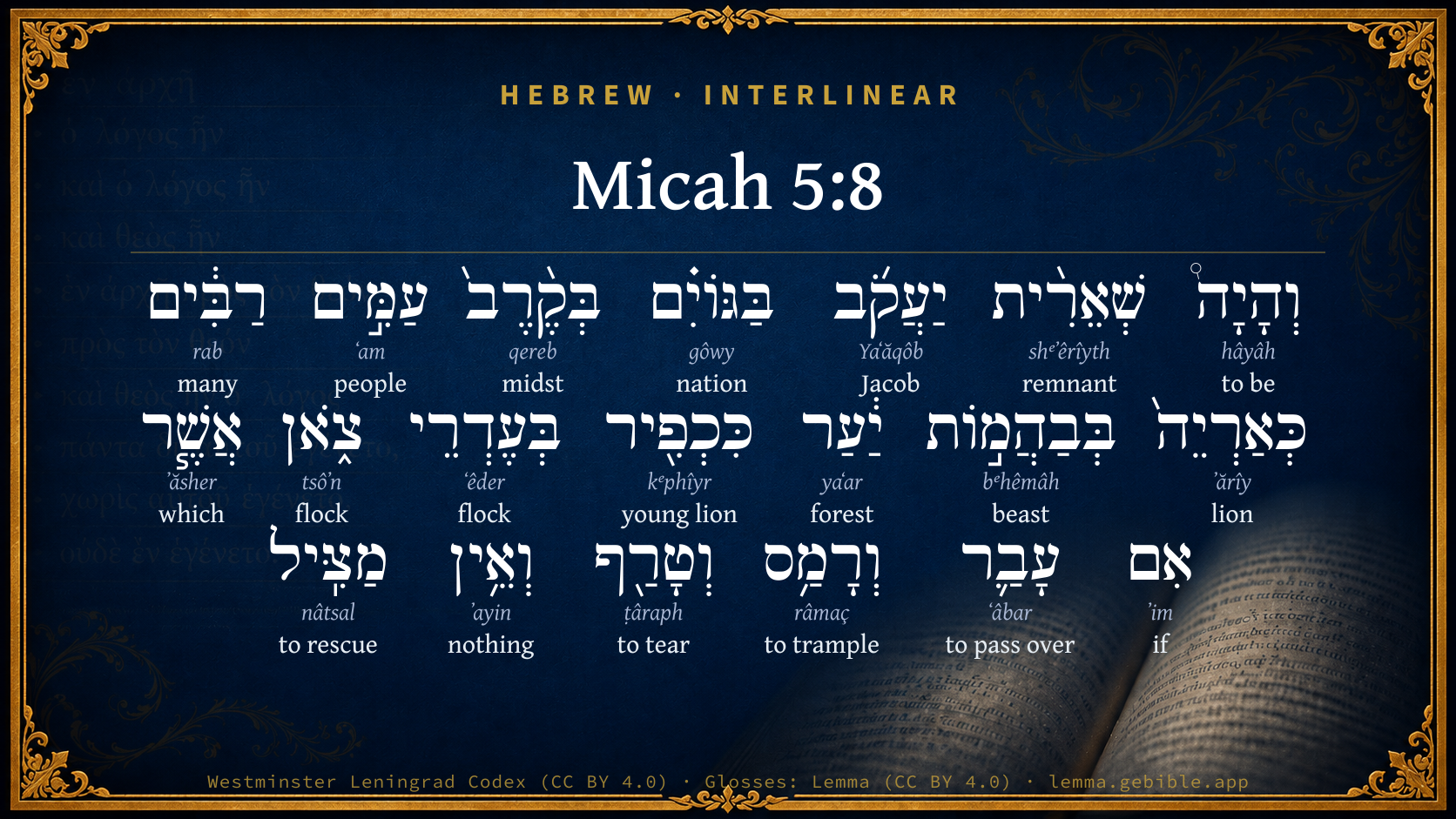
Micah 5:8

Hebrew (Westminster Leningrad Codex) Micah 5:8 appears in the Hebrew Old Testament. The text above is from the Westminster Leningrad Codex. Each word links to its Strong’s number, a concise gloss, and parsing drawn from the Open Scriptures Hebrew Bible morphology. Click any word for its full Brown-Driver-Briggs (BDB) entry.
Download image
Cite this verse

Micah 5:8 (World English Bible). Public Domain. Lemma interlinear Bible study tool, https://lemma.gebible.app/v/micah/5/8.

Show BibTeX & RIS
BibTeX
RIS
English Translation
The remnant of Jacob will be among the nations, In the midst of many peoples, Like a lion among the animals of the forest, Like a young lion among the flocks of sheep; Who, if he goes through, treads down and tears in pieces, And there is no one to deliver.
World English Bible · Public Domain
Download a study sheet

One document with this verse’s original text, its word-by-word gloss line, the meaning frame, cross-references with their text, attributed commentary, and full source and license credits — printable, and it pastes into notes with its structure intact.

This verse Autodidact and up

Study sheet (.html) Plain text (.txt)

A passage Seminary Student

Up to 50 verses in one chapter. A passage sheet keeps up to 6 commentary sources and 12 cross-references per verse, in the order this page ranks them, and says so on the sheet whenever that leaves anything out. Ask for a single verse and you get the Autodidact verse sheet above.

Everything on this page stays free to read, with no account — the sheet is a download of what is already on screen, not access to it.

Want to remove ads? Support Godless Engineer
Compare translations 3

The same verse in 3 English versions, stacked beneath the original-language interlinear above. Click any original word for its lexicon entry.

Each is an independent rendering of the whole verse — the interlinear is not word-aligned to these translations.

Highlighted words mark where these versions differ — a whole-verse word diff, not a word-by-word alignment.

  • World English Bible Public Domain
    The remnant of Jacob will be among the nations, In the midst of many peoples, Like a lion among the animals of the forest, Like a young lion among the flocks of sheep; Who, if he goes through, treads down and tears in pieces, And there is no one to deliver.
  • King James Version Public Domain
    And the remnant of Jacob shall be among the Gentiles in the midst of many people as a lion among the beasts of the forest, as a young lion among the flocks of sheep: who, if he go through, both treadeth down, and teareth in pieces, and none can deliver.
  • unfoldingWord Literal Text CC BY-SA 4.0
    And the remnant of Jacob will be among the nations, in the midst of many peoples, like a lion among the animals of the forest, like a young lion among the flocks of sheep, who, if he passes through, both tramples and tears, and there is no deliverer.

unfoldingWord Literal Text — © unfoldingWord, licensed CC BY-SA 4.0. Word-aligned USFM3 via Door43 (git.door43.org/unfoldingWord/en_ult).

Versions to compare (up to 4)

3 of 4 selected

Show all 18 translations

Every available English version of this verse, each an independent rendering of the whole verse.

  • World English Bible Public Domain
    The remnant of Jacob will be among the nations, In the midst of many peoples, Like a lion among the animals of the forest, Like a young lion among the flocks of sheep; Who, if he goes through, treads down and tears in pieces, And there is no one to deliver.
  • Berean Standard Bible Public Domain
    Then the remnant of Jacob will be among the nations, in the midst of many peoples, like a lion among the beasts of the forest, like a young lion among flocks of sheep, which tramples and tears as it passes through, with no one to rescue them.
  • Majority Standard Bible Public Domain
    Then the remnant of Jacob will be among the nations, in the midst of many peoples, like a lion among the beasts of the forest, like a young lion among flocks of sheep, which tramples and tears as it passes through, with no one to rescue them.
  • King James Version Public Domain
    And the remnant of Jacob shall be among the Gentiles in the midst of many people as a lion among the beasts of the forest, as a young lion among the flocks of sheep: who, if he go through, both treadeth down, and teareth in pieces, and none can deliver.
  • American Standard Version (1901) Public Domain
    And the remnant of Jacob shall be among the nations, in the midst of many peoples, as a lion among the beasts of the forest, as a young lion among the flocks of sheep; who, if he go through, treadeth down and teareth in pieces, and there is none to deliver.
  • Revised Version (1885) Public Domain
    And the remnant of Jacob shall be among the nations, in the midst of many peoples, as a lion among the beasts of the forest, as a young lion among the flocks of sheep: who, if he go through, treadeth down and teareth in pieces, and there is none to deliver.
  • Geneva Bible (1599) Public Domain
    And the remnant of Iaakob shalbe among the Gentiles in the middes of many people, as the lyon among the beastes of the forest, and as the lyons whelpe among the flockes of sheepe, who when he goeth thorow, treadeth downe and teareth in pieces, and none can deliuer.
  • Douay-Rheims (1899) Public Domain
    And the remnant of Jacob shall be among the Gentiles in the midst of many peoples as a lion among the beasts of the forests, and as a young lion among the docks of sheep: who when he shall go through and tread down, and take, there is none to deliver.
  • Young's Literal Translation Public Domain
    Yea, the remnant of Jacob hath been among nations, In the midst of many peoples, As a lion among beasts of a forest, As a young lion among ranks of a flock, Which if it hath passed through, Hath both trodden down and hath torn, And there is no deliverer.
  • Literal Standard Version CC BY-SA 4.0
    Indeed, the remnant of Jacob has been among nations, || In the midst of many peoples, || As a lion among beasts of a forest, || As a young lion among ranks of a flock, || Which if it has passed through, || Has both trodden down and has torn, || And there is no deliverer.
  • Unlocked Literal Bible CC BY-SA 4.0
    The remnant of Jacob will be among the nations, among many peoples, like a lion among the animals of the forest, like a young lion among the flocks of sheep. When he goes through them, he will trample over them and tear them to pieces, and there will be no one to save them.
  • unfoldingWord Literal Text CC BY-SA 4.0
    And the remnant of Jacob will be among the nations, in the midst of many peoples, like a lion among the animals of the forest, like a young lion among the flocks of sheep, who, if he passes through, both tramples and tears, and there is no deliverer.
  • Darby Bible Public Domain
    And the remnant of Jacob shall be among the nations, in the midst of many peoples, as a lion among the beasts of the forest, as a young lion among the flocks of sheep: who, if he go through, treadeth down, and teareth in pieces, and there is none to deliver.
  • World Messianic Bible Public Domain
    The remnant of Jacob will be among the nations, among many peoples, like a lion among the animals of the forest, like a young lion among the flocks of sheep; who, if he goes through, treads down and tears in pieces, and there is no one to deliver.
  • Webster's Bible Public Domain
    \\5:9\\Thy hand shall be lifted up upon thy adversaries, and all thy enemies shall be cut off.
  • Free Bible Version CC BY-SA 4.0
    Those who are left of the people of Jacob shall be among many nations, in the center of many peoples. They will be like a lion among the wild animals of the forest, like a young lion among flocks of sheep, clawing and tearing as it passes through, with no one to come to the rescue.
  • Bible in Basic English Public Domain
    Your hand is lifted up against those who are against you, and all your haters will be cut off.
  • JPS Tanakh (1917) Public Domain
    (5-7) And the remnant of Jacob shall be among the nations, in the midst of many peoples, as a lion among the beasts of the forest, as a young lion among the flocks of sheep, who, if he go through, treadeth down and teareth in pieces, and there is none to deliver.

Literal Standard Version (2020), Covenant Press — licensed CC BY-SA 4.0. Text via the HelloAO Bible API (eBible.org). Unlocked Literal Bible (unfoldingWord) — licensed CC BY-SA 4.0. Text via the HelloAO Bible API (eBible.org). unfoldingWord Literal Text — © unfoldingWord, licensed CC BY-SA 4.0. Word-aligned USFM3 via Door43 (git.door43.org/unfoldingWord/en_ult). Free Bible Version, Dr. Jonathan Gallagher — licensed CC BY-SA 4.0. Text via the HelloAO Bible API (eBible.org).

Word by word

More ways to search: Search by grammar → Find every occurrence → Compare this word →

Practice this passage: Drill this verse → Learn its vocabulary →

וְרָמַ֥ס
râmaç
H7429
“and · to trample”
Conjunction + Verb, Qal, Sequential Perfect, 3rd Person, Masculine, Singular
Part of Speech
Conjunction + Verb
Stem
Qal
Form
Sequential Perfect
Person
3rd Person
Gender
Masculine
Number
Singular
Full BDB Definition

Origin: a primitive root

TWOT: 2176

to trample - (Qal) - to trample - trampler (participle) - (Niphal) to be trampled
  1. וְהָיָה֩ hâyâh H1961 “and · to be” Conjunction + Verb, Qal, Sequential Perfect, 3rd Person, Masculine, Singular
  2. שְׁאֵרִ֨ית shᵉʼêrîyth H7611 “remnant of” Noun, Common, Feminine, Singular, Construct
  3. יַעֲקֹ֜ב Yaʻăqôb H3290 “Jacob” Noun, Proper
  4. בַּגּוֹיִ֗ם gôwy H1471 “in/at the · nations” Preposition, Determined + Noun, Common, Masculine, Plural, Absolute
  5. בְּקֶ֨רֶב֙ qereb H7130 “in/at · midst of” Preposition + Noun, Common, Masculine, Singular, Construct
  6. עַמִּ֣ים ʻam H5971 “peoples” Noun, Common, Masculine, Plural, Absolute
  7. רַבִּ֔ים rab H7227 “many” Adjective, Adjective, Masculine, Plural, Absolute
  8. כְּאַרְיֵה֙ ʼărîy H738 “like/as · lion” Preposition + Noun, Common, Masculine, Singular, Absolute
  9. בְּבַהֲמ֣וֹת bᵉhêmâh H929 “in/at · beasts of” Preposition + Noun, Common, Feminine, Plural, Construct
  10. יַ֔עַר yaʻar H3293 “forest” Noun, Common, Masculine, Singular, Absolute
  11. כִּכְפִ֖יר kᵉphîyr H3715 “like/as · young lion” Preposition + Noun, Common, Masculine, Singular, Absolute
  12. בְּעֶדְרֵי ʻêder H5739 “in/at · flocks of” Preposition + Noun, Common, Masculine, Plural, Construct
  13. צֹ֑אן tsôʼn H6629 “flock” Noun, Common, Both, Singular, Absolute
  14. אֲשֶׁ֧ר ʼăsher H834 “which” Particle, Relative
  15. אִם ʼim H518 “if” Conjunction
  16. עָבַ֛ר ʻâbar H5674 “to pass over” Verb, Qal, Perfect, 3rd Person, Masculine, Singular
  17. וְטָרַ֖ף ṭâraph H2963 “and · to tear” Conjunction + Verb, Qal, Sequential Perfect, 3rd Person, Masculine, Singular
  18. וְאֵ֥ין ʼayin H369 “and · nothing” Conjunction + Particle, Negative
  19. מַצִּֽיל nâtsal H5337 “rescuing” Verb, Hiphil, Participle Active, Masculine, Singular, Absolute

About this verse

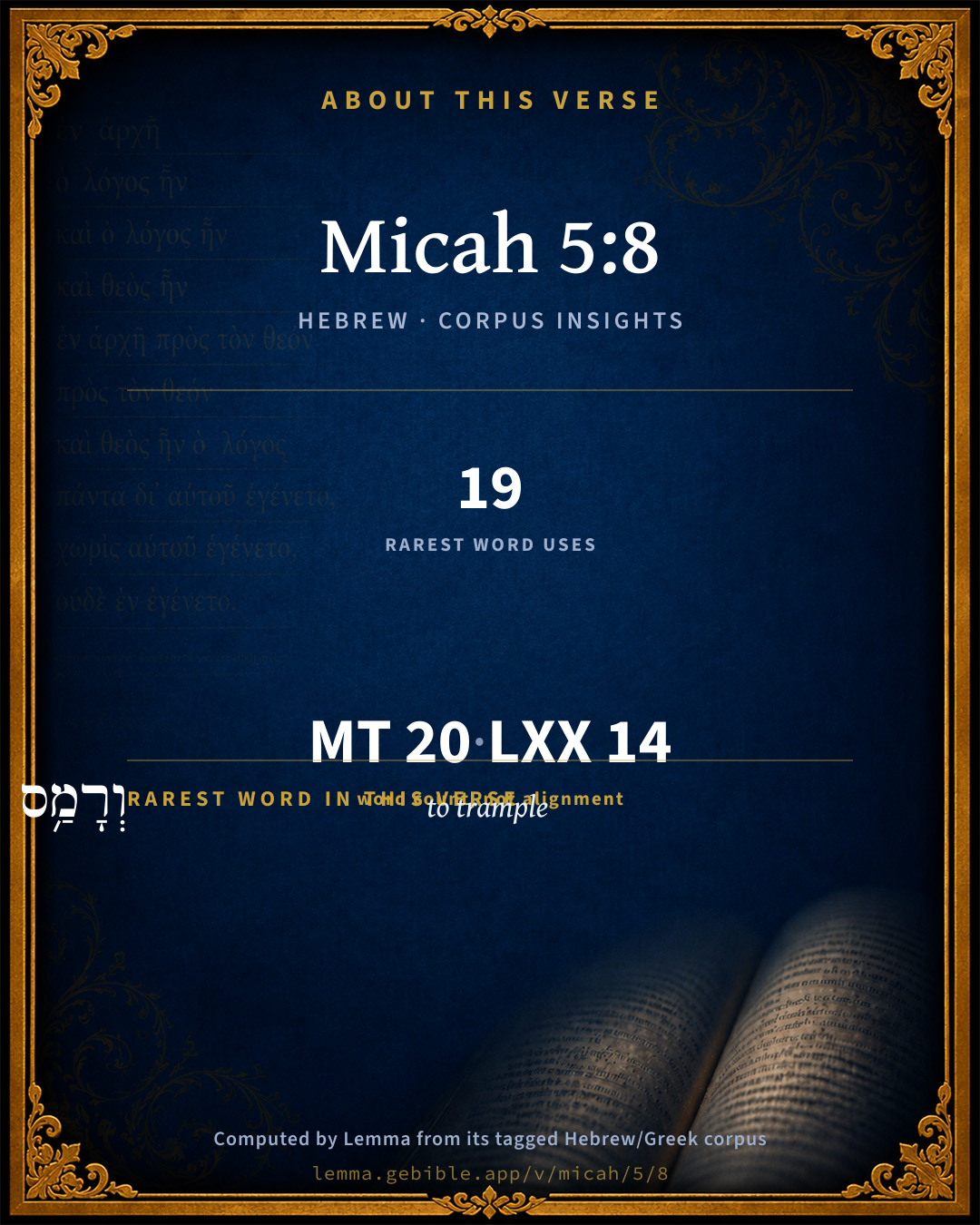
These counts appear in no published source. They are computed here, from the morphology-tagged text and Lemma’s own curated glosses. What Lemma adds →

20
words
20
distinct lemmas
Prophets
section

Notable vocabulary

The rarest word here is וְרָמַ֥ס to trample H7429 — appearing just 19 times in the whole Hebrew Bible.

Shared distinctive vocabulary

וְרָמַ֥ס to trample H7429 occurs in 19 verses of the Hebrew Bible. Also found in:

Grammatical profile

  • 5 verbs
  • 11 nouns
  • 1 adjective
  • 1 conjunction
  • 2 particles

Verb forms

  • וְהָיָה֩ Qal · Sequential Perfect
  • עָבַ֛ר Qal · Perfect
  • וְרָמַ֥ס Qal · Sequential Perfect
  • וְטָרַ֖ף Qal · Sequential Perfect
  • מַצִּֽיל Hiphil · Participle Active

Hebrew & Septuagint length

In English translation the verse runs 51 words from the Hebrew and 53 from the Septuagint (LXX English) — closely comparable.

A rough comparison of the two English renderings, which tokenize alike — not a word-level alignment.

Word counts can differ between the Hebrew and the Greek without any difference in meaning — e.g. the Hebrew direct-object marker אֵת has no separate Greek word, and Greek often adds the article ὁ.

In the original languages it is 20 Hebrew tokens and 14 Greek tokens — but the two are counted differently (Hebrew bundles its prefixes and suffixes into one token; the Greek is in lemma form), so that isn’t a like-for-like length.

Cross-references

16

Topical passages linked to Micah 5:8 in the Treasury of Scripture Knowledge — connected by theme and wording, ordered by reader-vote popularity; previews shown in the World English Bible.

  • Zechariah 10:5 They shall be as mighty men, Treading down muddy streets in the battle; And they shall fight, because Yahweh is with them; And the riders on horses will be confounded.
  • Micah 4:13 Arise and thresh, daughter of Zion; For I will make your horn iron, And I will make your hoofs brass; And you will beat in pieces many peoples: And I will devote their gain to Yahweh, And their substance to the Lord of the whole earth.
  • Psalms 2:8–12 Ask of me, and I will give the nations for your inheritance, The uttermost parts of the earth for your possession.
  • Psalms 50:22 "Now consider this, you who forget God, Lest I tear you into pieces, and there be none to deliver.
  • Isaiah 41:15–16 Behold, I have made you [to be] a new sharp threshing instrument having teeth; you shall thresh the mountains, and beat them small, and shall make the hills as chaff.
  • Hosea 5:14 For I will be to Ephraim like a lion, And like a young lion to the house of Judah. I myself will tear in pieces and go away. I will carry off, and there will be no one to deliver.
  • Obadiah 1:18–19 The house of Jacob will be a fire, the house of Joseph a flame, and the house of Esau for stubble. They will burn among them, and devour them. There will not be any remaining to the house of Esau." Indeed, Yahweh has spoken.
  • Zechariah 9:15 Yahweh of Hosts will defend them; And they will destroy and overcome with sling-stones; And they will drink, and roar as through wine; And they will be filled like bowls, Like the corners of the altar.
  • Zechariah 12:3 It will happen in that day, that I will make Jerusalem a burdensome stone for all the peoples. All who burden themselves with it will be severely wounded, and all the nations of the earth will be gathered together against it.
  • Genesis 49:9 Judah is a lion's cub. From the prey, my son, you have gone up. He stooped down, he crouched as a lion, As a lioness. Who will rouse him up?
  • Psalms 110:5–6 The Lord is at your right hand. He will crush kings in the day of his wrath.
  • Matthew 10:14 Whoever doesn't receive you, nor hear your words, as you go out of that house or that city, shake off the dust from your feet.
  • Acts 18:6 When they opposed him and blasphemed, he shook out his clothing and said to them, "Your blood be on your own heads! I am clean. From now on, I will go to the Gentiles!"
  • 2 Corinthians 2:15–17 For we are a sweet aroma of Christ to God, in those who are saved, and in those who perish;
  • Hebrews 12:25 See that you don't refuse him who speaks. For if they didn't escape when they refused him who warned on the Earth, how much more will we not escape who turn away from him who warns from heaven,
  • Hebrews 2:3 how will we escape if we neglect so great a salvation-- which at the first having been spoken through the Lord, was confirmed to us by those who heard;

Cross-references courtesy of OpenBible.info (CC BY 4.0).

Hebrew and Greek witnesses Masoretic Hebrew ↔ Greek Septuagint

The same verse in the two great witnesses to the Old Testament, shown verse-for-verse.

These are two independent witnesses, not word-aligned to each other, and the Septuagint is shown in lemma (dictionary) form.

Hebrew Micah 5:8 Masoretic · Westminster Leningrad Codex

וְהָיָה֩ שְׁאֵרִ֨ית יַעֲקֹ֜ב בַּגּוֹיִ֗ם בְּקֶ֨רֶב֙ עַמִּ֣ים רַבִּ֔ים כְּאַרְיֵה֙ בְּבַהֲמ֣וֹת יַ֔עַר כִּכְפִ֖יר בְּעֶדְרֵי צֹ֑אן אֲשֶׁ֧ר אִם עָבַ֛ר וְרָמַ֥ס וְטָרַ֖ף וְאֵ֥ין מַצִּֽיל

The remnant of Jacob will be among the nations, In the midst of many peoples, Like a lion among the animals of the forest, Like a young lion among the flocks of sheep; Who, if he goes through, treads down and tears in pieces, And there is no one to deliver.

World English Bible · Public Domain

Greek LXX Micah 5:8 Septuagint · lemma form

ὑψόω ὁ χείρ σύ ἐπί ὁ θλίβω σύ καί πᾶς ὁ ἐχθρός σύ ἐκὀλεθρεύω

And the remnant of Jacob shall be among the Gentiles in the midst of many nations, as a lion in the forest among cattle, and as a lion's whelp among the flocks of sheep, even as when he goes through, and selects, and carries off his prey, and there is none to deliver.

LXX2012 (modern English Septuagint) · Public Domain

Hebrew: Westminster Leningrad Codex (CC BY 4.0). Greek: Septuagint (public domain); English from LXX2012 (modern English Septuagint) (Public Domain). How the Septuagint differs from the Hebrew →

Targum (Aramaic paraphrase)

1

The Targum is the ancient Jewish Aramaic paraphrase of the Hebrew Scriptures — an interpretive translation, not the Hebrew text itself. Onkelos (literal) and Pseudo-Jonathan (expansive) render the Torah, and Jonathan the Prophets. Coverage is partial: where no permissively-licensed English translation exists for a verse, only the Aramaic is shown. This is verse-level text, not a word-by-word alignment to the Hebrew.

  1. Targum Jonathan Prophets (Joshua–Malachi)
    סַגִי מִבְּכֵן תִּתְקֵיף יְדָךְ יִשְׂרָאֵל עַל סַנְאָךְ וְכָל בַּעֲלֵי דְבָבָךְ יִשְׁתֵּיצוּן:

    (no public-domain English translation for this verse)

    Targum Jonathan — Aramaic: “Mikraot Gedolot” (public domain). English: “Sefaria Community Translation” (CC0 1.0 (public-domain dedication)); “London "Chaldee Paraphrase," 1871” (public domain). Text via Sefaria.

Commentary

Notes on Micah 5:8 from classic Christian and Jewish commentators (each source and its license shown beneath its notes). The classic Christian expositions comment on the surrounding passage and are grouped to its opening verse, so a note may address several verses; the Jewish commentaries on the Tanakh (Rashi and others) are per-verse, so they appear only where the commentator wrote on this verse.

Lemma curates 59 commentaries, every one of them public domain or Creative Commons licensed, each selected and text-cleaned for this edition rather than reprinted as found. About our sources →

Trapp's Complete Commentary

John Trapp

Mic 5:8 And the remnant of Jacob shall be among the Gentiles in the midst of many people as a lion among the beasts of the forest, as a young lion among the flocks of sheep: who, if he go through, both treadeth down, and teareth in pieces, and none can deliver.

Ver. 8. And the remnant of Jacob … as a lion among the beasts of the forest] The saints shall prosper and do great exploits, as being endued with an invincible force of the spirit, making them as so many Coeur-de-lions; or as Chrysostom saith of Peter, that he was like a man made all of fire walking among stubble. What lion-like men were all the apostles, those white horses upon which the Lord Christ rode about the world, "conquering and to conquer?" Rev 6:2. That Lion of the tribe of Juda, Rev 5:5, had put upon them of his own spirit; and of his fulness bestowed upon them grace for grace, Joh 1:16; hence their transcendent zeal and courage for the truth. Stephen was among his countrymen, the Jews, as a lion among the beasts of the forest. So were in their several generations Athanasius, Basil, Ambrose, Luther, Latimer, Farel, &c., that noble army of martyrs. One of them told the persecutors that they might pluck the heart out of his body, but never pluck the truth out of his heart. Another, that the heavens should sooner fall than he would turn. A third, that if every hair of his head were a man he would suffer death in the opinion and faith that he was now in. A fourth said, Can I die but once for Christ? And generally, the valour of the patient and the savageness of the persecutors strove together; till both exceeding nature and belief bred wonder and astonishment in beholders and readers, and in some effectual conversion, as in Justin Martyr, in Calberius, in those four hundred said to be converted at the martyrdom of Cecilia; and lastly, in Silvester, the executioner at the martyrdom of Simon Laloe, at Dijon, in France; where seeing the great faith and constance of that heavenly martyr, he was so compuncted with repentance, and fell into such despair of himself, that after much ado, being comforted and converted, he moved with all his family to the Church of Geneva. But what a silly conceit is that of the Jews at this day, that when Messiah comes they shall be these lions among the Gentiles in the midst of all other people to tread them down, and to tear in pieces without rescue; and what a true character hath a late writer (Sir H. Blount) given of them, that they are a light, aerial, and fanatical brained people; and easily apt to work themselves into the fool’s paradise of a sublime dotage!

John Trapp, A Commentary or Exposition upon All the Books of the Old and New Testament (1647–1656) — public domain. Text from a community e-Sword module.

Joseph Benson's Commentary

Mic 5:8. And the remnant of Jacob shall be among the Gentiles as a lion — For strength and courage, which the beasts of the forest dare not oppose, and cannot resist. This seems to be a prediction of what was to be effected in the times of the Maccabees, and those following them, when the Jewish people gained great advantages over the Idumeans, Moabites, Ammonites, Samaritans, &c. Or, as the former verse describes the benefits which the converted Jews should bring to those Gentiles that were disposed to embrace the gospel; this shows us what the enemies and opposers of the truth had to expect: see notes on Psa 2:5; Psa 2:9; Isa 60:12.

Joseph Benson's Commentary on the Old and New Testaments (1811–1818) — public domain. Text from a community e-Sword module.

The Preacher's Complete Homiletical Commentary

Joseph S. Exell (gen. ed.)

Mic_5:8. Lion] To take vengeance on her enemies (Isa_66:15-16; Zec_12:3-6; Zec_14:17-18); and strike terror into all opponents. A prediction of victory under the Maccabees and after-times.

Mic_5:9.] Exultant feeling; High be thy hand (Isa_26:11) to destroy the foe (Exo_13:9).

ISRAEL AS A LION.—Mic_5:8-9

God and his people have not only a benignant but a terrible aspect towards men,—as dew to the well-disposed, and as a lion to the assailants. In many respects the Church may be like the lion.

I. In that religious awe which they exercise over the minds of ungodly men. The lion among beasts of the forest and the young lion among flocks of sheep are feared beyond description. The good examples and consistent lives of pious men often strike terror into the conscience, and check the evil practices of the wicked. They are awed by them and dare not harm them. Herod feared John because he was a holy man (Mar_6:20).

II. In the courage with which they attack antagonists. “If he go through, both treadeth down and teareth in pieces.” It boldly faces and braves the force of arms. Wounds rather provoke than repress its fierceness. It is not daunted by numbers; will often attack an entire caravan, and if overpowered in the combat, instead of flying, will gradually retreat with its face to the enemy until it dies. Luther and Latimer were the lions of the Church. Christians now through God are Cœur-de-lions, and endued with invincible power. “Terrible as an army with banners.”

III. In the victory which they gain over the enemy. “Lifted up upon thine adversaries.”

1. The victory is resistless. “None can deliver,” however strong and determined.

2. The victory is complete. “All thine enemies shall be cut off.” Ceasing to be enemies or destroyed in their opposition. The victories of the Maccabees were earnests of future glories. The hand of the Church shall be strengthened by the might of Jehovah. All adversaries will shortly be bruised under her feet. “And he went forth conquering and to conquer.”

ILLUSTRATIONS TO CHAPTER 5

Mic_5:8-9. The lion was the emblem of strength and sovereignty (The Lion of England). Illustrative of Israel (Num_24:9), and Judah (Gen_49:9); the courage of brave men (2Sa_1:23; 2Sa_23:20), and the boldness of saints (Pro_28:1). The lion is fearless of men (Isa_31:4.; Nah_2:11). What can a javelin do against his strength! But even the king of the forest can read the eye and the language of man. Moral force is greater than physical force. What then must be the strength of the Christian Church under the leadership of “The Lion of the tribe of Judah”!

The Preacher's Complete Homiletical Commentary (gen. ed. Joseph S. Exell; Funk & Wagnalls, c. 1892) — public domain (pre-1929). A full-Bible homiletical/sermon-outline anthology covering 65 of 66 books (2 John is absent from the source module). Text from a community e-Sword module.

Tyndale Open Study Notes

Tyndale Open Resources

5:8-9 God’s people will have a unique place among the nations of the world (Gen 12:3; Exod 19:4-6). They will be the head and not the tail (Deut 28:13), and invincible as a lion (cp. Esth 6:13) as God gives them hegemony over the nations. • The Lord will judge their foes (see Mic 5:15) if they continue to rebel against him. The Lord’s desire, however, is ultimately to bless the nations, not to curse or destroy them (Gen 12:3; Jon 4:11; John 3:16).

Tyndale Open Study Notes — © Tyndale Open Resources, licensed CC BY-SA 4.0. Text via the HelloAO Bible API.

Jamieson, Fausset & Brown

Robert Jamieson, A. R. Fausset & David Brown

as a lion--In Mic 5:7 Israel's benignant influence on the nations is described; but here her vengeance on the godless hosts who assail her (Isa 66:15-16, Isa 66:19, Isa 66:24; Zac 12:3, Zac 12:6, Zac 12:8-9; Zac 14:17-18). Judah will be "as as lion," not in respect to its cruelty, but in its power of striking terror into all opponents. Under the Maccabees, the Jews acquired Idumea, Samaria, and parts of the territory of Ammon and Moab [GROTIUS]. But this was only the earnest of their future glory on their coming restoration.

Jamieson, Fausset & Brown — Commentary Critical and Explanatory on the Whole Bible (1871) — public domain (CC PDM 1.0). Text via the HelloAO Bible API.

Adam Clarke's Commentary

Verse 8. As a lion] In this and the following verse the victories of the Maccabees are supposed to be foretold.

Adam Clarke's Commentary on the Bible (1810–1826) — public domain. Text from a community e-Sword/MySword module.

John Calvin's Commentaries

Then follows this promise, — that God will arm his people with invincible and irresistible power, that they may be superior to all their enemies. Hence he says, that the residue of Israel shall be like a lion among the beasts of the forests and like a young lion among a flock of sheep As a strong lion then is superior to other beasts, and as a young lion dares ferociously to attack a flock of sheep; so he says, the people of Israel shall be; they shall be like lions, filling their enemies with terror, yea, and plundering and scattering them, so that no one will dare to resist them. The Prophet, by speaking thus, does not mean, that the people of God would be cruel and sanguinary: for we know that when the Prophets use similes of this kind, they express something not strictly suitable; for who would be so foolish as to select every thing that belongs to a lion, and apply it to the Church of God. Then the reason for this similitude must be observed; it was to show, that the faithful shall be endued with a power so superior to that of their enemies, that they shall be a terror to them. It does not hence follow that they shall be cruel.

But we must, at the same time, see what the Lord promises to his Church. Though God then recommends to his children the spirit of meekness, yet the faithful may still be a thread to their enemies; they ought, however, to observe what is just towards them, and to keep themselves within proper bounds. And yet Micah says, that they shall be endued with such power that they shall drive their enemies afar off; yea, that they shall plunder and tear them in pieces, while no one will be able to resist them. But these two things are necessary as to the preservation of the Church, that God may make it grow; for except it be miraculously increased, it can never grow; and then it has need of a strong and powerful defense against her enemies; for we know that there are always wicked men who oppose the Church, yea, who apply all their powers to destroy it: it is therefore necessary that it should be supplied by the Lord with invincible strength, as our Prophet declares here. Let us proceed —

John Calvin's Commentaries (1540-1563) — public domain. Text from the Calvin Translation Society English edition (1840s-50s) via the Christian Classics Ethereal Library (ccel.org). Calvin's coverage is partial (roughly two-thirds of the Bible); uncommented books and verses are honest gaps, never fabricated. The 19th-century editor's footnotes and remarks are omitted so the notes are faithfully Calvin's own voice.

Ellicott's Commentary for English Readers

(8) As a lion among the beasts of the forest.—There is righteous wrath as well as all-embracing mercy with God. Christ, whose graciousness is likened to the dew, and His gentleness to the lamb, is at the same time the Lion of the tribe of Judah. At the opening of the “sixth seal” the kings of the earth and great men are represented as in extreme terror at “the wrath of the Lamb” (Rev_6:16).

A Bible Commentary for English Readers, edited by Charles John Ellicott (1878–1897) — public domain. Text from a community e-Sword module.

John Gill's Exposition

And the remnant of Jacob shall be among the Gentiles in the midst of many people,.... The same persons are meant here as before; who are compared to dew and showers of rain, because numerous; and full of blessings in themselves, and useful and beneficial to others: and here are said to be

as a lion among the beasts of the forest; strong, mighty, powerful, and courageous, and superior to their enemies, as the lion is strongest among beasts, and keeps all others in awe of him. Some refer this to the times of the Maccabees; when Judas and his brethren behaved with great fortitude and courage, and were victorious, and prevailed over the armies of Antiochus, and others; but it seems rather to belong to the latter day, when the Jews shall be superior to their enemies the Turks, who would disturb them in the possession of their land: and shall be a terror to them,

as a young lion among the flocks of sheep; signifying that their enemies shall be no more to them, and no more able to oppose them, than a flock of sheep are to a young lion, or they to resist him The design of the metaphor is; not to signify the harmlessness and innocence of their enemies, but their weakness, and the strength and courage of them;

who, if he go through; the flock: on whatsoever he seizes,

both treadeth down, and teareth in pieces, and none can deliver; brings it to the ground at once, tramples upon it, and tears it in pieces as its prey; and none in the flock, or to whom it belongs, can deliver out of his hand. This will be the case when the Jews shall turn to the Lord, and the Lion of the tribe of Judah shall be at the head of them; though some interpret this of the first times of the Gospel, and take it to be fulfilled in the apostles and first ministers of the word, who were Jews; and who were valiant defenders of truth, and conquerors over the devil and the world, and were the instruments of bringing many into subjection to Christ; but it seems best to apply it to the last times, and not to the converted Jews only, though in the first place; but to all the, spiritual Israel of God, the whole Christian church, which will then be in such happy circumstances.

John Gill's Exposition of the Whole Bible (1746–1763) — public domain (CC PDM 1.0). Text via the HelloAO Bible API.

Albert Barnes' Notes on the Bible

And the remnant of Jacob shall be as a young lion - o: “What more unlike than the sweetness of the dew and the fierceness of the lion? What so different as the gentle shower distilling on the herb, and the savageness or vehemence of a lion roaring among “the flocks of sheeps?” Yet both are ascribed to “the remnant of Jacob.” Why? Because the Apostles of Christ are both tender and severe, tender in teaching and exhorting, severe in rebuking and avenging. How does Paul teach, “God was in Christ reconciling the world unto Himself, and hath committed unto us the word of reconciliation; now then we are ambassadors for Christ, as though God did beseech you by us: we pray you in Christ’s stead, be ye reconciled to God!” 2 Cor. 5:19–6:11. What sweeter than the dew of love, the shower of true affection? And so, on to that, “our heart is enlarged.” They are such drops of dew as no one could doubt came from “the Lord, the Father of our Lord Jesus Christ, the Father of mercies and the God of all comfort” 2Co 1:3.

Yet the same Apostle after a little writes, “This is the third time I am coming to you. I told you before and foretell you, and being absent now I write to them which heretofore have sinned and to all others, that if I come again, I will not spare, since ye seek a proof of Christ speaking in me” 2Co 13:1-3. See the severity of a master, like the roaring of “a lion among the beasts of the forest.” For such surely are they whom he rebukes for the 2Co 12:21 uncleanness and fornication and lasciviousness which they had committed. Was he not to such as a lion? 1Co 5:2-5? Was not Peter such, when he rebuked Ananias first and then Sapphira his wife, and they fell down and gave up the ghost? They tread down or “cast down imaginations and every high thing that exalteth itself against the knowledge of God” 2Co 10:5; as Christ Himself, who spake in them, is both a lamb and the “Lion of the tribe of Judah” Rev 5:5, and nothing is so terrible as “the wrath of the Lamb” Rev 6:16.

And none can deliver - Dionysius: “For as the Apostles past from nation to nation, and trod down paganism, subduing it to Christ, and taking within their net the many converted nations, none could withdraw from the Apostles’ doctrine those whom they had converted.” The pagan world “cried out that the state is beset, that the Christians are in their fields, their forts, their islands.” : “We are a people of yesterday, and yet we have filled every place belonging to you, cities, islands, castles, towns, assemblies, your very camp, your tribes, companies, palace, senate, forum! We leave you your temples only. We can count your armies, our numbers in a single province will be greater.”

Albert Barnes' Notes on the Bible (1834–1885) — public domain. Text from a community e-Sword/MySword module.

Haydock's Catholic Bible Commentary

Lion. This denotes the fortitude of these first preachers, and their success in their spiritual enterprises. (Challoner) --- The Jews, by leave of Assuerus, defended themselves; and the Machabees became terrible, Esther ix., and 1 Machabees iii. 4. The power of the latter was established, while the efforts of Eupator and of other Syrian persecutors for sixty years, down to Zebina, proved fruitless or destructive to themselves. (Calmet)

George Leo Haydock (1774–1849), Haydock's Catholic Family Bible and Commentary, 1859 edition — public domain. Excludes Psalms (Douay-Rheims chapter numbering differs from Protestant) and Deuterocanonical books (Catholic canon only).

Matthew Poole's English Annotations

In the midst of many people; see Mic 5:7; who are enemies, that do injure them.

As a lion for strength and courage, which the beasts of the forest dare not oppose: and cannot resist, so Should this remnant; much like that Lev 26:8.

As a young lion among the flocks of sheep; a second allusion of the same import, but yet with some greater emphasis; in the former comparison, the greater cattle, called behemoth, in this sheep, much lesser and weaker cattle, are compared with the lion and young lion.

Treadeth down; overbeareth, and throws down by his strength, and treads under foot with as much ease as a man would tread on worms, or tread down straw for the dunghill.

Teareth in pieces; to devour, satisfy his hunger, and repair his strength for a new assault on his prey.

None can deliver; that dares attempt a rescue; but the prey is left under the lion’s paw, to satisfy the hungry beast: so shall Israel be after their return out of captivity, and while they keep the ways of the Lord; so they were in Esther’s time, against such as would have destroyed them; so in the Maccabees’ time, when they subdued the nations about them. But the conquering power of the word, the rod of Christ’s strength, doth greater wonders than the sword of the Maccabees ever did. It is the mighty conquering power of the gospel that is here shadowed forth to us.

Matthew Poole's English Annotations on the Holy Bible (1683–1685) — public domain. Text from a community e-Sword/MySword module.

The Pulpit Commentary

Secondly, Israel shall be a terrible power among the nations, and invincible in strength. ("Nova theocratica agit suaviter et fortiter" (Knabenbauer). As a lion. The Lamb of God is also the Lion of the tribe of Judah, (Rev_5:5 Num_23:24) and he "is set for the fall and rising again of many". (Luk_2:34) In his irresistible strength Israel shall overcome all enemies. So Judas Maccabaeus is compared to a lion. (RAPC 1Ma 3:4)

The Pulpit Commentary (1880–1919), ed. H.D.M. Spence-Jones & Joseph S. Exell — public domain. Text from a community e-Sword module.

John Wesley's Explanatory Notes

As a lion - For strength and courage, which the beasts of the forest dare not oppose, and cannot resist.

John Wesley, Explanatory Notes Upon the Whole Bible (1754–1765) — public domain. Text via the GEBible commentary corpus.

unfoldingWord translationNotes

Door43 World Missions Community

General Information:

Yahweh promises that the Israelites who are alive after Yahweh has punished his people with war will completely defeat and rule over their enemies.

remnant of Jacob

descendants of Jacob who survive the war

among the nations, among many peoples

These two phrases mean basically the same thing and emphasize that the "remnant of Jacob" will live in many different nations. (See: Doublet)

like a lion among the animals of the forest, like a young lion among the flocks of sheep

Lions are able to kill and eat any wild animal of the forest, and they easily kill sheep. AT: "like the fiercest of wild animals, like a wild animal that kills helpless livestock" (See: Simile)

When he goes through them

when the young lion goes through the flocks of sheep

will trample over them and tear

"will jump on them so they fall down, and then he will tear"

Your hand ... your enemies

The writer is speaking to Yahweh, so both instances of "your" are masculine singular. (See: Forms of You)

Your hand will be lifted against your enemies

The hand is a metonym for the power that the hand exercises or a synecdoche for the whole person. To lift the hand is to exercise power. AT: "You will completely defeat your enemies" (See: Metonymy and Synecdoche)

it will destroy them

The hand is a synecdoche for the whole person. AT: "you will destroy them" (See: Synecdoche)

translationWords

remnant

Jacob

nation

people group

lions

flocks

ewe

save

hand

adversary

unfoldingWord translationNotes — © Distant Shores Media and the Door43 World Missions Community, licensed CC BY-SA 4.0. Source: git.door43.org/Door43/en_tn.

Lesson kit

Teaching starters — assembled from the data on this page, not authored interpretation. Every prompt links to the verse data it draws on. Edit before teaching.

Micah, in the Prophets, opens this verse with 20 words (20 distinct Hebrew lemmas). Its most distinctive word is râmaç (“to trample”). A historical commentator’s framing appears above. Read the whole chapter for the surrounding context.

Discussion questions

  1. What does “to trample” (râmaç) contribute to the verse as a whole?
  2. How does 2 Kings 7:17, which shares the word «to trample», read alongside this verse?
  3. The translations on this page render this verse differently — a whole-verse word diff, not a word-by-word alignment. What might account for the different wordings?
  4. «וְהָיָה֩» is a Qal Sequential Perfect verb. How does that grammatical form shape the action described?
  5. Compare how Trapp's Complete Commentary and Joseph Benson's Commentary read this verse. Where do they agree or differ?

Things to notice

Reading settings

Reading text

Shown beneath each verse's original-language words.

Old Testament
Old Testament edition

Read the OT as the Masoretic Hebrew (MT) or the Greek Septuagint (LXX).

English shown for the Greek Septuagint (in the Hebrew ↔ Greek comparison).

Comparing translations? Open the Compare panel on any verse page to stack up to four side by side.