
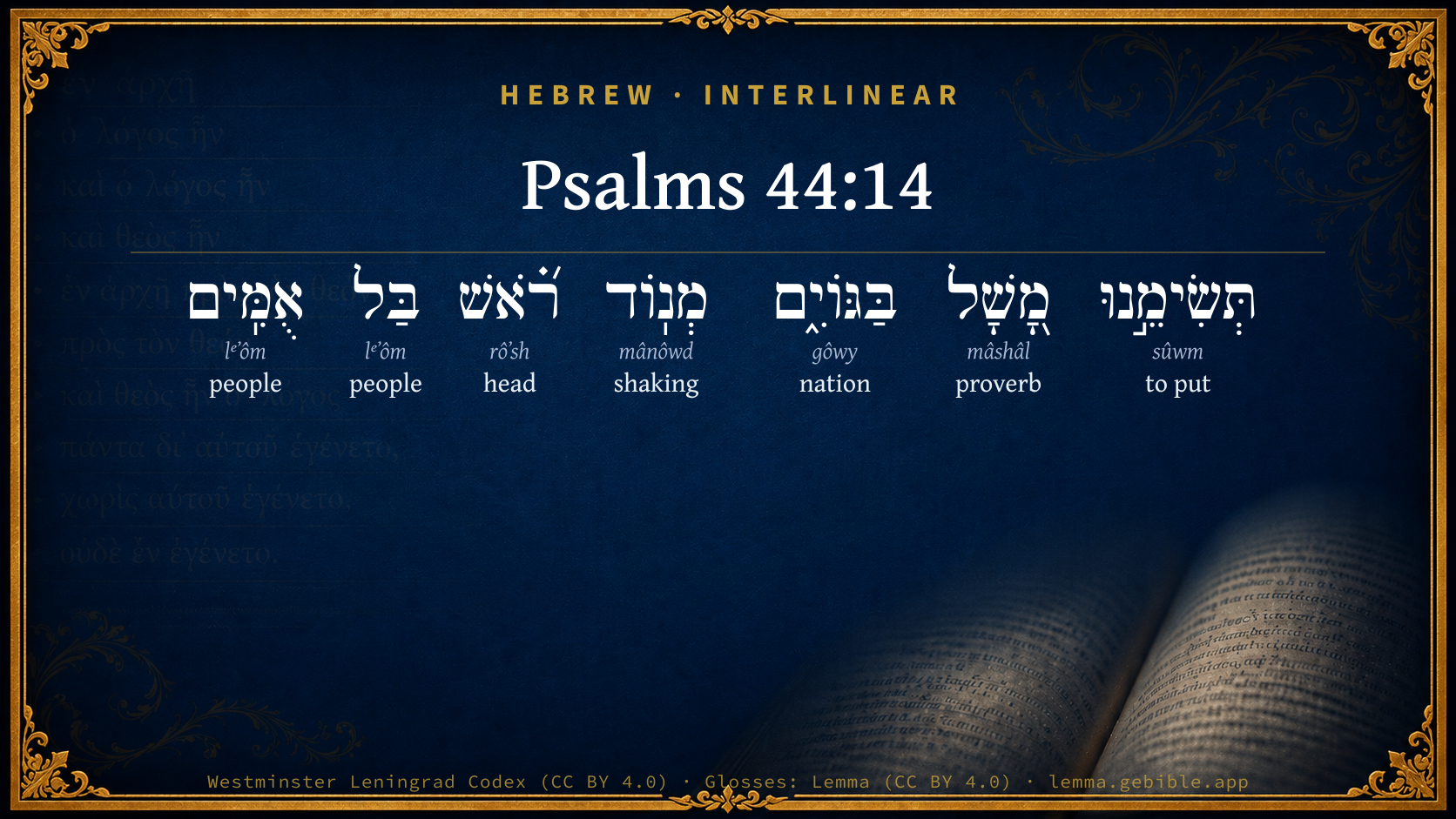
Psalms 44:14

Hebrew (Westminster Leningrad Codex) Psalms 44:14 appears in the Hebrew Old Testament. The text above is from the Westminster Leningrad Codex. Each word links to its Strong’s number, a concise gloss, and parsing drawn from the Open Scriptures Hebrew Bible morphology. Click any word for its full Brown-Driver-Briggs (BDB) entry.
Download image
Cite this verse

Psalms 44:14 (World English Bible). Public Domain. Lemma interlinear Bible study tool, https://lemma.gebible.app/v/psalms/44/14.

Show BibTeX & RIS
BibTeX
RIS
English Translation
You make us a byword among the nations, A shaking of the head among the peoples.
World English Bible · Public Domain
Highlights
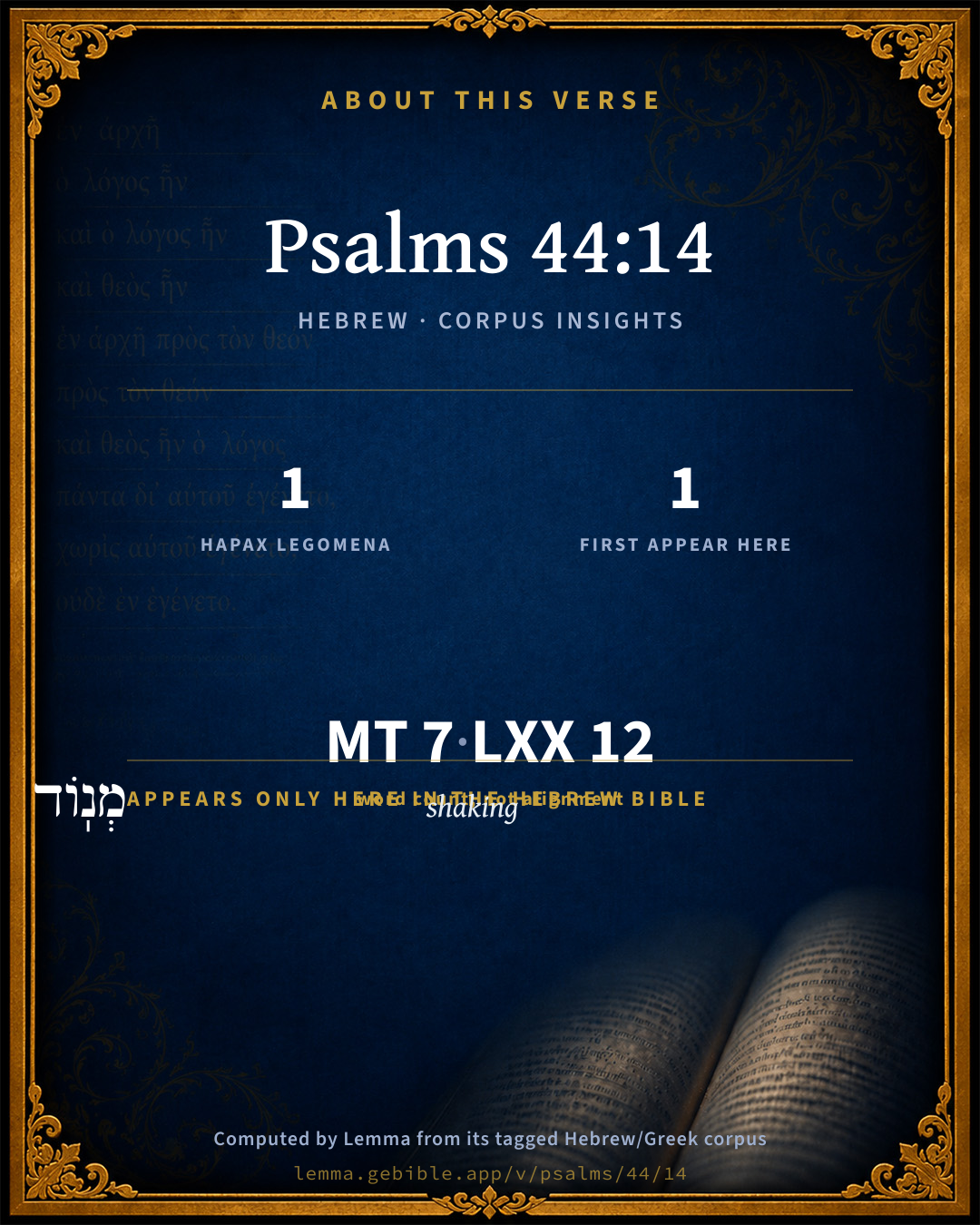
  • 1 hapax legomenon — only here in the Hebrew Bible
  • 1 first appearance in the Hebrew Bible
Full analysis ↓
Download a study sheet

One document with this verse’s original text, its word-by-word gloss line, the meaning frame, cross-references with their text, attributed commentary, and full source and license credits — printable, and it pastes into notes with its structure intact.

This verse Autodidact and up

Study sheet (.html) Plain text (.txt)

A passage Seminary Student

Up to 50 verses in one chapter. A passage sheet keeps up to 6 commentary sources and 12 cross-references per verse, in the order this page ranks them, and says so on the sheet whenever that leaves anything out. Ask for a single verse and you get the Autodidact verse sheet above.

Everything on this page stays free to read, with no account — the sheet is a download of what is already on screen, not access to it.

Want to remove ads? Support Godless Engineer
Compare translations 3

The same verse in 3 English versions, stacked beneath the original-language interlinear above. Click any original word for its lexicon entry.

Each is an independent rendering of the whole verse — the interlinear is not word-aligned to these translations.

Highlighted words mark where these versions differ — a whole-verse word diff, not a word-by-word alignment.

  • World English Bible Public Domain
    You make us a byword among the nations, A shaking of the head among the peoples.
  • King James Version Public Domain
    Thou makest us a byword among the heathen, a shaking of the head among the people.
  • unfoldingWord Literal Text CC BY-SA 4.0
    You have made us a proverb among the nations, a shaking of the head among the peoples.

unfoldingWord Literal Text — © unfoldingWord, licensed CC BY-SA 4.0. Word-aligned USFM3 via Door43 (git.door43.org/unfoldingWord/en_ult).

Versions to compare (up to 4)

3 of 4 selected

Show all 18 translations

Every available English version of this verse, each an independent rendering of the whole verse.

  • World English Bible Public Domain
    You make us a byword among the nations, A shaking of the head among the peoples.
  • Berean Standard Bible Public Domain
    You have made us a byword among the nations, a laughingstock among the peoples.
  • Majority Standard Bible Public Domain
    You have made us a byword among the nations, a laughingstock among the peoples.
  • King James Version Public Domain
    Thou makest us a byword among the heathen, a shaking of the head among the people.
  • American Standard Version (1901) Public Domain
    Thou makest us a byword among the nations, A shaking of the head among the peoples.
  • Revised Version (1885) Public Domain
    Thou makest us a byword among the nations, a shaking of the head among the peoples.
  • Geneva Bible (1599) Public Domain
    Thou makest vs a prouerbe among the nations, and a nodding of the head among the people.
  • Douay-Rheims (1899) Public Domain
    Thou hast made us a reproach to our neighbours, a scoff and derision to them that are round about us.
  • Young's Literal Translation Public Domain
    Thou makest us a simile among nations, A shaking of the head among peoples.
  • Literal Standard Version CC BY-SA 4.0
    You make us an allegory among nations, || A shaking of the head among peoples.
  • Unlocked Literal Bible CC BY-SA 4.0
    You make us an insult among the nations, a shaking of the head among the peoples.
  • unfoldingWord Literal Text CC BY-SA 4.0
    You have made us a proverb among the nations, a shaking of the head among the peoples.
  • Darby Bible Public Domain
    Thou makest us a byword among the nations, a shaking of the head among the peoples.
  • World Messianic Bible Public Domain
    You make us a byword among the nations, a shaking of the head among the peoples.
  • Webster's Bible Public Domain
    \\44:13\\Thou makest us a reproach to our neighbors, a scorn and a derision to them that are around us.
  • Free Bible Version CC BY-SA 4.0
    You have made us a joke to the other nations; they scornfully shake their heads at us.
  • Bible in Basic English Public Domain
    Our name is a word of shame among the nations, a sign for the shaking of heads among the peoples.
  • JPS Tanakh (1917) Public Domain
    (44-15) Thou makest us a byword among the nations, a shaking of the head among the peoples.

Literal Standard Version (2020), Covenant Press — licensed CC BY-SA 4.0. Text via the HelloAO Bible API (eBible.org). Unlocked Literal Bible (unfoldingWord) — licensed CC BY-SA 4.0. Text via the HelloAO Bible API (eBible.org). unfoldingWord Literal Text — © unfoldingWord, licensed CC BY-SA 4.0. Word-aligned USFM3 via Door43 (git.door43.org/unfoldingWord/en_ult). Free Bible Version, Dr. Jonathan Gallagher — licensed CC BY-SA 4.0. Text via the HelloAO Bible API (eBible.org).

Word by word

More ways to search: Search by grammar → Find every occurrence → Compare this word →

Practice this passage: Drill this verse → Learn its vocabulary →

About this verse

These counts appear in no published source. They are computed here, from the morphology-tagged text and Lemma’s own curated glosses. What Lemma adds →

7
words
6
distinct lemmas
Wisdom
section

Notable vocabulary

1 hapax legomenon — a word that appears only here in the entire Hebrew Bible:

  • מְנֽוֹד shaking H4493

First appearance in Scripture

This word makes its first canonical appearance in the Hebrew Bible here:

  • מְנֽוֹד shaking H4493

Shared distinctive vocabulary

בַּל people H3816 occurs in 31 verses of the Hebrew Bible. Also found in:

Grammatical profile

  • 1 verb
  • 5 nouns
  • 1 particle

Verb forms

  • תְּשִׂימֵ֣נוּ Qal · Imperfect

Repetition

A word recurs within this verse — often emphatic in Hebrew:

  • בַּל people H3816 ×2

Hebrew & Septuagint length

In English translation the verse runs 16 words from the Hebrew and 17 from the Septuagint (LXX English) — closely comparable.

A rough comparison of the two English renderings, which tokenize alike — not a word-level alignment.

Word counts can differ between the Hebrew and the Greek without any difference in meaning — e.g. the Hebrew direct-object marker אֵת has no separate Greek word, and Greek often adds the article ὁ.

In the original languages it is 7 Hebrew tokens and 12 Greek tokens — but the two are counted differently (Hebrew bundles its prefixes and suffixes into one token; the Greek is in lemma form), so that isn’t a like-for-like length.

Cross-references

11

Topical passages linked to Psalms 44:14 in the Treasury of Scripture Knowledge — connected by theme and wording, ordered by reader-vote popularity; previews shown in the World English Bible.

  • Jeremiah 24:9 I will even give them up to be tossed back and forth among all the kingdoms of the earth for evil; to be a reproach and a proverb, a taunt and a curse, in all places where I shall drive them.
  • Deuteronomy 28:37 You shall become an astonishment, a proverb, and a byword, among all the peoples where Yahweh shall lead you away.
  • 2 Kings 19:21 This is the word that Yahweh has spoken concerning him: The virgin daughter of Zion has despised you and ridiculed you; the daughter of Jerusalem has shaken her head at you.
  • Job 16:4 I also could speak as you do. If your soul were in my soul's place, I could join words together against you, And shake my head at you.
  • Job 17:6 "But he has made me a byword of the people. They spit in my face.
  • Lamentations 2:15–17 All that pass by clap their hands at you; They hiss and wag their head at the daughter of Jerusalem, [saying], Is this the city that men called The perfection of beauty, The joy of the whole earth?
  • 1 Kings 9:7 then will I cut off Israel out of the land which I have given them; and this house, which I have made holy for my name, will I cast out of my sight; and Israel shall be a proverb and a byword among all peoples.
  • 2 Chronicles 7:20 then will I pluck them up by the roots out of my land which I have given them; and this house, which I have made holy for my name, will I cast out of my sight, and I will make it a proverb and a byword among all peoples.
  • Psalms 22:7 All those who see me mock me. They insult me with their lips. They shake their heads, saying,
  • Psalms 109:25 I have also become a reproach to them. When they see me, they shake their head.
  • Isaiah 37:22 this is the word which Yahweh has spoken concerning him: The virgin daughter of Zion has despised you and ridiculed you; the daughter of Jerusalem has shaken her head at you.

Cross-references courtesy of OpenBible.info (CC BY 4.0).

Hebrew and Greek witnesses Masoretic Hebrew ↔ Greek Septuagint

The same verse in the two great witnesses to the Old Testament, shown verse-for-verse.

You’re reading Greek Psalm 43 (Hebrew Psalm 44). The Septuagint counts the superscription, so verse numbers can differ from the Hebrew — chapter-level alignment, not verse-by-verse. Numbering follows Rahlfs.

These are two independent witnesses, not word-aligned to each other, and the Septuagint is shown in lemma (dictionary) form.

Hebrew Psalms 44:14 Masoretic · Westminster Leningrad Codex

תְּשִׂימֵ֣נוּ מָ֭שָׁל בַּגּוֹיִ֑ם מְנֽוֹד רֹ֝֗אשׁ בַּל אֻמִּֽים

You make us a byword among the nations, A shaking of the head among the peoples.

World English Bible · Public Domain

Greek LXX Greek Psalm 43:14 Septuagint · lemma form

τίθημι ἐγώ ὄνειδος ὁ γείτων ἐγώ μυκτηρισμός καί κατάγελως ὁ κύκλος ἐγώ

You have made us a proverb among the Gentiles, a shaking of the head among the nations.

LXX2012 (modern English Septuagint) · Public Domain

Hebrew: Westminster Leningrad Codex (CC BY 4.0). Greek: Septuagint (public domain); English from LXX2012 (modern English Septuagint) (Public Domain). How the Septuagint differs from the Hebrew →

Commentary

Notes on Psalms 44:14 from classic Christian and Jewish commentators (each source and its license shown beneath its notes). The classic Christian expositions comment on the surrounding passage and are grouped to its opening verse, so a note may address several verses; the Jewish commentaries on the Tanakh (Rashi and others) are per-verse, so they appear only where the commentator wrote on this verse.

Lemma curates 59 commentaries, every one of them public domain or Creative Commons licensed, each selected and text-cleaned for this edition rather than reprinted as found. About our sources →

Trapp's Complete Commentary

John Trapp

Psa 44:14 Thou makest us a byword among the heathen, a shaking of the head among the people.

Ver. 14. Thou makest us a byword among the heathen] Who use to say, As base as a Jew, as wretched as an Israelite, &c. The Turks at this day say, Iudaeus sim si fallam, If I be not as good as my word, count me a very Jew. We use to say, As hard hearted as a Jew. Thus is fulfilled that which was threatened Deu 28:37 1Ki 9:7 Jer 24:9.

John Trapp, A Commentary or Exposition upon All the Books of the Old and New Testament (1647–1656) — public domain. Text from a community e-Sword module.

J. A. Alexander on Psalms

Joseph Addison Alexander

15. (Psa 44:14). Thou wilt make us a byword among the nations, a shaking of the head among the peoples. A byword, literally a likeness or comparison, a case that may be cited as a memorable instance or example. The expression is borrowed from Deu 28:37. A shaking of the head, i.e. an object at which men will shake their heads, as an expression of contemptuous pity. See above, on Psa 22:8 (7).

Joseph Addison Alexander, The Psalms Translated and Explained (1850) — public domain. Text from a community e-Sword module.

Adam Clarke's Commentary

Verse 14. Thou makest us a byword] We are evidently abandoned by thee, and are become so very miserable in consequence, that we are a proverb among the people: "See the Hebrews! see their misery and wretchedness! see how low the wrath of God has brought down an offending people!" And the worst curse that can be imprecated against a wicked nation is: "Mayest thou become as wretched as the Jews;" or as the old Psalter: "Thou has seet us reprove til our neghburs: scornyng and hethyng til tha that er in our umgang. That es, gref, tourment that es of our neghburs, and that hethyng es noght sone gave or passand, that we suffer of tha, that er al aboute us. When men sais so byfal ye, als byfel him."

Adam Clarke's Commentary on the Bible (1810–1826) — public domain. Text from a community e-Sword/MySword module.

Ellicott's Commentary for English Readers

(14) Shaking of the head.—Comp. Psa_22:7.

A Bible Commentary for English Readers, edited by Charles John Ellicott (1878–1897) — public domain. Text from a community e-Sword module.

The Cambridge Bible for Schools and Colleges

gen. ed. J. J. S. Perowne

14. the heathen … the people] Render with R.V., the nations … the peoples. They point to our fate as a proverbial instance of a people abandoned by its God, and make us the subject of taunting songs: they shake their heads at us in derision. Cp. Deu_28:37; 1Ki_9:7; Jer_24:9; Joe_2:17 (R.V. marg.); Psa_22:7; and generally Lam_2:15 ff.

The Cambridge Bible for Schools and Colleges (gen. ed. J. J. S. Perowne; Cambridge University Press, 1878–1918) — public domain. Text from a community e-Sword module.

John Gill's Exposition

Thou makest us a byword among the Heathen,.... Among the Papists, as the Jews were among the Gentiles, Deu 28:37; calling them schismatics, heretics, fanatics, and what not?

a shaking of the head among the people; by way of indignation, scorn, and contempt; see Psa 22:7.

John Gill's Exposition of the Whole Bible (1746–1763) — public domain (CC PDM 1.0). Text via the HelloAO Bible API.

Albert Barnes' Notes on the Bible

Thou makest us a byword among heathen - The word rendered “by-word” - משׁל mâshâl - means properly a similitude or parable; then, a sententious saying, and apophthegm; then, a proverb; then, a song or verse, particularly a satirical song, or a song of derision. The idea here is, that they were made a proverb, or were referred to as a striking instance of the divine abandonment, or as something marked to which the nations might and did refer as an example of calamity, judgment, misfortune, failure; a warning to all. See Deu 28:37.

A shaking of the head among the people - An occasion for the shaking of the head, in derision and scorn. Compare the notes at Psa 22:7.

Albert Barnes' Notes on the Bible (1834–1885) — public domain. Text from a community e-Sword/MySword module.

Matthew Poole's English Annotations

A by-word, or a proverb. They used to say proverbially, More despicable or miserable than an Israelite.

A shaking of the head; a gesture of scorn and insultation. See Poole "Psa 22:7".

Matthew Poole's English Annotations on the Holy Bible (1683–1685) — public domain. Text from a community e-Sword/MySword module.

The Treasury of David

Charles H. Spurgeon

Ver. 14. Thou makest us a byword among the heathen, a shaking of the head among the people. The lamentation is here repeated. They had sunk so low that none did them reverence, but universally and publicly they were treated as infamous and despicable. Those who reviled others dragged in Israel's name by the way as a garnish to their insults, and if perchance they saw one of the seed of Jacob in the street they used lewd gestures to annoy him. Those whose heads were emptiest wagged them at the separated people. They were the common butts of every fool's arrow. Such has been the lot of the righteous in ages past, such is their portion in a measure now, such may be yet again their heritage in the worst sense. The world knows not its nobility, it has no eye for true excellence: it found a cross for the Master, and cannot be expected to award crowns to his disciples.

Ver. 14. Thou makest us a byword; literally, for a similitude, (lvm) stands here, as in the original passage De 28:37, in the common signification, similitude. The misery of Israel is so great, that people would figuratively call a miserable man a Jew, just as liars were called Cretans; wretched slaves, Sardians. So far as the people from being now "blessed of the Lord" in whom according to the promise, all the heathen are to be blessed. E. W. Hengstenberg.

Ver. 14. Unholy proverbs or godless bywords.

Psalms 44:15*

Charles H. Spurgeon's The Treasury of David (1869–1885) — public domain. Psalms only. Text from a community e-Sword/MySword module.

The Pulpit Commentary

Thou makest us a byword among the heathen. (comp. Job_17:6 Jer_24:9) A shaking of the head among the people; rather, among the peoples. (comp. Psa_22:7)

The Pulpit Commentary (1880–1919), ed. H.D.M. Spence-Jones & Joseph S. Exell — public domain. Text from a community e-Sword module.

Lesson kit

Teaching starters — assembled from the data on this page, not authored interpretation. Every prompt links to the verse data it draws on. Edit before teaching.

Psalms, in the Wisdom, opens this verse with 7 words (6 distinct Hebrew lemmas). Its most distinctive word is mânôwd (“shaking”). A historical commentator’s framing appears above. Read the whole chapter for the surrounding context.

Discussion questions

  1. The word mânôwd carries the sense “shaking.” How does it shape the verse?
  2. 1 word here appears nowhere else in the Hebrew Bible. Why might the author reach for such rare wording?
  3. This is the first place “shaking” appears in Scripture (first appears here). What does its debut here establish?
  4. How does Genesis 25:23, which shares the word «people», read alongside this verse?
  5. What does the repetition of “people” (2× in this one verse) do in this verse?
  6. These translations render this verse differently. What is at stake in choosing one wording over another?
  7. «תְּשִׂימֵ֣נוּ» is a Qal Imperfect verb. How does that grammatical form shape the action described?
  8. Compare how Trapp's Complete Commentary and J. A. Alexander on Psalms read this verse. Where do they agree or differ?

Things to notice

  • 1 word in this verse appears nowhere else in the Hebrew Bible.
  • 1 word makes its first canonical appearance in Scripture here.
  • This verse counts 7 Hebrew ↔ 12 Greek words.
  • These translations choose different wording for 11 words in this verse.
  • “people” occurs 2× in this single verse.

Reading settings

Reading text

Shown beneath each verse's original-language words.

Old Testament
Old Testament edition

Read the OT as the Masoretic Hebrew (MT) or the Greek Septuagint (LXX).

English shown for the Greek Septuagint (in the Hebrew ↔ Greek comparison).

Comparing translations? Open the Compare panel on any verse page to stack up to four side by side.