
Psalms 72:11

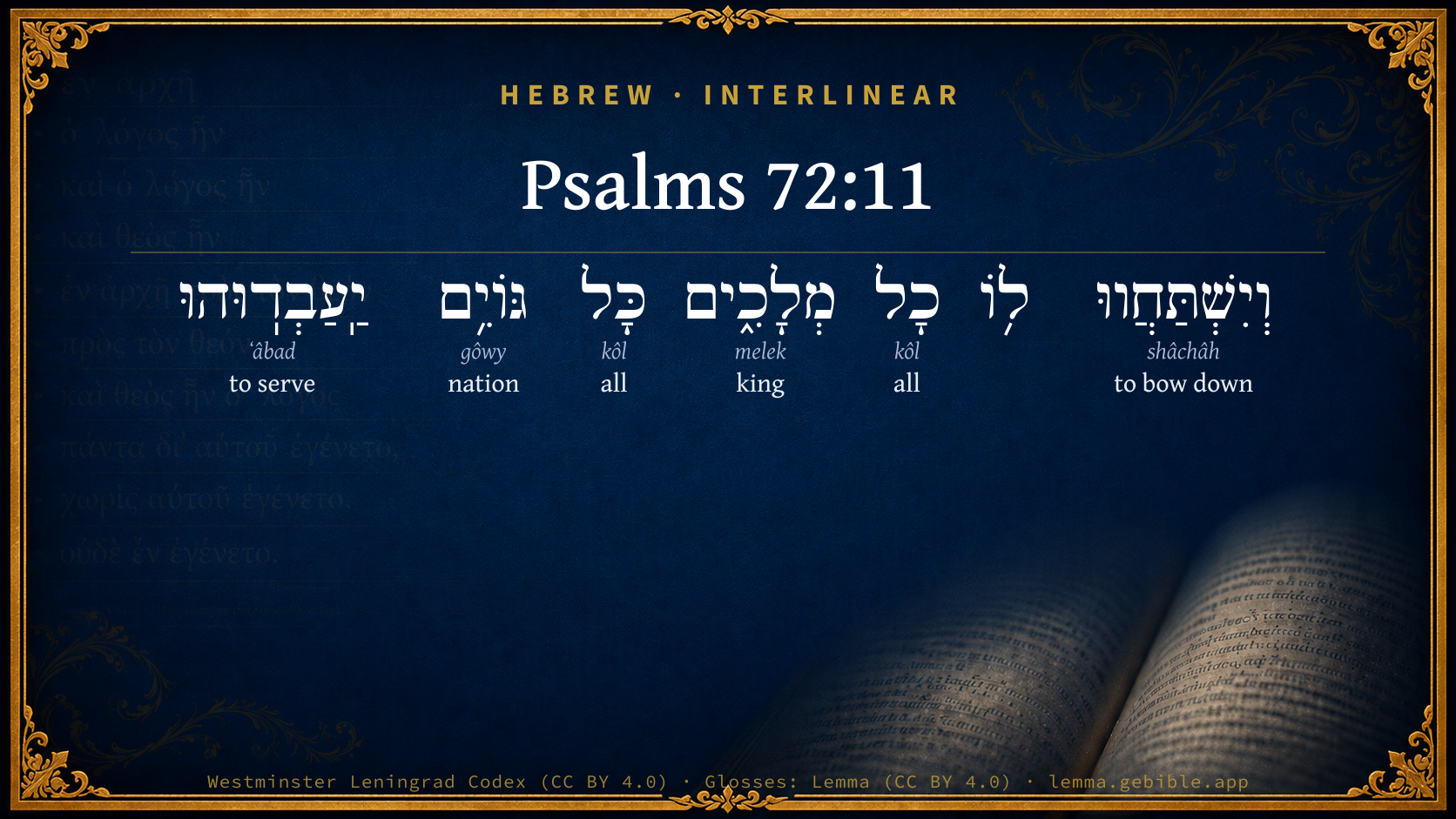
Hebrew (Westminster Leningrad Codex) Psalms 72:11 appears in the Hebrew Old Testament. The text above is from the Westminster Leningrad Codex. Each word links to its Strong’s number, a concise gloss, and parsing drawn from the Open Scriptures Hebrew Bible morphology. Click any word for its full Brown-Driver-Briggs (BDB) entry.
Download image
Cite this verse

Psalms 72:11 (World English Bible). Public Domain. Lemma interlinear Bible study tool, https://lemma.gebible.app/v/psalms/72/11.

Show BibTeX & RIS
BibTeX
RIS
English Translation
Yes, all kings shall fall down before him. All nations shall serve him.
World English Bible · Public Domain
Download a study sheet

One document with this verse’s original text, its word-by-word gloss line, the meaning frame, cross-references with their text, attributed commentary, and full source and license credits — printable, and it pastes into notes with its structure intact.

This verse Autodidact and up

Study sheet (.html) Plain text (.txt)

A passage Seminary Student

Up to 50 verses in one chapter. A passage sheet keeps up to 6 commentary sources and 12 cross-references per verse, in the order this page ranks them, and says so on the sheet whenever that leaves anything out. Ask for a single verse and you get the Autodidact verse sheet above.

Everything on this page stays free to read, with no account — the sheet is a download of what is already on screen, not access to it.

Want to remove ads? Support Godless Engineer
Compare translations 3

The same verse in 3 English versions, stacked beneath the original-language interlinear above. Click any original word for its lexicon entry.

Each is an independent rendering of the whole verse — the interlinear is not word-aligned to these translations.

Highlighted words mark where these versions differ — a whole-verse word diff, not a word-by-word alignment.

  • World English Bible Public Domain
    Yes, all kings shall fall down before him. All nations shall serve him.
  • King James Version Public Domain
    Yea, all kings shall fall down before him: all nations shall serve him.
  • unfoldingWord Literal Text CC BY-SA 4.0
    And may all kings bow down to him; may all nations serve him.

unfoldingWord Literal Text — © unfoldingWord, licensed CC BY-SA 4.0. Word-aligned USFM3 via Door43 (git.door43.org/unfoldingWord/en_ult).

Versions to compare (up to 4)

3 of 4 selected

Show all 18 translations

Every available English version of this verse, each an independent rendering of the whole verse.

  • World English Bible Public Domain
    Yes, all kings shall fall down before him. All nations shall serve him.
  • Berean Standard Bible Public Domain
    May all kings bow down to him and all nations serve him.
  • Majority Standard Bible Public Domain
    May all kings bow down to him and all nations serve him.
  • King James Version Public Domain
    Yea, all kings shall fall down before him: all nations shall serve him.
  • American Standard Version (1901) Public Domain
    Yea, all kings shall fall down before him; All nations shall serve him.
  • Revised Version (1885) Public Domain
    Yea, all kings shall fall down before him: all nations shall serve him.
  • Geneva Bible (1599) Public Domain
    Yea, all Kings shall worship him: all nations shall serue him.
  • Douay-Rheims (1899) Public Domain
    And all kings of the earth shall adore him: all nations shall serve him.
  • Young's Literal Translation Public Domain
    And all kings do bow themselves to him, All nations do serve him,
  • Literal Standard Version CC BY-SA 4.0
    And all kings bow themselves to Him, || All nations serve Him,
  • Unlocked Literal Bible CC BY-SA 4.0
    Indeed, may all kings fall down before him; may all nations serve him.
  • unfoldingWord Literal Text CC BY-SA 4.0
    And may all kings bow down to him; may all nations serve him.
  • Darby Bible Public Domain
    Yea, all kings shall bow down before him; all nations shall serve him.
  • World Messianic Bible Public Domain
    Yes, all kings shall fall down before him. All nations shall serve him.
  • Webster's Bible Public Domain
    Yes, all kings shall fall down before him: all nations shall serve him.
  • Free Bible Version CC BY-SA 4.0
    Every king will bow down to him; every nation will serve him.
  • Bible in Basic English Public Domain
    Yes, let all kings go down before him; let all nations be his servants.
  • JPS Tanakh (1917) Public Domain
    Yea, all kings shall prostrate themselves before him; all nations shall serve him.

Literal Standard Version (2020), Covenant Press — licensed CC BY-SA 4.0. Text via the HelloAO Bible API (eBible.org). Unlocked Literal Bible (unfoldingWord) — licensed CC BY-SA 4.0. Text via the HelloAO Bible API (eBible.org). unfoldingWord Literal Text — © unfoldingWord, licensed CC BY-SA 4.0. Word-aligned USFM3 via Door43 (git.door43.org/unfoldingWord/en_ult). Free Bible Version, Dr. Jonathan Gallagher — licensed CC BY-SA 4.0. Text via the HelloAO Bible API (eBible.org).

Word by word

More ways to search: Search by grammar → Find every occurrence → Compare this word →

Practice this passage: Drill this verse → Learn its vocabulary →

וְיִשְׁתַּחֲווּ
shâchâh
H7812
“and · to bow down”
Conjunction + Verb, Hishtaphel, Imperfect, 3rd Person, Masculine, Plural
Part of Speech
Conjunction + Verb
Stem
Hishtaphel
Form
Imperfect
Person
3rd Person
Gender
Masculine
Number
Plural
Full BDB Definition

Origin: a primitive root

TWOT: 2360

to bow down - (Qal) to bow down - (Hiphil) to depress (figuratively) - (Hithpael) - to bow down, prostrate oneself - before superior in homage - before God in worship - before false gods - before angel
  1. כָל kôl H3605 “all of” Noun, Common, Masculine, Singular, Construct
  2. מְלָכִ֑ים melek H4428 “kings” Noun, Common, Masculine, Plural, Absolute
  3. כָּל kôl H3605 “all of” Noun, Common, Masculine, Singular, Construct
  4. גּוֹיִ֥ם gôwy H1471 “nations” Noun, Common, Masculine, Plural, Absolute
  5. יַֽעַבְדֽוּהוּ ʻâbad H5647 “to serve · him” Verb, Qal, Imperfect, 3rd Person, Masculine, Plural + Suffix, Personal, 3rd Person, Masculine, Singular

About this verse

These counts appear in no published source. They are computed here, from the morphology-tagged text and Lemma’s own curated glosses. What Lemma adds →

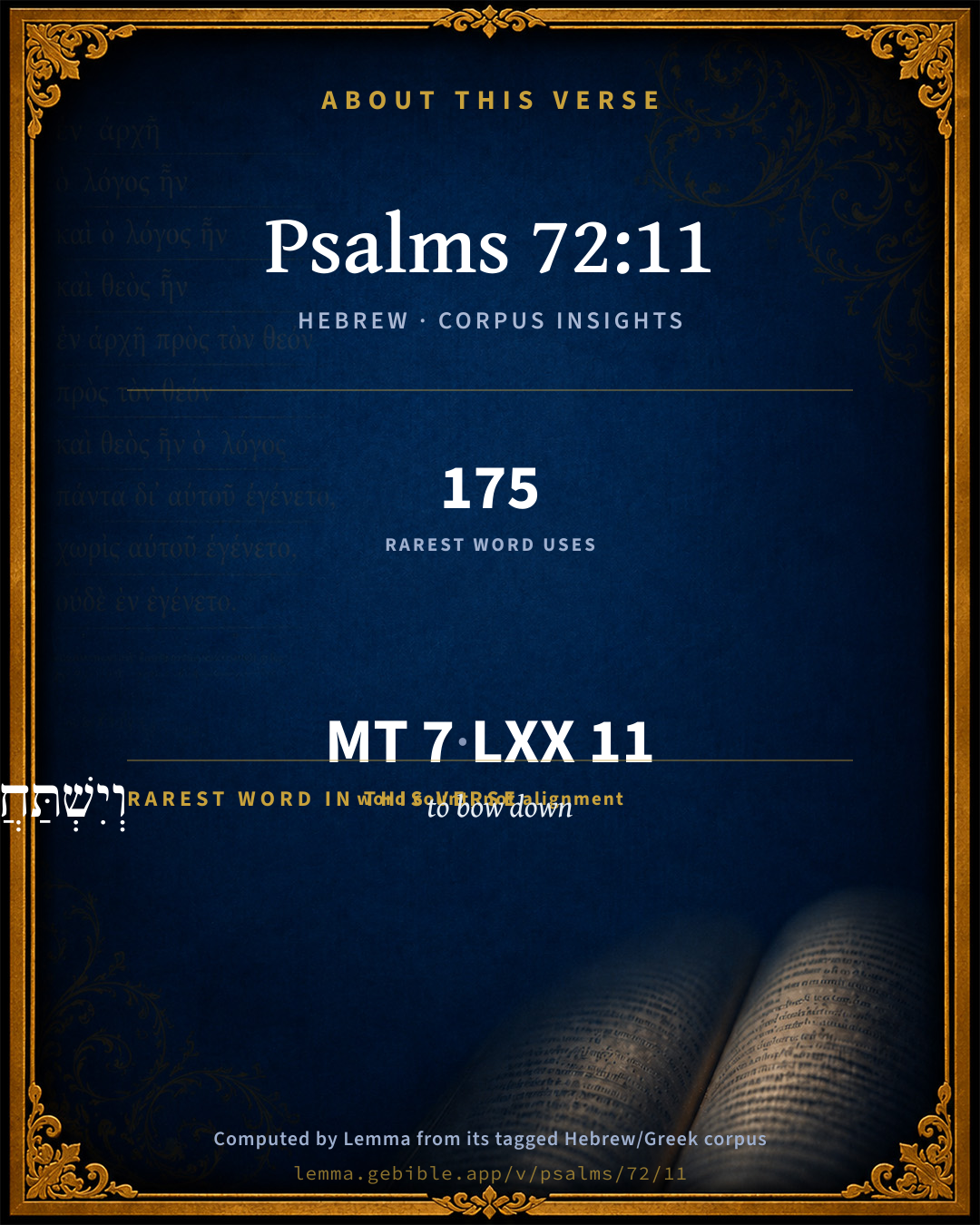
7
words
5
distinct lemmas
Wisdom
section

Grammatical profile

  • 2 verbs
  • 4 nouns
  • 1 preposition

Verb forms

  • וְיִשְׁתַּחֲווּ Hishtaphel · Imperfect
  • יַֽעַבְדֽוּהוּ Qal · Imperfect

Repetition

A word recurs within this verse — often emphatic in Hebrew:

Hebrew & Septuagint length

In English translation the verse runs 13 words from the Hebrew and 12 from the Septuagint (LXX English) — closely comparable.

A rough comparison of the two English renderings, which tokenize alike — not a word-level alignment.

Word counts can differ between the Hebrew and the Greek without any difference in meaning — e.g. the Hebrew direct-object marker אֵת has no separate Greek word, and Greek often adds the article ὁ.

In the original languages it is 7 Hebrew tokens and 11 Greek tokens — but the two are counted differently (Hebrew bundles its prefixes and suffixes into one token; the Greek is in lemma form), so that isn’t a like-for-like length.

Cross-references

13

Topical passages linked to Psalms 72:11 in the Treasury of Scripture Knowledge — connected by theme and wording, ordered by reader-vote popularity; previews shown in the World English Bible.

  • Psalms 86:9 All nations you have made will come and worship before you, Lord. They shall glorify your name.
  • Revelation 11:15 The seventh angel sounded, and great voices in heaven followed, saying, "The kingdom of the world has become the Kingdom of our Lord, and of his Christ. He will reign forever and ever!"
  • Isaiah 49:22–23 Thus says the Lord Yahweh, Behold, I will lift up my hand to the nations, and set up my ensign to the peoples; and they shall bring your sons in their bosom, and your daughters shall be carried on their shoulders.
  • Revelation 17:14 These will war against the Lamb, and the Lamb will overcome them, for he is Lord of lords, and King of kings. They also will overcome who are with him, called and chosen and faithful."
  • Psalms 138:4–5 All the kings of the earth will give you thanks, Yahweh, For they have heard the words of your mouth.
  • Isaiah 54:5 For your Maker is your husband; Yahweh of Hosts is his name: and the Holy One of Israel is your Redeemer; the God of the whole earth shall he be called.
  • Revelation 20:1–6 I saw an angel coming down out of heaven, having the key of the abyss and a great chain in his hand.
  • Revelation 21:24 The nations will walk in its light. The kings of the earth bring the glory and honor of the nations into it.
  • Revelation 21:26 and they shall bring the glory and the honor of the nations into it so that they may enter.
  • Psalms 2:10–12 Now therefore be wise, you kings. Be instructed, you judges of the earth.
  • Isaiah 11:9 They shall not hurt nor destroy in all my holy mountain; for the earth shall be full of the knowledge of Yahweh, as the waters cover the sea.
  • Isaiah 49:7 Thus says Yahweh, the Redeemer of Israel, [and] his Holy One, to him whom man despises, to him whom the nation abhors, to a servant of rulers: Kings shall see and arise; princes, and they shall worship; because of Yahweh who is faithful, [even] the Holy One of Israel, who has chosen you.
  • Romans 11:25 For I don't desire, brothers, to have you ignorant of this mystery, so that you won't be wise in your own conceits, that a partial hardening has happened to Israel, until the fullness of the Gentiles has come in,

Cross-references courtesy of OpenBible.info (CC BY 4.0).

Hebrew and Greek witnesses Masoretic Hebrew ↔ Greek Septuagint

The same verse in the two great witnesses to the Old Testament, shown verse-for-verse.

You’re reading Greek Psalm 71 (Hebrew Psalm 72). The Septuagint counts the superscription, so verse numbers can differ from the Hebrew — chapter-level alignment, not verse-by-verse. Numbering follows Rahlfs.

These are two independent witnesses, not word-aligned to each other, and the Septuagint is shown in lemma (dictionary) form.

Hebrew Psalms 72:11 Masoretic · Westminster Leningrad Codex

וְיִשְׁתַּחֲווּ ל֥וֹ כָל מְלָכִ֑ים כָּל גּוֹיִ֥ם יַֽעַבְדֽוּהוּ

Yes, all kings shall fall down before him. All nations shall serve him.

World English Bible · Public Domain

Greek LXX Greek Psalm 71:11 Septuagint · lemma form

καί προςκυνέω αὐτός πᾶς ὁ βασιλεύς πᾶς ὁ ἔθνος δουλεύω αὐτός

And all kings shall worship him; all the Gentiles shall serve him.

LXX2012 (modern English Septuagint) · Public Domain

Hebrew: Westminster Leningrad Codex (CC BY 4.0). Greek: Septuagint (public domain); English from LXX2012 (modern English Septuagint) (Public Domain). How the Septuagint differs from the Hebrew →

Commentary

Notes on Psalms 72:11 from classic Christian and Jewish commentators (each source and its license shown beneath its notes). The classic Christian expositions comment on the surrounding passage and are grouped to its opening verse, so a note may address several verses; the Jewish commentaries on the Tanakh (Rashi and others) are per-verse, so they appear only where the commentator wrote on this verse.

Lemma curates 59 commentaries, every one of them public domain or Creative Commons licensed, each selected and text-cleaned for this edition rather than reprinted as found. About our sources →

Trapp's Complete Commentary

John Trapp

Psa 72:11 Yea, all kings shall fall down before him: all nations shall serve him.

Ver. 11. Yea, all kings, &c.] Of Christ this is and shall be verified without a hyperbole. Constantine, Valentinian, and Theodosius, three emperors, called themselves Christ’s vassals, as Socrates reporteth; Canutus set his crown upon the crucifix, &c.

John Trapp, A Commentary or Exposition upon All the Books of the Old and New Testament (1647–1656) — public domain. Text from a community e-Sword module.

J. A. Alexander on Psalms

Joseph Addison Alexander

Psa 72:11. And to him shall all kings bow (or prostrate themselves), all nations shall serve him. That the preceding verse contains only a sample of the nations over whom the Messiah was to reign, is distinctly intimated by the universal and unqualified expressions of the verse before us. The act described in the first clause is one expressive both of civil homage and religious worship. The same thing is true of the verb in the last clause, which may be applied either to the civil service of a sovereign by his subjects, or to the religious service of a deity by his worshippers. In this case, as in Psa 72:10, both were meant to be included.

Joseph Addison Alexander, The Psalms Translated and Explained (1850) — public domain. Text from a community e-Sword module.

Tyndale Open Study Notes

Tyndale Open Resources

72:11 All kings and all nations must submit to the messianic king. The hope expressed in 2:10-11 will be realized (see 96:1-3; 1 Cor 15:25) when other leaders and peoples bow before and serve this king.

Tyndale Open Study Notes — © Tyndale Open Resources, licensed CC BY-SA 4.0. Text via the HelloAO Bible API.

Adam Clarke's Commentary

Verse 11. All kings shall fall down before] They shall reverence him on account of his great wisdom, riches, c.

All nations shalt serve him.] All the surrounding nations. This and the preceding verses are fully explained by 1Kg 10:23-25: "King Solomon exceeded all the kings of the earth for riches and for wisdom. And all the earth sought unto Solomon to hear his wisdom. And they brought every man his present, vessels of silver, and vessels of gold, and garments and armour, and spices, horses and mules, a rate year by year." If we take these expressions to mean literally all the habitable globe, then they cannot be applied to Solomon but if we take them as they are most evidently used by the sacred writer, then they are literally true. When all the earth shall be brought to receive the Gospel of Christ, then they may be applied to him.

Adam Clarke's Commentary on the Bible (1810–1826) — public domain. Text from a community e-Sword/MySword module.

John Calvin's Commentaries

11. And all kings shall prostrate themselves before him. This verse contains a more distinct statement of the truth, That the whole world will be brought in subjection to the authority of Christ. The kingdom of Judah was unquestionably never more flourishing than under the reign of Solomon; but even then there were only a small number of kings who paid tribute to him, and what they paid was inconsiderable in amount; and, moreover, it was paid upon condition that they should be allowed to live in the enjoyment of liberty under their own laws. While David then began with his own son, and the posterity of his son, he rose by the Spirit of prophecy to the spiritual kingdom of Christ; a point worthy of our special notice, since it teaches us that we have not been called to the hope of everlasting salvation by chance, but because our heavenly Father had already destined to give us to his Son. From this we also learn, that in the Church and flock of Christ there is a place for kings; whom David does not here disarm of their sword nor despoil of their crown, in order to admit them into the Church, but rather declares that they will come with all the dignity of their station to prostrate themselves at the feet of Christ.

John Calvin's Commentaries (1540-1563) — public domain. Text from the Calvin Translation Society English edition (1840s-50s) via the Christian Classics Ethereal Library (ccel.org). Calvin's coverage is partial (roughly two-thirds of the Bible); uncommented books and verses are honest gaps, never fabricated. The 19th-century editor's footnotes and remarks are omitted so the notes are faithfully Calvin's own voice.

Ellicott's Commentary for English Readers

(11) Yea, all kings shall . . .—Better, as before, Let all kings.

A Bible Commentary for English Readers, edited by Charles John Ellicott (1878–1897) — public domain. Text from a community e-Sword module.

The Cambridge Bible for Schools and Colleges

gen. ed. J. J. S. Perowne

11. Yea, let all kings fall down before him,

Let all nations serve him.

The allusions to Solomon’s empire in this and the preceding verse are obvious. “All kingdoms brought presents and served Solomon.” … “All the earth sought to Solomon, to hear his wisdom, … and they brought every man his present.” His alliance with Phoenicia brought him into connexion with the West; he had extensive commerce both by sea and land with the East and South; his fame brought the queen of Sheba to visit him in person. See 1Ki_4:21; 1Ki_4:34; 1Ki_10:1 ff., 1Ki_10:11; 1Ki_10:15; 1Ki_10:22; 1Ki_10:25; 1Ki_10:28-29.

The Cambridge Bible for Schools and Colleges (gen. ed. J. J. S. Perowne; Cambridge University Press, 1878–1918) — public domain. Text from a community e-Sword module.

John Gill's Exposition

Yea, all kings shall fall down before him,.... Or worship him; not with a civil, but religious worship; for such worship is due to Christ, he being God equal with the Father, and so to be equally honoured; the Creator of all things, the Redeemer of his people, Head and Lord of the church, and whom the angels adore; every part of worship is to be given him; internal, which lies in the exercise of faith, hope, love, fear, &c. and external, which consists of prayer to him, praise of him, preaching in his name, and the administration of ordinances; and this worship is to be performed in the same manner as to the Father, in spirit and in truth, in righteousness and holiness, with reverence and godly fear. This is to be understood, either literally of the kings of the earth, and which will have its full accomplishment in the latter day; see Isa 49:23; or mystically of such who are made kings unto God the Father by Christ; who reign spiritually now, through the power of divine grace in their hearts; have the honour, riches, and attendance of kings, and a crown and kingdom prepared for them; and shall reign with Christ on earth, though under him, at whose feet they cast their crowns: all this shows the dignity of Christ's person and office; that he is the Prince of the kings of the earth, the firstborn of God, whom he has made higher than they, and King of kings, and Lord of lords; whose princes, and all whose subjects, are altogether kings. This passage is allowed to belong to the Messiah, both by ancient and modern Jews (g); and indeed it never was true of Solomon, nor of any other;

all nations shall serve him; which will be in the latter day; see Isa 2:2; the Jews say (h), that in the world to come, or the times of the Messiah, all the Gentiles shall be voluntary proselytes.

(g) Zohar in Gen. fol. 84. 4. Bemidbar Rabba, s. 13. fol. 209. 4. Midrash Megillat Esther, fol. 86. 2. R. Isaac Chizzuk Emunah, par. 1. p. 44. (h) T. Avodah Zarah, fol. 24. 1.

John Gill's Exposition of the Whole Bible (1746–1763) — public domain (CC PDM 1.0). Text via the HelloAO Bible API.

Albert Barnes' Notes on the Bible

Yea, all kings shall fall down ... - That is, his reign will be universal. The kings and people mentioned in the previous verses are only specimens of what will occur. “All” kings - “all” nations - will do what these are represented as doing. They will submit to the Messiah; they will own him as their Lord. See the notes at Psa 2:8. Compare Isa 49:23.

Albert Barnes' Notes on the Bible (1834–1885) — public domain. Text from a community e-Sword/MySword module.

Matthew Poole's English Annotations

Which cannot be said of Solomon with any truth or colour, but was unquestionably verified in Christ; of whom therefore this must be understood. For what is said 1Ki 4:21, that Solomon reigned over all kingdoms, is there limited to them that reigned from the river unto Egypt; whereas the expressions here are unlimited and universal.

Matthew Poole's English Annotations on the Holy Bible (1683–1685) — public domain. Text from a community e-Sword/MySword module.

The Treasury of David

Charles H. Spurgeon

Ver. 11. Yea, all kings shall fall down before him. Personally shall they pay their reverence, however mighty they may be. No matter how high their state, how ancient their dynasty, or far off their realms, they shall willingly accept him as their Imperial Lord.

All nations shall serve him. The people shall be as obedient as the governors. The extent of the mediatorial rule is set forth by the two far reaching alls, all kings, and all nations: we see not as yet all things put under him, but since we see Jesus crowned with glory and honour in heaven, we are altogether without doubt as to his universal monarchy on earth. It is not to be imagined that an Alexander or a Caesar shall have wider sway than the Son of God. "Every knee shall bow to him, and every tongue shall confess that Jesus Christ is Lord, to the glory of God the Father." Hasten it, O Lord, in thine own time.

Charles H. Spurgeon's The Treasury of David (1869–1885) — public domain. Psalms only. Text from a community e-Sword/MySword module.

Whedon's Commentary on the Bible

Daniel D. Whedon

11. All kings… all nations—This is a summing up of all that has been said, and clearly fixes the world-dominion of the “king” here prophetically extolled.

Daniel D. Whedon (gen. ed.), Commentary on the Old and New Testaments (1874–1909) — public domain. Text from a community e-Sword module.

The Pulpit Commentary

Yea, all kings shall fall down before him: all nations shall serve him. (comp. Isa_49:7, 23 60:3-14) This prophecy has not yet been fulfilled in the letter; but it may one day be exactly accomplished. Or it may not have been intended to be understood literally. General truths are often expressed by the sacred writers universally.

The Pulpit Commentary (1880–1919), ed. H.D.M. Spence-Jones & Joseph S. Exell — public domain. Text from a community e-Sword module.

John Wesley's Explanatory Notes

All nations - Which cannot be said of Solomon with any truth or colour, but was unquestionably verified in Christ,

John Wesley, Explanatory Notes Upon the Whole Bible (1754–1765) — public domain. Text via the GEBible commentary corpus.

unfoldingWord translationNotes

Door43 World Missions Community

fall down before him

"bow down before him" or "honor him as their king"

all nations

Here the word "nations" represents the people who live in the nations. AT: "the people who live in every nation" (See: Metonymy)

no other helper

"no one else to help him"

translationWords

nation

servant

cry

unfoldingWord translationNotes — © Distant Shores Media and the Door43 World Missions Community, licensed CC BY-SA 4.0. Source: git.door43.org/Door43/en_tn.

Rashi

Rabbi Shlomo Yitzchaki (Rashi)

may all nations serve him (I Kings 10:24f.): “And all the [inhabitants of] the earth sought Solomon’s presence etc. And each one would bring his gift.”

Rashi on the Tanakh — English translations: “The Judaica Press complete Tanach with Rashi, translated by A. J. Rosenberg” (CC BY 4.0); “Pentateuch with Rashi's commentary by M. Rosenbaum and A.M. Silbermann, 1929-1934” (public domain); “The Metsudah Tanach series, Lakewood, N.J” (CC BY 4.0); and “The Book of Joshua, Metsudah Publications, 1997” (CC BY 4.0). Text via Sefaria.

Lesson kit

Teaching starters — assembled from the data on this page, not authored interpretation. Every prompt links to the verse data it draws on. Edit before teaching.

Psalms, in the Wisdom, opens this verse with 7 words (5 distinct Hebrew lemmas). Its most distinctive word is shâchâh (“to bow down”). A historical commentator’s framing appears above. Read the whole chapter for the surrounding context.

Discussion questions

  1. What does “to bow down” (shâchâh) contribute to the verse as a whole?
  2. How does Psalms 86:9, which shares this passage’s theme, read alongside this verse?
  3. What does the repetition of “all” (2× in this one verse) do in this verse?
  4. These translations render this verse differently; the difference is in the English rendering, not the original. What questions does that raise?
  5. «וְיִשְׁתַּחֲווּ» is a Hishtaphel Imperfect verb. How does that grammatical form shape the action described?
  6. Compare how Trapp's Complete Commentary and J. A. Alexander on Psalms read this verse. Where do they agree or differ?

Things to notice

Reading settings

Reading text

Shown beneath each verse's original-language words.

Old Testament
Old Testament edition

Read the OT as the Masoretic Hebrew (MT) or the Greek Septuagint (LXX).

English shown for the Greek Septuagint (in the Hebrew ↔ Greek comparison).

Comparing translations? Open the Compare panel on any verse page to stack up to four side by side.