Numbers 23:9

Hebrew (Westminster Leningrad Codex) Numbers 23:9 appears in the Hebrew Old Testament. The text above is from the Westminster Leningrad Codex. Each word links to its Strong’s number, a concise gloss, and parsing drawn from the Open Scriptures Hebrew Bible morphology. Click any word for its full Brown-Driver-Briggs (BDB) entry.
Download image
Cite this verse

Numbers 23:9 (World English Bible). Public Domain. Lemma interlinear Bible study tool, https://lemma.gebible.app/v/numbers/23/9.

Show BibTeX & RIS
BibTeX
RIS
English Translation
For from the top of the rocks I see him, From the hills I see him: behold, it is a people that dwells alone, And shall not be reckoned among the nations.
World English Bible · Public Domain
Highlights
  • 2 first appearances in the Hebrew Bible
Full analysis ↓
Download a study sheet

One document with this verse’s original text, its word-by-word gloss line, the meaning frame, cross-references with their text, attributed commentary, and full source and license credits — printable, and it pastes into notes with its structure intact.

This verse Autodidact and up

Study sheet (.html) Plain text (.txt)

A passage Seminary Student

Up to 50 verses in one chapter. A passage sheet keeps up to 6 commentary sources and 12 cross-references per verse, in the order this page ranks them, and says so on the sheet whenever that leaves anything out. Ask for a single verse and you get the Autodidact verse sheet above.

Everything on this page stays free to read, with no account — the sheet is a download of what is already on screen, not access to it.

Want to remove ads? Support Godless Engineer
Compare translations 3

The same verse in 3 English versions, stacked beneath the original-language interlinear above. Click any original word for its lexicon entry.

Each is an independent rendering of the whole verse — the interlinear is not word-aligned to these translations.

Highlighted words mark where these versions differ — a whole-verse word diff, not a word-by-word alignment.

  • World English Bible Public Domain
    For from the top of the rocks I see him, From the hills I see him: behold, it is a people that dwells alone, And shall not be reckoned among the nations.
  • King James Version Public Domain
    For from the top of the rocks I see him, and from the hills I behold him: lo, the people shall dwell alone, and shall not be reckoned among the nations.
  • unfoldingWord Literal Text CC BY-SA 4.0
    For from the top of the rocks I see him, and from the hills I look at him. Behold, a people dwells alone, and among the nations it does not reckon itself.

unfoldingWord Literal Text — © unfoldingWord, licensed CC BY-SA 4.0. Word-aligned USFM3 via Door43 (git.door43.org/unfoldingWord/en_ult).

Versions to compare (up to 4)

3 of 4 selected

Show all 18 translations

Every available English version of this verse, each an independent rendering of the whole verse.

  • World English Bible Public Domain
    For from the top of the rocks I see him, From the hills I see him: behold, it is a people that dwells alone, And shall not be reckoned among the nations.
  • Berean Standard Bible Public Domain
    For I see them from atop the rocky cliffs, and I watch them from the hills. Behold, a people dwelling apart, not reckoning themselves among the nations.
  • Majority Standard Bible Public Domain
    For I see them from atop the rocky cliffs, and I watch them from the hills. Behold, a people dwelling apart, not reckoning themselves among the nations.
  • King James Version Public Domain
    For from the top of the rocks I see him, and from the hills I behold him: lo, the people shall dwell alone, and shall not be reckoned among the nations.
  • American Standard Version (1901) Public Domain
    For from the top of the rocks I see him, And from the hills I behold him: lo, it is a people that dwelleth alone, And shall not be reckoned among the nations.
  • Revised Version (1885) Public Domain
    For from the top of the rocks I see him, And from the hills I behold him: Lo, it is a people that dwell alone, And shall not be reckoned among the nations.
  • Geneva Bible (1599) Public Domain
    For from the top of the rocks I did see him, and from the hils I did beholde him: lo, the people shall dwell by themselues, and shall not be reckened among the nations.
  • Douay-Rheims (1899) Public Domain
    I shall see him from the tops of the rocks, and shall consider him from the hills. This people shall dwell alone, and shall not be reckoned among the nations.
  • Young's Literal Translation Public Domain
    For from the top of rocks I see it, And from heights I behold it; Lo a people! alone it doth tabernacle, And among nations doth not reckon itself.
  • Literal Standard Version CC BY-SA 4.0
    For from the top of rocks I see him, || And from heights I behold him; Behold a people! He dwells alone, || And does not reckon himself among nations.
  • Unlocked Literal Bible CC BY-SA 4.0
    For from the top of the rocks I see him; from the hills I look at him. See, there is a people who live alone and do not consider themselves as just an ordinary nation.
  • unfoldingWord Literal Text CC BY-SA 4.0
    For from the top of the rocks I see him, and from the hills I look at him. Behold, a people dwells alone, and among the nations it does not reckon itself.
  • Darby Bible Public Domain
    For from the top of the rocks I see him, and from the hills I behold him: Lo, [it is] a people that shall dwell alone and shall not be reckoned among the nations.
  • World Messianic Bible Public Domain
    For from the top of the rocks I see him. From the hills I see him. Behold, it is a people that dwells alone, and shall not be listed among the nations.
  • Webster's Bible Public Domain
    For from the top of the rocks I see him, and from the hills I behold him: lo, the people shall dwell alone, and shall not be reckoned among the nations.
  • Free Bible Version CC BY-SA 4.0
    For I'm looking down on them from the top of rocky crags; I'm watching them from the hills. I see a people who live on their own, different from the other nations.
  • Bible in Basic English Public Domain
    From the top of the rocks I see him, looking down on him from the hills: it is a people made separate, not to be numbered among the nations.
  • JPS Tanakh (1917) Public Domain
    For from the top of the rocks I see him, and from the hills I behold him: lo, it is a people that shall dwell alone, and shall not be reckoned among the nations.

Literal Standard Version (2020), Covenant Press — licensed CC BY-SA 4.0. Text via the HelloAO Bible API (eBible.org). Unlocked Literal Bible (unfoldingWord) — licensed CC BY-SA 4.0. Text via the HelloAO Bible API (eBible.org). unfoldingWord Literal Text — © unfoldingWord, licensed CC BY-SA 4.0. Word-aligned USFM3 via Door43 (git.door43.org/unfoldingWord/en_ult). Free Bible Version, Dr. Jonathan Gallagher — licensed CC BY-SA 4.0. Text via the HelloAO Bible API (eBible.org).

Word by word

More ways to search: Search by grammar → Find every occurrence → Compare this word →

Practice this passage: Drill this verse → Learn its vocabulary →

לְבָדָ֣ד
bâdâd
H910
“to/for · isolation”
Preposition + Noun, Common, Masculine, Singular, Absolute
Part of Speech
Preposition + Noun
Type
Common
Gender
Masculine
Number
Singular
State
Absolute
Full BDB Definition

Origin: from H909

TWOT: 201b

isolation, withdrawal, separation (noun masculine) - an isolated city - alone (adverb) - security (figuratively)
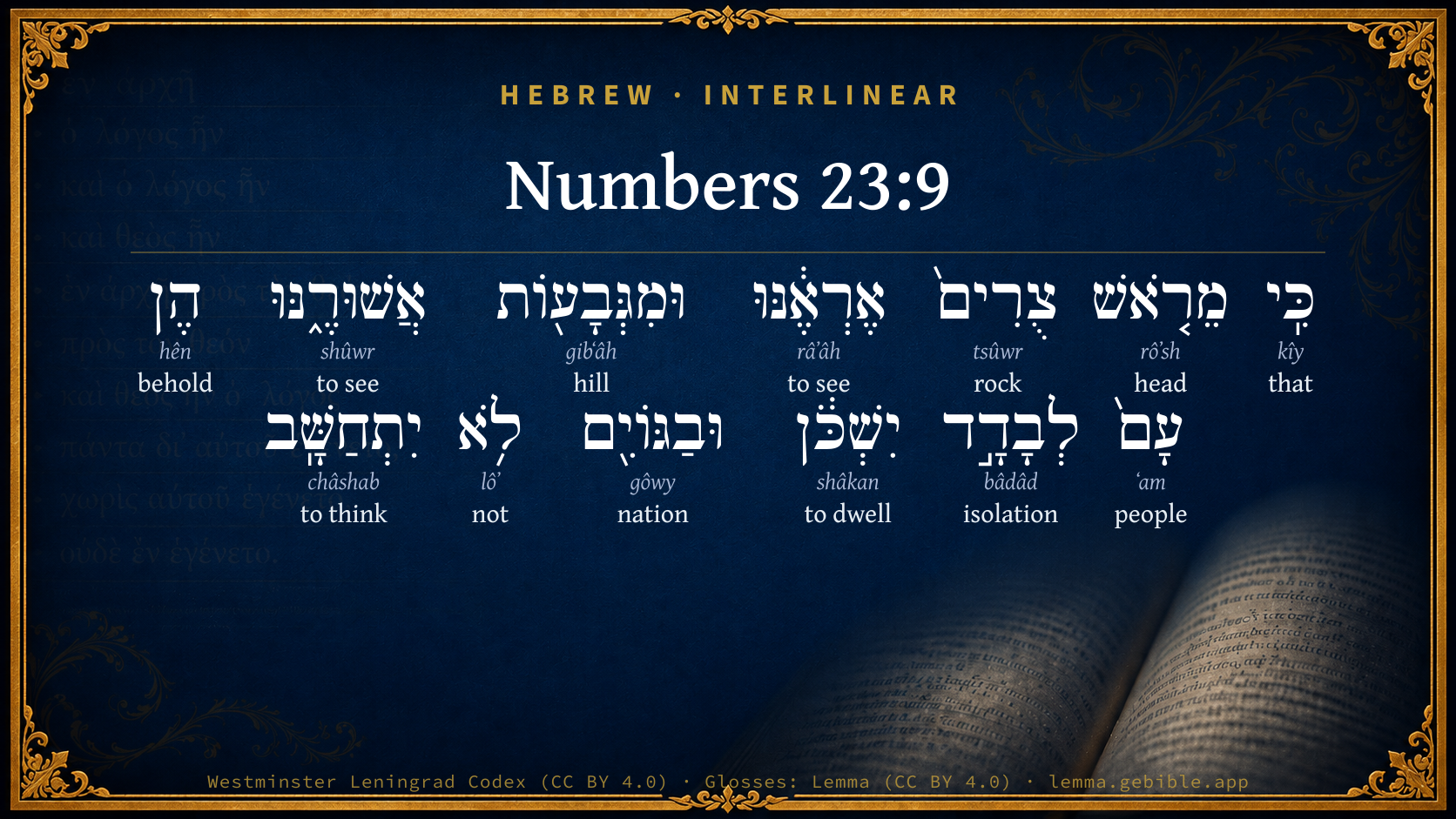
  1. כִּֽי kîy H3588 “that” Conjunction
  2. מֵרֹ֤אשׁ rôʼsh H7218 “from · head of” Preposition + Noun, Common, Masculine, Singular, Construct
  3. צֻרִים֙ tsûwr H6697 “rocks” Noun, Common, Masculine, Plural, Absolute
  4. אֶרְאֶ֔נּוּ râʼâh H7200 “to see · him” Verb, Qal, Imperfect, 1st Person, Common, Singular + Suffix, Personal, 3rd Person, Masculine, Singular
  5. וּמִגְּבָע֖וֹת gibʻâh H1389 “and · from · hills” Conjunction + Preposition + Noun, Common, Feminine, Plural, Absolute
  6. אֲשׁוּרֶ֑נּוּ shûwr H7789 “to see · him” Verb, Qal, Imperfect, 1st Person, Common, Singular + Suffix, Personal, 3rd Person, Masculine, Singular
  7. הֶן hên H2005 “behold” Particle, Interjection
  8. עָם֙ ʻam H5971 “people” Noun, Common, Masculine, Singular, Absolute
  9. יִשְׁכֹּ֔ן shâkan H7931 “to dwell” Verb, Qal, Imperfect, 3rd Person, Masculine, Singular
  10. וּבַגּוֹיִ֖ם gôwy H1471 “and · in/at the · nations” Conjunction + Preposition, Determined + Noun, Common, Masculine, Plural, Absolute
  11. לֹ֥א lôʼ H3808 “not” Particle, Negative
  12. יִתְחַשָּֽׁב châshab H2803 “to think” Verb, Hithpael, Imperfect, 3rd Person, Masculine, Singular

About this verse

These counts appear in no published source. They are computed here, from the morphology-tagged text and Lemma’s own curated glosses. What Lemma adds →

13
words
13
distinct lemmas
Pentateuch
section

Notable vocabulary

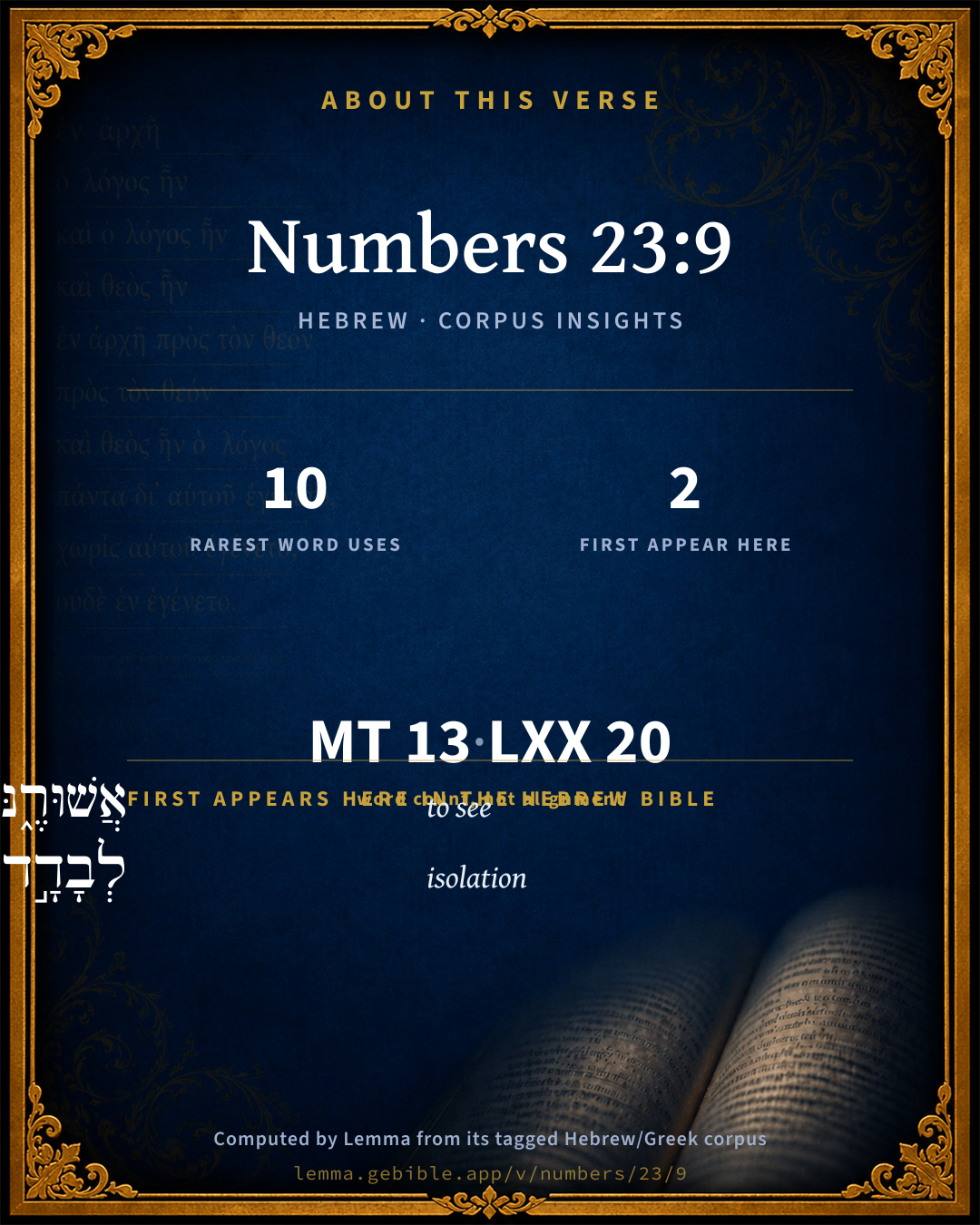
The rarest word here is לְבָדָ֣ד isolation H910 — appearing just 10 times in the whole Hebrew Bible.

First appearance in Scripture

These words make their first canonical appearance in the Hebrew Bible here:

  • אֲשׁוּרֶ֑נּוּ to see H7789
  • לְבָדָ֣ד isolation H910

Shared distinctive vocabulary

לְבָדָ֣ד isolation H910 occurs in 10 verses of the Hebrew Bible. Also found in:

Grammatical profile

  • 4 verbs
  • 6 nouns
  • 1 conjunction
  • 2 particles

Verb forms

  • אֶרְאֶ֔נּוּ Qal · Imperfect
  • אֲשׁוּרֶ֑נּוּ Qal · Imperfect
  • יִשְׁכֹּ֔ן Qal · Imperfect
  • יִתְחַשָּֽׁב Hithpael · Imperfect

Hebrew & Septuagint length

In English translation the verse runs 32 words from the Hebrew and 33 from the Septuagint (LXX English) — closely comparable.

A rough comparison of the two English renderings, which tokenize alike — not a word-level alignment.

Word counts can differ between the Hebrew and the Greek without any difference in meaning — e.g. the Hebrew direct-object marker אֵת has no separate Greek word, and Greek often adds the article ὁ.

In the original languages it is 13 Hebrew tokens and 20 Greek tokens — but the two are counted differently (Hebrew bundles its prefixes and suffixes into one token; the Greek is in lemma form), so that isn’t a like-for-like length.

Cross-references

13

Topical passages linked to Numbers 23:9 in the Treasury of Scripture Knowledge — connected by theme and wording, ordered by reader-vote popularity; previews shown in the World English Bible.

  • Deuteronomy 33:28 Israel dwells in safety, The fountain of Jacob alone, In a land of grain and new wine; Yes, his heavens drop down dew.
  • Deuteronomy 32:8 When the Most High gave to the nations their inheritance, When he separated the children of men, He set the bounds of the peoples According to the number of the children of Israel.
  • Exodus 33:16 For how would people know that I have found favor in your sight, I and your people? Isn't it in that you go with us, so that we are separated, I and your people, from all the people who are on the surface of the earth?"
  • Ezra 9:2 For they have taken of their daughters for themselves and for their sons, so that the holy seed have mixed themselves with the peoples of the lands: yes, the hand of the princes and rulers has been chief in this trespass.
  • Esther 3:8 Haman said to king Ahasuerus, There is a certain people scattered abroad and dispersed among the peoples in all the provinces of your kingdom; and their laws are diverse from [those of] every people; neither keep they the king's laws: therefore it is not for the king's profit to allow them.
  • Exodus 19:5–6 Now therefore, if you will indeed obey my voice, and keep my covenant, then you shall be my own possession from among all peoples; for all the earth is mine;
  • Jeremiah 46:28 Don't be afraid you, O Jacob my servant, says Yahweh; for I am with you: for I will make a full end of all the nations where I have driven you; but I will not make a full end of you, but I will correct you in measure, and will in no way leave you unpunished.
  • Amos 9:9 "For, behold, I will command, and I will sift the house of Israel among all the nations, as grain is sifted in a sieve, yet not the least kernel will fall on the earth.
  • Romans 15:8–10 Now I say that Christ has been made a minister of the circumcision for the truth of God, that he might confirm the promises given to the fathers,
  • 2 Corinthians 6:17 Therefore, "'Come out from among them, And be separate,' says the Lord, 'Touch no unclean thing. I will receive you.
  • Ephesians 2:12–14 that you were at that time separate from Christ, alienated from the commonwealth of Israel, and strangers from the covenants of the promise, having no hope and without God in the world.
  • Titus 2:14 who gave himself for us, that he might redeem us from all iniquity, and purify for himself a people for his own possession, zealous for good works.
  • 1 Peter 2:9 But you are a chosen race, a royal priesthood, a holy nation, a people for God's own possession, that you may show forth the excellencies of him who called you out of darkness into his marvelous light:

Cross-references courtesy of OpenBible.info (CC BY 4.0).

Hebrew and Greek witnesses Masoretic Hebrew ↔ Greek Septuagint

The same verse in the two great witnesses to the Old Testament, shown verse-for-verse.

These are two independent witnesses, not word-aligned to each other, and the Septuagint is shown in lemma (dictionary) form.

Hebrew Numbers 23:9 Masoretic · Westminster Leningrad Codex

כִּֽי מֵרֹ֤אשׁ צֻרִים֙ אֶרְאֶ֔נּוּ וּמִגְּבָע֖וֹת אֲשׁוּרֶ֑נּוּ הֶן עָם֙ לְבָדָ֣ד יִשְׁכֹּ֔ן וּבַגּוֹיִ֖ם לֹ֥א יִתְחַשָּֽׁב

For from the top of the rocks I see him, From the hills I see him: behold, it is a people that dwells alone, And shall not be reckoned among the nations.

World English Bible · Public Domain

Greek LXX Numbers 23:9 Septuagint · lemma form

ὅτι ἀπό κορυφή ὄρος ὁράω αὐτός καί ἀπό βουνός προςνοέω αὐτός ἰδού λαός μόνος καταοἰκέω καί ἐν ἔθνος οὐ συνλογίζω

For from the top of the mountains I shall see him, and from the hills I shall observe him: behold, the people shall dwell alone, and shall not be reckoned among the nations.

LXX2012 (modern English Septuagint) · Public Domain

Hebrew: Westminster Leningrad Codex (CC BY 4.0). Greek: Septuagint (public domain); English from LXX2012 (modern English Septuagint) (Public Domain). How the Septuagint differs from the Hebrew →

Targum (Aramaic paraphrase)

2

The Targum is the ancient Jewish Aramaic paraphrase of the Hebrew Scriptures — an interpretive translation, not the Hebrew text itself. Onkelos (literal) and Pseudo-Jonathan (expansive) render the Torah, and Jonathan the Prophets. Coverage is partial: where no permissively-licensed English translation exists for a verse, only the Aramaic is shown. This is verse-level text, not a word-by-word alignment to the Hebrew.

  1. Targum Onkelos Torah (Genesis–Deuteronomy)
    אֲרֵי מֵרֵישׁ טוּרַיָא חֲזִיתֵיהּ וּמֵרָמָתָא סְכִיתֵיהּ הָא עַמָא בִּלְחוֹדֵיהוֹן עֲתִידִין דְיַחְסְנוּן עַלְמָא וּבְעַמְמַיָא לָא יִתְדְנוּן גְמִירָא

    (no public-domain English translation for this verse)

    Targum Onkelos — Aramaic: “Onkelos Genesis” (public domain); “Onkelos Exodus” (public domain); “Onkelos Leviticus” (public domain); “Onkelos Numbers” (public domain); “Onkelos Deuteronomy” (public domain). English: “Sefaria Community Translation” (CC0 1.0 (public-domain dedication)); “J.W. Etheridge. The Targums of Onkelos and Jonathan Ben Uzziel on the Pentateuch. London: Longmans, Green, 1862” (public domain). Text via Sefaria.

  2. Targum Pseudo-Jonathan Torah (Genesis–Deuteronomy)
    אָמַר בִּלְעָם רַשִׁיעָא מִסְתַּכֵּל אֲנָא בְּעַמָא הָדֵין דְהִינוּן מְדַבְּרִין בִּזְכוּת אַבְהַתְהוֹן צַדִיקַיָא דִמְתִילִין לְטַוְרַיָא וּבִזְכוּת אִימָהַתְהוֹן דִמְתִילַן לִגְלִימָתָא הָא עַמָא בִלְחוֹדֵיהוֹן עֲתִידִין לְמִיחְסַן עַלְמָא מְטוּל דִבְנִימוּסֵי אוּמַיָא לָא מְדַבְּרִין

    For, said Bileam the wicked, I look on this people who are led on for the sake of their righteous fathers, who are like the mountains, and of their mothers, who are like the hills: behold, this people alone are to possess the world, because they are not led by the laws of the nations.

    Targum Pseudo-Jonathan — Aramaic: “Targum Jonathan on Genesis” (public domain); “Targum Jonathan on Exodus” (public domain); “Targum Jonathan on Leviticus” (public domain); “Targum Jonathan on Numbers” (public domain); “Targum Jonathan on Deuteronomy” (public domain). English: “The Targum of Jonathan ben Uzziel, trans. J. W. Etheridge, London, 1862” (public domain). Text via Sefaria.

Commentary

Notes on Numbers 23:9 from classic Christian and Jewish commentators (each source and its license shown beneath its notes). The classic Christian expositions comment on the surrounding passage and are grouped to its opening verse, so a note may address several verses; the Jewish commentaries on the Tanakh (Rashi and others) are per-verse, so they appear only where the commentator wrote on this verse.

Lemma curates 59 commentaries, every one of them public domain or Creative Commons licensed, each selected and text-cleaned for this edition rather than reprinted as found. About our sources →

Trapp's Complete Commentary

John Trapp

Num 23:9 For from the top of the rocks I see him, and from the hills I behold him: lo, the people shall dwell alone, and shall not be reckoned among the nations.

Ver. 9. From the top of the rocks I see him.] And have no power to hurt him. She heard me without daunting; I departed not without terror, when I opened the conspiracy against her life; howbeit, clothed with the best art I could; - said Parry the traitor concerning Queen Elizabeth. {a} Achilles was said to be Styge armatus, but Israel was Deo armatus, and therefore extra iactum.

Lo, the people shall dwell alone.] That they might have no meddling with the heathen. God would not have them lie near the sea coasts, for the Philistines lay between them and the sea, lest they should by commerce wax prouder, as Tyre did, {Eze 27:3} and learn foreign fashions. See Est 3:8. Hence Judea, though part of the continent, is called an "island." {Isa 20:6}

{a} Camden’s Elisab.

John Trapp, A Commentary or Exposition upon All the Books of the Old and New Testament (1647–1656) — public domain. Text from a community e-Sword module.

Joseph Benson's Commentary

Num 23:9. From the hills I behold him — The hills on which he then stood. This and the former expression may relate not only to the present view he had of the camp of Israel, but to their future settlement in Canaan; wherein they were represented to the eye of his mind, as dwelling securely under the protection of the Almighty.

The people shall dwell alone — Separated from other nations by peculiar laws, religion, and manners. See on Exo 19:5; Lev 20:24-26; Exo 3:8. By which means they had so little communication with the Gentiles, that they were called an unsociable people, and thought to have an enmity to the rest of the world, as we may read in Diodorus Siculus, Tacitus, and others.

And here we may reflect with the greatest admiration upon what Balaam said on this occasion; and be convinced that he was indeed under the influence of that Spirit to whom all things are known, at all times, from the beginning to the end. For how could he otherwise, as Bishop Newton properly argues, “upon a distant view only of a people whom he had never seen or known before, have discovered the genius and manners, not only of the people then living, but of their posterity to the latest generations? What renders it more extraordinary is, the singularity of the character, that they should differ from all the people in the world, and should dwell by themselves among the nations, without mixing and incorporating with any. The time too when this was affirmed increases the wonder, it being before the people were well known in the world, before their religion and government were established, and even before they had obtained a settlement anywhere; but yet that the character was fully verified in the event, not only all history testifies, but we have even ocular demonstration at this day. The Jews, in their religion and laws, their rites and ceremonies, their manners and customs, were so totally different from all other nations, that they had little intercourse or communication with them. An eminent author hath shown that there was a general intercommunity among the gods of paganism; but no such thing was allowed between the God of Israel and the gods of the nations. There was to be no fellowship between God and Belial, though there might be between Belial and Dagon. And hence the Jews were branded for their inhumanity and unsociableness; and they as generally hated, as they were hated by, the rest of mankind. Other nations, the conquerors and the conquered, have often associated and united, as one body, under the same laws; but the Jews, in their captivities, have commonly been more bigoted to their own religion, and more tenacious of their own rites and ceremonies, than at other times. And even now, while they are dispersed among all nations, they yet live distinct and separate from all, trading only with others, but eating, marrying, and conversing chiefly among themselves. We see, therefore, how exactly and wonderfully Balaam characterized the whole race, from the first to the last, when he said, Lo, the people shall dwell alone, and shall not be reckoned among the nations.”

Joseph Benson's Commentary on the Old and New Testaments (1811–1818) — public domain. Text from a community e-Sword module.

Geneva Bible (1599)

Geneva Bible translators

But shall have religion and laws apart.

Geneva Bible (1599) marginal notes — public domain. Text via Bolls.life.

Jamieson, Fausset & Brown

Robert Jamieson, A. R. Fausset & David Brown

from the top--literally, "a bare place" on the rocks, to which Balak had taken him, for it was deemed necessary to see the people who were to be devoted to destruction. But that commanding prospect could contribute nothing to the accomplishment of the king's object, for the destiny of Israel was to be a distinct, peculiar people, separated from the rest of the nations in government, religion, customs, and divine protection (Deu 33:28). So that although I might be able to gratify your wishes against other people, I can do nothing against them (Exo 19:5; Lev 20:24).

Jamieson, Fausset & Brown — Commentary Critical and Explanatory on the Whole Bible (1871) — public domain (CC PDM 1.0). Text via the HelloAO Bible API.

Adam Clarke's Commentary

Verse 9. From the top of the rocks I see him] That is, from the high places of Baal where he went, Nu 22:41, that he might the more advantageously see the whole camp of Israel.

The people shall dwell alone] They shall ever be preserved as a distinct nation. This prophecy has been literally fulfilled through a period of 3300 years to the present day. This is truly astonishing.

Adam Clarke's Commentary on the Bible (1810–1826) — public domain. Text from a community e-Sword/MySword module.

Ellicott's Commentary for English Readers

(9) For from the top of the rocks I see him . . . —From the summit of the rocky mountain on which Balak had erected his seven altars, Balaam, according to one interpretation (see Num_22:41, and Note), had a full view of the outstretched camps of Israel.

Lo, the people shall dwell alone . . . —Better, Lo, it is a people that dwelleth alone, and that is not numbered, &c. In the fact that the host of Israel dwelt by itself in a separate encampment, Balaam discerned a type of the essential separation of Israel from the surrounding nations. When Israel adopted the ways of the heathen nations it speedily lost its external independence. Hengstenberg observes upon the last clause of this verse as follows:—“How truly Balaam said that Israel ‘did not reckon itself with the heathen’ appears from the fact that while all the powerful empires of the ancient world—the Egyptian, Assyrian, Babylonian, and others—have utterly perished, Israel (which even under the Old Covenant was rescued from so many dangers that threatened its entire destruction, particularly in being brought back from exile) flourishes anew in the Church of the New Covenant, and continues also to exist in that part of it which, though at present rejected, is destined to restoration at a future period.” (History of Balaam, &c., p. 409.)

A Bible Commentary for English Readers, edited by Charles John Ellicott (1878–1897) — public domain. Text from a community e-Sword module.

The Cambridge Bible for Schools and Colleges

gen. ed. J. J. S. Perowne

9. And reckoneth not itself among the nations] Israel felt themselves to be completely separate from, and superior to, other nations because they possessed Jehovah’s love and protection.

The Cambridge Bible for Schools and Colleges (gen. ed. J. J. S. Perowne; Cambridge University Press, 1878–1918) — public domain. Text from a community e-Sword module.

John Gill's Exposition

For from the top of the rocks I see him, and from the hills I behold him,.... That is, Israel in their camps; Balaam being at this time on the top of a rock, or on an high hill, from whence he had a view of Israel, encamped in the plains of Moab below him:

lo, the people shall dwell alone; this certainly respects their dwelling in the land of Canaan, where they dwelt a separate people from all others, distinguished by their language, religion, laws, customs, and manner of living, being different both in their clothing, and in their food, from other people; nor had they dealings, nor did they company with those of other nations; see Est 3:8 "or shall dwell safely" (z), or securely, not so much because of the situation of their country, but because of the protection of the Almighty; see Deu 33:28.

and shall not be reckoned among the nations; as belonging to them, shall not be made of any account by them, but be despised and reproached for their religion chiefly; nor reckon themselves of them, nor mix with them; so the Targum of Jerusalem,"they shall not be mixed;''or, as Jonathan,"they shall not be led in the laws of the people;''and though they are now scattered among the people and nations of the world, yet they are not mixed with them, nor reckoned to be a part of them; nor do they reckon themselves to be of them, but are a separate distinct people from them. Thus Israel, or the people of God in a spiritual sense, dwell alone; not solitarily, or without company, in every sense, for they have the company of Father, Son, and Spirit, of angels and saints; but they dwell in God, in Christ, in the house of God, and with one another, separately and distinctly from the world: they are a separate people in the love of God; in the choice of them in Christ; in the covenant of grace made with them in him; in redemption by him; in his intercession for them; in effectual calling; as they will be in the resurrection morn, and in heaven to all eternity: and they shall dwell safely, God being around them; Christ the rock and fortress of them; the Spirit in them being greater than he that is in the world; angels their guardians, and they in a strong city, whose walls and bulwarks are salvation: nor are they reckoned among the nations; they are chosen, redeemed, and called out of them, and are not accounted of by them any other than the refuse and offscouring of all things; nor do they reckon themselves to be of the world, but as pilgrims and strangers in it. Baal Hatturim refers this prophecy to the days of the Messiah; see Jer 23:5.

(z) "confidenter", Pagninus; "securus", Vatablus.

John Gill's Exposition of the Whole Bible (1746–1763) — public domain (CC PDM 1.0). Text via the HelloAO Bible API.

Albert Barnes' Notes on the Bible

For from the top of the rocks ... - The “for” indicates the constraint under which Balaam felt himself. He had been met by God in his own way; from the cliff he had watched for the expected augury; and by the light of this he here interprets, according to the rules of his art, the destiny of Israel.

Dwell alone - i. e., apart from others, undisturbed by their tumults, and therefore in safety and just security. Compare the same idea in marginal reference; Jer 49:31; and Mic 7:14. This tranquility was realized by the Israelites so long as they clave to God as their shelter and protection. But the inward “dwelling alone” was the indispensable condition of the outward “dwelling alone,” and so soon as the influence of the pagan world affected Israel internally, the external power of paganism prevailed also. Balaam himself, when he eventually counseled tempting the people into sin, acted upon the knowledge that God’s blessing and Israel’s prosperity depended essentially on faithfulness to God.

Albert Barnes' Notes on the Bible (1834–1885) — public domain. Text from a community e-Sword/MySword module.

Haydock's Catholic Bible Commentary

Hills. But all in vain. (Calmet) --- I am prevented from cursing him; and if I should do it, my imprecations would be turned into blessings by a superior Being. (Haydock) --- Alone, without standing in need of any auxiliaries, and devoid of fear, Deuteronomy xiii. 28., and Jeremias xlix. 31. The Jews had but few connections with foreign nations, keeping at a distance from them, as being of a different religion. (Calmet) --- Indeed, when they applied for aid to the Egyptians, &c., it generally turned out to their detriment, that they might learn to trust in God alone, who would effectually protect them, if they observed his law, as he had repeatedly promised. (Haydock) --- Nations. Israel shall not be like other people. He is under the peculiar care of God, covered with glory, full of confidence, and inspired with the love of independence; so that he will have nothing to do with the rest of the world. (Calmet)

George Leo Haydock (1774–1849), Haydock's Catholic Family Bible and Commentary, 1859 edition — public domain. Excludes Psalms (Douay-Rheims chapter numbering differs from Protestant) and Deuterocanonical books (Catholic canon only).

Matthew Poole's English Annotations

From the top of the rocks, upon which I now stand, I see the people, according to thy desire, Num 22:41, but cannot improve that sight to the end for which thou didst design it, to wit, to curse them. This people are of a distinct kind from others, God’s peculiar people, separated from all other nations, as in religion and laws, also in Divine protection; and therefore my enchantments cannot have that power against them which they have against other persons and people. See Exo 19:5; Lev 20:21,26.

Matthew Poole's English Annotations on the Holy Bible (1683–1685) — public domain. Text from a community e-Sword/MySword module.

Whedon's Commentary on the Bible

Daniel D. Whedon

9. From the top of the rocks — From which he thought that he might most effectually curse the people; but the sight of them did so amaze him that he blessed them.

Shall dwell alone — This predicts not so much quietude and safety as unprecedented separation from all the Gentile world. This isolation was manifested to the natural eye of the seer in the fact that the Israelites were then dwelling in a separate encampment on the plain. “In this his spirit discerned the inward and essential separation of Israel from all the heathen.” — Baumgarten. As soon as they lost this peculiarity by copying heathen ways they lost their independence.

Shall not be reckoned — Literally, shall not reckon itself among the Gentiles, having a different God and Defender. The capacity of the Jews to resist absorption into the nations among which they have been scattered for eighteen centuries is one of the world’s perpetual wonders. The Jews are a standing, incontrovertible proof of the truth of revelation.

Daniel D. Whedon (gen. ed.), Commentary on the Old and New Testaments (1874–1909) — public domain. Text from a community e-Sword module.

The Pulpit Commentary

The people shall dwell alone, and shall not be reckoned. Rather, "It is a people that dwelleth apart, and is not numbered." It was not the outward isolation on which his eye was fixed, for that indeed was only temporary and accidental, but the religious and moral separateness of Israel as the chosen people of God, which was the very secret of their national greatness.

The Pulpit Commentary (1880–1919), ed. H.D.M. Spence-Jones & Joseph S. Exell — public domain. Text from a community e-Sword module.

John Wesley's Explanatory Notes

The rocks - Upon which I now stand. I see him - I see the people, according to thy desire, ver. 41, but cannot improve that sight to the end for which thou didst design it, to curse them. The people shall dwell alone - This people are of a distinct kind from others, God's peculiar people, separated from all other nations, as in religion and laws, so also in divine protection; and therefore enchantments cannot have that power against them which they have against other persons and people.

John Wesley, Explanatory Notes Upon the Whole Bible (1754–1765) — public domain. Text via the GEBible commentary corpus.

unfoldingWord translationNotes

Door43 World Missions Community

from the top of the rocks I see him ... from the hills I look at him

These two phrases mean the same thing. Balaam viewed Israel from the top of a hill. (See: Parallelism)

I see him ... I look at him

Here "him" is a metonym that refers to the people of Israel. (See: Metonymy)

there is a people

"there is a group of people"

do not consider themselves as just an ordinary nation

This negative statement is used to stress that the opposite is true. AT: "they consider themselves to be a special nation" (See: Litotes)

translationWords

people group

nation

unfoldingWord translationNotes — © Distant Shores Media and the Door43 World Missions Community, licensed CC BY-SA 4.0. Source: git.door43.org/Door43/en_tn.

Rashi

Rabbi Shlomo Yitzchaki (Rashi)

כי מראש צורים אראנו FOR FROM THE TOP OF THE ROCKS I SEE HIM — I look at their origin and at the beginning of their root (descent), and I behold them strongly founded as younder rocks and mountains through their ancestors and ancestresses (Rashi translates thus: For (כי) starting from their very beginning (מראש) I behold them firm as rocks) (Midrash Tanchuma, Balak 12).

הן עם לבדד ישכן LO, THE PEOPLE SHALL DWELL ALONE — This it is what their ancestors have given them as a prerogative: to dwell in the world alone — as is the sense given to the passage by the Targum (“Lo, this people is alone destined to inherit the world").

ובגוים לא יתחשב AND SHALL NOT RECKON ITSELF AMONG THE NATIONS — Understand this as the Targum does — They will not be exterminated with the other nations, as it is said, ( 30:11) “For I will make a full end of all the nations [… but I will not make a full end of thee]”. The words therefore mean: They do not come under the same reckoning (לא יתחשב) with other nations. — Another explanation is: When they rejoice, no other nation rejoices with them, as it is said, (Deuteronomy 32:12) “The Lord will lead him alone to future bliss”, and when the nations are in prosperity they (the Israelites) eat with each one of them and yet it is not taken into account or them thereby to diminish their reward in the future life; and this is the meaning of ובגוים לא יתחשב (“and when they enjoy with the nations it is not taken into account) (Midrash Tanchuma, Balak 12).

Rashi on the Tanakh — English translations: “The Judaica Press complete Tanach with Rashi, translated by A. J. Rosenberg” (CC BY 4.0); “Pentateuch with Rashi's commentary by M. Rosenbaum and A.M. Silbermann, 1929-1934” (public domain); “The Metsudah Tanach series, Lakewood, N.J” (CC BY 4.0); and “The Book of Joshua, Metsudah Publications, 1997” (CC BY 4.0). Text via Sefaria.

Ramban (Nachmanides)

Rabbi Moshe ben Nachman (Ramban / Nachmanides)

FOR FROM THE TOP OF THE ROCKS I SEE HIM. The meaning of this is that since Balak had brought him up to Bamoth-baal [which was a high place] to see Israel, Balaam said: “From the top of the rocks and from the hills I look and I see him, for he [is a people that] shall dwell alone, and there is no other nation with him that can be counted together with him, in the way that many [different] peoples and various nations gather together to become one camp — for these [people of Israel] all have one law and one ordinance, 15:16. and are one nation, dwelling alone by the name of Jacob and Israel.” Therefore he [Balaam] mentioned, Come, curse me Jacob, and come defy Israel, referring to them [both] by their name of honor [Israel] and by the name of their ancestor [Jacob], meaning to say that they are a people alone, and have names befitting them from their ancestors. For Balak did not tell him [Balaam] the name “Israel,” but merely said, Behold, there is a people come out from Egypt, as if he was a stranger to them and did not know them, and he was not grateful for the favor that their father had done. And the meaning of Balaam’s words is that “just as I see him now dwelling alone, so will he forever dwell in safety, the fountain of Jacob alone, and he will always be at the head, for no nation will [ever] prevail over him [and cause him to perish], and he will never become assimilated to them [i.e., other nations].

Ramban (Nachmanides) on the Tanakh — English translation: “Commentary on the Torah by Ramban (Nachmanides). Translated and annotated by Charles B. Chavel. New York, Shilo Pub. House, 1971-1976” (CC BY 4.0). Text via Sefaria.

Lesson kit

Teaching starters — assembled from the data on this page, not authored interpretation. Every prompt links to the verse data it draws on. Edit before teaching.

Numbers, in the Pentateuch, opens this verse with 13 words (13 distinct Hebrew lemmas). Its most distinctive word is bâdâd (“isolation”). A historical commentator’s framing appears above. Read the whole chapter for the surrounding context.

Discussion questions

  1. The word bâdâd carries the sense “isolation.” How does it shape the verse?
  2. 2 words here appear for the first time in Scripture. What is being introduced at this debut?
  3. Deuteronomy 32:12 shares the word «isolation» with this verse. How do the two illuminate each other?
  4. These translations render this verse differently. What is at stake in choosing one wording over another?
  5. The verb «אֶרְאֶ֔נּוּ» is Qal Imperfect. How does its form color the action?
  6. Reading how Trapp's Complete Commentary and Joseph Benson's Commentary read this verse, where do the two commentators agree and where do they part?

Things to notice

Reading settings

Reading text

Shown beneath each verse's original-language words.

Old Testament
Old Testament edition

Read the OT as the Masoretic Hebrew (MT) or the Greek Septuagint (LXX).

English shown for the Greek Septuagint (in the Hebrew ↔ Greek comparison).

Comparing translations? Open the Compare panel on any verse page to stack up to four side by side.