
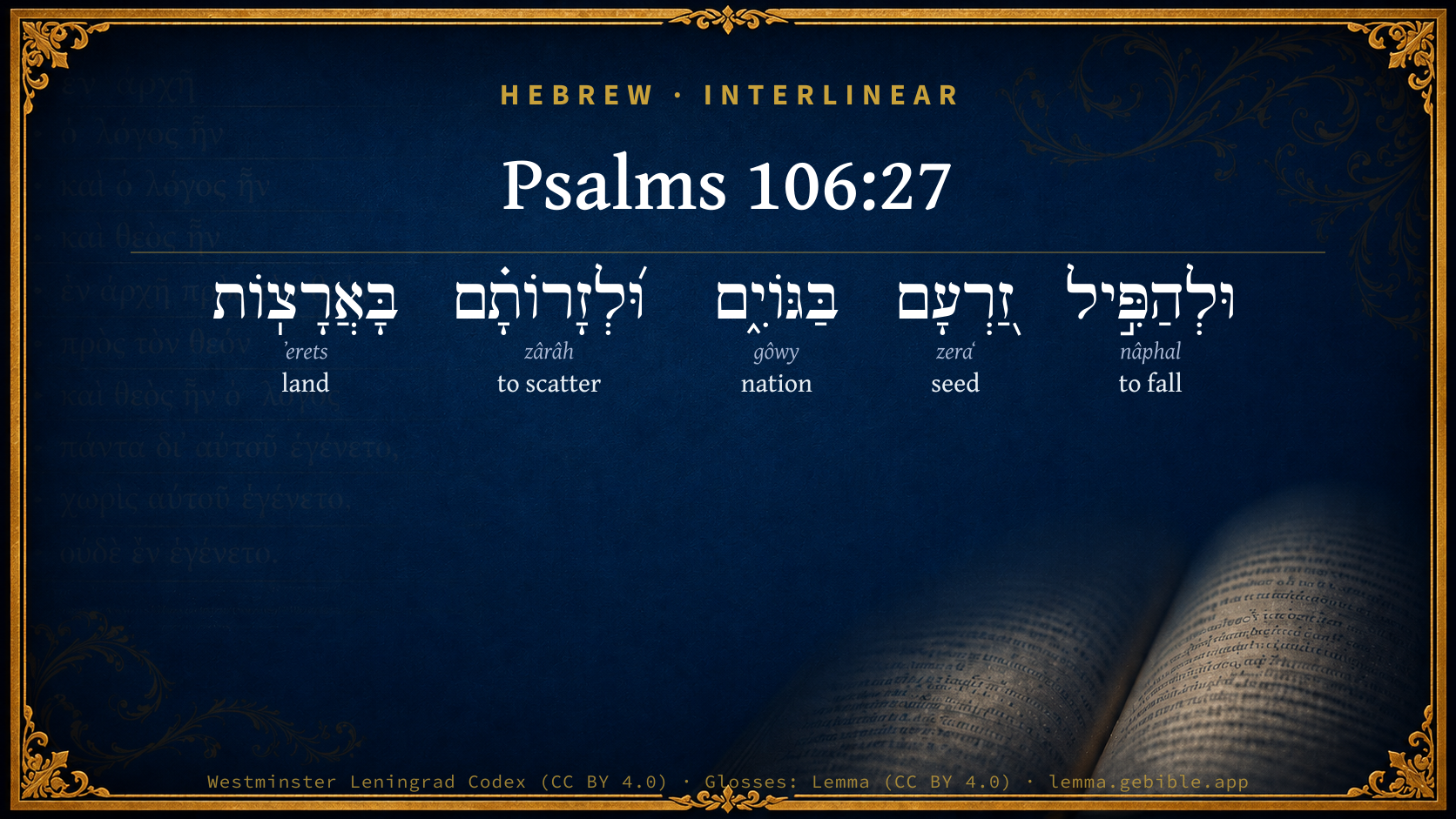
Psalms 106:27

Hebrew (Westminster Leningrad Codex) Psalms 106:27 appears in the Hebrew Old Testament. The text above is from the Westminster Leningrad Codex. Each word links to its Strong’s number, a concise gloss, and parsing drawn from the Open Scriptures Hebrew Bible morphology. Click any word for its full Brown-Driver-Briggs (BDB) entry.
Download image
Cite this verse

Psalms 106:27 (World English Bible). Public Domain. Lemma interlinear Bible study tool, https://lemma.gebible.app/v/psalms/106/27.

Show BibTeX & RIS
BibTeX
RIS
English Translation
That he would overthrow their seed among the nations, And scatter them in the lands.
World English Bible · Public Domain
Download a study sheet

One document with this verse’s original text, its word-by-word gloss line, the meaning frame, cross-references with their text, attributed commentary, and full source and license credits — printable, and it pastes into notes with its structure intact.

This verse Autodidact and up

Study sheet (.html) Plain text (.txt)

A passage Seminary Student

Up to 50 verses in one chapter. A passage sheet keeps up to 6 commentary sources and 12 cross-references per verse, in the order this page ranks them, and says so on the sheet whenever that leaves anything out. Ask for a single verse and you get the Autodidact verse sheet above.

Everything on this page stays free to read, with no account — the sheet is a download of what is already on screen, not access to it.

Want to remove ads? Support Godless Engineer
Compare translations 3

The same verse in 3 English versions, stacked beneath the original-language interlinear above. Click any original word for its lexicon entry.

Each is an independent rendering of the whole verse — the interlinear is not word-aligned to these translations.

Highlighted words mark where these versions differ — a whole-verse word diff, not a word-by-word alignment.

  • World English Bible Public Domain
    That he would overthrow their seed among the nations, And scatter them in the lands.
  • King James Version Public Domain
    To overthrow their seed also among the nations, and to scatter them in the lands.
  • unfoldingWord Literal Text CC BY-SA 4.0
    and to make their seed fall among the nations, and to scatter them among the lands.

unfoldingWord Literal Text — © unfoldingWord, licensed CC BY-SA 4.0. Word-aligned USFM3 via Door43 (git.door43.org/unfoldingWord/en_ult).

Versions to compare (up to 4)

3 of 4 selected

Show all 18 translations

Every available English version of this verse, each an independent rendering of the whole verse.

  • World English Bible Public Domain
    That he would overthrow their seed among the nations, And scatter them in the lands.
  • Berean Standard Bible Public Domain
    to disperse their offspring among the nations and scatter them throughout the lands.
  • Majority Standard Bible Public Domain
    to disperse their offspring among the nations and scatter them throughout the lands.
  • King James Version Public Domain
    To overthrow their seed also among the nations, and to scatter them in the lands.
  • American Standard Version (1901) Public Domain
    And that he would overthrow their seed among the nations, And scatter them in the lands.
  • Revised Version (1885) Public Domain
    And that he would overthrow their seed among the nations, and scatter them in the lands.
  • Geneva Bible (1599) Public Domain
    And to destroy their seede among the nations, and to scatter them throughout the countries.
  • Douay-Rheims (1899) Public Domain
    And to cast down their seed among the nations, and to scatter them in the countries.
  • Young's Literal Translation Public Domain
    And to cause their seed to fall among nations, And to scatter them through lands.
  • Literal Standard Version CC BY-SA 4.0
    And to cause their seed to fall among nations, || And to scatter them through lands.
  • Unlocked Literal Bible CC BY-SA 4.0
    scatter their descendants among the nations, and scatter them in foreign lands.
  • unfoldingWord Literal Text CC BY-SA 4.0
    and to make their seed fall among the nations, and to scatter them among the lands.
  • Darby Bible Public Domain
    And that he would make their seed fall among the nations, and disperse them through the countries.
  • World Messianic Bible Public Domain
    that he would overthrow their offspring among the nations, and scatter them in the lands.
  • Webster's Bible Public Domain
    To overthrow their seed also among the nations, and to scatter them in the lands.
  • Free Bible Version CC BY-SA 4.0
    that he would disperse their descendants among the heathen nations, scattering them among countries far away.
  • Bible in Basic English Public Domain
    That their children might be mixed among the nations, and sent away into other lands.
  • JPS Tanakh (1917) Public Domain
    And that He would cast out their seed among the nations, and scatter them in the lands.

Literal Standard Version (2020), Covenant Press — licensed CC BY-SA 4.0. Text via the HelloAO Bible API (eBible.org). Unlocked Literal Bible (unfoldingWord) — licensed CC BY-SA 4.0. Text via the HelloAO Bible API (eBible.org). unfoldingWord Literal Text — © unfoldingWord, licensed CC BY-SA 4.0. Word-aligned USFM3 via Door43 (git.door43.org/unfoldingWord/en_ult). Free Bible Version, Dr. Jonathan Gallagher — licensed CC BY-SA 4.0. Text via the HelloAO Bible API (eBible.org).

Word by word

More ways to search: Search by grammar → Find every occurrence → Compare this word →

Practice this passage: Drill this verse → Learn its vocabulary →

וּ֝לְזָרוֹתָ֗ם
zârâh
H2219
“and · to scatter · them”
Conjunction + Preposition + Verb, Piel, Infinitive Construct + Suffix, Personal, 3rd Person, Masculine, Plural
Part of Speech
Conjunction + Preposition + Verb
Stem
Piel
Form
Infinitive Construct
Full BDB Definition

Origin: a primitive root [compare H2114 ]

TWOT: 579

to scatter, fan, cast away, winnow, disperse, compass, spread, be scattered, be dispersed - (Qal) - to scatter - to fan, winnow - (Niphal) to be scattered, be dispersed - (Piel) - to scatter, disperse (intensive of Qal) - to winnow, sift - (Pual) to be scattered, be spread out
  1. וּלְהַפִּ֣יל nâphal H5307 “and · to fall” Conjunction + Preposition + Verb, Hiphil, Infinitive Construct
  2. זַ֭רְעָם zeraʻ H2233 “seed · their” Noun, Common, Masculine, Singular, Construct + Suffix, Personal, 3rd Person, Masculine, Plural
  3. בַּגּוֹיִ֑ם gôwy H1471 “in/at the · nations” Preposition, Determined + Noun, Common, Masculine, Plural, Absolute
  4. בָּאֲרָצֽוֹת ʼerets H776 “in/at the · lands” Preposition, Determined + Noun, Common, Both, Plural, Absolute

About this verse

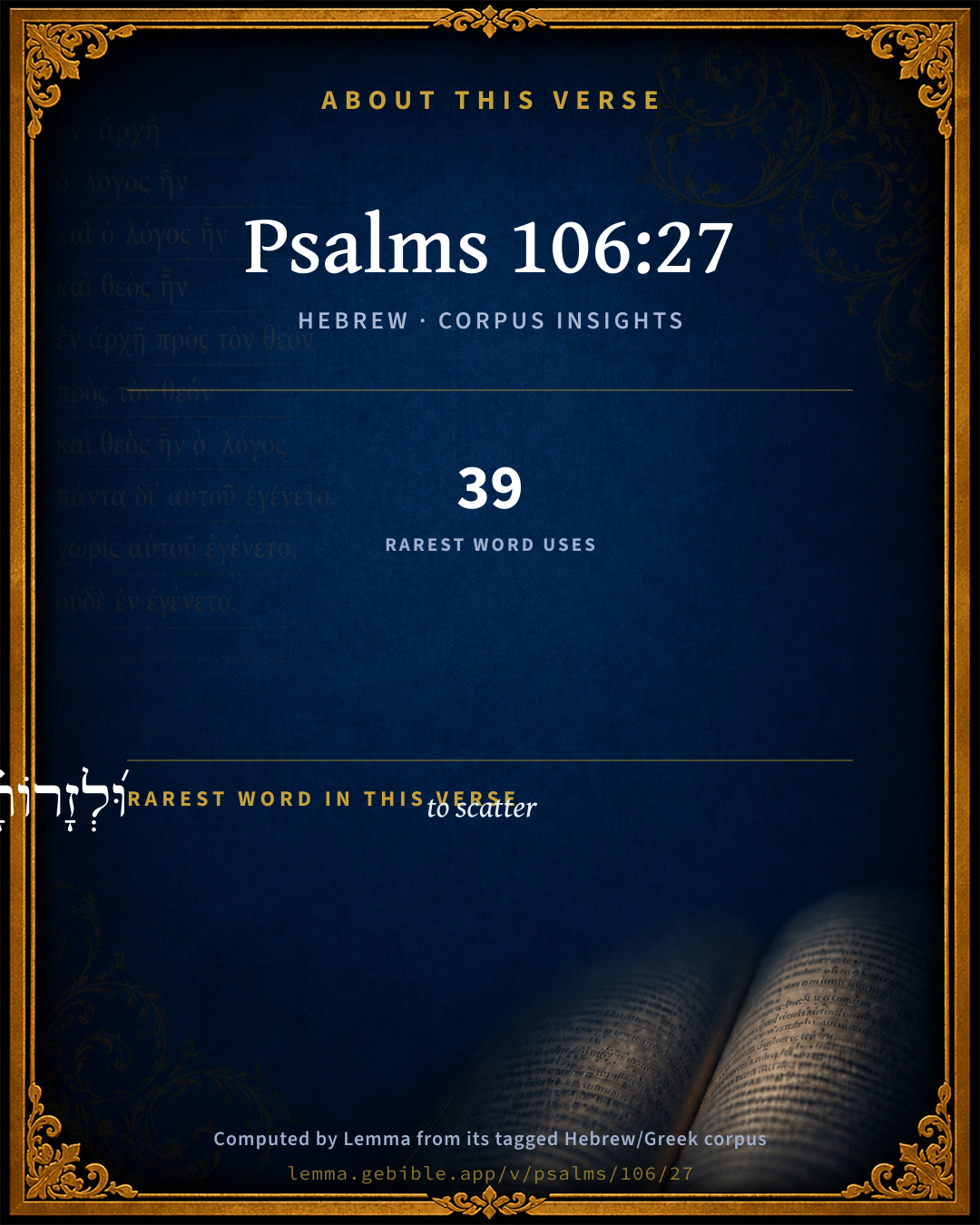
These counts appear in no published source. They are computed here, from the morphology-tagged text and Lemma’s own curated glosses. What Lemma adds →

5
words
5
distinct lemmas
Wisdom
section

Shared distinctive vocabulary

וּ֝לְזָרוֹתָ֗ם to scatter H2219 occurs in 38 verses of the Hebrew Bible. Also found in:

Grammatical profile

  • 2 verbs
  • 3 nouns

Verb forms

  • וּלְהַפִּ֣יל Hiphil · Infinitive Construct
  • וּ֝לְזָרוֹתָ֗ם Piel · Infinitive Construct

Hebrew & Septuagint length

In English translation the verse runs 15 words from the Hebrew and 16 from the Septuagint (LXX English) — closely comparable.

A rough comparison of the two English renderings, which tokenize alike — not a word-level alignment.

Word counts can differ between the Hebrew and the Greek without any difference in meaning — e.g. the Hebrew direct-object marker אֵת has no separate Greek word, and Greek often adds the article ὁ.

Cross-references

7

Topical passages linked to Psalms 106:27 in the Treasury of Scripture Knowledge — connected by theme and wording, ordered by reader-vote popularity; previews shown in the World English Bible.

  • Leviticus 26:33 I will scatter you among the nations, and I will draw out the sword after you: and your land will be a desolation, and your cities shall be a waste.
  • Psalms 44:11 You have made us like sheep for food, And have scattered us among the nations.
  • Deuteronomy 28:64–65 Yahweh will scatter you among all peoples, from the one end of the earth even to the other end of the earth; and there you shall serve other gods, which you have not known, you nor your fathers, even wood and stone.
  • Ezekiel 20:23 Moreover I swore to them in the wilderness, that I would scatter them among the nations, and disperse them through the countries;
  • Deuteronomy 4:26–27 I call heaven and earth to witness against you this day, that you shall soon utterly perish from off the land whereunto you go over the Jordan to possess it; you shall not prolong your days on it, but shall utterly be destroyed.
  • Deuteronomy 28:37 You shall become an astonishment, a proverb, and a byword, among all the peoples where Yahweh shall lead you away.
  • Deuteronomy 32:26–27 I said, I would scatter them afar, I would make the memory of them to cease from among men;

Cross-references courtesy of OpenBible.info (CC BY 4.0).

Hebrew and Greek witnesses Masoretic Hebrew ↔ Greek Septuagint

The same verse in the two great witnesses to the Old Testament, shown verse-for-verse.

You’re reading Greek Psalm 105 (Hebrew Psalm 106). The Septuagint counts the superscription, so verse numbers can differ from the Hebrew — chapter-level alignment, not verse-by-verse. Numbering follows Rahlfs.

These are two independent witnesses, not word-aligned to each other, and the Septuagint is shown in lemma (dictionary) form.

Hebrew Psalms 106:27 Masoretic · Westminster Leningrad Codex

וּלְהַפִּ֣יל זַ֭רְעָם בַּגּוֹיִ֑ם וּ֝לְזָרוֹתָ֗ם בָּאֲרָצֽוֹת

That he would overthrow their seed among the nations, And scatter them in the lands.

World English Bible · Public Domain

Greek LXX Greek Psalm 105:27 Septuagint · lemma form

καί ὁ καταβάλλω ὁ σπέρμα αὐτός ἐν ὁ ἔθνος καί διασκορπίζω αὐτός ἐν ὁ χώρα

and to cast down their seed among the nations, and to scatter them in the countries.

LXX2012 (modern English Septuagint) · Public Domain

On this verse, Ellicott's Commentary for English Readers discusses the Septuagint’s reading. Read the note in Commentary ↓

Hebrew: Westminster Leningrad Codex (CC BY 4.0). Greek: Septuagint (public domain); English from LXX2012 (modern English Septuagint) (Public Domain). How the Septuagint differs from the Hebrew →

Commentary

Notes on Psalms 106:27 from classic Christian and Jewish commentators (each source and its license shown beneath its notes). The classic Christian expositions comment on the surrounding passage and are grouped to its opening verse, so a note may address several verses; the Jewish commentaries on the Tanakh (Rashi and others) are per-verse, so they appear only where the commentator wrote on this verse.

Lemma curates 59 commentaries, every one of them public domain or Creative Commons licensed, each selected and text-cleaned for this edition rather than reprinted as found. About our sources →

Trapp's Complete Commentary

John Trapp

Psa 106:27 To overthrow their seed also among the nations, and to scatter them in the lands.

Ver. 27. To overthrow their seed also among the nations] This clause of God’s oath is not expressed in Numbers, but drawn there hence as a fearful consequence, both here by the psalmist, and also by the prophet Ezekiel, Eze 20:1-49 And R. Solomon’s note upon this text is, Tunc erat decretum de desolando Templo, ut lachrymas pro re magna, sicut ante pro nihilo effunderent, Then was the desolation of the temple (though it fell out long after) determined, that those malcontents who cried for nothing before, might have somewhat to cry for.

John Trapp, A Commentary or Exposition upon All the Books of the Old and New Testament (1647–1656) — public domain. Text from a community e-Sword module.

J. A. Alexander on Psalms

Joseph Addison Alexander

27. (Psa 106:27) And to make their seed fall in the nations, and to scatter them in the lands. As the appointed punishment of the older generation was to die in the wilderness, so that of their descendants was to die in dispersion and captivity among the Gentiles. See Lev 26:33; Lev 26:38; and compare Deu 28:32; Deu 28:36; Deu 28:64; Deu 28:68. The recollection of this threatening must have been peculiarly affecting to the Jews in Babylon.

Joseph Addison Alexander, The Psalms Translated and Explained (1850) — public domain. Text from a community e-Sword module.

Ellicott's Commentary for English Readers

(27) Overthrow.—This verse is evidently copied from Eze_20:23, but the psalmist has either intentionally or accidentally changed the prophet’s verb “scatter” into “overthrow,” just used in Psa_106:26. The error, if an error, is as old as the LXX. version.

A Bible Commentary for English Readers, edited by Charles John Ellicott (1878–1897) — public domain. Text from a community e-Sword module.

The Cambridge Bible for Schools and Colleges

gen. ed. J. J. S. Perowne

27. And that he would scatter their seed among the nations,

And disperse them in the lands.

Almost verbatim as Eze_20:23, from which the text must be corrected here. The Heb. words for make to fall and scatter are very similar (הפיץ … הפיל), and the former was accidentally repeated from Psa_106:26. The allusion to the warnings of banishment from the land in Lev_26:33; Deu_28:64 is suggested by the mention of the exclusion of the faithless Israelites from the land in Psa_106:26.

The Cambridge Bible for Schools and Colleges (gen. ed. J. J. S. Perowne; Cambridge University Press, 1878–1918) — public domain. Text from a community e-Sword module.

John Gill's Exposition

To overthrow their seed also among the nations,.... Their posterity was not overthrown in the wilderness; they were spared to possess the land their fathers despised. This respects later times, as does what follows:

and to scatter them in the lands; which Kimchi explains by the discomfiture of them by the Amalekites and Canaanites, when they presumed, contrary to the will of God, to go up to the top of the hill; and by Arad's taking some of them prisoner, afterwards, Num 14:45. But this was not done, nor to be done, in the wilderness: but the meaning is, that God lifted up his hand in the wilderness, and sware there, as Ezekiel says, Eze 20:23, that he would scatter them and disperse them among the Heathen; that is, at one time or another; which he did in part at the Babylonish captivity, and completely by the Romans: which is now their case, and is a standing proof of this prophecy, and an accomplishment of the oath of God.

John Gill's Exposition of the Whole Bible (1746–1763) — public domain (CC PDM 1.0). Text via the HelloAO Bible API.

Albert Barnes' Notes on the Bible

To overthrow their seed also among the nations - Margin, as in Hebrew, “to make them fall;” to wit, among the surrounding people. The reference here is to the posterity of those who complained and fell in the wilderness. The result of their rebellion and complaining would not terminate with them. It would extend to their posterity, and the rebellion of the fathers would be remembered in distant generations. The overthrow of the nation, and its captivity in Babylon was thus one of the remote consequences of their rebellion in the wilderness.

And to scatter them in the lands - In foreign lands - as at Babylon. If this psalm was written at the time of the Babylonian captivity, this allusion would be most appropriate. It would remind the nation that its captivity there had its origin in the ancient and long-continued disposition of the people to revolt from God.

Albert Barnes' Notes on the Bible (1834–1885) — public domain. Text from a community e-Sword/MySword module.

Matthew Poole's English Annotations

To overthrow their seed; he sware also (though not at the same time) that he would punish their sins, not only in their persons, but also in their posterity. See Exo 20:5; 32:34; Lev 26:33. Others refer this to the same oath and history, Num 14, because God intended at first to destroy both parents and children, even the whole nation, Psa 106:12,15, though afterwards upon Moses’s intercession he limited the judgment to that generation. But that destruction threatened was by the pestilence, Psa 106:12, not, as here, by captivity and banishment. Besides, God said that, Psa 106:11, but he did not swear it, but the oath came afterward, Psa 106:21.

Matthew Poole's English Annotations on the Holy Bible (1683–1685) — public domain. Text from a community e-Sword/MySword module.

Whedon's Commentary on the Bible

Daniel D. Whedon

27. To overthrow their seed—As this is spoken of the “seed,” or posterity, of the unbelieving Israelites of the desert, it may refer to any subsequent periods and generations, and is founded on such general warnings as Leviticus 26, and Deuteronomy 28.

To scatter them in the lands—This was so far fulfilled during the times of the Judges as fully to answer to Psa_106:47, without resorting to the exile in Babylon.

Daniel D. Whedon (gen. ed.), Commentary on the Old and New Testaments (1874–1909) — public domain. Text from a community e-Sword module.

The Pulpit Commentary

To overthrow their seed also among the nations. Like Ezekiel, (Eze_20:23) the writer regards the Babylonish captivity as in part a punishment for the sins committed in the wilderness. And to scatter them in the lands. (comp. Lev_26:33 Deu_28:64) The Israelites were punished, not merely by being carried into captivity, but by being completely broken up as a nation, and "scattered" widely over Western Asia some in Gozan and on the Khabonr, (2Ki_17:6) some in Haran, (1Ch_5:26) some in "the cities of the Modes", (2Ki_18:11 RAPC Tob 1:14 3:7) others in Babylonia. (2Ki_24:14-16 2Ch_36:20 Eze_1:1-3, etc.) The "scattering" has in later times increased ever more and more.

The Pulpit Commentary (1880–1919), ed. H.D.M. Spence-Jones & Joseph S. Exell — public domain. Text from a community e-Sword module.

John Wesley's Explanatory Notes

Overthrow - He swear also (tho' not at the same time) that he would punish their sins, not only in their persons, but in their posterity.

John Wesley, Explanatory Notes Upon the Whole Bible (1754–1765) — public domain. Text via the GEBible commentary corpus.

Rashi

Rabbi Shlomo Yitzchaki (Rashi)

And to cast their seed among the nations From that time, the destruction of the Temple was decreed upon them, for on the night of the ninth of Ab they went, and the Holy One, blessed be He, said, “They wept for nothing, and I shall establish for them weeping for generations.”

Rashi on the Tanakh — English translations: “The Judaica Press complete Tanach with Rashi, translated by A. J. Rosenberg” (CC BY 4.0); “Pentateuch with Rashi's commentary by M. Rosenbaum and A.M. Silbermann, 1929-1934” (public domain); “The Metsudah Tanach series, Lakewood, N.J” (CC BY 4.0); and “The Book of Joshua, Metsudah Publications, 1997” (CC BY 4.0). Text via Sefaria.

Lesson kit

Teaching starters — assembled from the data on this page, not authored interpretation. Every prompt links to the verse data it draws on. Edit before teaching.

Psalms, in the Wisdom, opens this verse with 5 words (5 distinct Hebrew lemmas). Its most distinctive word is zârâh (“to scatter”). A historical commentator’s framing appears above. Read the whole chapter for the surrounding context.

Discussion questions

  1. The word zârâh carries the sense “to scatter.” How does it shape the verse?
  2. Exodus 32:20 shares the word «to scatter» with this verse. How do the two illuminate each other?
  3. These translations render this verse differently; the difference is in the English rendering, not the original. What questions does that raise?
  4. The verb «וּלְהַפִּ֣יל» is Hiphil Infinitive Construct. How does its form color the action?
  5. Reading how Trapp's Complete Commentary and J. A. Alexander on Psalms read this verse, where do the two commentators agree and where do they part?

Things to notice

Reading settings

Reading text

Shown beneath each verse's original-language words.

Old Testament
Old Testament edition

Read the OT as the Masoretic Hebrew (MT) or the Greek Septuagint (LXX).

English shown for the Greek Septuagint (in the Hebrew ↔ Greek comparison).

Comparing translations? Open the Compare panel on any verse page to stack up to four side by side.