
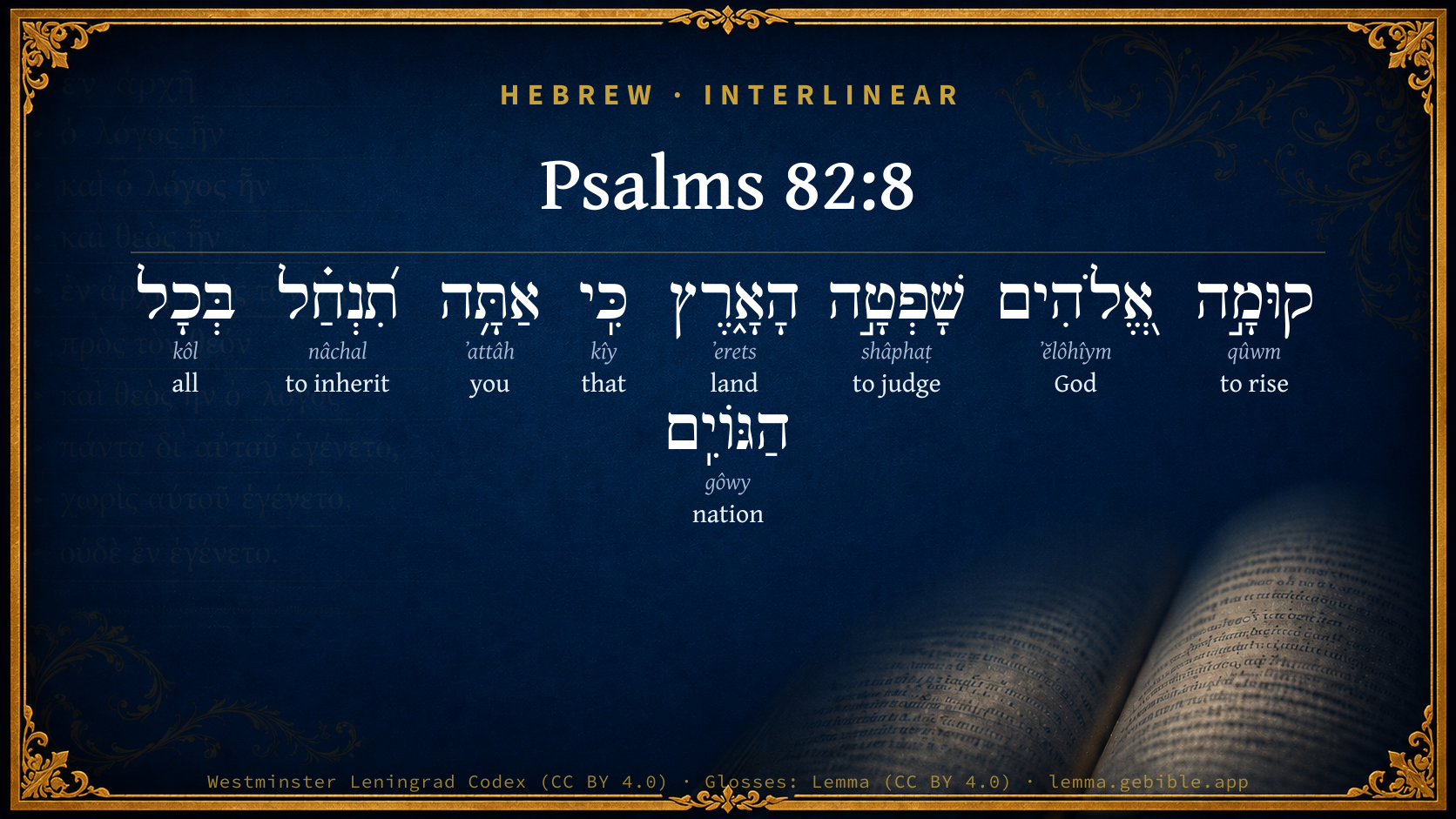
Psalms 82:8

Hebrew (Westminster Leningrad Codex) Psalms 82:8 appears in the Hebrew Old Testament. The text above is from the Westminster Leningrad Codex. Each word links to its Strong’s number, a concise gloss, and parsing drawn from the Open Scriptures Hebrew Bible morphology. Click any word for its full Brown-Driver-Briggs (BDB) entry.
Download image
Cite this verse

Psalms 82:8 (World English Bible). Public Domain. Lemma interlinear Bible study tool, https://lemma.gebible.app/v/psalms/82/8.

Show BibTeX & RIS
BibTeX
RIS
English Translation
Arise, God, judge the earth, For you inherit all of the nations.
World English Bible · Public Domain
Download a study sheet

One document with this verse’s original text, its word-by-word gloss line, the meaning frame, cross-references with their text, attributed commentary, and full source and license credits — printable, and it pastes into notes with its structure intact.

This verse Autodidact and up

Study sheet (.html) Plain text (.txt)

A passage Seminary Student

Up to 50 verses in one chapter. A passage sheet keeps up to 6 commentary sources and 12 cross-references per verse, in the order this page ranks them, and says so on the sheet whenever that leaves anything out. Ask for a single verse and you get the Autodidact verse sheet above.

Everything on this page stays free to read, with no account — the sheet is a download of what is already on screen, not access to it.

Want to remove ads? Support Godless Engineer
Compare translations 3

The same verse in 3 English versions, stacked beneath the original-language interlinear above. Click any original word for its lexicon entry.

Each is an independent rendering of the whole verse — the interlinear is not word-aligned to these translations.

Highlighted words mark where these versions differ — a whole-verse word diff, not a word-by-word alignment.

  • World English Bible Public Domain
    Arise, God, judge the earth, For you inherit all of the nations.
  • King James Version Public Domain
    Arise, O God, judge the earth: for thou shalt inherit all nations.
  • unfoldingWord Literal Text CC BY-SA 4.0
    Arise, God, judge the earth, for you, you will inherit among all of the nations.

unfoldingWord Literal Text — © unfoldingWord, licensed CC BY-SA 4.0. Word-aligned USFM3 via Door43 (git.door43.org/unfoldingWord/en_ult).

Versions to compare (up to 4)

3 of 4 selected

Show all 18 translations

Every available English version of this verse, each an independent rendering of the whole verse.

  • World English Bible Public Domain
    Arise, God, judge the earth, For you inherit all of the nations.
  • Berean Standard Bible Public Domain
    Arise, O God, judge the earth, for all the nations are Your inheritance.
  • Majority Standard Bible Public Domain
    Arise, O God, judge the earth, for all the nations are Your inheritance.
  • King James Version Public Domain
    Arise, O God, judge the earth: for thou shalt inherit all nations.
  • American Standard Version (1901) Public Domain
    Arise, O God, judge the earth; For thou shalt inherit all the nations. Psalm 83 A song. A Psalm of Asaph.
  • Revised Version (1885) Public Domain
    Arise, O God, judge the earth: for thou shalt inherit all the nations.
  • Geneva Bible (1599) Public Domain
    O God, arise, therefore iudge thou the earth: for thou shalt inherite all nations.
  • Douay-Rheims (1899) Public Domain
    Arise, O God, judge thou the earth: for thou shalt inherit among all the nations.
  • Young's Literal Translation Public Domain
    Rise, O God, judge the earth, For Thou hast inheritance among all the nations!
  • Literal Standard Version CC BY-SA 4.0
    Rise, O God, judge the earth, || For You have inheritance among all the nations!
  • Unlocked Literal Bible CC BY-SA 4.0
    Arise, God, judge the earth, for you have an inheritance in all the nations.
  • unfoldingWord Literal Text CC BY-SA 4.0
    Arise, God, judge the earth, for you, you will inherit among all of the nations.
  • Darby Bible Public Domain
    Arise, O God, judge the earth; for *thou* shalt inherit all the nations.
  • World Messianic Bible Public Domain
    Arise, God, judge the earth, for you inherit all of the nations.
  • Webster's Bible Public Domain
    Arise, O God, judge the earth: for thou wilt inherit all nations.
  • Free Bible Version CC BY-SA 4.0
    Stand up, Lord, and judge the earth, for all the nations belong to you.
  • Bible in Basic English Public Domain
    Up! O God, come as judge of the earth; for all the nations are your heritage.
  • JPS Tanakh (1917) Public Domain
    Arise, O God, judge the earth; for Thou shalt possess all nations.

Literal Standard Version (2020), Covenant Press — licensed CC BY-SA 4.0. Text via the HelloAO Bible API (eBible.org). Unlocked Literal Bible (unfoldingWord) — licensed CC BY-SA 4.0. Text via the HelloAO Bible API (eBible.org). unfoldingWord Literal Text — © unfoldingWord, licensed CC BY-SA 4.0. Word-aligned USFM3 via Door43 (git.door43.org/unfoldingWord/en_ult). Free Bible Version, Dr. Jonathan Gallagher — licensed CC BY-SA 4.0. Text via the HelloAO Bible API (eBible.org).

Word by word

More ways to search: Search by grammar → Find every occurrence → Compare this word →

Practice this passage: Drill this verse → Learn its vocabulary →

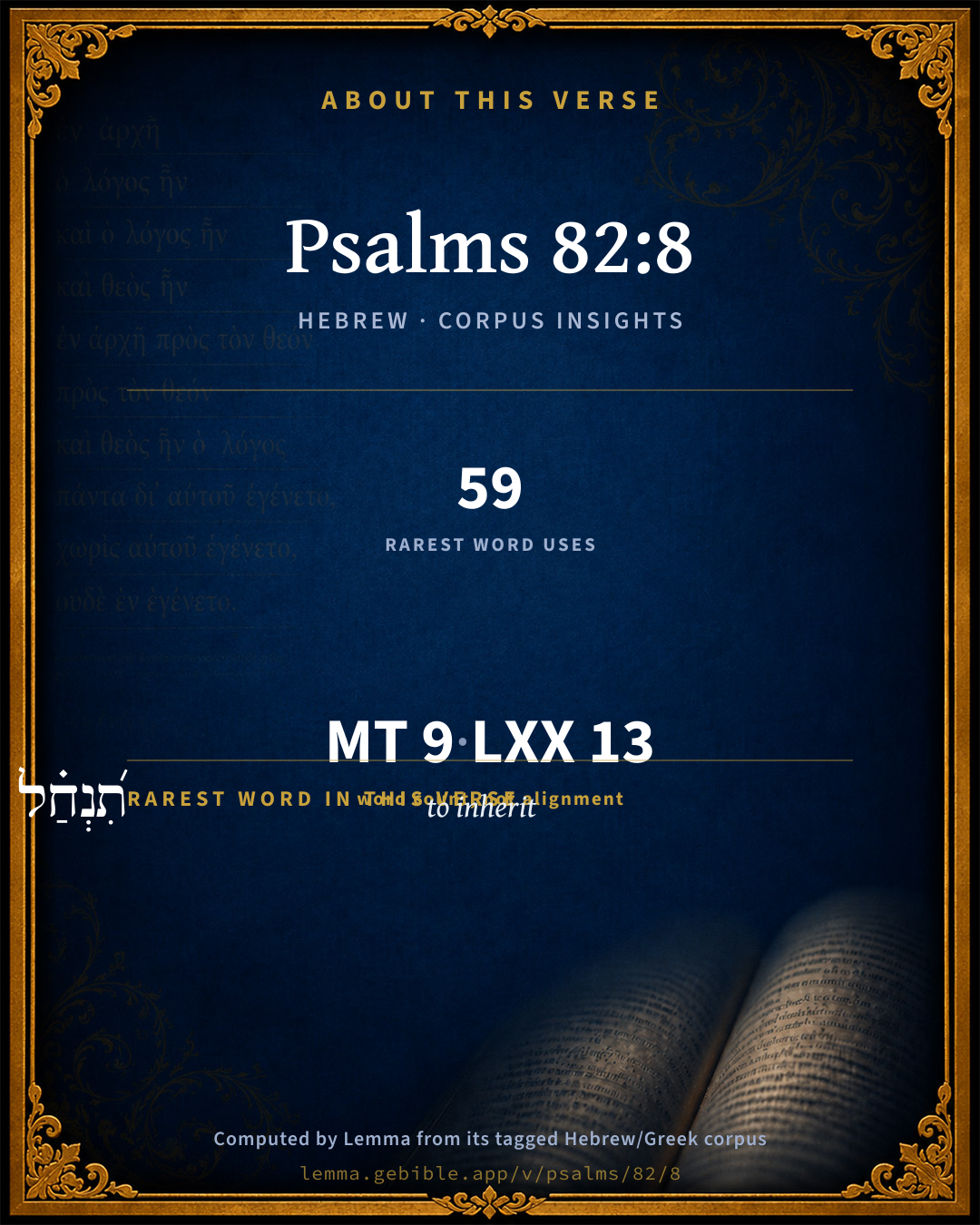
תִ֝נְחַ֗ל
nâchal
H5157
“to inherit”
Verb, Qal, Imperfect, 2nd Person, Masculine, Singular
Part of Speech
Verb
Stem
Qal
Form
Imperfect
Person
2nd Person
Gender
Masculine
Number
Singular
Full BDB Definition

Origin: a primitive root

TWOT: 1342

to get as a possession, acquire, inherit, possess - (Qal) - to take possession, inherit - to have or get as a possession or property (figuratively) - to divide the land for a possession - to acquire (testimonies) (figuratively) - (Piel) to divide for a possession - (Hithpael) to possess oneself of - (Hiphil) - to give as a possession - to cause to inherit, give as an inheritance - (Hophal) to be allotted, be made to possess
  1. קוּמָ֣ה qûwm H6965 “rise” Verb, Qal, Imperative, 2nd Person, Masculine, Singular + Suffix, h
  2. אֱ֭לֹהִים ʼĕlôhîym H430 “God(s)” Noun, Common, Masculine, Plural, Absolute
  3. שָׁפְטָ֣ה shâphaṭ H8199 “judge” Verb, Qal, Imperative, 2nd Person, Masculine, Singular + Suffix, h
  4. הָאָ֑רֶץ ʼerets H776 “the · land” Particle, Definite Article + Noun, Common, Both, Singular, Absolute
  5. כִּֽי kîy H3588 “that” Conjunction
  6. אַתָּ֥ה ʼattâh H859 “you” Pronoun, Personal, 2nd Person, Masculine, Singular
  7. בְּכָל kôl H3605 “in/at · all of” Preposition + Noun, Common, Masculine, Singular, Construct
  8. הַגּוֹיִֽם gôwy H1471 “the · nations” Particle, Definite Article + Noun, Common, Masculine, Plural, Absolute

About this verse

These counts appear in no published source. They are computed here, from the morphology-tagged text and Lemma’s own curated glosses. What Lemma adds →

9
words
9
distinct lemmas
Wisdom
section

Shared distinctive vocabulary

תִ֝נְחַ֗ל to inherit H5157 occurs in 57 verses of the Hebrew Bible. Also found in:

Grammatical profile

  • 3 verbs
  • 4 nouns
  • 1 pronoun
  • 1 conjunction

Verb forms

  • קוּמָ֣ה Qal · Imperative
  • שָׁפְטָ֣ה Qal · Imperative
  • תִ֝נְחַ֗ל Qal · Imperfect

Hebrew & Septuagint length

In English translation the verse runs 12 words from the Hebrew and 12 from the Septuagint (LXX English) — the same length.

A rough comparison of the two English renderings, which tokenize alike — not a word-level alignment.

Word counts can differ between the Hebrew and the Greek without any difference in meaning — e.g. the Hebrew direct-object marker אֵת has no separate Greek word, and Greek often adds the article ὁ.

In the original languages it is 9 Hebrew tokens and 13 Greek tokens — but the two are counted differently (Hebrew bundles its prefixes and suffixes into one token; the Greek is in lemma form), so that isn’t a like-for-like length.

Cross-references

12

Topical passages linked to Psalms 82:8 in the Treasury of Scripture Knowledge — connected by theme and wording, ordered by reader-vote popularity; previews shown in the World English Bible.

  • Revelation 11:15 The seventh angel sounded, and great voices in heaven followed, saying, "The kingdom of the world has become the Kingdom of our Lord, and of his Christ. He will reign forever and ever!"
  • Psalms 2:8 Ask of me, and I will give the nations for your inheritance, The uttermost parts of the earth for your possession.
  • Psalms 96:13 Before Yahweh; for he comes, For he comes to judge the earth. He will judge the world with righteousness, The peoples with his truth.
  • Psalms 22:28 For the kingdom is Yahweh's. He is the ruler over the nations.
  • Psalms 102:13 You will arise and have mercy on Zion; For it is time to have pity on her. Yes, the set time has come.
  • Psalms 12:5 "Because of the oppression of the weak and because of the groaning of the needy, I will now arise," says Yahweh; "I will set him in safety from those who malign him."
  • Psalms 44:26 Rise up to help us. Redeem us for your loving kindness' sake.
  • Micah 7:7 But as for me, I will look to Yahweh. I will wait for the God of my salvation. My God will hear me.
  • Zephaniah 3:8 "Therefore wait for me," says Yahweh, "until the day that I rise up to the prey, for my determination is to gather the nations, that I may assemble the kingdoms, to pour on them my indignation, even all my fierce anger, for all the earth will be devoured with the fire of my jealousy.
  • Isaiah 51:9 Awake, awake, put on strength, arm of Yahweh; awake, as in the days of old, the generations of ancient times. Isn't it you who did cut Rahab in pieces, who pierced the monster?
  • Micah 7:2 The godly man has perished out of the earth, And there is no one upright among men. They all lie in wait for blood; Every man hunts his brother with a net.
  • Psalms 7:6 Arise, Yahweh, in your anger. Lift up yourself against the rage of my adversaries. Awake for me. You have commanded judgment.

Cross-references courtesy of OpenBible.info (CC BY 4.0).

Hebrew and Greek witnesses Masoretic Hebrew ↔ Greek Septuagint

The same verse in the two great witnesses to the Old Testament, shown verse-for-verse.

You’re reading Greek Psalm 81 (Hebrew Psalm 82). The Septuagint counts the superscription, so verse numbers can differ from the Hebrew — chapter-level alignment, not verse-by-verse. Numbering follows Rahlfs.

These are two independent witnesses, not word-aligned to each other, and the Septuagint is shown in lemma (dictionary) form.

Hebrew Psalms 82:8 Masoretic · Westminster Leningrad Codex

קוּמָ֣ה אֱ֭לֹהִים שָׁפְטָ֣ה הָאָ֑רֶץ כִּֽי אַתָּ֥ה תִ֝נְחַ֗ל בְּכָל הַגּוֹיִֽם

Arise, God, judge the earth, For you inherit all of the nations.

World English Bible · Public Domain

Greek LXX Greek Psalm 81:8 Septuagint · lemma form

ἀναἵστημι ὁ θεός κρίνω ὁ γῆ ὅτι σύ κατακληρονομέω ἐν πᾶς ὁ ἔθνος

Arise, O God, judge the earth: for you shall inherit all nations.

LXX2012 (modern English Septuagint) · Public Domain

On this verse, Keil & Delitzsch discusses the Septuagint’s reading. Read the note in Commentary ↓

Hebrew: Westminster Leningrad Codex (CC BY 4.0). Greek: Septuagint (public domain); English from LXX2012 (modern English Septuagint) (Public Domain). How the Septuagint differs from the Hebrew →

Commentary

Notes on Psalms 82:8 from classic Christian and Jewish commentators (each source and its license shown beneath its notes). The classic Christian expositions comment on the surrounding passage and are grouped to its opening verse, so a note may address several verses; the Jewish commentaries on the Tanakh (Rashi and others) are per-verse, so they appear only where the commentator wrote on this verse.

Lemma curates 59 commentaries, every one of them public domain or Creative Commons licensed, each selected and text-cleaned for this edition rather than reprinted as found. About our sources →

Adam Clarke's Commentary

Verse 8. Arise, O God, judge the earth] Justice is perverted in the land: take the sceptre, and rule thyself.

For thou shalt inherit all nations.] Does not this last verse contain a prophecy of our Lord, the calling of the Gentiles, and the prevalence of Christianity over the earth? Thus several of the fathers have understood the passage. It is only by the universal spread of Christianity over the world, that the reign of righteousness and justice is to be established: and of whom can it be said that he shall inherit all nations, but of Jesus Christ?

ANALYSIS OF THE EIGHTY-SECOND PSALM

There are three parts in this Psalm: -

I. The prophet's proclamation, Ps 82:1.

II. God's controversy with the judges of the land, Ps 82:2-7.

III. The prophet's prayer that God would rise and judge, Ps 82:8.

I. God's presence proclaimed in court. At an assize the judge sits in the midst of the justices: "God standeth in the congregation," c., Ps 82:1.

II. 1. He reproves them, Ps 82:2. 1. For their unjust judgment: "Ye judge unjustly." 2. For their obstinate continuance in it: "How long will ye," c. Ye have not done it once, but often. 3. For their partiality: "they accepted persons," Ps 82:2.

2. He exhorts them to do their duty. 1. "Defend the poor and fatherless." Do right to every man. 2. "Deliver the poor and needy," Ps 82:3.

3. He acquaints them with the events that shall follow where justice is not done: all is out of order and the judges are the cause of it.

1. Through ignorance: "They know not the law," Ps 82:5.

2. Through obstinacy: "They will not learn it," Ps 82:5.

3. Through their determination to walk in their own way, Ps 82:5: "They walk on in darkness."

4. They shall in consequence be brought, 1. To an untimely death: "Ye shall die like men." 2. To a shameful death: "Ye shall fall like one of the princes," ye shall have a mighty fall, Ps 82:7.

III. The prophet's prayer. Since judgment and justice have failed in the land, he says, 1. "Arise, O Lord! " He does not say, Arise, O people, and put down those unjust judges. No their function is from God, and God alone is to reform, or strip, or punish them. 2. "Judge the earth." Take the state of all people into thy consideration: there is much injustice in the earth. 3. For this petition he gives a reason: "For thou shalt inherit all nations," Ps 82:8. Publish thy own laws, appoint thy own officers and let them in thy name dispense righteousness and true holiness throughout the world.

Adam Clarke's Commentary on the Bible (1810–1826) — public domain. Text from a community e-Sword/MySword module.

Trapp's Complete Commentary

John Trapp

Psa 82:8 Arise, O God, judge the earth: for thou shalt inherit all nations.

Ver. 8. Arise, O God, judge the earth] Take the matter into thine own hand, for it is but time, all things here being, so ill-ordered by thy substitutes; nam alioqui prae iudiciorum constupratione terra tota videtur collapsura, all will be nought else.

For thou shalt inherit all nations] Thou, Lord Jesus, shalt, Psa 2:8 Heb 1:1-14 : 2Ki 11:15. Come, therefore, yea, come quickly.

John Trapp, A Commentary or Exposition upon All the Books of the Old and New Testament (1647–1656) — public domain. Text from a community e-Sword module.

The Biblical Illustrator

Joseph S. Exell

Psa_82:8

Arise, O God, judge the earth: for Thou shalt inherit all nations.

The true hope of the world

This cry is--

I. One of the deepest cries of universal man. This cry, in some form or other, goes up to Heaven in every language udder the sky. Arise, O God. There is no hope but in Thee, Thine arm is mighty, etc.

II. Implies the want of confidence in all creature help. Men have tried to put the world right. Moralists, statesmen, philanthropists, saints, have all tried. Every age has been rife with remedial schemes, but all have proved ineffective. Arise, O God, etc.

III. Involves a confidence in the possibility of securing Divine interposition. What rational spirit would cry to Him if it believed that His assistance was unattainable. Men have an instinctive faith in the power of prayer. Thank God, we have abundant evidence of its efficiency, in the Bible, in the memoirs of the good, and in our own experience. Call upon Me in the day of trouble, etc. (Homilist.)

.

Psa_83:1-18

The Biblical Illustrator, edited by Joseph S. Exell (c. 1880s–1900s) — public domain. Text from a community e-Sword module.

Joseph Benson's Commentary

Psa 82:8. Arise, O God, judge the earth — Seeing the state of the world is so universally corrupt and desperate, and the vicegerents betray their trust, and oppress the nations of the earth, which they were appointed to preserve, do thou, therefore, O God, take the sword of justice into thine own hand, and maintain the cause and right of the oppressed against their potent oppressors, and let truth and justice be established in all parts of the earth. For thou shalt inherit all nations — For, as thou wast the Creator, so thou still art the supreme and unquestionable Lord, Possessor, and Ruler, of all nations, and therefore do thou protect and rescue thy people from all those who invade thine and their rights. This prayer will in due time be fully answered; or, rather, it is a prophecy which shall be perfectly accomplished at the proper season. A time is coming when God will bring all nations to the knowledge of himself, and to obedience to his laws; and then he will govern them by his Son, to whom he has committed all judgment, and by his Spirit, the one source of truth, justice, and mercy, and of all righteousness and peace.

Joseph Benson's Commentary on the Old and New Testaments (1811–1818) — public domain. Text from a community e-Sword module.

J. A. Alexander on Psalms

Joseph Addison Alexander

8. (Psa 82:8) Arise, 0 God, judge the earth; for thou art to possess all nations. This is not, as some interpreters suppose, a mere wish that God would do what he had just threatened; for this would make the psalm end with a feeble anti-climax. It is rather a petition that, since the representative or delegated judges had proved so unfaithful, God would appear in person and reclaim the powers which had been so wickedly abused. And this he is besought to do, not only in Israel, where the proximate occasion of the prayer was furnished, but throughout the earth, over all whose nations he possessed, and was one day to make good, the same hereditary right, i.e. a right continuing unchanged through all successive generations.

Joseph Addison Alexander, The Psalms Translated and Explained (1850) — public domain. Text from a community e-Sword module.

Tyndale Open Study Notes

Tyndale Open Resources

82:8 The nations belong to God; he will take over the realms formerly ruled by local deities and give them to his people, just as he did with the Promised Land.

Tyndale Open Study Notes — © Tyndale Open Resources, licensed CC BY-SA 4.0. Text via the HelloAO Bible API.

Geneva Bible (1599)

Geneva Bible translators

Therefore no tyrant shall pluck thy right and authority from thee.

Geneva Bible (1599) marginal notes — public domain. Text via Bolls.life.

John Calvin's Commentaries

8 Arise, O God! judge the earth. The reason why this psalm concludes with a prayer has been already stated at the commencement. The prophet, finding that his admonitions and remonstrances were ineffectual, and that princes, inflated with pride, treated with contempt all instruction on the principles of equity, addresses himself to God, and calls upon Him to repress their insolence. By this means, the Holy Spirit furnishes us with ground of comfort whenever we are cruelly treated by tyrants. We may perceive no power on earth to restrain their excesses; but it becomes us to lift up our eyes to heaven, and to seek redress from Him whose office it is to judge the world, and who does not claim this office to himself in vain. It is therefore our bounden duty to beseech him to restore to order what is embroiled in confusion. The reason of this which immediately follows — for thou shalt inherit all nations — is understood by some as a prophecy concerning the kingdom of Christ, by whom God has brought all nations in subjection to himself. But it is to be viewed in a more extensive sense, as implying that God has a rightful claim to the obedience of all nations, and that tyrants are chargeable with wickedly and unjustly wresting from him his prerogative of bearing rule, when they set at nought his authority, and confound good and evil, right and wrong. We ought therefore to beseech him to restore to order the confusions of the world, and thus to recover the rightful dominion which he has over it.

John Calvin's Commentaries (1540-1563) — public domain. Text from the Calvin Translation Society English edition (1840s-50s) via the Christian Classics Ethereal Library (ccel.org). Calvin's coverage is partial (roughly two-thirds of the Bible); uncommented books and verses are honest gaps, never fabricated. The 19th-century editor's footnotes and remarks are omitted so the notes are faithfully Calvin's own voice.

Ellicott's Commentary for English Readers

(8) Arise.—The psalm would have been incomplete had not the poet here resumed in his own person, with an appeal to the Supreme Judge to carry His decrees into effect against the oppressors of Israel. Here, at least, if not all through it, the affliction of the community, and the perversion of justice by foreign rulers, are the motives of the song. It is as if, despairing of the amendment of the corrupt magistrates, the poet, pleading for Israel, takes his case out of their hands, as Cranmer in the play takes his case out of the hands of the council, and entrusts it to the Great Judge of the world, to whom, as a special inheritance, Israel belonged, but who was also to show His claim to the submission and obedience of all nations.

A Bible Commentary for English Readers, edited by Charles John Ellicott (1878–1897) — public domain. Text from a community e-Sword module.

The Cambridge Bible for Schools and Colleges

gen. ed. J. J. S. Perowne

8. The Psalmist has watched the trial and condemnation of Israel’s judges; and the sight stirs him to appeal to God Himself to assume the office of Judge not only for Israel but for all the world. If Israel’s judges have failed so lamentably in their duty towards their own countrymen, how can Israel rule the world, though all the nations have been promised to its kings for their inheritance (Psa_2:8)? Nay, God Himself—Thou is emphatic—must take possession of all the nations as their Sovereign and their Judge.

The Cambridge Bible for Schools and Colleges (gen. ed. J. J. S. Perowne; Cambridge University Press, 1878–1918) — public domain. Text from a community e-Sword module.

John Gill's Exposition

Arise, O God,.... These are the words of the prophet, or of the church, whom he represents, addressing Christ, who is God over all; that seeing there was such a corruption and degeneracy in the world, and such wretched perversion of justice, that he would arise and exert himself, and show himself strong on the behalf of his people:

judge the earth: who is the Judge of the whole earth, to whom all judgment is committed, and who will judge the world in righteousness:

for thou shalt inherit all nations; which he will do in the latter day, when he shall be King over all the earth, and the Heathen shall be given him for his inheritance, he being heir of all things; and universal justice will not take place in the world till that time comes; and therefore it is to be wished and prayed for, as by the prophet and church here.

Next: Psalms Chapter 83

John Gill's Exposition of the Whole Bible (1746–1763) — public domain (CC PDM 1.0). Text via the HelloAO Bible API.

Albert Barnes' Notes on the Bible

Arise, O God, judge the earth - That is, Since there is such a failure in the administration of justice by those to whom it pertains, and who are appointed to do it in thy stead, do thou, O God, come forth thyself, and see that justice is executed among people. Do thou take the matter into thine own hands, and see that impartial justice is done everywhere among people. It pertains to thee as the great Proprietor of the earth to exercise justice; and we have nowhere else to look when men fail to do their duty.

For thou shalt inherit all nations - Or rather, All nations belong to thee as thine inheritance; that is, as thine own. The word “inherit” is used here, as it often is, merely to denote possession or proprietorship, without reference to the question how the possession is obtained. The word strictly refers to what has been received from parents, or what people are heirs to; and, in this sense, it is commonly applied to the land of Palestine, either as what was derived by the Jewish people from their ancestors the patriarchs, or as what they had received from God as a Father. Exo 32:13; Deu 1:38; Deu 12:10. It is here used simply in the sense of possessing it. That is, the whole earth belonged to God, and the administration of its affairs pertained to him. As those had failed who had been appointed under him to the office of judges - as they had not been faithful to their trust - as no confidence could be reposed in them, - the psalmist calls upon God to interfere, either by appointing other magistrates; or by leading those who were in office to just views of their duty; or by his own direct judgments, punishing the wicked, and rewarding the righteous, by the interpositions of his providence. We may hence learn

(1) That there are times on earth when wickedness is so prevalent, and when there is such a want of faithfulness in civil rulers, that we have no other resource but to call upon God to interpose.

(2) That it is right to call upon Him to see that justice should be done in the earth even in the punishment of the guilty, since all the interests of society depend on the proper administration of justice.

(3) For the same reason it is right to pray that God would judge the world, and that justice may be done on the human race.

It is desirable and proper that justice should be done; hence, there is no malignity in desiring that there may be a universal judgment, and that the affairs of the universe should be placed on an equal and righteous foundation. It is possible that there may be a just and holy joy at the idea that justice is done, and that God shows himself the friend of truth, of order, and of law. Compare Psa 58:10, note; Rev 19:1-3, notes.

Albert Barnes' Notes on the Bible (1834–1885) — public domain. Text from a community e-Sword/MySword module.

Matthew Poole's English Annotations

Seeing the state of the world is so universally corrupt and desperate, and thy vicegerents betray their trust, and oppress and ruin the nations of the earth, whom they were appointed to preserve, do thou therefore, O God, take the sword of justice into thine own hand, and maintain the cause and rights of the oppressed against their potent oppressors, and let truth and justice be established in all the parts of the earth. For as thou wast the Creator, so thou still art the supreme and unquestionable Lord, and Possessor, and Ruler of all nations, and therefore do thou protect and rescue them from all those who invade thine and their rights. And although at present thou seemest in some sort to confine thy care to Israel, and to neglect other nations; yet there is a time coming when thou wilt bring all nations to the knowledge of thyself, and the obedience of thy laws, and govern them by thy Son and Spirit, which thou wilt send into the world for that purpose. Do thou therefore preserve them in the mean time till that blessed day cometh, and hasten the coming of it.

Matthew Poole's English Annotations on the Holy Bible (1683–1685) — public domain. Text from a community e-Sword/MySword module.

The Treasury of David

Charles H. Spurgeon

Ver. 8. Arise, O God, and judge the earth. Come thou Judge of all mankind, put the bad judges to thy bar and end their corruption and baseness. Here is the world's true hope of rescue from the fangs of tyranny.

For thou shalt inherit all nations. The time will come when all races of men shall own their God, and accept him as their king. There is one who is "King by right divine, "and he is even now on his way. The last days shall see him enthroned, and all unrighteous potentates broken like potter's vessels by his potent sceptre. The second advent is still earth's brightest hope. Come quickly, even so, come, Lord Jesus.

Whole Psalm. Asaph, who has written so much in the previous Psalms of the coming of Christ in the flesh, now speaks of his second coming to judgment. Josephus Maria Thomasius. 1649-1713.

Ver. 7-8. See Psalms on "Ps 82:7" for further information.

Ver. 8. Arise, O God. A metaphor taken from the common gesture of judges, whose usual manner is to sit while they are hearing of cases; to arise and stand up when they come to give sentence. Thomas Gataker.

Ver. 8.

I. The invocation: Arise, etc.

II. The prediction: For thou shalt, etc.

G. R.

Charles H. Spurgeon's The Treasury of David (1869–1885) — public domain. Psalms only. Text from a community e-Sword/MySword module.

Whedon's Commentary on the Bible

Daniel D. Whedon

8. Arise, O God, judge the earth—The king now speaks. As the earth is full of misrule and violence, God is invoked, as the blessed and supreme “judge,” to take into his own hands the disordered affairs of the world.

For thou shalt inherit all nations—A prophetic anticipation of Rev_11:17. “We give thanks unto thee, O Lord God Almighty, which art, and wast, and art to come; because thou hast taken to thee thy great power, and hast reigned.”

Daniel D. Whedon (gen. ed.), Commentary on the Old and New Testaments (1874–1909) — public domain. Text from a community e-Sword module.

The Pulpit Commentary

Arise, O God, judge the earth. The words of God (vers. 2-7) being ended, the psalmist calls upon him to proceed at once to judgment; but he does not limit the judgment to Israel"s unjust judges. God is asked to "arise" and "judge the earth," i.e. the whole world. (comp. Psa_7:7, 8 56:7 59:5) For thou shalt inherit; or, "for thou dost inherit." "God is the King of all the earth", (Psa_47:2) not of Israel only. All nations the whole world must be regarded as his possession or "inheritance.

God"s inheritance in all nations.

Bishop Perowne translates this, "For thou hast all the nations for thine inheritance." Bishop Wordsworth says, "All nations are thine inheritance. Thou gavest a special inheritance to Israel; but all lands are thy Canaan, and all will be judged by thee." The term "inheritance" is used in a somewhat unusual way, and what we regard as its precise meaning is not to be pressed. The idea in the mind of the psalmist was that God is the rightful Sovereign of the whole earth, and therefore he may be asked personally to correct the evils of his representatives. An "inheritance" is here viewed as something which comes to a man, and is absolutely his, over which he has entire control. Israel was God"s inheritance because entirely in his control. But those called gods, judges, princes, had nothing that was theirs in any such sense. But every land and every people is, in this way, God"s inheritance. And when the subordinate servants fail anywhere, appeal can be made to the absolute Ruler and Judge. Aglen puts the point of the verse in this way: "It is as if, despairing of the amending of the corrupt magistrates, the poet, pleading for Israel, takes his case out of their hands, as Cranmer in the play takes his case out of the hands of the council, and entrusts it to the great Judge of the world, to whom, as a special inheritance, Israel belonged, but who was also to show his claim to the submission and obedience of all nations." The point to work out is this when we are troubled by thoughts of the injustice and untrustworthiness of men in whom we ought to be able to confide, we may find consolation in large comprehensive views of the supremacy of God our God over all the earth. In this way we get helpful impressions of

I GOD"S EXPERIENCE. These failures that surprise and alarm us are no surprise to the God of the whole earth. He has had to deal with such things and such people over and over again. He knows how to deal with such cases.

II GOD"S INTERVENTION. When we see God as having all nations for his inheritance, we realize that he must, through long ages, and he must still, be constantly engaged in righting things; holily interfering with wilful men, putting confused things straight. Then we are reassured. He can put right what perplexes us. R.T.

The Pulpit Commentary (1880–1919), ed. H.D.M. Spence-Jones & Joseph S. Exell — public domain. Text from a community e-Sword module.

John Wesley's Explanatory Notes

Arise - Take the sword of justice into thine own hand.

John Wesley, Explanatory Notes Upon the Whole Bible (1754–1765) — public domain. Text via the GEBible commentary corpus.

Keil & Delitzsch

C. F. Keil & F. Delitzsch

The poet closes with the prayer for the realization of that which he has beheld in spirit. He implored God Himself to sit in judgment (שׁפטה as in Lam 3:59), since judgment is so badly exercised upon the earth. All peoples are indeed His נחלה, He has an hereditary and proprietary right among (lxx and Vulgate according to Num 18:20, and frequently), or rather in (בּ as in משׁל בּ, instead of the accusative of the object, Zac 2:11), all nations (ἔθνη) - may He then be pleased to maintain it judicially. The inference drawn from this point backwards, that the Psalm is directed against the possessors of power among the Gentiles, is erroneous. Israel itself, in so far as it acts inconsistently with its theocratic character, belies its sanctified nationality, is a גוי like the גוים, and is put into the same category with these. The judgment over the world is also a judgment over the Israel that is become conformed to the world, and its God-estranged chiefs.

Keil & Delitzsch — Biblical Commentary on the Old Testament (1861–1891) — public domain (CC PDM 1.0). Text via the HelloAO Bible API. (Old Testament only.)

unfoldingWord translationNotes

Door43 World Missions Community

General Information:

The writer is speaking again.

judge the earth

Here "earth" represents the people. AT: "judge the people of the earth" (See: Metonymy)

for you have an inheritance in all the nations

"for all the nations are your inheritance." Yahweh taking all the people as his own and ruling over them is spoken of as if the nations were a possession that he inherited. AT: "for you rule over all the people of every nation" (See: Metaphor)

all the nations

Here "nations" represents the people of the nations. (See: Metonymy)

translationWords

raise

judge

inherit

nation

unfoldingWord translationNotes — © Distant Shores Media and the Door43 World Missions Community, licensed CC BY-SA 4.0. Source: git.door43.org/Door43/en_tn.

Rashi

Rabbi Shlomo Yitzchaki (Rashi)

Arise, O God Asaph commences to pray that He rise and cut off from Israel those corrupt judges.

for You are the One Who inherits the nations, and everyone is in Your hands to judge.

Rashi on the Tanakh — English translations: “The Judaica Press complete Tanach with Rashi, translated by A. J. Rosenberg” (CC BY 4.0); “Pentateuch with Rashi's commentary by M. Rosenbaum and A.M. Silbermann, 1929-1934” (public domain); “The Metsudah Tanach series, Lakewood, N.J” (CC BY 4.0); and “The Book of Joshua, Metsudah Publications, 1997” (CC BY 4.0). Text via Sefaria.

Lesson kit

Teaching starters — assembled from the data on this page, not authored interpretation. Every prompt links to the verse data it draws on. Edit before teaching.

Psalms, in the Wisdom, opens this verse with 9 words (9 distinct Hebrew lemmas). Its most distinctive word is nâchal (“to inherit”). A historical commentator’s framing appears above. Read the whole chapter for the surrounding context.

Discussion questions

  1. The word nâchal carries the sense “to inherit.” How does it shape the verse?
  2. Exodus 23:30 shares the word «to inherit» with this verse. How do the two illuminate each other?
  3. These translations render this verse differently; the difference is in the English rendering, not the original. What questions does that raise?
  4. The verb «קוּמָ֣ה» is Qal Imperative. How does its form color the action?
  5. Reading how Adam Clarke's Commentary and Trapp's Complete Commentary read this verse, where do the two commentators agree and where do they part?

Things to notice

Reading settings

Reading text

Shown beneath each verse's original-language words.

Old Testament
Old Testament edition

Read the OT as the Masoretic Hebrew (MT) or the Greek Septuagint (LXX).

English shown for the Greek Septuagint (in the Hebrew ↔ Greek comparison).

Comparing translations? Open the Compare panel on any verse page to stack up to four side by side.