
Deuteronomy 4:34

Hebrew (Westminster Leningrad Codex) Deuteronomy 4:34 appears in the Hebrew Old Testament. The text above is from the Westminster Leningrad Codex. Each word links to its Strong’s number, a concise gloss, and parsing drawn from the Open Scriptures Hebrew Bible morphology. Click any word for its full Brown-Driver-Briggs (BDB) entry.
Download image
Cite this verse

Deuteronomy 4:34 (World English Bible). Public Domain. Lemma interlinear Bible study tool, https://lemma.gebible.app/v/deuteronomy/4/34.

Show BibTeX & RIS
BibTeX
RIS
English Translation
Or has God tried to go and take him a nation from the midst of [another] nation, by trials, by signs, and by wonders, and by war, and by a mighty hand, and by an outstretched arm, and by great terrors, according to all that Yahweh your God did for you in Egypt before your eyes?
World English Bible · Public Domain
Highlights
  • 1 first appearance in the Hebrew Bible
Full analysis ↓
Download a study sheet

One document with this verse’s original text, its word-by-word gloss line, the meaning frame, cross-references with their text, attributed commentary, and full source and license credits — printable, and it pastes into notes with its structure intact.

This verse Autodidact and up

Study sheet (.html) Plain text (.txt)

A passage Seminary Student

Up to 50 verses in one chapter. A passage sheet keeps up to 6 commentary sources and 12 cross-references per verse, in the order this page ranks them, and says so on the sheet whenever that leaves anything out. Ask for a single verse and you get the Autodidact verse sheet above.

Everything on this page stays free to read, with no account — the sheet is a download of what is already on screen, not access to it.

Want to remove ads? Support Godless Engineer
Compare translations 3

The same verse in 3 English versions, stacked beneath the original-language interlinear above. Click any original word for its lexicon entry.

Each is an independent rendering of the whole verse — the interlinear is not word-aligned to these translations.

Highlighted words mark where these versions differ — a whole-verse word diff, not a word-by-word alignment.

  • World English Bible Public Domain
    Or has God tried to go and take him a nation from the midst of [another] nation, by trials, by signs, and by wonders, and by war, and by a mighty hand, and by an outstretched arm, and by great terrors, according to all that Yahweh your God did for you in Egypt before your eyes?
  • King James Version Public Domain
    Or hath God assayed to go and take him a nation from the midst of another nation, by temptations, by signs, and by wonders, and by war, and by a mighty hand, and by a stretched out arm, and by great terrors, according to all that the LORD your God did for you in Egypt before your eyes?
  • unfoldingWord Literal Text CC BY-SA 4.0
    Or has God attempted to go and take for himself a nation from the midst of nation, by trials, by signs and by wonders and by war and by a mighty hand and by an outstretched arm and by great terrors, as everything that Yahweh your God did for you in Egypt before your eyes?

unfoldingWord Literal Text — © unfoldingWord, licensed CC BY-SA 4.0. Word-aligned USFM3 via Door43 (git.door43.org/unfoldingWord/en_ult).

Versions to compare (up to 4)

3 of 4 selected

Show all 18 translations

Every available English version of this verse, each an independent rendering of the whole verse.

  • World English Bible Public Domain
    Or has God tried to go and take him a nation from the midst of [another] nation, by trials, by signs, and by wonders, and by war, and by a mighty hand, and by an outstretched arm, and by great terrors, according to all that Yahweh your God did for you in Egypt before your eyes?
  • Berean Standard Bible Public Domain
    Or has any god tried to take as his own a nation out of another nation—by trials, signs, wonders, and war, by a strong hand and an outstretched arm, and by great terrors—as the LORD your God did for you in Egypt, before your eyes?
  • Majority Standard Bible Public Domain
    Or has any god tried to take as his own a nation out of another nation—by trials, signs, wonders, and war, by a strong hand and an outstretched arm, and by great terrors—as the LORD your God did for you in Egypt, before your eyes?
  • King James Version Public Domain
    Or hath God assayed to go and take him a nation from the midst of another nation, by temptations, by signs, and by wonders, and by war, and by a mighty hand, and by a stretched out arm, and by great terrors, according to all that the LORD your God did for you in Egypt before your eyes?
  • American Standard Version (1901) Public Domain
    Or hath God assayed to go and take him a nation from the midst of `another' nation, by trials, by signs, and by wonders, and by war, and by a mighty hand, and by an outstretched arm, and by great terrors, according to all that Jehovah your God did for you in Egypt before your eyes?
  • Revised Version (1885) Public Domain
    Or hath God assayed to go and take him a nation from the midst of another nation, by temptations, by signs, and by wonders, and by war, and by a mighty hand, and by a stretched out arm, and by great terrors, according to all that the LORD your God did for you in Egypt before your eyes?
  • Geneva Bible (1599) Public Domain
    Or hath God assayed to go and take him a nation from among nations, by tentations, by signes, and by wonders, and by warre, and by a mightie hand, and by a stretched out arme, and by great feare, according vnto all that the Lord your God did vnto you in Egypt before your eyes?
  • Douay-Rheims (1899) Public Domain
    If God ever did so as to go, and take to himself a nation out of the midst of nations by temptations, signs, and wonders, by fight, and a strong hand, and stretched out arm, and horrible visions according to all the things that the Lord your God did for you in Egypt, before thy eyes.
  • Young's Literal Translation Public Domain
    Or hath God tried to go in to take to Himself, a nation from the midst of a nation, by trials, by signs, and by wonders, and by war, and by a strong hand, and by a stretched-out arm, and by great terrors -- according to all that Jehovah your God hath done to you, in Egypt, before your eyes?
  • Literal Standard Version CC BY-SA 4.0
    Or has God tried to go in to take a nation for Himself from the midst of a nation, by trials, by signs, and by wonders, and by war, and by a strong hand, and by an outstretched arm, and by great terrors, according to all that your God YHWH has done to you in Egypt before your eyes?
  • Unlocked Literal Bible CC BY-SA 4.0
    Or has God ever attempted to go and take for himself a nation from the midst of another nation, by trials, by signs, and by wonders, and by war, and by a mighty hand, and by an outstretched arm, and by great terrors, as everything that Yahweh your God did for you in Egypt before your eyes?
  • unfoldingWord Literal Text CC BY-SA 4.0
    Or has God attempted to go and take for himself a nation from the midst of nation, by trials, by signs and by wonders and by war and by a mighty hand and by an outstretched arm and by great terrors, as everything that Yahweh your God did for you in Egypt before your eyes?
  • Darby Bible Public Domain
    Or hath God essayed to come to take him a nation from the midst of a nation, by trials, by signs, and by wonders, and by war, and by a powerful hand, and by a stretched-out arm, and by great terrors, according to all that Jehovah your God did for you in Egypt before your eyes?
  • World Messianic Bible Public Domain
    Or has God tried to go and take a nation for himself from among another nation, by trials, by signs, by wonders, by war, by a mighty hand, by an outstretched arm, and by great terrors, according to all that the LORD your God did for you in Egypt before your eyes?
  • Webster's Bible Public Domain
    Or hath God essayed to go and take him a nation from the midst of another nation, by temptations, by signs, and by wonders, and by war, and by a mighty hand, and by an out-stretched arm, and by great terrors, according to all that the LORD your God did for you in Egypt before your eyes?
  • Free Bible Version CC BY-SA 4.0
    Has any god tried to take a nation out of another nation and make them his own, using tests and signs and miracles and war—with his great power and incredible strength and terrifying actions—like the Lord your God did for you in Egypt, before your very eyes?
  • Bible in Basic English Public Domain
    Has God ever before taken a nation for himself from out of another nation, by punishments and signs and wonders, by war and by a strong hand and a stretched-out arm and great acts of wonder and fear, as the Lord your God did for you in Egypt, before your very eyes?
  • JPS Tanakh (1917) Public Domain
    Or hath God assayed to go and take Him a nation from the midst of another nation, by trials, by signs, and by wonders, and by war, and by a mighty hand, and by an outstretched arm, and by great terrors, according to all that the LORD your God did for you in Egypt before thine eyes?

Literal Standard Version (2020), Covenant Press — licensed CC BY-SA 4.0. Text via the HelloAO Bible API (eBible.org). Unlocked Literal Bible (unfoldingWord) — licensed CC BY-SA 4.0. Text via the HelloAO Bible API (eBible.org). unfoldingWord Literal Text — © unfoldingWord, licensed CC BY-SA 4.0. Word-aligned USFM3 via Door43 (git.door43.org/unfoldingWord/en_ult). Free Bible Version, Dr. Jonathan Gallagher — licensed CC BY-SA 4.0. Text via the HelloAO Bible API (eBible.org).

Word by word

More ways to search: Search by grammar → Find every occurrence → Compare this word →

Practice this passage: Drill this verse → Learn its vocabulary →

בְּמַסֹּת֩
maççâh
H4531
“in/at · trials”
Preposition + Noun, Common, Feminine, Plural, Absolute
Part of Speech
Preposition + Noun
Type
Common
Gender
Feminine
Number
Plural
State
Absolute
Full BDB Definition

Origin: from H5254

TWOT: 1223b

despair, test - despair - testing, proving, trial
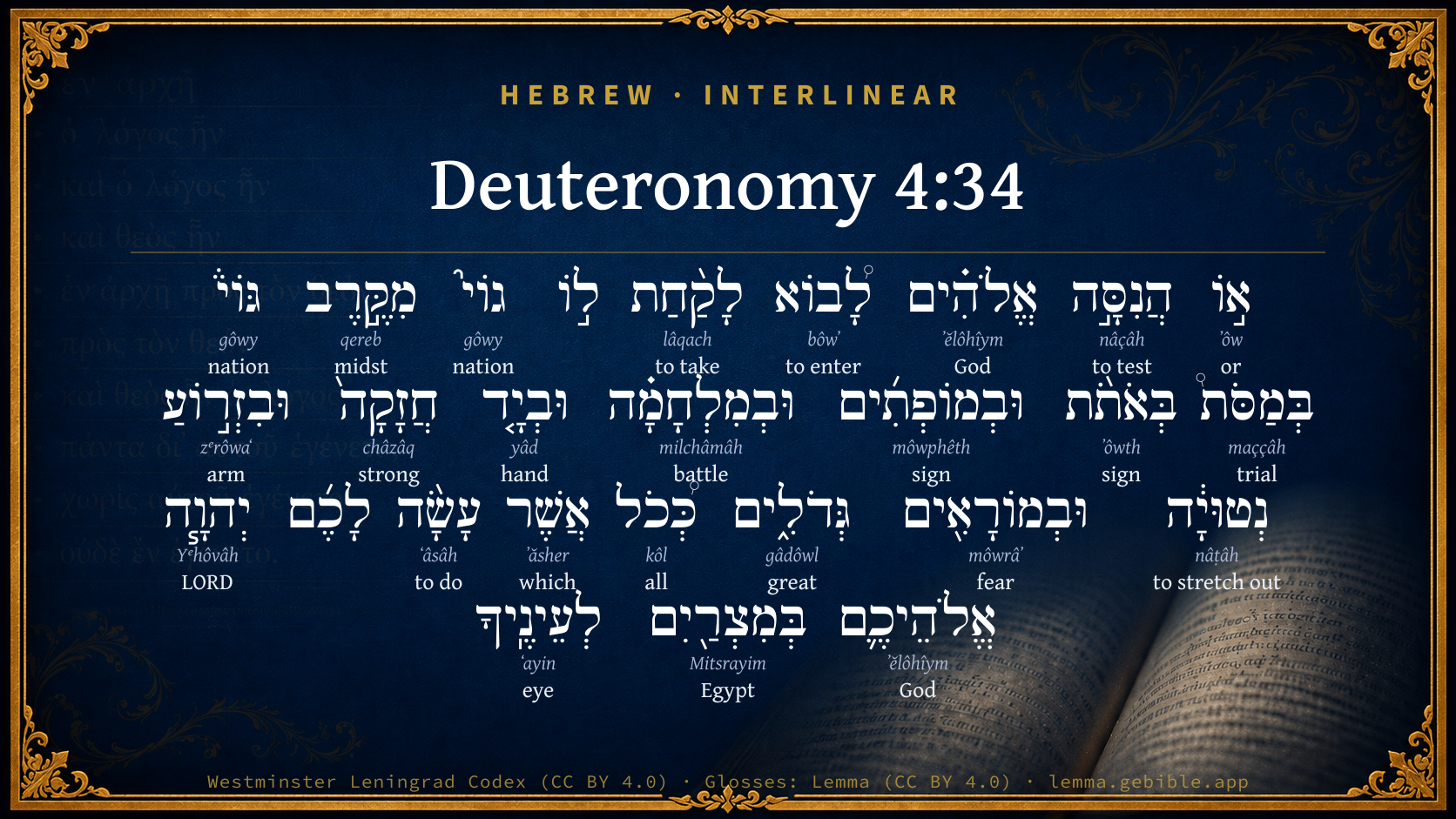
  1. א֣וֹ ʼôw H176 “or” Conjunction
  2. הֲנִסָּ֣ה nâçâh H5254 “to test” Particle, Interrogative + Verb, Piel, Perfect, 3rd Person, Masculine, Singular
  3. אֱלֹהִ֗ים ʼĕlôhîym H430 “God(s)” Noun, Common, Masculine, Plural, Absolute
  4. לָ֠בוֹא bôwʼ H935 “to enter” Preposition + Verb, Qal, Infinitive Construct
  5. לָקַ֨חַת lâqach H3947 “to take” Preposition + Verb, Qal, Infinitive Construct
  6. גוֹי֮ gôwy H1471 “nation” Noun, Common, Masculine, Singular, Absolute
  7. מִקֶּ֣רֶב qereb H7130 “from · midst of” Preposition + Noun, Common, Masculine, Singular, Construct
  8. גּוֹי֒ gôwy H1471 “nation” Noun, Common, Masculine, Singular, Absolute
  9. בְּאֹתֹ֨ת ʼôwth H226 “in/at · signs” Preposition + Noun, Common, Both, Plural, Absolute
  10. וּבְמוֹפְתִ֜ים môwphêth H4159 “and · in/at · signs” Conjunction + Preposition + Noun, Common, Masculine, Plural, Absolute
  11. וּבְמִלְחָמָ֗ה milchâmâh H4421 “and · in/at · battle” Conjunction + Preposition + Noun, Common, Feminine, Singular, Absolute
  12. וּבְיָ֤ד yâd H3027 “and · in/at · hand” Conjunction + Preposition + Noun, Common, Both, Singular, Absolute
  13. חֲזָקָה֙ châzâq H2389 “strong” Adjective, Adjective, Feminine, Singular, Absolute
  14. וּבִזְר֣וֹעַ zᵉrôwaʻ H2220 “and · in/at · arm” Conjunction + Preposition + Noun, Common, Both, Singular, Absolute
  15. נְטוּיָ֔ה nâṭâh H5186 “stretched out” Verb, Qal, Participle Passive, Feminine, Singular, Absolute
  16. וּבְמוֹרָאִ֖ים môwrâʼ H4172 “and · in/at · terrors” Conjunction + Preposition + Noun, Common, Masculine, Plural, Absolute
  17. גְּדֹלִ֑ים gâdôwl H1419 “great” Adjective, Adjective, Masculine, Plural, Absolute
  18. כְּ֠כֹל kôl H3605 “like/as · all” Preposition + Noun, Common, Masculine, Singular, Absolute
  19. אֲשֶׁר ʼăsher H834 “which” Particle, Relative
  20. עָשָׂ֨ה ʻâsâh H6213 “to do” Verb, Qal, Perfect, 3rd Person, Masculine, Singular
  21. יְהוָ֧ה Yᵉhôvâh H3068 “LORD” Noun, Proper
  22. אֱלֹהֵיכֶ֛ם ʼĕlôhîym H430 “God(s) · your” Noun, Common, Masculine, Plural, Construct + Suffix, Personal, 2nd Person, Masculine, Plural
  23. בְּמִצְרַ֖יִם Mitsrayim H4714 “in/at · Egypt” Preposition + Noun, Proper
  24. לְעֵינֶֽיךָ ʻayin H5869 “to/for · eyes · your” Preposition + Noun, Common, Both, Dual, Construct + Suffix, Personal, 2nd Person, Masculine, Singular

About this verse

These counts appear in no published source. They are computed here, from the morphology-tagged text and Lemma’s own curated glosses. What Lemma adds →

27
words
23
distinct lemmas
Pentateuch
section

Notable vocabulary

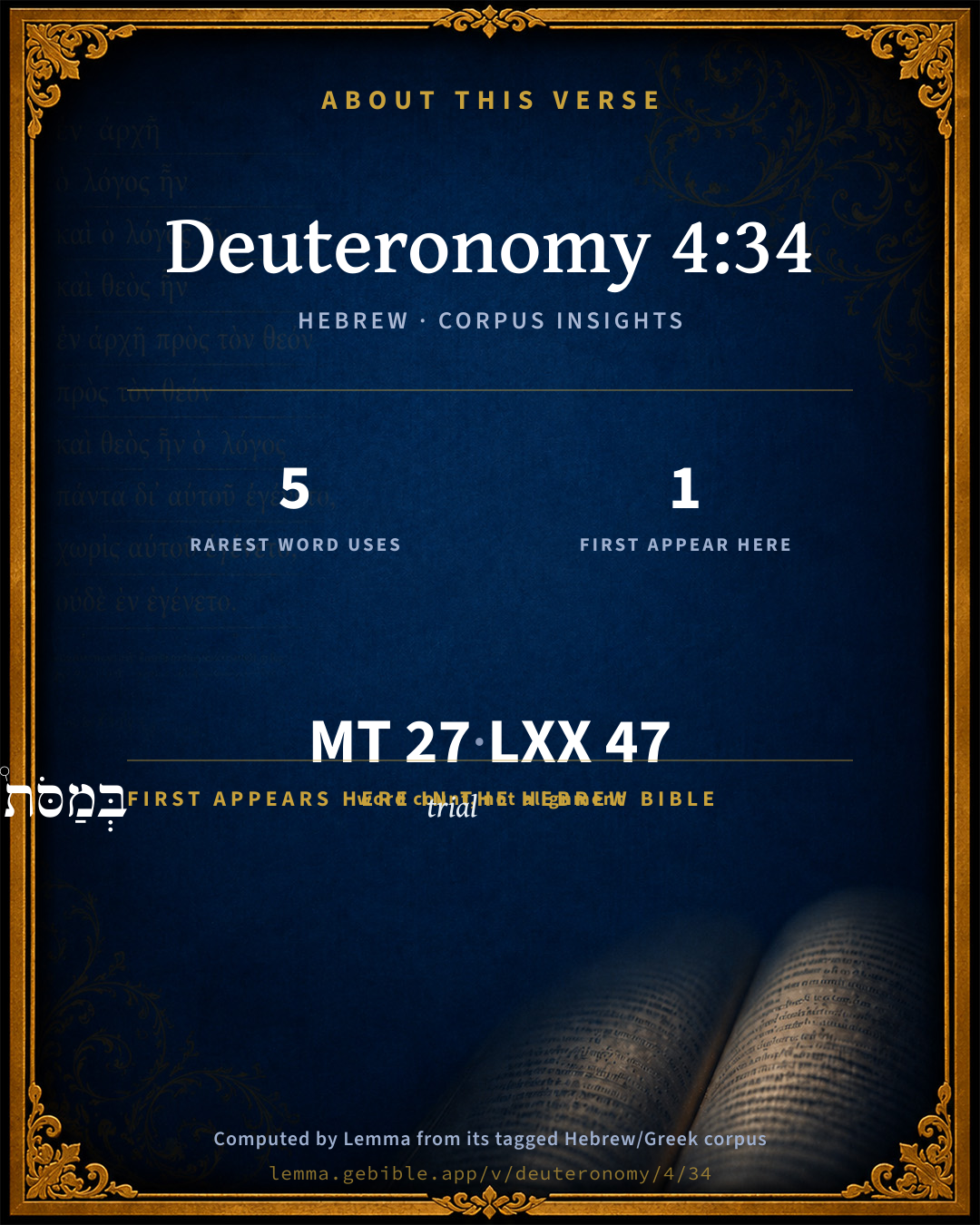
The rarest word here is בְּמַסֹּת֩ trial H4531 — appearing just 5 times in the whole Hebrew Bible.

First appearance in Scripture

This word makes its first canonical appearance in the Hebrew Bible here:

  • בְּמַסֹּת֩ trial H4531

Shared distinctive vocabulary

בְּמַסֹּת֩ trial H4531 occurs in 5 verses of the Hebrew Bible. Also found in:

Grammatical profile

  • 5 verbs
  • 16 nouns
  • 2 adjectives
  • 2 prepositions
  • 1 conjunction
  • 1 particle

Verb forms

  • הֲנִסָּ֣ה Piel · Perfect
  • לָ֠בוֹא Qal · Infinitive Construct
  • לָקַ֨חַת Qal · Infinitive Construct
  • נְטוּיָ֔ה Qal · Participle Passive
  • עָשָׂ֨ה Qal · Perfect

Repetition

Words recur within this verse — often emphatic in Hebrew:

  • אֱלֹהִ֗ים God H430 ×2
  • גוֹי֮ nation H1471 ×2

Hebrew & Septuagint length

In English translation the verse runs 56 words from the Hebrew and 60 from the Septuagint (LXX English) — closely comparable.

A rough comparison of the two English renderings, which tokenize alike — not a word-level alignment.

Word counts can differ between the Hebrew and the Greek without any difference in meaning — e.g. the Hebrew direct-object marker אֵת has no separate Greek word, and Greek often adds the article ὁ.

In the original languages it is 27 Hebrew tokens and 47 Greek tokens — but the two are counted differently (Hebrew bundles its prefixes and suffixes into one token; the Greek is in lemma form), so that isn’t a like-for-like length.

Cross-references

20

Topical passages linked to Deuteronomy 4:34 in the Treasury of Scripture Knowledge — connected by theme and wording, ordered by reader-vote popularity; previews shown in the World English Bible.

  • Deuteronomy 26:8 and Yahweh brought us forth out of Egypt with a mighty hand, and with an outstretched arm, and with great terror, and with signs, and with wonders;
  • Deuteronomy 5:15 You shall remember that you were a servant in the land of Egypt, and Yahweh your God brought you out of there by a mighty hand and by an outstretched arm: therefore Yahweh your God commanded you to keep the Sabbath day.
  • Exodus 6:6 Therefore tell the children of Israel, 'I am Yahweh, and I will bring you out from under the burdens of the Egyptians, and I will rid you out of their bondage, and I will redeem you with an outstretched arm, and with great judgments:
  • Deuteronomy 7:19 the great trials which your eyes saw, and the signs, and the wonders, and the mighty hand, and the outstretched arm, by which Yahweh your God brought you out: so shall Yahweh your God do to all the peoples of whom you are afraid.
  • Deuteronomy 7:8–9 but because Yahweh loves you, and because he would keep the oath which he swore to your fathers, has Yahweh brought you out with a mighty hand, and redeemed you out of the house of bondage, from the hand of Pharaoh king of Egypt.
  • Jeremiah 32:21 and brought forth your people Israel out of the land of Egypt with signs, and with wonders, and with a strong hand, and with an outstretched arm, and with great terror;
  • Deuteronomy 6:21 then you shall tell your son, We were Pharaoh's bondservants in Egypt: and Yahweh brought us out of Egypt with a mighty hand;
  • Exodus 13:3 Moses said to the people, "Remember this day, in which you came out from Egypt, out of the house of bondage; for by strength of hand Yahweh brought you out from this place. No leavened bread shall be eaten.
  • Psalms 78:48–53 He gave over their cattle also to the hail, And their flocks to hot thunderbolts.
  • Exodus 3:17–20 and I have said, I will bring you up out of the affliction of Egypt to the land of the Canaanite, the Hittite, the Amorite, the Perizzite, the Hivite, and the Jebusite, to a land flowing with milk and honey."'
  • Deuteronomy 34:12 and in all the mighty hand, and in all the great terror, which Moses worked in the sight of all Israel.
  • Exodus 12:30–33 Pharaoh rose up in the night, he, and all his servants, and all the Egyptians; and there was a great cry in Egypt, for there was not a house where there was not one dead.
  • Exodus 3:10 Come now therefore, and I will send you to Pharaoh, that you may bring forth my people, the children of Israel, out of Egypt."
  • Exodus 10:7 Pharaoh's servants said to him, "How long will this man be a snare to us? Let the men go, that they may serve Yahweh, their God. Don't you yet know that Egypt is destroyed?"
  • 1 Peter 5:6 Humble yourselves therefore under the mighty hand of God, that he may exalt you in due time;
  • Exodus 7:3 I will harden Pharaoh's heart, and multiply my signs and my wonders in the land of Egypt.
  • Exodus 9:20–21 Those who feared the word of Yahweh among the servants of Pharaoh made their servants and their cattle flee into the houses.
  • Deuteronomy 29:3 the great trials which your eyes saw, the signs, and those great wonders:
  • Exodus 1:9 He said to his people, "Behold, the people of the children of Israel are more and mightier than we.
  • Psalms 78:12 He did marvelous things in the sight of their fathers, In the land of Egypt, in the field of Zoan.

Cross-references courtesy of OpenBible.info (CC BY 4.0).

Hebrew and Greek witnesses Masoretic Hebrew ↔ Greek Septuagint

The same verse in the two great witnesses to the Old Testament, shown verse-for-verse.

These are two independent witnesses, not word-aligned to each other, and the Septuagint is shown in lemma (dictionary) form.

Hebrew Deuteronomy 4:34 Masoretic · Westminster Leningrad Codex

א֣וֹ הֲנִסָּ֣ה אֱלֹהִ֗ים לָ֠בוֹא לָקַ֨חַת ל֣וֹ גוֹי֮ מִקֶּ֣רֶב גּוֹי֒ בְּמַסֹּת֩ בְּאֹתֹ֨ת וּבְמוֹפְתִ֜ים וּבְמִלְחָמָ֗ה וּבְיָ֤ד חֲזָקָה֙ וּבִזְר֣וֹעַ נְטוּיָ֔ה וּבְמוֹרָאִ֖ים גְּדֹלִ֑ים כְּ֠כֹל אֲשֶׁר עָשָׂ֨ה לָכֶ֜ם יְהוָ֧ה אֱלֹהֵיכֶ֛ם בְּמִצְרַ֖יִם לְעֵינֶֽיךָ

Or has God tried to go and take him a nation from the midst of [another] nation, by trials, by signs, and by wonders, and by war, and by a mighty hand, and by an outstretched arm, and by great terrors, according to all that Yahweh your God did for you in Egypt before your eyes?

World English Bible · Public Domain

Greek LXX Deuteronomy 4:34 Septuagint · lemma form

εἰ πειράζω ὁ θεός εἰςἔρχομαι λαμβάνω ἑαυτοῦ ἔθνος ἐκ μέσος ἔθνος ἐν πειρασμός καί ἐν σημεῖον καί ἐν τέρας καί ἐν πόλεμος καί ἐν χείρ κραταιός καί ἐν βραχίων ὑψηλός καί ἐν ὅραμα μέγας κατά πᾶς ὅσος ποιέω κύριος ὁ θεός ἐγώ ἐν αἴγυπτος ἐνώπιον σύ βλέπω

if God has assayed to go and take to himself a nation out of the midst of another nation with trial, and with signs, and with wonders, and with war, and with a mighty hand, and with a high arm, and with great sights, according to all the things which the Lord our God did in Egypt in your sight.

LXX2012 (modern English Septuagint) · Public Domain

On this verse, Adam Clarke's Commentary discusses the Septuagint’s reading. Read the note in Commentary ↓

Hebrew: Westminster Leningrad Codex (CC BY 4.0). Greek: Septuagint (public domain); English from LXX2012 (modern English Septuagint) (Public Domain). How the Septuagint differs from the Hebrew →

Targum (Aramaic paraphrase)

2

The Targum is the ancient Jewish Aramaic paraphrase of the Hebrew Scriptures — an interpretive translation, not the Hebrew text itself. Onkelos (literal) and Pseudo-Jonathan (expansive) render the Torah, and Jonathan the Prophets. Coverage is partial: where no permissively-licensed English translation exists for a verse, only the Aramaic is shown. This is verse-level text, not a word-by-word alignment to the Hebrew.

  1. Targum Onkelos Torah (Genesis–Deuteronomy)
    אוֹ נִסִין דִי עֲבַד יְיָ לְאִתְגַלָאָה לְמִפְרַק לֵהּ עַם מִגוֹ עַם בְּנִסִין בְּאָתִין וּבְמוֹפְתִין וּבִקְרָבָא וּבִידָא תַקִיפָא וּבִדְרָעָא מְרָמָא וּבְחֶזְוָנִין רַבְרְבִין כְּכֹל דִי עֲבַד לְכוֹן יְיָ אֱלָהֲכוֹן בְּמִצְרַיִם לְעֵינָיךְ

    (no public-domain English translation for this verse)

    Targum Onkelos — Aramaic: “Onkelos Genesis” (public domain); “Onkelos Exodus” (public domain); “Onkelos Leviticus” (public domain); “Onkelos Numbers” (public domain); “Onkelos Deuteronomy” (public domain). English: “Sefaria Community Translation” (CC0 1.0 (public-domain dedication)); “J.W. Etheridge. The Targums of Onkelos and Jonathan Ben Uzziel on the Pentateuch. London: Longmans, Green, 1862” (public domain). Text via Sefaria.

  2. Targum Pseudo-Jonathan Torah (Genesis–Deuteronomy)
    אוֹ הֵיךְ נִיסָא דְעָבַד יְיָ לְאִתְגְּלָאָה לְמִפְרְשָׁא לֵיהּ אוּמָא בְּפִיצְתָא מִגּוֹ עָם אוֹחֲרֵי בְּנִיסִין בְּאָתִין וּבְתִמְהִין וּבְסִדְרֵי נִצְחָנֵי קְרָבִין וּבְאֶדְרַע מְרַמֵם וּבְחֶזְוָנֵי רַבְרְבִין הֵי כְּכָל מַה דְּעָבַד לְכוֹן יְיָ אֱלָהָכוֹן בְּמִצְרַיִם וְעֵינֵיכוֹן חַמְיָין

    Or, as the wonder which the Lord hath wrought, revealing Himself to separate a people to Himself from among another people, by signs, by miracles, by portents, by the victories of ordered battles, by an uplifted arm, and by great visions, like all that the Lord our God hath done for us in Mizraim, and your eyes beholding?

    Targum Pseudo-Jonathan — Aramaic: “Targum Jonathan on Genesis” (public domain); “Targum Jonathan on Exodus” (public domain); “Targum Jonathan on Leviticus” (public domain); “Targum Jonathan on Numbers” (public domain); “Targum Jonathan on Deuteronomy” (public domain). English: “The Targum of Jonathan ben Uzziel, trans. J. W. Etheridge, London, 1862” (public domain). Text via Sefaria.

Commentary

Notes on Deuteronomy 4:34 from classic Christian and Jewish commentators (each source and its license shown beneath its notes). The classic Christian expositions comment on the surrounding passage and are grouped to its opening verse, so a note may address several verses; the Jewish commentaries on the Tanakh (Rashi and others) are per-verse, so they appear only where the commentator wrote on this verse.

Lemma curates 59 commentaries, every one of them public domain or Creative Commons licensed, each selected and text-cleaned for this edition rather than reprinted as found. About our sources →

Tyndale Open Study Notes

Tyndale Open Resources

4:34 strong hand, a powerful arm: Describing divine qualities in human terms is called anthropomorphism (see study note on 8:2). Here it represents God’s sovereign power in delivering Israel from bondage in Egypt.

Tyndale Open Study Notes — © Tyndale Open Resources, licensed CC BY-SA 4.0. Text via the HelloAO Bible API.

Geneva Bible (1599)

Geneva Bible translators

By so manifest proofs that none could doubt thereof.

Geneva Bible (1599) marginal notes — public domain. Text via Bolls.life.

Adam Clarke's Commentary

Verse 34. From the midst of another nation] This was a most extraordinary thing, that a whole people, consisting of upwards of 600,000 effective men, besides women and children, should, without striking a blow, be brought out of the midst of a very powerful nation, to the political welfare of which their services were so essential; that they should be brought out in so open and public a manner; that the sea itself should be supernaturally divided to afford this mighty host a passage; and that, in a desert utterly unfriendly to human life, they should be sustained for forty years. These were such instances of the almighty power and goodness of God as never could be forgotten.

In this verse Moses enumerates seven different means used by the Almighty in effecting Israel's deliverance.

1. TEMPTATIONS, מסת massoth, from נשה nasah, to try or prove; the miracles which God wrought to try the faith and prove the obedience of the children of Israel.

2. SIGNS, אתת othoth, from אתה athah, to come near; such signs as God gave them of his continual presence and especial providence, particularly the pillar of cloud and pillar of fire, keeping near to them night and day, and always directing their journeys, showing them when and where to pitch their tents, c., c.

3. WONDERS, מופתים mophethim, from יפת yaphath, to persuade persuasive facts and events, says Parkhurst, whether strictly miraculous, and exceeding the powers of nature, as Ex 7:9; Ex 11:9-10; or not, as Isa 20:3; Eze 12:6; Eze 12:11. It probably means typical representations: in this signification the word is used, Zec 3:8. Joshua, the high priest, and his companions were אנשי מופת anshey mopheth, typical men, raised up by God as types of Christ, and proofs that God would bring his servant THE BRANCH. All the dealings of God with this people, and even the people themselves, were types-present significators of distant facts and future occurrences.

4. WAR, מלחמה milchamah, hostile engagements; such as those with the Amalekites, the Amorites, and the Bashanites, in which the hand of God was seen rather than the hand of man.

5. A MIGHTY HAND, יד חזקה yad chazakah; one that is strong to deal its blows, irresistible in its operations, and grasps its enemies hard, so that they cannot escape, and protects its friends so powerfully that they cannot be injured. Neither stratagem nor policy was used in this business, but the openly displayed power of God.

6. A STRETCHED-OUT ARM, זרוע נטויה zeroa netuyah; a series of almighty operations, following each other in quick astonishing succession. Let it be noted that in the Scriptures,

(1) The finger of God denotes any manifestation of the Divine power, where effects are produced beyond the power of art or nature.

(2) The hand of God signifies the same power, but put forth in a more signal manner.

(3) The arm of God, the Divine omnipotence manifested in the most stupendous miracles.

(4) The arm of God stretched out, this same omnipotence exerted in a continuation of stupendous miracles, both in the way of judgment and mercy. In this latter sense it appears to be taken in the text: the judgments were poured out on the Egyptians; the mercies wrought in favour of the Israelites.

7. GREAT TERRORS, מוראים גדלים moraim gedolim; such terror, dismay, and consternation as were produced by the ten plagues, to which probably the inspired penman here alludes: or, as the Septuagint has it, εν ὁραμασιν μεγαλοις, with great or portentous sights; such as that when God looked out of the cloud upon the Egyptians, and their chariot wheels were taken off, Ex 14:24-25. More awful displays of God's judgments, power, and might, were never witnessed by man.

Adam Clarke's Commentary on the Bible (1810–1826) — public domain. Text from a community e-Sword/MySword module.

The Cambridge Bible for Schools and Colleges

gen. ed. J. J. S. Perowne

34. Or hath God assayed] Rather, hath a god. The verb nissah is rendered in Deu_28:56 adventured. It is also used for the tempting or testing of Israel by God, Deu_8:2; Deu_8:16, Deu_13:3 (4) (also in E), or of God by Israel, Deu_6:16 (also in JE).

to go] Heb. to come, which is better, meaning to come upon earth.

by temptations, by signs, and by wonders] Deu_7:19, Deu_29:2 (partly Deu_6:22, Deu_11:3). Temptations, rather tests, provings or experiments, massôth (from the verb explained in previous note), such as those applied to Phara‘oh; not only to prove him, but to offer him proofs that God was with Israel—so in the account of the plagues in JE, especially Exo_8:9 ff; Exo_9:27. Signs or evidences, ’othôth, in the widest sense, any distinguishing mark (e.g. blood on the doorposts of the Israelites, Exo_12:13; a family mark or ensign, Num_2:2); but usually of an action or event attached to an oracle, either to illustrate or enforce its meaning (Isaiah stripped and barefoot, Isa_20:3) or to prove its divinity (Isa_7:3, etc.). These last, though startling, were not necessarily miraculous; cp. 1Sa_2:34, the death of Eli’s sons, Isa_8:18, the prophet’s sons with the ominous names and as above, Isa_20:3; but as in the cases before us they might be so. Orientals make no distinction, except, of degree, between one kind and another. Wonders, môphethîm (usually with signs; in addition to deuteronomic passages quoted above, and Deu_13:1 (2), see Isa_8:18; Isa_20:3), rather portents, more closely attached to the idea of the extraordinary than sign is. Also with the particular sense of foreshadowing, prodigium; cp. Zec_3:8. See also Driver’s Exodus p. 59.

by war] To ask whether this implies a supernatural element, or simply the inspiration of Israel’s armies, is to ignore the fact that Israel themselves made no such distinction. Jehovah himself was their warlord. J, Exo_14:14, Jehovah shall fight for you, ye shall hold your peace; E, id. Exo_14:24 b, He discomfited the Egyptian host; J, id. Exo_14:25, He took off their chariot-wheels … so that the Egyptians said, Jehovah fighteth for them. But in other cases Israel themselves also fought.

by a mighty hand] In D 10 times, both with Sg. and Pl.; Deu_3:24, thy mighty hand; followed by outstretched arm, as here, Deu_5:15, Deu_7:19, Deu_11:2, Deu_26:8; alone, Deu_6:21, Deu_7:8, Deu_9:26; followed by great terrors, Deu_34:12. In JE (?), Exo_3:19; Exo_6:1, alone; cp. Deu_13:14; Deu_13:16, strength of hand.

and by a stretched out arm] In D 6 times both with Sg. and Pl.; of which five times (as above) with a mighty hand, and once Deu_9:29 with great power. Elsewhere in the Hex. only in P, Exo_6:6, which also uses the verb stretch forth in Exo_7:5.

by great terrors] Heb. môra’îm, terrifying things. LXX ὀράματα, marĕ’îm, accepted by Geiger; but it is weaker than the other. Cp. Deu_10:21, great and terrible things.

for you] LXX omits and for your God gives our God. The only plurals in this section; probably editorial.

before your eyes] Heb. thine eyes; the your of both EVV shows how easy it is to change the original forms of address under the influence of attraction: there is a similar instance in A.V. Deu_4:3 you for thee.

The Cambridge Bible for Schools and Colleges (gen. ed. J. J. S. Perowne; Cambridge University Press, 1878–1918) — public domain. Text from a community e-Sword module.

John Gill's Exposition

Or hath God assayed to go and take him a nation from the midst of another nation,.... As he now had done, namely, the nation of Israel out of the nation of the Egyptians; this he not only had assayed to do, but had actually done it; whereas no such instance like it could be produced, and especially as done in the manner this was:

by temptations, by signs, and by wonders, and by war; the word "temptations" may be considered as a general word, as Aben Ezra thinks, and may signify the temptations by signs, &c. or the various essays and trials, ways, means, and methods taken by the Lord to bring about the event; by "signs" may be meant those which were required of Moses, and done by him before the people of Israel, and before Pharaoh, as proofs of his mission from the Lord, Exo 4:1 and by "wonders", the ten plagues of Egypt, which were done by a supernatural and miraculous operation, and were amazing things; see Psa 78:11; and by "war", either the slaying of the firstborn, with the destruction of the judges and gods of Egypt, as Aben Ezra; or the Lord's fighting for Israel at the Red sea, as Jarchi; he saved them and destroyed the Egyptians, and showed himself to be a man of war, Exo 14:14.

and by a mighty hand and stretched out arm; phrases frequently used when this affair is spoken of, and are expressive of the mighty power of God in the above instances, and in the issue of them, bringing Israel out of Egypt; though Aben Ezra interprets it of the pillar of fire and cloud in which the Lord went before them:

and by great terrors; which the same writer interprets of the drowning of Pharaoh and his host in the sea, and dividing it for Israel; but may be understood not only of the terrors which possessed him and his people then, but at other times, especially at the time of the thunder and lightning, and when they sat in thick darkness, and particularly when all their firstborn were slain; see Deu 26:8,

according to all that the Lord your God did for you in Egypt before your eyes; among the men of Egypt, as the above writer, Pharaoh and his courtiers: the above things were done as before them for their terror, so before Israel for their encouragement.

John Gill's Exposition of the Whole Bible (1746–1763) — public domain (CC PDM 1.0). Text via the HelloAO Bible API.

Haydock's Catholic Bible Commentary

Temptations. The Chaldean and Arabic understand this of the prodigies which God wrought in favour of his people; though they may also denote the trials to which the Patriarchs and the Hebrews had been exposed, that their virtue might shine more brightly. Many indeed lost courage under these trials, but they were of great service to form a perfect people; and those who continued to lead a virtuous life received the reward of their labours. (Calmet) --- Visions, during the three days’ darkness mentioned, Wisdom xvii. 9, 18, &c., (Menochius) or those terrible appearances on Sinai, ver. 33, 36., and chap. v. 22. (Calmet) Hebrew may be, "by great terrors." --- In Egypt. God himself fought for his people, when he brought them out of that country. He repeatedly made the king and his people feel the impressions of terror, but as they presently recovered their wonted insolence and pride, he at last miraculously divided the Red Sea, and buried vast multitudes in its waters. (Haydock)

George Leo Haydock (1774–1849), Haydock's Catholic Family Bible and Commentary, 1859 edition — public domain. Excludes Psalms (Douay-Rheims chapter numbering differs from Protestant) and Deuterocanonical books (Catholic canon only).

Matthew Poole's English Annotations

By temptations; by tribulations and persecutions, which are commonly called temptations, which are here fitly mentioned as one great occasion first of their cries unto God, and then of God’s coming for their rescue. Or, temptations is the general title, which is explained by the following particulars,

signs and wonders, & c., which are called temptations, because they were trials both to the Egyptians and Israelites, whether thereby they would be induced to believe and obey God or no.

Great terrors, raised in the minds of the Egyptians, as the history showeth; compare Deu 2:25; 34:12; or by terrible things done among them.

Matthew Poole's English Annotations on the Holy Bible (1683–1685) — public domain. Text from a community e-Sword/MySword module.

The Pulpit Commentary

Hath God assayed, etc.; hath he ever made the attempt to come on the earth and take a nation from the midst of a nation, as he took the Hebrew people from among the Egyptians? By temptations (twOSm, plu. of hSm, a testing, a trial)i.e. by the plagues inflicted on Pharaoh and his people, whereby they were tested and triedby signs and by wonders. "The wonder (tpewm) differs from the sign (twOa) in this, that the former denotes the properly marvelous, the extraordinary, the uncommon, consequently the subjective apprehension of the miraculous event; the latter the significant element in the miracle, the reference to the higher, Divine design, the purpose of God in it, consequently to the objective side of the miracle". (comp. Deu_13:2) (Havernick, "Comment. ub. Ezech," p. 161). By war; (cf. Exo_14:14 Exo_15:3-10) by a mighty hand, and by a stretched out arm (Exo_6:6 Exo_14:8; Deu_5:15) and by great terrors, (Exo_12:30-36) the effect on the Egyptians of the Divine inflictions (cf. Psa_105:27-38 Psa_106:21, Psa_106:22)

The Pulpit Commentary (1880–1919), ed. H.D.M. Spence-Jones & Joseph S. Exell — public domain. Text from a community e-Sword module.

John Wesley's Explanatory Notes

By temptations - Temptations is the general title, which is explained by the following particulars, signs, and wonders, &c. which are called temptations, because they were trials both to the Egyptians and Israelites, whether they would be induced to believe and obey God or no. By terrors - Raised in the minds of the Egyptians, or, by terrible things done among them.

John Wesley, Explanatory Notes Upon the Whole Bible (1754–1765) — public domain. Text via the GEBible commentary corpus.

unfoldingWord translationNotes

Door43 World Missions Community

General Information:

Moses continues to speak to the people of Israel.

by a mighty hand, and by an outstretched arm

Here "a mighty hand" and "an outstretched arm" are metaphors for Yahweh's power. AT: "by showing his mighty power" (See: Metaphor)

before your eyes

Here "eyes" refer to the whole person. AT: "in front of you" (See: Synecdoche)

translationWords

God

nation

trial

miracle

might

hand

terror

Yahweh

Egypt

unfoldingWord translationNotes — © Distant Shores Media and the Door43 World Missions Community, licensed CC BY-SA 4.0. Source: git.door43.org/Door43/en_tn.

Rashi

Rabbi Shlomo Yitzchaki (Rashi)

הנסה אלהים which means, HAS ANY GOD DONE MIRACLES (לבוא לקחת לו גוי וגו׳,(נס TO GO AND TAKE HIM A NATION [FROM THE MIDST OF A NATION] etc. — All these letters ה are interrogative prefixes, and therefore they are vowelled with Chataph Patach: הֲנהיה, הֲנשמע, הֲשמע, הֲנסה.

במסות BY TRIALS — through trials imposed upon Him He showed them His mighty deeds, as e.g., (Exodus 8:5) “Boast yourself over Me”, whether I am able to do so: here you have a trial (putting God to the proof).

באתת i.e. BY SIGNS to confirm that he is the messenger of the Omnipresent, as e.g., (Exodus 4:2) “What is that in your hand?"

ובמפתים these are WONDERS: — that He brought upon them (the Egyptians) wondrous plagues.

ובמלחמה AND BY WAR, at the Red Sea, as it is said, (Exodus 14:25) “For the Lord fought for them".

Rashi on the Tanakh — English translations: “The Judaica Press complete Tanach with Rashi, translated by A. J. Rosenberg” (CC BY 4.0); “Pentateuch with Rashi's commentary by M. Rosenbaum and A.M. Silbermann, 1929-1934” (public domain); “The Metsudah Tanach series, Lakewood, N.J” (CC BY 4.0); and “The Book of Joshua, Metsudah Publications, 1997” (CC BY 4.0). Text via Sefaria.

Lesson kit

Teaching starters — assembled from the data on this page, not authored interpretation. Every prompt links to the verse data it draws on. Edit before teaching.

Deuteronomy, in the Pentateuch, opens this verse with 27 words (23 distinct Hebrew lemmas). Its most distinctive word is maççâh (“trial”). A historical commentator’s framing appears above. Read the whole chapter for the surrounding context.

Discussion questions

  1. What does “trial” (maççâh) contribute to the verse as a whole?
  2. The word “trial” first appears here in Scripture. What is being introduced at this debut?
  3. Deuteronomy 7:19 shares the word «trial» with this verse. How do the two illuminate each other?
  4. “God” occurs 2× in this one verse. What is the effect of the repetition?
  5. These translations render this verse differently; the difference is in the English rendering, not the original. What questions does that raise?
  6. The verb «הֲנִסָּ֣ה» is Piel Perfect. How does its form color the action?
  7. Reading how Tyndale Open Study Notes and Geneva Bible (1599) read this verse, where do the two commentators agree and where do they part?

Things to notice

Reading settings

Reading text

Shown beneath each verse's original-language words.

Old Testament
Old Testament edition

Read the OT as the Masoretic Hebrew (MT) or the Greek Septuagint (LXX).

English shown for the Greek Septuagint (in the Hebrew ↔ Greek comparison).

Comparing translations? Open the Compare panel on any verse page to stack up to four side by side.