
Joshua 10:13

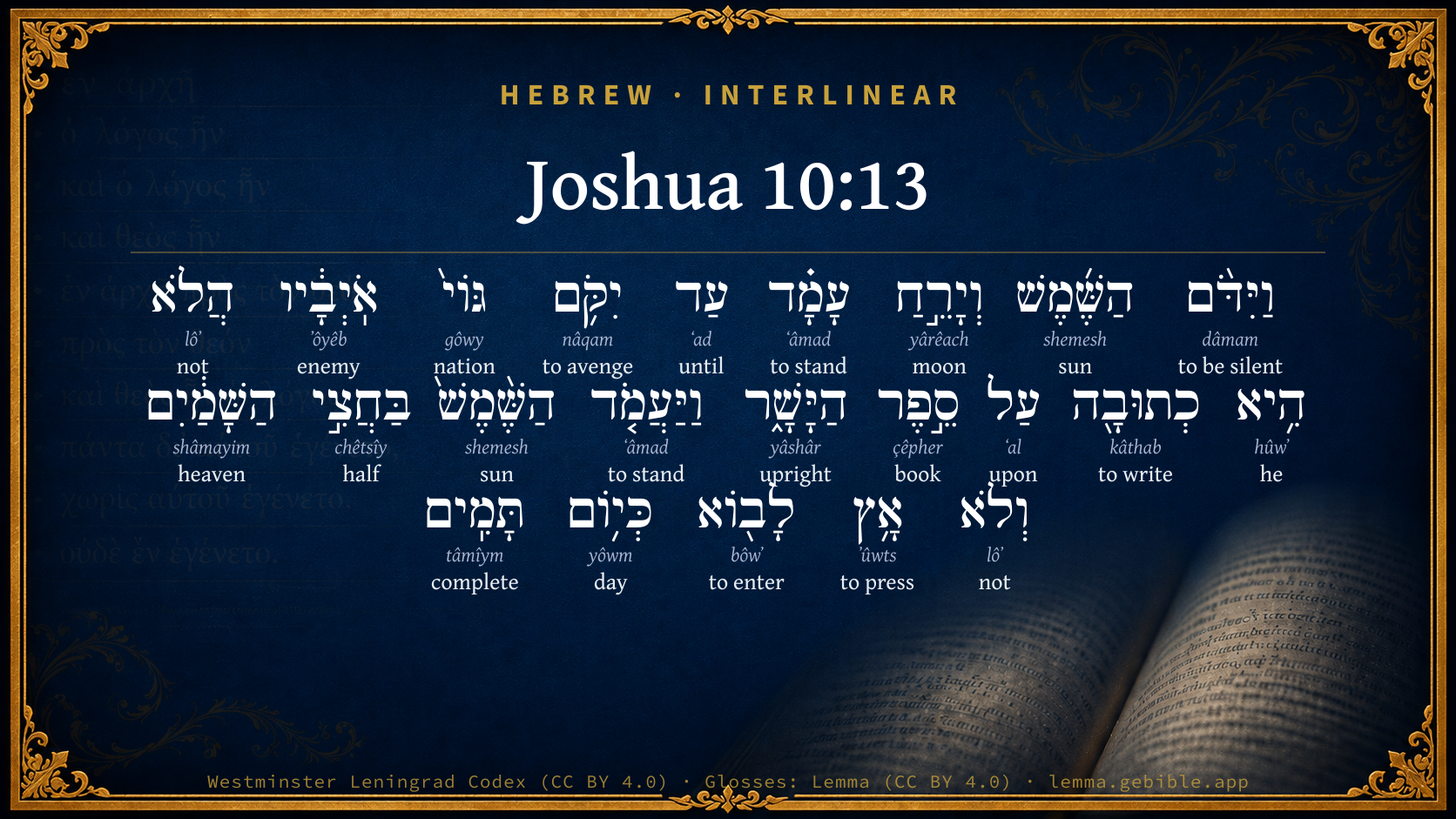
Hebrew (Westminster Leningrad Codex) Joshua 10:13 appears in the Hebrew Old Testament. The text above is from the Westminster Leningrad Codex. Each word links to its Strong’s number, a concise gloss, and parsing drawn from the Open Scriptures Hebrew Bible morphology. Click any word for its full Brown-Driver-Briggs (BDB) entry.
Download image
Cite this verse

Joshua 10:13 (World English Bible). Public Domain. Lemma interlinear Bible study tool, https://lemma.gebible.app/v/joshua/10/13.

Show BibTeX & RIS
BibTeX
RIS
English Translation
The sun stood still, and the moon stayed, Until the nation had avenged themselves of their enemies. Isn't this written in the book of Jashar? The sun stayed in the midst of the sky, and didn't hurry to go down about a whole day.
World English Bible · Public Domain
Download a study sheet

One document with this verse’s original text, its word-by-word gloss line, the meaning frame, cross-references with their text, attributed commentary, and full source and license credits — printable, and it pastes into notes with its structure intact.

This verse Autodidact and up

Study sheet (.html) Plain text (.txt)

A passage Seminary Student

Up to 50 verses in one chapter. A passage sheet keeps up to 6 commentary sources and 12 cross-references per verse, in the order this page ranks them, and says so on the sheet whenever that leaves anything out. Ask for a single verse and you get the Autodidact verse sheet above.

Everything on this page stays free to read, with no account — the sheet is a download of what is already on screen, not access to it.

Want to remove ads? Support Godless Engineer
Compare translations 3

The same verse in 3 English versions, stacked beneath the original-language interlinear above. Click any original word for its lexicon entry.

Each is an independent rendering of the whole verse — the interlinear is not word-aligned to these translations.

Highlighted words mark where these versions differ — a whole-verse word diff, not a word-by-word alignment.

  • World English Bible Public Domain
    The sun stood still, and the moon stayed, Until the nation had avenged themselves of their enemies. Isn't this written in the book of Jashar? The sun stayed in the midst of the sky, and didn't hurry to go down about a whole day.
  • King James Version Public Domain
    And the sun stood still, and the moon stayed, until the people had avenged themselves upon their enemies. Is not this written in the book of Jasher? So the sun stood still in the midst of heaven, and hasted not to go down about a whole day.
  • unfoldingWord Literal Text CC BY-SA 4.0
    And the sun was still, and the moon stood, until the nation avenged its enemies. Is it not written in the Book of Jashar? And the sun stood in the middle of the heavens, and it did not hurry to go, about a whole day.

unfoldingWord Literal Text — © unfoldingWord, licensed CC BY-SA 4.0. Word-aligned USFM3 via Door43 (git.door43.org/unfoldingWord/en_ult).

Versions to compare (up to 4)

3 of 4 selected

Show all 18 translations

Every available English version of this verse, each an independent rendering of the whole verse.

  • World English Bible Public Domain
    The sun stood still, and the moon stayed, Until the nation had avenged themselves of their enemies. Isn't this written in the book of Jashar? The sun stayed in the midst of the sky, and didn't hurry to go down about a whole day.
  • Berean Standard Bible Public Domain
    So the sun stood still and the moon stopped until the nation took vengeance upon its enemies. Is this not written in the Book of Jashar? “So the sun stopped in the middle of the sky and delayed going down about a full day.”
  • Majority Standard Bible Public Domain
    So the sun stood still and the moon stopped until the nation took vengeance upon its enemies. Is this not written in the Book of Jashar? “So the sun stopped in the middle of the sky and delayed going down about a full day.”
  • King James Version Public Domain
    And the sun stood still, and the moon stayed, until the people had avenged themselves upon their enemies. Is not this written in the book of Jasher? So the sun stood still in the midst of heaven, and hasted not to go down about a whole day.
  • American Standard Version (1901) Public Domain
    And the sun stood still, and the moon stayed, Until the nation had avenged themselves of their enemies. Is not this written in the book of Jashar? And the sun stayed in the midst of heaven, and hasted not to go down about a whole day.
  • Revised Version (1885) Public Domain
    And the sun stood still, and the moon stayed, until the nation had avenged themselves of their enemies. Is not this written in the book of Jashar? And the sun stayed in the midst of heaven, and hasted not to go down about a whole day.
  • Geneva Bible (1599) Public Domain
    And the Sunne abode, and the moone stood still, vntill the people auenged themselues vpon their enemies: (Is not this written in the booke of Iasher?) so the Sunne abode in the middes of the heauen, and hasted not to goe downe for a whole day.
  • Douay-Rheims (1899) Public Domain
    And the sun and the moon stood still, till the people revenged themselves of their enemies. Is not this written in the book of the just? So the sun stood still in the midst of heaven, and hasted not to go down the space of one day.
  • Young's Literal Translation Public Domain
    and the sun standeth still, and the moon hath stood -- till the nation taketh vengeance `on' its enemies; is it not written on the Book of the Upright, `and the sun standeth in the midst of the heavens, and hath not hasted to go in -- as a perfect day?'
  • Literal Standard Version CC BY-SA 4.0
    and the sun stands still, and the moon has stood—until the nation takes vengeance [on] its enemies; is it not written on the Scroll of the Upright, “and the sun stands in the midst of the heavens, and has not hurried to go in—as a perfect day?”
  • Unlocked Literal Bible CC BY-SA 4.0
    The sun stood still, and the moon stopped moving until the nation took vengeance on their enemies. Is this not written in the Book of Jashar? The sun stayed in the middle of the sky; it did not go down for about a whole day.
  • unfoldingWord Literal Text CC BY-SA 4.0
    And the sun was still, and the moon stood, until the nation avenged its enemies. Is it not written in the Book of Jashar? And the sun stood in the middle of the heavens, and it did not hurry to go, about a whole day.
  • Darby Bible Public Domain
    And the sun stood still, and the moon remained where it was, until the nation had avenged themselves upon their enemies. Is not this written in the book of Jasher? And the sun remained standing in the midst of heaven, and hasted not to go down about a full day.
  • World Messianic Bible Public Domain
    The sun stood still, and the moon stayed, until the nation had avenged themselves of their enemies. Isn’t this written in the book of Jashar? The sun stayed in the middle of the sky, and didn’t hurry to go down about a whole day.
  • Webster's Bible Public Domain
    And the sun stood still, and the moon stayed, until the people had avenged themselves upon their enemies. Is not this written in the book of Jasher? So the sun stood still in the midst of heaven, and hasted not to go down about a whole day.
  • Free Bible Version CC BY-SA 4.0
    The sun stopped moving, and the moon stood still, until the nation of Israel had inflicted defeat on their enemies. (This is recorded in the Book of Jashar ). The sun stopped in the middle of the sky and did not go down for around a full day.
  • Bible in Basic English Public Domain
    And the sun was at rest and the moon kept its place till the nation had given punishment to their attackers. (Is it not recorded in the book of Jashar?) So the sun kept its place in the middle of the heavens, and was waiting, and did not go down, for the space of a day.
  • JPS Tanakh (1917) Public Domain
    And the sun stood still, and the moon stayed, until the nation had avenged themselves of their enemies. Is not this written in the book of Jashar? And the sun stayed in the midst of heaven, and hasted not to go down about a whole day.

Literal Standard Version (2020), Covenant Press — licensed CC BY-SA 4.0. Text via the HelloAO Bible API (eBible.org). Unlocked Literal Bible (unfoldingWord) — licensed CC BY-SA 4.0. Text via the HelloAO Bible API (eBible.org). unfoldingWord Literal Text — © unfoldingWord, licensed CC BY-SA 4.0. Word-aligned USFM3 via Door43 (git.door43.org/unfoldingWord/en_ult). Free Bible Version, Dr. Jonathan Gallagher — licensed CC BY-SA 4.0. Text via the HelloAO Bible API (eBible.org).

Word by word

More ways to search: Search by grammar → Find every occurrence → Compare this word →

Practice this passage: Drill this verse → Learn its vocabulary →

אָ֥ץ
ʼûwts
H213
“to press”
Verb, Qal, Perfect, 3rd Person, Masculine, Singular
Part of Speech
Verb
Stem
Qal
Form
Perfect
Person
3rd Person
Gender
Masculine
Number
Singular
Full BDB Definition

Origin: a primitive root

TWOT: 51

to press, be pressed, make haste, urge, be narrow - (Qal) - to press, hasten - to be pressed, confined, narrow - to hasten, make haste - be narrow - (Hiphil) - to urge, insist - to hasten
  1. וַיִּדֹּ֨ם dâmam H1826 “and · to be silent” Conjunction + Verb, Qal, Sequential Imperfect, 3rd Person, Masculine, Singular
  2. הַשֶּׁ֜מֶשׁ shemesh H8121 “the · sun” Particle, Definite Article + Noun, Common, Both, Singular, Absolute
  3. וְיָרֵ֣חַ yârêach H3394 “and · moon” Conjunction + Noun, Common, Masculine, Singular, Absolute
  4. עָמָ֗ד ʻâmad H5975 “to stand” Verb, Qal, Perfect, 3rd Person, Masculine, Singular
  5. עַד ʻad H5704 “until” Preposition
  6. יִקֹּ֥ם nâqam H5358 “to avenge” Verb, Qal, Imperfect, 3rd Person, Masculine, Singular
  7. גּוֹי֙ gôwy H1471 “nation” Noun, Common, Masculine, Singular, Absolute
  8. אֹֽיְבָ֔יו ʼôyêb H341 “enemy · him” Verb, Qal, Participle Active, Masculine, Plural, Construct + Suffix, Personal, 3rd Person, Masculine, Singular
  9. הֲלֹא lôʼ H3808 “not” Particle, Interrogative + Particle, Negative
  10. הִ֥יא hûwʼ H1931 “he” Pronoun, Personal, 3rd Person, Feminine, Singular
  11. כְתוּבָ֖ה kâthab H3789 “written” Verb, Qal, Participle Passive, Feminine, Singular, Absolute
  12. עַל ʻal H5921 “upon” Preposition
  13. סֵ֣פֶר çêpher H5612 “book of” Noun, Common, Masculine, Singular, Construct
  14. הַיָּשָׁ֑ר yâshâr H3477 “the · upright” Particle, Definite Article + Adjective, Adjective, Masculine, Singular, Absolute
  15. וַיַּעֲמֹ֤ד ʻâmad H5975 “and · to stand” Conjunction + Verb, Qal, Sequential Imperfect, 3rd Person, Masculine, Singular
  16. הַשֶּׁ֨מֶשׁ֙ shemesh H8121 “the · sun” Particle, Definite Article + Noun, Common, Both, Singular, Absolute
  17. בַּחֲצִ֣י chêtsîy H2677 “in/at · half of” Preposition + Noun, Common, Masculine, Singular, Construct
  18. הַשָּׁמַ֔יִם shâmayim H8064 “the · heaven(s)” Particle, Definite Article + Noun, Common, Masculine, Plural, Absolute
  19. וְלֹא lôʼ H3808 “and · not” Conjunction + Particle, Negative
  20. לָב֖וֹא bôwʼ H935 “to enter” Preposition + Verb, Qal, Infinitive Construct
  21. כְּי֥וֹם yôwm H3117 “like/as · day” Preposition + Noun, Common, Masculine, Singular, Absolute
  22. תָּמִֽים tâmîym H8549 “complete” Adjective, Adjective, Masculine, Singular, Absolute

About this verse

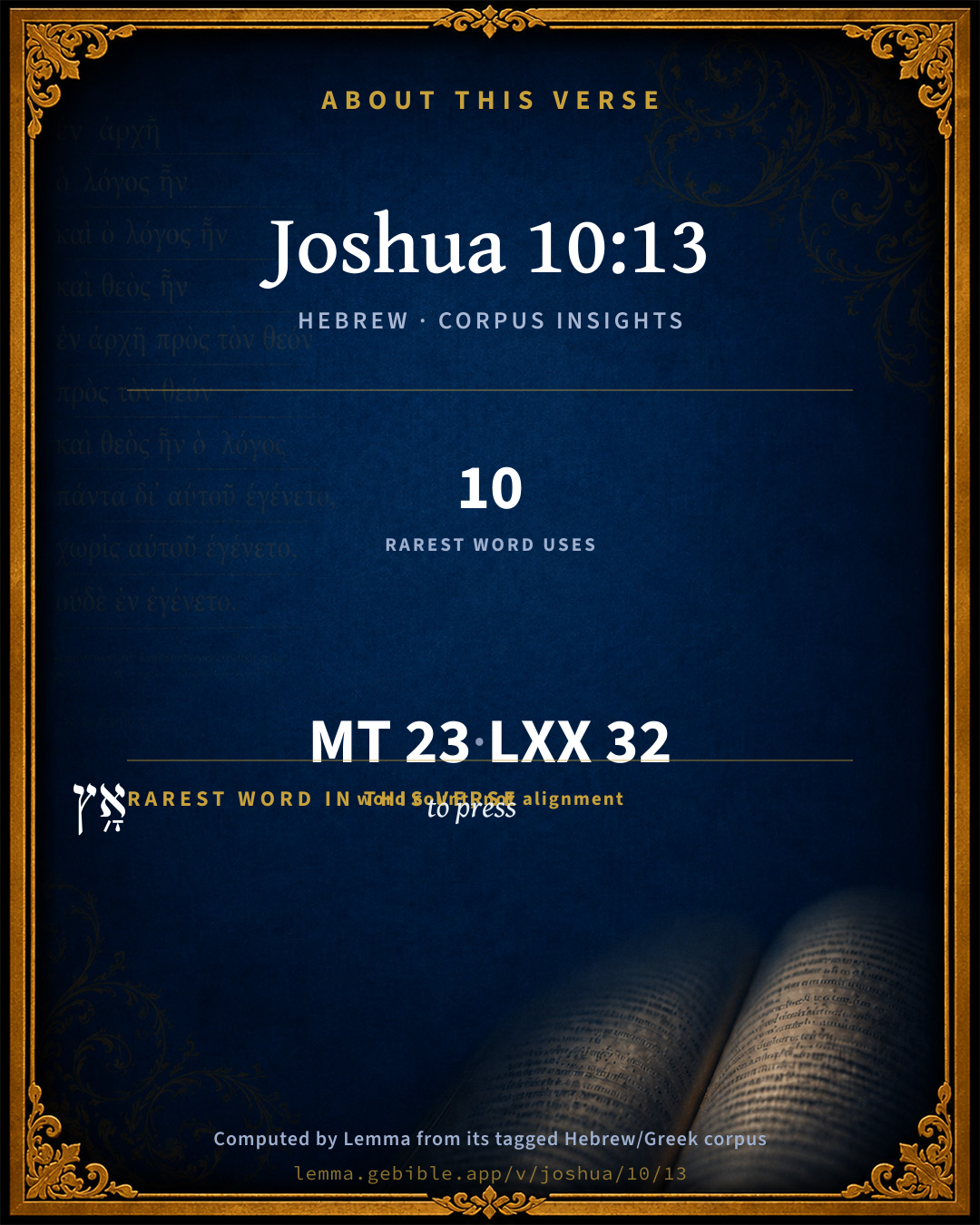
These counts appear in no published source. They are computed here, from the morphology-tagged text and Lemma’s own curated glosses. What Lemma adds →

23
words
20
distinct lemmas
Historical
section

Notable vocabulary

The rarest word here is אָ֥ץ to press H213 — appearing just 10 times in the whole Hebrew Bible.

Shared distinctive vocabulary

אָ֥ץ to press H213 occurs in 10 verses of the Hebrew Bible. Also found in:

Grammatical profile

  • 8 verbs
  • 8 nouns
  • 2 adjectives
  • 1 pronoun
  • 2 prepositions
  • 2 particles

Verb forms

  • וַיִּדֹּ֨ם Qal · Sequential Imperfect
  • עָמָ֗ד Qal · Perfect
  • יִקֹּ֥ם Qal · Imperfect
  • אֹֽיְבָ֔יו Qal · Participle Active
  • כְתוּבָ֖ה Qal · Participle Passive
  • וַיַּעֲמֹ֤ד Qal · Sequential Imperfect
  • אָ֥ץ Qal · Perfect
  • לָב֖וֹא Qal · Infinitive Construct

Repetition

Words recur within this verse — often emphatic in Hebrew:

  • הַשֶּׁ֜מֶשׁ sun H8121 ×2
  • עָמָ֗ד to stand H5975 ×2
  • הֲלֹא not H3808 ×2

Hebrew & Septuagint length

In English translation the verse runs 44 words from the Hebrew and 37 from the Septuagint (LXX English) — closely comparable.

A rough comparison of the two English renderings, which tokenize alike — not a word-level alignment.

Word counts can differ between the Hebrew and the Greek without any difference in meaning — e.g. the Hebrew direct-object marker אֵת has no separate Greek word, and Greek often adds the article ὁ.

In the original languages it is 23 Hebrew tokens and 32 Greek tokens — but the two are counted differently (Hebrew bundles its prefixes and suffixes into one token; the Greek is in lemma form), so that isn’t a like-for-like length.

Cross-references

25

Topical passages linked to Joshua 10:13 in the Treasury of Scripture Knowledge — connected by theme and wording, ordered by reader-vote popularity; previews shown in the World English Bible.

  • Habakkuk 3:11 The sun and moon stood still in the sky, At the light of your arrows as they went, At the shining of your glittering spear.
  • Isaiah 38:8 behold, I will cause the shadow on the steps, which is gone down on the dial of Ahaz with the sun, to return backward ten steps. So the sun returned ten steps on the dial whereon it was gone down.
  • Joshua 10:14 There was no day like that before it or after it, that Yahweh listened to the voice of a man: for Yahweh fought for Israel.
  • Judges 16:28 Samson called to Yahweh, and said, Lord Yahweh, remember me, Please, and strengthen me, Please, only this once, God, that I may be at once avenged of the Philistines for my two eyes.
  • 2 Samuel 1:18 (and he bade them teach the children of Judah [the song of] the bow: behold, it is written in the book of Jashar):
  • Esther 8:13 A copy of the writing, that the decree should be given out in every province, was published to all the peoples, and that the Jews should be ready against that day to avenge themselves on their enemies.
  • Psalms 19:4 Their voice has gone out through all the earth, Their words to the end of the world. In them he has set a tent for the sun,
  • Psalms 136:7–9 To him who made the great lights; For his loving kindness endures forever:
  • Psalms 148:3 Praise him, sun and moon! Praise him, all you shining stars!
  • Joel 2:10 The earth quakes before them. The heavens tremble. The sun and the moon are darkened, And the stars withdraw their shining.
  • Joel 3:15 The sun and the moon are darkened, And the stars withdraw their shining."
  • Luke 18:7 Won't God avenge his chosen ones, who are crying out to him day and night, and yet he exercises patience with them?
  • Numbers 31:2 Avenge the children of Israel of the Midianites: afterward you shall be gathered to your people.
  • Joshua 10:11 It happened, as they fled from before Israel, while they were at the descent of Beth Horon, that Yahweh cast down great stones from the sky on them to Azekah, and they died: they were more who died with the hailstones than they whom the children of Israel killed with the sword.
  • Judges 5:2 For that the leaders took the lead in Israel, For that the people offered themselves willingly, Bless you Yahweh.
  • Psalms 74:16–17 The day is yours, the night is also yours. You have prepared the light and the sun.
  • Isaiah 24:23 Then the moon shall be confounded, and the sun ashamed; for Yahweh of Hosts will reign on Mount Zion, and in Jerusalem; and before his elders shall be glory.
  • Acts 2:20 The sun will be turned into darkness, And the moon into blood, Before the great and glorious day of the Lord comes.
  • Revelation 6:10 They cried with a loud voice, saying, "How long, Master, the holy and true, until you judge and avenge our blood on those who dwell on the earth?"
  • Revelation 6:12 I saw when he opened the sixth seal, and there was a great earthquake. The sun became black as sackcloth made of hair, and the whole moon became as blood.
  • Revelation 8:12 The fourth angel sounded, and one third of the sun was struck, and one third of the moon, and one third of the stars; so that one third of them would be darkened, and the day wouldn't shine for one third of it, and the night in the same way.
  • Revelation 16:8–9 The fourth poured out his bowl on the sun, and it was given to him to scorch men with fire.
  • Revelation 21:23 The city has no need for the sun, neither of the moon, to shine, for the very glory of God illuminated it, and its lamp is the Lamb.
  • Numbers 21:14 Therefore it is said in the book of the Wars of Yahweh, Vaheb in Suphah, The valleys of the Arnon,
  • Matthew 5:45 that you may be children of your Father who is in heaven. For he makes his sun to rise on the evil and the good, and sends rain on the just and the unjust.

Cross-references courtesy of OpenBible.info (CC BY 4.0).

Hebrew and Greek witnesses Masoretic Hebrew ↔ Greek Septuagint

The same verse in the two great witnesses to the Old Testament, shown verse-for-verse.

These are two independent witnesses, not word-aligned to each other, and the Septuagint is shown in lemma (dictionary) form.

Hebrew Joshua 10:13 Masoretic · Westminster Leningrad Codex

וַיִּדֹּ֨ם הַשֶּׁ֜מֶשׁ וְיָרֵ֣חַ עָמָ֗ד עַד יִקֹּ֥ם גּוֹי֙ אֹֽיְבָ֔יו הֲלֹא הִ֥יא כְתוּבָ֖ה עַל סֵ֣פֶר הַיָּשָׁ֑ר וַיַּעֲמֹ֤ד הַשֶּׁ֨מֶשׁ֙ בַּחֲצִ֣י הַשָּׁמַ֔יִם וְלֹא אָ֥ץ לָב֖וֹא כְּי֥וֹם תָּמִֽים

The sun stood still, and the moon stayed, Until the nation had avenged themselves of their enemies. Isn't this written in the book of Jashar? The sun stayed in the midst of the sky, and didn't hurry to go down about a whole day.

World English Bible · Public Domain

Greek LXX Joshua 10:13 Septuagint · lemma form

καί ἵστημι ὁ ἥλιος καί ὁ σελήνη ἐν στάσις ἕως ἀμύνω ὁ θεός ὁ ἐχθρός αὐτός καί ἵστημι ὁ ἥλιος κατά μέσος ὁ οὐρανός οὐ προπορεύομαι εἰς δυσμή εἰς τέλος ἡμέρα εἷς

And the sun and the moon stood still, until God executed vengeance on their enemies; and the sun stood still in the midst of heaven; it did not proceed to set till the end of one day.

LXX2012 (modern English Septuagint) · Public Domain

On this verse, The Pulpit Commentary discusses the Septuagint’s reading. Read the note in Commentary ↓

Hebrew: Westminster Leningrad Codex (CC BY 4.0). Greek: Septuagint (public domain); English from LXX2012 (modern English Septuagint) (Public Domain). How the Septuagint differs from the Hebrew →

Targum (Aramaic paraphrase)

1

The Targum is the ancient Jewish Aramaic paraphrase of the Hebrew Scriptures — an interpretive translation, not the Hebrew text itself. Onkelos (literal) and Pseudo-Jonathan (expansive) render the Torah, and Jonathan the Prophets. Coverage is partial: where no permissively-licensed English translation exists for a verse, only the Aramaic is shown. This is verse-level text, not a word-by-word alignment to the Hebrew.

  1. Targum Jonathan Prophets (Joshua–Malachi)
    וְאוֹרְיַךְ שִׁמְשָׁא וְסִיהֲרָה קָם עַד דְאִתְפְּרַע עַמָא יִשְׂרָאֵל מִבַּעֲלֵי דְבָבֵיהוֹן הֲלָא הִיא כְתִיבָא עַל סִפְרָא דְאוֹרַיְיתָא וְקָם שִׁמְשָׁא בְּפַלְגוּת שְׁמַיָא וְלָא דָחַק לְמֵיעַל כְּיוֹם שְׁלִים:

    (no public-domain English translation for this verse)

    Targum Jonathan — Aramaic: “Mikraot Gedolot” (public domain). English: “Sefaria Community Translation” (CC0 1.0 (public-domain dedication)); “London "Chaldee Paraphrase," 1871” (public domain). Text via Sefaria.

Commentary

Notes on Joshua 10:13 from classic Christian and Jewish commentators (each source and its license shown beneath its notes). The classic Christian expositions comment on the surrounding passage and are grouped to its opening verse, so a note may address several verses; the Jewish commentaries on the Tanakh (Rashi and others) are per-verse, so they appear only where the commentator wrote on this verse.

Lemma curates 59 commentaries, every one of them public domain or Creative Commons licensed, each selected and text-cleaned for this edition rather than reprinted as found. About our sources →

Trapp's Complete Commentary

John Trapp

Jos 10:13 And the sun stood still, and the moon stayed, until the people had avenged themselves upon their enemies. [Is] not this written in the book of Jasher? So the sun stood still in the midst of heaven, and hasted not to go down about a whole day.

Ver. 13. And the sun stood still.] Heb., Was silent. The whole body of the movable heaven stopped its course, and made a halt. Neither need it offend us that there is no record of this miracle in heathen histories; for Diodorus Siculus confesseth, that all heathen antiquities before the Theban and Trojan wars are either fabulous narrations, or little better.

Is not this written in the book of Jasher?] Which Jerome {a} will have to be Genesis: but it seemeth rather to have been some civil history or continued chronicle, such as are amongst us the Chronicles of England, which is now lost, as are also some other books, {1Ch 29:29; 2Ch 12:15; 2Ch 9:29} and was therefore, we may be sure, no part of the holy canon: God, by his providence, taking care and course that no one hair of that sacred head should fall to the ground. This book of Jasher, or the upright, together with Solomon’s Physics, {1Ki 4:32-33} the book of his Acts, {1Ki 11:41} the books of Nathan and Gad, {1Ch 29:29} of Shemaiah, {2Ch 12:15} of Jehu, {2Ch 20:34} the books of the Chronicles of the Kings of Israel and Judah, &c., were not testamentary or canonical: and are now taken away, not because they contained matter either above human capacity, or else corrupt and unsound, as Origen {b} determineth: but rather, as Augustine {c} hath it, we are to know, that although they were both pious and profitable, yet were they written out of a historical diligence for more plentiful knowledge; not by divine inspiration, for the authority of religion.

{a} In Ezek. xviii.

{b} Prolog. in Cant., ad finem.

{c} De Civ. Dei, lib. xviii, cap. 38.

John Trapp, A Commentary or Exposition upon All the Books of the Old and New Testament (1647–1656) — public domain. Text from a community e-Sword module.

Joseph Benson's Commentary

Jos 10:13. And the sun stood still — God heard Joshua’s request, and gave him the thing he asked for, a prolongation of the day to near twice the length of any other day. This is the fact here attested, and this we are bound to believe on the divine testimony. But as to the manner in which this wonderful miracle was accomplished, God has not informed us; and to make inquiries concerning it would be a mere waste of time, being beyond our discovery and comprehension. Until the people had avenged themselves upon their enemies — That is, till they had utterly destroyed them. Is not this written in the book of Jasher? — This book was written and made public before Joshua wrote his history, and is therefore properly alluded to here. It was probably a collection of records, or of poems, concerning the principal events of these wars, and no doubt gave a further account of this miracle. But this and some other books of these ages have long been lost, not being canonical, and therefore not preserved by the Jews with the same care wherewith they guarded their inspired writings. If it seem strange to any one that so wonderful an event as is here recorded should not be mentioned by any heathen writers, it may be answered, 1st, That many learned men have shown that there is a great appearance of its being alluded to in many of the fables of the heathen poets, and mythologists of Greece and Rome, and in the histories of the Chinese. But whether or not, it must be observed, 2d, That it is confessed by the generality of writers, heathen and others, that there is no certain history or monument in heathen authors of any thing done before the Trojan war, which happened a thousand years after Joshua’s time, and that all the ages preceding that war are termed, by the most learned heathen, the uncertain, unknown, or obscure time.

Joseph Benson's Commentary on the Old and New Testaments (1811–1818) — public domain. Text from a community e-Sword module.

Tyndale Open Study Notes

Tyndale Open Resources

10:13 God caused the sun to stay in the middle of the sky. Not all miracles can be understood, whether in purpose, in scope, or in mechanism. • The Book of Jashar served as one of the ancient sources for Israel’s historians. While well known in ancient Israel, it did not survive as a separate document.

Tyndale Open Study Notes — © Tyndale Open Resources, licensed CC BY-SA 4.0. Text via the HelloAO Bible API.

Geneva Bible (1599)

Geneva Bible translators

Some read the book of the righteous, meaning Moses: the Chaldea text readeth in the book of the Law, but it is like that it was a book thus named, which is now lost.

Geneva Bible (1599) marginal notes — public domain. Text via Bolls.life.

John Calvin's Commentaries

13. And the sun stood still, etc The question how the sun stood in Gibeon, is no less unseasonably raised by some than unskillfully explained by others. For Joshua did not subtlety place the sun in any particular point, making it necessary to feign that the battle was fought at the summer solstice, but as it was turning towards the district of Ajalon as far as the eye could discern, Joshua bids it stay and rest there, in other words, remain above what is called the horizon. In short, the sun, which was already declining to the west, is kept from setting.

I do not give myself any great anxiety as to the number of the hours; because it is enough for me that the day was continued through the whole night. Were histories of that period extant, they would doubtless celebrate this great miracle; lest its credibility, however, should be questioned, the writer of this book mentions that an account of it was given elsewhere, though the work which he quotes has been lost, and expounders are not well agreed as to the term Jazar. Those who think Moses is meant, insist on referring the example which is here given to general predictions. As Moses applies this name to the chosen people, it is more congruous to hold that commentaries on the events in their history are meant. I, for my part, understand by it either God or Israel, rather than the author of a history.

John Calvin's Commentaries (1540-1563) — public domain. Text from the Calvin Translation Society English edition (1840s-50s) via the Christian Classics Ethereal Library (ccel.org). Calvin's coverage is partial (roughly two-thirds of the Bible); uncommented books and verses are honest gaps, never fabricated. The 19th-century editor's footnotes and remarks are omitted so the notes are faithfully Calvin's own voice.

Ellicott's Commentary for English Readers

(13) And the sun stood still, and the moon stayed.—Literally, the sun was silent, and the moon stopped.

The sun stood still (i.e., stopped) in the midst of heaven.—Literally, in the half of the heavens—i.e., either “in the midst of heaven,” or “in the same hemisphere” (in the one-half of the heavens).

And hasted not to go down (or to go in) about a whole day.—The word cannot mean to rise, or ascend, and thus these words absolutely exclude the view that what Joshua desired was to prevent the sun from rising, in order to complete a night attack upon the Amorites.

A Bible Commentary for English Readers, edited by Charles John Ellicott (1878–1897) — public domain. Text from a community e-Sword module.

The Cambridge Bible for Schools and Colleges

gen. ed. J. J. S. Perowne

13. And the sun stood still] God hearkened to the voice of Joshua. Once more the sunlight burst forth, and the day was miraculously protracted till the end was gained. For expressions similar to those here used compare what is said in Jdg_5:20, of the stars “fighting (not in but out of) their courses against Sisera;” in Isa_34:3; Amo_9:13; Mic_1:4, of the melting down of the mountains; in Isa_64:1, of the rending of the heavens; in Psa_29:6, of the skipping of Lebanon; in Isa_55:12, of the clapping of hands by the trees in the field; in Psa_18:9, of the bowing of the heavens. How or in what way this protraction of the light was brought about we are not told.

Is not this written in the book of Jasher?] The Book here quoted is also alluded to in 2Sa_1:18, “Also he—David—bade them teach the children of Israel the Bow (i.e. ‘the Song of the Bow’); behold, it is written in the Book of Jasher,” or, as it is rendered in the margin, “the Book of the Upright,” or “Righteous.” It was in all probability a collection, rhythmical in form and poetical in diction, of various pieces celebrating the heroes of the Hebrew nation and their achievements. The word itself Jasher, or Jashar, is considered to be an appellation of the Elect Nation, nearly equivalent to “Jeshurun” in Deu_32:15. The Book was naturally compiled only by degrees, and gradually any ode or song deemed worthy of preservation was added to it, “so that the quotation of it here is no proof at all that the Book of Joshua was composed after the date of the reference to the ‘Book of Jasher’ in 2Sa_1:18, and as little is the quotation there a proof that the ‘Book of Jasher’ was not extant until, at any rate, the time of David.”

And hasted not to go] Edersheim would translate this, “And hasted not to go—like (as on) a complete day.”

The Cambridge Bible for Schools and Colleges (gen. ed. J. J. S. Perowne; Cambridge University Press, 1878–1918) — public domain. Text from a community e-Sword module.

John Gill's Exposition

And the sun stood still, and the moon stayed,.... The sun that came out of his chamber like a bridegroom, and rejoiced as a strong man to run his course, stopped his course at once; and the moon that walks in her brightness proceeded not on, but both stood still, motionless, and continued in this position:

until the people had avenged themselves on their enemies: until the nation and people of Israel had taken vengeance on and destroyed the live kings and their forces: how this is to be reconciled to the Copernican system, or that with this, I shall not inquire. It was a most wonderful and surprising phenomenon, to see both luminaries standing still in the midst of heaven; it is pretended by some historians (f), that a like miracle was wrought at the battle of Mulberg, won by the Emperor Charles the Fifth, on April 24, 1547. In the Chinese history (g) it is reported, that in the time of their seventh, emperor, Yao, the sun did not set for ten days, and that men were afraid the world would be burnt, and there were great fires at that time; and though the time of the sun's standing still is enlarged beyond the bounds of truth, yet it seems to refer to this fact, and was manifestly about the same time; for this miracle was wrought in the year of the world 2554, which fell in the seventy fifth, or, as some say, the sixty seventh year of that emperor's reign, who reigned ninety years:

is not this written in the book of Jasher? about which the Jews are divided; some say it is the book of Genesis, others the book of Deuteronomy, others the book of Judges (h); the Targum interprets it of the book of the law, and so Jarchi and Kimchi; and Ben Melech interprets it of the book of the law of Moses, where they suppose this miracle was predicted. The former thinks, in the words of Jacob to Joseph, "his seed shall fill the nations", Gen 48:19; which he supposes was fulfilled in Joshua of the tribe of Ephraim, when the whole world was filled with the fame of him on account of this miracle; and the latter in the words, "before all thy people I will do miracles", Exo 34:10; one was in making the face of Moses to shine, the other the standing still of the sun for Joshua, as he interprets it. Bolducius, a commentator on the book of Job (i), fancies that that book is designed, and that this miracle is foretold in it, particularly in Job 9:7; "which commandeth the sun, and it riseth not"; it is most likely that this book of Jasher, in which this miracle was recorded, was a public register, or annals, in which memorable events were written, as they happened in different ages by different persons; and Masius thinks Josephus (k) means this by the archives laid up in the temple, to which he appeals for the truth of this miracle:

so the sun stood still in the midst of heaven; somewhere above the horizon, very probably this was about noon, when the sun was in its meridian. Gussetius (l) thinks about ten or eleven o'clock; it may be supposed that early in the morning Joshua came up with his troops, and engaged the kings, and it might be noon before the battle was over, and the victory obtained, at least before Joshua had proceeded in his pursuit of them, so far as he had done, when the miracle was wrought; and the rather, as it would be the more conspicuous in the several parts of the world; for had it been near sun setting, it could not have been seen in some places, and particularly by the Chinese, as it seems to have been by what has been observed:

and hasted not to go down about a whole day; which was either artificial or natural; if an artificial day, then it stood still but twelve hours; if a natural day, twenty four hours; and accordingly the length of the day must be judged of; if it was at noon when it stood still, and continued so a natural day, or twenty four hours, then as it had gone six hours to noon, and, after it returned to its motion, had six more to go to its setting, this day must be thirty six hours long; and so the Jews commonly say (m); but if an artificial day, or twelve hours, then it was but a day of twenty four hours; but if this was, as the Jews say (n), on the third of Tammuz, which answers to part of June, and was in the summer solstice, on the longest day in the year, when their days consisted of fourteen hours, this will make this long day four hours longer. According to the author of Ecclesiasticus, in the Apocrypha:"Did not the sun go back by his means? and was not one day as long as two?'' (Sirach 46:4)it was a double day, or, as he expresses it, one day became two, or was as long as two. (In the late 1960's, someone circulated a story that NASA had discovered there was a missing day in the solar system. Using this passage they accounted for about twenty one missing hours and the account in Isa 38:8 to account for the rest of the missing time. This story is a complete fable and has absolutely no basis in fact. Editor.)

(f) See Bayle's Dictionary, vol. 4. p. 268. (g) Martin. Sinie. Histor. l. 1. p. 25. (h) T. Bab. Avoda Zara, fol. 35. 1. (i) Bolduc. in Job. ix. 7. (k) Antiqu. l. 5. c. 1. sect. 17. (l) Comment. Ebr. p. 281. (m) Targum in Cant. i. 1. T. Bab. Avoda Zara, fol. 25. 1. Kimchi in loc. So Justin Martyr. Dialog. cum Tryph. p. 361. (n) Seder Olam Rabba, c. 11. p. 31. Kimchi in loc.

John Gill's Exposition of the Whole Bible (1746–1763) — public domain (CC PDM 1.0). Text via the HelloAO Bible API.

Haydock's Catholic Bible Commentary

The book of the just. In Hebrew Sepher hayashar; an ancient book long since lost. (Challoner) --- It was probably of the same nature with that of the wars of the Lord, (Numbers xxi. 4,) containing an account of the most memorable occurrences which concerned the people of Israel, the just, or Ischuron, Deuteronomy xxxiii. 5. Josephus ([Antiquities?] v. 2,) says, such "records were kept in the archives of the temple." They were drawn up by people of character. The quotations inserted are in a poetical style, as the book might contain various canticles, though the rest was written in prose. See 2 Kings i. 18. It might appear unnecessary for Josue to appeal to this work, as the fact in question was known to all. (Calmet) --- But too great precaution could not be taken to prevent the danger of people calling in question the reality of the miracle. If the book of the just was a more detailed history of facts, out of which this work of Josue has been compiled, as Theodoret supposes, the author might very well remit the more inquisitive reader to that authentic source. (Haydock) --- Midst. It was then almost noon. (Calmet) --- Josue was nevertheless afraid lest the day should not allow them time to destroy their fleeing enemies completely. (Haydock) --- If the evening had been at hand, he would have said, return sun towards Gabaon, as it would have been on the west of his army. The battle had begun early in the morning, and the pursuit had lasted perhaps four or five hours. (Calmet) --- Day. Hebrew, "about a whole day." Many think that a day here comprises 24 hours; and as the sun had been above the horizon six hours, and continued other six, it must have been visible for the space of 36 hours, as the Jews believe, and as it is specified in St. Justin Martyr, Dialogue with Trypho. The author of Ecclesiasticus xlvi. 5, says, Was not the sun stopped in his anger, and one day made as two? that is, 24 hour long, allowing 12 unequal ones to form a day, according to the reckoning of those times. Others suppose that the day of Josue might consist of 18 (Calmet) or of 48 hours. But how would the soldiers be able to support such a fatigue? They had been marching all the preceding night from Galgal. (Haydock) --- If they had stopped to take refreshment, their enemies would have escaped. Hence some of the Fathers imagine, that God enabled his people to pursue them without taking any food. (St. Jerome, contra Jov. ii.) They might, however, take some along with them, as it was then customary; and eat as they pursued, whenever they could find an opportunity. Josue had given no prohibition; and Jonathan observed that his father, Saul, had troubled Israel, by following a different plan, 1 Kings xiv. 24. (Calmet)

George Leo Haydock (1774–1849), Haydock's Catholic Family Bible and Commentary, 1859 edition — public domain. Excludes Psalms (Douay-Rheims chapter numbering differs from Protestant) and Deuterocanonical books (Catholic canon only).

Matthew Poole's English Annotations

Stood still, Heb. was silent, i.e. still, as this phrase is commonly used, as 1Sa 14:9; Psa 4:4; Jon 1:12; the cessation of the tongue’s motion being put synecdochically for the cessation of any other motion or action.

Until the people had avenged themselves upon their enemies, i.e. till they had utterly destroyed them, as is mentioned in the following chapter.

The book of Jasher; either of a man so called, or of the righteous or upright, wherein possibly the memorable actions of worthy men were recorded, and this amongst the rest. And this book was written and published before Joshua wrote his, and so is fitly alleged here. But this, as well as some few other historical books, is lost, not being a canonical book, and therefore not preserved by the Jews with the same care as they were.

So the sun stood still: here is no mention of the moon, because the sun’s standing was the only thing which Joshua desired and needed; and the moon’s standing he desired only by accident, to prevent irregularity in the motions of those celestial lights. Some take this to be but a poetical phrase and relation of the victory, that Joshua did so many and such great things in that day, as if the sun and moon had stood still and given him longer time for it. But the frequent repetition and magnificent declaration of this wonder manifestly confutes that fancy. That the sun and moon did really stand still, is affirmed, Hab 3:11; Sir 46:5,6. And if it seem strange to any one that so wonderful a work, observed by the whole world that then was, should not be mentioned in any heathen writers; he must needs be satisfied, if he, considers, that it is confessed by the generality of writers, heathens and others, that there is no certain history or monument in heathen authors of any thing done before the Trojan wars, which was a thousand years after Joshua’s time; and that all time before that is called by the learnedest heathens the uncertain, unknown, or obscure time. In the midst of heaven; not mathematically, in the very meridian or middle part of that hemisphere; but morally, and with some latitude, when it had begun a little to decline, the consideration whereof seems to have given Joshua occasion for his desire.

About a whole day, i.e. for the space of a whole day. Understand an artificial day, between sun-rising and sun-setting; for that was the day which Joshua needed and desired, a day to give him light for his work.

Matthew Poole's English Annotations on the Holy Bible (1683–1685) — public domain. Text from a community e-Sword/MySword module.

Whedon's Commentary on the Bible

Daniel D. Whedon

13. The book of Jasher — This was a poetical book in praise of the heroes of the theocracy — a collection of national songs. Both its name and extant fragments seem to show that it was composed to celebrate upright men in Israel, like Joshua and Jonathan. Jasher signifies the upright. It was probably written in the reign of David, or soon after. It may have been compiled gradually through a long course of years, one national song after another being added to the collection, but it certainly was not completed till David’s time, for it contained his elegy on Saul and Jonathan. See 2Sa_1:18. Furst is of the opinion that Jasher is a collective term for Israelites, and that it should be translated the book of the Israelites, that is, the national book. We are ignorant of its author or compiler. If it had been divinely inspired, Providence would doubtless have preserved it for the benefit of mankind. The modern works bearing its title are later and spurious.

About a whole day — The exposition of Bush, who translates this passage as at the perfect day, signifying only that the sun did not go down at its usual time at the close of the day, but pretty soon after, is rather far-fetched. The Vulgate version, “Nor was there before nor afterward so long a day,” contains the true explanation of this expression, namely, that the day was greatly extended, perhaps nearly doubled in length. A study of the whole chapter, and a consideration of the many acts performed by Joshua and his army, would seem to require about two days for their accomplishment.

Daniel D. Whedon (gen. ed.), Commentary on the Old and New Testaments (1874–1909) — public domain. Text from a community e-Sword module.

The Pulpit Commentary

The moon stayed. The word dm, which does mean to stand still, is used here. See also Hab_3:11. But if we are to apply it to the moon and not to the light of the moon, where would be the use of the moon"s standing still in the valley of Ajalon, when she would be low down in the sky westward, and incapable of rendering Joshua any help? If we regard the light of the moon as meant, there is no phrase more common in poetry and poetic prose than to speak of moonbeams "resting" upon an object. The people. The word here is ywOig. See note on Jos_5:6. The Book of Jasher. See Introduction, Note 6. And the sun stood still. Here the word dm is used of the sun. But, as before, it refers naturally enough to the sun"s light. The declining sun continued to shine upon Gibeon, and in the neighbourhood, upon the descent from Beth-heron the Upper, and on the whole region throughout which the fugitive Canaanites were scattered. We need not suppose that all the discomfited host fled in one direction, and possibly in the neighbourhood of Gibeon itself there remained quite enough of the scattered portions of the host to need urgently the sun"s light to complete their destruction. The midst. The Hebrew here is not the usual word for midst. It signifies literally, the half. About a whole day. Literally, as a perfect day. The LXX renders ou proseporeueto eiv iusmav eiv telov hmerav miav , and the Vulgate, "Non festinavit occumbere spatio unius dict." What is the precise meaning of this passage it is difficult to say. The language is very obscure. It has been usually interpreted to mean that the sun remained in the heavens twelve hours longer than usual. But this, though the most natural, is by no means the only interpretation of the passage. The words, "did not hasten to go down as a perfect day," cannot be proved to have this meaning. In fact, it is difficult to fix a precise meaning on them. They belong rather to the domain of poetry than history, and their language is that of hyperbole rather than of exact narration of facts. Consequently, we are not entitled to build conclusions upon them, or draw arguments from them. It seems tolerably clear that twelve additional hours could hardly have been required by the Israelites for the complete extermination of their enemies.

The Pulpit Commentary (1880–1919), ed. H.D.M. Spence-Jones & Joseph S. Exell — public domain. Text from a community e-Sword module.

John Wesley's Explanatory Notes

Avenged them on their enemies - That is, till they bad utterly destroyed them. Book of Jasher - This book was written and published before Joshua wrote his, and so is fitly alluded here. But this, as well as some other historical books, is lost, not being a canonical book, and therefore not preserved by the Jews with the same care as they were. The sun stood - Here is no mention of the moon, because the sun's standing was the only thing which Joshua desired and needed; and the moon's standing he desired only by accident to prevent irregularity in the motions of those celestial lights. And if it seem strange to any one, that so wonderful a work should not be mentioned in any Heathen writers; he must consider, that it is confessed by the generality of writers, Heathens and others, that there is no certain history or monument in Heathen authors of any thing done before the Trojan war, which was a thousand years after Joshua's time; and that all time before that, is called by the most learned Heathens, the uncertain, unknown, or obscure time. A whole day - That is, for the space of a whole day. Understand an artificial day between sun-rising and sun-setting; for that was the day which Joshua needed and desired, a day to give him light for his work.

John Wesley, Explanatory Notes Upon the Whole Bible (1754–1765) — public domain. Text via the GEBible commentary corpus.

unfoldingWord translationNotes

Door43 World Missions Community

the nation

This refers to the people of Israel. (See: Metonymy)

Is this not written in the Book of Jashar?

The writer uses this question as background information to remind the reader that the incident is well-documented. AT: "This is written in The Book of Jashar." (See: Rhetorical Question and Background Information)

translationWords

avenge

Yahweh

Israel

unfoldingWord translationNotes — © Distant Shores Media and the Door43 World Missions Community, licensed CC BY-SA 4.0. Source: git.door43.org/Door43/en_tn.

Rashi

Rabbi Shlomo Yitzchaki (Rashi)

Is it not written [in the Seifer Ha Yoshor.] This subject is recorded in the Torah, for Yaakov had said to Yosef, regarding the descendents of Ephraim “The fame of his descendants will fill the nations.” When did this occur? On the day the sun stood still for Yehoshua, the entire world was filled with the fame of Yehoshua. The sun stood still half-way in the sky and did not hasten to set for a complete day.

Rashi on the Tanakh — English translations: “The Judaica Press complete Tanach with Rashi, translated by A. J. Rosenberg” (CC BY 4.0); “Pentateuch with Rashi's commentary by M. Rosenbaum and A.M. Silbermann, 1929-1934” (public domain); “The Metsudah Tanach series, Lakewood, N.J” (CC BY 4.0); and “The Book of Joshua, Metsudah Publications, 1997” (CC BY 4.0). Text via Sefaria.

Lesson kit

Teaching starters — assembled from the data on this page, not authored interpretation. Every prompt links to the verse data it draws on. Edit before teaching.

Joshua, in the Historical, opens this verse with 23 words (20 distinct Hebrew lemmas). Its most distinctive word is ʼûwts (“to press”). A historical commentator’s framing appears above. Read the whole chapter for the surrounding context.

Discussion questions

  1. The word ʼûwts carries the sense “to press.” How does it shape the verse?
  2. How does Genesis 19:15, which shares the word «to press», read alongside this verse?
  3. What does the repetition of “sun” (2× in this one verse) do in this verse?
  4. The translations on this page render this verse differently — a whole-verse word diff, not a word-by-word alignment. What might account for the different wordings?
  5. «וַיִּדֹּ֨ם» is a Qal Sequential Imperfect verb. How does that grammatical form shape the action described?
  6. Compare how Trapp's Complete Commentary and Joseph Benson's Commentary read this verse. Where do they agree or differ?

Things to notice

Reading settings

Reading text

Shown beneath each verse's original-language words.

Old Testament
Old Testament edition

Read the OT as the Masoretic Hebrew (MT) or the Greek Septuagint (LXX).

English shown for the Greek Septuagint (in the Hebrew ↔ Greek comparison).

Comparing translations? Open the Compare panel on any verse page to stack up to four side by side.