
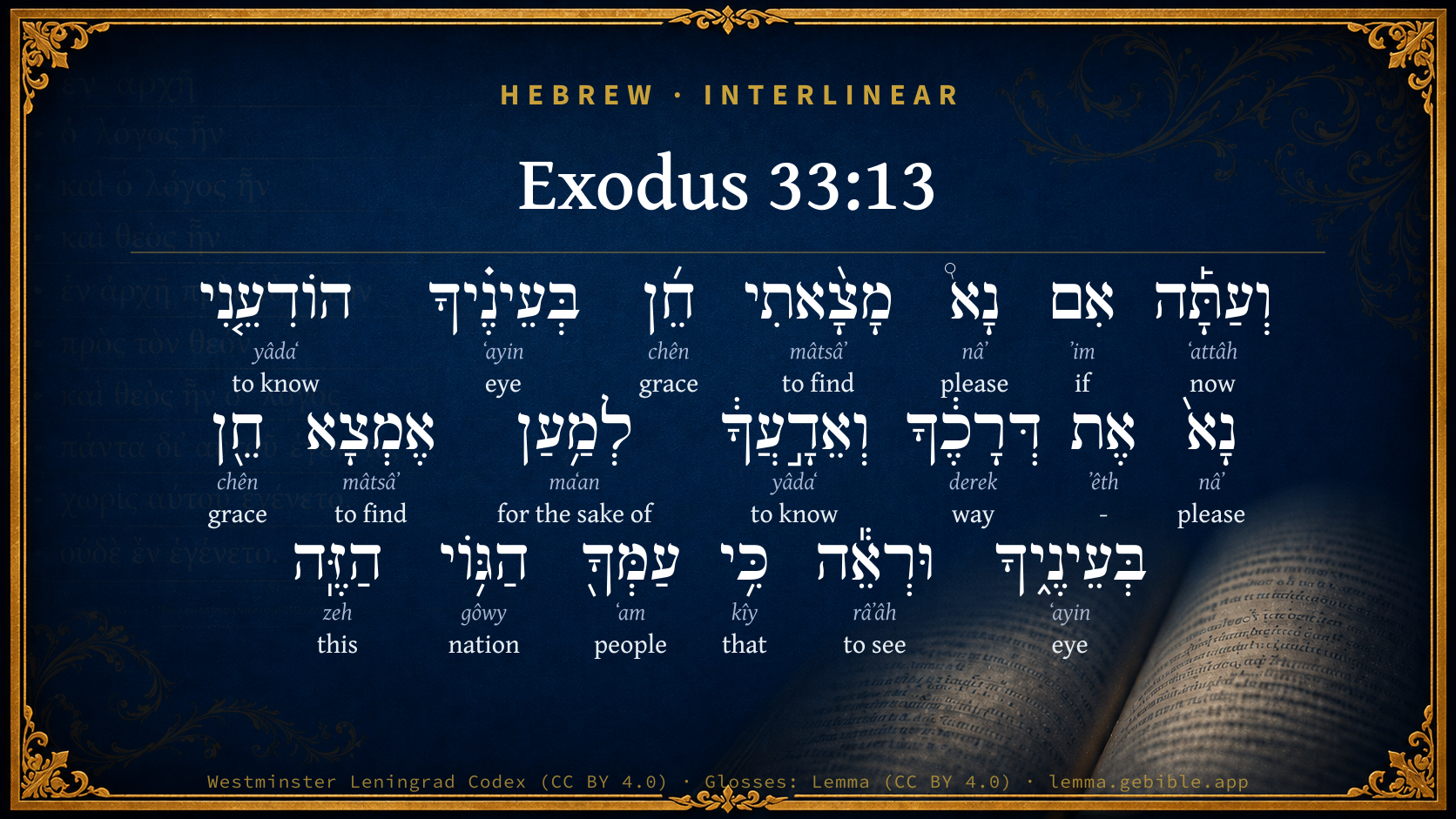
Exodus 33:13

Hebrew (Westminster Leningrad Codex) Exodus 33:13 appears in the Hebrew Old Testament. The text above is from the Westminster Leningrad Codex. Each word links to its Strong’s number, a concise gloss, and parsing drawn from the Open Scriptures Hebrew Bible morphology. Click any word for its full Brown-Driver-Briggs (BDB) entry.
Download image
Cite this verse

Exodus 33:13 (World English Bible). Public Domain. Lemma interlinear Bible study tool, https://lemma.gebible.app/v/exodus/33/13.

Show BibTeX & RIS
BibTeX
RIS
English Translation
Now therefore, if I have found favor in your sight, please show me now your ways, that I may know you, so that I may find favor in your sight: and consider that this nation is your people."
World English Bible · Public Domain
Download a study sheet

One document with this verse’s original text, its word-by-word gloss line, the meaning frame, cross-references with their text, attributed commentary, and full source and license credits — printable, and it pastes into notes with its structure intact.

This verse Autodidact and up

Study sheet (.html) Plain text (.txt)

A passage Seminary Student

Up to 50 verses in one chapter. A passage sheet keeps up to 6 commentary sources and 12 cross-references per verse, in the order this page ranks them, and says so on the sheet whenever that leaves anything out. Ask for a single verse and you get the Autodidact verse sheet above.

Everything on this page stays free to read, with no account — the sheet is a download of what is already on screen, not access to it.

Want to remove ads? Support Godless Engineer
Compare translations 3

The same verse in 3 English versions, stacked beneath the original-language interlinear above. Click any original word for its lexicon entry.

Each is an independent rendering of the whole verse — the interlinear is not word-aligned to these translations.

Highlighted words mark where these versions differ — a whole-verse word diff, not a word-by-word alignment.

  • World English Bible Public Domain
    Now therefore, if I have found favor in your sight, please show me now your ways, that I may know you, so that I may find favor in your sight: and consider that this nation is your people."
  • King James Version Public Domain
    Now therefore, I pray thee, if I have found grace in thy sight, show me now thy way, that I may know thee, that I may find grace in thy sight: and consider that this nation is thy people.
  • unfoldingWord Literal Text CC BY-SA 4.0
    And now please, if I have found favor in your eyes, please cause me to know your ways, and I will know you so that I can find favor in your eyes. And see that this nation is your people.”

unfoldingWord Literal Text — © unfoldingWord, licensed CC BY-SA 4.0. Word-aligned USFM3 via Door43 (git.door43.org/unfoldingWord/en_ult).

Versions to compare (up to 4)

3 of 4 selected

Show all 18 translations

Every available English version of this verse, each an independent rendering of the whole verse.

  • World English Bible Public Domain
    Now therefore, if I have found favor in your sight, please show me now your ways, that I may know you, so that I may find favor in your sight: and consider that this nation is your people."
  • Berean Standard Bible Public Domain
    Now if indeed I have found favor in Your sight, please let me know Your ways, that I may know You and find favor in Your sight. Remember that this nation is Your people.”
  • Majority Standard Bible Public Domain
    Now if indeed I have found favor in Your sight, please let me know Your ways, that I may know You and find favor in Your sight. Remember that this nation is Your people.”
  • King James Version Public Domain
    Now therefore, I pray thee, if I have found grace in thy sight, show me now thy way, that I may know thee, that I may find grace in thy sight: and consider that this nation is thy people.
  • American Standard Version (1901) Public Domain
    Now therefore, I pray thee, if I have found favor in thy sight, show me now thy ways, that I may know thee, to the end that I may find favor in thy sight: and consider that this nation is thy people.
  • Revised Version (1885) Public Domain
    Now therefore, I pray thee, if I have found grace in thy sight, shew me now thy ways, that I may know thee, to the end that I may find grace in thy sight: and consider that this nation is thy people.
  • Geneva Bible (1599) Public Domain
    Nowe therefore, I pray thee, if I haue founde fauour in thy sight, shewe mee nowe thy way, that I may knowe thee, and that I may finde grace in thy sight: consider also that this nation is thy people.
  • Douay-Rheims (1899) Public Domain
    If therefore I have found favour in thy sight, show me thy face, that I may know thee, and may find grace before thy eyes: look upon thy people this nation.
  • Young's Literal Translation Public Domain
    `And now, if, I pray Thee, I have found grace in Thine eyes, cause me to know, I pray Thee, Thy way, and I know Thee, so that I find grace in Thine eyes, and consider that this nation `is' Thy people;'
  • Literal Standard Version CC BY-SA 4.0
    And now, if, please, I have found grace in Your eyes, please cause me to know Your way, and I know You, so that I find grace in Your eyes, and consider that this nation [is] Your people”;
  • Unlocked Literal Bible CC BY-SA 4.0
    Now if I have found favor in your eyes, show me your ways so that I may know you and continue to find favor in your eyes. Remember that this nation is your people.”
  • unfoldingWord Literal Text CC BY-SA 4.0
    And now please, if I have found favor in your eyes, please cause me to know your ways, and I will know you so that I can find favor in your eyes. And see that this nation is your people.”
  • Darby Bible Public Domain
    And now, if indeed I have found grace in thine eyes, make me now to know thy way, that I may know thee, that I may find grace in thine eyes; and consider that this nation is thy people!
  • World Messianic Bible Public Domain
    Now therefore, if I have found favor in your sight, please show me your way, now, that I may know you, so that I may find favor in your sight; and consider that this nation is your people.”
  • Webster's Bible Public Domain
    Now therefore, I pray thee, if I have found grace in thy sight, show me now thy way, that I may know thee, that I may find grace in thy sight: and consider that this nation is thy people.
  • Free Bible Version CC BY-SA 4.0
    Now if it's true that you're happy with me, please teach me your ways so I can get to know you, and go on pleasing you. Remember that the people of this nation are yours.”
  • Bible in Basic English Public Domain
    If then I have grace in your eyes, let me see your ways, so that I may have knowledge of you and be certain of your grace; and my prayer is that you will keep in mind that this nation is your people.
  • JPS Tanakh (1917) Public Domain
    Now therefore, I pray Thee, if I have found grace in Thy sight, show me now Thy ways, that I may know Thee, to the end that I may find grace in Thy sight; and consider that this nation is Thy people.'

Literal Standard Version (2020), Covenant Press — licensed CC BY-SA 4.0. Text via the HelloAO Bible API (eBible.org). Unlocked Literal Bible (unfoldingWord) — licensed CC BY-SA 4.0. Text via the HelloAO Bible API (eBible.org). unfoldingWord Literal Text — © unfoldingWord, licensed CC BY-SA 4.0. Word-aligned USFM3 via Door43 (git.door43.org/unfoldingWord/en_ult). Free Bible Version, Dr. Jonathan Gallagher — licensed CC BY-SA 4.0. Text via the HelloAO Bible API (eBible.org).

Word by word

More ways to search: Search by grammar → Find every occurrence → Compare this word →

Practice this passage: Drill this verse → Learn its vocabulary →

חֵ֜ן
chên
H2580
“grace”
Noun, Common, Masculine, Singular, Absolute
Part of Speech
Noun
Type
Common
Gender
Masculine
Number
Singular
State
Absolute
Full BDB Definition

Origin: from H2603

TWOT: TWOT- 694a

favour, grace, charm - favour, grace, elegance - favour, acceptance
  1. וְעַתָּ֡ה ʻattâh H6258 “and · now” Conjunction + Adverb
  2. אִם ʼim H518 “if” Conjunction
  3. נָא֩ nâʼ H4994 “please” Particle, Exhortation
  4. מָצָ֨אתִי mâtsâʼ H4672 “to find” Verb, Qal, Perfect, 1st Person, Common, Singular
  5. בְּעֵינֶ֗יךָ ʻayin H5869 “in/at · eyes · your” Preposition + Noun, Common, Both, Dual, Construct + Suffix, Personal, 2nd Person, Masculine, Singular
  6. הוֹדִעֵ֤נִי yâdaʻ H3045 “know · me” Verb, Hiphil, Imperative, 2nd Person, Masculine, Singular + Suffix, Personal, 1st Person, Common, Singular
  7. נָא֙ nâʼ H4994 “please” Particle, Exhortation
  8. אֶת ʼêth H853 “-” Particle, Direct Object
  9. דְּרָכֶ֔ךָ derek H1870 “ways · your” Noun, Common, Both, Plural, Construct + Suffix, Personal, 2nd Person, Masculine, Singular
  10. וְאֵדָ֣עֲךָ֔ yâdaʻ H3045 “and · to know · you” Conjunction + Verb, Qal, Imperfect, 1st Person, Common, Singular + Suffix, Personal, 2nd Person, Masculine, Singular
  11. לְמַ֥עַן maʻan H4616 “for the sake of” Preposition
  12. אֶמְצָא mâtsâʼ H4672 “to find” Verb, Qal, Imperfect, 1st Person, Common, Singular
  13. חֵ֖ן chên H2580 “grace” Noun, Common, Masculine, Singular, Absolute
  14. בְּעֵינֶ֑יךָ ʻayin H5869 “in/at · eyes · your” Preposition + Noun, Common, Both, Dual, Construct + Suffix, Personal, 2nd Person, Masculine, Singular
  15. וּרְאֵ֕ה râʼâh H7200 “and · see” Conjunction + Verb, Qal, Imperative, 2nd Person, Masculine, Singular
  16. כִּ֥י kîy H3588 “that” Conjunction
  17. עַמְּךָ֖ ʻam H5971 “people · your” Noun, Common, Masculine, Singular, Construct + Suffix, Personal, 2nd Person, Masculine, Singular
  18. הַגּ֥וֹי gôwy H1471 “the · nation” Particle, Definite Article + Noun, Common, Masculine, Singular, Absolute
  19. הַזֶּֽה zeh H2088 “the · this” Particle, Definite Article + Pronoun, Demonstrative, Masculine, Singular

About this verse

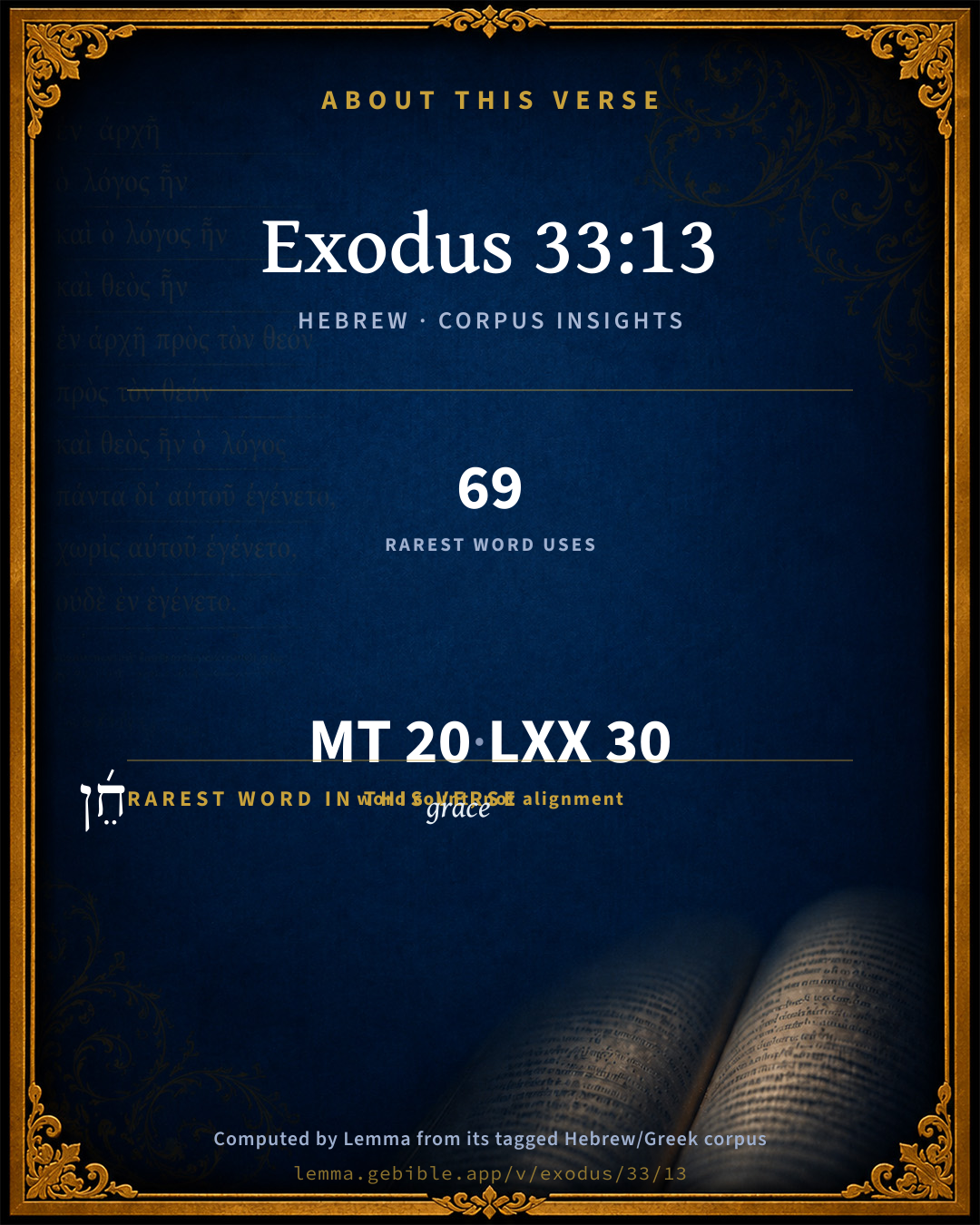
These counts appear in no published source. They are computed here, from the morphology-tagged text and Lemma’s own curated glosses. What Lemma adds →

20
words
15
distinct lemmas
Pentateuch
section

Grammatical profile

  • 5 verbs
  • 7 nouns
  • 1 pronoun
  • 1 preposition
  • 2 conjunctions
  • 1 adverb
  • 3 particles

Verb forms

  • מָצָ֨אתִי Qal · Perfect
  • הוֹדִעֵ֤נִי Hiphil · Imperative
  • וְאֵדָ֣עֲךָ֔ Qal · Imperfect
  • אֶמְצָא Qal · Imperfect
  • וּרְאֵ֕ה Qal · Imperative

Repetition

Words recur within this verse — often emphatic in Hebrew:

  • נָא֩ please H4994 ×2
  • מָצָ֨אתִי to find H4672 ×2
  • חֵ֜ן grace H2580 ×2
  • בְּעֵינֶ֗יךָ eye H5869 ×2
  • הוֹדִעֵ֤נִי to know H3045 ×2

Hebrew & Septuagint length

In English translation the verse runs 38 words from the Hebrew and 39 from the Septuagint (LXX English) — closely comparable.

A rough comparison of the two English renderings, which tokenize alike — not a word-level alignment.

Word counts can differ between the Hebrew and the Greek without any difference in meaning — e.g. the Hebrew direct-object marker אֵת has no separate Greek word, and Greek often adds the article ὁ.

In the original languages it is 20 Hebrew tokens and 30 Greek tokens — but the two are counted differently (Hebrew bundles its prefixes and suffixes into one token; the Greek is in lemma form), so that isn’t a like-for-like length.

Cross-references

18

Topical passages linked to Exodus 33:13 in the Treasury of Scripture Knowledge — connected by theme and wording, ordered by reader-vote popularity; previews shown in the World English Bible.

  • Psalms 119:33 Teach me, Yahweh, the way of your statutes. I will keep them to the end.
  • Psalms 25:4 Show me your ways, Yahweh. Teach me your paths.
  • Psalms 27:11 Teach me your way, Yahweh. Lead me in a straight path, because of my enemies.
  • Psalms 86:11 Teach me your way, Yahweh. I will walk in your truth. Make my heart undivided to fear your name.
  • Deuteronomy 9:26 I prayed to Yahweh, and said, Lord Yahweh, don't destroy your people and your inheritance, that you have redeemed through your greatness, that you have brought forth out of Egypt with a mighty hand.
  • Isaiah 30:21 and your ears shall hear a word behind you, saying, This is the way, walk you in it; when you turn to the right hand, and when you turn to the left.
  • John 17:3 This is eternal life, that they should know you, the only true God, and him whom you sent, Jesus Christ.
  • Ephesians 1:17 that the God of our Lord Jesus Christ, the Father of glory, may give to you a spirit of wisdom and revelation in the knowledge of him;
  • Colossians 1:10 that you may walk worthily of the Lord, to please him in all respects, bearing fruit in every good work, and increasing in the knowledge of God;
  • Deuteronomy 9:29 Yet they are your people and your inheritance, which you brought out by your great power and by your outstretched arm.
  • Exodus 34:9 He said, "If now I have found favor in your sight, Lord, please let the Lord go in the midst of us; although this is a stiff-necked people; pardon our iniquity and our sin, and take us for your inheritance."
  • Joel 2:17 Let the priests, the ministers of Yahweh, weep between the porch and the altar, And let them say, "Spare your people, Yahweh, And don't give your heritage to reproach, That the nations should rule over them. Why should they say among the peoples, 'Where is their God?'"
  • 2 Peter 3:18 But grow in the grace and knowledge of our Lord and Savior Jesus Christ. To him be the glory both now and forever. Amen.
  • Exodus 33:17–18 Yahweh said to Moses, "I will do this thing also that you have spoken; for you have found favor in my sight, and I know you by name."
  • Romans 11:28 Concerning the Gospel, they are enemies for your sake. But concerning the election, they are beloved for the fathers' sake.
  • Exodus 32:7 Yahweh spoke to Moses, "Go, get down; for your people, who you brought up out of the land of Egypt, have corrupted themselves!
  • Isaiah 63:17 O Yahweh, why do you make us to err from your ways, and harden our heart from your fear? Return for your servants' sake, the tribes of your inheritance.
  • Isaiah 63:19 We are become as they over whom you never bear rule, as those who were not called by your name.

Cross-references courtesy of OpenBible.info (CC BY 4.0).

Hebrew and Greek witnesses Masoretic Hebrew ↔ Greek Septuagint

The same verse in the two great witnesses to the Old Testament, shown verse-for-verse.

These are two independent witnesses, not word-aligned to each other, and the Septuagint is shown in lemma (dictionary) form.

Hebrew Exodus 33:13 Masoretic · Westminster Leningrad Codex

וְעַתָּ֡ה אִם נָא֩ מָצָ֨אתִי חֵ֜ן בְּעֵינֶ֗יךָ הוֹדִעֵ֤נִי נָא֙ אֶת דְּרָכֶ֔ךָ וְאֵדָ֣עֲךָ֔ לְמַ֥עַן אֶמְצָא חֵ֖ן בְּעֵינֶ֑יךָ וּרְאֵ֕ה כִּ֥י עַמְּךָ֖ הַגּ֥וֹי הַזֶּֽה

Now therefore, if I have found favor in your sight, please show me now your ways, that I may know you, so that I may find favor in your sight: and consider that this nation is your people."

World English Bible · Public Domain

Greek LXX Exodus 33:13 Septuagint · lemma form

εἰ οὖν εὑρίσκω χάρις ἐναντίον σύ ἐνφανίζω ἐγώ σεαυτοῦ γνωστῶς ὁράω σύ ὅπως ἄν εἰμί εὑρίσκω χάρις ἐναντίον σύ καί ἵνα γιγνώσκω ὅτι λαός σύ ὁ ἔθνος ὁ μέγας οὗτος

If then I have found favor in your sight, reveal yourself to me, that I may evidently see you; that I may find favor in your sight, and that I may know that this great nation is your people.

LXX2012 (modern English Septuagint) · Public Domain

Hebrew: Westminster Leningrad Codex (CC BY 4.0). Greek: Septuagint (public domain); English from LXX2012 (modern English Septuagint) (Public Domain). How the Septuagint differs from the Hebrew →

Targum (Aramaic paraphrase)

2

The Targum is the ancient Jewish Aramaic paraphrase of the Hebrew Scriptures — an interpretive translation, not the Hebrew text itself. Onkelos (literal) and Pseudo-Jonathan (expansive) render the Torah, and Jonathan the Prophets. Coverage is partial: where no permissively-licensed English translation exists for a verse, only the Aramaic is shown. This is verse-level text, not a word-by-word alignment to the Hebrew.

  1. Targum Onkelos Torah (Genesis–Deuteronomy)
    וּכְעַן אִם כְּעַן אַשְׁכָּחִית רַחֲמִין קֳדָמָךְ הוֹדַעְנִי כְעַן יָת אוֹרַח טּוּבָךְ וְאִדַע רַחֲמָךְ בְּדִיל דְאַשְׁכַּח רַחֲמִין קֳדָמָךְ וּגְלֵי קֳדָמָךְ אֲרֵי עַמָךְ עַמָא הָדֵין:

    (no public-domain English translation for this verse)

    Targum Onkelos — Aramaic: “Onkelos Genesis” (public domain); “Onkelos Exodus” (public domain); “Onkelos Leviticus” (public domain); “Onkelos Numbers” (public domain); “Onkelos Deuteronomy” (public domain). English: “Sefaria Community Translation” (CC0 1.0 (public-domain dedication)); “J.W. Etheridge. The Targums of Onkelos and Jonathan Ben Uzziel on the Pentateuch. London: Longmans, Green, 1862” (public domain). Text via Sefaria.

  2. Targum Pseudo-Jonathan Torah (Genesis–Deuteronomy)
    וּכְדוּן אִין בְּבָעוּ אַשְׁכָּחִית רַחֲמִין קֳדָמָךְ אוֹדְעַנִי כְּדוּן יַת אוֹרַח טוּבָךְ וְאִנְדַע רַחֲמָךְ הֵיךְ אַנְתְּ מְדַבֵּר עִם בְּנֵי נְשָׁא זַכָּאִין מָטֵי לְהוֹן הֵי כְחַיְיבִין וּלְחַיְיבִין הֵי כְזַכָּאִין וְתוּב זַכָּאִין מָטֵי לְהוֹן הֵי כְזָכְוַותְהוֹן וְחַיְיבִין מָטֵי לְהוֹן הֵי כְחוֹבֵיהֶן מִן בִּגְלַל דְּאַשְׁכַּח רַחֲמִין קֳדָמָךְ וּגְלֵי קֳדָמָךְ אֲרוּם עַמָּךְ עַמָּא הָדֵין

    But now I pray, if I have found mercy before Thee, make me to know the way of Thy goodness, to understand Thy mercy when in Thy dealing with just men it falleth to them as it (falleth) to the guilty, and to the guilty as to the just; but, on the contrary how it (indeed) befalleth the just according to their righteousness and the guilty according to their guilt: that I may find mercy before Thee, and it be made manifest by Thee that this people is Thy people.

    Targum Pseudo-Jonathan — Aramaic: “Targum Jonathan on Genesis” (public domain); “Targum Jonathan on Exodus” (public domain); “Targum Jonathan on Leviticus” (public domain); “Targum Jonathan on Numbers” (public domain); “Targum Jonathan on Deuteronomy” (public domain). English: “The Targum of Jonathan ben Uzziel, trans. J. W. Etheridge, London, 1862” (public domain). Text via Sefaria.

Commentary

Notes on Exodus 33:13 from classic Christian and Jewish commentators (each source and its license shown beneath its notes). The classic Christian expositions comment on the surrounding passage and are grouped to its opening verse, so a note may address several verses; the Jewish commentaries on the Tanakh (Rashi and others) are per-verse, so they appear only where the commentator wrote on this verse.

Lemma curates 59 commentaries, every one of them public domain or Creative Commons licensed, each selected and text-cleaned for this edition rather than reprinted as found. About our sources →

Trapp's Complete Commentary

John Trapp

Exo 33:13 Now therefore, I pray thee, if I have found grace in thy sight, shew me now thy way, that I may know thee, that I may find grace in thy sight: and consider that this nation [is] thy people.

Ver. 13. That I may know thee.] Moses knew more of God than any man; he was but newly come down from the mount, and at the tabernacle door God spake with Moses "face to face, as a man speaketh unto his friend." {Exo 33:11} The more a man knows of God, the more desirous he is to know him.

John Trapp, A Commentary or Exposition upon All the Books of the Old and New Testament (1647–1656) — public domain. Text from a community e-Sword module.

Joseph Benson's Commentary

Exo 33:13. Now, if I have found grace in thy sight — What favour God had expressed to the people they had forfeited the benefit of; and therefore Moses lays the stress of his plea upon what God had said to him. By this, therefore, he takes hold on God; Lord, if thou wilt do any thing for me, do this for the people. Thus our Lord Jesus, in his intercession, presents himself to the Father as one in whom he is always well pleased, and so obtains mercy for us, with whom he is justly displeased. Show me thy way — What course thou meanest now to take with us; that I may know thee, that I may find grace in thy sight — That by proof and experience I may know how good thou art to them that seek thee, and may be assured that I have found grace in thy sight. He intimates that the people also, though most unworthy, yet were in some relation to God; consider that this nation is thy people — A people that thou hast done great things for, redeemed to thyself, and taken into covenant with thyself; Lord, they are thy own, do not leave them.

Joseph Benson's Commentary on the Old and New Testaments (1811–1818) — public domain. Text from a community e-Sword module.

Tyndale Open Study Notes

Tyndale Open Resources

33:13 let me know your ways: Moses did not merely want God’s blessings; he wanted to know God’s nature and character, as well as the manner of and reasons for his actions. God’s goal of revealing himself was beginning to be realized, at least in one person. • Moses wanted God himself to accompany them, because they were the Lord’s own people.

Tyndale Open Study Notes — © Tyndale Open Resources, licensed CC BY-SA 4.0. Text via the HelloAO Bible API.

Adam Clarke's Commentary

Verse 13. Show me now thy way] Let me know the manner in which thou wouldst have this people led up and governed, because this nation is thy people, and should be governed and guided in thy own way.

Adam Clarke's Commentary on the Bible (1810–1826) — public domain. Text from a community e-Sword/MySword module.

Ellicott's Commentary for English Readers

(13) Shew me now thy way—i.e., Thy course—Thy intention. Let me know if Thou really intendest to withdraw Thyself from us, and put a created being in Thy place or no.

Consider that this nation is thy people.—Moses glances back at God’s words recorded in Exo_32:7, and reminds God that the Israelites are not merely his (Moses’) people, but also, in a higher sense, God’s people. As such, God had acknowledged them (Exo_3:7; Exo_3:10; Exo_5:1; Exo_6:7; Exo_7:4, &c.).

A Bible Commentary for English Readers, edited by Charles John Ellicott (1878–1897) — public domain. Text from a community e-Sword module.

The Cambridge Bible for Schools and Colleges

gen. ed. J. J. S. Perowne

13. if, &c.] A common Heb. phrase: Gen_18:3; Gen_30:27 al.

shew] lit. make me to know. ‘Shew’ in Old English meant not only to let see, but also to let know, or tell: see on Dan_2:2; Dan_4:2 in the Camb. Bible, or the writer’s Parallel Psalter, p. 481. Cf. Psa_103:7.

ways] His ways of dealing with men, Deu_32:4 : see Exo_34:6 f.

that I may know thee, &c.] understand what Thy nature and character is, and shape my petitions accordingly, that so I may find grace in thy sight, and my future prayers may be answered.

is thy people] and should not, therefore, be left by Thee without a leader.

The Cambridge Bible for Schools and Colleges (gen. ed. J. J. S. Perowne; Cambridge University Press, 1878–1918) — public domain. Text from a community e-Sword module.

John Gill's Exposition

Now therefore, I pray thee, if I have found grace in thy sight,.... Which he said, not as doubting whether he had or not, but as taking it for granted he had, and so argues from it, and improves his interest in it, in his pleading with God:

shew me now thy way: either the way which he himself would take, the way of his providence in bringing the children of Israel into the land of Canaan; or the way he would have him take, the way of his duty, how he would have him behave in conducting them thither; unless he means the Messiah, Christ, the way to the heavenly Canaan, to whom he seems greatly to have respect in the following part of this chapter:

that I may know thee, that I may find grace in thy sight; by which he might have a further evidence of his being acceptable to God, and having a share in his good will; as well as he would better know in what way grace is communicated, Christ being the way both of access into the grace of God, and of acceptance with him, and of the communication of grace from him:

and consider that this nation is thy people; though they had sinned against him in the manner they had done, they were a people he had chosen above all people to be his; he had made a covenant with them, and was their covenant God; he had redeemed them out of Egypt, and had called them from thence, and had wrought a great salvation for them, and had bestowed many peculiar favours upon them; and though for this their gross idolatry and sad apostasy from him they were unworthy of the relation, and he had thought fit not to call them his people, but the people, or the people of Moses, yet they still were his people, and he entreats he would consider the relation they stood in to him, and show mercy to them.

John Gill's Exposition of the Whole Bible (1746–1763) — public domain (CC PDM 1.0). Text via the HelloAO Bible API.

Albert Barnes' Notes on the Bible

Thy way - He desires not to be left in uncertainty, but to be assured, by Yahweh’s mode of proceeding, of the reality of the promises that had been made to him.

Albert Barnes' Notes on the Bible (1834–1885) — public domain. Text from a community e-Sword/MySword module.

Haydock's Catholic Bible Commentary

Face. Hebrew, "way." Be thou our guide. --- Thy people. Acknowledge them again. Moses begs not for any special favour for himself, but only for the Hebrews. (Salien.)

George Leo Haydock (1774–1849), Haydock's Catholic Family Bible and Commentary, 1859 edition — public domain. Excludes Psalms (Douay-Rheims chapter numbering differs from Protestant) and Deuterocanonical books (Catholic canon only).

Matthew Poole's English Annotations

Show me now thy way; the course and manner of thy dealings with men, and particularly thy purpose and will concerning me and thy people, and the method which thou wilt choose for the fulfilling of thy promise, and the course which thou wouldst have me take, and the way by which I shall conduct thy people to the Promised Land.

That I may know thee, i.e. thy mind herein; men are said to know God when they know his mind and will; or that I may experimentally know thee to be what thou hast promised thou wilt be to me and to thy people; or rather,

that I may thereby know thee, namely, that I shall find grace

in thy sight, as it follows; that I may be assured that thou wilt be reconciled to and present with me and thy people.

Thy people, both by thy own choice and purpose, and promise to their parents, and by their recognition of thee for their God, and their returning to thee again.

Matthew Poole's English Annotations on the Holy Bible (1683–1685) — public domain. Text from a community e-Sword/MySword module.

Whedon's Commentary on the Bible

Daniel D. Whedon

13. Show me now thy way — The way thou wilt lead us; the manner in which the guiding Angel will direct our ways, and drive out our enemies before us.

That I may know thee — Notwithstanding all the communion face to face between Jehovah and Moses, (Exo_33:11,) this leader of the chosen nation feels that he does not sufficiently know Jehovah. He prays for a fuller, clearer revelation of his nature and his glory.

This nation is thy people — Jehovah had spoken to Moses of Israel as “the people which thou hast brought up out of the land of Egypt, (Exo_33:1, comp. Exo_32:7;) Moses now insists that Jehovah had called this nation as his own. Thus had he called them when he first appeared to Moses at the bush, and sent him unto Pharaoh. See Exo_3:7.

Daniel D. Whedon (gen. ed.), Commentary on the Old and New Testaments (1874–1909) — public domain. Text from a community e-Sword module.

John Wesley's Explanatory Notes

Now therefore, if I have found grace in thy sight, shew me thy way - What favour God had expressed to the people they had forfeited the benefit of; and therefore Moses lays the stress of his plea upon what God had said to him. By this therefore he takes hold on God, Lord, if thou wilt do any thing for me, do this for the people. Thus our Lord Jesus, in his intercession, presents himself to the Father, as one in whom he is always well-pleased, and so obtains mercy for us with whom he is justly displeased, Shew me thy way, that I may know thee, that I may find grace in thy sight - He insinuates that the people also, though most unworthy, yet were in some relation to God; consider that this nation is thy people; a people that thou hast done great things for, redeemed to thyself, and taken into covenant with thyself; Lord, they are thy own, do not leave them.

John Wesley, Explanatory Notes Upon the Whole Bible (1754–1765) — public domain. Text via the GEBible commentary corpus.

Rashi

Rabbi Shlomo Yitzchaki (Rashi)

ועתה וגו׳ NOW THEREFORE etc. — If it is true that I have found favour in Thy eyes, הודיעני נא את דרכך LET ME KNOW THY WAY — let me know what is the reward which Thou givest to those who find favour in Thine eyes.

ואדעך למען אמצא חן בעיניך means, that I may know by this (by Your letting me know Your way) the nature of the reward You bestow — what is this “finding of grace” which You have granted to me (Hebrew: which I found in Your eyes). The explanation of למען אמצא חן accordingly is: that I may find out (אמצא) how great is the reward attendant on this “finding of grace”.

וראה כי עמך הגוי הזה AND CONSIDER THAT THIS NATION IS THY PEOPLE so that You should not say, as You have said, (Exodus 32:10) “And I will make thee a great nation”, whilst these (the whole people) You will abandon! Consider that they are Your nation from of old, and if You reject them, surely I cannot rely upon it that those who are born of me will endure — rather let me know through this people the reward that is to be paid me (by sparing them). Our Rabbis have given a Midrashic explanation of this in Treatise Berakhot 7a but I come (my purpose is) to explain the verses in a manner fitting to them and in their context.

Rashi on the Tanakh — English translations: “The Judaica Press complete Tanach with Rashi, translated by A. J. Rosenberg” (CC BY 4.0); “Pentateuch with Rashi's commentary by M. Rosenbaum and A.M. Silbermann, 1929-1934” (public domain); “The Metsudah Tanach series, Lakewood, N.J” (CC BY 4.0); and “The Book of Joshua, Metsudah Publications, 1997” (CC BY 4.0). Text via Sefaria.

Lesson kit

Teaching starters — assembled from the data on this page, not authored interpretation. Every prompt links to the verse data it draws on. Edit before teaching.

Exodus, in the Pentateuch, opens this verse with 20 words (15 distinct Hebrew lemmas). Its most distinctive word is chên (“grace”). A historical commentator’s framing appears above. Read the whole chapter for the surrounding context.

Discussion questions

  1. The word chên carries the sense “grace.” How does it shape the verse?
  2. Psalms 119:33 shares this passage’s theme. How do the two illuminate each other?
  3. “please” occurs 2× in this one verse. What is the effect of the repetition?
  4. The translations on this page render this verse differently — a whole-verse word diff, not a word-by-word alignment. What might account for the different wordings?
  5. The verb «מָצָ֨אתִי» is Qal Perfect. How does its form color the action?
  6. Reading how Trapp's Complete Commentary and Joseph Benson's Commentary read this verse, where do the two commentators agree and where do they part?

Things to notice

Reading settings

Reading text

Shown beneath each verse's original-language words.

Old Testament
Old Testament edition

Read the OT as the Masoretic Hebrew (MT) or the Greek Septuagint (LXX).

English shown for the Greek Septuagint (in the Hebrew ↔ Greek comparison).

Comparing translations? Open the Compare panel on any verse page to stack up to four side by side.