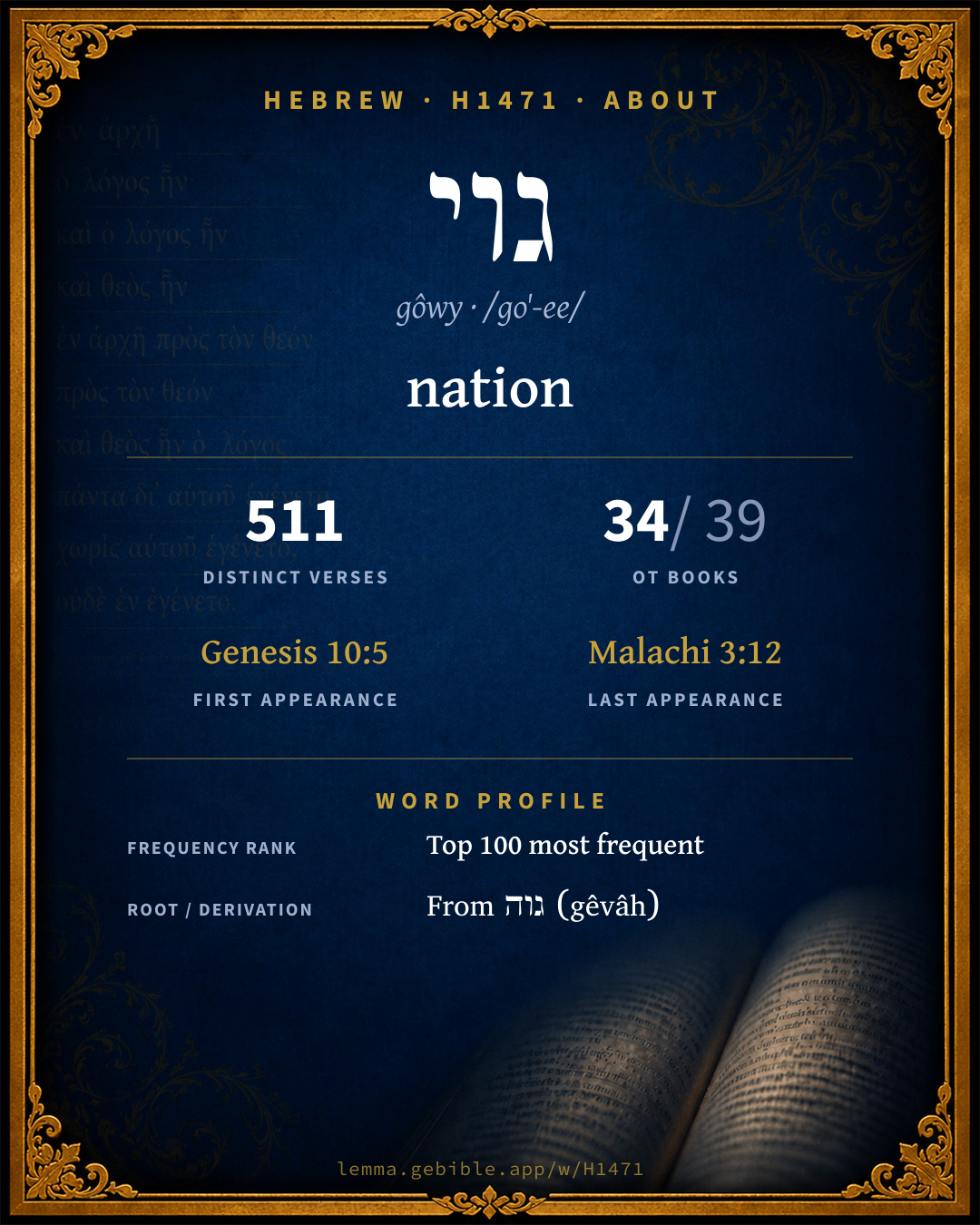
גּוֹי
nation
‘nation’ is one of 4 main senses fuller range ↓
Full lexicon entry — Brown-Driver-Briggs (BDB)
From Brown-Driver-Briggs (BDB)
Where this word appears
See every Absolute-state word in the Hebrew Bible →
Grammar key — what these labels mean
Part of speech
- Noun
- A naming word — a person, place, thing, or idea.
Noun type
- Common
- A common noun — a general class of person, place, or thing (“king,” “city,” “water”), not a specific name.
- Proper
- A name of a specific person, place, or people (e.g. Abraham, Zion, Israel).
State
- Absolute
- The independent form of a noun, not bound to a following word.
- Construct
- A noun bound to a following noun in a possessive / “of” relationship (the construct chain).
Gender
- Masculine
- Grammatically masculine.
Number
- Plural
- More than one (in Hebrew, generally three or more).
- Singular
- One.
Every verse where H1471 appears in the Book of Zechariah — 17 distinct verses. Click any verse to open its interlinear word-by-word view. Verse text shown in the World English Bible for context — . Each verse’s Hebrew form is shown with its reference; the English is not keyword-highlighted, since the data carries no word-level English alignment. Use “Compare translations” on any verse to read it across multiple English versions. This concordance covers the Hebrew Bible; Septuagint (Greek Old Testament) occurrences are not indexed here.
Zechariah
- Zechariah 1:15 הַ/גּוֹיִ֖ם ptcl def.art + n c mp I am very angry with the nations that are at ease; for I was but a little displeased, but they added to the calamity."
- Zechariah 1:21 הַ/גּוֹיִ֗ם ptcl def.art + n c mp Then I asked, "What are these coming to do?" He said, "These are the horns which scattered Judah, so that no man lifted up his head; but these have come to terrify them, to cast down the horns of the nations, which lifted up their horn against the land of Judah to scatter it."
- Zechariah 2:8 הַ/גּוֹיִ֖ם ptcl def.art + n c mp For thus says Yahweh of hosts: 'For honor he has sent me to the nations which plundered you; for he who touches you touches the apple of his eye.
- Zechariah 2:11 גוֹיִ֨ם n c mp Many nations shall join themselves to Yahweh in that day, and shall be my people; and I will dwell in the midst of you, and you shall know that Yahweh of Hosts has sent me to you.
- Zechariah 7:14 הַ/גּוֹיִם֙ ptcl def.art + n c mp "but I will scatter them with a whirlwind among all the nations which they have not known. Thus the land was desolate after them, so that no man passed through nor returned: for they made the pleasant land desolate."
- Zechariah 8:13 בַּ/גּוֹיִ֗ם prep det + n c mp It shall come to pass that, as you were a curse among the nations, house of Judah and house of Israel, so will I save you, and you shall be a blessing. Don't be afraid. Let your hands be strong."
- Zechariah 8:22 וְ/גוֹיִ֣ם conj + n c mp Yes, many peoples and strong nations will come to seek Yahweh of Hosts in Jerusalem, and to entreat the favor of Yahweh."
- Zechariah 8:23 הַ/גּוֹיִ֑ם ptcl def.art + n c mp Thus says Yahweh of Hosts: "In those days, ten men will take hold, out of all the languages of the nations, they will take hold of the skirt of him who is a Jew, saying, 'We will go with you, for we have heard that God is with you.'"
- Zechariah 9:10 לַ/גּוֹיִ֑ם prep det + n c mp I will cut off the chariot from Ephraim, And the horse from Jerusalem; And the battle bow will be cut off; And he will speak peace to the nations: And his dominion will be from sea to sea, And from the River to the ends of the earth.
- Zechariah 12:3 גּוֹיֵ֥י n c mp cs It will happen in that day, that I will make Jerusalem a burdensome stone for all the peoples. All who burden themselves with it will be severely wounded, and all the nations of the earth will be gathered together against it.
- Zechariah 12:9 הַ/גּוֹיִ֔ם ptcl def.art + n c mp It will happen in that day, that I will seek to destroy all the nations that come against Jerusalem.
- Zechariah 14:2 הַ/גּוֹיִ֥ם ptcl def.art + n c mp For I will gather all nations against Jerusalem to battle; and the city will be taken, the houses rifled, and the women ravished. half of the city will go out into captivity, and the rest of the people will not be cut off from the city.
- Zechariah 14:3 בַּ/גּוֹיִ֣ם prep det + n c mp Then Yahweh will go out and fight against those nations, as when he fought in the day of battle.
- Zechariah 14:14 הַ/גּוֹיִ֜ם ptcl def.art + n c mp Judah also will fight at Jerusalem; and the wealth of all the surrounding nations will be gathered together: gold, and silver, and clothing, in great abundance.
- Zechariah 14:16 הַ/גּוֹיִ֔ם ptcl def.art + n c mp It will happen that everyone who is left of all the nations that came against Jerusalem will go up from year to year to worship the King, Yahweh of Hosts, and to keep the feast of tents.
- Zechariah 14:18 הַ/גּוֹיִ֔ם ptcl def.art + n c mp If the family of Egypt doesn't go up, and doesn't come, neither will it rain on them. This will be the plague with which Yahweh will strike the nations that don't go up to keep the feast of tents.
- Zechariah 14:19 הַ/גּוֹיִ֔ם ptcl def.art + n c mp This will be the punishment of Egypt, and the punishment of all the nations that don't go up to keep the feast of tents.
About this entry
At a glance — auto-summarized from this page’s data, not written by a person. Every figure links to its source below. This summary describes the numbers; it doesn’t interpret them.
“nation” is the headline sense of the Hebrew word גוי (gôwy). One archaism survives in the King James Version — “heathen” — where modern Bibles read “nations”; see the renderings breakdown. It turns up in 511 verses across 34 books, one of the most common footprint. Its earliest occurrence is Genesis 10:5. Its meaning spans more than one sense — see its full sense range. See the sense tree, 511-verse concordance, and the renderings breakdown below.
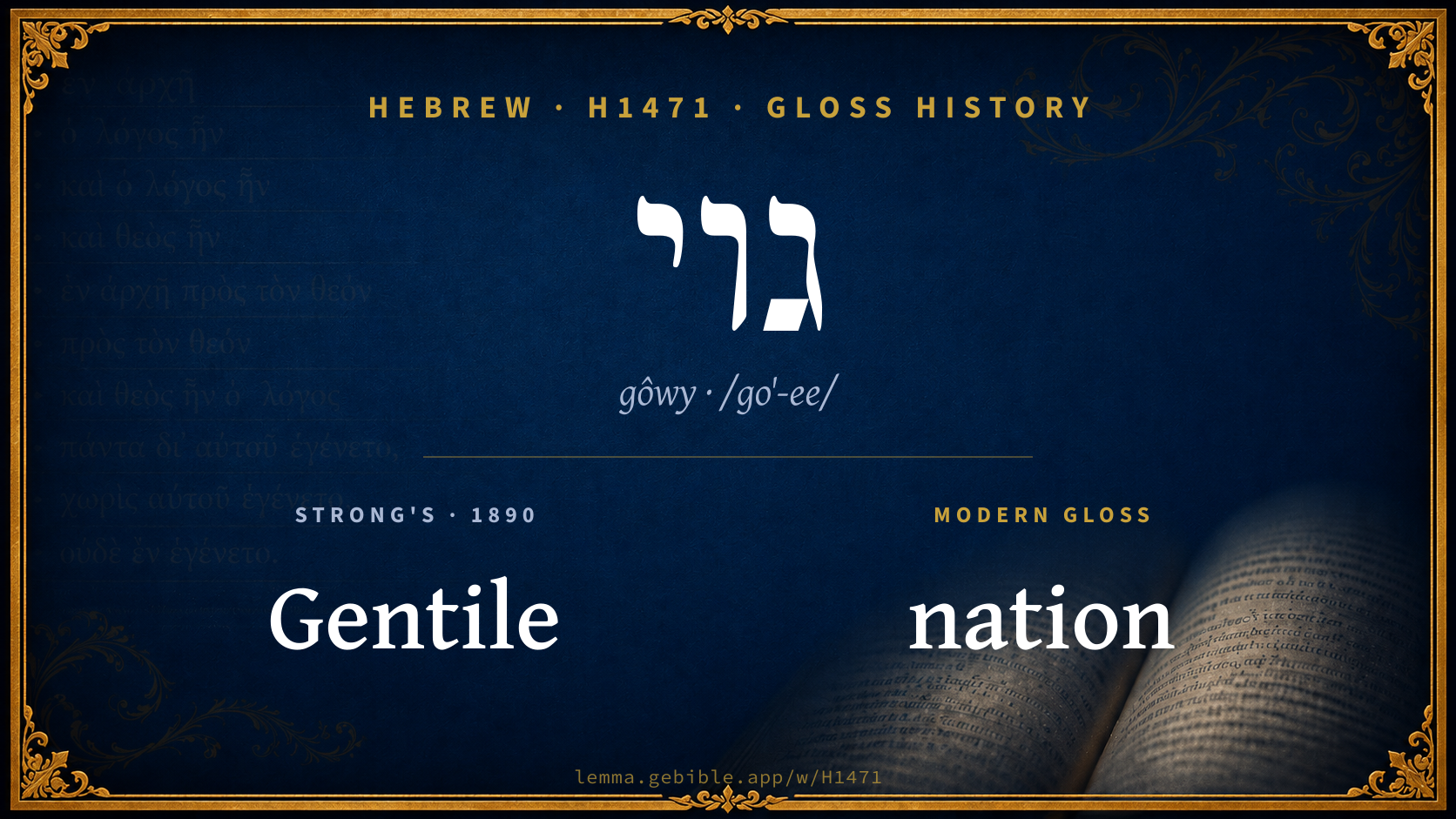
Gloss history
Strong's 1890 vs modern scholarship
About this word
Strong's H1471 catalogs a Hebrew word from the Hebrew Old Testament.
These counts are not copied from any lexicon or concordance. They are computed here, from the morphology-tagged Hebrew Old Testament. What Lemma adds →
- 511
- distinct verses
- The word appears in 511 distinct verses.
- 34 / 39
- OT books
- The word appears in 34 of 39 Old Testament books.
- #87
- by frequency
- Top 100 most frequent Hebrew words (rank 87 of 8,640 Hebrew words by occurrence).
View all 511 occurrences in the concordance →
By section of the Old Testament
By traditional corpus
Conventional, traditional groupings — biblical authorship is debated, so this is a traditional corpus grouping, not an authorship claim. Each share is this word’s portion of its verses in that division of the Hebrew canon. Each figure is a share of the word’s 511 distinct verses.
- Prophets (Nevi'im) 333 verses · 65%
- Writings (Ketuvim) 96 verses · 19%
- Torah (Pentateuch) 82 verses · 16%
How translations render this word
Counts come from each version’s own published word-to-Strong’s tagging or interlinear alignment — an approximate guide to how each version renders this word, not a word-level alignment the data otherwise carries. Because each total is that version’s own tagged count, the per-version totals vary from one another and need not match the appearance or distinct-verse counts above. These counts may also differ from a printed concordance because Lemma counts each distinctly tagged rendering and does not collapse phrase taggings into a single head-word total. This is a fixed set of word-tagged versions (KJV, ASV, BSB, ULT) and does not change with the reading translation you choose elsewhere. Each version’s license is shown beside its name below (and on Sources).
BDB lists this Strong’s number as 3 distinct words (homographs). Each count above pools all of them and is not split by sense — see the Senses section below. A low-frequency rendering may belong to a different one of those words, not the primary meaning.
- King James Version†: Nations 145×, Heathen 77×, Nation 76×
- American Standard Version†: Nations 212×, Nation 68×, Among the nations 54×
- Berean Standard Bible†: Nations 330×, Nation 107×, Among the nations 63×
- unfoldingWord Literal Text†: Nations 311×, Nation 108×, Among the nations 51×
King James Version Public Domain
Renders H1471 across 558† tagged occurrences — most commonly:
Plus other, less common renderings. Plus 88 renderings that appear only once — usually multi-word phrases or single function words the recovered tagging swept in, not distinct renderings.
American Standard Version Public Domain
Renders H1471 across 559† tagged occurrences — most commonly:
Plus other, less common renderings. Plus 115 renderings that appear only once — usually multi-word phrases or single function words the recovered tagging swept in, not distinct renderings.
Berean Standard Bible Public Domain
Renders H1471 across 553† tagged occurrences — most commonly:
Plus 28 renderings that appear only once — usually multi-word phrases or single function words the recovered tagging swept in, not distinct renderings. Not rendered by a distinct English word in 8 further occurrences.
unfoldingWord Literal Text CC BY-SA 4.0
Renders H1471 across 563† tagged occurrences — most commonly:
Plus other, less common renderings. Plus 42 renderings that appear only once — usually multi-word phrases or single function words the recovered tagging swept in, not distinct renderings.
Senses in the full BDB
What do BDB’s symbols mean?
BDB uses these scholarly abbreviations:
| Symbol | Meaning |
|---|---|
| 𝔊 | the Septuagint (the ancient Greek translation, LXX) |
| 𝔙 | the Vulgate (the Latin translation) |
| 𝔖 | the Syriac version (the Peshitta) |
| 𝔗 | the Targum (the Aramaic translation) |
| ψ | the Psalms |
| √ | root (the underlying root or stem) |
| ‖ | parallel passage (a synonymous or contrasted parallel) |
| † | the dagger: every passage where the word occurs is cited |
The 6 senses and sub-senses the full Brown-Driver-Briggs lexicon distinguishes for this word, in lexicon order (not ranked by frequency), with BDB’s own verbatim wording and sub-sense lettering. Shown in Hebrew script with BDB’s own scholarly abbreviations. The condensed entry is in the Lexicon Entry tab. See also the Forms in the corpus table below.
- 1. nation, people Gn 10:5(×2), 20, 31, 32(×2) (all P) +; Is 2:2, 4(×2) = Mi 4:2, 3(×2); †Jb 12:23(×2); 34:29†; Pr 14:34; כֹּל גּוֹיֵי הָאָרֶץ Gn 18:18; 22:18; 26:4 (all J) Dt 28:1. e.g. Genesis 10:5
- a. specif. of descendants of Abraham, גּוֹי גָּדוֹל Gn 12:2 cf. 18:18 (both J), גּוֹיִם 17:6, הֲמוֹן גּוֹיִם 17:4, 5 (all P); of Sarah גּוֹיִם 17:16 (P); of Ishmael גּוֹי 21:13, גּוֹי גָּדוֹל v 18 (both E), גּוֹי גָּדוֹל 17:20 (P); of Jacob גּוֹי וּקְהַל גּוֹיִם Gn 35:11 (P), גּוֹי גָּדוֹל 46:3 (E); of Ephraim מְלֹא הַגּ׳ 48:19 (J); of Moses גּוֹי גָּדוֹל Ex 32:10 (J) cf. Nu 14:12 (J) Dt 9:14; of Jacob and Esau as two nations Gn 25:23 (J). e.g. Genesis 12:2
- b. definitely of Israel Ex 19:6 (גּ׳ קָדוֹשׁ) 33:13 (both JE), Dt 4:6 (הַגּוֹי הַגָּדוֹל הַזֶּה, said by heathen cf. v 7, 8) v. also v 34, 26:5 cf. ψ 33:12, ψ 83:5 (said by enemies) Je 31:36; 33:24 Ez 27:22; in narrative Jos 3:17; 4:1; 5:8 (JE), v 6 (D), 10:13 (poet., no art.); of Israel and Judah as two nations Ez 35:10 (said by heathen) 37:22; of Judah Is 26:2, 15(×2) cf. 58:2; 60:22 Mi 4:7; once my people Zp 2:9 (‖ עַם); thy people ψ 106:5 (i.e. of י׳), cf. also Ez 36:13, 14 (read Kt); especially of Israel and (or) Judah as sinful, rebellious Dt 32:28 Ju 2:20 Is 1:4; 10:6 Je 5:9, 29; 7:28; 9:8; 12:17 Ez 2:3 (del. 𝔊 Co) Hg 2:14 Mal 3:9.—Note. This definite ref. to Israel and (or) Judah is comparatively rare; in Hex not P (yet v. Gn 17:4, 5, 6, 16; 35:11 P); seldom in exile & post-exile proph.; not Chr.— e.g. Exodus 19:6
- c. usually of non-Heb. peoples Ex 9:24; 34:10 (JE) Lv 25:44 (H) Nu 14:15 (J) Dt 15:6(×2) 1 K 5:11 1 Ch 14:17; 16:20 Is 11:10, 12 + often; opp. Israel as עם י׳ 2 S 7:23 1 Ch 17:21(×2) ect., v. עם, cf. also Nu 23:9; note especially גְּלִיל הַגּוֹיִם Is 8:23 circle or district of the nations (v. גָּלִיל); also חֲרֹשֶׁת הַגּ׳ Ju 4:2, 13, 16 Charosheth of the nations, & מֶלֶךְ גּוֹיִם לְגִלְגָּ֖ל Jos 12:23 king of nations (peoples, tribes) belonging to Gilgal (𝔊 Di to the district, i.e. ‘Galilee’); especially of these peoples as heathen: idolatrous Lv 8:24, 28 (P) 20:23 (H) 1 K 14:24 2 K 17:8, 11, 15, 26, 29(×2) 2 Ch 28:3; 32:13 +, Ezr 6:21 Ez 5:6 +; hostile Gn 15:14 (J) Lv 26:33; 38, 45 (H) Dt 4:27; 9:4, 5; 18:9 1 Ch 16:35 Je 5:15 Ez 4:13 + often Je Ez, etc.; in simile Ez 20:32; 25:8; sometimes ‖ עַם ψ 33:10, 12 Is 11:10 Je 6:18, v. also Is 2:2, 4 comp. with Mi 4:1, 3. e.g. Exodus 9:24
- 2. fig. of swarm of locusts Jo 1:6; of all species of beasts Zp 2:14. e.g. Joel 1:6
- 3. גּוֹיִם Gn 14:1, 9 prob. mutilated n.pr. v. infr. e.g. Genesis 14:1
Senses from the full Brown-Driver-Briggs lexicon (Brown, Driver, Briggs; Oxford 1906 — public domain), digitized via Sefaria, supplemented by the OpenScriptures HebrewLexicon (CC BY 4.0). Full attribution on Sources.
Word origin
I. n.m. Gn 12:2 nation, people (NH id. Gentiles, Ph. גו community, ܓܰܘܳܐ, Sab. גו id., DHMZMG 1883, 348)—ג׳ Gn 12:2 + 121 times; sf. i s. גּוֹיִ Zp 2:9, גּוֹיֶ֑ךָ ψ 106:5, גּוֹיֵךְ Kt Ez 36:13, 14, 15 (Qr wrongly גּוֹיַיִךְ cf. Co, who del. v 15); pl. גּוֹיִם Gn 10:5 + 410 times + Qr Gn 25:23 ψ 79:10 (Kt גיים) + 6 times Ez (var. emend. Co); cstr. גּוֹיֵי Gn 18:18 + 8 times, גּוֹיֵ 2 Ch 32:13 Ezr 6:21 (cf. Baer’s notes); sf. גּוֹיֵהֶם Gn 10:5, 20, 31, 32;—
I. n.pr.gent. Gn 14:1, 9, in phr. תִּדְעָל מֶלֶךְ גּוֹיִם Tidʿal king of Goim; prob. a Babylonian (Elamitic, etc.) name corrupted; H. Rawlinson proposes Gutî, a people NE. of Babylonia, COT on Gn 14:1; also KGF 258 al.; cf. also DlPa 233 f.
— Brown-Driver-Briggs (Oxford 1906, public domain), digitized via Sefaria, supplemented by the OpenScriptures HebrewLexicon (CC BY 4.0). See Sources.
Derived from גוה (gêvâh) (H1465) — back.
Jastrow Dictionary
A second Hebrew/Aramaic lexicon for comparison, covering Aramaic and post-biblical (Talmudic, Targumic, Midrashic) usage that the biblical-Hebrew BDB does not. Matched by lemma rather than by Strong’s number, so a lemma may carry more than one Jastrow headword (shown separately below), and the entries cover usage well beyond the Bible.
גּוֹי
- crowd, people, nation; pl. גּוֹיִם gentiles, fr. which גּוֹי = נָכְרִי or עכו"ם, gentile, idolator. Tosef. Ab. Zar. III, 4 sq.; Y. ib. IV, 41ᵃ top contrad. to כותי (Bab. ib. 29ᵃ נכרי); a. v. fr.—Pl. גּוֹיִים, גּוֹיִם. Ab. Zar. I, 1 sq. in Y. ed. ג׳ (Bab. ed. נכרים, עכו"ם, Mish. עכומ"ז, נכרים indiscriminately); a. v. fr.—Fem. גּוֹיָה gentile woman. Y. Yeb. II, 4ᵃ top ואין בנך מן הג׳ וכ׳ thy son from a gentile is not called thy son but her son (Bab. ib. 23ᵃ נכרית); a. fr.—Pl. גּוֹיוֹת. Y. ib. IV, 6ᵃ bot. [Y. Gitt. I, 43ᵇ top, a. e. גויים לוקין, v. גַּיּוּס.]
A Dictionary of the Targumim, the Talmud Babli and Yerushalmi, and the Midrashic Literature (Marcus Jastrow; London, Luzac, 1903) — Public Domain. Digitized via Sefaria. Digitized via Sefaria. Full attribution on Sources.
Forms in the corpus
The 166 distinct written forms H1471 takes in the Hebrew Bible, most frequent first — each parse links to that state’s occurrences in the concordance. Hebrew forms include their vowel points and cantillation, so a single lemma takes many written forms.
The 60 most common forms are shown; 106 rarer forms follow in the full concordance.
Same root — word family
Other BDB entries built from the same root as H1471, grouped by Strong’s listed origin. These share a root / origin per the lexicon — not necessarily a shared meaning. Each links to that word’s own entry.
Derives from
Shares the same root
Compare all same-root words → They share a root, not necessarily a meaning.
Septuagint verse parallels
This word appears in 472 verses that also exist in the Greek Old Testament (Septuagint), out of the 511 Hebrew verses it occurs in. You can read those verses in Greek by switching the Old Testament edition to the Septuagint.
Read these verses in the Septuagint
- Genesis 10:5
- Exodus 9:24
- Leviticus 18:24
- Numbers 14:12
- Deuteronomy 4:6
- Joshua 3:17
- Judges 2:20
- 1 Samuel 8:5
- 2 Samuel 7:23
- 1 Kings 11:2
- 2 Kings 6:18
- 1 Chronicles 14:17
This is a verse-level parallel only — the same verses exist in both the Hebrew and Greek Old Testaments. No word-level Hebrew↔Greek correspondence is claimed: the data carries no such alignment, so no Greek word is shown as this Hebrew word’s translation. Coverage is not total — the Septuagint omits the deuterocanon and renumbers the Psalms, so some Hebrew verses have no direct Greek parallel.