
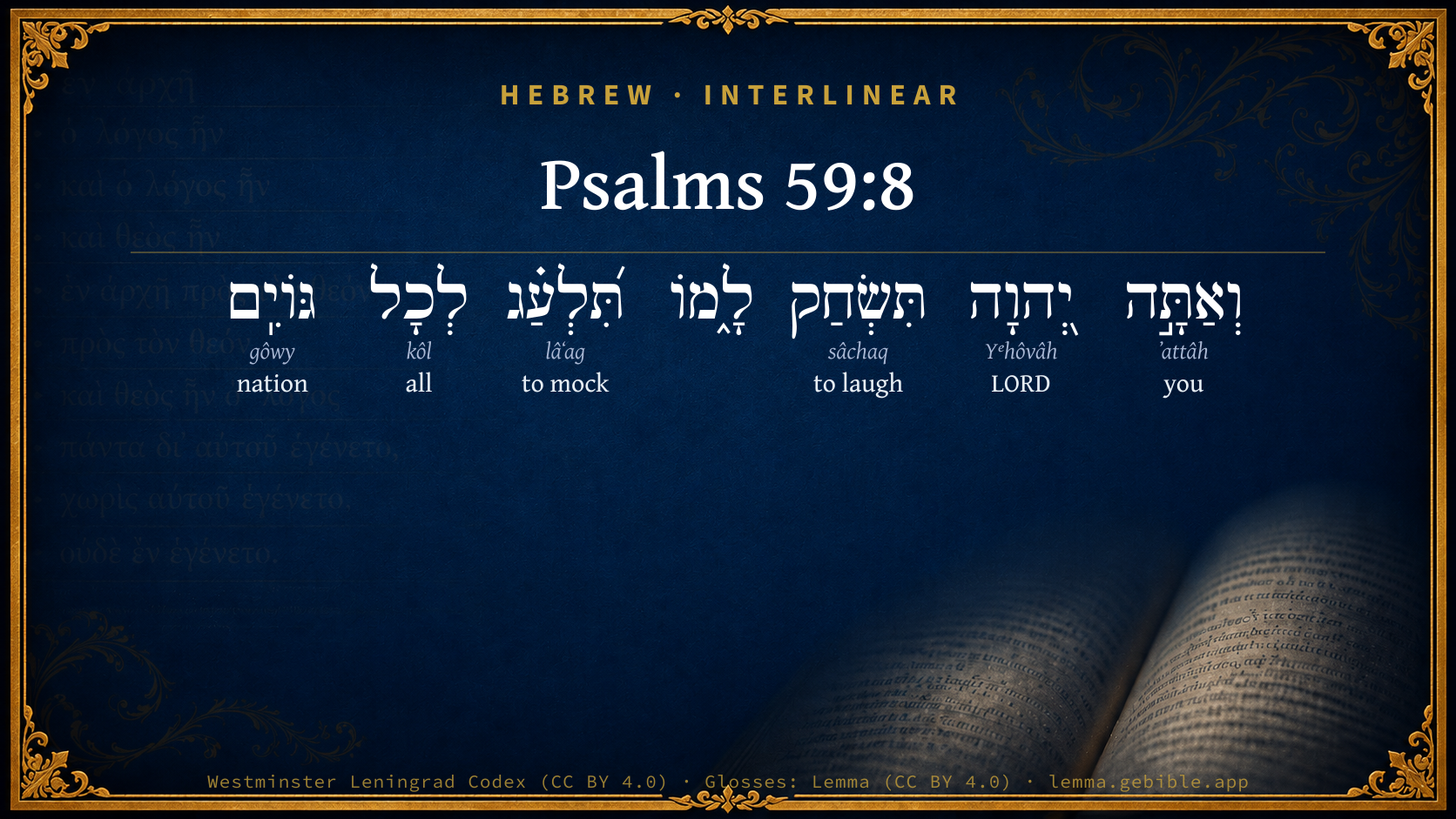
Psalms 59:8

Hebrew (Westminster Leningrad Codex) Psalms 59:8 appears in the Hebrew Old Testament. The text above is from the Westminster Leningrad Codex. Each word links to its Strong’s number, a concise gloss, and parsing drawn from the Open Scriptures Hebrew Bible morphology. Click any word for its full Brown-Driver-Briggs (BDB) entry.
Download image
Cite this verse

Psalms 59:8 (World English Bible). Public Domain. Lemma interlinear Bible study tool, https://lemma.gebible.app/v/psalms/59/8.

Show BibTeX & RIS
BibTeX
RIS
English Translation
But you, Yahweh, laugh at them. You scoff at all the nations.
World English Bible · Public Domain
Download a study sheet

One document with this verse’s original text, its word-by-word gloss line, the meaning frame, cross-references with their text, attributed commentary, and full source and license credits — printable, and it pastes into notes with its structure intact.

This verse Autodidact and up

Study sheet (.html) Plain text (.txt)

A passage Seminary Student

Up to 50 verses in one chapter. A passage sheet keeps up to 6 commentary sources and 12 cross-references per verse, in the order this page ranks them, and says so on the sheet whenever that leaves anything out. Ask for a single verse and you get the Autodidact verse sheet above.

Everything on this page stays free to read, with no account — the sheet is a download of what is already on screen, not access to it.

Want to remove ads? Support Godless Engineer
Compare translations 3

The same verse in 3 English versions, stacked beneath the original-language interlinear above. Click any original word for its lexicon entry.

Each is an independent rendering of the whole verse — the interlinear is not word-aligned to these translations.

Highlighted words mark where these versions differ — a whole-verse word diff, not a word-by-word alignment.

  • World English Bible Public Domain
    But you, Yahweh, laugh at them. You scoff at all the nations.
  • King James Version Public Domain
    But thou, O LORD, shalt laugh at them; thou shalt have all the heathen in derision.
  • unfoldingWord Literal Text CC BY-SA 4.0
    But you, Yahweh, laugh at them. You mock all of the nations.

unfoldingWord Literal Text — © unfoldingWord, licensed CC BY-SA 4.0. Word-aligned USFM3 via Door43 (git.door43.org/unfoldingWord/en_ult).

Versions to compare (up to 4)

3 of 4 selected

Show all 18 translations

Every available English version of this verse, each an independent rendering of the whole verse.

  • World English Bible Public Domain
    But you, Yahweh, laugh at them. You scoff at all the nations.
  • Berean Standard Bible Public Domain
    But You, O LORD, laugh at them; You scoff at all the nations.
  • Majority Standard Bible Public Domain
    But You, O LORD, laugh at them; You scoff at all the nations.
  • King James Version Public Domain
    But thou, O LORD, shalt laugh at them; thou shalt have all the heathen in derision.
  • American Standard Version (1901) Public Domain
    But thou, O Jehovah, wilt laugh at them; Thou wilt have all the nations in derision.
  • Revised Version (1885) Public Domain
    But thou, O LORD, shalt laugh at them; thou shalt have all the heathen in derision.
  • Geneva Bible (1599) Public Domain
    But thou, O Lord, shalt haue them in derision, and thou shalt laugh at all the heathen.
  • Douay-Rheims (1899) Public Domain
    Behold they shall speak with their mouth, and a sword is in their lips: for who, say they, hath heard us?
  • Young's Literal Translation Public Domain
    And Thou, O Jehovah dost laugh at them, Thou dost mock at all the nations.
  • Literal Standard Version CC BY-SA 4.0
    And You, O YHWH, laugh at them, || You mock at all the nations.
  • Unlocked Literal Bible CC BY-SA 4.0
    But you, Yahweh, laugh at them; you hold all the nations in derision.
  • unfoldingWord Literal Text CC BY-SA 4.0
    But you, Yahweh, laugh at them. You mock all of the nations.
  • Darby Bible Public Domain
    But thou, Jehovah, wilt laugh at them; thou wilt have all the nations in derision.
  • World Messianic Bible Public Domain
    But you, LORD, laugh at them. You scoff at all the nations.
  • Webster's Bible Public Domain
    \\59:7\\Behold, they belch out with their mouth: swords are in their lips: for who, say they, doth hear?
  • Free Bible Version CC BY-SA 4.0
    But you, Lord, you laugh at them; you pour scorn on all the nations.
  • Bible in Basic English Public Domain
    But you are laughing at them, O Lord; you will make sport of all the nations.
  • JPS Tanakh (1917) Public Domain
    (59-9) But Thou, O LORD, shalt laugh at them; Thou shalt have all the nations in derision.

Literal Standard Version (2020), Covenant Press — licensed CC BY-SA 4.0. Text via the HelloAO Bible API (eBible.org). Unlocked Literal Bible (unfoldingWord) — licensed CC BY-SA 4.0. Text via the HelloAO Bible API (eBible.org). unfoldingWord Literal Text — © unfoldingWord, licensed CC BY-SA 4.0. Word-aligned USFM3 via Door43 (git.door43.org/unfoldingWord/en_ult). Free Bible Version, Dr. Jonathan Gallagher — licensed CC BY-SA 4.0. Text via the HelloAO Bible API (eBible.org).

Word by word

More ways to search: Search by grammar → Find every occurrence → Compare this word →

Practice this passage: Drill this verse → Learn its vocabulary →

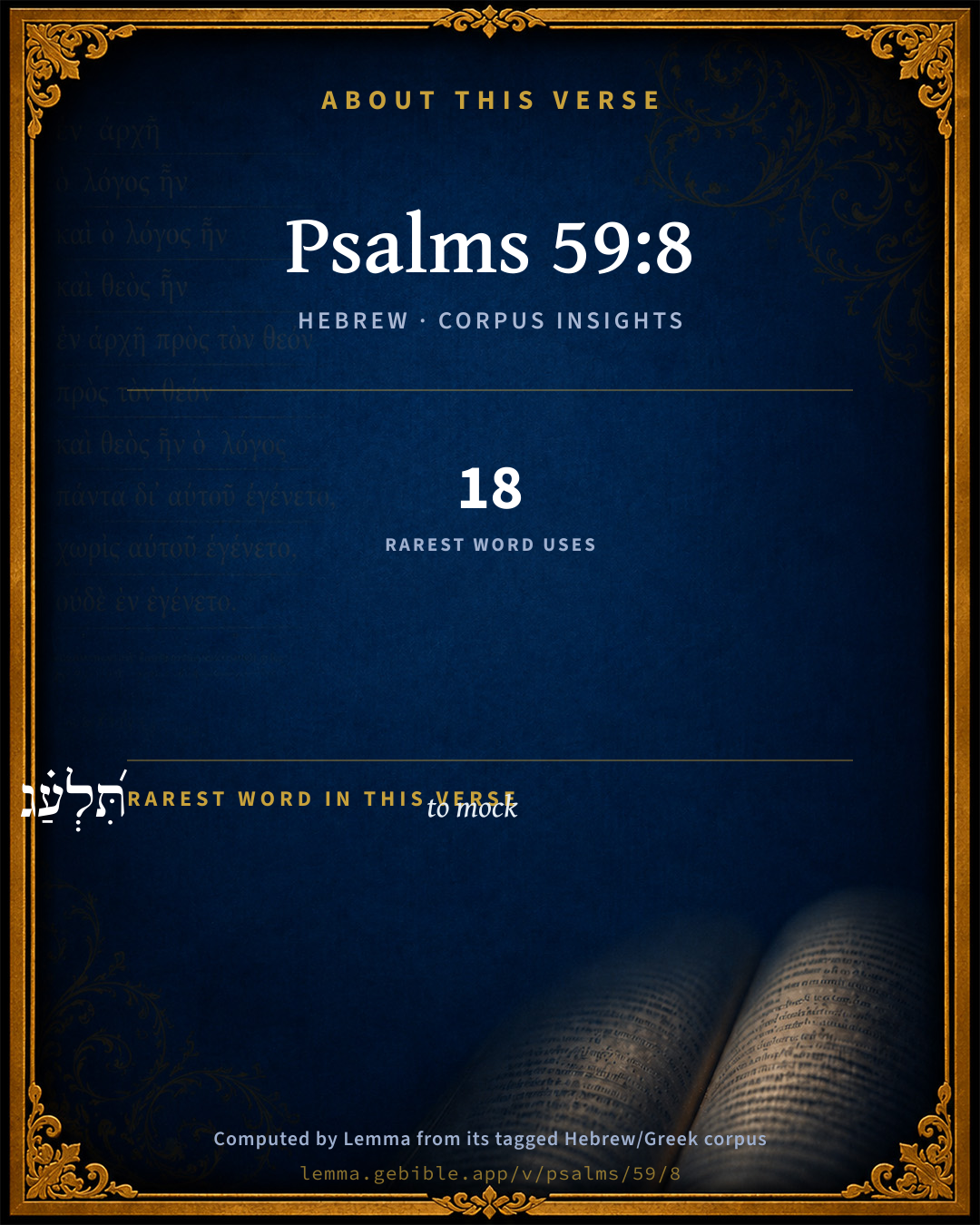
About this verse

These counts appear in no published source. They are computed here, from the morphology-tagged text and Lemma’s own curated glosses. What Lemma adds →

7
words
6
distinct lemmas
Wisdom
section

Notable vocabulary

The rarest word here is תִּ֝לְעַ֗ג to mock H3932 — appearing just 18 times in the whole Hebrew Bible.

Shared distinctive vocabulary

תִּ֝לְעַ֗ג to mock H3932 occurs in 18 verses of the Hebrew Bible. Also found in:

Grammatical profile

  • 2 verbs
  • 3 nouns
  • 1 pronoun
  • 1 preposition

Verb forms

  • תִּשְׂחַק Qal · Imperfect
  • תִּ֝לְעַ֗ג Qal · Imperfect

Hebrew & Septuagint length

In English translation the verse runs 12 words from the Hebrew and 17 from the Septuagint (LXX English) — closely comparable.

A rough comparison of the two English renderings, which tokenize alike — not a word-level alignment.

Word counts can differ between the Hebrew and the Greek without any difference in meaning — e.g. the Hebrew direct-object marker אֵת has no separate Greek word, and Greek often adds the article ὁ.

Cross-references

6

Topical passages linked to Psalms 59:8 in the Treasury of Scripture Knowledge — connected by theme and wording, ordered by reader-vote popularity; previews shown in the World English Bible.

  • Psalms 37:13 The Lord will laugh at him, For he sees that his day is coming.
  • Proverbs 1:26 I also will laugh at your disaster. I will mock when calamity overtakes you;
  • Psalms 2:4 He who sits in the heavens will laugh. The Lord will have them in derision.
  • Psalms 59:5 You, Yahweh God of hosts, the God of Israel, Rouse yourself to punish the nations. Show no mercy to the wicked traitors. Selah.
  • Matthew 18:17 If he refuses to listen to them, tell it to the assembly. If he refuses to hear the assembly also, let him be to you as a Gentile or a tax collector.
  • 1 Samuel 19:15–16 Saul sent the messengers to see David, saying, Bring him up to me in the bed, that I may kill him.

Cross-references courtesy of OpenBible.info (CC BY 4.0).

Hebrew and Greek witnesses Masoretic Hebrew ↔ Greek Septuagint

The same verse in the two great witnesses to the Old Testament, shown verse-for-verse.

You’re reading Greek Psalm 58 (Hebrew Psalm 59). The Septuagint counts the superscription, so verse numbers can differ from the Hebrew — chapter-level alignment, not verse-by-verse. Numbering follows Rahlfs.

These are two independent witnesses, not word-aligned to each other, and the Septuagint is shown in lemma (dictionary) form.

Hebrew Psalms 59:8 Masoretic · Westminster Leningrad Codex

וְאַתָּ֣ה יְ֭הוָה תִּשְׂחַק לָ֑מוֹ תִּ֝לְעַ֗ג לְכָל גּוֹיִֽם

But you, Yahweh, laugh at them. You scoff at all the nations.

World English Bible · Public Domain

Greek LXX Greek Psalm 58:8 Septuagint · lemma form

ἰδού ἀποφθέγγομαι ἐν ὁ στόμα αὐτός καί ῥομφαία ἐν ὁ χεῖλος αὐτός ὅτι τίς ἀκούω

But you, Lord, will laugh them to scorn; you will utterly set at nothing all the heathen.

LXX2012 (modern English Septuagint) · Public Domain

Hebrew: Westminster Leningrad Codex (CC BY 4.0). Greek: Septuagint (public domain); English from LXX2012 (modern English Septuagint) (Public Domain). How the Septuagint differs from the Hebrew →

Commentary

Notes on Psalms 59:8 from classic Christian and Jewish commentators (each source and its license shown beneath its notes). The classic Christian expositions comment on the surrounding passage and are grouped to its opening verse, so a note may address several verses; the Jewish commentaries on the Tanakh (Rashi and others) are per-verse, so they appear only where the commentator wrote on this verse.

Lemma curates 59 commentaries, every one of them public domain or Creative Commons licensed, each selected and text-cleaned for this edition rather than reprinted as found. About our sources →

Matthew Henry's Commentary

David here encourages himself, in reference to the threatening power of his enemies, with a pious resolution to wait upon God and a believing expectation that he should yet praise him.

I. He resolves to wait upon God (Psa 59:9): "Because of his strength" (either the strength of his enemies, the fear of which drove him to God, or because of God's strength, the hope of which drew him to God) "Will I wait upon thee, with a believing dependence upon thee and confidence in thee." It is our wisdom and duty, in times of danger and difficulty, to wait upon God; for he is our defence, our high place, in whom we shall be safe. He hopes, 1. That God will be to him a God of mercy (Psa 59:10): "The God of my mercy shall prevent me with the blessings of his goodness and the gifts of his mercy, prevent my fears, prevent my prayers, and be better to me than my own expectations." It is very comfortable to us, in prayer, to eye God, not only as the God of mercy, but as the God of our mercy, the author of all good in us and the giver of all good to us. Whatever mercy there is in God, it is laid up for us, and is ready to be laid out upon us. Justly does the psalmist call God's mercy his mercy, for all the blessings of the new covenant are called the sure mercies of David (Isa 55:3); and they are sure to all the seed. 2. That he will be to his persecutors a God of vengeance. His expectation of this he expresses partly by way of prediction and partly by way of petition, which come all to one; for his prayer that it might be so amounts to a prophecy that it shall be so. Here are several things which he foretels concerning his enemies, or observers, that sought occasions against him and opportunity to do him a mischief, in all which he should see his desire, not a passionate or revengeful desire, but a believing desire upon them, Psa 59:10. (1.) He foresees that God would expose them to scorn, as they had indeed made themselves ridiculous, Psa 59:8. "They think God does not hear them, does not heed them; but thou, O Lord! shalt laugh at them for their folly, to think that he who planted the ear shall not hear, and thou shalt have not them only, but all such other heathenish people that live without God in the world, in derision." Note, Atheists and persecutors are worthy to be laughed at and had in derision. See Psa 2:4; Pro 1:26; Isa 37:22. (2.) That God would make them standing monuments of his justice (Psa 59:11): Slay them not; let them not be killed outright, lest my people forget. If the execution be soon done, the impressions of it will not be keep, and therefore will not be durable, but will quickly wear off. Swift destructions startle men for the present, but they are soon forgotten, for which reason he prays that this might be gradual: "Scatter them by thy power, and let them carry about with them, in their wanderings, such tokens of God's displeasure as may spread the notice of their punishment to all parts of the country." Thus Cain himself, though a murderer, was not slain, lest the vengeance should be forgotten, but was sentenced to be a fugitive and a vagabond. Note, When we think God's judgments come slowly upon sinners we must conclude that God has wise and holy ends in the gradual proceedings of his wrath. "So scatter them as that they may never again unite to do mischief, bring them down, O Lord, our shield!" If God has undertaken the protection of his people as their shield, he will doubtless humble and abase all those that fight against them. (3.) That they might be dealt with according to their deserts (Psa 59:12): For the sin of their mouth, even for the words of their lips (for every word they speak has sin in it), let them for this be taken in their pride, even for their cursing others and themselves (a sin Saul was subject to, Sa1 14:28, Sa1 14:44), and lying. Note, There is a great deal of malignity in tongue-sins, more than is commonly thought of. Note, further, Cursing, and lying, and speaking proudly, are some of the worst of the sins of the tongue; and that man is truly miserable whom God deals with according to the deserts of these, making his own tongue to fall on him. (4.) That God would glorify himself, as Israel's God and King, in their destruction (Psa 59:13): "Consume them in wrath, consume them; that is, follow them with one judgment after another, till they be utterly ruined; let them be sensibly, but gradually wasted, that they themselves, while they are in the consuming, may know, and that the standers-by may likewise draw this inference form it, That God ruleth in Jacob unto the ends of the earth." Saul and his party think to rule and carry all before them, but they shall be made to know that there is a higher than they, that there is one who does and will overrule them. The design of God's judgments is to convince men that the Lord reigns, that he fulfils his own counsels, gives law to all the creatures, and disposes all things to his own glory, so that the greatest of men are under his check, and he makes what use he pleases of them. He rules in Jacob; for there he keeps his court; there it is known, and his name is great. But he rules to the end of the earth; for all nations are within the territories of his kingdom. He rules to the ends of the earth, even over those that know him not, but he rules for Jacob (so it may be read); he has an eye to the good of his church in the government of the world; the administrations of that government, even to the ends of the earth, are for Jacob his servant's sake and for Israel's his elect, Isa 45:4. (5.) That he would make their sin their punishment, Psa 59:14, compare Psa 59:6. Their sin was their hunting for David to make a prey of him; their punishment should be that they should be reduced to such extreme poverty that they should hunt about for meat to satisfy their hunger, and should miss of it as they missed of David. Thus they should be, not cut off at once, but scattered (Psa 59:11), and gradually consumed (Psa 59:13); those that die by famine die by inches, and feel themselves die, Lam 4:9. He foretels that they should be forced to beg their bread from door to door. [1.] That they should do it with the greatest regret and reluctancy imaginable. To beg they are ashamed (which makes it the greater punishment to them), and therefore they do it at evening, when it begins to be dark, that they may not be seen, at the time when other beasts of prey creep forth, Psa 104:20. [2.] That yet they should be very clamorous and loud in their complaints, which would proceed from a great indignation at their condition, which they cannot in the least degree reconcile themselves to: They shall make a noise like a dog. When they were in quest of David they made a noise like an angry dog snarling and barking; now, when they are in quest of meat, they shall make a noise like a hungry dog howling and wailing. Those that repent of their sins mourn, when in trouble, like doves; those whose hearts are hardened make a noise, when in trouble, like dogs, like a wild bull in a net, full of the fury of the Lord. See Hos 7:14, They have not cried unto me with their heart when they howled on their beds for corn and wine. [3.] That they should meet with little relief, but the hearts of people should be very much hardened towards them, so that they should go round about the city, and wander up and down for meat (Psa 59:15), and should get nothing but by dint of importunity (according to our marginal reading, If they be not satisfied, they will tarry all night), so that what people do give them is not with good-will, but only to get rid of them, lest by their continual coming they weary them. [4.] That they should be insatiable, which is the greatest misery of all in a poor condition. They are greedy dogs which can never have enough (Isa 56:11), and they grudge if they be not satisfied. A contented man, if he has not what he would have, yet does not grudge, does not quarrel with Providence, nor fret within himself; but those whose God is their belly, if that be not filled and its appetites gratified, fall out both with God and themselves. It is not poverty, but discontent, that makes a man unhappy.

II. He expects to praise God, that God's providence would find him matter for praise and that God's grace would work in him a heart for praise, Psa 59:16, Psa 59:17. Observe,

1. What he would praise God for. (1.) He would praise his power and his mercy; both should be the subject-matter of his song. Power, without mercy, is to be dreaded; mercy, without power, is not what a man can expect much benefit from; but God's power by which he is able to help us, and his mercy by which he is inclined to help us, will justly be the everlasting praise of all the saints. (2.) He would praise him because he had, many a time, and all along, found him his defence and his refuge in the day of trouble. God brings his people into trouble, that they may experience his power and mercy in protecting and sheltering them, and may have occasion to praise him. (3.) He would praise him because he had still a dependence upon him and a confidence in him, as his strength to support him and carry him on in his duty, his defence to keep him safe from evil, and the God of his mercy to make him happy and easy. He that is all this to us is certainly worthy of our best affections, praises, and services.

2. How he would praise God. (1.) He would sing. As that is a natural expression of joy, so it is an instituted ordinance for the exerting and exciting of holy joy and thankfulness. (2.) He would sing aloud, as one much affected with the glory of God, that was not ashamed to own it, and that desired to affect others with it. He will sing of God's power, but he will sing aloud of his mercy; the consideration of that raises his affections more than any thing else. (3.) He would sing aloud in the morning, when his spirits were most fresh and lively. God's compassions are new every morning, and therefore it is fit to begin the day with his praises. (4.) He would sing unto God (Psa 59:17), to his honour and glory, and with him in his eye. As we must direct our prayers to God, so to him we must direct our praises, and must look up, making melody to the Lord.

Matthew Henry's Commentary on the Whole Bible (1708–1710) — public domain (CC PDM 1.0). Text via the HelloAO Bible API.

Trapp's Complete Commentary

John Trapp

Psa 59:8 But thou, O LORD, shalt laugh at them; thou shalt have all the heathen in derision.

Ver. 8. But thou, O Lord, shalt laugh at them] q.d. Thou not only hearest, but jeerest, at their madness, and wilt bring all their purposes to nought with little ado; and, as it were, playing and sporting. See Psa 2:4.

John Trapp, A Commentary or Exposition upon All the Books of the Old and New Testament (1647–1656) — public domain. Text from a community e-Sword module.

Joseph Benson's Commentary

Psa 59:8-9. But thou, O Lord, shalt laugh at them — Shalt disappoint their high confidence and hopeful designs, and then deride them, and make them ridiculous and contemptible to others. Because of his strength — That is, Saul’s strength, because he is too strong for me: or, as to his strength; will I wait on thee — Hebrew, אליךְ אשׁמרה, eeleicha eshmorah, I will observe, or look, to thee. “Saul’s soldiers give me no concern; mine eyes are toward thee;” for God is my defence — Hebrew, משׁגבי, mishgabbi, my high place, my refuge.

Joseph Benson's Commentary on the Old and New Testaments (1811–1818) — public domain. Text from a community e-Sword module.

Whedon's Commentary on the Bible

Daniel D. Whedon

8. But thou… shalt laugh at them—Indicating with what infinite ease God will frustrate them. See on Psa_2:4.

All the heathen—This recurrence to the Gentile nations suggests how strongly David’s mind is impressed that, back of Saul and the mercenary Doeg, there was a heathen plot, or intrigue, which had worked its way into Saul’s court and threatened evil to the Hebrew people. See note on Psa_59:5. The preceding verses describe David’s enemies. The adversative sense of the particle ve, but, at the beginning of Psa_59:8, changes the subject to the contemplation of the power, mercy and judgment of God.

Daniel D. Whedon (gen. ed.), Commentary on the Old and New Testaments (1874–1909) — public domain. Text from a community e-Sword module.

J. A. Alexander on Psalms

Joseph Addison Alexander

9. (Psa 59:8). And thou, Jehovah, wilt laugh at them; thou wilt mock at all nations. The resistance of whole nations, or of all collectively, is but an object of contempt to thee; how much more that of even the most potent individuals. See above, on Psa 2:4; Psa 37:13. The connection between this verse and the one before it depends upon the meaning of the question with which Psa 59:7 closes. If that be regarded as the language of the enemy, the thought to be supplied is, "But although they thus imagine that thou dost not hear, thou wilt soon undeceive them by deriding them." On the other supposition it is this: "Although I am continually tempted to say, who doth hear? I am, nevertheless, persuaded that thou dost hear and despise their impotent malignity."

Joseph Addison Alexander, The Psalms Translated and Explained (1850) — public domain. Text from a community e-Sword module.

Jamieson, Fausset & Brown

Robert Jamieson, A. R. Fausset & David Brown

(Compare Psa 2:4; Psa 37:13).

Jamieson, Fausset & Brown — Commentary Critical and Explanatory on the Whole Bible (1871) — public domain (CC PDM 1.0). Text via the HelloAO Bible API.

Adam Clarke's Commentary

Verse 8. Thou, O Lord, shalt laugh at them] They have mocked us; God will turn them and their schemes into ridicule and contempt: "Thou shalt have all these heathenish nations in derision."

Adam Clarke's Commentary on the Bible (1810–1826) — public domain. Text from a community e-Sword/MySword module.

John Calvin's Commentaries

8. But thou, O Jehovah! shalt laugh at them. In the face of all this opposition, David only rises to greater confidence. When he says that God would laugh at his enemies, he employs a figure which is well fitted to enhance the power of God, suggesting that, when the wicked have perfected their schemes to the uttermost, God can, without any effort, and, as it were, in sport, dissipate them all. No sooner does God connive at their proceedings, than their pride and insolence take occasion to manifest themselves: for they forget that even when he seems to have suspended operation, he needs but nod, and his judgments shall be executed. David, accordingly, in contempt of his adversaries, tells them that God was under no necessity to make extensive preparations, but, at the moment when he saw fit to make retribution, would, by a mere play of his power, annihilate them all. He in this manner conveys a severe rebuke to that blind infatuation which led them to boast so intemperately of their own powers, and to imagine that God was slumbering in the heavens. In the close of the verse, mention is made of all nations, to intimate that though they might equal the whole world in numbers, they would prove a mere mockery with all their influence and resources. Or the words may be read — Even As thou hast all the nations in derision. One thing is obvious, that David ridicules the vain boasting of his enemies, who thought no undertaking too great to be accomplished by their numbers.

John Calvin's Commentaries (1540-1563) — public domain. Text from the Calvin Translation Society English edition (1840s-50s) via the Christian Classics Ethereal Library (ccel.org). Calvin's coverage is partial (roughly two-thirds of the Bible); uncommented books and verses are honest gaps, never fabricated. The 19th-century editor's footnotes and remarks are omitted so the notes are faithfully Calvin's own voice.

Ellicott's Commentary for English Readers

(8) Laugh.—Comp. Psa_2:4, Note. Probably the same contrast is intended in these clauses as in Psa_59:5.

A Bible Commentary for English Readers, edited by Charles John Ellicott (1878–1897) — public domain. Text from a community e-Sword module.

The Cambridge Bible for Schools and Colleges

gen. ed. J. J. S. Perowne

8. The verbs are the same as in Psa_2:4 : cp. Psa_37:13; Isa_37:22. The bold phrase “expresses generally the truth that the machinations of God’s enemies are not less absurd than wicked.” Speaker’s Comm.

For the meaning of ‘heathen’ or ‘nations,’ see note on Psa_59:5.

The Cambridge Bible for Schools and Colleges (gen. ed. J. J. S. Perowne; Cambridge University Press, 1878–1918) — public domain. Text from a community e-Sword module.

John Gill's Exposition

But thou, O Lord, shall laugh at them,.... Disappoint their counsels, hinder them from performing their enterprise; send them back with shame and confusion, and expose them to the laughter and derision of others; as Saul's messengers were, when instead of David they found an image in the bed, with a pillow of goats' hair for its bolster, Sa1 19:16; the same is said as here with respect to the enemies of Christ, Psa 2:4;

thou shall have all the Heathen in derision: either David's enemies, who, though Israelites, yet acted like Heathens to him, as in Psa 59:5; or the Gentiles that were gathered together against Christ, Psa 2:1; or the antichristian states and powers, who will be triumphed over at the time of their ruin, Rev 18:20; and even all the wicked at the last day, Pro 1:26.

John Gill's Exposition of the Whole Bible (1746–1763) — public domain (CC PDM 1.0). Text via the HelloAO Bible API.

Albert Barnes' Notes on the Bible

But thou, O Lord, shalt laugh at them - That is, God will hear them, and will have all their efforts in derision, or will treat them with contempt. See Psa 2:4, note; Psa 37:13, note.

Thou shalt have all the heathen in derision - All those referred to in this psalm - the enemies of David - who have the character, and who manifest the spirit of the pagan; that is, of those who are not actuated by true religion. See the notes at Psa 59:5. This verse expresses the strong conviction of David, that all the efforts of his enemies would be vain; that God “would be” his Protector; and that he would save him from their evil designs.

Albert Barnes' Notes on the Bible (1834–1885) — public domain. Text from a community e-Sword/MySword module.

Matthew Poole's English Annotations

Disappoint their high confidences and hopeful designs, and then deride them, and make them ridiculous and contemptible to others.

Matthew Poole's English Annotations on the Holy Bible (1683–1685) — public domain. Text from a community e-Sword/MySword module.

The Treasury of David

Charles H. Spurgeon

Ver. 8. But thou, O Lord, shalt laugh at them. He speaks to God, as to one who is close at hand. He points to the liers in wait and speaks to God about them. They are laughing at me, and longing for my destruction, but thou hast the laugh of them seeing thou hast determined to send them away without their victim, and made fools of by Michal. The greatest, cleverest, and most malicious of the enemies of the church are only objects of ridicule to the Lord; their attempts are utterly futile, they need give no concern to our faith.

Thou shalt have all the heathen in derision. As if David had said --What are these fellows who lie in ambush! And what is the king their master, if God be on my side? If not only these but all the heathen nations were besetting the house, yet Jehovah would readily enough disappoint them and deliver them. In the end of all things it will be seen how utterly contemptible and despicable are all the enemies of the cause and kingdom of God. He is a brave man who sees this today when the enemy is in great power, and while the church is often as one shut up and besieged in his house.

Ver. 8. God sees and smiles, he looks and laughs at these giants; he sits in heaven far above their reach; neither doth he much trouble himself about the matter; no more should we, but trust in him, and know that there is a counsel in heaven, that will dash the mould of all contrary counsels upon the earth, as the stone cut out of the mountain did the four great monarchies. Da 2:34. And therefore though the wicked, in the pride of his heart, doth persecute the poor; though they belch out with their mouth, and seek to double murder the innocent, by detraction and by deadly practice, yet God both hears and jeers at their madness, and will bring all their purposes to nought with little ado; nay, the very cruelty of his enemies will move God to make haste. The saints fare the better for the insolence and outrages of their enemies, whose ruin is thereby accelerated; and somewhat God will do the sooner for his people, lest the enemy exalt himself. Ps 140:8. Abraham Wright.

Ver. 8. (last clause). In the close of the verse, mention is made of all nations, to intimate, that though they might equal the whole world in numbers, they would prove a mere mockery with all their influence and resources. Or the words may be read--EVEN AS thou hast all the nations in derision. One thing is obvious, that David ridicules the vain boasting of his enemies, who thought no undertaking too great to be accomplished by their numbers. John Calvin.

Ver. 8-9.

8 But thou, Lord, laugh at them;

You deride all the heathen.

9 His strength! Toward thee will I keep watch,

For God is my high fort. William Kay.

None.

Psalms 59:9*

Ver. 8-9.

8 But thou, Lord, laugh at them;

You deride all the heathen.

9 His strength! Toward thee will I keep watch,

For God is my high fort. William Kay.

Charles H. Spurgeon's The Treasury of David (1869–1885) — public domain. Psalms only. Text from a community e-Sword/MySword module.

The Pulpit Commentary

But thou, O Lord, shalt laugh at them. (comp. Psa_2:4) Thou shalt have all the heathen in derision (see the comment on ver. 5, and particularly the explanation there given of "all the heathen").

The Pulpit Commentary (1880–1919), ed. H.D.M. Spence-Jones & Joseph S. Exell — public domain. Text from a community e-Sword module.

unfoldingWord translationNotes

Door43 World Missions Community

laugh at them

"laugh at them scornfully" or "mock them." God would laugh at them because they are worthless and powerless.

you hold all the nations in derision

"you ridicule all the nations" or "you know that the people of the nations are fools"

derision

ridicule

my strength

God's being the psalmist's strength represents God protecting him. AT: "you are my strength" or "you are my protector" (See: Metonymy)

you are my high tower

A high tower is a place that people could go to for shelter from their enemies. The psalmist speaks of God protecting him as if God were a strong, safe shelter. AT: "you protect me like a high tower" (See: Metaphor)

translationWords

Yahweh

nation

God

strength

watchtower

unfoldingWord translationNotes — © Distant Shores Media and the Door43 World Missions Community, licensed CC BY-SA 4.0. Source: git.door43.org/Door43/en_tn.

Rashi

Rabbi Shlomo Yitzchaki (Rashi)

swords in their lips and they think to themselves, “Who hears?”

Rashi on the Tanakh — English translations: “The Judaica Press complete Tanach with Rashi, translated by A. J. Rosenberg” (CC BY 4.0); “Pentateuch with Rashi's commentary by M. Rosenbaum and A.M. Silbermann, 1929-1934” (public domain); “The Metsudah Tanach series, Lakewood, N.J” (CC BY 4.0); and “The Book of Joshua, Metsudah Publications, 1997” (CC BY 4.0). Text via Sefaria.

Lesson kit

Teaching starters — assembled from the data on this page, not authored interpretation. Every prompt links to the verse data it draws on. Edit before teaching.

Psalms, in the Wisdom, opens this verse with 7 words (6 distinct Hebrew lemmas). Its most distinctive word is lâʻag (“to mock”). A historical commentator’s framing appears above. Read the whole chapter for the surrounding context.

Discussion questions

  1. How does “to mock” (lâʻag) shape what this verse is saying?
  2. 2 Kings 19:21 shares the word «to mock» with this verse. How do the two illuminate each other?
  3. The translations on this page render this verse differently — a whole-verse word diff, not a word-by-word alignment. What might account for the different wordings?
  4. The verb «תִּשְׂחַק» is Qal Imperfect. How does its form color the action?
  5. Reading how Matthew Henry's Commentary and Trapp's Complete Commentary read this verse, where do the two commentators agree and where do they part?

Things to notice

Reading settings

Reading text

Shown beneath each verse's original-language words.

Old Testament
Old Testament edition

Read the OT as the Masoretic Hebrew (MT) or the Greek Septuagint (LXX).

English shown for the Greek Septuagint (in the Hebrew ↔ Greek comparison).

Comparing translations? Open the Compare panel on any verse page to stack up to four side by side.