
Deuteronomy 31:3

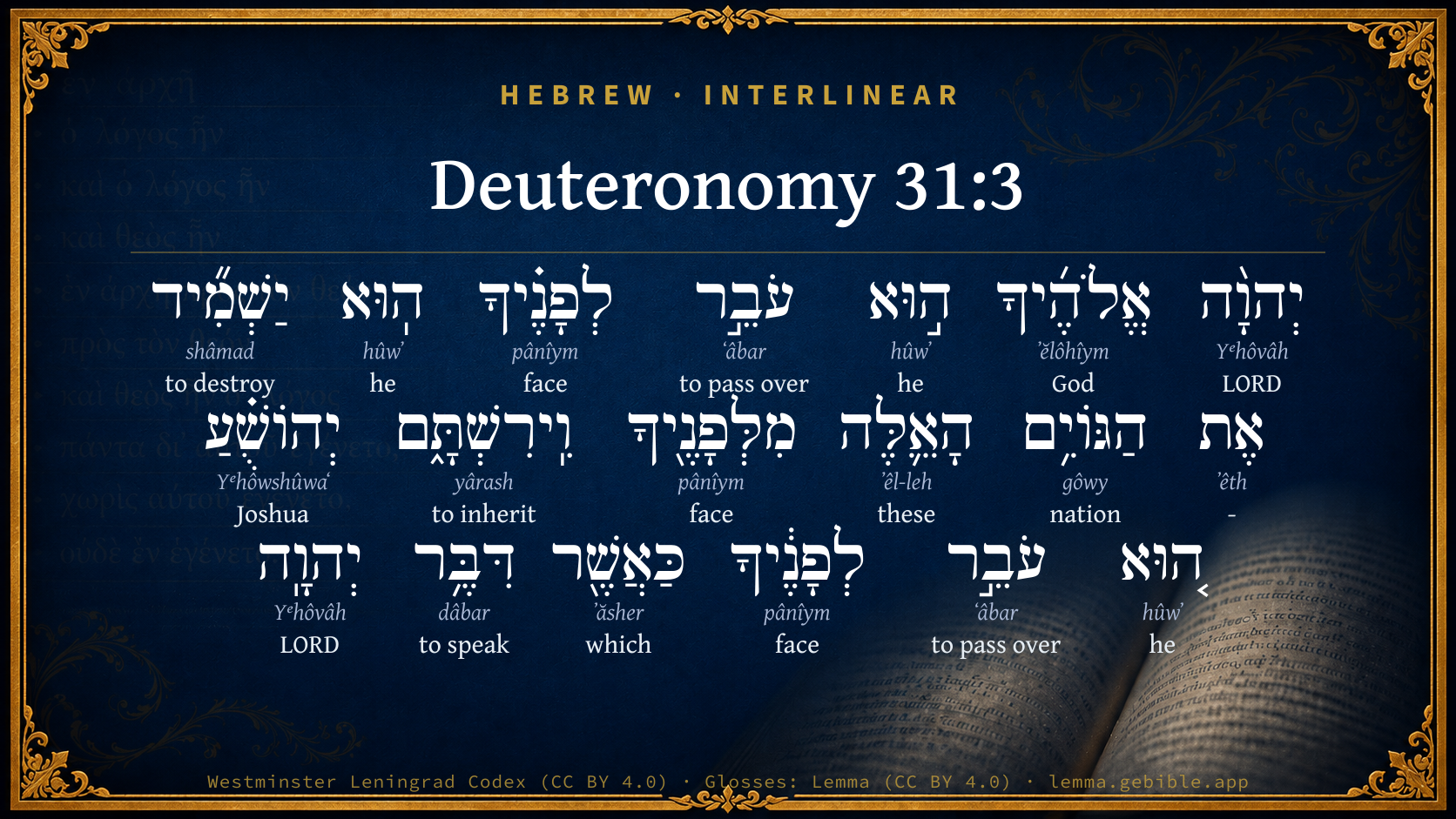
Hebrew (Westminster Leningrad Codex) Deuteronomy 31:3 appears in the Hebrew Old Testament. The text above is from the Westminster Leningrad Codex. Each word links to its Strong’s number, a concise gloss, and parsing drawn from the Open Scriptures Hebrew Bible morphology. Click any word for its full Brown-Driver-Briggs (BDB) entry.
Download image
Cite this verse

Deuteronomy 31:3 (World English Bible). Public Domain. Lemma interlinear Bible study tool, https://lemma.gebible.app/v/deuteronomy/31/3.

Show BibTeX & RIS
BibTeX
RIS
English Translation
Yahweh your God, he will go over before you; he will destroy these nations from before you, and you shall dispossess them: [and] Joshua, he shall go over before you, as Yahweh has spoken.
World English Bible · Public Domain
Download a study sheet

One document with this verse’s original text, its word-by-word gloss line, the meaning frame, cross-references with their text, attributed commentary, and full source and license credits — printable, and it pastes into notes with its structure intact.

This verse Autodidact and up

Study sheet (.html) Plain text (.txt)

A passage Seminary Student

Up to 50 verses in one chapter. A passage sheet keeps up to 6 commentary sources and 12 cross-references per verse, in the order this page ranks them, and says so on the sheet whenever that leaves anything out. Ask for a single verse and you get the Autodidact verse sheet above.

Everything on this page stays free to read, with no account — the sheet is a download of what is already on screen, not access to it.

Want to remove ads? Support Godless Engineer
Compare translations 3

The same verse in 3 English versions, stacked beneath the original-language interlinear above. Click any original word for its lexicon entry.

Each is an independent rendering of the whole verse — the interlinear is not word-aligned to these translations.

Highlighted words mark where these versions differ — a whole-verse word diff, not a word-by-word alignment.

  • World English Bible Public Domain
    Yahweh your God, he will go over before you; he will destroy these nations from before you, and you shall dispossess them: [and] Joshua, he shall go over before you, as Yahweh has spoken.
  • King James Version Public Domain
    The LORD thy God, he will go over before thee, and he will destroy these nations from before thee, and thou shalt possess them: and Joshua, he shall go over before thee, as the LORD hath said.
  • unfoldingWord Literal Text CC BY-SA 4.0
    Yahweh your God, he will go over to your faces; he will destroy these nations from to your faces, and you will dispossess them. Joshua, he will go over to your faces, as Yahweh has spoken.

unfoldingWord Literal Text — © unfoldingWord, licensed CC BY-SA 4.0. Word-aligned USFM3 via Door43 (git.door43.org/unfoldingWord/en_ult).

Versions to compare (up to 4)

3 of 4 selected

Show all 18 translations

Every available English version of this verse, each an independent rendering of the whole verse.

  • World English Bible Public Domain
    Yahweh your God, he will go over before you; he will destroy these nations from before you, and you shall dispossess them: [and] Joshua, he shall go over before you, as Yahweh has spoken.
  • Berean Standard Bible Public Domain
    The LORD your God Himself will cross over ahead of you. He will destroy these nations before you, and you will dispossess them. Joshua will cross ahead of you, as the LORD has said.
  • Majority Standard Bible Public Domain
    The LORD your God Himself will cross over ahead of you. He will destroy these nations before you, and you will dispossess them. Joshua will cross ahead of you, as the LORD has said.
  • King James Version Public Domain
    The LORD thy God, he will go over before thee, and he will destroy these nations from before thee, and thou shalt possess them: and Joshua, he shall go over before thee, as the LORD hath said.
  • American Standard Version (1901) Public Domain
    Jehovah thy God, he will go over before thee; he will destroy these nations from before thee, and thou shalt dispossess them: `and' Joshua, he shall go over before thee, as Jehovah hath spoken.
  • Revised Version (1885) Public Domain
    The LORD thy God, he will go over before thee; he will destroy these nations from before thee, and thou shalt possess them: and Joshua, he shall go over before thee, as the LORD hath spoken.
  • Geneva Bible (1599) Public Domain
    The Lord thy God he will go ouer before thee: he will destroy these nations before thee, and thou shalt possesse them. Ioshua, he shall goe before thee, as the Lord hath said.
  • Douay-Rheims (1899) Public Domain
    The Lord thy God then will pass over before thee: he will destroy all these nations in thy sight, and thou shalt possess them: and this Josue shall go over before thee, as the Lord hath spoken.
  • Young's Literal Translation Public Domain
    `Jehovah thy God He is passing over before thee, He doth destroy these nations from before thee, and thou hast possessed them; Joshua -- he is passing over before thee as Jehovah hath spoken,
  • Literal Standard Version CC BY-SA 4.0
    Your God YHWH—He is passing over before you; He destroys these nations from before you, and you have possessed them; Joshua—he is passing over before you, as YHWH has spoken.
  • Unlocked Literal Bible CC BY-SA 4.0
    Yahweh your God, he will go over before you; he will destroy these nations from before you, and you will dispossess them. Joshua, he will go over before you, as Yahweh has spoken.
  • unfoldingWord Literal Text CC BY-SA 4.0
    Yahweh your God, he will go over to your faces; he will destroy these nations from to your faces, and you will dispossess them. Joshua, he will go over to your faces, as Yahweh has spoken.
  • Darby Bible Public Domain
    Jehovah thy God, he will go over before thee, he will destroy these nations from before thee, that thou mayest take possession of them: Joshua, he shall go over before thee, as Jehovah hath said.
  • World Messianic Bible Public Domain
    The LORD your God himself will go over before you. He will destroy these nations from before you, and you shall dispossess them. Joshua will go over before you, as the LORD has spoken.
  • Webster's Bible Public Domain
    The LORD thy God, he will go over before thee, and he will destroy these nations from before thee, and thou shalt possess them: and Joshua he shall go over before thee, as the LORD hath said.
  • Free Bible Version CC BY-SA 4.0
    The Lord your God himself is going to lead you across. He will destroy these nations as you advance, and you will take over their land. Joshua will cross ahead of you, as the Lord said.
  • Bible in Basic English Public Domain
    The Lord your God, he will go over before you; he will send destruction on all those nations, and you will take their land as your heritage: and Joshua will go over at your head as the Lord has said.
  • JPS Tanakh (1917) Public Domain
    The LORD thy God, He will go over before thee; He will destroy these nations from before thee, and thou shalt dispossess them; and Joshua, he shall go over before thee, as the LORD hath spoken.

Literal Standard Version (2020), Covenant Press — licensed CC BY-SA 4.0. Text via the HelloAO Bible API (eBible.org). Unlocked Literal Bible (unfoldingWord) — licensed CC BY-SA 4.0. Text via the HelloAO Bible API (eBible.org). unfoldingWord Literal Text — © unfoldingWord, licensed CC BY-SA 4.0. Word-aligned USFM3 via Door43 (git.door43.org/unfoldingWord/en_ult). Free Bible Version, Dr. Jonathan Gallagher — licensed CC BY-SA 4.0. Text via the HelloAO Bible API (eBible.org).

Word by word

More ways to search: Search by grammar → Find every occurrence → Compare this word →

Practice this passage: Drill this verse → Learn its vocabulary →

יַשְׁמִ֞יד
shâmad
H8045
“to destroy”
Verb, Hiphil, Imperfect, 3rd Person, Masculine, Singular
Part of Speech
Verb
Stem
Hiphil
Form
Imperfect
Person
3rd Person
Gender
Masculine
Number
Singular
Full BDB Definition

Origin: a primitive root

TWOT: 2406

to destroy, exterminate, be destroyed, be exterminated - (Niphal) - to be annihilated, be exterminated - to be destroyed, be devastated - (Hiphil) - to annihilate, exterminate - to destroy
  1. יְהוָ֨ה Yᵉhôvâh H3068 “LORD” Noun, Proper
  2. אֱלֹהֶ֜יךָ ʼĕlôhîym H430 “God(s) · your” Noun, Common, Masculine, Plural, Construct + Suffix, Personal, 2nd Person, Masculine, Singular
  3. ה֣וּא hûwʼ H1931 “he” Pronoun, Personal, 3rd Person, Masculine, Singular
  4. עֹבֵ֣ר ʻâbar H5674 “passing over” Verb, Qal, Participle Active, Masculine, Singular, Absolute
  5. לְפָנֶ֗יךָ pânîym H6440 “to/for · face(s) · your” Preposition + Noun, Common, Both, Plural, Construct + Suffix, Personal, 2nd Person, Masculine, Singular
  6. הֽוּא hûwʼ H1931 “he” Pronoun, Personal, 3rd Person, Masculine, Singular
  7. אֶת ʼêth H853 “-” Particle, Direct Object
  8. הַגּוֹיִ֥ם gôwy H1471 “the · nations” Particle, Definite Article + Noun, Common, Masculine, Plural, Absolute
  9. הָאֵ֛לֶּה ʼêl-leh H428 “the · these” Particle, Definite Article + Pronoun, Demonstrative, Common, Plural
  10. מִלְּפָנֶ֖יךָ pânîym H6440 “from · to/for · face(s) · your” Preposition + Preposition + Noun, Common, Both, Plural, Construct + Suffix, Personal, 2nd Person, Masculine, Singular
  11. וִֽירִשְׁתָּ֑ם yârash H3423 “and · to inherit · them” Conjunction + Verb, Qal, Sequential Perfect, 2nd Person, Masculine, Singular + Suffix, Personal, 3rd Person, Masculine, Plural
  12. יְהוֹשֻׁ֗עַ Yᵉhôwshûwaʻ H3091 “Joshua” Noun, Proper
  13. ה֚וּא hûwʼ H1931 “he” Pronoun, Personal, 3rd Person, Masculine, Singular
  14. עֹבֵ֣ר ʻâbar H5674 “passing over” Verb, Qal, Participle Active, Masculine, Singular, Absolute
  15. לְפָנֶ֔יךָ pânîym H6440 “to/for · face(s) · your” Preposition + Noun, Common, Both, Plural, Construct + Suffix, Personal, 2nd Person, Masculine, Singular
  16. כַּאֲשֶׁ֖ר ʼăsher H834 “like/as · which” Preposition + Particle, Relative
  17. דִּבֶּ֥ר dâbar H1696 “to speak” Verb, Piel, Perfect, 3rd Person, Masculine, Singular
  18. יְהוָֽה Yᵉhôvâh H3068 “LORD” Noun, Proper

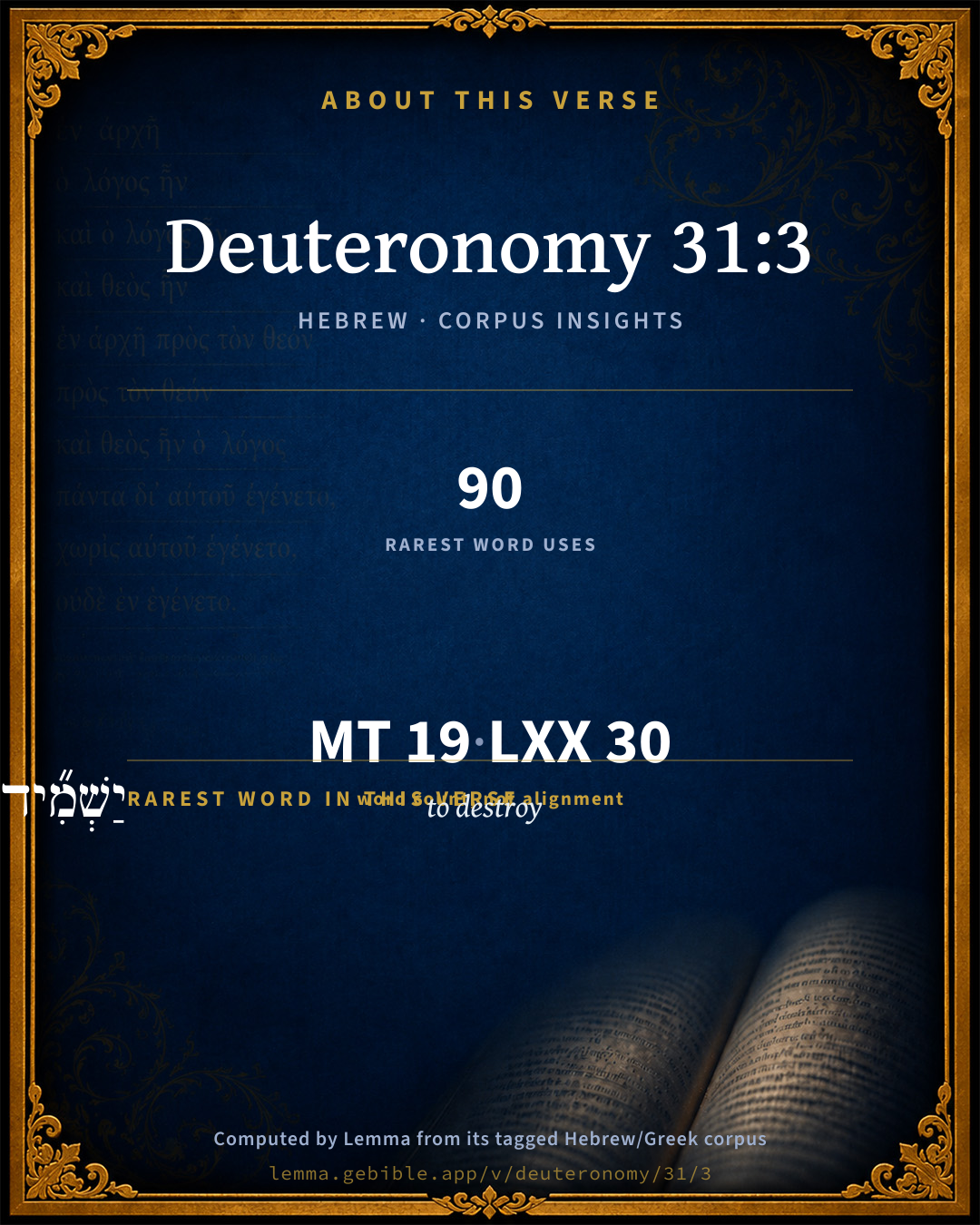
About this verse

These counts appear in no published source. They are computed here, from the morphology-tagged text and Lemma’s own curated glosses. What Lemma adds →

19
words
13
distinct lemmas
Pentateuch
section

Grammatical profile

  • 5 verbs
  • 8 nouns
  • 4 pronouns
  • 2 particles

Verb forms

  • עֹבֵ֣ר Qal · Participle Active
  • יַשְׁמִ֞יד Hiphil · Imperfect
  • וִֽירִשְׁתָּ֑ם Qal · Sequential Perfect
  • עֹבֵ֣ר Qal · Participle Active
  • דִּבֶּ֥ר Piel · Perfect

Repetition

Words recur within this verse — often emphatic in Hebrew:

  • לְפָנֶ֗יךָ face H6440 ×3
  • יְהוָ֨ה LORD H3068 ×2
  • עֹבֵ֣ר to pass over H5674 ×2
  • ה֣וּא he H1931 ×3

Hebrew & Septuagint length

In English translation the verse runs 34 words from the Hebrew and 35 from the Septuagint (LXX English) — closely comparable.

A rough comparison of the two English renderings, which tokenize alike — not a word-level alignment.

Word counts can differ between the Hebrew and the Greek without any difference in meaning — e.g. the Hebrew direct-object marker אֵת has no separate Greek word, and Greek often adds the article ὁ.

In the original languages it is 19 Hebrew tokens and 30 Greek tokens — but the two are counted differently (Hebrew bundles its prefixes and suffixes into one token; the Greek is in lemma form), so that isn’t a like-for-like length.

Cross-references

15

Topical passages linked to Deuteronomy 31:3 in the Treasury of Scripture Knowledge — connected by theme and wording, ordered by reader-vote popularity; previews shown in the World English Bible.

  • Deuteronomy 9:3 Know therefore this day, that Yahweh your God is he who goes over before you as a devouring fire; he will destroy them, and he will bring them down before you: so shall you drive them out, and make them to perish quickly, as Yahweh has spoken to you.
  • Deuteronomy 31:23 He gave Joshua the son of Nun a charge, and said, Be strong and of good courage; for you shall bring the children of Israel into the land which I swore to them: and I will be with you.
  • Deuteronomy 3:28 But charge Joshua, and encourage him, and strengthen him; for he shall go over before this people, and he shall cause them to inherit the land which you shall see.
  • Joshua 4:14 On that day Yahweh magnified Joshua in the sight of all Israel; and they feared him, as they feared Moses, all the days of his life.
  • Genesis 48:21 Israel said to Joseph, "Behold, I am dying, but God will be with you, and bring you again to the land of your fathers.
  • Numbers 27:18–21 Yahweh said to Moses, Take Joshua the son of Nun, a man in whom is the Spirit, and lay your hand on him;
  • Deuteronomy 31:7–8 Moses called to Joshua, and said to him in the sight of all Israel, Be strong and of good courage: for you shall go with this people into the land which Yahweh has sworn to their fathers to give them; and you shall cause them to inherit it.
  • Deuteronomy 31:14 Yahweh said to Moses, Behold, your days approach that you must die: call Joshua, and present yourselves in the tent of meeting, that I may give him a charge. Moses and Joshua went, and presented themselves in the tent of meeting.
  • Deuteronomy 34:9 Joshua the son of Nun was full of the spirit of wisdom; for Moses had laid his hands on him: and the children of Israel listened to him, and did as Yahweh commanded Moses.
  • Joshua 1:2 Moses my servant is dead; now therefore arise, go over this Jordan, you, and all this people, to the land which I do give to them, even to the children of Israel.
  • Psalms 44:2–3 You drove out the nations with your hand, But you planted them. You afflicted the peoples, But you spread them abroad.
  • Psalms 146:3–6 Don't put your trust in princes, Each a son of man in whom there is no help.
  • Hebrews 4:8 For if Joshua had given them rest, he would not have spoken afterward of another day.
  • Joshua 3:7 Yahweh said to Joshua, This day will I begin to magnify you in the sight of all Israel, that they may know that, as I was with Moses, so I will be with you.
  • Acts 7:45 which also our fathers, in their turn, brought in with Joshua when they entered into the possession of the nations, whom God drove out before the face of our fathers, to the days of David,

Cross-references courtesy of OpenBible.info (CC BY 4.0).

Hebrew and Greek witnesses Masoretic Hebrew ↔ Greek Septuagint

The same verse in the two great witnesses to the Old Testament, shown verse-for-verse.

These are two independent witnesses, not word-aligned to each other, and the Septuagint is shown in lemma (dictionary) form.

Hebrew Deuteronomy 31:3 Masoretic · Westminster Leningrad Codex

יְהוָ֨ה אֱלֹהֶ֜יךָ ה֣וּא עֹבֵ֣ר לְפָנֶ֗יךָ הֽוּא יַשְׁמִ֞יד אֶת הַגּוֹיִ֥ם הָאֵ֛לֶּה מִלְּפָנֶ֖יךָ וִֽירִשְׁתָּ֑ם יְהוֹשֻׁ֗עַ ה֚וּא עֹבֵ֣ר לְפָנֶ֔יךָ כַּאֲשֶׁ֖ר דִּבֶּ֥ר יְהוָֽה

Yahweh your God, he will go over before you; he will destroy these nations from before you, and you shall dispossess them: [and] Joshua, he shall go over before you, as Yahweh has spoken.

World English Bible · Public Domain

Greek LXX Deuteronomy 31:3 Septuagint · lemma form

κύριος ὁ θεός σύ ὁ προπορεύομαι πρό πρόσωπον σύ αὐτός ἐκὀλεθρεύω ὁ ἔθνος οὗτος ἀπό πρόσωπον σύ καί κατακληρονομέω αὐτός καί ἰησοῦς ὁ προπορεύομαι πρό πρόσωπον σύ καθά λαλέω κύριος

The Lord your God who goes before you, he shall destroy these nations before you, and you shall inherit them: and it shall be Joshua that goes before your face, as the Lord has spoken.

LXX2012 (modern English Septuagint) · Public Domain

On this verse, Haydock's Catholic Bible Commentary discusses the Septuagint’s reading. Read the note in Commentary ↓

Hebrew: Westminster Leningrad Codex (CC BY 4.0). Greek: Septuagint (public domain); English from LXX2012 (modern English Septuagint) (Public Domain). How the Septuagint differs from the Hebrew →

Targum (Aramaic paraphrase)

2

The Targum is the ancient Jewish Aramaic paraphrase of the Hebrew Scriptures — an interpretive translation, not the Hebrew text itself. Onkelos (literal) and Pseudo-Jonathan (expansive) render the Torah, and Jonathan the Prophets. Coverage is partial: where no permissively-licensed English translation exists for a verse, only the Aramaic is shown. This is verse-level text, not a word-by-word alignment to the Hebrew.

  1. Targum Onkelos Torah (Genesis–Deuteronomy)
    יְיָ אֱלָהָךְ מֵימְרֵהּ עֲבַר קֳדָמָךְ הוּא יְשֵׁצֵי יָת עַמְמַיָא הָאִלֵין מִקֳדָמָךְ וְתֵירְתִנוּן יְהוֹשֻׁעַ הוּא עֲבַר קֳדָמָךְ כְּמָא דִי מַלִיל יְיָ

    (no public-domain English translation for this verse)

    Targum Onkelos — Aramaic: “Onkelos Genesis” (public domain); “Onkelos Exodus” (public domain); “Onkelos Leviticus” (public domain); “Onkelos Numbers” (public domain); “Onkelos Deuteronomy” (public domain). English: “Sefaria Community Translation” (CC0 1.0 (public-domain dedication)); “J.W. Etheridge. The Targums of Onkelos and Jonathan Ben Uzziel on the Pentateuch. London: Longmans, Green, 1862” (public domain). Text via Sefaria.

  2. Targum Pseudo-Jonathan Torah (Genesis–Deuteronomy)
    יְיָ אֱלָהָכוֹן וּשְׁכִינְתֵּיהּ עָבִיר קֳדָמֵיכוֹן הוּא יְשֵׁיצֵי יַת עַמְמַיָא הָאִלֵין וְתֵירְתִינוּן יְהוֹשֻׁעַ הוּא יְטַיֵיל קֳדָמֵיכוֹן הֵיכְמָא דְמַלֵיל יְיָ

    The Lord your God, and His Shekinah, will go over before you. He will destroy those nations, and you shall possess them. Jehoshua also will go before you, as the Lord hath said.

    Targum Pseudo-Jonathan — Aramaic: “Targum Jonathan on Genesis” (public domain); “Targum Jonathan on Exodus” (public domain); “Targum Jonathan on Leviticus” (public domain); “Targum Jonathan on Numbers” (public domain); “Targum Jonathan on Deuteronomy” (public domain). English: “The Targum of Jonathan ben Uzziel, trans. J. W. Etheridge, London, 1862” (public domain). Text via Sefaria.

Commentary

Notes on Deuteronomy 31:3 from classic Christian and Jewish commentators (each source and its license shown beneath its notes). The classic Christian expositions comment on the surrounding passage and are grouped to its opening verse, so a note may address several verses; the Jewish commentaries on the Tanakh (Rashi and others) are per-verse, so they appear only where the commentator wrote on this verse.

Lemma curates 59 commentaries, every one of them public domain or Creative Commons licensed, each selected and text-cleaned for this edition rather than reprinted as found. About our sources →

Trapp's Complete Commentary

John Trapp

Deu 31:3 The LORD thy God, he will go over before thee, [and] he will destroy these nations from before thee, and thou shalt possess them: [and] Joshua, he shall go over before thee, as the LORD hath said.

Ver. 3. And Joshua.] Called Jesus. {Heb 4:8} A clear type of Jesus Christ. What Moses could not do because of the people’s unbelief - viz., to bring them to Canaan, Joshua did. So what Moses’s law could not do - viz., to bring us to heaven, because of the infirmity of our flesh, Christ by his gospel hath done for us. {Rom 8:3}

John Trapp, A Commentary or Exposition upon All the Books of the Old and New Testament (1647–1656) — public domain. Text from a community e-Sword module.

Tyndale Open Study Notes

Tyndale Open Resources

31:3 The Lord . . . will cross over ahead of you: The conquest would be God’s war. The conflict would be commanded, initiated, and led by the Divine Warrior, the Lord God of Israel (see 1:30). • From the earliest days of the Sinai wandering (Exod 17:8) to the present, Joshua had served as Moses’ attendant; now he was divinely appointed as Moses’ successor (see Deut 1:38; 3:23-29; Num 27:15-23).

Tyndale Open Study Notes — © Tyndale Open Resources, licensed CC BY-SA 4.0. Text via the HelloAO Bible API.

Adam Clarke's Commentary

Verse 3. Joshua, he shall go over before thee] See Clarke on Nu 27:17, &c.

Adam Clarke's Commentary on the Bible (1810–1826) — public domain. Text from a community e-Sword/MySword module.

The Cambridge Bible for Schools and Colleges

gen. ed. J. J. S. Perowne

3. will go over before thee] Deu_9:3, where also there follows (with much else) as here, he will destroy, thou shalt dispossess or succeed them (but in another form of the vb.). This part of the v. may be a later intrusion, for the remainder follows naturally in Deu_31:2.

The Cambridge Bible for Schools and Colleges (gen. ed. J. J. S. Perowne; Cambridge University Press, 1878–1918) — public domain. Text from a community e-Sword module.

John Gill's Exposition

And the Lord shall do unto them as he did unto Sihon, and to Og, kings of the Amorites,.... Deliver them up into their hands; see the history of this in Num 21:10,

and unto the land of them whom he destroyed; put them into the possession of the land of Canaan, as they were now in possession of the land of those two kings he destroyed by them. This instance is given to encourage their faith, assuring them that what had been done to them would be done to the Canaanitish kings, and their subjects, and their lands.

John Gill's Exposition of the Whole Bible (1746–1763) — public domain (CC PDM 1.0). Text via the HelloAO Bible API.

Haydock's Catholic Bible Commentary

Then. This word is not in Hebrew or the Septuagint; neither does Moses mean to insinuate, that God would take his place in conducting the people; but only that after he should be no more, the divine Providence would no less watch over his people, and direct the councils of Josue, who stood beside him. (Haydock) --- The ark preceded the army, (Josue iii.) and God invisibly put the enemies of Israel to flight. (Menochius)

George Leo Haydock (1774–1849), Haydock's Catholic Family Bible and Commentary, 1859 edition — public domain. Excludes Psalms (Douay-Rheims chapter numbering differs from Protestant) and Deuterocanonical books (Catholic canon only).

The Pulpit Commentary

Vers. 3-6. But though Moses was no longer to be their leader, he assures them that the Lord would fulfill his engagement to conduct them to the possession of Canaan, even as he had already given them the territory of the kings of the Amorites; and he therefore exhorts them to be of good courage and fearlessly go forward to the conquest of the laud. (cf. Deu_1:21 Deu_10:3)

Vers. 3-8, 23. Joshua.

Joshua a type of Jesus, the true Leader into the rest of God. (Heb_4:8) God has given him, as formerly he gave the son of Nun, for "a Leader and Commander to the people". (Isa_55:4)

I THE MAN. Joshua as leader was:

1. Divinely appointed (ver. 3).

2. Divinely led. "He doth go before thee" (ver. 8). The captain had a higher Captain. (Jos_5:14)

3. Divinely assisted. "He will be with thee" (ver. 8). Our Leader is Emmanuel with us". (Mat_1:23)

4. He was to be strong and courageous (ver. 7). The ground of true courage is God being with us. It is said of the Savior, "He shall not fail nor be discouraged". (Isa_42:4) The perseverance of the Savior is as deserving of consideration as the perseverance of the saints.

II HIS WORK. While Joshua"s and the people"s, it was still more God"s work (vers. 3, 4). With Joshua as leader:

1. The enemy would be overthrown (vers. 3-6).

2. All opposition would be overcome.

3. He would conduct the people unto the land of their inheritance (ver. 7).

4. He would cause them to inherit it (ver. 7),

i.e. settle them in their possessions. Christ in like manner has overthrown the enemy; (Col_2:15) has won an inheritance for his people; (Col_1:12) in his victory they are enabled to overcome the (Joh_16:33; 1Jn_4:4) his cause is steadily triumphing; he is conducting, and has already conducted, many sons to glory. J.O. (Heb_5:10)

The Pulpit Commentary (1880–1919), ed. H.D.M. Spence-Jones & Joseph S. Exell — public domain. Text from a community e-Sword module.

Lesson kit

Teaching starters — assembled from the data on this page, not authored interpretation. Every prompt links to the verse data it draws on. Edit before teaching.

Deuteronomy, in the Pentateuch, opens this verse with 19 words (13 distinct Hebrew lemmas). Its most distinctive word is shâmad (“to destroy”). A historical commentator’s framing appears above. Read the whole chapter for the surrounding context.

Discussion questions

  1. How does “to destroy” (shâmad) shape what this verse is saying?
  2. Deuteronomy 9:3 shares this passage’s theme. How do the two illuminate each other?
  3. “face” occurs 3× in this one verse. What is the effect of the repetition?
  4. These translations render this verse differently; the difference is in the English rendering, not the original. What questions does that raise?
  5. The verb «עֹבֵ֣ר» is Qal Participle Active. How does its form color the action?
  6. Reading how Trapp's Complete Commentary and Tyndale Open Study Notes read this verse, where do the two commentators agree and where do they part?

Things to notice

Reading settings

Reading text

Shown beneath each verse's original-language words.

Old Testament
Old Testament edition

Read the OT as the Masoretic Hebrew (MT) or the Greek Septuagint (LXX).

English shown for the Greek Septuagint (in the Hebrew ↔ Greek comparison).

Comparing translations? Open the Compare panel on any verse page to stack up to four side by side.