Deuteronomy 4:27

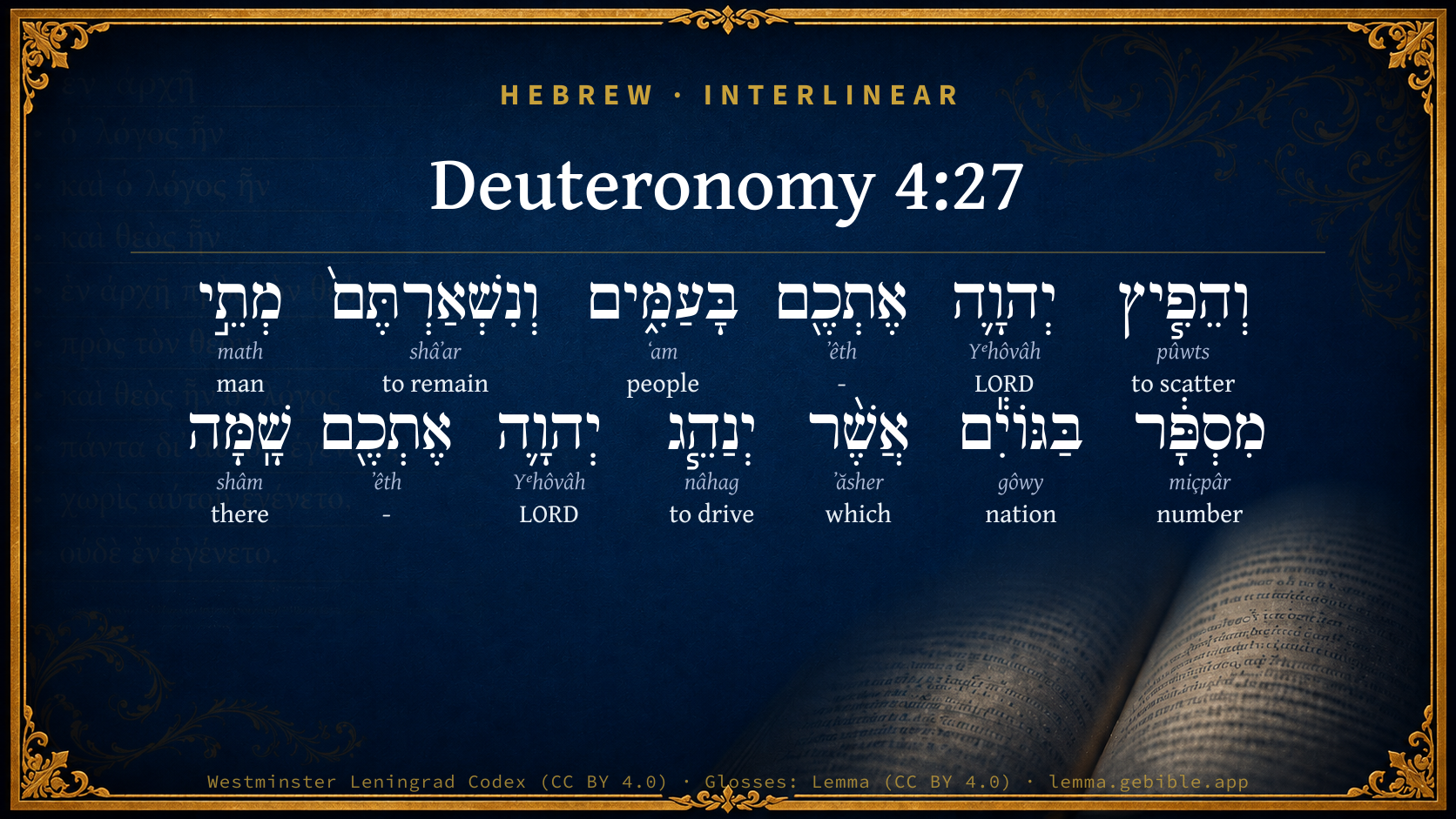
Hebrew (Westminster Leningrad Codex) Deuteronomy 4:27 appears in the Hebrew Old Testament. The text above is from the Westminster Leningrad Codex. Each word links to its Strong’s number, a concise gloss, and parsing drawn from the Open Scriptures Hebrew Bible morphology. Click any word for its full Brown-Driver-Briggs (BDB) entry.
Download image
Cite this verse

Deuteronomy 4:27 (World English Bible). Public Domain. Lemma interlinear Bible study tool, https://lemma.gebible.app/v/deuteronomy/4/27.

Show BibTeX & RIS
BibTeX
RIS
English Translation
Yahweh will scatter you among the peoples, and you shall be left few in number among the nations, where Yahweh shall lead you away.
World English Bible · Public Domain
Download a study sheet

One document with this verse’s original text, its word-by-word gloss line, the meaning frame, cross-references with their text, attributed commentary, and full source and license credits — printable, and it pastes into notes with its structure intact.

This verse Autodidact and up

Study sheet (.html) Plain text (.txt)

A passage Seminary Student

Up to 50 verses in one chapter. A passage sheet keeps up to 6 commentary sources and 12 cross-references per verse, in the order this page ranks them, and says so on the sheet whenever that leaves anything out. Ask for a single verse and you get the Autodidact verse sheet above.

Everything on this page stays free to read, with no account — the sheet is a download of what is already on screen, not access to it.

Want to remove ads? Support Godless Engineer
Compare translations 3

The same verse in 3 English versions, stacked beneath the original-language interlinear above. Click any original word for its lexicon entry.

Each is an independent rendering of the whole verse — the interlinear is not word-aligned to these translations.

Highlighted words mark where these versions differ — a whole-verse word diff, not a word-by-word alignment.

  • World English Bible Public Domain
    Yahweh will scatter you among the peoples, and you shall be left few in number among the nations, where Yahweh shall lead you away.
  • King James Version Public Domain
    And the LORD shall scatter you among the nations, and ye shall be left few in number among the heathen, whither the LORD shall lead you.
  • unfoldingWord Literal Text CC BY-SA 4.0
    And Yahweh will scatter you among the peoples, and you will be left men of number in the nations, where Yahweh will drive you there.

unfoldingWord Literal Text — © unfoldingWord, licensed CC BY-SA 4.0. Word-aligned USFM3 via Door43 (git.door43.org/unfoldingWord/en_ult).

Versions to compare (up to 4)

3 of 4 selected

Show all 18 translations

Every available English version of this verse, each an independent rendering of the whole verse.

  • World English Bible Public Domain
    Yahweh will scatter you among the peoples, and you shall be left few in number among the nations, where Yahweh shall lead you away.
  • Berean Standard Bible Public Domain
    Then the LORD will scatter you among the peoples, and only a few of you will survive among the nations to which the LORD will drive you.
  • Majority Standard Bible Public Domain
    Then the LORD will scatter you among the peoples, and only a few of you will survive among the nations to which the LORD will drive you.
  • King James Version Public Domain
    And the LORD shall scatter you among the nations, and ye shall be left few in number among the heathen, whither the LORD shall lead you.
  • American Standard Version (1901) Public Domain
    And Jehovah will scatter you among the peoples, and ye shall be left few in number among the nations, whither Jehovah shall lead you away.
  • Revised Version (1885) Public Domain
    And the LORD shall scatter you among the peoples, and ye shall be left few in number among the nations, whither the LORD shall lead you away.
  • Geneva Bible (1599) Public Domain
    And the Lord shall scatter you among the people, and ye shall be left few in nomber among the nations, whither the Lord shall bring you:
  • Douay-Rheims (1899) Public Domain
    And scatter you among all nations, and you shall remain a few among the nations, to which the Lord shall lead you.
  • Young's Literal Translation Public Domain
    and Jehovah hath scattered you among the peoples, and ye have been left few in number among the nations, whither Jehovah leadeth you,
  • Literal Standard Version CC BY-SA 4.0
    and YHWH has scattered you among the peoples, and you have been left few in number among the nations to where YHWH leads you,
  • Unlocked Literal Bible CC BY-SA 4.0
    Yahweh will scatter you among the peoples, and you will be left few in number among the nations, where Yahweh will lead you away.
  • unfoldingWord Literal Text CC BY-SA 4.0
    And Yahweh will scatter you among the peoples, and you will be left men of number in the nations, where Yahweh will drive you there.
  • Darby Bible Public Domain
    And Jehovah will scatter you among the peoples, and ye shall be left a small company among the nations to which Jehovah will lead you.
  • World Messianic Bible Public Domain
    The LORD will scatter you among the peoples, and you will be left few in number among the nations where the LORD will lead you away.
  • Webster's Bible Public Domain
    And the LORD shall scatter you among the nations, and ye shall be left few in number among the heathen, whither the LORD shall lead you.
  • Free Bible Version CC BY-SA 4.0
    The Lord will scatter you among the other nations, and not many of you will survive in the countries where the Lord has exiled you.
  • Bible in Basic English Public Domain
    And the Lord will send you wandering among the peoples; only a small band of you will be kept from death among the nations where the Lord will send you.
  • JPS Tanakh (1917) Public Domain
    And the LORD shall scatter you among the peoples, and ye shall be left few in number among the nations, whither the LORD shall lead you away.

Literal Standard Version (2020), Covenant Press — licensed CC BY-SA 4.0. Text via the HelloAO Bible API (eBible.org). Unlocked Literal Bible (unfoldingWord) — licensed CC BY-SA 4.0. Text via the HelloAO Bible API (eBible.org). unfoldingWord Literal Text — © unfoldingWord, licensed CC BY-SA 4.0. Word-aligned USFM3 via Door43 (git.door43.org/unfoldingWord/en_ult). Free Bible Version, Dr. Jonathan Gallagher — licensed CC BY-SA 4.0. Text via the HelloAO Bible API (eBible.org).

Word by word

More ways to search: Search by grammar → Find every occurrence → Compare this word →

Practice this passage: Drill this verse → Learn its vocabulary →

מְתֵ֣י
math
H4962
“men of”
Noun, Common, Masculine, Plural, Construct
Part of Speech
Noun
Type
Common
Gender
Masculine
Number
Plural
State
Construct
Full BDB Definition

Origin: from the same as H4970

TWOT: 1263

male, man - males, men - few men (in prose) - less emphasis on sex - men (poetic) - less emphasis on sex
  1. וְהֵפִ֧יץ pûwts H6327 “and · to scatter” Conjunction + Verb, Hiphil, Sequential Perfect, 3rd Person, Masculine, Singular
  2. יְהוָ֛ה Yᵉhôvâh H3068 “LORD” Noun, Proper
  3. אֶתְכֶ֖ם ʼêth H853 “- · you” Particle, Direct Object + Suffix, Personal, 2nd Person, Masculine, Plural
  4. בָּעַמִּ֑ים ʻam H5971 “in/at the · peoples” Preposition, Determined + Noun, Common, Masculine, Plural, Absolute
  5. וְנִשְׁאַרְתֶּם֙ shâʼar H7604 “and · to remain” Conjunction + Verb, Niphal, Sequential Perfect, 2nd Person, Masculine, Plural
  6. מִסְפָּ֔ר miçpâr H4557 “number” Noun, Common, Masculine, Singular, Absolute
  7. בַּגּוֹיִ֕ם gôwy H1471 “in/at the · nations” Preposition, Determined + Noun, Common, Masculine, Plural, Absolute
  8. אֲשֶׁ֨ר ʼăsher H834 “which” Particle, Relative
  9. יְנַהֵ֧ג nâhag H5090 “to drive” Verb, Piel, Imperfect, 3rd Person, Masculine, Singular
  10. יְהוָ֛ה Yᵉhôvâh H3068 “LORD” Noun, Proper
  11. אֶתְכֶ֖ם ʼêth H853 “- · you” Particle, Direct Object + Suffix, Personal, 2nd Person, Masculine, Plural
  12. שָֽׁמָּה shâm H8033 “there · toward” Adverb + Suffix, Demonstrative

About this verse

These counts appear in no published source. They are computed here, from the morphology-tagged text and Lemma’s own curated glosses. What Lemma adds →

13
words
11
distinct lemmas
Pentateuch
section

Notable vocabulary

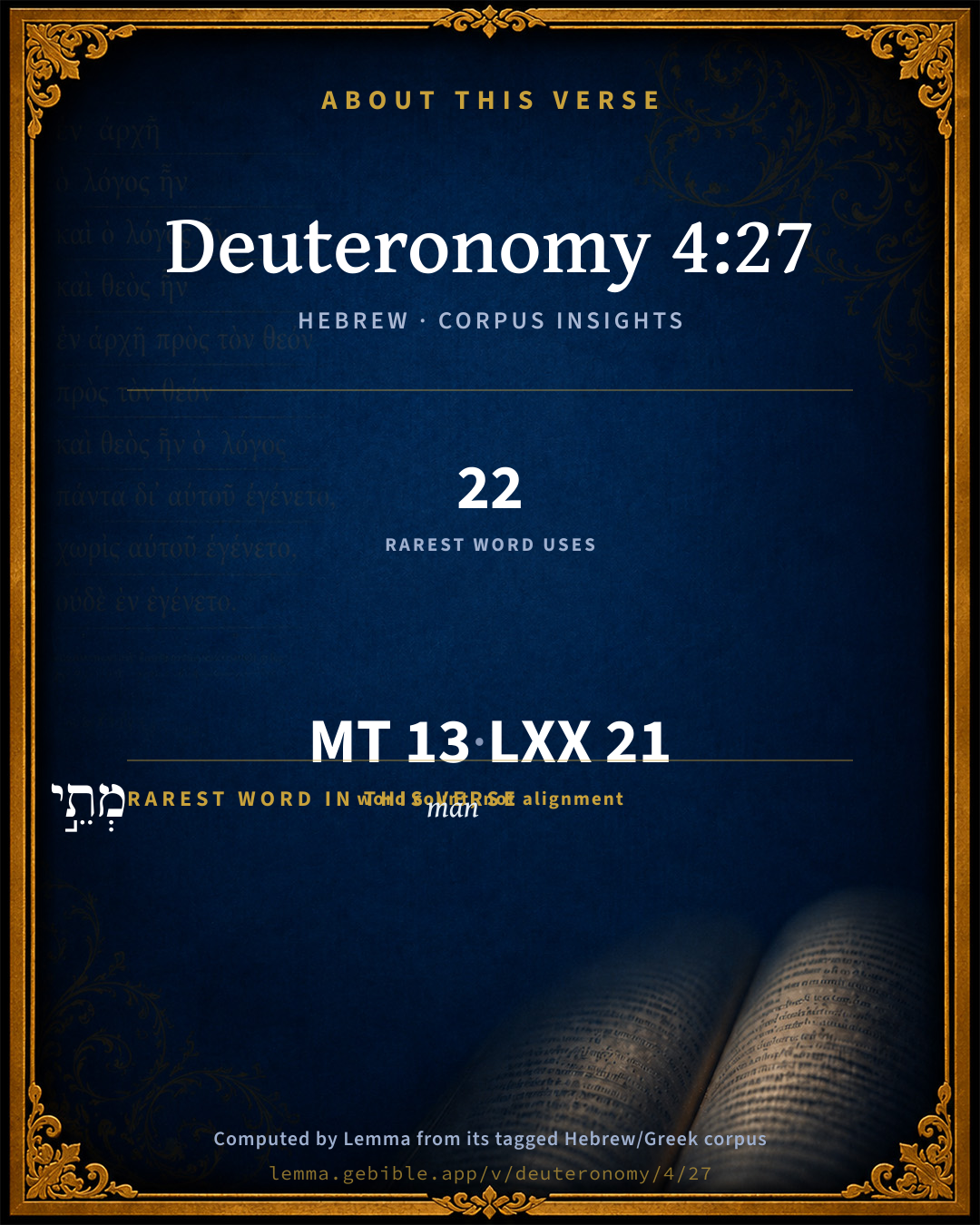
The rarest word here is מְתֵ֣י man H4962 — appearing just 22 times in the whole Hebrew Bible.

Shared distinctive vocabulary

מְתֵ֣י man H4962 occurs in 21 verses of the Hebrew Bible. Also found in:

Grammatical profile

  • 3 verbs
  • 6 nouns
  • 1 adverb
  • 3 particles

Verb forms

  • וְהֵפִ֧יץ Hiphil · Sequential Perfect
  • וְנִשְׁאַרְתֶּם֙ Niphal · Sequential Perfect
  • יְנַהֵ֧ג Piel · Imperfect

Repetition

A word recurs within this verse — often emphatic in Hebrew:

  • יְהוָ֛ה LORD H3068 ×2

Hebrew & Septuagint length

In English translation the verse runs 24 words from the Hebrew and 28 from the Septuagint (LXX English) — closely comparable.

A rough comparison of the two English renderings, which tokenize alike — not a word-level alignment.

Word counts can differ between the Hebrew and the Greek without any difference in meaning — e.g. the Hebrew direct-object marker אֵת has no separate Greek word, and Greek often adds the article ὁ.

In the original languages it is 13 Hebrew tokens and 21 Greek tokens — but the two are counted differently (Hebrew bundles its prefixes and suffixes into one token; the Greek is in lemma form), so that isn’t a like-for-like length.

Cross-references

6

Topical passages linked to Deuteronomy 4:27 in the Treasury of Scripture Knowledge — connected by theme and wording, ordered by reader-vote popularity; previews shown in the World English Bible.

  • Deuteronomy 28:62–64 You shall be left few in number, whereas you were as the stars of the sky for multitude; because you didn't listen to the voice of Yahweh your God.
  • Leviticus 26:33 I will scatter you among the nations, and I will draw out the sword after you: and your land will be a desolation, and your cities shall be a waste.
  • Nehemiah 1:3 They said to me, The remnant who are left of the captivity there in the province are in great affliction and reproach: the wall of Jerusalem also is broken down, and the gates of it are burned with fire.
  • Nehemiah 1:8–9 Remember, I beg you, the word that you commanded your servant Moses, saying, If you trespass, I will scatter you abroad among the peoples:
  • Ezekiel 12:15 They shall know that I am Yahweh, when I shall disperse them among the nations, and scatter them through the countries.
  • Ezekiel 32:26 There is Meshech, Tubal, and all their multitude; their graves are round about them; all of them uncircumcised, slain by the sword; for they caused their terror in the land of the living.

Cross-references courtesy of OpenBible.info (CC BY 4.0).

Hebrew and Greek witnesses Masoretic Hebrew ↔ Greek Septuagint

The same verse in the two great witnesses to the Old Testament, shown verse-for-verse.

These are two independent witnesses, not word-aligned to each other, and the Septuagint is shown in lemma (dictionary) form.

Hebrew Deuteronomy 4:27 Masoretic · Westminster Leningrad Codex

וְהֵפִ֧יץ יְהוָ֛ה אֶתְכֶ֖ם בָּעַמִּ֑ים וְנִשְׁאַרְתֶּם֙ מְתֵ֣י מִסְפָּ֔ר בַּגּוֹיִ֕ם אֲשֶׁ֨ר יְנַהֵ֧ג יְהוָ֛ה אֶתְכֶ֖ם שָֽׁמָּה

Yahweh will scatter you among the peoples, and you shall be left few in number among the nations, where Yahweh shall lead you away.

World English Bible · Public Domain

Greek LXX Deuteronomy 4:27 Septuagint · lemma form

καί διασπείρω κύριος σύ ἐν πᾶς ὁ ἔθνος καί καταλείπω ὀλίγος ἀριθμός ἐν ὁ ἔθνος εἰς ὅς εἰςἄγω κύριος σύ ἐκεῖ

And the Lord shall scatter you among all nations, and you⌃ shall be left few in number among all the nations, among which the Lord shall bring you.

LXX2012 (modern English Septuagint) · Public Domain

Hebrew: Westminster Leningrad Codex (CC BY 4.0). Greek: Septuagint (public domain); English from LXX2012 (modern English Septuagint) (Public Domain). How the Septuagint differs from the Hebrew →

Targum (Aramaic paraphrase)

2

The Targum is the ancient Jewish Aramaic paraphrase of the Hebrew Scriptures — an interpretive translation, not the Hebrew text itself. Onkelos (literal) and Pseudo-Jonathan (expansive) render the Torah, and Jonathan the Prophets. Coverage is partial: where no permissively-licensed English translation exists for a verse, only the Aramaic is shown. This is verse-level text, not a word-by-word alignment to the Hebrew.

  1. Targum Onkelos Torah (Genesis–Deuteronomy)
    וִיבַדַר יְיָ יָתְכוֹן בְּעַמְמַיָא וְתִשְׁתָּאֲרוּן עַם דְמִנְיָן בְּעַמְמַיָא דִי יְדַבַּר יְיָ יָתְכוֹן לְתַמָן

    (no public-domain English translation for this verse)

    Targum Onkelos — Aramaic: “Onkelos Genesis” (public domain); “Onkelos Exodus” (public domain); “Onkelos Leviticus” (public domain); “Onkelos Numbers” (public domain); “Onkelos Deuteronomy” (public domain). English: “Sefaria Community Translation” (CC0 1.0 (public-domain dedication)); “J.W. Etheridge. The Targums of Onkelos and Jonathan Ben Uzziel on the Pentateuch. London: Longmans, Green, 1862” (public domain). Text via Sefaria.

  2. Targum Pseudo-Jonathan Torah (Genesis–Deuteronomy)
    וִיבַדַר יְיָ יַתְכוֹן בֵּינֵי עַמְמַיָא וְתִשְׁתּוֹתְרוּן בְּעָם קָלִיל בֵּינֵי עַמְמַיָא דִיבַדַר יְיָ יַתְכוֹן תַּמָּן בְּגָלוּתָא

    And the Lord will scatter you among the Gentiles, and you will remain as a little people with the nations among whom the Lord will disperse you in captivity.

    Targum Pseudo-Jonathan — Aramaic: “Targum Jonathan on Genesis” (public domain); “Targum Jonathan on Exodus” (public domain); “Targum Jonathan on Leviticus” (public domain); “Targum Jonathan on Numbers” (public domain); “Targum Jonathan on Deuteronomy” (public domain). English: “The Targum of Jonathan ben Uzziel, trans. J. W. Etheridge, London, 1862” (public domain). Text via Sefaria.

Commentary

Notes on Deuteronomy 4:27 from classic Christian and Jewish commentators (each source and its license shown beneath its notes). The classic Christian expositions comment on the surrounding passage and are grouped to its opening verse, so a note may address several verses; the Jewish commentaries on the Tanakh (Rashi and others) are per-verse, so they appear only where the commentator wrote on this verse.

Lemma curates 59 commentaries, every one of them public domain or Creative Commons licensed, each selected and text-cleaned for this edition rather than reprinted as found. About our sources →

Tyndale Open Study Notes

Tyndale Open Resources

4:27 scatter you: One of the curses directed against Israel if it violated the terms of the covenant was the dispersion of the people to the ends of the earth (28:64). This judgment later came to pass repeatedly, especially when the Assyrians occupied the northern kingdom in 722 BC, when the Babylonians conquered Judah in 605–586 BC, and when Jerusalem was destroyed in AD 70.

Tyndale Open Study Notes — © Tyndale Open Resources, licensed CC BY-SA 4.0. Text via the HelloAO Bible API.

Geneva Bible (1599)

Geneva Bible translators

So that his curse shall make his former blessings of none effect.

Geneva Bible (1599) marginal notes — public domain. Text via Bolls.life.

Adam Clarke's Commentary

Verse 27. The Lord shall scatter you among the nations] This was amply verified in their different captivities and dispersions.

Adam Clarke's Commentary on the Bible (1810–1826) — public domain. Text from a community e-Sword/MySword module.

Ellicott's Commentary for English Readers

(27) And the Lord shall scatter you.—Our familiarity with this fact in history must not blind us to its force when uttered as a prophecy. The fact that the Jews were taken captive for idolatry, and dispersed for the rejection of JESUS, is a remarkable proof that the real reason why they were brought into Canaan, and kept there, was to be witnesses for Jehovah.

A Bible Commentary for English Readers, edited by Charles John Ellicott (1878–1897) — public domain. Text from a community e-Sword module.

The Cambridge Bible for Schools and Colleges

gen. ed. J. J. S. Perowne

27. few in number] Heb. idiom men of a number, easily counted, instead of being innumerable, as the stars in heaven for multitude.

The Cambridge Bible for Schools and Colleges (gen. ed. J. J. S. Perowne; Cambridge University Press, 1878–1918) — public domain. Text from a community e-Sword module.

John Gill's Exposition

And the Lord shall scatter you among the nations,.... As they were by both captivities; the ten tribes were dispersed among the cities of the Medes, and the two tribes throughout the empire of Babylon:

and ye shall be left few in number among the Heathen, whither the Lord shall lead you; or be "men of number" (i), so few that they might be easily numbered; which intimates that it should be other wise with them than when in Egypt; there they were multiplied and increased the more they were afflicted, but in these captivities they should be greatly diminished.

(i) "viri numeri", Montanus, Drusius.

John Gill's Exposition of the Whole Bible (1746–1763) — public domain (CC PDM 1.0). Text via the HelloAO Bible API.

Haydock's Catholic Bible Commentary

Nations. This prediction we see verified at the present day. They are despised by all. No one of their numerous masters embraces their religion. No one of their numerous masters embraces their religion. They are so few, as to hardly possess a single town. (Calmet)

George Leo Haydock (1774–1849), Haydock's Catholic Family Bible and Commentary, 1859 edition — public domain. Excludes Psalms (Douay-Rheims chapter numbering differs from Protestant) and Deuterocanonical books (Catholic canon only).

Whedon's Commentary on the Bible

Daniel D. Whedon

27. The Lord shall scatter you — How clearly this was fulfilled in the nation’s history! Assyrians, Babylonians, the Seleucid and Ptolemaic dynasties, and finally the Romans, scattered the rebellious people.

Daniel D. Whedon (gen. ed.), Commentary on the Old and New Testaments (1874–1909) — public domain. Text from a community e-Sword module.

The Pulpit Commentary

Few in number; literally, men of number, i.e. that may be counted; few as compared with the heathen among whom they should be dispersed. (Gen_34:30) Shall lead you. The verb here (gheni, Piel of ghn) is frequently used in the sense of conducting gently and kindly (Isa_49:10 Isa_63:14; Psa_48:14 Psa_78:52) but it also means to drive, to carry off, to convey forcibly (Exo_14:25; Exo_10:13; Psa_78:26) the connection shows that it is in the latter sense it is to be taken here. Dispersed among the heathen, they, who had dishonored God by making an image to represent him, should be compelled to do service to mere dead idols, the work of men"s hands, which not only could not hear or see, as God can, but also could not-perform even such animal functions as eating and smelling (Psa_115:4-7; Jer_10:3-9) These idols are called "gods" by Moses,because they were so counted by those who worshipped them; elsewhere he stigmatizes them as "abominations," things to be loathed and abhorred ( (Deu_27:15 Deu_29:17) As had been their sin, so should be their punishment; as they had dishonored God, so should they be themselves dishonored; as they had worshipped by an image him who is spirit and without form, they should be made to sink down to an utterly materialized worship, that of mere idols, the work of men"s hands; as they had apostatized from the one holy and true God, they should be degraded to become the servants of abominations, objects of loathing and abhorrence (Jer_16:13; Act_7:42) God, however, would not utterly cast them off: if, in their misery and degradation, they should repent and turn again to him and seek him sincerely and earnestly, they should find him; for he is a merciful God, and mindful of the covenant which he swam unto their fathers (cf. Lev_26:39, etc.)

The Pulpit Commentary (1880–1919), ed. H.D.M. Spence-Jones & Joseph S. Exell — public domain. Text from a community e-Sword module.

unfoldingWord translationNotes

Door43 World Missions Community

General Information:

Moses continues speaking to the people of Israel.

Yahweh will scatter you among the peoples

Moses speaks as if the people were seeds that Yahweh would scatter around a field. AT: "Yahweh will send you to many different places and force you to live there" (See: Metaphor)

will lead you away

"will send you" or "will cause your enemies to take you away"

the work of men's hands, wood and stone

Here "men's hands" refers the men themselves, and "the work ... wood and stone" to the idols that they have created. AT: "the wood and stone idols that men have made" (See: Synecdoche)

translationWords

Yahweh

people group

nation

servant

false god

works

hand

unfoldingWord translationNotes — © Distant Shores Media and the Door43 World Missions Community, licensed CC BY-SA 4.0. Source: git.door43.org/Door43/en_tn.

Ramban (Nachmanides)

Rabbi Moshe ben Nachman (Ramban / Nachmanides)

AND YE SHALL BE LEFT FEW IN NUMBER. He is stating that we will be left as a minority among any of the nations whereto G-d will lead us, for He will scatter us as the four winds of the heaven, but in our totality we are many [i.e., Israel will remain a large nation, but because of our dispersion we are in a minority in each of the many countries] — praise be to G-d [that in our totality we are many]!

Ramban (Nachmanides) on the Tanakh — English translation: “Commentary on the Torah by Ramban (Nachmanides). Translated and annotated by Charles B. Chavel. New York, Shilo Pub. House, 1971-1976” (CC BY 4.0). Text via Sefaria.

Lesson kit

Teaching starters — assembled from the data on this page, not authored interpretation. Every prompt links to the verse data it draws on. Edit before teaching.

Deuteronomy, in the Pentateuch, opens this verse with 13 words (11 distinct Hebrew lemmas). Its most distinctive word is math (“man”). A historical commentator’s framing appears above. Read the whole chapter for the surrounding context.

Discussion questions

  1. The word math carries the sense “man.” How does it shape the verse?
  2. Genesis 34:30 shares the word «man» with this verse. How do the two illuminate each other?
  3. “LORD” occurs 2× in this one verse. What is the effect of the repetition?
  4. These translations render this verse differently. What is at stake in choosing one wording over another?
  5. The verb «וְהֵפִ֧יץ» is Hiphil Sequential Perfect. How does its form color the action?
  6. Reading how Tyndale Open Study Notes and Geneva Bible (1599) read this verse, where do the two commentators agree and where do they part?

Things to notice

Reading settings

Reading text

Shown beneath each verse's original-language words.

Old Testament
Old Testament edition

Read the OT as the Masoretic Hebrew (MT) or the Greek Septuagint (LXX).

English shown for the Greek Septuagint (in the Hebrew ↔ Greek comparison).

Comparing translations? Open the Compare panel on any verse page to stack up to four side by side.