
Job 12:23

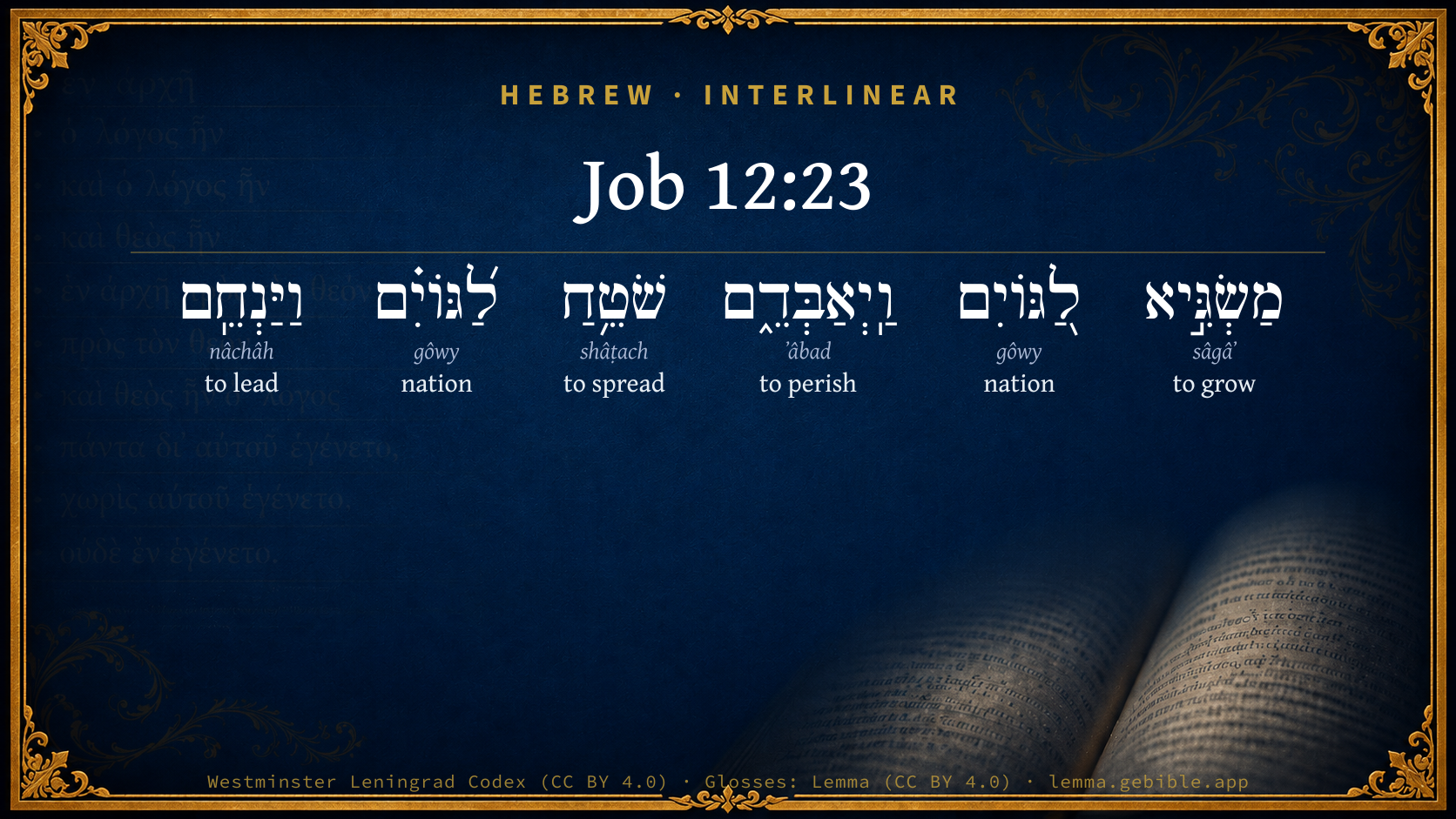
Hebrew (Westminster Leningrad Codex) Job 12:23 appears in the Hebrew Old Testament. The text above is from the Westminster Leningrad Codex. Each word links to its Strong’s number, a concise gloss, and parsing drawn from the Open Scriptures Hebrew Bible morphology. Click any word for its full Brown-Driver-Briggs (BDB) entry.
Download image
Cite this verse

Job 12:23 (World English Bible). Public Domain. Lemma interlinear Bible study tool, https://lemma.gebible.app/v/job/12/23.

Show BibTeX & RIS
BibTeX
RIS
English Translation
He increases the nations, and he destroys them. He enlarges the nations, and he leads them captive.
World English Bible · Public Domain
Highlights
  • 1 first appearance in the Hebrew Bible
Full analysis ↓
Download a study sheet

One document with this verse’s original text, its word-by-word gloss line, the meaning frame, cross-references with their text, attributed commentary, and full source and license credits — printable, and it pastes into notes with its structure intact.

This verse Autodidact and up

Study sheet (.html) Plain text (.txt)

A passage Seminary Student

Up to 50 verses in one chapter. A passage sheet keeps up to 6 commentary sources and 12 cross-references per verse, in the order this page ranks them, and says so on the sheet whenever that leaves anything out. Ask for a single verse and you get the Autodidact verse sheet above.

Everything on this page stays free to read, with no account — the sheet is a download of what is already on screen, not access to it.

Want to remove ads? Support Godless Engineer
Compare translations 3

The same verse in 3 English versions, stacked beneath the original-language interlinear above. Click any original word for its lexicon entry.

Each is an independent rendering of the whole verse — the interlinear is not word-aligned to these translations.

Highlighted words mark where these versions differ — a whole-verse word diff, not a word-by-word alignment.

  • World English Bible Public Domain
    He increases the nations, and he destroys them. He enlarges the nations, and he leads them captive.
  • King James Version Public Domain
    He increaseth the nations, and destroyeth them: he enlargeth the nations, and straiteneth them again.
  • unfoldingWord Literal Text CC BY-SA 4.0
    the one magnifying nations, and he destroys them; the one enlarging nations, and he exiles them;

unfoldingWord Literal Text — © unfoldingWord, licensed CC BY-SA 4.0. Word-aligned USFM3 via Door43 (git.door43.org/unfoldingWord/en_ult).

Versions to compare (up to 4)

3 of 4 selected

Show all 18 translations

Every available English version of this verse, each an independent rendering of the whole verse.

  • World English Bible Public Domain
    He increases the nations, and he destroys them. He enlarges the nations, and he leads them captive.
  • Berean Standard Bible Public Domain
    He makes nations great and destroys them; He enlarges nations, then disperses them.
  • Majority Standard Bible Public Domain
    He makes nations great and destroys them; He enlarges nations, then disperses them.
  • King James Version Public Domain
    He increaseth the nations, and destroyeth them: he enlargeth the nations, and straiteneth them again.
  • American Standard Version (1901) Public Domain
    He increaseth the nations, and he destroyeth them: He enlargeth the nations, and he leadeth them captive.
  • Revised Version (1885) Public Domain
    He increaseth the nations, and destroyeth them: he spreadeth the nations abroad, and bringeth them in.
  • Geneva Bible (1599) Public Domain
    He increaseth the people, and destroyeth them: he inlargeth the nations, and bringeth them in againe.
  • Douay-Rheims (1899) Public Domain
    He multiplieth nations, and destroyeth them, and restoreth them again after they were overthrown.
  • Young's Literal Translation Public Domain
    Magnifying the nations, and He destroyeth them, Spreading out the nations, and He quieteth them.
  • Literal Standard Version CC BY-SA 4.0
    Magnifying the nations, and He destroys them, || Spreading out the nations, and He quiets them.
  • Unlocked Literal Bible CC BY-SA 4.0
    He makes nations strong, and he also destroys them; He enlarges nations, and he also leads them along as prisoners.
  • unfoldingWord Literal Text CC BY-SA 4.0
    the one magnifying nations, and he destroys them; the one enlarging nations, and he exiles them;
  • Darby Bible Public Domain
    He increaseth the nations, and destroyeth them; he spreadeth out the nations, and bringeth them in;
  • World Messianic Bible Public Domain
    He increases the nations, and he destroys them. He enlarges the nations, and he leads them captive.
  • Webster's Bible Public Domain
    He increaseth nations, and destroyeth them: he enlargeth nations, and straiteneth them again.
  • Free Bible Version CC BY-SA 4.0
    He makes nations great and he destroys them; he expands nations and ruins them.
  • Bible in Basic English Public Domain
    Increasing nations, and sending destruction on them; making wide the lands of peoples, and then giving them up.
  • JPS Tanakh (1917) Public Domain
    He increaseth the nations, and destroyeth them; He enlargeth the nations, and leadeth them away.

Literal Standard Version (2020), Covenant Press — licensed CC BY-SA 4.0. Text via the HelloAO Bible API (eBible.org). Unlocked Literal Bible (unfoldingWord) — licensed CC BY-SA 4.0. Text via the HelloAO Bible API (eBible.org). unfoldingWord Literal Text — © unfoldingWord, licensed CC BY-SA 4.0. Word-aligned USFM3 via Door43 (git.door43.org/unfoldingWord/en_ult). Free Bible Version, Dr. Jonathan Gallagher — licensed CC BY-SA 4.0. Text via the HelloAO Bible API (eBible.org).

Word by word

More ways to search: Search by grammar → Find every occurrence → Compare this word →

Practice this passage: Drill this verse → Learn its vocabulary →

About this verse

These counts appear in no published source. They are computed here, from the morphology-tagged text and Lemma’s own curated glosses. What Lemma adds →

6
words
5
distinct lemmas
Wisdom
section

Notable vocabulary

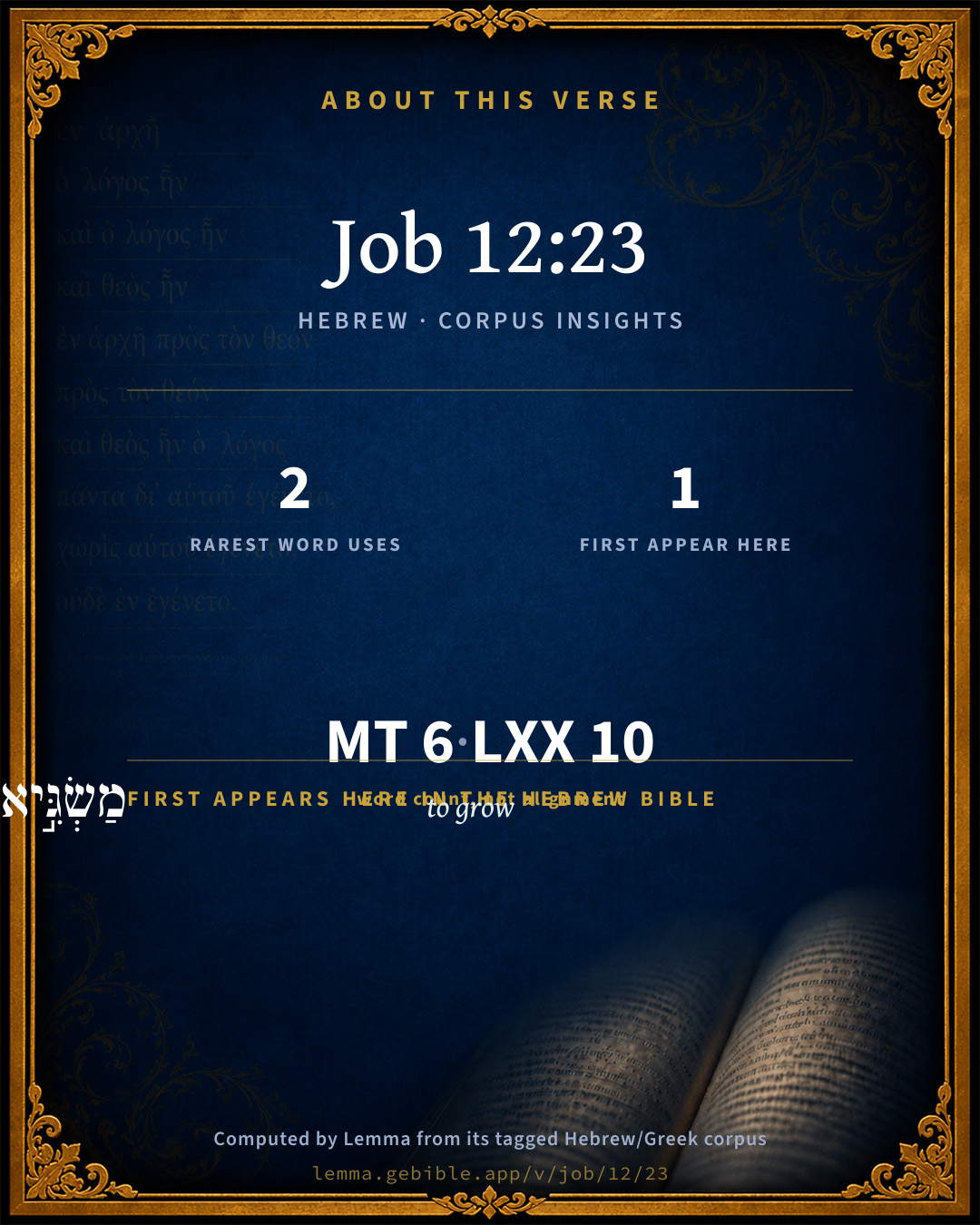
The rarest word here is מַשְׂגִּ֣יא to grow H7679 — appearing just 2 times in the whole Hebrew Bible.

First appearance in Scripture

This word makes its first canonical appearance in the Hebrew Bible here:

  • מַשְׂגִּ֣יא to grow H7679

Shared distinctive vocabulary

מַשְׂגִּ֣יא to grow H7679 occurs in 2 verses of the Hebrew Bible. Also found in:

Grammatical profile

  • 4 verbs
  • 2 nouns

Verb forms

  • מַשְׂגִּ֣יא Hiphil · Participle Active
  • וַֽיְאַבְּדֵ֑ם Piel · Sequential Imperfect
  • שֹׁטֵ֥חַ Qal · Participle Active
  • וַיַּנְחֵֽם Hiphil · Sequential Imperfect

Repetition

A word recurs within this verse — often emphatic in Hebrew:

  • לַ֭גּוֹיִם nation H1471 ×2

Hebrew & Septuagint length

In English translation the verse runs 17 words from the Hebrew and 15 from the Septuagint (LXX English) — closely comparable.

A rough comparison of the two English renderings, which tokenize alike — not a word-level alignment.

Word counts can differ between the Hebrew and the Greek without any difference in meaning — e.g. the Hebrew direct-object marker אֵת has no separate Greek word, and Greek often adds the article ὁ.

In the original languages it is 6 Hebrew tokens and 10 Greek tokens — but the two are counted differently (Hebrew bundles its prefixes and suffixes into one token; the Greek is in lemma form), so that isn’t a like-for-like length.

Cross-references

11

Topical passages linked to Job 12:23 in the Treasury of Scripture Knowledge — connected by theme and wording, ordered by reader-vote popularity; previews shown in the World English Bible.

  • Isaiah 9:3 You have multiplied the nation, you have increased their joy: they joy before you according to the joy in harvest, as men rejoice when they divide the spoil.
  • Isaiah 26:15 You have increased the nation, O Yahweh, you have increased the nation; you are glorified; you have enlarged all the borders of the land.
  • Isaiah 60:22 The little one shall become a thousand, and the small one a strong nation; I, Yahweh, will hasten it in its time.
  • Psalms 107:38 He blesses them also, so that they are multiplied greatly. He doesn't allow their cattle to decrease.
  • Exodus 1:7 The children of Israel were fruitful, and increased abundantly, and multiplied, and grew exceedingly mighty; and the land was filled with them.
  • Exodus 1:20 God dealt well with the midwives, and the people multiplied, and grew very mighty.
  • Isaiah 27:6 In days to come shall Jacob take root; Israel shall blossom and bud; and they shall fill the surface of the world with fruit.
  • Isaiah 51:2 Look to Abraham your father, and to Sarah who bore you; for when he was but one I called him, and I blessed him, and made him many.
  • Jeremiah 30:19 Out of them shall proceed thanksgiving and the voice of those who make merry: and I will multiply them, and they shall not be few; I will also glorify them, and they shall not be small.
  • Jeremiah 33:22 As the host of the sky can't be numbered, neither the sand of the sea measured; so will I multiply the seed of David my servant, and the Levites who minister to me.
  • Zechariah 10:8 I will signal for them, and gather them; For I have redeemed them; And they will increase as they have increased.

Cross-references courtesy of OpenBible.info (CC BY 4.0).

Hebrew and Greek witnesses Masoretic Hebrew ↔ Greek Septuagint

The same verse in the two great witnesses to the Old Testament, shown verse-for-verse.

These are two independent witnesses, not word-aligned to each other, and the Septuagint is shown in lemma (dictionary) form.

Hebrew Job 12:23 Masoretic · Westminster Leningrad Codex

מַשְׂגִּ֣יא לַ֭גּוֹיִם וַֽיְאַבְּדֵ֑ם שֹׁטֵ֥חַ לַ֝גּוֹיִ֗ם וַיַּנְחֵֽם

He increases the nations, and he destroys them. He enlarges the nations, and he leads them captive.

World English Bible · Public Domain

Greek LXX Job 12:23 Septuagint · lemma form

πλανάω ἔθνος καί ἀποὀλλύω αὐτός καταστρωννύω ἔθνος καί καταὁδηγέω αὐτός

Causing the nations to wander, and destroying them: overthrowing the nations, and leading them away.

LXX2012 (modern English Septuagint) · Public Domain

On this verse, Haydock's Catholic Bible Commentary discusses the Septuagint’s reading. Read the note in Commentary ↓

Hebrew: Westminster Leningrad Codex (CC BY 4.0). Greek: Septuagint (public domain); English from LXX2012 (modern English Septuagint) (Public Domain). How the Septuagint differs from the Hebrew →

Commentary

Notes on Job 12:23 from classic Christian and Jewish commentators (each source and its license shown beneath its notes). The classic Christian expositions comment on the surrounding passage and are grouped to its opening verse, so a note may address several verses; the Jewish commentaries on the Tanakh (Rashi and others) are per-verse, so they appear only where the commentator wrote on this verse.

Lemma curates 59 commentaries, every one of them public domain or Creative Commons licensed, each selected and text-cleaned for this edition rather than reprinted as found. About our sources →

Jamieson, Fausset & Brown

Robert Jamieson, A. R. Fausset & David Brown

job 12:23Isa 9:3; Psa 107:38-39, which Psalm quotes this chapter elsewhere. (See on Job 12:21).

straiteneth--literally, "leadeth in," that is, "reduces."

Jamieson, Fausset & Brown — Commentary Critical and Explanatory on the Whole Bible (1871) — public domain (CC PDM 1.0). Text via the HelloAO Bible API.

Trapp's Complete Commentary

John Trapp

Job 12:23 He increaseth the nations, and destroyeth them: he enlargeth the nations, and straiteneth them [again].

Ver. 23. He increaseth the nations, and destroyeth them] It is all one with God whether against a single man or a whole nation, Job 34:29, when he once taketh them to do. "The wicked shall be turned into hell," and (that they may not hope to escape because a multitude) "all the nations that forget God," Psa 9:17. Soon after the flood the Babel builders were scattered; Sodom and her sisters were not only consumed with fire from heaven, Gen 19:23-29, but thrown forth for an example, suffering the vengeance of eternal fire, Jdg 1:7. Some nations were ejected, and others substituted, Deu 2:10; Deu 2:12; Deu 2:20. Some utterly wasted and rooted out, such as the Edomites, Ammonites, Moabites, &c., that live by fame only; others not so much as by fame, their very names being blotted out from under heaven. "The cities be wasted without inhabitant, and the houses without man, and the land is utterly desolate," Isa 6:11. Now all this is the Lord’s own doing, and should be marvellous in our eyes. He plants, and plucks up; he builds, and breaks down, Jer 31:28.

He enlargeth the nations, and straiteneth them again] Or, that he may straiten them again: so in the former clause, that he may destroy them. This if he may justly do to whole nations, why should it seem so strange that he suffereth particular persons, though wicked, to prosper for a season; and though righteous, for a while to suffer hardship?

John Trapp, A Commentary or Exposition upon All the Books of the Old and New Testament (1647–1656) — public domain. Text from a community e-Sword module.

Joseph Benson's Commentary

Job 12:23-25. He increaseth the nations, &c. — What he had hitherto said of princes, he now applies to nations and people, whom God either increases or diminishes as he pleases. He enlargeth the nations — He multiplies them so that they are forced to send forth colonies into other lands; and straiteneth them again — Diminishes them by war, famine, or pestilence: or, as ינחם, janchem, more properly signifies, leadeth them in, or bringeth them back, namely, into their own land, and confineth them there. So that whole nations, as well as their princes, are perfectly under his power, and he enlarges their bounds, or reduces them into more narrow limits, as he pleaseth. He taketh away the heart of the chief of the people — Deprives them both of courage and judgment, and causeth them to wander in a wilderness; that is, fills them with confusion, uncertainty, and perplexity of mind, so that they know not which way to turn themselves. They grope in the dark — Like men that cannot see their way. And he maketh them to stagger like a drunken man — Who reels hither and thither without any certainty. So they sometimes take one course, and sometimes another, as resolving to try all experiments, and indeed not knowing what to do. All their counsels and motions are as unsteady and fluctuating as those of a man intoxicated.

Joseph Benson's Commentary on the Old and New Testaments (1811–1818) — public domain. Text from a community e-Sword module.

Tyndale Open Study Notes

Tyndale Open Resources

12:23-24 Cp. Dan 2:21. • strips kings of understanding: See Job 12:18; cp. Dan 4:23, 32-33. • He . . . leaves them wandering in a pathless wasteland like the princes in Ps 107:40 (see Job 12:21).

Tyndale Open Study Notes — © Tyndale Open Resources, licensed CC BY-SA 4.0. Text via the HelloAO Bible API.

Geneva Bible (1599)

Geneva Bible translators

In this discourse of God’s wonderful works, Job showeth that whatsoever is done in this world both in the order and change of things, is by God’s will and appointment: wherein he declareth that he thinketh well of God, and is as able to set forth his power in words as they that reasoned against, were.

Geneva Bible (1599) marginal notes — public domain. Text via Bolls.life.

Adam Clarke's Commentary

Verse 23. He increaseth the nations] Mr. Good translates, He letteth the nations grow licentious. Pride, fulness of bread, with extensive trade and commerce, produce luxury; and this is ever accompanied with profligacy of manners. When, then, the cup of this iniquity is full, God destroys the nation, by bringing or permitting to come against it a nation less pampered, more necessitous, and inured to toil.

He enlargeth the nations] Often permits a nation to acquire an accession of territory, and afterwards shuts them up within their ancient boundaries, and often contracts even those. All these things seem to occur as natural events, and the consequences of state intrigues, and such like causes; but when Divine inspiration comes to pronounce upon them, they are shown to be the consequence of God's acting in his judgment and mercy; for it is by him that kings reign; it is he who putteth down one and raiseth up another.

Adam Clarke's Commentary on the Bible (1810–1826) — public domain. Text from a community e-Sword/MySword module.

Ellicott's Commentary for English Readers

(23) He increaseth the nations, and destroyeth them.—The latter part of this chapter teaches us a truth that is apt to be forgotten in the present day, which is, nevertheless, the key to much of the history of the world Why is it that nations are marked with such characteristic differences? as, for instance, the Greeks, the Romans, and the Jews in ancient times; the French, the English, and the Germans in our own. Why is it that the counsel of the wisest sometimes faileth, as with Ahitophel—the bravery of the boldest sometimes forsaketh them? but because there is One working underneath it all for His own ends and to His own glory, as seemeth Him good. Zophar, with all his common sense, had scarcely risen to the perception of this truth, for while Job maintained that there was always a deeper depth, he was prepared, at all events, to imply that the dealings of God were intelligible, and approved themselves to the conceptions of human equity. Job, on the other hand, declared that they were inscrutable, and, consequently, from their very darkness, suggested the necessity for faith His teaching here may seem to savour of fatalism, but that is simply because he deals only with one side of the problem. Had he found occasion, he would have stated with equal force the correlative truth of the absolute responsibility of man, even though but as clay in the hands of the potter; for, in fact, were it not so, how then should God judge the world? Into the mazes of this problem Job enters not, being concerned with other questions and mysteries. Job s conception, therefore, of the righteous government of God as far transcended that of his friends as their estimate of his righteousness fell short of the truth. Justly, therefore, he exclaims, “I am not inferior unto you.”

A Bible Commentary for English Readers, edited by Charles John Ellicott (1878–1897) — public domain. Text from a community e-Sword module.

The Cambridge Bible for Schools and Colleges

gen. ed. J. J. S. Perowne

23. God’s rule among the nations and direction of their fate.

and straiteneth them again] Perhaps, and leadeth them away, cf. 2Ki_18:17. The clause is obscure, it may not be a direct, but an inverse parallel to the first clause, and mean: he spreadeth abroad (or, scattereth, cf. Jer_8:2; Num_11:32), and giveth them settlements again.

The Cambridge Bible for Schools and Colleges (gen. ed. J. J. S. Perowne; Cambridge University Press, 1878–1918) — public domain. Text from a community e-Sword module.

John Gill's Exposition

He taketh away the heart of the chief of the people of the earth,.... The people of the earth are the common people; the "chief" or "heads" (f) of them, as it may be rendered, are kings, princes and generals of armies; whose "hearts" may be said to be "taken away" when they are dispirited, and deprived both of courage and conduct; have neither valour nor wisdom, neither fortitude of mind, nor military skill to defend themselves and their people against their enemies. Sephorno interprets this of Sihon and Og, whose spirits the Lord hardened, and made their hearts obstinate to war with Israel, Deu 2:30; but it may be better understood of the Israelites, and the heads of them, when they were discomfited by the Amalekites, quickly after their coming out of Egypt, see Num 14:45; about which time Job lived: and the rather, since it follows,

and caused them to wander in a wilderness where there is no way: no track, no beaten path to follow, to be a guide to them, and direct their way; in such a wilderness the Israelites wandered near forty years, see Psa 107:40.

(f) "capitum", Montanus, Cocceius, Schmidt, Michaelis, Schultens.

John Gill's Exposition of the Whole Bible (1746–1763) — public domain (CC PDM 1.0). Text via the HelloAO Bible API.

Albert Barnes' Notes on the Bible

He increaseth the nations, and destroyeth them - He has entire control over them. The sources of prosperity are in his hand, and at his pleasure he can visit them with famine, pestilence, or war, and diminish their numbers and arrest their prosperity. Dr. Good renders this very improperly, “He letteth the nations grow licentious;” but the word שׂגא śâgâ' never has this sense. It means, to make great; to multiply; to increase.

And straiteneth them again - Margin, “leadeth in.” So the word נחה nâchâh means. The idea is, that he increases a nation so that it spreads abroad beyond its usual limits, and then at his pleasure leads them back again, or confines them within the limits from where they had emigrated.

Albert Barnes' Notes on the Bible (1834–1885) — public domain. Text from a community e-Sword/MySword module.

Haydock's Catholic Bible Commentary

Multiplieth. Hebrew, Septuagint, and Syriac, "deceiveth," (Calmet) suffering them to confide too much in their strength, so that they fall an easy prey. (Haydock) --- How many nations, once so powerful, are now fallen; while others of no account have risen to eminence!

George Leo Haydock (1774–1849), Haydock's Catholic Family Bible and Commentary, 1859 edition — public domain. Excludes Psalms (Douay-Rheims chapter numbering differs from Protestant) and Deuterocanonical books (Catholic canon only).

Matthew Poole's English Annotations

What hitherto he said of princes, he now applies to nations and people, whom God doth either increase or diminish as he pleaseth.

He enlargeth the nations; he multiplies them, so that they are forced to send forth colonies into other lands.

Straiteneth them again; or, leadeth them in, or bringeth them back, into their own land, and confineth them there.

Matthew Poole's English Annotations on the Holy Bible (1683–1685) — public domain. Text from a community e-Sword/MySword module.

Whedon's Commentary on the Bible

Daniel D. Whedon

23. Straiteneth them — Leadeth them away (into captivity). Compare 2Ki_18:11.

Daniel D. Whedon (gen. ed.), Commentary on the Old and New Testaments (1874–1909) — public domain. Text from a community e-Sword module.

The Pulpit Commentary

He increaseth the nations, and destroyeth them. God"s providence concerns itself, not only with the fate of individual men, bet also with that of nations. With Israel, his "peculiar people", (Deu_14:2) he especially concerned himself, but not with Israel only. Babylon, Assyria, Egypt, Elam, Edom, Ammon, Moab, were likewise objects of his attention, of his guidance, of his chastening hand, of his avenging rod. Particular nations were consigned by God to the charge of particular angels. (Dan_10:13, Dan_10:20) At his pleasure he can "increase" nations by blessing them with extraordinary fecundity, (Exo_1:7-12) or "destroy" them by internal decay, by civil wars, or by the swords of their neighbours. He enlargeth the nations, and straiteneth them again; i.e. "enlarges their bounds, or diminishes them." In Western Asia, where Job lived, empires were continually starting up, growing and expanding, increasing to vast dimensions, and then after a while shrinking back again to their original narrow limits Egypt, Elam, Babylon, and the Hittite nation were eases in point.

The Pulpit Commentary (1880–1919), ed. H.D.M. Spence-Jones & Joseph S. Exell — public domain. Text from a community e-Sword module.

John Wesley's Explanatory Notes

Nations - What hitherto he said of princes, he now applies to nations, whom God does either increase or diminish as he pleases.

John Wesley, Explanatory Notes Upon the Whole Bible (1754–1765) — public domain. Text via the GEBible commentary corpus.

Rashi

Rabbi Shlomo Yitzchaki (Rashi)

He makes nations great and destroys them Heb. משׂגיא. Some say, as He did to the Egyptians when they overtook Israel before Baal-zephon (Exod. 14:9). They erred and said, “You should know that He agreed with us, to drown them in the sea as we decreed, ‘Every son that is born you shall cast into the river’ (ibid. 1:22), and [they also said] that their deity Baal-zephon is mighty, seeing that no acts of judgment were performed upon it, as [they were upon) all the [other] gods of Egypt, and the Omnipresent caused them to be misled in order to drown them. But this explanation is not the main one, for were it so, it should have been dotted on the right, מַשְׁגִיא like שׁוגֶה, the misled. This is the main explanation: It means making great, an expression of שׂגיא כֹח, having great strength. He makes the nations great and causes them to prosper, and their heart becomes haughty with their prosperity, so that [the fact] that they prosper is their destruction.

He spreads out He multiplies them to spread them out over the earth and to cover them.

Rashi on the Tanakh — English translations: “The Judaica Press complete Tanach with Rashi, translated by A. J. Rosenberg” (CC BY 4.0); “Pentateuch with Rashi's commentary by M. Rosenbaum and A.M. Silbermann, 1929-1934” (public domain); “The Metsudah Tanach series, Lakewood, N.J” (CC BY 4.0); and “The Book of Joshua, Metsudah Publications, 1997” (CC BY 4.0). Text via Sefaria.

Lesson kit

Teaching starters — assembled from the data on this page, not authored interpretation. Every prompt links to the verse data it draws on. Edit before teaching.

Job, in the Wisdom, opens this verse with 6 words (5 distinct Hebrew lemmas). Its most distinctive word is sâgâʼ (“to grow”). A historical commentator’s framing appears above. Read the whole chapter for the surrounding context.

Discussion questions

  1. The word sâgâʼ carries the sense “to grow.” How does it shape the verse?
  2. This is the first place “to grow” appears in Scripture (first appears here). What does its debut here establish?
  3. How does Job 36:24, which shares the word «to grow», read alongside this verse?
  4. What does the repetition of “nation” (2× in this one verse) do in this verse?
  5. These translations render this verse differently. What is at stake in choosing one wording over another?
  6. «מַשְׂגִּ֣יא» is a Hiphil Participle Active verb. How does that grammatical form shape the action described?
  7. Compare how Jamieson, Fausset & Brown and Trapp's Complete Commentary read this verse. Where do they agree or differ?

Things to notice

Reading settings

Reading text

Shown beneath each verse's original-language words.

Old Testament
Old Testament edition

Read the OT as the Masoretic Hebrew (MT) or the Greek Septuagint (LXX).

English shown for the Greek Septuagint (in the Hebrew ↔ Greek comparison).

Comparing translations? Open the Compare panel on any verse page to stack up to four side by side.