Genesis 15:14

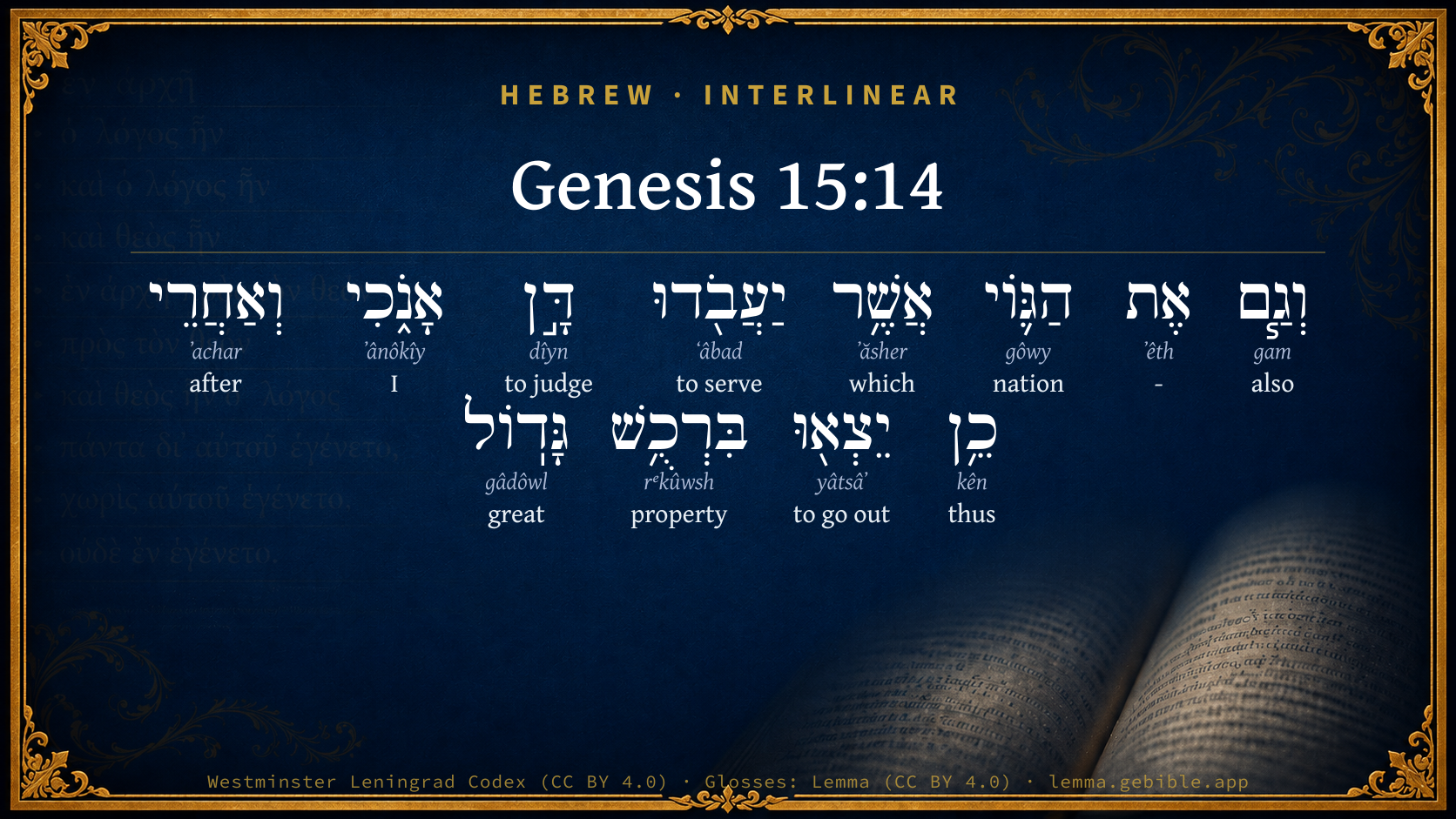
Hebrew (Westminster Leningrad Codex) Genesis 15:14 appears in the Hebrew Old Testament. The text above is from the Westminster Leningrad Codex. Each word links to its Strong’s number, a concise gloss, and parsing drawn from the Open Scriptures Hebrew Bible morphology. Click any word for its full Brown-Driver-Briggs (BDB) entry.
Download image
Cite this verse

Genesis 15:14 (World English Bible). Public Domain. Lemma interlinear Bible study tool, https://lemma.gebible.app/v/genesis/15/14.

Show BibTeX & RIS
BibTeX
RIS
English Translation
I will also judge that nation, whom they will serve. Afterward they will come out with great substance.
World English Bible · Public Domain
Download a study sheet

One document with this verse’s original text, its word-by-word gloss line, the meaning frame, cross-references with their text, attributed commentary, and full source and license credits — printable, and it pastes into notes with its structure intact.

This verse Autodidact and up

Study sheet (.html) Plain text (.txt)

A passage Seminary Student

Up to 50 verses in one chapter. A passage sheet keeps up to 6 commentary sources and 12 cross-references per verse, in the order this page ranks them, and says so on the sheet whenever that leaves anything out. Ask for a single verse and you get the Autodidact verse sheet above.

Everything on this page stays free to read, with no account — the sheet is a download of what is already on screen, not access to it.

Want to remove ads? Support Godless Engineer
Compare translations 3

The same verse in 3 English versions, stacked beneath the original-language interlinear above. Click any original word for its lexicon entry.

Each is an independent rendering of the whole verse — the interlinear is not word-aligned to these translations.

Highlighted words mark where these versions differ — a whole-verse word diff, not a word-by-word alignment.

  • World English Bible Public Domain
    I will also judge that nation, whom they will serve. Afterward they will come out with great substance.
  • King James Version Public Domain
    And also that nation, whom they shall serve, will I judge: and afterward shall they come out with great substance.
  • unfoldingWord Literal Text CC BY-SA 4.0
    But also, the nation that they serve I will judge, and after that they will come out with great possessions.

unfoldingWord Literal Text — © unfoldingWord, licensed CC BY-SA 4.0. Word-aligned USFM3 via Door43 (git.door43.org/unfoldingWord/en_ult).

Versions to compare (up to 4)

3 of 4 selected

Show all 18 translations

Every available English version of this verse, each an independent rendering of the whole verse.

  • World English Bible Public Domain
    I will also judge that nation, whom they will serve. Afterward they will come out with great substance.
  • Berean Standard Bible Public Domain
    But I will judge the nation they serve as slaves, and afterward they will depart with many possessions.
  • Majority Standard Bible Public Domain
    But I will judge the nation they serve as slaves, and afterward they will depart with many possessions.
  • King James Version Public Domain
    And also that nation, whom they shall serve, will I judge: and afterward shall they come out with great substance.
  • American Standard Version (1901) Public Domain
    and also that nation, whom they shall serve, will I judge: and afterward shall they come out with great substance.
  • Revised Version (1885) Public Domain
    and also that nation, whom they shall serve, will I judge: and afterward shall they come out with great substance.
  • Geneva Bible (1599) Public Domain
    Notwithstanding the nation, whom they shall serue, will I iudge: and afterward shall they come out with great substance.
  • Douay-Rheims (1899) Public Domain
    But I will judge the nation which they shall serve, and after this they shall come out with great substance.
  • Young's Literal Translation Public Domain
    and the nation also whom they serve I judge, and after this they go out with great substance;
  • Literal Standard Version CC BY-SA 4.0
    and the nation also whom they serve I judge, and after this they go out with great substance;
  • Unlocked Literal Bible CC BY-SA 4.0
    I will judge that nation that they will serve, and afterward they will come out with abundant possessions.
  • unfoldingWord Literal Text CC BY-SA 4.0
    But also, the nation that they serve I will judge, and after that they will come out with great possessions.
  • Darby Bible Public Domain
    But also that nation which they shall serve I will judge; and afterwards they shall come out with great property.
  • World Messianic Bible Public Domain
    I will also judge that nation, whom they will serve. Afterward they will come out with great wealth;
  • Webster's Bible Public Domain
    And also that nation which they shall serve, will I judge: and afterward shall they come out with great substance.
  • Free Bible Version CC BY-SA 4.0
    However, I will punish the nation that makes them slaves, and later on they will leave, taking many valuable possessions with them.
  • Bible in Basic English Public Domain
    But I will be the judge of that nation whose servants they are, and they will come out from among them with great wealth.
  • JPS Tanakh (1917) Public Domain
    and also that nation, whom they shall serve, will I judge; and afterward shall they come out with great substance.

Literal Standard Version (2020), Covenant Press — licensed CC BY-SA 4.0. Text via the HelloAO Bible API (eBible.org). Unlocked Literal Bible (unfoldingWord) — licensed CC BY-SA 4.0. Text via the HelloAO Bible API (eBible.org). unfoldingWord Literal Text — © unfoldingWord, licensed CC BY-SA 4.0. Word-aligned USFM3 via Door43 (git.door43.org/unfoldingWord/en_ult). Free Bible Version, Dr. Jonathan Gallagher — licensed CC BY-SA 4.0. Text via the HelloAO Bible API (eBible.org).

Word by word

More ways to search: Search by grammar → Find every occurrence → Compare this word →

Practice this passage: Drill this verse → Learn its vocabulary →

דָּ֣ן
dîyn
H1777
“judging”
Verb, Qal, Participle Active, Masculine, Singular, Absolute
Part of Speech
Verb
Stem
Qal
Form
Participle Active
Gender
Masculine
Number
Singular
State
Absolute
Full BDB Definition

Origin: a primitive root [comp. H113 ]

TWOT: 426

to judge, contend, plead - (Qal) - to act as judge, minister judgment - to plead a cause - to execute judgment, requite, vindicate - to govern - to contend, strive - (Niphal) to be at strife, quarrel
  1. וְגַ֧ם gam H1571 “and · also” Conjunction + Particle, Accusative
  2. אֶת ʼêth H853 “-” Particle, Direct Object
  3. הַגּ֛וֹי gôwy H1471 “the · nation” Particle, Definite Article + Noun, Common, Masculine, Singular, Absolute
  4. אֲשֶׁ֥ר ʼăsher H834 “which” Particle, Relative
  5. יַעֲבֹ֖דוּ ʻâbad H5647 “to serve” Verb, Qal, Imperfect, 3rd Person, Masculine, Plural
  6. אָנֹ֑כִי ʼânôkîy H595 “I” Pronoun, Personal, 1st Person, Common, Singular
  7. וְאַחֲרֵי ʼachar H310 “and · after” Conjunction + Preposition
  8. כֵ֥ן kên H3651 “thus” Adverb
  9. יֵצְא֖וּ yâtsâʼ H3318 “to go out” Verb, Qal, Imperfect, 3rd Person, Masculine, Plural
  10. בִּרְכֻ֥שׁ rᵉkûwsh H7399 “in/at · property” Preposition + Noun, Common, Masculine, Singular, Absolute
  11. גָּדֽוֹל gâdôwl H1419 “great” Adjective, Adjective, Masculine, Singular, Absolute

About this verse

These counts appear in no published source. They are computed here, from the morphology-tagged text and Lemma’s own curated glosses. What Lemma adds →

12
words
12
distinct lemmas
Pentateuch
section

Notable vocabulary

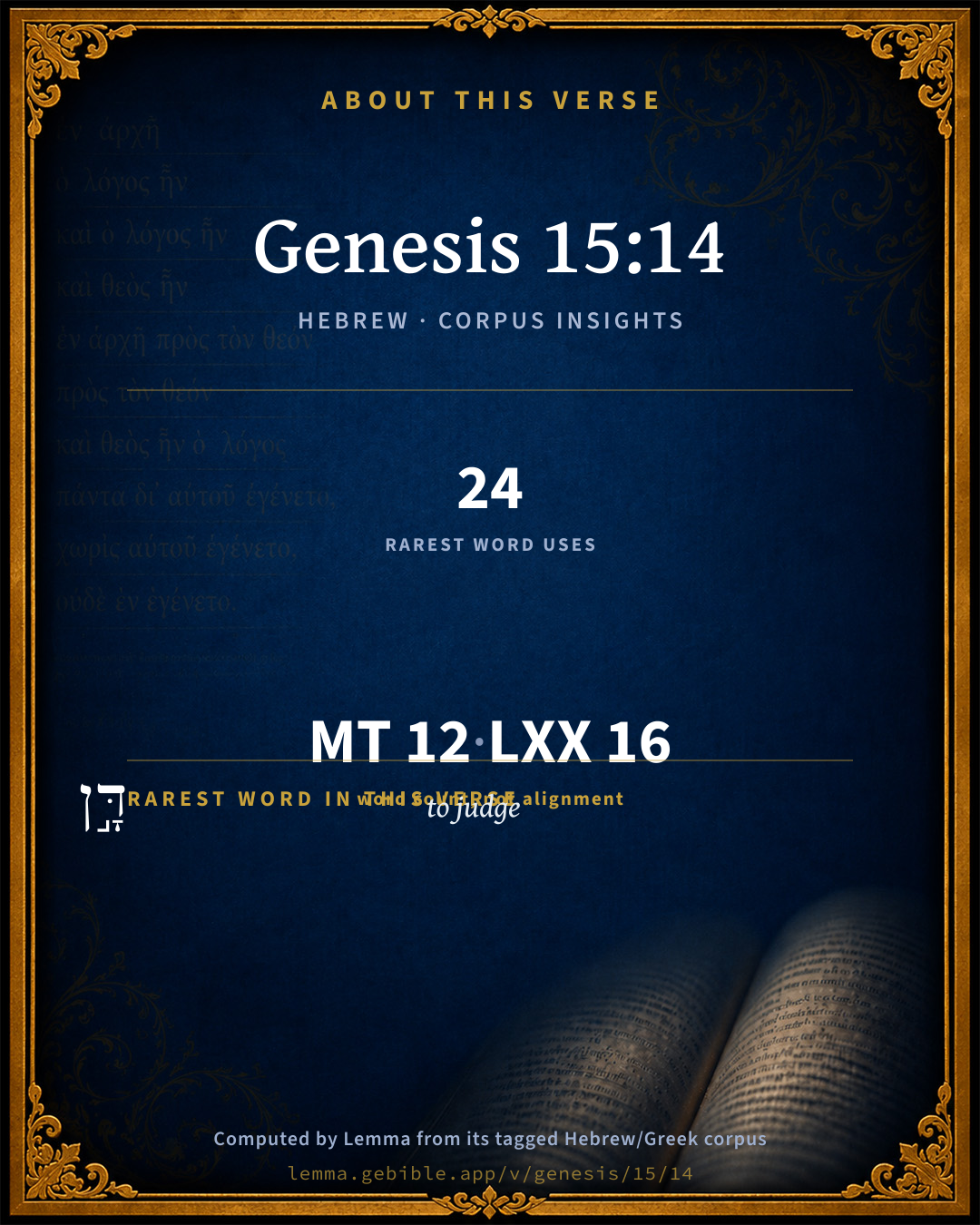
The rarest word here is דָּ֣ן to judge H1777 — appearing just 24 times in the whole Hebrew Bible.

Shared distinctive vocabulary

דָּ֣ן to judge H1777 occurs in 24 verses of the Hebrew Bible. Also found in:

Grammatical profile

  • 3 verbs
  • 2 nouns
  • 1 adjective
  • 1 pronoun
  • 1 preposition
  • 1 adverb
  • 3 particles

Verb forms

  • יַעֲבֹ֖דוּ Qal · Imperfect
  • דָּ֣ן Qal · Participle Active
  • יֵצְא֖וּ Qal · Imperfect

Hebrew & Septuagint length

In English translation the verse runs 18 words from the Hebrew and 21 from the Septuagint (LXX English) — closely comparable.

A rough comparison of the two English renderings, which tokenize alike — not a word-level alignment.

Word counts can differ between the Hebrew and the Greek without any difference in meaning — e.g. the Hebrew direct-object marker אֵת has no separate Greek word, and Greek often adds the article ὁ.

In the original languages it is 12 Hebrew tokens and 16 Greek tokens — but the two are counted differently (Hebrew bundles its prefixes and suffixes into one token; the Greek is in lemma form), so that isn’t a like-for-like length.

Cross-references

18

Topical passages linked to Genesis 15:14 in the Treasury of Scripture Knowledge — connected by theme and wording, ordered by reader-vote popularity; previews shown in the World English Bible.

  • Nehemiah 9:9–11 You saw the affliction of our fathers in Egypt, and heard their cry by the Red Sea,
  • Exodus 6:5–6 Moreover I have heard the groaning of the children of Israel, whom the Egyptians keep in bondage, and I have remembered my covenant.
  • Exodus 12:32–38 Take both your flocks and your herds, as you have said, and be gone; and bless me also!"
  • Joshua 24:4–7 I gave to Isaac Jacob and Esau: and I gave to Esau Mount Seir, to possess it: and Jacob and his children went down into Egypt.
  • Exodus 7:1–14 Yahweh said to Moses, "Behold, I have made you as God to Pharaoh; and Aaron your brother shall be your prophet.
  • Deuteronomy 4:20 But Yahweh has taken you, and brought you forth out of the iron furnace, out of Egypt, to be to him a people of inheritance, as at this day.
  • 1 Samuel 12:8 When Jacob was come into Egypt, and your fathers cried to Yahweh, then Yahweh sent Moses and Aaron, who brought forth your fathers out of Egypt, and made them to dwell in this place.
  • Psalms 135:14 For Yahweh will judge his people, And have compassion on his servants.
  • Deuteronomy 6:22 and Yahweh shown signs and wonders, great and sore, on Egypt, on Pharaoh, and on all his house, before our eyes;
  • Deuteronomy 7:18–19 you shall not be afraid of them: you shall well remember what Yahweh your God did to Pharaoh, and to all Egypt;
  • Joshua 24:17 for Yahweh our God, he it is who brought us and our fathers up out of the land of Egypt, from the house of bondage, and who did those great signs in our sight, and preserved us in all the way in which we went, and among all the peoples through the midst of whom we passed;
  • Genesis 46:1–34 Israel traveled with all that he had, and came to Beersheba, and offered sacrifices to the God of his father, Isaac.
  • Exodus 3:21–22 I will give this people favor in the sight of the Egyptians, and it will happen that when you go, you shall not go empty-handed.
  • Deuteronomy 11:2–4 Know you this day: for I don't speak with your children who have not known, and who have not seen the chastisement of Yahweh your God, his greatness, his mighty hand, and his outstretched arm,
  • Psalms 105:27–37 They performed miracles among them, And wonders in the land of Ham.
  • Psalms 51:4 Against you, and you only, have I sinned, And done that which is evil in your sight; That you may be proved right when you speak, And justified when you judge.
  • Psalms 78:43–51 How he set his signs in Egypt, His wonders in the field of Zoan,
  • Psalms 135:9 Who sent signs and wonders into the midst of you, Egypt, On Pharaoh, and on all his servants;

Cross-references courtesy of OpenBible.info (CC BY 4.0).

Hebrew and Greek witnesses Masoretic Hebrew ↔ Greek Septuagint

The same verse in the two great witnesses to the Old Testament, shown verse-for-verse.

These are two independent witnesses, not word-aligned to each other, and the Septuagint is shown in lemma (dictionary) form.

Hebrew Genesis 15:14 Masoretic · Westminster Leningrad Codex

וְגַ֧ם אֶת הַגּ֛וֹי אֲשֶׁ֥ר יַעֲבֹ֖דוּ דָּ֣ן אָנֹ֑כִי וְאַחֲרֵי כֵ֥ן יֵצְא֖וּ בִּרְכֻ֥שׁ גָּדֽוֹל

I will also judge that nation, whom they will serve. Afterward they will come out with great substance.

World English Bible · Public Domain

Greek LXX Genesis 15:14 Septuagint · lemma form

ὁ δέ ἔθνος ὅς ἐάν δουλεύω κρίνω ἐγώ μετά δέ οὗτος ἐκἔρχομαι ὧδε μετά ἀποσκευή πολύς

And the nation whoever they shall serve I will judge; and after this, they shall come forth hither with much property.

LXX2012 (modern English Septuagint) · Public Domain

Hebrew: Westminster Leningrad Codex (CC BY 4.0). Greek: Septuagint (public domain); English from LXX2012 (modern English Septuagint) (Public Domain). How the Septuagint differs from the Hebrew →

Targum (Aramaic paraphrase)

2

The Targum is the ancient Jewish Aramaic paraphrase of the Hebrew Scriptures — an interpretive translation, not the Hebrew text itself. Onkelos (literal) and Pseudo-Jonathan (expansive) render the Torah, and Jonathan the Prophets. Coverage is partial: where no permissively-licensed English translation exists for a verse, only the Aramaic is shown. This is verse-level text, not a word-by-word alignment to the Hebrew.

  1. Targum Onkelos Torah (Genesis–Deuteronomy)
    וְאַף יָת עַמָא דְיִפְלְחוּן בְּהוֹן דָיִין אֲנָא וּבָתַר כֵּן יִפְקוּן בְּקִנְיָנָא סַגִי

    (no public-domain English translation for this verse)

    Targum Onkelos — Aramaic: “Onkelos Genesis” (public domain); “Onkelos Exodus” (public domain); “Onkelos Leviticus” (public domain); “Onkelos Numbers” (public domain); “Onkelos Deuteronomy” (public domain). English: “Sefaria Community Translation” (CC0 1.0 (public-domain dedication)); “J.W. Etheridge. The Targums of Onkelos and Jonathan Ben Uzziel on the Pentateuch. London: Longmans, Green, 1862” (public domain). Text via Sefaria.

  2. Targum Pseudo-Jonathan Torah (Genesis–Deuteronomy)
    וְאוּף יַת עַמָא דְיִפְלְחוּן לְהוֹם דַיָין אֲנָא בְּמָאתָן וְחַמְשִׁין מָחָן וּמִן בָּתַר כֵּן יִפְקוּן לְחֵירוּתָא בְּנִכְסִין סַגִיאִין

    and also that the people whom they shall serve I will judge with two hundred and fifty plagues, and afterwards they shall go forth into liberty with great riches.

    Targum Pseudo-Jonathan — Aramaic: “Targum Jonathan on Genesis” (public domain); “Targum Jonathan on Exodus” (public domain); “Targum Jonathan on Leviticus” (public domain); “Targum Jonathan on Numbers” (public domain); “Targum Jonathan on Deuteronomy” (public domain). English: “The Targum of Jonathan ben Uzziel, trans. J. W. Etheridge, London, 1862” (public domain). Text via Sefaria.

Commentary

Notes on Genesis 15:14 from classic Christian and Jewish commentators (each source and its license shown beneath its notes). The classic Christian expositions comment on the surrounding passage and are grouped to its opening verse, so a note may address several verses; the Jewish commentaries on the Tanakh (Rashi and others) are per-verse, so they appear only where the commentator wrote on this verse.

Lemma curates 59 commentaries, every one of them public domain or Creative Commons licensed, each selected and text-cleaned for this edition rather than reprinted as found. About our sources →

Trapp's Complete Commentary

John Trapp

Gen 15:14 And also that nation, whom they shall serve, will I judge: and afterward shall they come out with great substance.

Ver. 14. Afterward shall they come out, &c.] All the saints’ abasements are but in order to their advancement. As God brought forth his Israel with jewels, and other wealth; so the "afflicted" Church, and "tossed with tempest," shall build her walls and "lay her foundations with sapphires and agates". {Isa 54:11-12} See Isa 62:3-4.

John Trapp, A Commentary or Exposition upon All the Books of the Old and New Testament (1647–1656) — public domain. Text from a community e-Sword module.

Joseph Benson's Commentary

Gen 15:14. That nation whom they shall serve, even the Egyptians, will I judge — This points at the plagues of Egypt, by which God not only constrained the Egyptians to release Israel, but punished them for all the hardships they had put upon them. The punishing of persecutors is the judging of them; it is a righteous thing with God, and a particular act of justice, to “recompense tribulation to those that trouble” his people.

Joseph Benson's Commentary on the Old and New Testaments (1811–1818) — public domain. Text from a community e-Sword module.

Adam Clarke's Commentary

Verse 14. And also that nation, &c.] How remarkably was this promise fulfilled, in the redemption of Israel from its bondage, in the plagues and destruction of the Egyptians, and in the immense wealth which the Israelites brought out of Egypt! Not a more circumstantial or literally fulfilled promise is to be found in the sacred writings.

Adam Clarke's Commentary on the Bible (1810–1826) — public domain. Text from a community e-Sword/MySword module.

John Calvin's Commentaries

14. Also that nations whom they serve. A consolation is now subjoined, in which this is the first thing, God testifies that he will be the vindicator of his people. Whence it follows, that he will take upon himself the care of the salvation of those whom he has embraced, and will not suffer them to be harassed by the ungodly and the wicked with impunity. And although he here expressly announces that he will take vengeance on the Egyptians; yet all the enemies of the Church are exposed to the same judgment: even as Moses in his song extends to all ages and nations the threat that the Lord will exact punishment for unjust persecutions.

‘Vengeance is mine, I, saith he, will repay,’ (Deuteronomy 32:35.)

Therefore, whenever we happen to be treated with inhumanity by tyrants, (which is very usual with the Church,) let this be our consolation, that after our faith shall be sufficiently proved by bearing the cross, God, at whose pleasure we are thus humbled, will himself be the Judge, who will repay to our enemies the due reward of the cruelty which they now exercise. Although they now exult with intoxicated joy, it will at length appear by the event itself, that our miseries are happy ones, but their triumphs wretched; because God, who cares for us, is their adversary. But let us remember that we must give place unto the wrath of God, as Paul exhorts, in order that we may not be hurried headlong to seek revenge. Place also must be given to hope, that it may sustain us when oppressed and groaning under the burden of evils. To judge the nation, means the same thing as to summon it to judgment, in order that God, when he has long reposed in silence, may openly manifest himself as the Judge.

John Calvin's Commentaries (1540-1563) — public domain. Text from the Calvin Translation Society English edition (1840s-50s) via the Christian Classics Ethereal Library (ccel.org). Calvin's coverage is partial (roughly two-thirds of the Bible); uncommented books and verses are honest gaps, never fabricated. The 19th-century editor's footnotes and remarks are omitted so the notes are faithfully Calvin's own voice.

Ellicott's Commentary for English Readers

(14) That nation.—Had it been expressly revealed that the country that would afflict them was Egypt, the patriarchs might have been unwilling to go thither; but the reference to the plagues in the denunciation of judgment, and to the spoiling of the Egyptians in the promise that they should “come out with great substance” (Exo_12:36), gave detail sufficient for future guidance, and for their assurance in time to come that the promise had been fulfilled.

A Bible Commentary for English Readers, edited by Charles John Ellicott (1878–1897) — public domain. Text from a community e-Sword module.

The Cambridge Bible for Schools and Colleges

gen. ed. J. J. S. Perowne

14. will I judge] Referring to the plagues of Egypt.

with great substance] See Exo_12:35-36; Psa_105:37.

The Cambridge Bible for Schools and Colleges (gen. ed. J. J. S. Perowne; Cambridge University Press, 1878–1918) — public domain. Text from a community e-Sword module.

John Gill's Exposition

And thou shall go to thy fathers in peace,.... Or die, which is a going the way of all flesh, to a man's long home, out of this world to another, to the world of spirits, to those that are gone before them; which is no inconsiderable proof of the immortality of the soul. Jarchi infers from hence, that Terah, Abram's father, was a penitent, and died a good man, and went to heaven, the place and state of the blessed, whither Abram should go at death; but the phrase of going to the fathers is used both of good and bad men: it is moreover said of Abram, that he should go in peace; being freed from all the fatigues of his journeying from place to place in his state of pilgrimage, and not living to see the afflictions of his posterity, and to have any share in them; and dying in spiritual peace, in tranquillity of mind, knowing in whom he had believed, and where his salvation was safe and secure, and whither he was going; for a good man dies with peace of conscience, having his sins freely forgiven, and he justified from them by the righteousness of the living Redeemer, and enters into eternal peace, see Psa 37:37,

thou shall be buried in a good old age; this signifies that he should live long, see many days and good ones, enjoy much health and prosperity, continue in the ways of truth and righteousness to the end, and come to his grave like a shock of corn fully ripe, and fit for an other world; and that he should have a decent interment in the land of Canaan, where he purchased a burial place, and which was a pledge and earnest of the future possession of it by his seed, the thing here promised.

John Gill's Exposition of the Whole Bible (1746–1763) — public domain (CC PDM 1.0). Text via the HelloAO Bible API.

Haydock's Catholic Bible Commentary

Judge and punish the Egyptians, overwhelming them in the Red sea, &c. (Haydock)

George Leo Haydock (1774–1849), Haydock's Catholic Family Bible and Commentary, 1859 edition — public domain. Excludes Psalms (Douay-Rheims chapter numbering differs from Protestant) and Deuterocanonical books (Catholic canon only).

Matthew Poole's English Annotations

That nation whom they shall serve, i.e. Egypt, the principal seat of their servitude, and the instrument of their sorest bondage,

will I judge, i.e. punish, as that word is used, Psa 51:4; Oba 1:21, and elsewhere.

With great substance; the accomplishment of this, see Exo 3:22; 11:2; 12:35,37.

Matthew Poole's English Annotations on the Holy Bible (1683–1685) — public domain. Text from a community e-Sword/MySword module.

Whedon's Commentary on the Bible

Daniel D. Whedon

14. That nation… will I judge — As seen in the history of the plagues of Egypt. Come out with great substance — See Exo_12:31-36.

Daniel D. Whedon (gen. ed.), Commentary on the Old and New Testaments (1874–1909) — public domain. Text from a community e-Sword module.

The Pulpit Commentary

And also that nation (the name of which he does not reveal, in case of seeming to interfere with the free volition of his creatures, who, while accomplishing his high designs and secret purposes, are ever conscious of their moral freedom), whom they shall serve, will I judge:i.e. punish after judging, which prediction was in due course fulfilled (Exo_6:11) and afterward shall they come out with great substance recush (cf. Gen_13:6; vide. Exo_12:36)

The Pulpit Commentary (1880–1919), ed. H.D.M. Spence-Jones & Joseph S. Exell — public domain. Text from a community e-Sword module.

John Wesley's Explanatory Notes

That nation whom they shall serve, even the Egyptians, will I judge - This points at the plagues of Egypt, by which God not only constrained the Egyptians to release Israel, but punished them for all the hardships they had put upon them. The punishing of persecutors is the judging of them; it is a righteous thing with God, and a particular act of justice, to recompense tribulation to those that trouble his people. 3. The deliverance of Abram's seed out of Egypt. And afterwards shall they come out with great substance - Either after they have been afflicted 400 years, or, after the Egyptians are judged and plagued.

John Wesley, Explanatory Notes Upon the Whole Bible (1754–1765) — public domain. Text via the GEBible commentary corpus.

unfoldingWord translationNotes

Door43 World Missions Community

General Information:

Yahweh continued to speak to Abram while Abram dreamed.

I will judge

Here "judge" is a metonym for what will happen after God makes the judgment. AT: "I will punish" (See: Metonymy)

that they will serve

The full meaning of this statement can be made explicit. AT: "that your descendants will serve" (See: Assumed Knowledge and Implicit Information)

abundant possessions

This is an idiom. AT: "many possessions" or "great wealth" (See: Idiom)

you will go to your fathers

This is a polite way of saying "you will die." (See: Euphemism)

fathers

The word "fathers" is a synecdoche for all ancestors. AT: "ancestors" or "ancestral fathers" (See: Synecdoche)

you will be buried in a good old age

"you will be very old when you die and your family buries your body"

In the fourth generation

Here one generation refers to a lifespan of 100 years. "After four hundred years"

they will come here again

"your descendants will come back here." Abraham's descendants would come to the land where Abram was then living, the land that Yahweh had promised to give to him.

has not yet reached its limit

"is not yet complete" or "will get much worse before I punish them"

translationWords

judge

nation

servant

ancestor

peace

generation

iniquity

Amorite

unfoldingWord translationNotes — © Distant Shores Media and the Door43 World Missions Community, licensed CC BY-SA 4.0. Source: git.door43.org/Door43/en_tn.

Rashi

Rabbi Shlomo Yitzchaki (Rashi)

וגם את הגוי AND ALSO THAT NATION — The word וגם and also—(that nation also will I judge)—suggests that other nations will be judged as well: it is used here to include the four Monarchies (of the book of Daniel) who also will perish because they enslaved Israel (Genesis Rabbah 44:19).

דן אנכי I WILL JUDGE with ten plagues (Genesis Rabbah 44:20).

ברכוש גדול WITH GREAT SUBSTANCE — with great wealth, as it is said, (Exodus 12:36) “And they despoiled the Egyptians.”

Rashi on the Tanakh — English translations: “The Judaica Press complete Tanach with Rashi, translated by A. J. Rosenberg” (CC BY 4.0); “Pentateuch with Rashi's commentary by M. Rosenbaum and A.M. Silbermann, 1929-1934” (public domain); “The Metsudah Tanach series, Lakewood, N.J” (CC BY 4.0); and “The Book of Joshua, Metsudah Publications, 1997” (CC BY 4.0). Text via Sefaria.

Ramban (Nachmanides)

Rabbi Moshe ben Nachman (Ramban / Nachmanides)

‘VEGAM’ (AND ALSO) THAT NATION THAT MADE SLAVES OF THEM WILL I JUDGE. The words, And also, include the kingdoms of the four exiles which will be judged for having enslaved Israel. Thus the language of Rashi.By way of the simple meaning of Scripture, the verse is stating: “Just as I decreed exile and affliction for your children on account of sin, so will I bring judgment upon the nation that will enslave them for the violence they will do to them.”The correct meaning of the word vegam appears to me to be as follows: Even though I have decreed that your children be strangers in a land not their own, and they shall enslave them and afflict them, I will nevertheless judge the nation that will enslave them for what they will do to them, and they will not be exonerated for having done My decree.” The reason for this is as Scripture states: I am jealous for Jerusalem and for Zion with a great jealousy; and I am very sore displeased with the nations that are at ease; for I was but a little displeased, and they helped for evil. And it says again, I was wroth with My people, I profaned Mine inheritance, and gave them into thy hand; thou didst show them no mercy; upon the aged hast thou very heavily laid the yoke. Such was the case with the Egyptians who increased the evil. They threw the children of the Israelites into the river, embittered their lives, and they intended to eradicate their name from memory. This is the meaning of the expression will I judge, i.e., “I will bring them to judgment to determine whether they did as was decreed upon them or if they increased the evil inflicted upon them.” It is this principle which Jethro stated: For it is the thing wherein they acted presumptuously [that caused the punishment to come] upon them., 18:11. It was their presumptuousness that brought upon the Egyptians the great punishment which utterly destroyed them. And this principle is also expressed in the verse: for thou knewest that they dealt proudly against them. Now the Rabbi, Note 139. stated the reason [for the punishment of the Egyptians — a punishment meted out even though it had been decreed that they were to enslave the Israelites] — in the Book of Knowledge: “It had not been decreed on any particular [Egyptian that he was to afflict the Israelites], and if any one of all those who perpetrated evil against Israel had not wanted to do it, he had the liberty to do so since the decree was not directed at any specific person.” )But to me the Rabbi’s words are not reconciled with the facts. Even if the Holy One, blessed be He, were to decree that any individual among all the nations should do them [the Israelites] evil in such-and-such a manner, and this specific individual fulfilled His decree with alacrity, he has the merit of fulfilling a Divine commandment. What sense is there in the Rabbi’s words? If a king were to command that the inhabitants of a certain country do a particular deed, he who is slack and throws the matter upon others offends and sins against himself, while he who does it wins the king’s favor. And this is all the more since Scripture states, And also that nation that made slaves of them, which clearly implies that the entire Egyptian nation was to enslave them, and they came to Egypt of their own free will! Instead, the reason [for the punishment of the Egyptians] is as I have written above.Our Rabbis already mentioned this matter when they said in Shmoth Rabbah: “This may be likened to a lord who told his son that he should work for a certain person who should not cause him any suffering. So he went and worked for him. Now even though he worked for him without recompense, the master did not cease causing him suffering. When the lord finally was reconciled with his son, he decreed death to those who caused his son suffering. Similarly, the Holy One, blessed be He, decreed that Israel be in servitude in Egypt. But the Egyptians overwhelmed them and enslaved them by force. “Said the Holy One, blessed be He: ‘You should have used them as servants who would do your needs. I was but a little displeased, and they helped for evil.’” Thus far [is the quote from the Midrash Shmoth Rabbah].Now it is clear that throwing Hebrew children into the river was not included in the decree, And they shall enslave them, and afflict them, for this would result in their complete destruction. Similarly, that which the Egyptians said at first, Come, let us deal wisely with them lest they multiply is not part of servitude or affliction. Besides, they themselves increased the degree of affliction, as Scripture testifies, And they made their lives bitter with hard service, etc., Verse 14. It is this which Scripture states in the following verse: And he saw our affliction, and our toil, and our oppression. Know and understand that a person who, on the New Year, has been inscribed and sealed for a violent death, the bandits who kill him will not be guiltless because they fulfilled that which had been decreed against him. That wicked man shall die in his iniquity, but his blood will be sought from the murderer. However, when a decree issues from the mouth of a prophet, there are different laws concerning one who fulfills it. If he heard it and he wishes to fulfill the Will of his Creator as decreed, there is no sin upon him for doing so. On the contrary, it is accounted to him as a merit, just as it is said concerning King Jehu: Because thou hast done well in executing that which is right in Mine eyes, and hast done unto the house of Ahab according to all that was in My heart, thy sons of the fourth generation shall sit on the throne of Israel. However, if he heard the command and killed him out of his personal hatred or in order to take his wealth, he is subject to punishment for his intention was to sin, and it is accounted to him as a transgression. Scripture so states with respect to Sennacherib, [king of Assyria]: O Asshur the rod of Mine anger… I do send him against an ungodly nation, and against the people of My wrath do I give him a charge. And Scripture continues: but not so doth he mean, neither doth his heart think so, but it is in his heart to destroy., Verse 7. This is why he was punished in the end, just as it is said, Wherefore it shall come to pass, that when the Eternal hath performed his whole work… I will punish the fruit of the arrogant heart of the king of Assyria, and the glory of his haughty looks, etc., Verse 12. Again it says concerning Sennacherib: Israel is a scattered sheep, the lions have driven him away; first the king of Assyria hath devoured him, and last this Nebuchadrezzar king of Babylon. …Therefore thus said the Eternal… Behold, I will punish the king of Babylon and his land, as I have punished the king of Assyria. This is proof that the king of Assyria was punished because of the evil he did to Israel. Now Nebuchadrezzar heard that the prophets unanimously called upon him to destroy Jerusalem, and he and all his people were commanded to do this by word of the prophet, as it is written, Behold, I will send and take all the families of the north, saith the Eternal, and I will send unto Nebuchadrezzar the king of Babylon, My servant, and will bring them against this land, and against the inhabitants thereof… and I will utterly destroy them., 25:9. And it is further written, Behold I will give this city into the hand of the Chaldeans, and into the hand of Nebuchadrezzar king of Babylon… and they shall set the city on fire., 32:28-29. Concerning the Sanctuary itself, the prophet said, I will make this house like Shiloh., 26:6. Shiloh was destroyed by the Philistines. (I Samuel 4.) The Chaldeans knew that it was the command of G-d, as Nebuzaradan [captain of the guard of the King of Babylon] said to Jeremiah, The Eternal thy G-d pronounced this evil upon this place; and the Eternal hath brought it, and done according as He spoke, because ye have sinned against the Eternal., 40:2-3. Yet despite this, the Chaldeans were all punished in the end. This was because of two reasons. First, Nebuchadrezzar also intended to destroy the entire land in order to increase his authority, as it is written concerning him: And I will cause the arrogancy of the proud to cease, and will lay low the haughtiness of the tyrants; and again it is written: And thou hast said in thy heart, I will ascend into heaven… I will ascend above the heights of the clouds; I will be like the Most High., 14:13-14. Concerning his nation it is written, Thou sayest in thy heart: I am, and there is none else beside me., 47:8. Habakkuk the prophet said concerning him, Woe to him that gaineth evil gains for his house, that he may set his nest on high, etc. Thus Nebuchadrezzar’s punishment is as that of Sennacherib. It is for this reason that Scripture says, Therefore thus saith the Eternal… Behold, I will punish the king of Babylon and his land, as I have punished the king of Assyria. And there was yet another reason for punishment in the case of the king of Babylon, i.e., for his having added to the decree and having exceedingly perpetrated evil against Israel, as it is said concerning him, I was wroth with My people, I profaned Mine inheritance, and gave them into thy hand; thou didst show no mercy, upon the aged hast thou very heavily laid thy yoke. Therefore did a twofold punishment come upon him: his people were utterly destroyed, there remaining of Babylon no name and remnant, offshoot and offspring, 14:22. and his city was destroyed forever, as it is said, And Babylon, the glory of kingdoms, the beauty of the Chaldeans’ pride, shall be as when G-d overthrew Sodom and Gomorrah. It shall never be inhabited, neither shall it be dwelled in from generation to generation… But wild-cats shall lie there… and satyrs shall dance there., 13:19-21. Scripture further states concerning him, For it is the vengeance of the Eternal, the vengeance of His temple, and it is written, ‘The violence done to me and to my flesh be upon Babylon,’ shall the inhabitants of Zion say; and ‘My blood be upon the inhabitants of Chaldaea,’ shall Jerusalem say. Therefore thus saith the Eternal: Behold, I will plead thy cause, and take vengeance for thee., 51:35-6. There are many verses like these.

Ramban (Nachmanides) on the Tanakh — English translation: “Commentary on the Torah by Ramban (Nachmanides). Translated and annotated by Charles B. Chavel. New York, Shilo Pub. House, 1971-1976” (CC BY 4.0). Text via Sefaria.

Radak

Rabbi David Kimhi (Radak)

וגם את הגוי אשר יעבדו דן אנכי, I will judge the Egyptians even though it was I Who decreed that the Israelites would be enslaved by them. The reason why I will judge them is that they acted with great cruelty toward the Israelites, something which I had not decreed. The prophet Zacharyah 1,15 spelled out this concept in connection with the punishment G’d visited on the Babylonians, who, though entitled to destroy the Temple in Jerusalem, had never been entitled to go about it with such a vengeance. Similar verses justifying G’d punishing those who had carried out part of His plan against the Jewish people, but with needless harshness, are also found in Isaiah 47,6. The harshness of the slavery in Egypt was a punishment for the Israelites having abandoned the traditions of their fathers, having reverted to idolatry, having violated the covenant between G’d and Avraham, and not even having circumcised their male children. According to Ezekiel 20,7-8 and 9, the Israelites in Egypt had actually been guilty of utter annihilation for forsaking this covenant, and if G’d nonetheless redeemed them, this was for the sake of His name, not because they had deserved it. Having sworn to Avraham that He would redeem his offspring from the country in which they would be enslaved, we must view the Exodus as primarily an exercise of preserving G’d’s image. G’d had told Moses already in Exodus 6,8 that He had sworn an oath to Avraham, etc. Such statements are meant to demonstrate that the Israelites while in Egypt had not been forsaken by G’d, that He had not overlooked what was happening to them, but that they had been the architects of their own misfortune, and that if it had not been for G’d’s oath to the patriarchs, they would have perished there. Apparently, G’d had sent prophets to them prior to Moses, warning them of what might happen, but they had turned a deaf ear to such warnings. This is why Moses, aware of this, said to G’d that He should send another prophet, as He had been in the habit of doing, שלח נא ביד תשלח (Exodus 4,13). This is also what the prophet Ezekiel had in mind in the paragraph that we have referred to earlier. [All of this demonstrates that when Avram asked in verse 8 of this chapter במה אדע כי אירשנה, which we explained as his concern that G’d’s promise might not become actual due to some sin of his offspring, he was quite justified in worrying about such a scenario. It also explains still better G’d’s answer and His statement that He gave Avram a lot of credit for believing G’d’s assurance that in spite of his fears the promise would be carried out in due course. G’d’s answer to Avram contained an acknowledgement that He was aware that the Israelites would indeed sin in Egypt, but also the fact that He would punish them there but not annihilate them, so that eventually they would leave from there with great riches. The redemption would occur after their punishment had run its course. Perhaps, in support of our author’s theory, we might add that the word וגם, “and also,” in our verse, which appears strange since we had not been told who else had been judged and punished, refers to the Jewish people, who by that time had received their punishment in full, so that the remnant, the 20% of whom Rashi speaks on Exodus 13,18 (וחמושים) were entitled to redemption after risking their lives by slaughtering the lamb and circumcising themselves. Ed.]

Radak on the Tanakh — English translations: “Sefaria Community Translation” (CC0 1.0 (public-domain dedication)); “Eliyahu Munk, HaChut Hameshulash” (CC BY 4.0); “Rabbi Mike Feuer, Jerusalem Anthology” (CC BY 4.0); and “R. David Kimhi on the first book of Psalms, Translated by R.G. Finch, London, 1919” (public domain). Text via Sefaria.

Lesson kit

Teaching starters — assembled from the data on this page, not authored interpretation. Every prompt links to the verse data it draws on. Edit before teaching.

Genesis, in the Pentateuch, opens this verse with 12 words (12 distinct Hebrew lemmas). Its most distinctive word is dîyn (“to judge”). A historical commentator’s framing appears above. Read the whole chapter for the surrounding context.

Discussion questions

  1. The word dîyn carries the sense “to judge.” How does it shape the verse?
  2. How does Genesis 6:3, which shares the word «to judge», read alongside this verse?
  3. The translations on this page render this verse differently — a whole-verse word diff, not a word-by-word alignment. What might account for the different wordings?
  4. «יַעֲבֹ֖דוּ» is a Qal Imperfect verb. How does that grammatical form shape the action described?
  5. Compare how Trapp's Complete Commentary and Joseph Benson's Commentary read this verse. Where do they agree or differ?

Things to notice

Reading settings

Reading text

Shown beneath each verse's original-language words.

Old Testament
Old Testament edition

Read the OT as the Masoretic Hebrew (MT) or the Greek Septuagint (LXX).

English shown for the Greek Septuagint (in the Hebrew ↔ Greek comparison).

Comparing translations? Open the Compare panel on any verse page to stack up to four side by side.