
1 Kings 18:10

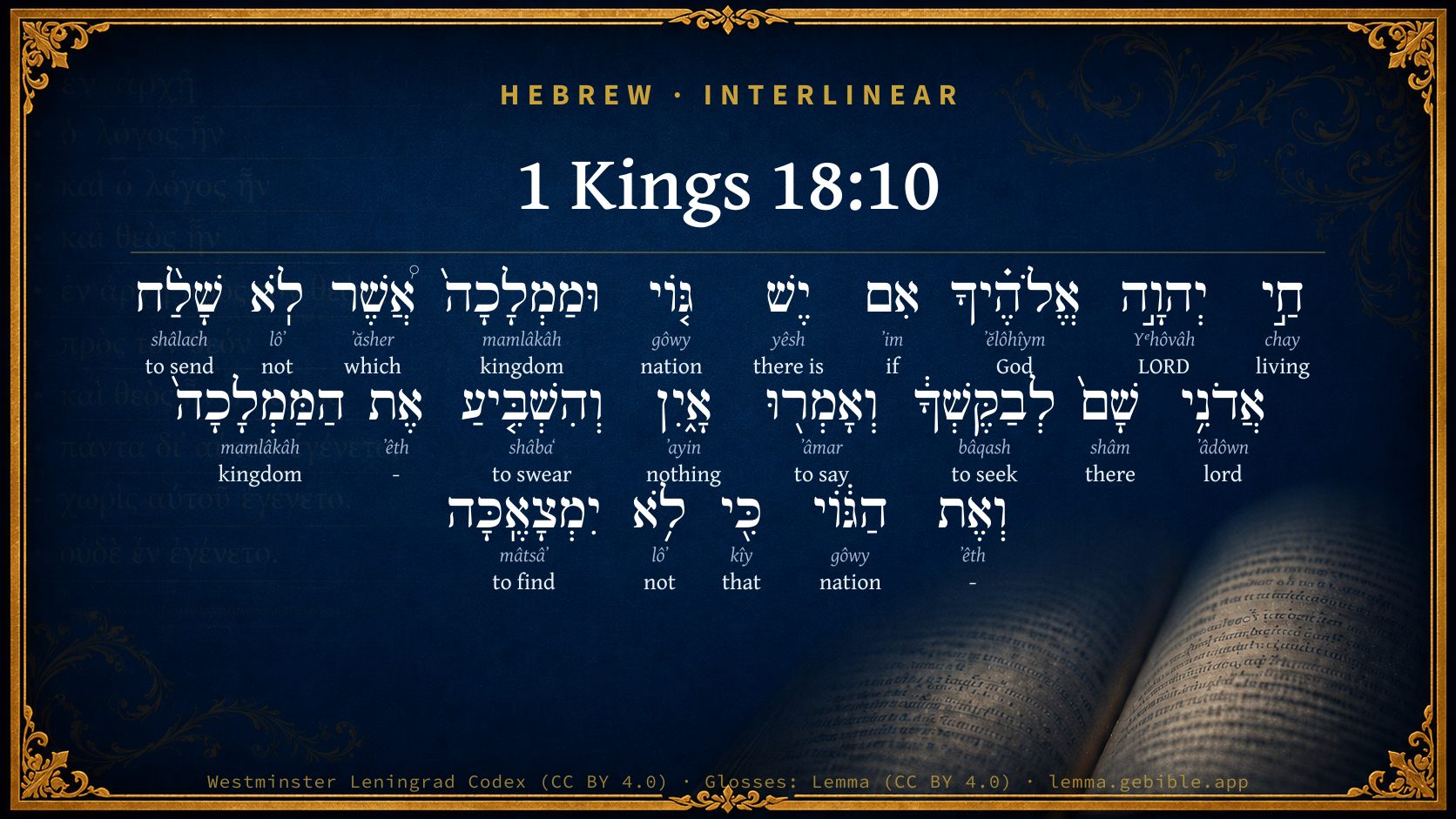
Hebrew (Westminster Leningrad Codex) 1 Kings 18:10 appears in the Hebrew Old Testament. The text above is from the Westminster Leningrad Codex. Each word links to its Strong’s number, a concise gloss, and parsing drawn from the Open Scriptures Hebrew Bible morphology. Click any word for its full Brown-Driver-Briggs (BDB) entry.
Download image
Cite this verse

1 Kings 18:10 (World English Bible). Public Domain. Lemma interlinear Bible study tool, https://lemma.gebible.app/v/1-kings/18/10.

Show BibTeX & RIS
BibTeX
RIS
English Translation
As Yahweh your God lives, there is no nation or kingdom, where my lord has not sent to seek you: and when they said, He is not here, he took an oath of the kingdom and nation, that they didn't find you.
World English Bible · Public Domain
Download a study sheet

One document with this verse’s original text, its word-by-word gloss line, the meaning frame, cross-references with their text, attributed commentary, and full source and license credits — printable, and it pastes into notes with its structure intact.

This verse Autodidact and up

Study sheet (.html) Plain text (.txt)

A passage Seminary Student

Up to 50 verses in one chapter. A passage sheet keeps up to 6 commentary sources and 12 cross-references per verse, in the order this page ranks them, and says so on the sheet whenever that leaves anything out. Ask for a single verse and you get the Autodidact verse sheet above.

Everything on this page stays free to read, with no account — the sheet is a download of what is already on screen, not access to it.

Want to remove ads? Support Godless Engineer
Compare translations 3

The same verse in 3 English versions, stacked beneath the original-language interlinear above. Click any original word for its lexicon entry.

Each is an independent rendering of the whole verse — the interlinear is not word-aligned to these translations.

Highlighted words mark where these versions differ — a whole-verse word diff, not a word-by-word alignment.

  • World English Bible Public Domain
    As Yahweh your God lives, there is no nation or kingdom, where my lord has not sent to seek you: and when they said, He is not here, he took an oath of the kingdom and nation, that they didn't find you.
  • King James Version Public Domain
    As the LORD thy God liveth, there is no nation or kingdom, whither my lord hath not sent to seek thee: and when they said, He is not there; he took an oath of the kingdom and nation, that they found thee not.
  • unfoldingWord Literal Text CC BY-SA 4.0
    The life of Yahweh your God, if is a nation or a kingdom where my master has not sent to seek you there. If they said ‘Not,’ then he made the kingdom or the nation swear that it had not found you.

unfoldingWord Literal Text — © unfoldingWord, licensed CC BY-SA 4.0. Word-aligned USFM3 via Door43 (git.door43.org/unfoldingWord/en_ult).

Versions to compare (up to 4)

3 of 4 selected

Show all 18 translations

Every available English version of this verse, each an independent rendering of the whole verse.

  • World English Bible Public Domain
    As Yahweh your God lives, there is no nation or kingdom, where my lord has not sent to seek you: and when they said, He is not here, he took an oath of the kingdom and nation, that they didn't find you.
  • Berean Standard Bible Public Domain
    As surely as the LORD your God lives, there is no nation or kingdom where my lord has not sent someone to search for you. When they said, ‘He is not here,’ he made that kingdom or nation swear that they had not found you.
  • Majority Standard Bible Public Domain
    As surely as the LORD your God lives, there is no nation or kingdom where my lord has not sent someone to search for you. When they said, ‘He is not here,’ he made that kingdom or nation swear that they had not found you.
  • King James Version Public Domain
    As the LORD thy God liveth, there is no nation or kingdom, whither my lord hath not sent to seek thee: and when they said, He is not there; he took an oath of the kingdom and nation, that they found thee not.
  • American Standard Version (1901) Public Domain
    As Jehovah thy God liveth, there is no nation or kingdom, whither my lord hath not sent to seek thee: and when they said, He is not here, he took an oath of the kingdom and nation, that they found thee not.
  • Revised Version (1885) Public Domain
    As the LORD thy God liveth, there is no nation or kingdom, whither my lord hath not sent to seek thee: and when they said, He is not here, he took an oath of the kingdom and nation, that they found thee not.
  • Geneva Bible (1599) Public Domain
    As the Lord thy God liueth, there is no nation or kingdome, whither my lorde hath not sent to seeke thee: and when they sayd, He is not here, he tooke an othe of the kingdome and nation, if they had not found thee.
  • Douay-Rheims (1899) Public Domain
    As the Lord thy God liveth, there is no nation or kingdom, whither my lord hath not sent to seek thee: and when all answered: He is not here: he took an oath of every kingdom and nation, because thou wast not found.
  • Young's Literal Translation Public Domain
    Jehovah thy God liveth, if there is a nation and kingdom whither my lord hath not sent to seek thee; and they said, He is not, then he caused the kingdom and the nation to swear, that it doth not find thee;
  • Literal Standard Version CC BY-SA 4.0
    Your God YHWH lives, if there is a nation and kingdom to where my lord has not sent to seek [for] you; and they said, He is not, then he caused the kingdom and the nation to swear, that it does not find you;
  • Unlocked Literal Bible CC BY-SA 4.0
    As Yahweh your God lives, there is no nation or kingdom where my master has not sent men to find you. Whenever a nation or kingdom says, 'Elijah is not here,' Ahab makes them take an oath swearing that they could not find you.
  • unfoldingWord Literal Text CC BY-SA 4.0
    The life of Yahweh your God, if is a nation or a kingdom where my master has not sent to seek you there. If they said ‘Not,’ then he made the kingdom or the nation swear that it had not found you.
  • Darby Bible Public Domain
    As Jehovah thy God liveth, there is no nation or kingdom whither my lord has not sent to seek thee; and when they said, He is not [here], he took an oath of the kingdom or nation that they found thee not.
  • World Messianic Bible Public Domain
    As the LORD your God lives, there is no nation or kingdom where my lord has not sent to seek you. When they said, ‘He is not here,’ he took an oath of the kingdom and nation that they didn’t find you.
  • Webster's Bible Public Domain
    As the LORD thy God liveth, there is no nation nor kingdom, whither my lord hath not sent to seek thee: and when they said, He is not there; he took an oath of the kingdom and nation, that they found thee not.
  • Free Bible Version CC BY-SA 4.0
    As the Lord your God lives, there's no nation or kingdom where my master hasn't sent someone to search for you. When a nation or kingdom said you weren't there, he made them swear that they couldn't find you.
  • Bible in Basic English Public Domain
    By the life of the Lord your God, there is not a nation or kingdom where my lord has not sent in search of you; and when they said, He is not here; he made them take an oath that they had not seen you.
  • JPS Tanakh (1917) Public Domain
    As the LORD thy God liveth, there is no nation or kingdom, whither my lord hath not sent to seek thee; and when they said: He is not here, he took an oath of the kingdom and nation, that they found thee not.

Literal Standard Version (2020), Covenant Press — licensed CC BY-SA 4.0. Text via the HelloAO Bible API (eBible.org). Unlocked Literal Bible (unfoldingWord) — licensed CC BY-SA 4.0. Text via the HelloAO Bible API (eBible.org). unfoldingWord Literal Text — © unfoldingWord, licensed CC BY-SA 4.0. Word-aligned USFM3 via Door43 (git.door43.org/unfoldingWord/en_ult). Free Bible Version, Dr. Jonathan Gallagher — licensed CC BY-SA 4.0. Text via the HelloAO Bible API (eBible.org).

Word by word

More ways to search: Search by grammar → Find every occurrence → Compare this word →

Practice this passage: Drill this verse → Learn its vocabulary →

וּמַמְלָכָה֙
mamlâkâh
H4467
“and · kingdom”
Conjunction + Noun, Common, Feminine, Singular, Absolute
Part of Speech
Conjunction + Noun
Type
Common
Gender
Feminine
Number
Singular
State
Absolute
Full BDB Definition

Origin: from H4427

TWOT: 1199f

kingdom, dominion, reign, sovereignty - kingdom, realm - sovereignty, dominion - reign
  1. חַ֣י chay H2416 “living” Adjective, Adjective, Masculine, Singular, Absolute
  2. יְהוָ֣ה Yᵉhôvâh H3068 “LORD” Noun, Proper
  3. אֱלֹהֶ֗יךָ ʼĕlôhîym H430 “God(s) · your” Noun, Common, Masculine, Plural, Construct + Suffix, Personal, 2nd Person, Masculine, Singular
  4. אִם ʼim H518 “if” Conjunction
  5. יֶשׁ yêsh H3426 “there is” Particle, Demonstrative
  6. גּ֤וֹי gôwy H1471 “nation” Noun, Common, Masculine, Singular, Absolute
  7. אֲ֠שֶׁר ʼăsher H834 “which” Particle, Relative
  8. לֹֽא lôʼ H3808 “not” Particle, Negative
  9. שָׁלַ֨ח shâlach H7971 “to send” Verb, Qal, Perfect, 3rd Person, Masculine, Singular
  10. אֲדֹנִ֥י ʼâdôwn H113 “lord · my” Noun, Common, Masculine, Singular, Construct + Suffix, Personal, 1st Person, Common, Singular
  11. שָׁם֙ shâm H8033 “there” Adverb
  12. לְבַקֶּשְׁךָ֔ bâqash H1245 “to seek · you” Preposition + Verb, Piel, Infinitive Construct + Suffix, Personal, 2nd Person, Masculine, Singular
  13. וְאָמְר֖וּ ʼâmar H559 “and · to say” Conjunction + Verb, Qal, Perfect, 3rd Person, Common, Plural
  14. אָ֑יִן ʼayin H369 “nothing” Particle, Negative
  15. וְהִשְׁבִּ֤יעַ shâbaʻ H7650 “and · to swear” Conjunction + Verb, Hiphil, Sequential Perfect, 3rd Person, Masculine, Singular
  16. אֶת ʼêth H853 “-” Particle, Direct Object
  17. הַמַּמְלָכָה֙ mamlâkâh H4467 “the · kingdom” Particle, Definite Article + Noun, Common, Feminine, Singular, Absolute
  18. וְאֶת ʼêth H853 “and · -” Conjunction + Particle, Direct Object
  19. הַגּ֔וֹי gôwy H1471 “the · nation” Particle, Definite Article + Noun, Common, Masculine, Singular, Absolute
  20. כִּ֖י kîy H3588 “that” Conjunction
  21. לֹ֥א lôʼ H3808 “not” Particle, Negative
  22. יִמְצָאֶֽכָּה mâtsâʼ H4672 “to find · you” Verb, Qal, Imperfect, 3rd Person, Masculine, Singular + Suffix, Personal, 2nd Person, Masculine, Singular

About this verse

These counts appear in no published source. They are computed here, from the morphology-tagged text and Lemma’s own curated glosses. What Lemma adds →

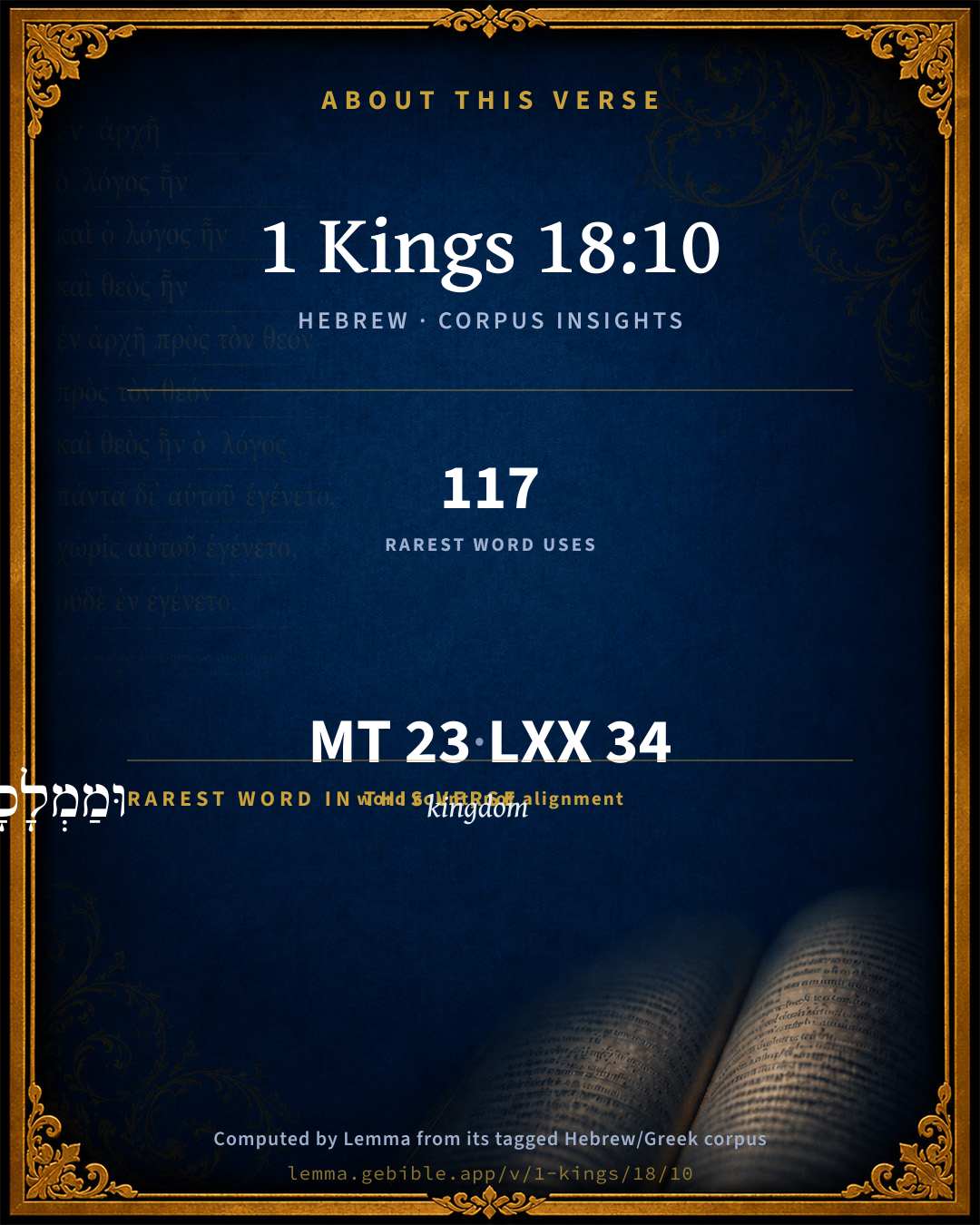
23
words
19
distinct lemmas
Historical
section

Grammatical profile

  • 5 verbs
  • 7 nouns
  • 1 adjective
  • 2 conjunctions
  • 1 adverb
  • 7 particles

Verb forms

  • שָׁלַ֨ח Qal · Perfect
  • לְבַקֶּשְׁךָ֔ Piel · Infinitive Construct
  • וְאָמְר֖וּ Qal · Perfect
  • וְהִשְׁבִּ֤יעַ Hiphil · Sequential Perfect
  • יִמְצָאֶֽכָּה Qal · Imperfect

Repetition

Words recur within this verse — often emphatic in Hebrew:

  • גּ֤וֹי nation H1471 ×2
  • וּמַמְלָכָה֙ kingdom H4467 ×2
  • לֹֽא not H3808 ×2

Hebrew & Septuagint length

In English translation the verse runs 42 words from the Hebrew and 47 from the Septuagint (LXX English) — closely comparable.

A rough comparison of the two English renderings, which tokenize alike — not a word-level alignment.

Word counts can differ between the Hebrew and the Greek without any difference in meaning — e.g. the Hebrew direct-object marker אֵת has no separate Greek word, and Greek often adds the article ὁ.

In the original languages it is 23 Hebrew tokens and 34 Greek tokens — but the two are counted differently (Hebrew bundles its prefixes and suffixes into one token; the Greek is in lemma form), so that isn’t a like-for-like length.

Cross-references

15

Topical passages linked to 1 Kings 18:10 in the Treasury of Scripture Knowledge — connected by theme and wording, ordered by reader-vote popularity; previews shown in the World English Bible.

  • 1 Kings 17:1 Elijah the Tishbite, who was of the foreigners of Gilead, said to Ahab, As Yahweh, the God of Israel, lives, before whom I stand, there shall not be dew nor rain these years, but according to my word.
  • 1 Samuel 29:6 Then Achish called David, and said to him, As Yahweh lives, you have been upright, and your going out and your coming in with me in the host is good in my sight; for I have not found evil in you since the day of your coming to me to this day: nevertheless the lords don't favor you.
  • 1 Kings 1:29 The king swore, and said, As Yahweh lives, who has redeemed my soul out of all adversity,
  • 1 Kings 2:24 Now therefore as Yahweh lives, who has established me, and set me on the throne of David my father, and who has made me a house, as he promised, surely Adonijah shall be put to death this day.
  • 1 Kings 17:5 So he went and did according to the word of Yahweh; for he went and lived by the brook Cherith, that is before the Jordan.
  • 1 Kings 17:9 Arise, get you to Zarephath, which belongs to Sidon, and dwell there: behold, I have commanded a widow there to sustain you.
  • 1 Kings 17:12 She said, As Yahweh your God lives, I don't have a cake, but a handful of meal in the jar, and a little oil in the jar: and, behold, I am gathering two sticks, that I may go in and bake it for me and my son, that we may eat it, and die.
  • 1 Kings 18:15 Elijah said, As Yahweh of Hosts lives, before whom I stand, I will surely show myself to him today.
  • Psalms 10:2 In arrogance, the wicked hunt down the weak; They are caught in the schemes that they devise.
  • Psalms 12:7–8 You will keep them, Yahweh, You will preserve them from this generation forever.
  • Psalms 31:20 In the shelter of your presence you will hide them from the plotting of man. You will keep them secretly in a dwelling away from the strife of tongues.
  • Psalms 91:1 He who dwells in the secret place of the Most High Will rest in the shadow of the Almighty.
  • Jeremiah 26:20–23 There was also a man who prophesied in the name of Yahweh, Uriah the son of Shemaiah of Kiriath Jearim; and he prophesied against this city and against this land according to all the words of Jeremiah:
  • Jeremiah 36:26 The king commanded Jerahmeel the king's son, and Seraiah the son of Azriel, and Shelemiah the son of Abdeel, to take Baruch the scribe and Jeremiah the prophet; but Yahweh hid them.
  • John 8:59 Therefore they took up stones to throw at him, but Jesus was hidden, and went out of the temple, having gone through the midst of them, and so passed by.

Cross-references courtesy of OpenBible.info (CC BY 4.0).

Hebrew and Greek witnesses Masoretic Hebrew ↔ Greek Septuagint

The same verse in the two great witnesses to the Old Testament, shown verse-for-verse.

These are two independent witnesses, not word-aligned to each other, and the Septuagint is shown in lemma (dictionary) form.

Hebrew 1 Kings 18:10 Masoretic · Westminster Leningrad Codex

חַ֣י יְהוָ֣ה אֱלֹהֶ֗יךָ אִם יֶשׁ גּ֤וֹי וּמַמְלָכָה֙ אֲ֠שֶׁר לֹֽא שָׁלַ֨ח אֲדֹנִ֥י שָׁם֙ לְבַקֶּשְׁךָ֔ וְאָמְר֖וּ אָ֑יִן וְהִשְׁבִּ֤יעַ אֶת הַמַּמְלָכָה֙ וְאֶת הַגּ֔וֹי כִּ֖י לֹ֥א יִמְצָאֶֽכָּה

As Yahweh your God lives, there is no nation or kingdom, where my lord has not sent to seek you: and when they said, He is not here, he took an oath of the kingdom and nation, that they didn't find you.

World English Bible · Public Domain

Greek LXX 1 Kings 18:10 Septuagint · lemma form

ζάω κύριος ὁ θεός σύ εἰ εἰμί ἔθνος ἤ βασιλεία ὅς οὐ ἀποστέλλω ὁ κύριος ἐγώ ζητέω σύ καί εἶπον οὐ εἰμί καί ἐνπίμπρημι ὁ βασιλεία καί ὁ χώρα αὐτός ὅτι οὐ εὑρίσκω σύ

As the Lord your God lives, there is not a nation or kingdom, whither my lord has not sent to seek you; and if they said, He is not here, then has he set fire to the kingdom and its territories, because he has not found you.

LXX2012 (modern English Septuagint) · Public Domain

On this verse, The Cambridge Bible for Schools and Colleges discusses the Septuagint’s reading. Read the note in Commentary ↓

Hebrew: Westminster Leningrad Codex (CC BY 4.0). Greek: Septuagint (public domain); English from LXX2012 (modern English Septuagint) (Public Domain). How the Septuagint differs from the Hebrew →

Targum (Aramaic paraphrase)

1

The Targum is the ancient Jewish Aramaic paraphrase of the Hebrew Scriptures — an interpretive translation, not the Hebrew text itself. Onkelos (literal) and Pseudo-Jonathan (expansive) render the Torah, and Jonathan the Prophets. Coverage is partial: where no permissively-licensed English translation exists for a verse, only the Aramaic is shown. This is verse-level text, not a word-by-word alignment to the Hebrew.

  1. Targum Jonathan Prophets (Joshua–Malachi)
    קַיָם הוּא יְיָ אֱלָהָךְ אִם אִית עַם וּמַלְכוּ דְלָא שְׁלַח רִבּוֹנִי לְתַמָן לְמִבְעָךְ וַאֲמַרוּ לָא הֲוָה כָּא וּמוֹמֵי יַת מַלְכוּתָא וְיַת עַמָא אֲרֵי לָא מַשְׁכַּח לָךְ:

    (no public-domain English translation for this verse)

    Targum Jonathan — Aramaic: “Mikraot Gedolot” (public domain). English: “Sefaria Community Translation” (CC0 1.0 (public-domain dedication)); “London "Chaldee Paraphrase," 1871” (public domain). Text via Sefaria.

Commentary

Notes on 1 Kings 18:10 from classic Christian and Jewish commentators (each source and its license shown beneath its notes). The classic Christian expositions comment on the surrounding passage and are grouped to its opening verse, so a note may address several verses; the Jewish commentaries on the Tanakh (Rashi and others) are per-verse, so they appear only where the commentator wrote on this verse.

Lemma curates 59 commentaries, every one of them public domain or Creative Commons licensed, each selected and text-cleaned for this edition rather than reprinted as found. About our sources →

Trapp's Complete Commentary

John Trapp

1Ki 18:10 [As] the LORD thy God liveth, there is no nation or kingdom, whither my lord hath not sent to seek thee: and when they said, [He is] not [there]; he took an oath of the kingdom and nation, that they found thee not.

Ver. 10. There is no nation or kingdom.] And yet the prophet, by the widow’s industry, lay hid no farther off him than was Zarephath, a city of his father-in-law Ethbaal’s. This was God’s own doing; and the like was done for good Athanasius, who, for the space of forty-six years - so long his troubles lasted - is said to have found no friend but God and death: the one a defender of his innocency, the other the finisher of all his miseries. Some report of him, that he lived six years in a well, without the light of the sun, forsaken of friends, and everywhere hunted by enemies.

John Trapp, A Commentary or Exposition upon All the Books of the Old and New Testament (1647–1656) — public domain. Text from a community e-Sword module.

Tyndale Open Study Notes

Tyndale Open Resources

18:10 every nation and kingdom: Ancient Near Eastern protocol called for the extradition of fugitives or runaway slaves, as noted in the famous treaty between Pharaoh Ramses II and the Hittite king Hattusilis (see ANET 200b, 203a). But Elijah had not had to seek asylum with a foreign king. God provided for his safety at Kerith Brook (17:3) and with the widow at Zarephath (17:9).

Tyndale Open Study Notes — © Tyndale Open Resources, licensed CC BY-SA 4.0. Text via the HelloAO Bible API.

Adam Clarke's Commentary

Verse 10. There is no nation or kingdom] He had sent through all his own states and to the neighbouring governments to find out the prophet, as he knew, from his own declaration, that both rain and drought were to be the effect of his prayers. Had he found him, he no doubt intended to oblige him to procure rain, or punish him for having brought on this drought.

He took an oath] Ahab must have had considerable power and authority among the neighbouring nations to require and exact this, and Elijah must have kept himself very secret to have shunned such an extensive and minute search.

Adam Clarke's Commentary on the Bible (1810–1826) — public domain. Text from a community e-Sword/MySword module.

Ellicott's Commentary for English Readers

(10) There is no nation.—This unremitting search—implying perhaps some supremacy or authority over neighbouring kingdoms—suits ill with the half-hearted enmity of Ahab. No doubt it was the work of Jezebel, in Ahab’s name, connived at (as in the murder of Naboth) by his timidity.

A Bible Commentary for English Readers, edited by Charles John Ellicott (1878–1897) — public domain. Text from a community e-Sword module.

The Cambridge Bible for Schools and Colleges

gen. ed. J. J. S. Perowne

10. there is no nation or kingdom] Of course Obadiah’s words only apply to those countries immediately around Israel and into which Elijah could be supposed to have fled for refuge. But he employs the language of Oriental hyperbole, so frequently found in the Old Testament Cf. Gen_7:19; Deu_2:25.

he took an oath] The search had been made after a very thorough and formal manner, and solemn attestation made of its fruitlessness. The LXX. says ‘he burnt up that kingdom and the countries thereof because he did not find thee.’

The Cambridge Bible for Schools and Colleges (gen. ed. J. J. S. Perowne; Cambridge University Press, 1878–1918) — public domain. Text from a community e-Sword module.

John Gill's Exposition

As the Lord thy God liveth,.... Which is the form of an oath he thought fit to make, to ascertain the truth of what he was about to say:

there is no nation or kingdom, whither my lord hath not sent to seek thee; which is either an hyperbolical expression, signifying he had sought for him in many places, and in every place he could think of; or it must be understood either of the ten tribes, which were as so many nations and kingdoms as they had been; or were more in the times of the Canaanites; or of the nations round about, that were in alliance with or tributary to the king of Israel:

and when they said, he is not there, he took an oath of the kingdom and nation that they found thee not; which he might exact of his own subjects, but could not of other nations, unless they were free to it of themselves; or he might take it of their ambassadors or merchants that came into his land, of whom he inquired, and adjured them to tell him the truth.

John Gill's Exposition of the Whole Bible (1746–1763) — public domain (CC PDM 1.0). Text via the HelloAO Bible API.

Albert Barnes' Notes on the Bible

There is no nation ... - This is expressed in the style of Oriental hyperbole. What Obadiah means is: “there is no nation nor kingdom, of those over which he has influence, whither the king has not sent.” He could scarcely, for example, have exacted an oath from such countries as Egypt or Syria of Damascus. But Ahab may have been powerful enough to expect an oath from the neighboring Hittite, Moabite, and Edomite tribes, perhaps even from Ethbaal his father-in-law, and the kings of Hamath and Arpad.

Albert Barnes' Notes on the Bible (1834–1885) — public domain. Text from a community e-Sword/MySword module.

Haydock's Catholic Bible Commentary

An oath of every kingdom, adjuring all his neighbours to tell if they knew any thing about Elias. (Haydock) --- Achab wished to make him restore rain, or to punish him for the refusal. (Calmet) --- How stupid he must have been, not to perceive that God was punishing him! (Haydock) --- Elias must have kept himself very retired, not to be discovered at Sarephta, which was so near, (Calmet) and where Jezabel’s father reigned. But God could render him invisible, even upon the high road, when he went thither. (Haydock)

George Leo Haydock (1774–1849), Haydock's Catholic Family Bible and Commentary, 1859 edition — public domain. Excludes Psalms (Douay-Rheims chapter numbering differs from Protestant) and Deuterocanonical books (Catholic canon only).

Matthew Poole's English Annotations

There is no nation or kingdom, to wit, near to his own, where he could in reason think that Elijah had hid himself. Nothing is more frequent than to understand general expressions with such limitations.

He took an oath of the kingdom and nation, that they found thee not; not that he could force other kingdoms to take an oath, but that by his persuasions he prevailed with the chief persons in several kingdoms for his satisfaction to swear that they did not know of Elijah’s being among them; which was not hard for him to obtain. For Ahab was a great prince, and had a great interest among the neighbouring kings, the king of Tyre was his father-in-law; the king of Moab tributary to him; Jehoshaphat his friend and relation, to whom the king of Edom was tributary. We read also of

all the kings of Arabia, and of all the kings of the Hittites, and of Syria, 1Ki 10:15,29; which as they corresponded with Solomon, so how far they might be allied to or confederate with Ahab we know not; nor what articles or agreements were between him and them, among which this might be one, that they should deliver up to one another all their fugitive or banished subjects upon demand; which might give sufficient ground for his desire or expectation of this oath.

Quest. How then could Elijah lie hid in the house of the widow of Sarepta?

Answ. That might easily be, either because she herself, or at least others, did not know particularly who he was; or because she used all possible care to conceal him, her conscience and interest both obliging her so to do; or because God secured him there.

Matthew Poole's English Annotations on the Holy Bible (1683–1685) — public domain. Text from a community e-Sword/MySword module.

Whedon's Commentary on the Bible

Daniel D. Whedon

10. No nation or kingdom — Ahab had sought far and near for the stern prophet, whom he regarded as the troubler of Israel. 1Ki_18:17. “It was then, doubtless, as it still is, the belief of Eastern countries that seers and saints have the power of withholding or giving rain. In the convent of Mount Sinai the Arabs believe that there is a book, by the opening or shutting of which the monks can disperse or retain the rain of the peninsula.” — Stanley.

Took an oath… that they found thee not — That is, he made each nation and kingdom through which he sought, swear to him that they had not found the prophet, and knew not the place of his concealment.

Daniel D. Whedon (gen. ed.), Commentary on the Old and New Testaments (1874–1909) — public domain. Text from a community e-Sword module.

The Pulpit Commentary

As the Lord thy God liveth Obadiah uses precisely the same adjuration as the widow of Zarephath, 1Ki_17:12. But then, though Jehovah was undoubtedly his God, He was in a more special and intimate manner Elijah"s God. The oath corresponds well with the prophet"s name there is no nation or kingdom, whither my lord hath not sent to seek thee Keil says the hyperbole is to be explained by the "inward excitement and fear" of the speaker. But the Orientals use similar exaggerations in their calmest moments. All that is meant is that all neighbouring and accessible courts had been communicated with. This search for Elijah shows that Ahab regarded him as the author of the drought, and did not recognize it as sent by God. The belief in occult and magical powers has always held possession of the Eastern mind: and when they said, He is not there Heb. Not, and he, etc.; he took an oath LXX. ejneprhse, which has been thought by some to point to acts of vengeance. But more probably it is a clerical error, perhaps for wrkise, or ejnwrkise. On the frequency of oaths in that age (see on 1Ki_1:51) of the kingdom and nation, that they found thee not.

The Pulpit Commentary (1880–1919), ed. H.D.M. Spence-Jones & Joseph S. Exell — public domain. Text from a community e-Sword module.

John Wesley's Explanatory Notes

No nation - Near his own, where he could in reason think that Elijah had hid himself. It does not appear, that Ahab sought him, in order to put him to death: but rather in hopes of prevailing upon him, to pray for the removal of the drought.

John Wesley, Explanatory Notes Upon the Whole Bible (1754–1765) — public domain. Text via the GEBible commentary corpus.

Rashi

Rabbi Shlomo Yitzchaki (Rashi)

That they did not find you. For the nation was unable to find you.

Rashi on the Tanakh — English translations: “The Judaica Press complete Tanach with Rashi, translated by A. J. Rosenberg” (CC BY 4.0); “Pentateuch with Rashi's commentary by M. Rosenbaum and A.M. Silbermann, 1929-1934” (public domain); “The Metsudah Tanach series, Lakewood, N.J” (CC BY 4.0); and “The Book of Joshua, Metsudah Publications, 1997” (CC BY 4.0). Text via Sefaria.

Lesson kit

Teaching starters — assembled from the data on this page, not authored interpretation. Every prompt links to the verse data it draws on. Edit before teaching.

1 Kings, in the Historical, opens this verse with 23 words (19 distinct Hebrew lemmas). Its most distinctive word is mamlâkâh (“kingdom”). A historical commentator’s framing appears above. Read the whole chapter for the surrounding context.

Discussion questions

  1. The word mamlâkâh carries the sense “kingdom.” How does it shape the verse?
  2. How does 1 Kings 17:1, which shares this passage’s theme, read alongside this verse?
  3. What does the repetition of “nation” (2× in this one verse) do in this verse?
  4. These translations render this verse differently. What is at stake in choosing one wording over another?
  5. «שָׁלַ֨ח» is a Qal Perfect verb. How does that grammatical form shape the action described?
  6. Compare how Trapp's Complete Commentary and Tyndale Open Study Notes read this verse. Where do they agree or differ?

Things to notice

Reading settings

Reading text

Shown beneath each verse's original-language words.

Old Testament
Old Testament edition

Read the OT as the Masoretic Hebrew (MT) or the Greek Septuagint (LXX).

English shown for the Greek Septuagint (in the Hebrew ↔ Greek comparison).

Comparing translations? Open the Compare panel on any verse page to stack up to four side by side.