
Deuteronomy 32:8

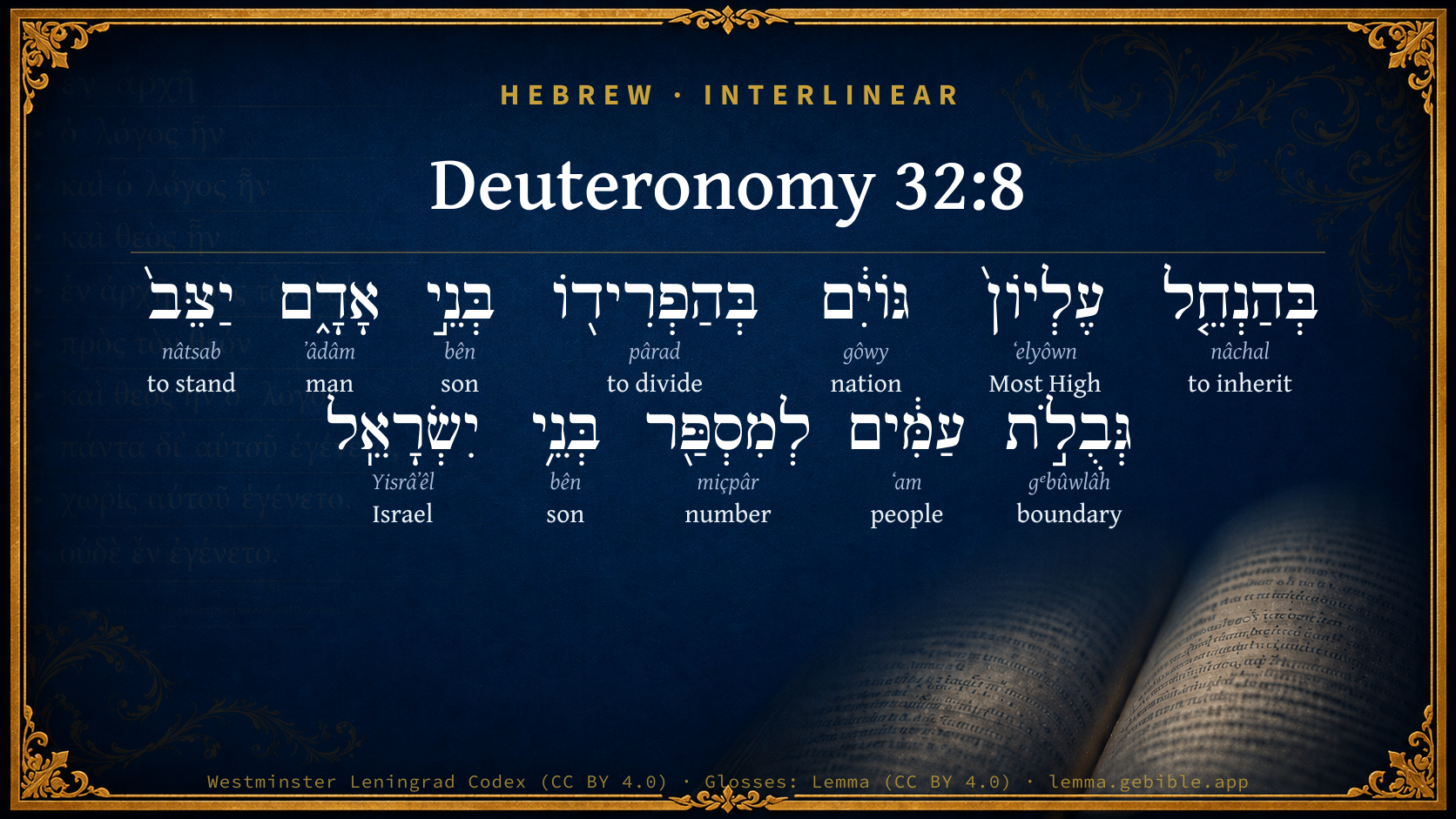
Hebrew (Westminster Leningrad Codex) Deuteronomy 32:8 appears in the Hebrew Old Testament. The text above is from the Westminster Leningrad Codex. Each word links to its Strong’s number, a concise gloss, and parsing drawn from the Open Scriptures Hebrew Bible morphology. Click any word for its full Brown-Driver-Briggs (BDB) entry.
Download image
Cite this verse

Deuteronomy 32:8 (World English Bible). Public Domain. Lemma interlinear Bible study tool, https://lemma.gebible.app/v/deuteronomy/32/8.

Show BibTeX & RIS
BibTeX
RIS
English Translation
When the Most High gave to the nations their inheritance, When he separated the children of men, He set the bounds of the peoples According to the number of the children of Israel.
World English Bible · Public Domain
Download a study sheet

One document with this verse’s original text, its word-by-word gloss line, the meaning frame, cross-references with their text, attributed commentary, and full source and license credits — printable, and it pastes into notes with its structure intact.

This verse Autodidact and up

Study sheet (.html) Plain text (.txt)

A passage Seminary Student

Up to 50 verses in one chapter. A passage sheet keeps up to 6 commentary sources and 12 cross-references per verse, in the order this page ranks them, and says so on the sheet whenever that leaves anything out. Ask for a single verse and you get the Autodidact verse sheet above.

Everything on this page stays free to read, with no account — the sheet is a download of what is already on screen, not access to it.

Want to remove ads? Support Godless Engineer
Compare translations 3

The same verse in 3 English versions, stacked beneath the original-language interlinear above. Click any original word for its lexicon entry.

Each is an independent rendering of the whole verse — the interlinear is not word-aligned to these translations.

Highlighted words mark where these versions differ — a whole-verse word diff, not a word-by-word alignment.

  • World English Bible Public Domain
    When the Most High gave to the nations their inheritance, When he separated the children of men, He set the bounds of the peoples According to the number of the children of Israel.
  • King James Version Public Domain
    When the Most High divided to the nations their inheritance, when he separated the sons of Adam, he set the bounds of the people according to the number of the children of Israel.
  • unfoldingWord Literal Text CC BY-SA 4.0
    When the Most High gave the nations an inheritance, when he divided the sons of man, he defined the boundaries of the peoples, according to the number of the sons of Israel.

unfoldingWord Literal Text — © unfoldingWord, licensed CC BY-SA 4.0. Word-aligned USFM3 via Door43 (git.door43.org/unfoldingWord/en_ult).

Versions to compare (up to 4)

3 of 4 selected

Show all 18 translations

Every available English version of this verse, each an independent rendering of the whole verse.

  • World English Bible Public Domain
    When the Most High gave to the nations their inheritance, When he separated the children of men, He set the bounds of the peoples According to the number of the children of Israel.
  • Berean Standard Bible Public Domain
    When the Most High gave the nations their inheritance, when He divided the sons of man, He set the boundaries of the peoples according to the number of the sons of God.
  • Majority Standard Bible Public Domain
    When the Most High gave the nations their inheritance, when He divided the sons of man, He set the boundaries of the peoples according to the number of the sons of God.
  • King James Version Public Domain
    When the Most High divided to the nations their inheritance, when he separated the sons of Adam, he set the bounds of the people according to the number of the children of Israel.
  • American Standard Version (1901) Public Domain
    When the Most High gave to the nations their inheritance, When he separated the children of men, He set the bounds of the peoples According to the number of the children of Israel.
  • Revised Version (1885) Public Domain
    When the Most High gave to the nations their inheritance, When he separated the children of men, He set the bounds of the peoples According to the number of the children of Israel.
  • Geneva Bible (1599) Public Domain
    When the most hie God deuided to the nations their inheritance, when he separated the sonnes of Adam, he appoynted the borders of the people, according to the nomber of the children of Israel.
  • Douay-Rheims (1899) Public Domain
    When the Most High divided the nations: when he separated the sons of Adam, he appointed the bounds of people according to the number of the children of Israel.
  • Young's Literal Translation Public Domain
    In the Most High causing nations to inherit, In His separating sons of Adam -- He setteth up the borders of the peoples By the number of the sons of Israel.
  • Literal Standard Version CC BY-SA 4.0
    In the Most High causing nations to inherit, || In His separating sons of Adam—He sets up the borders of the peoples || By the number of the sons of God [[or sons of Israel]].
  • Unlocked Literal Bible CC BY-SA 4.0
    When the Most High gave the nations their inheritance— when he divided all of mankind, and he set the boundaries of the peoples, as he also fixed the number of their gods.
  • unfoldingWord Literal Text CC BY-SA 4.0
    When the Most High gave the nations an inheritance, when he divided the sons of man, he defined the boundaries of the peoples, according to the number of the sons of Israel.
  • Darby Bible Public Domain
    When the Most High assigned to the nations their inheritance, When he separated the sons of Adam, He set the bounds of the peoples According to the number of the children of Israel.
  • World Messianic Bible Public Domain
    When the Most High gave to the nations their inheritance, when he separated the children of men, he set the bounds of the peoples according to the number of the children of Israel.
  • Webster's Bible Public Domain
    When the Most High divided to the nations their inheritance, when he separated the sons of Adam, he set the bounds of the people according to the number of the children of Israel.
  • Free Bible Version CC BY-SA 4.0
    The Most High gave the nations their lands when he divided the human race; he fixed their borders depending on their gods.
  • Bible in Basic English Public Domain
    When the Most High gave the nations their heritage, separating into groups the children of men, he had the limits of the peoples marked out, keeping in mind the number of the children of Israel.
  • JPS Tanakh (1917) Public Domain
    When the Most High gave to the nations their inheritance, when He separated the children of men, He set the borders of the peoples according to the number of the children of Israel.

Literal Standard Version (2020), Covenant Press — licensed CC BY-SA 4.0. Text via the HelloAO Bible API (eBible.org). Unlocked Literal Bible (unfoldingWord) — licensed CC BY-SA 4.0. Text via the HelloAO Bible API (eBible.org). unfoldingWord Literal Text — © unfoldingWord, licensed CC BY-SA 4.0. Word-aligned USFM3 via Door43 (git.door43.org/unfoldingWord/en_ult). Free Bible Version, Dr. Jonathan Gallagher — licensed CC BY-SA 4.0. Text via the HelloAO Bible API (eBible.org).

Word by word

More ways to search: Search by grammar → Find every occurrence → Compare this word →

Practice this passage: Drill this verse → Learn its vocabulary →

גְּבֻלֹ֣ת
gᵉbûwlâh
H1367
“boundaries of”
Noun, Common, Feminine, Plural, Construct
Part of Speech
Noun
Type
Common
Gender
Feminine
Number
Plural
State
Construct
Full BDB Definition

Origin: from H1366

TWOT: 307b

border, boundary
  1. בְּהַנְחֵ֤ל nâchal H5157 “in/at · to inherit” Preposition + Verb, Hiphil, Infinitive Construct
  2. עֶלְיוֹן֙ ʻelyôwn H5945 “Most High” Adjective, Adjective, Masculine, Singular, Absolute
  3. גּוֹיִ֔ם gôwy H1471 “nations” Noun, Common, Masculine, Plural, Absolute
  4. בְּהַפְרִיד֖וֹ pârad H6504 “in/at · to divide · him” Preposition + Verb, Hiphil, Infinitive Construct + Suffix, Personal, 3rd Person, Masculine, Singular
  5. בְּנֵ֣י bên H1121 “sons of” Noun, Common, Masculine, Plural, Construct
  6. אָדָ֑ם ʼâdâm H120 “man” Noun, Common, Masculine, Singular, Absolute
  7. יַצֵּב֙ nâtsab H5324 “to stand” Verb, Hiphil, Imperfect, 3rd Person, Masculine, Singular
  8. עַמִּ֔ים ʻam H5971 “peoples” Noun, Common, Masculine, Plural, Absolute
  9. לְמִסְפַּ֖ר miçpâr H4557 “to/for · number of” Preposition + Noun, Common, Masculine, Singular, Construct
  10. בְּנֵ֥י bên H1121 “sons of” Noun, Common, Masculine, Plural, Construct
  11. יִשְׂרָאֵֽל Yisrâʼêl H3478 “Israel” Noun, Proper

About this verse

These counts appear in no published source. They are computed here, from the morphology-tagged text and Lemma’s own curated glosses. What Lemma adds →

12
words
11
distinct lemmas
Pentateuch
section

Notable vocabulary

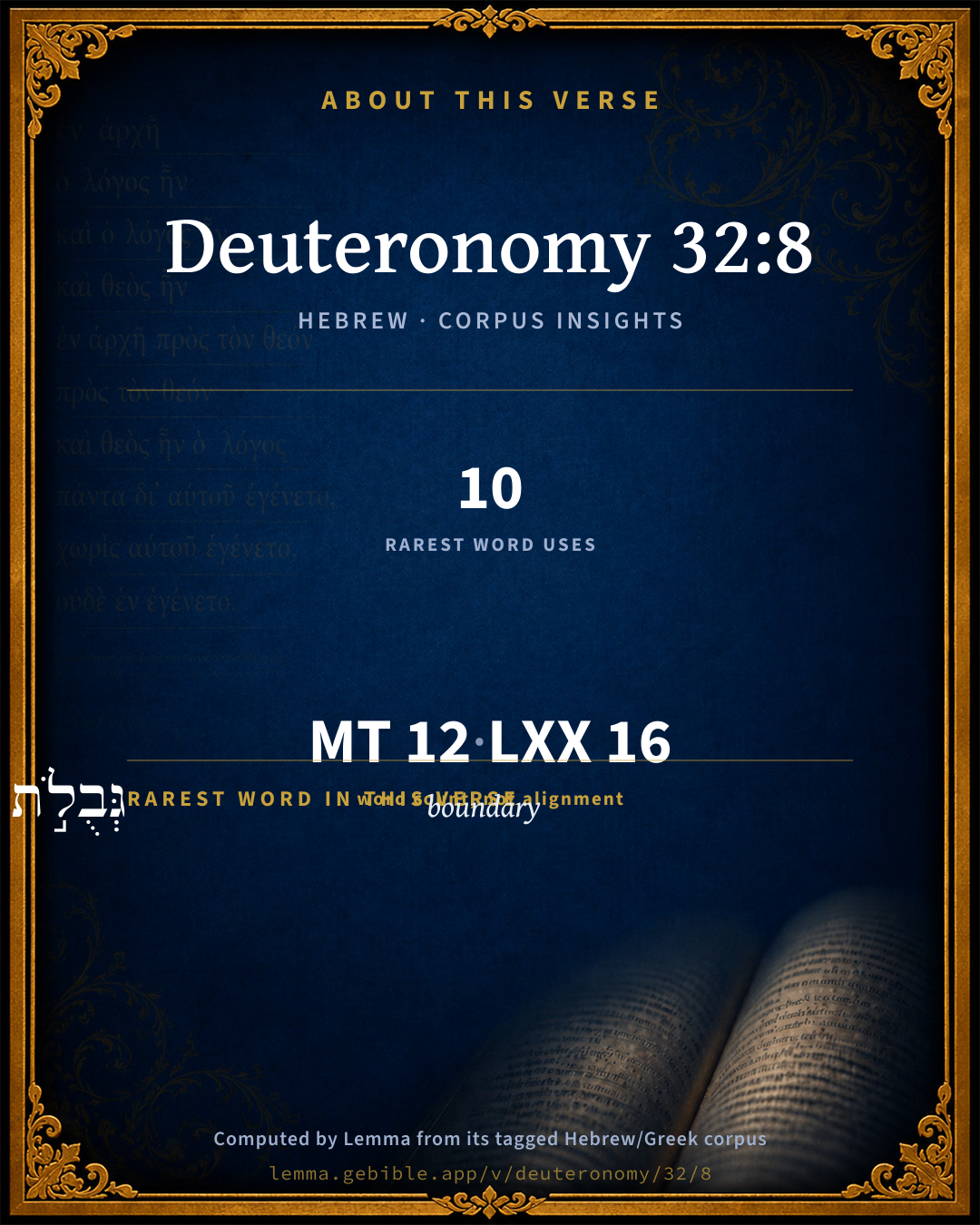
The rarest word here is גְּבֻלֹ֣ת boundary H1367 — appearing just 10 times in the whole Hebrew Bible.

Shared distinctive vocabulary

גְּבֻלֹ֣ת boundary H1367 occurs in 10 verses of the Hebrew Bible. Also found in:

Grammatical profile

  • 3 verbs
  • 8 nouns
  • 1 adjective

Verb forms

  • בְּהַנְחֵ֤ל Hiphil · Infinitive Construct
  • בְּהַפְרִיד֖וֹ Hiphil · Infinitive Construct
  • יַצֵּב֙ Hiphil · Imperfect

Repetition

A word recurs within this verse — often emphatic in Hebrew:

  • בְּנֵ֣י son H1121 ×2

Hebrew & Septuagint length

In English translation the verse runs 33 words from the Hebrew and 30 from the Septuagint (LXX English) — closely comparable.

A rough comparison of the two English renderings, which tokenize alike — not a word-level alignment.

Word counts can differ between the Hebrew and the Greek without any difference in meaning — e.g. the Hebrew direct-object marker אֵת has no separate Greek word, and Greek often adds the article ὁ.

In the original languages it is 12 Hebrew tokens and 16 Greek tokens — but the two are counted differently (Hebrew bundles its prefixes and suffixes into one token; the Greek is in lemma form), so that isn’t a like-for-like length.

Cross-references

16

Topical passages linked to Deuteronomy 32:8 in the Treasury of Scripture Knowledge — connected by theme and wording, ordered by reader-vote popularity; previews shown in the World English Bible.

  • Acts 17:26 He made from one blood every nation of men to dwell on all the surface of the earth, having determined appointed seasons, and the boundaries of their dwellings,
  • Genesis 11:8–9 So Yahweh scattered them abroad from there on the surface of all the earth. They stopped building the city.
  • Daniel 4:17 The sentence is by the decree of the watchers, and the demand by the word of the holy ones; to the intent that the living may know that the Most High rules in the kingdom of men, and gives it to whoever he will, and sets up over it the lowest of men.
  • Genesis 10:25 To Eber were born two sons. The name of the one was Peleg, for in his days was the earth divided. His brother's name was Joktan.
  • Genesis 15:18–21 In that day Yahweh made a covenant with Abram, saying, "To your seed have I given this land, from the river of Egypt to the great river, the river Euphrates:
  • Psalms 115:16 The heavens are the heavens of Yahweh; But the earth has he given to the children of men.
  • Genesis 10:15 Canaan became the father of Sidon (his firstborn), Heth,
  • Psalms 91:1 He who dwells in the secret place of the Most High Will rest in the shadow of the Almighty.
  • Psalms 92:8 But you, Yahweh, are on high forevermore.
  • Numbers 24:16 He says, who hears the words of God, Knows the knowledge of the Most High, Who sees the vision of the Almighty, Falling down, and having his eyes open:
  • Psalms 7:17 I will give thanks to Yahweh according to his righteousness, And will sing praise to the name of Yahweh Most High.
  • Psalms 50:14 Offer to God the sacrifice of thanksgiving. Pay your vows to the Most High.
  • Psalms 82:6 I said, "You are gods, All of you are sons of the Most High.
  • Isaiah 14:14 I will ascend above the heights of the clouds; I will make myself like the Most High.
  • Daniel 5:18 You king, the Most High God gave Nebuchadnezzar your father the kingdom, and greatness, and glory, and majesty:
  • Acts 7:48 However, the Most High doesn't dwell in temples made with hands, as the prophet says,

Cross-references courtesy of OpenBible.info (CC BY 4.0).

Hebrew and Greek witnesses Masoretic Hebrew ↔ Greek Septuagint

The same verse in the two great witnesses to the Old Testament, shown verse-for-verse.

These are two independent witnesses, not word-aligned to each other, and the Septuagint is shown in lemma (dictionary) form.

Hebrew Deuteronomy 32:8 Masoretic · Westminster Leningrad Codex

בְּהַנְחֵ֤ל עֶלְיוֹן֙ גּוֹיִ֔ם בְּהַפְרִיד֖וֹ בְּנֵ֣י אָדָ֑ם יַצֵּב֙ גְּבֻלֹ֣ת עַמִּ֔ים לְמִסְפַּ֖ר בְּנֵ֥י יִשְׂרָאֵֽל

When the Most High gave to the nations their inheritance, When he separated the children of men, He set the bounds of the peoples According to the number of the children of Israel.

World English Bible · Public Domain

Greek LXX Deuteronomy 32:8 Septuagint · lemma form

ὅτε διαμερίζω ὁ ὕψιστος ἔθνος ὡς διασπείρω υἱός αδαμ ἵστημι ὅριον ἔθνος κατά ἀριθμός ἄγγελος θεός

When the Most High divided the nations, when he separated the sons of Adam, he set the bounds of the nations according to the number of the angels of God.

LXX2012 (modern English Septuagint) · Public Domain

On this verse, Ellicott's Commentary for English Readers discusses the Septuagint’s reading. Read the note in Commentary ↓

Hebrew: Westminster Leningrad Codex (CC BY 4.0). Greek: Septuagint (public domain); English from LXX2012 (modern English Septuagint) (Public Domain). How the Septuagint differs from the Hebrew →

Targum (Aramaic paraphrase)

2

The Targum is the ancient Jewish Aramaic paraphrase of the Hebrew Scriptures — an interpretive translation, not the Hebrew text itself. Onkelos (literal) and Pseudo-Jonathan (expansive) render the Torah, and Jonathan the Prophets. Coverage is partial: where no permissively-licensed English translation exists for a verse, only the Aramaic is shown. This is verse-level text, not a word-by-word alignment to the Hebrew.

  1. Targum Onkelos Torah (Genesis–Deuteronomy)
    בְּאַחֲסָנָא עִלָאָה עַמְמַיָא בְּפָרָשׁוּתֵהּ בְּנֵי אֲנָשָׁא קַיִים תְּחוּמֵי עַמְמַיָא לְמִנְיַן בְּנֵי יִשְׂרָאֵל

    (no public-domain English translation for this verse)

    Targum Onkelos — Aramaic: “Onkelos Genesis” (public domain); “Onkelos Exodus” (public domain); “Onkelos Leviticus” (public domain); “Onkelos Numbers” (public domain); “Onkelos Deuteronomy” (public domain). English: “Sefaria Community Translation” (CC0 1.0 (public-domain dedication)); “J.W. Etheridge. The Targums of Onkelos and Jonathan Ben Uzziel on the Pentateuch. London: Longmans, Green, 1862” (public domain). Text via Sefaria.

  2. Targum Pseudo-Jonathan Torah (Genesis–Deuteronomy)
    בְּאַחְסָנוּת עִלָאָה עַלְמָא לְעַמְמַיָא דִי נְפָקוּ מִבְּנוֹי דְנׂחַ בְּאַפְרָשׁוּתֵיהּ מִכְתָּבִין וְלִישְׁנִין לִבְנֵי נְשָׁא בְּדָרָא דְפַלְגוּתָא בֵּי הוּא זִמְנָא רָמָא פִיצְתָא עִם שׁוּבְעִין מַלְאָכַיָא רַבְרְבֵי עַמְמִין דְאִתְגְלֵי עִמְהוֹן לְמֶחֱמֵי קַרְתָּא וּבֵי הוּא זִמְנָא אָקִים תְּחוּמֵי אוּמַיָא כִּסְכוּם מִנְיַין שׁוּבְעִין נַפְשָׁתָא דְיִשְרָאֵל דִנְחָתוּ לְמִצְרַיִם

    When the Most High made allotment of the world unto the nations which proceeded from the sons of Noach, in the separation of the writings and languages of the children of men at the time of the division, He cast the lot among the seventy angels, the princes of the nations with whom is the revelation to oversee the city, even at that time He established the limits of the nations according to the sum of the number of the seventy souls of Israel who went down into Mizraim.

    Targum Pseudo-Jonathan — Aramaic: “Targum Jonathan on Genesis” (public domain); “Targum Jonathan on Exodus” (public domain); “Targum Jonathan on Leviticus” (public domain); “Targum Jonathan on Numbers” (public domain); “Targum Jonathan on Deuteronomy” (public domain). English: “The Targum of Jonathan ben Uzziel, trans. J. W. Etheridge, London, 1862” (public domain). Text via Sefaria.

Commentary

Notes on Deuteronomy 32:8 from classic Christian and Jewish commentators (each source and its license shown beneath its notes). The classic Christian expositions comment on the surrounding passage and are grouped to its opening verse, so a note may address several verses; the Jewish commentaries on the Tanakh (Rashi and others) are per-verse, so they appear only where the commentator wrote on this verse.

Lemma curates 59 commentaries, every one of them public domain or Creative Commons licensed, each selected and text-cleaned for this edition rather than reprinted as found. About our sources →

Ellicott's Commentary for English Readers

(8, 9) Comp. Deu_21:16.

“when the Most High made nations to inherit,

When He parted the sons of Adam,

He set the bounds of the peoples,

According to the number of the sons of Israel.

For the portion of Jehovah is His people,

Jacob the cord [7] of His inheritance”

[7] i.e., limit.

The allusion is to the dispersion from Babel (Genesis 10, 11). The Jews were accustomed to reckon seventy nations and languages in that dispersion. Seventy members of Jacob’s household went down into Egypt. And literally they interpret this passage to mean that in dividing the lands to the peoples, Jehovah left room for His own, so that they might inherit the promised land without any undue pressure upon other nations. It is noticeable that the children of Lot and Esau were carefully preserved from disturbance by Israel (Deuteronomy 2). But this is the bare literal interpretation. The true meaning of the passage is given by St. Paul in his speech at Athens: “He determined (for all nations) times before appointed, and the setting of the boundaries of their habitation, that they might seek the Lord.” The nations were so disposed in the world, and so developed, that each might have its opportunity of seeking Jehovah, in due season, through contact with His people—“if, as was certainly not impossible, they might feel after Him and find Him, who is not far from any one of us. For we are even His offspring.” Hence He appoints our inheritance. With some such thought as this, the LXX. translate the latter half of Deu_32:8, “He set the bounds of the peoples according to the number of the angels of God” The chosen people were to be His messengers to the nations. He chose Israel for His own portion, that through them He might inherit the world. And yet in the face of this glorious calling and mission, the undutiful behaviour of Israel was their one great blot. They had only to accept the position already prepared for them, and they refused!

A Bible Commentary for English Readers, edited by Charles John Ellicott (1878–1897) — public domain. Text from a community e-Sword module.

Trapp's Complete Commentary

John Trapp

Deu 32:8 When the most High divided to the nations their inheritance, when he separated the sons of Adam, he set the bounds of the people according to the number of the children of Israel.

Ver. 8. He set the bounds of the people.] Of the seventy nations reckoned, {Gen 10:1-32} and the seventy souls of Israel. {Gen 46:27 Deu 10:22} The Jews have a saying, that those seventy souls were as much as all the seventy nations of the world, as being the Lord’s portion, for whom he espied out the land of Canaan, which is "the glory of all lands." {Eze 20:6}

John Trapp, A Commentary or Exposition upon All the Books of the Old and New Testament (1647–1656) — public domain. Text from a community e-Sword module.

Joseph Benson's Commentary

Deu 32:8. Their inheritance — When God, by his providence, allotted the several parts of the world to several people, which was done, Gen 10:11. When he separated — Divided them in their languages and habitations, according to their families. He set the bounds — That is, he disposed of the several lands and limits of the people, so as to reserve a sufficient place for the great numbers of the people of Israel. And therefore he so guided the hearts of several people, that the posterity of Canaan, which was accursed of God, and devoted to ruin, should be seated in that country which God intended for the children of Israel, that so when their iniquities were ripe they might be rooted out, and the Israelites come in their stead.

Joseph Benson's Commentary on the Old and New Testaments (1811–1818) — public domain. Text from a community e-Sword module.

Tyndale Open Study Notes

Tyndale Open Resources

32:8 God is sovereign over and concerned with all nations and has allotted their land in accord with his own purposes (see Ps 74:17; Acts 17:26). • the Most High (Hebrew ‘Elyon): Abraham learned this name for God when he encountered Melchizedek (Gen 14:19). This ancient name describes God’s universal sovereignty. • assigned lands: One evidence of God’s sovereignty was his distribution of lands to the nations (see Gen 10).

Tyndale Open Study Notes — © Tyndale Open Resources, licensed CC BY-SA 4.0. Text via the HelloAO Bible API.

Geneva Bible (1599)

Geneva Bible translators

When God by his providence divided the world, he lent for a time that portion to the Canaanites, which should after be an inheritance for all his people Israel.

Geneva Bible (1599) marginal notes — public domain. Text via Bolls.life.

Jamieson, Fausset & Brown

Robert Jamieson, A. R. Fausset & David Brown

When the most High divided to the nations their inheritance--In the division of the earth, which Noah is believed to have made by divine direction (Gen 10:5; Deu 2:5-9; Act 17:26-27), Palestine was reserved by the wisdom and goodness of Heaven for the possession of His peculiar people and the display of the most stupendous wonders. The theater was small, but admirably suited for the convenient observation of the human race--at the junction of the two great continents of Asia and Africa, and almost within sight of Europe. From this spot as from a common center the report of God's wonderful works, the glad tidings of salvation through the obedience and sufferings of His own eternal Son, might be rapidly and easily wafted to every part of the globe.

he set the bounds of the people according to the number of the children of Israel--Another rendering, which has received the sanction of eminent scholars, has been proposed as follows: "When the Most High divided to the nations their inheritance, when He separated the sons of Adam and set the bounds of every people, the children of Israel were few in numbers, when the Lord chose that people and made Jacob His inheritance" (compare Deu 30:5; Gen 34:30; Psa 105:9-12).

Jamieson, Fausset & Brown — Commentary Critical and Explanatory on the Whole Bible (1871) — public domain (CC PDM 1.0). Text via the HelloAO Bible API.

Adam Clarke's Commentary

Verse 8. When the Most High divided to the nations, c.] Verses 8 and 9, says Dr. Kennicott, give us express authority for believing that the earth was very early divided in consequence of a Divine command, and probably by lot, (see Ac 17:26) and as Africa is called the land of Ham, (Ps 78:51; Ps 105:23; Ps 105:27; Ps 106:22), probably that country fell to him and to his descendants, at the same time that Europe fell to Japheth, and Asia to Shem, with a particular reserve of Palestine to be the Lord's portion, for some one peculiar people. And this separation of mankind into three bodies, called the general migration, was commanded to Noah, and by him to his sons, so as to take place in the days of Peleg, about two hundred years afterwards. This general migration was prior to the partial dispersion from Babel by about five hundred years.

He set the bounds of the people according to the number of the children of Israel.] The Septuagint is very curious, Εστησεν ὁρια εθνων κατα αριθμον αγγελων του Θεου. "He established the bounds of the nations according to the number of the angels of God." The meaning of the passage seems to be, that when God divided the earth among mankind, he reserved twelve lots, according to the number of the sons of Jacob, which he was now about to give to their descendants, according to his promise.

Adam Clarke's Commentary on the Bible (1810–1826) — public domain. Text from a community e-Sword/MySword module.

The Cambridge Bible for Schools and Colleges

gen. ed. J. J. S. Perowne

8. Most High] Heb. ‘Elyôn, Num_24:16, Isa_14:14, and many Pss.

gave … inheritance] See Deu_1:38.

separated] Gen_10:32 (P).

children of Israel] The purpose of His division was to leave room for Israel’s numbers.

But for the sons of Israel LXX has ἀγγέλων θεοῦ, angels of God, i.e. sons of ’El, after a late Jewish conception of a guardian angel for each nation (Dan_10:13; Dan_10:20 f., Deu_12:1, Sir_17:17), an antithesis to Jehovah’s own guardianship of Israel in the following vv., which accordingly LXX introduces by and = but in place of Heb. for. This reading and interpretation is accepted by Steuern., Berth., Marti, Robinson. But the text as read by the LXX seems to be rather an adaptation of the Heb. to the conception aforesaid (Dillm.); and it is difficult to see how the Heb. arose out of the LXX text if the latter was original.

The Cambridge Bible for Schools and Colleges (gen. ed. J. J. S. Perowne; Cambridge University Press, 1878–1918) — public domain. Text from a community e-Sword module.

John Gill's Exposition

When the Most High divided to the nations their inheritance,.... In the times of Noah and his sons, in the days of Peleg, who had his name (that is "Division") from thence, Gen 10:25; "the Most High" is a well known and proper, epithet of God; the dividing of the earth to the several nations of it, and giving to everyone their part and portion to possess and inherit, was the work of God; for though it was done by the sons of Noah, yet by the order, appointment, and direction of the Most High, who rules in heaven and in earth, Gen 10:32; men might not and did not take what they pleased, or seize on as much as they could, but each had their parcel allotted and portioned out to them, by the Lord himself; so the Targum of Jonathan."when by lot the Most High divided the world to the people that sprung from the sons of Noah:"

when he separated the sons of Adam; one from another; distinguished by the persons from whom they descended, by the tribes and nations to which they belonged, and by the countries they inhabited; for though they descended from Noah and his sons, they were the sons of Adam, the first man: or rather "the children of men", as the wicked of that generation were called, in distinction from the sons of God, or his people and worshippers; and may have respect to the separation of them at Babel, where their languages were confounded, and they were scattered about, and some went into one part of the world, and some into another, according to the appointment and direction of divine Providence; so the builders of Babel are called, and this was what befell them, Gen 11:5; which sense the above Targum confirms,"when he separated the writings, the languages of the children of men in the generation of the division:''

he set the bounds of the people; or nations, the seven nations of the land of Canaan; he pitched upon and fixed the land they should inherit, and settled the bounds of it, how far it should reach, east, west, north and south:

according to the number of the children of Israel: the sense is, that such a country was measured out and bounded, as would be sufficient to hold the twelve tribes of Israel, when numerous, and their time was come to inhabit it; and which, in the mean while was put into the hands of Canaan and his eleven sons to possess; not as their proper inheritance, but as tenants at will, until the proper heirs existed, and were at an age, and of a sufficient number to inherit; in which may be observed the wise disposition of divine Providence, to put it into the hands of a people cursed of God, so that to take it from them at any time could not have the appearance of any injustice in it; and their enjoying it so long as they did was a mercy to them, for so long they had a reprieve: now here was an early instance of the goodness of God to Israel, that he should make such an early provision of the land flowing with milk and honey for them, even before they were in being, yea, before their ancestors, Abraham, Isaac, and Jacob, existed; as early as the days of Noah; and yet, ungrateful as they were despised and set at nought his Son, the rock of salvation, when sent unto them: thus the heavenly inheritance, typified by the land of Canaan, was not only promised, but prepared, provided, secured, and reserved for the spiritual Israel of God, before the foundation of the world, from all eternity, and which is appointed according to their number; there is room enough in it for them all, though they are many; in it are many mansions for the many sons to be brought to glory.

John Gill's Exposition of the Whole Bible (1746–1763) — public domain (CC PDM 1.0). Text via the HelloAO Bible API.

Haydock's Catholic Bible Commentary

Israel. He suffered the people of Chanaan to occupy as much land as would be requisite for the Israelites. Septuagint, "according to the number of the angels of God." Hence many of the ancients gathered that there were seventy angel guardians of provinces, and as many languages; while others did not pretend to determine the exact number. But the version which they have followed, is in opposition to all the rest. (Calmet) --- They have also disputed, on this occasion, whether the elect will be equal in number to the good angels, as St. Gregory thinks; (hom. 34, in Luke xv.) or they will only fill up the places of those who have fallen. See Mag. Sent. ii. 9. Abenezra observes, that interpreters understand this text as alluding to the dispersion of nations, (Genesis xi.,) when God decreed that the land of the seven nations should belong to and be sufficient for the Israelites. (Amama) (Haydock) --- The Hebrew may be rendered, "He fixed the limits of each people. At that time the children of Israel were few in number, (Ver. 9) when the Lord chose his people," &c. Long after the division of the earth, (which the Lord had ordered, Acts xvii. 26,) the Israelites were very few in number, as Jacob observes, Genesis xxxiv. 30. See chap. xxvi. 5., and Psalm civ. 9, 12. (Calmet) --- But this explication does not satisfy Houbigant, (p. 76, Prol.) no more than that of Le Clerc. He is convinced that a word has been transposed, and another left out, as the Samaritan copy has Israel twice, and he would therefore translate, "He divided his people according to the number of the sons of Israel." In his eternal decrees, He allotted twelve portions of land in Chanaan to the descendants of Jacob, and these Josue was ordered to mark out for them. See Josue iv. 5. (Haydock)

George Leo Haydock (1774–1849), Haydock's Catholic Family Bible and Commentary, 1859 edition — public domain. Excludes Psalms (Douay-Rheims chapter numbering differs from Protestant) and Deuterocanonical books (Catholic canon only).

Matthew Poole's English Annotations

When God by his providence did allot the several parts of the world to several people, which was done Ge 10; Ge 11. See Deu 2:5,9; Am 9:7; Act 17:26,27.

Separated the sons of Adam, i.e. divided them in their languages and habitations according to their families.

He set the bounds of the people, i.e. he disposed of the several lands and limits of the people, so as he did reserve a convenient and sufficient place for the great numbers of the people of Israel, whom he designed to make as numerous as the stars of heaven. And therefore he so guided the hearts of several people, that the posterity of Canaan, which was accursed of God, Gen 9:25-27, and devoted to ruin, should be seated in that country which God intended for the children of Israel, that so when their iniquities were ripe, and God’s time came, they might be rooted out, and the Israelites might come in their stead.

Matthew Poole's English Annotations on the Holy Bible (1683–1685) — public domain. Text from a community e-Sword/MySword module.

Whedon's Commentary on the Bible

Daniel D. Whedon

8. The Most High divided to the nations their inheritance — Then Israel was in his thoughts. He selected Israel as his peculiar people.

Daniel D. Whedon (gen. ed.), Commentary on the Old and New Testaments (1874–1909) — public domain. Text from a community e-Sword module.

The Pulpit Commentary

Vers. 8, 9. From the very beginning, when God first allotted to the nations a place and a heritage, he had respect in his arrangements to the sons of Israel, who were his portion, and had as it were kept their interest in view in all that he appointed and ordered. According to the number of the children of Israel. When the Most High portioned out to the nations the heritage of each, he reserved for Israel, as the people of his choice, an inheritance proportioned to its numbers. The LXX has "according to the number of the angels of God," an arbitrary departure from the original text, in accommodation, probably, to the later Jewish notion of each nation having its guardian angel. The Lord"s portion is his people (cf. Exo_15:16 Exo_19:5; 1Sa_10:1; Psa_78:71) The lot of his inheritance; literally, the cord, etc., the allusion being to the measuring of land by a cord, equivalent to the portion by measure which Jehovah allotted to himself as his inheritance. (cf. Psa_16:6)

The world ruled for the benefit of the Church.

What this verse asserts is that in the providential distribution of the nations, and assignment to them of their special territories, respect was had from the beginning to the provision of a suitable dwelling-place for the chosen race. Our subject isThe government of the world conducted with a view to the interests of the Church.

I A TRUTH FREQUENTLY TAUGHT IN SCRIPTURE. Both by facts of history, and by express statement. Israel"s position brought it into contact, not only with petty neighboring states, but with the mightiest empires of East and West. These appear in Scripture only as they affect the chosen race, but it is then made manifest how entirely their movements are directed and controlled by Divine providence. And the center of God"s purposes is always Israel. "For your sake," says God, "I have sent to Babylonia, and have brought down all their nobles, and the Chaldeans, whose cry is in the ships". (Isa_43:14; cf. vers. 3, 4) Is Egypt visited with famines with scarce years and good years? The design is the working out of a certain plan in the chain of God"s appointments for Israel. Is a Cyrus raised up in Persia? God saith of him, "He is my shepherd, and shall perform all my pleasure," etc.. (Isa_44:28) So is it throughout. Egypt, Assyria, Babylonia, Persia, Greece, Rome, appear in all their relations with Israel as ministers of the Divine will, as simple executors of the Divine purposes, and their power is strictly limited by their commission. In harmony with this prophetic teaching are the express testimonies of the Epistles. (e.g. Rom_8:28; Eph_1:20-23 Eph_3:9-11)

(1) Nature,

(2) history, are ruled for the benefit Of the Church.

II A TRUTH IN ITSELF REASONABLE. Once admit the goal of history to be the establishment on earth of a universal spiritual kingdom a gathering together in one of all things with Christ as Head, (Eph_1:10) and it is certain that herein must lie the key to all historical developments, the explanation of all arrangements and movements of Divine providence. The center of interest must always be that portion of the race with which for the time being the kingdom of God is identified. Just as, in tracing the course of a stream, not the huge morasses nor the vast stagnant pools on either side would delay us: we should not, because of their extent, count them the river, but recognize that as such, though it were the slenderest thread, in which an onward movement might be discerned; so is it here. Egypt and Assyria and Babylon were but the vast stagnant morasses on either side of the river; the Man in whose seed the whole earth should be blessed, he and his family were the little stream in which the life and onward movement of the world were to be traced They belong not to history, least of all to sacred history, those Babels, those cities of confusion, those huge pens into which by force and fraud the early hunters of men, the Nimrods and Sesostrises, drove and compelled their fellows... where no faith existed but in the blind powers of nature and the brute forces of the natural man" (Archbishop Trench).

III A TRUTH FRAUGHT TO THE CHURCH WITH COMFORT AND ENCOURAGEMENT.

1. When the powers of the world are threatening.

2. In times of internal decay.

3. Under long-continued trials. J.O.

The Pulpit Commentary (1880–1919), ed. H.D.M. Spence-Jones & Joseph S. Exell — public domain. Text from a community e-Sword module.

John Wesley's Explanatory Notes

Their inheritance - When God by his providence allotted the several parts of the world to several people, which was done Gen. x, 1-32 Gen. xi, 1-9. When he separated - Divided them in their languages and habitations according to their families. He set the bounds - That is, he disposed of the several lands and limits of the people so as to reserve a sufficient place for the great numbers of the people of Israel. And therefore he so guided the hearts of several people, that the posterity of Canaan, which was accursed of God, and devoted to ruin, should be seated in that country which God intended for the children of Israel, that so when their iniquities were ripe, they might be rooted out, and the Israelites come in their stead.

John Wesley, Explanatory Notes Upon the Whole Bible (1754–1765) — public domain. Text via the GEBible commentary corpus.

Rashi

Rabbi Shlomo Yitzchaki (Rashi)

בהנחל עליון גוים WHEN THE MOST HIGH DIVIDED TO THE NATIONS THEIR INHERITANCE — when the Holy One, blessed be He gave those who provoked Him to anger their inheritance, He afterwards caused the flood to pass over them and He drowned them (Sifrei Devarim 311:1)

בהפרידו בני אדם WHEN HE SEPARATED THE SONS OF ADAM — i.e. when He scattered the generation which witnessed the separation of races, He also had the power to remove them from the world, yet He did not do so, but יצב גבלת עמים HE FIRMLY ESTABLISHED THE BOUNDARIES OF THE NATIONS — He let them (the peoples) remain in existence and did not destroy them,

למספר בני ישראל ACCORDING TO THE NUMBER OF THE CHILDREN OF ISRAEL — i.e. because of the number of the children of Israel that were in future to descend from Shem’s sons, and in accordance with the number of seventy souls of the children of Israel who went down to Egypt He firmly established גבלת עמים THE NATIONS ACCORDING TO THEIR BOUNDARIES — i.e. seventy separate nations (cf. Sifrei Devarim 311:5).

Rashi on the Tanakh — English translations: “The Judaica Press complete Tanach with Rashi, translated by A. J. Rosenberg” (CC BY 4.0); “Pentateuch with Rashi's commentary by M. Rosenbaum and A.M. Silbermann, 1929-1934” (public domain); “The Metsudah Tanach series, Lakewood, N.J” (CC BY 4.0); and “The Book of Joshua, Metsudah Publications, 1997” (CC BY 4.0). Text via Sefaria.

Lesson kit

Teaching starters — assembled from the data on this page, not authored interpretation. Every prompt links to the verse data it draws on. Edit before teaching.

Deuteronomy, in the Pentateuch, opens this verse with 12 words (11 distinct Hebrew lemmas). Its most distinctive word is gᵉbûwlâh (“boundary”). A historical commentator’s framing appears above. Read the whole chapter for the surrounding context.

Discussion questions

  1. How does “boundary” (gᵉbûwlâh) shape what this verse is saying?
  2. Numbers 32:33 shares the word «boundary» with this verse. How do the two illuminate each other?
  3. “son” occurs 2× in this one verse. What is the effect of the repetition?
  4. The translations on this page render this verse differently — a whole-verse word diff, not a word-by-word alignment. What might account for the different wordings?
  5. The verb «בְּהַנְחֵ֤ל» is Hiphil Infinitive Construct. How does its form color the action?
  6. Reading how Ellicott's Commentary for English Readers and Trapp's Complete Commentary read this verse, where do the two commentators agree and where do they part?

Things to notice

Reading settings

Reading text

Shown beneath each verse's original-language words.

Old Testament
Old Testament edition

Read the OT as the Masoretic Hebrew (MT) or the Greek Septuagint (LXX).

English shown for the Greek Septuagint (in the Hebrew ↔ Greek comparison).

Comparing translations? Open the Compare panel on any verse page to stack up to four side by side.