
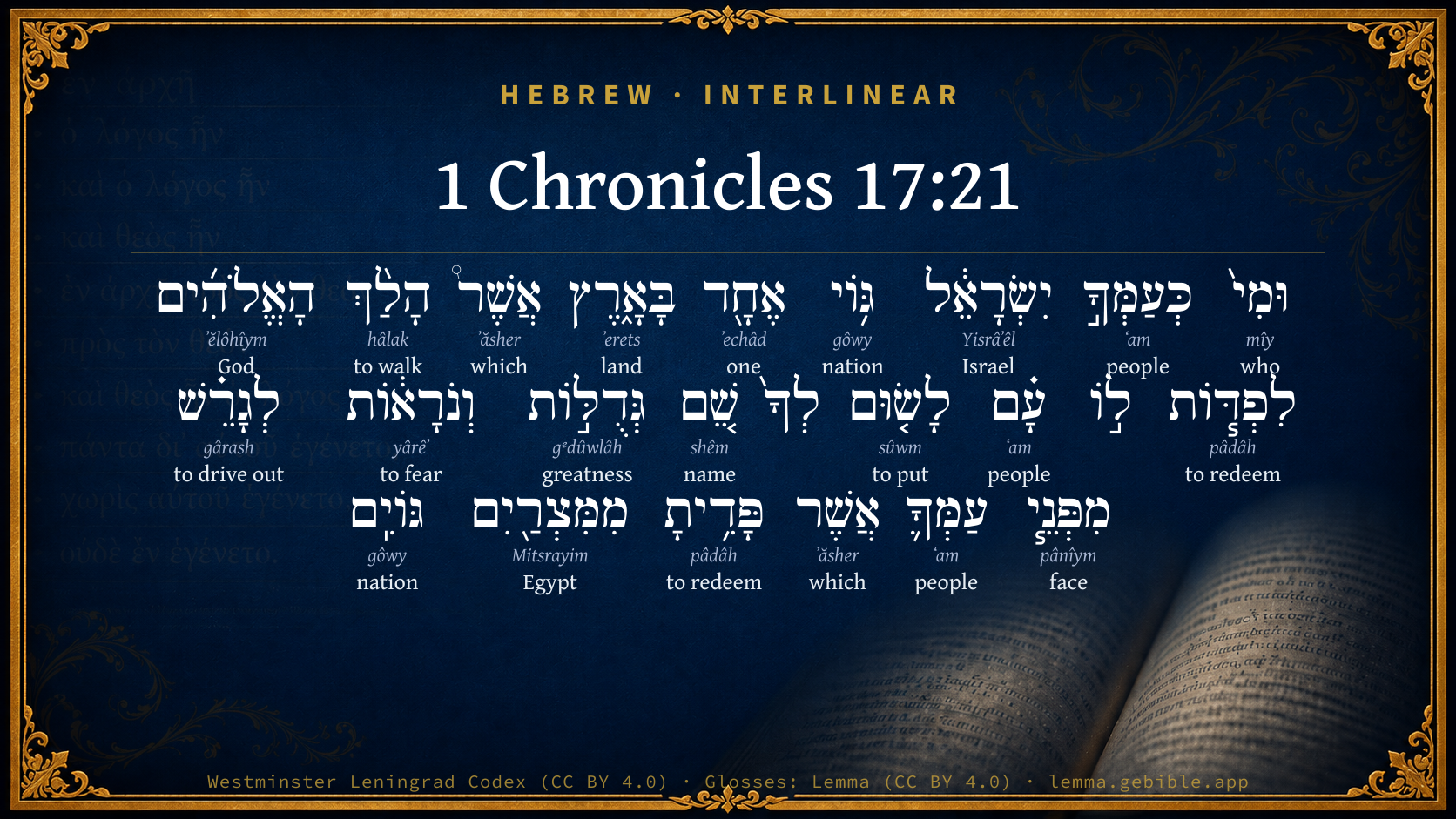
1 Chronicles 17:21

Hebrew (Westminster Leningrad Codex) 1 Chronicles 17:21 appears in the Hebrew Old Testament. The text above is from the Westminster Leningrad Codex. Each word links to its Strong’s number, a concise gloss, and parsing drawn from the Open Scriptures Hebrew Bible morphology. Click any word for its full Brown-Driver-Briggs (BDB) entry.
Download image
Cite this verse

1 Chronicles 17:21 (World English Bible). Public Domain. Lemma interlinear Bible study tool, https://lemma.gebible.app/v/1-chronicles/17/21.

Show BibTeX & RIS
BibTeX
RIS
English Translation
What one nation in the earth is like your people Israel, whom God went to redeem to himself for a people, to make you a name by great and awesome things, in driving out nations from before your people, whom you redeem out of Egypt?
World English Bible · Public Domain
Download a study sheet

One document with this verse’s original text, its word-by-word gloss line, the meaning frame, cross-references with their text, attributed commentary, and full source and license credits — printable, and it pastes into notes with its structure intact.

This verse Autodidact and up

Study sheet (.html) Plain text (.txt)

A passage Seminary Student

Up to 50 verses in one chapter. A passage sheet keeps up to 6 commentary sources and 12 cross-references per verse, in the order this page ranks them, and says so on the sheet whenever that leaves anything out. Ask for a single verse and you get the Autodidact verse sheet above.

Everything on this page stays free to read, with no account — the sheet is a download of what is already on screen, not access to it.

Want to remove ads? Support Godless Engineer
Compare translations 3

The same verse in 3 English versions, stacked beneath the original-language interlinear above. Click any original word for its lexicon entry.

Each is an independent rendering of the whole verse — the interlinear is not word-aligned to these translations.

Highlighted words mark where these versions differ — a whole-verse word diff, not a word-by-word alignment.

  • World English Bible Public Domain
    What one nation in the earth is like your people Israel, whom God went to redeem to himself for a people, to make you a name by great and awesome things, in driving out nations from before your people, whom you redeem out of Egypt?
  • King James Version Public Domain
    And what one nation in the earth is like thy people Israel, whom God went to redeem to be his own people, to make thee a name of greatness and terribleness, by driving out nations from before thy people whom thou hast redeemed out of Egypt?
  • unfoldingWord Literal Text CC BY-SA 4.0
    And who like your people Israel, the one nation on the earth whose God went to redeem for himself a people, to make for himself a great and feared name, to dispossess nations from the face of your people whom you redeemed from Egypt?

unfoldingWord Literal Text — © unfoldingWord, licensed CC BY-SA 4.0. Word-aligned USFM3 via Door43 (git.door43.org/unfoldingWord/en_ult).

Versions to compare (up to 4)

3 of 4 selected

Show all 18 translations

Every available English version of this verse, each an independent rendering of the whole verse.

  • World English Bible Public Domain
    What one nation in the earth is like your people Israel, whom God went to redeem to himself for a people, to make you a name by great and awesome things, in driving out nations from before your people, whom you redeem out of Egypt?
  • Berean Standard Bible Public Domain
    And who is like Your people Israel—the one nation on earth whom God went out to redeem as a people for Himself? You made a name for Yourself through great and awesome wonders by driving out nations from before Your people, whom You redeemed from Egypt.
  • Majority Standard Bible Public Domain
    And who is like Your people Israel—the one nation on earth whom God went out to redeem as a people for Himself? You made a name for Yourself through great and awesome wonders by driving out nations from before Your people, whom You redeemed from Egypt.
  • King James Version Public Domain
    And what one nation in the earth is like thy people Israel, whom God went to redeem to be his own people, to make thee a name of greatness and terribleness, by driving out nations from before thy people whom thou hast redeemed out of Egypt?
  • American Standard Version (1901) Public Domain
    And what one nation in the earth is like thy people Israel, whom God went to redeem unto himself for a people, to make thee a name by great and terrible things, in driving out nations from before thy people, whom thou redeemest out of Egypt?
  • Revised Version (1885) Public Domain
    And what one nation in the earth is like thy people Israel, whom God went to redeem unto himself for a people, to make thee a name by great and terrible things, in driving out nations from before thy people, which thou redeemedst out of Egypt?
  • Geneva Bible (1599) Public Domain
    Moreouer what one nation in the earth is like thy people Israel, whose God went to redeeme them to be his people, and to make thy selfe a Name, and to doe great and terrible things by casting out nations from before thy people, whom thou hast deliuered out of Egypt?
  • Douay-Rheims (1899) Public Domain
    For what other nation is there upon earth like thy people Israel, whom God went to deliver, and make a people for himself, and by his greatness and terrors cast out nations before their face whom he had delivered out of Egypt?
  • Young's Literal Translation Public Domain
    `And who `is' as Thy people Israel, one nation in the earth whom God hath gone to ransom to Him for a people, to make for Thee a name great and fearful, to cast out from the presence of Thy people whom Thou hast ransomed out of Egypt -- nations?
  • Literal Standard Version CC BY-SA 4.0
    And who [is] as Your people Israel, one nation in the earth whom God has gone to ransom to Himself for a people, to make a great and fearful name for Yourself, to cast out nations from the presence of Your people whom You have ransomed out of Egypt?
  • Unlocked Literal Bible CC BY-SA 4.0
    For what nation on earth is like your people Israel, whom you, God, rescued from Egypt as a people for yourself, to make a name for yourself by great and awesome deeds? You drove out nations from before your people, whom you rescued from Egypt.
  • unfoldingWord Literal Text CC BY-SA 4.0
    And who like your people Israel, the one nation on the earth whose God went to redeem for himself a people, to make for himself a great and feared name, to dispossess nations from the face of your people whom you redeemed from Egypt?
  • Darby Bible Public Domain
    And who is like thy people Israel, the one nation in the earth that God went to redeem to be a people to himself, to make thee a name of greatness and terribleness, by driving out nations from before thy people, which thou hast redeemed out of Egypt?
  • World Messianic Bible Public Domain
    What one nation in the earth is like your people Israel, whom God went to redeem to himself for a people, to make you a name by great and awesome things, in driving out nations from before your people whom you redeemed out of Egypt?
  • Webster's Bible Public Domain
    And what one nation in the earth is like thy people Israel, whom God went to redeem to be his own people, to make thee a name of greatness and terribleness, by driving out nations from before thy people, whom thou hast redeemed out of Egypt?
  • Free Bible Version CC BY-SA 4.0
    Who else is as fortunate as your people Israel? Who else on earth did God go and redeem to make his own people? You gained a wonderful reputation for yourself by all the tremendous, amazing things you did in driving out other nations before your people as you redeemed them from Egypt.
  • Bible in Basic English Public Domain
    And what other nation in the earth, like your people Israel, did a god go out to take for himself, to be his people, making his name great and to be feared, driving out the nations from before your people whom you made free and took out of Egypt?
  • JPS Tanakh (1917) Public Domain
    And who is like Thy people Israel, a nation one in the earth, whom God went to redeem unto Himself for a people, to make Thee a name by great and tremendous things, in driving out nations from before Thy people, whom Thou didst redeem out of Egypt.

Literal Standard Version (2020), Covenant Press — licensed CC BY-SA 4.0. Text via the HelloAO Bible API (eBible.org). Unlocked Literal Bible (unfoldingWord) — licensed CC BY-SA 4.0. Text via the HelloAO Bible API (eBible.org). unfoldingWord Literal Text — © unfoldingWord, licensed CC BY-SA 4.0. Word-aligned USFM3 via Door43 (git.door43.org/unfoldingWord/en_ult). Free Bible Version, Dr. Jonathan Gallagher — licensed CC BY-SA 4.0. Text via the HelloAO Bible API (eBible.org).

Word by word

More ways to search: Search by grammar → Find every occurrence → Compare this word →

Practice this passage: Drill this verse → Learn its vocabulary →

גְּדֻלּ֣וֹת
gᵉdûwlâh
H1420
“greatness”
Noun, Common, Feminine, Plural, Absolute
Part of Speech
Noun
Type
Common
Gender
Feminine
Number
Plural
State
Absolute
Full BDB Definition

Origin: from H1419

TWOT: 315e

greatness - of man - of God's greatness (as an attribute)
  1. וּמִי֙ mîy H4310 “and · who” Conjunction + Particle, Interrogative
  2. כְּעַמְּךָ֣ ʻam H5971 “like/as · people · your” Preposition + Noun, Common, Masculine, Singular, Construct + Suffix, Personal, 2nd Person, Masculine, Singular
  3. יִשְׂרָאֵ֔ל Yisrâʼêl H3478 “Israel” Noun, Proper
  4. גּ֥וֹי gôwy H1471 “nation” Noun, Common, Masculine, Singular, Absolute
  5. אֶחָ֖ד ʼechâd H259 “one” Adjective, Cardinal number, Masculine, Singular, Absolute
  6. בָּאָ֑רֶץ ʼerets H776 “in/at the · land” Preposition, Determined + Noun, Common, Both, Singular, Absolute
  7. אֲשֶׁר֩ ʼăsher H834 “which” Particle, Relative
  8. הָלַ֨ךְ hâlak H1980 “to walk” Verb, Qal, Perfect, 3rd Person, Masculine, Singular
  9. הָאֱלֹהִ֜ים ʼĕlôhîym H430 “the · God(s)” Particle, Definite Article + Noun, Common, Masculine, Plural, Absolute
  10. לִפְדּ֧וֹת pâdâh H6299 “to redeem” Preposition + Verb, Qal, Infinitive Construct
  11. עָ֗ם ʻam H5971 “people” Noun, Common, Masculine, Singular, Absolute
  12. לָשׂ֤וּם sûwm H7760 “to put” Preposition + Verb, Qal, Infinitive Construct
  13. שֵׁ֚ם shêm H8034 “name” Noun, Common, Masculine, Singular, Absolute
  14. וְנֹרָא֔וֹת yârêʼ H3372 “and · fearing” Conjunction + Verb, Niphal, Participle Active, Feminine, Plural, Absolute
  15. לְגָרֵ֗שׁ gârash H1644 “to drive out” Preposition + Verb, Piel, Infinitive Construct
  16. מִפְּנֵ֧י pânîym H6440 “from · face(s) of” Preposition + Noun, Common, Both, Plural, Construct
  17. עַמְּךָ֛ ʻam H5971 “people · your” Noun, Common, Masculine, Singular, Construct + Suffix, Personal, 2nd Person, Masculine, Singular
  18. אֲשֶׁר ʼăsher H834 “which” Particle, Relative
  19. פָּדִ֥יתָ pâdâh H6299 “to redeem” Verb, Qal, Perfect, 2nd Person, Masculine, Singular
  20. מִמִּצְרַ֖יִם Mitsrayim H4714 “from · Egypt” Preposition + Noun, Proper
  21. גּוֹיִֽם gôwy H1471 “nations” Noun, Common, Masculine, Plural, Absolute

About this verse

These counts appear in no published source. They are computed here, from the morphology-tagged text and Lemma’s own curated glosses. What Lemma adds →

24
words
17
distinct lemmas
Historical
section

Notable vocabulary

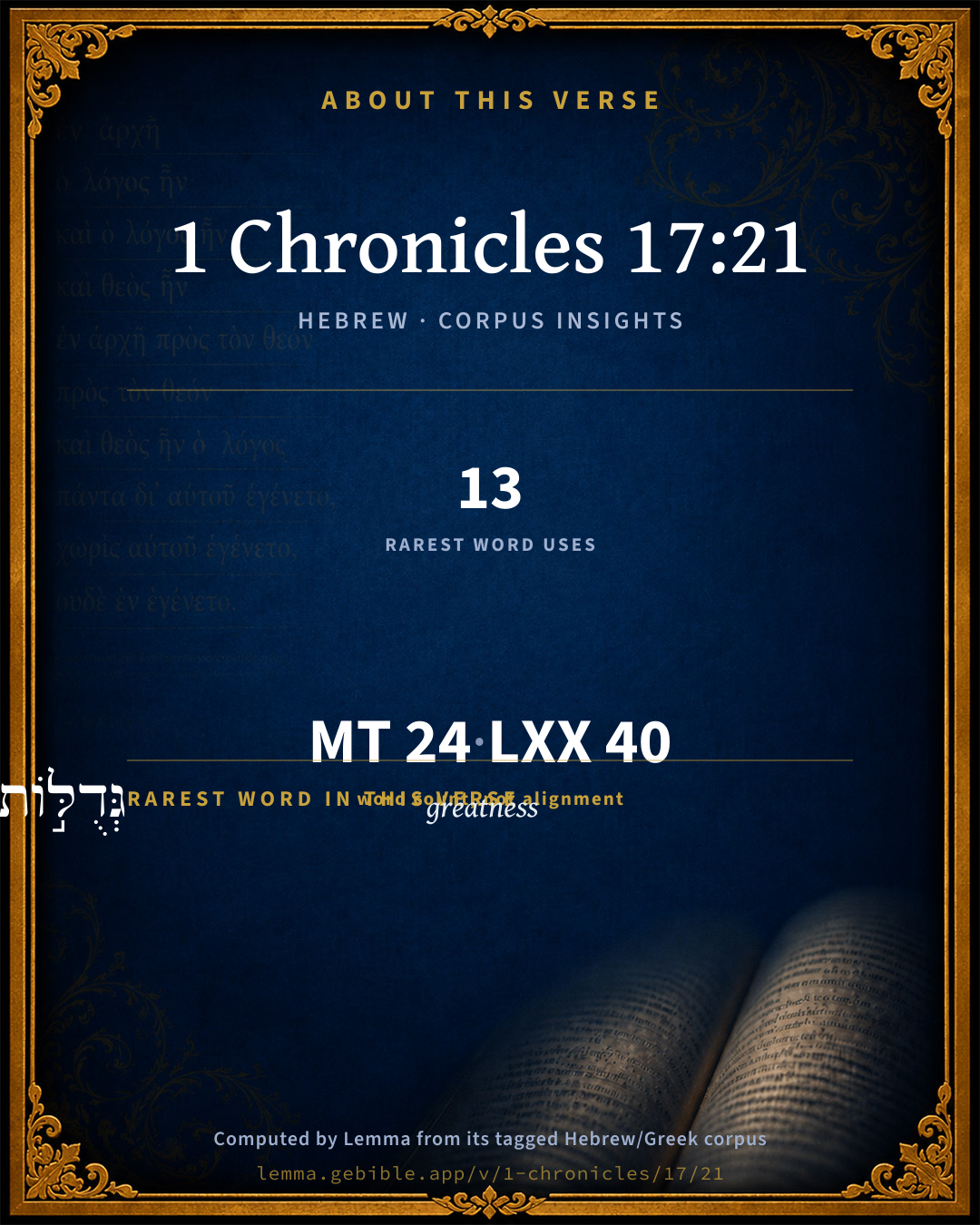
The rarest word here is גְּדֻלּ֣וֹת greatness H1420 — appearing just 13 times in the whole Hebrew Bible.

Shared distinctive vocabulary

גְּדֻלּ֣וֹת greatness H1420 occurs in 11 verses of the Hebrew Bible. Also found in:

Grammatical profile

  • 6 verbs
  • 12 nouns
  • 1 adjective
  • 2 prepositions
  • 3 particles

Verb forms

  • הָלַ֨ךְ Qal · Perfect
  • לִפְדּ֧וֹת Qal · Infinitive Construct
  • לָשׂ֤וּם Qal · Infinitive Construct
  • וְנֹרָא֔וֹת Niphal · Participle Active
  • לְגָרֵ֗שׁ Piel · Infinitive Construct
  • פָּדִ֥יתָ Qal · Perfect

Repetition

Words recur within this verse — often emphatic in Hebrew:

  • כְּעַמְּךָ֣ people H5971 ×3
  • גּ֥וֹי nation H1471 ×2
  • לִפְדּ֧וֹת to redeem H6299 ×2
  • אֲשֶׁר֩ which H834 ×2

Hebrew & Septuagint length

In English translation the verse runs 45 words from the Hebrew and 49 from the Septuagint (LXX English) — closely comparable.

A rough comparison of the two English renderings, which tokenize alike — not a word-level alignment.

Word counts can differ between the Hebrew and the Greek without any difference in meaning — e.g. the Hebrew direct-object marker אֵת has no separate Greek word, and Greek often adds the article ὁ.

In the original languages it is 24 Hebrew tokens and 40 Greek tokens — but the two are counted differently (Hebrew bundles its prefixes and suffixes into one token; the Greek is in lemma form), so that isn’t a like-for-like length.

Cross-references

25

Topical passages linked to 1 Chronicles 17:21 in the Treasury of Scripture Knowledge — connected by theme and wording, ordered by reader-vote popularity; previews shown in the World English Bible.

  • Ezekiel 20:9–10 But I worked for my name's sake, that it should not be profaned in the sight of the nations, among which they were, in whose sight I made myself known to them, in bringing them forth out of the land of Egypt.
  • Exodus 3:7–8 Yahweh said, "I have surely seen the affliction of my people who are in Egypt, and have heard their cry because of their taskmasters, for I know their sorrows.
  • Exodus 19:4–6 'You have seen what I did to the Egyptians, and how I bore you on eagles' wings, and brought you to myself.
  • Deuteronomy 4:7 For what great nation is there, that has a god so near to them, as Yahweh our God is whenever we call on him?
  • Deuteronomy 4:32–34 For ask now of the days that are past, which were before you, since the day that God created man on the earth, and from the one end of the sky to the other, whether there has been [any such thing] as this great thing is, or has been heard like it?
  • Deuteronomy 7:1–2 When Yahweh your God shall bring you into the land where you go to possess it, and shall cast out many nations before you, the Hittite, and the Girgashite, and the Amorite, and the Canaanite, and the Perizzite, and the Hivite, and the Jebusite, seven nations greater and mightier than you;
  • Deuteronomy 15:15 You shall remember that you were a bondservant in the land of Egypt, and Yahweh your God redeemed you: therefore I command you this thing today.
  • Deuteronomy 33:26–29 There is none like God, Jeshurun, Who rides on the heavens for your help, In his excellency on the skies.
  • Joshua 10:42 All these kings and their land did Joshua take at one time, because Yahweh, the God of Israel, fought for Israel.
  • Joshua 21:43–45 So Yahweh gave to Israel all the land which he swore to give to their fathers; and they possessed it, and lived therein.
  • Joshua 24:11–12 You went over the Jordan, and came to Jericho: and the men of Jericho fought against you, the Amorite, and the Perizzite, and the Canaanite, and the Hittite, and the Girgashite, the Hivite, and the Jebusite; and I delivered them into your hand.
  • Nehemiah 9:10 and shown signs and wonders on Pharaoh, and on all his servants, and on all the people of his land; for you knew that they dealt proudly against them, and did get you a name, as it is this day.
  • Psalms 44:2–3 You drove out the nations with your hand, But you planted them. You afflicted the peoples, But you spread them abroad.
  • Psalms 65:5 By awesome deeds of righteousness, you answer us, God of our salvation. You who are the hope of all the ends of the earth, Of those who are far away on the sea;
  • Psalms 66:3–7 Tell God, "How awesome are your deeds! Through the greatness of your power, your enemies submit themselves to you.
  • Psalms 77:15 You have redeemed your people with your arm, The sons of Jacob and Joseph. Selah.
  • Psalms 107:2 Let the redeemed by Yahweh say so, Whom he has redeemed from the hand of the adversary,
  • Psalms 111:9 He has sent redemption to his people. He has ordained his covenant forever. His name is holy and awesome!
  • Psalms 114:3–8 The sea saw it, and fled. The Jordan was driven back.
  • Psalms 147:20 He has not done this for just any nation. They don't know his ordinances. Praise Yah!
  • Isaiah 48:9 For my name's sake will I defer my anger, and for my praise will I refrain for you, that I not cut you off.
  • Isaiah 63:9 In all their affliction he was afflicted, and the angel of his presence saved them: in his love and in his pity he redeemed them; and he bore them, and carried them all the days of old.
  • Isaiah 63:12 who caused his glorious arm to go at the right hand of Moses? who divided the waters before them, to make himself an everlasting name?
  • Isaiah 64:3 When you did terrible things which we didn't look for, you came down, the mountains quaked at your presence.
  • Titus 2:14 who gave himself for us, that he might redeem us from all iniquity, and purify for himself a people for his own possession, zealous for good works.

Cross-references courtesy of OpenBible.info (CC BY 4.0).

Hebrew and Greek witnesses Masoretic Hebrew ↔ Greek Septuagint

The same verse in the two great witnesses to the Old Testament, shown verse-for-verse.

These are two independent witnesses, not word-aligned to each other, and the Septuagint is shown in lemma (dictionary) form.

Hebrew 1 Chronicles 17:21 Masoretic · Westminster Leningrad Codex

וּמִי֙ כְּעַמְּךָ֣ יִשְׂרָאֵ֔ל גּ֥וֹי אֶחָ֖ד בָּאָ֑רֶץ אֲשֶׁר֩ הָלַ֨ךְ הָאֱלֹהִ֜ים לִפְדּ֧וֹת ל֣וֹ עָ֗ם לָשׂ֤וּם לְךָ֙ שֵׁ֚ם גְּדֻלּ֣וֹת וְנֹרָא֔וֹת לְגָרֵ֗שׁ מִפְּנֵ֧י עַמְּךָ֛ אֲשֶׁר פָּדִ֥יתָ מִמִּצְרַ֖יִם גּוֹיִֽם

What one nation in the earth is like your people Israel, whom God went to redeem to himself for a people, to make you a name by great and awesome things, in driving out nations from before your people, whom you redeem out of Egypt?

World English Bible · Public Domain

Greek LXX 1 Chronicles 17:21 Septuagint · lemma form

καί οὐ εἰμί ὡς ὁ λαός σύ ἰσραήλ ἔθνος ἔτι ἐπί ὁ γῆ ὡς ὁδηγέω αὐτός ὁ θεός ὁ λυτρόω ἑαυτοῦ λαός ὁ τίθημι ἑαυτοῦ ὄνομα μέγας καί ἐπιφανής ὁ ἐκβάλλω ἀπό πρόσωπον λαός σύ ὅς λυτρόω ἐκ αἴγυπτος ἔθνος

Neither is there another nation upon the earth such as your people Israel, whereas God led him in the way, to redeem a people for himself, to make for himself a great and glorious name, to cast out nations from before your people, whom you redeemed out of Egypt.

LXX2012 (modern English Septuagint) · Public Domain

On this verse, Ellicott's Commentary for English Readers discusses the Septuagint’s reading. Read the note in Commentary ↓

Hebrew: Westminster Leningrad Codex (CC BY 4.0). Greek: Septuagint (public domain); English from LXX2012 (modern English Septuagint) (Public Domain). How the Septuagint differs from the Hebrew →

Commentary

Notes on 1 Chronicles 17:21 from classic Christian and Jewish commentators (each source and its license shown beneath its notes). The classic Christian expositions comment on the surrounding passage and are grouped to its opening verse, so a note may address several verses; the Jewish commentaries on the Tanakh (Rashi and others) are per-verse, so they appear only where the commentator wrote on this verse.

Lemma curates 59 commentaries, every one of them public domain or Creative Commons licensed, each selected and text-cleaned for this edition rather than reprinted as found. About our sources →

Ellicott's Commentary for English Readers

(21) And what one nation in the earth.—Rather, And who is like Thy people Israel, a single (isolated) race on the earth? (Comp. Num_23:9.)

Nation (gôy)—i.e., race; a people considered as united by common blood, speech, country.

People (‘âm)—i.e., a political community, social union, or state, owning one sovereign.

Whom God went . . .—Literally, which God went (marched) to redeem to Himself as a people. Samuel has “which gods went.”

To make thee a name.—That is, for Thyself, God. Samuel has “for him,” in the same sense.

A name of greatness and terribleness.—Both nouns are plural, and imply renown for great and terrible deeds.

By driving.—To drive; parallel with “to redeem “and “to make.”

Nations.—Samuel adds, “and his gods.” The text of this verse in Samuel is corrupt (comp. the LXX.), and perhaps the added phrase is spurious. But, on the other hand, the chronicler may have omitted it because, like Isaiah, he regarded the heathen deities as non-entities. In earlier times, foreign gods were spoken of as real beings, subordinate to Jehovah. (Comp. the LXX. rendering of Deu_32:8.)

A Bible Commentary for English Readers, edited by Charles John Ellicott (1878–1897) — public domain. Text from a community e-Sword module.

The Cambridge Bible for Schools and Colleges

gen. ed. J. J. S. Perowne

21. what one nation in the earth is like thy people Israel] Better as R.V. mg., who is like thy people Israel, a nation that is alone in the earth. Cp. Targ. a people unique and chosen in the earth.

of greatness and terribleness] R.V. by great and terrible things.

The Cambridge Bible for Schools and Colleges (gen. ed. J. J. S. Perowne; Cambridge University Press, 1878–1918) — public domain. Text from a community e-Sword module.

Haydock's Catholic Bible Commentary

Himself. Hebrew adds, "and to make thee a name."

George Leo Haydock (1774–1849), Haydock's Catholic Family Bible and Commentary, 1859 edition — public domain. Excludes Psalms (Douay-Rheims chapter numbering differs from Protestant) and Deuterocanonical books (Catholic canon only).

The Pulpit Commentary

In the parallel verse, (2Sa_7:23) our Authorized Version, following the Hebrew text ( reads, "To do for you great things and terrible." The transition is awkward, no way in harmony with the other short clauses of the passage, and it would be inexplicable except for the alternative open to us, of regarding it as a quotation from Deu_4:34, brought in regardless of the context into which it was introduced. The difficulty does not meet us in our present passage, being obviated by the other sentences of our compiler. Both places, however, manifestly quote from the Book of Deuteronomy, with the grand passages and grand verbiage of which we may well imagine David familiar. A similar familiarity is also betokened in the following verses, as regard other Pentateuchal passages.

The Pulpit Commentary (1880–1919), ed. H.D.M. Spence-Jones & Joseph S. Exell — public domain. Text from a community e-Sword module.

Rashi

Rabbi Shlomo Yitzchaki (Rashi)

And who is like Your people Israel, one nation And how are they singled out from all the nations? In this manner... whom God went by Himself. to redeem for Himself a people as a people, as it is written (Exod. 11:4): “I shall step forth in the midst of Egypt.” In this, we were singled out, that He did not do this to any nation in the world.

to drive nations from before Your people, whom You redeemed from Egypt And since You are One in Your world, and Your people are singled out from all nations; therefore, it is fitting for You to give them a proper and great king.

Rashi on the Tanakh — English translations: “The Judaica Press complete Tanach with Rashi, translated by A. J. Rosenberg” (CC BY 4.0); “Pentateuch with Rashi's commentary by M. Rosenbaum and A.M. Silbermann, 1929-1934” (public domain); “The Metsudah Tanach series, Lakewood, N.J” (CC BY 4.0); and “The Book of Joshua, Metsudah Publications, 1997” (CC BY 4.0). Text via Sefaria.

Lesson kit

Teaching starters — assembled from the data on this page, not authored interpretation. Every prompt links to the verse data it draws on. Edit before teaching.

1 Chronicles, in the Historical, opens this verse with 24 words (17 distinct Hebrew lemmas). Its most distinctive word is gᵉdûwlâh (“greatness”). A historical commentator’s framing appears above. Read the whole chapter for the surrounding context.

Discussion questions

  1. The word gᵉdûwlâh carries the sense “greatness.” How does it shape the verse?
  2. 2 Samuel 7:21 shares the word «greatness» with this verse. How do the two illuminate each other?
  3. “people” occurs 3× in this one verse. What is the effect of the repetition?
  4. These translations render this verse differently. What is at stake in choosing one wording over another?
  5. The verb «הָלַ֨ךְ» is Qal Perfect. How does its form color the action?
  6. Reading how Ellicott's Commentary for English Readers and The Cambridge Bible for Schools and Colleges read this verse, where do the two commentators agree and where do they part?

Things to notice

Reading settings

Reading text

Shown beneath each verse's original-language words.

Old Testament
Old Testament edition

Read the OT as the Masoretic Hebrew (MT) or the Greek Septuagint (LXX).

English shown for the Greek Septuagint (in the Hebrew ↔ Greek comparison).

Comparing translations? Open the Compare panel on any verse page to stack up to four side by side.