Jeremiah 5:9

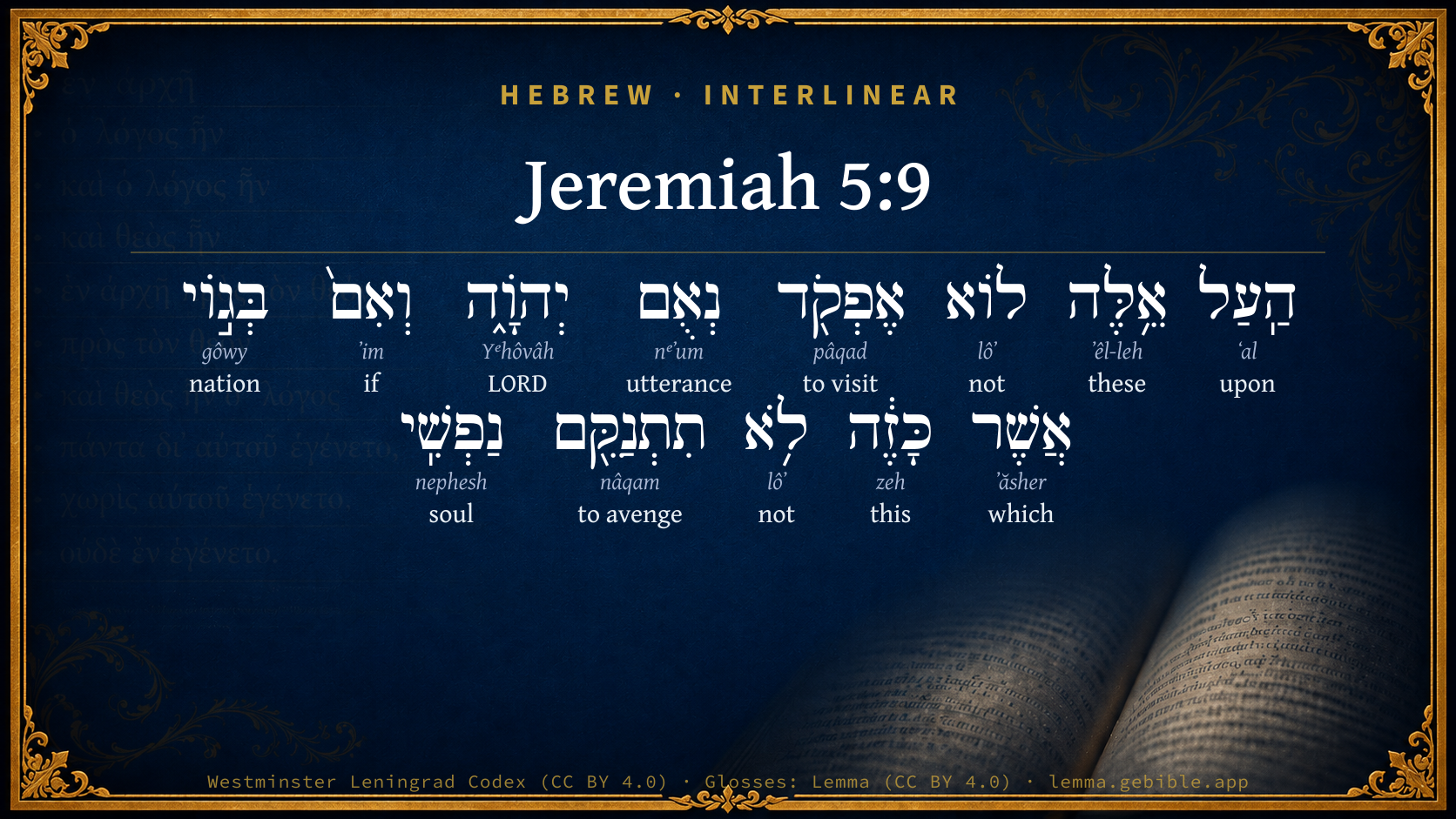
Hebrew (Westminster Leningrad Codex) Jeremiah 5:9 appears in the Hebrew Old Testament. The text above is from the Westminster Leningrad Codex. Each word links to its Strong’s number, a concise gloss, and parsing drawn from the Open Scriptures Hebrew Bible morphology. Click any word for its full Brown-Driver-Briggs (BDB) entry.
Download image
Cite this verse

Jeremiah 5:9 (World English Bible). Public Domain. Lemma interlinear Bible study tool, https://lemma.gebible.app/v/jeremiah/5/9.

Show BibTeX & RIS
BibTeX
RIS
English Translation
Shall I not visit for these things? says Yahweh; and shall not my soul be avenged on such a nation as this?
World English Bible · Public Domain
Download a study sheet

One document with this verse’s original text, its word-by-word gloss line, the meaning frame, cross-references with their text, attributed commentary, and full source and license credits — printable, and it pastes into notes with its structure intact.

This verse Autodidact and up

Study sheet (.html) Plain text (.txt)

A passage Seminary Student

Up to 50 verses in one chapter. A passage sheet keeps up to 6 commentary sources and 12 cross-references per verse, in the order this page ranks them, and says so on the sheet whenever that leaves anything out. Ask for a single verse and you get the Autodidact verse sheet above.

Everything on this page stays free to read, with no account — the sheet is a download of what is already on screen, not access to it.

Want to remove ads? Support Godless Engineer
Compare translations 3

The same verse in 3 English versions, stacked beneath the original-language interlinear above. Click any original word for its lexicon entry.

Each is an independent rendering of the whole verse — the interlinear is not word-aligned to these translations.

Highlighted words mark where these versions differ — a whole-verse word diff, not a word-by-word alignment.

  • World English Bible Public Domain
    Shall I not visit for these things? says Yahweh; and shall not my soul be avenged on such a nation as this?
  • King James Version Public Domain
    Shall I not visit for these things? saith the LORD: and shall not my soul be avenged on such a nation as this?
  • unfoldingWord Literal Text CC BY-SA 4.0
    Should I not punish because of these —the declaration of Yahweh— or even against a nation that like this, should I not avenge myself? ts\*

unfoldingWord Literal Text — © unfoldingWord, licensed CC BY-SA 4.0. Word-aligned USFM3 via Door43 (git.door43.org/unfoldingWord/en_ult).

Versions to compare (up to 4)

3 of 4 selected

Show all 18 translations

Every available English version of this verse, each an independent rendering of the whole verse.

  • World English Bible Public Domain
    Shall I not visit for these things? says Yahweh; and shall not my soul be avenged on such a nation as this?
  • Berean Standard Bible Public Domain
    Should I not punish them for these things?” declares the LORD. “Should I not avenge Myself on such a nation as this?
  • Majority Standard Bible Public Domain
    Should I not punish them for these things?” declares the LORD. “Should I not avenge Myself on such a nation as this?
  • King James Version Public Domain
    Shall I not visit for these things? saith the LORD: and shall not my soul be avenged on such a nation as this?
  • American Standard Version (1901) Public Domain
    Shall I not visit for these things? saith Jehovah; and shall not my soul be avenged on such a nation as this?
  • Revised Version (1885) Public Domain
    shall I not visit for these things? saith the LORD: and shall not my soul be avenged on such a nation as this?
  • Geneva Bible (1599) Public Domain
    Shall I not visite for these things, saith the Lord? Shall not my soule be auenged on such a nation as this?
  • Douay-Rheims (1899) Public Domain
    Shall I not visit for these things, sayeth the Lord? and shall not my soul take revenge on such a nation?
  • Young's Literal Translation Public Domain
    For these do I not lay a charge? An affirmation of Jehovah, And on a nation such as this, Doth not My soul avenge itself?
  • Literal Standard Version CC BY-SA 4.0
    Do I not lay a charge for these?” A declaration of YHWH, “And on a nation such as this, || Does My soul not avenge itself?
  • Unlocked Literal Bible CC BY-SA 4.0
    So should I not punish them—this is Yahweh's declaration— and should I not avenge myself on a nation that is like this?
  • unfoldingWord Literal Text CC BY-SA 4.0
    Should I not punish because of these —the declaration of Yahweh— or even against a nation that like this, should I not avenge myself? ts\*
  • Darby Bible Public Domain
    Shall I not visit for these things? saith Jehovah, and shall not my soul be avenged on such a nation as this?
  • World Messianic Bible Public Domain
    Shouldn’t I punish them for these things?” says the LORD. “Shouldn’t my soul be avenged on such a nation as this?
  • Webster's Bible Public Domain
    Shall I not visit for these things? saith the LORD: and shall not my soul be avenged on such a nation as this?
  • Free Bible Version CC BY-SA 4.0
    Shouldn't I punish them for all this? declares the Lord. Shouldn't I retaliate for what this nation has done?
  • Bible in Basic English Public Domain
    Am I not to give punishment for these things? says the Lord: will not my soul take payment from such a nation as this?
  • JPS Tanakh (1917) Public Domain
    Shall I not punish for these things? saith the LORD; and shall not My soul be avenged on such a nation as this?

Literal Standard Version (2020), Covenant Press — licensed CC BY-SA 4.0. Text via the HelloAO Bible API (eBible.org). Unlocked Literal Bible (unfoldingWord) — licensed CC BY-SA 4.0. Text via the HelloAO Bible API (eBible.org). unfoldingWord Literal Text — © unfoldingWord, licensed CC BY-SA 4.0. Word-aligned USFM3 via Door43 (git.door43.org/unfoldingWord/en_ult). Free Bible Version, Dr. Jonathan Gallagher — licensed CC BY-SA 4.0. Text via the HelloAO Bible API (eBible.org).

Word by word

More ways to search: Search by grammar → Find every occurrence → Compare this word →

Practice this passage: Drill this verse → Learn its vocabulary →

תִתְנַקֵּ֖ם
nâqam
H5358
“to avenge”
Verb, Hithpael, Imperfect, 3rd Person, Feminine, Singular
Part of Speech
Verb
Stem
Hithpael
Form
Imperfect
Person
3rd Person
Gender
Feminine
Number
Singular
Full BDB Definition

Origin: a primitive root

TWOT: 1413

to avenge, take vengeance, revenge, avenge oneself, be avenged, be punished - (Qal) - to avenge, take vengeance - to entertain revengeful feelings - (Niphal) - to avenge oneself - to suffer vengeance - (Piel) to avenge - (Hophal) to be avenged, vengeance be taken (for blood) - (Hithpael) to avenge oneself
  1. הַֽעַל ʻal H5921 “upon” Particle, Interrogative + Preposition
  2. אֵ֥לֶּה ʼêl-leh H428 “these” Pronoun, Demonstrative, Common, Plural
  3. לוֹא lôʼ H3808 “not” Particle, Negative
  4. אֶפְקֹ֖ד pâqad H6485 “to visit” Verb, Qal, Imperfect, 1st Person, Common, Singular
  5. נְאֻם nᵉʼum H5002 “utterance of” Noun, Common, Masculine, Singular, Construct
  6. יְהֹוָ֑ה Yᵉhôvâh H3068 “LORD” Noun, Proper
  7. וְאִם֙ ʼim H518 “and · if” Conjunction + Conjunction
  8. בְּג֣וֹי gôwy H1471 “in/at · nation” Preposition + Noun, Common, Masculine, Singular, Absolute
  9. אֲשֶׁר ʼăsher H834 “which” Particle, Relative
  10. כָּזֶ֔ה zeh H2088 “like/as · this” Preposition + Pronoun, Demonstrative, Masculine, Singular
  11. לֹ֥א lôʼ H3808 “not” Particle, Negative
  12. נַפְשִֽׁי nephesh H5315 “soul · my” Noun, Common, Both, Singular, Construct + Suffix, Personal, 1st Person, Common, Singular

About this verse

These counts appear in no published source. They are computed here, from the morphology-tagged text and Lemma’s own curated glosses. What Lemma adds →

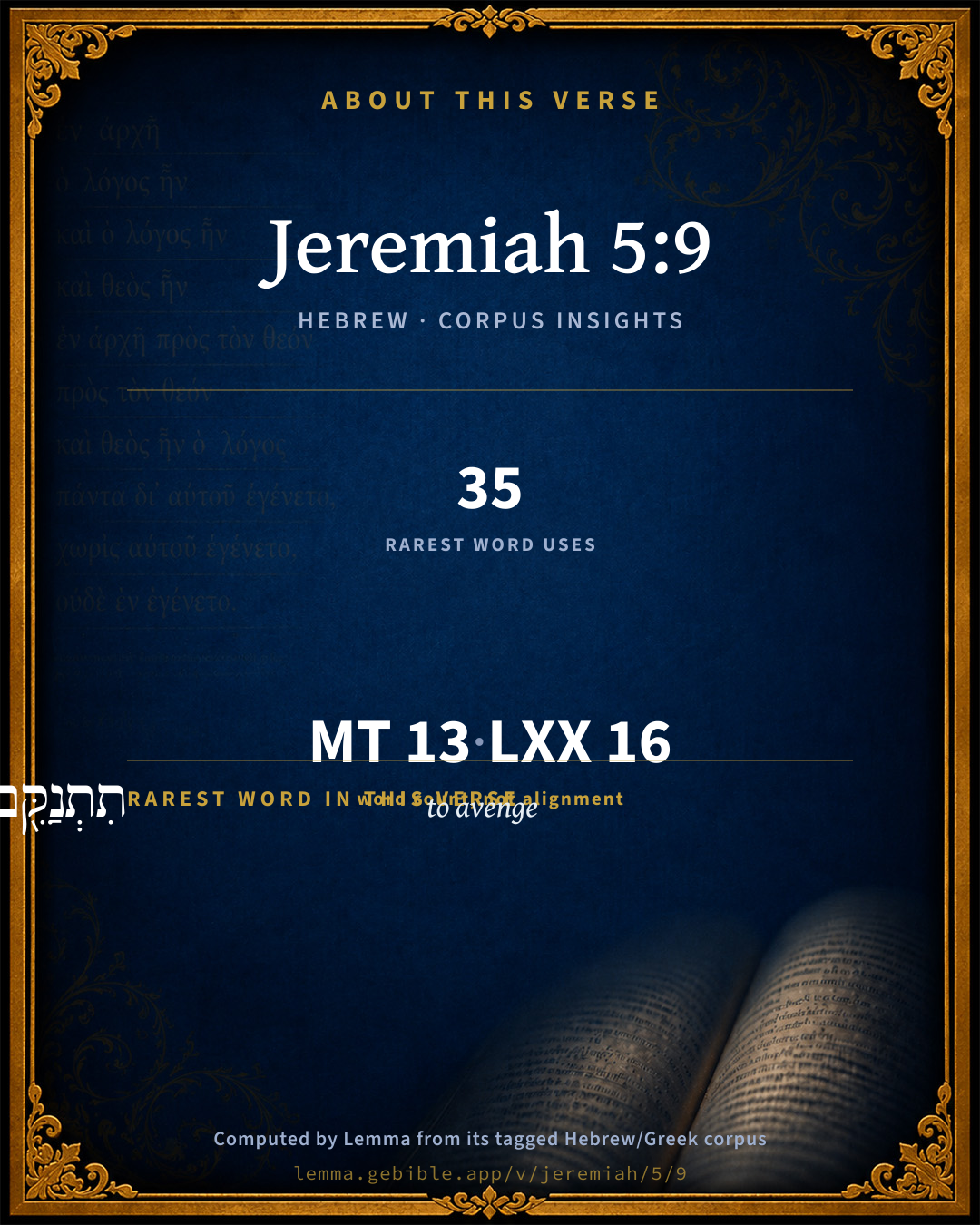
13
words
12
distinct lemmas
Prophets
section

Shared distinctive vocabulary

תִתְנַקֵּ֖ם to avenge H5358 occurs in 31 verses of the Hebrew Bible. Also found in:

Grammatical profile

  • 2 verbs
  • 4 nouns
  • 2 pronouns
  • 1 preposition
  • 1 conjunction
  • 3 particles

Verb forms

  • אֶפְקֹ֖ד Qal · Imperfect
  • תִתְנַקֵּ֖ם Hithpael · Imperfect

Repetition

A word recurs within this verse — often emphatic in Hebrew:

Hebrew & Septuagint length

In the original languages it is 13 Hebrew tokens and 16 Greek tokens — but the two are counted differently (Hebrew bundles its prefixes and suffixes into one token; the Greek is in lemma form), so that isn’t a like-for-like length.

Cross-references

14

Topical passages linked to Jeremiah 5:9 in the Treasury of Scripture Knowledge — connected by theme and wording, ordered by reader-vote popularity; previews shown in the World English Bible.

  • Jeremiah 9:9 Shall I not visit them for these things? says Yahweh; shall not my soul be avenged on such a nation as this?
  • Jeremiah 5:29 Shall I not visit for these things? says Yahweh; shall not my soul be avenged on such a nation as this?
  • Isaiah 1:24 Therefore the Lord, Yahweh of Hosts, The Mighty One of Israel, says: "Ah, I will get relief from my adversaries, And avenge myself of my enemies;
  • Leviticus 26:25 I will bring a sword upon you, that will execute the vengeance of the covenant; and you will be gathered together within your cities: and I will send the pestilence among you; and you will be delivered into the hand of the enemy.
  • Deuteronomy 32:35 Vengeance is mine, and recompense, At the time when their foot shall slide: For the day of their calamity is at hand, The things that are to come on them shall make haste.
  • Deuteronomy 32:43 Rejoice, you nations, [with] his people: For he will avenge the blood of his servants, Will render vengeance to his adversaries, Will make expiation for his land, for his people.
  • Jeremiah 23:2 Therefore thus says Yahweh, the God of Israel, against the shepherds who feed my people: You have scattered my flock, and driven them away, and have not visited them; behold, I will visit on you the evil of your doings, says Yahweh.
  • Jeremiah 44:22 so that Yahweh could no longer bear, because of the evil of your doings, and because of the abominations which you have committed; therefore is your land become a desolation, and an astonishment, and a curse, without inhabitant, as it is this day.
  • Lamentations 4:22 The punishment of your iniquity is accomplished, daughter of Zion; he will no more carry you away into captivity: He will visit your iniquity, daughter of Edom; he will uncover your sins.
  • Ezekiel 5:13–15 Thus shall my anger be accomplished, and I will cause my wrath toward them to rest, and I shall be comforted; and they shall know that I, Yahweh, have spoken in my zeal, when I have accomplished my wrath on them.
  • Ezekiel 7:9 My eye shall not spare, neither will I have pity: I will bring on you according to your ways; and your abominations shall be in the midst of you; and you shall know that I, Yahweh, do strike.
  • Hosea 2:13 I will visit on her the days of the Baals, To which she burned incense, When she decked herself with her earrings and her jewels, And went after her lovers, And forgot me," says Yahweh.
  • Hosea 8:13 As for the sacrifices of my offerings, they sacrifice flesh and eat it; But Yahweh doesn't accept them. Now he will remember their iniquity, And punish their sins. They will return to Egypt.
  • Nahum 1:2 Yahweh is a jealous God and avenges. Yahweh avenges and is full of wrath. Yahweh takes vengeance on his adversaries, and he maintains wrath against his enemies.

Cross-references courtesy of OpenBible.info (CC BY 4.0).

Hebrew and Greek witnesses Masoretic Hebrew ↔ Greek Septuagint

The same verse in the two great witnesses to the Old Testament, shown verse-for-verse.

These are two independent witnesses, not word-aligned to each other, and the Septuagint is shown in lemma (dictionary) form.

Hebrew Jeremiah 5:9 Masoretic · Westminster Leningrad Codex

הַֽעַל אֵ֥לֶּה לוֹא אֶפְקֹ֖ד נְאֻם יְהֹוָ֑ה וְאִם֙ בְּג֣וֹי אֲשֶׁר כָּזֶ֔ה לֹ֥א תִתְנַקֵּ֖ם נַפְשִֽׁי

Shall I not visit for these things? says Yahweh; and shall not my soul be avenged on such a nation as this?

World English Bible · Public Domain

Greek LXX Structure differs

In the Septuagint, Jeremiah is about an eighth shorter than the Hebrew and arranges its material differently — the Oracles Against the Nations (Hebrew chapters 46–51) appear in the middle of the Greek book, after 25:13. Because the chapter and verse boundaries do not line up, a verse-for-verse comparison with the Hebrew is not shown.

A verse-for-verse comparison isn’t shown here because the chapters and verses don’t line up. Switch to the LXX edition with the MT / LXX toggle above to read the Greek directly.

Hebrew: Westminster Leningrad Codex (CC BY 4.0). Greek: Septuagint (public domain); English from a public-domain English Septuagint. How the Septuagint differs from the Hebrew →

Targum (Aramaic paraphrase)

1

The Targum is the ancient Jewish Aramaic paraphrase of the Hebrew Scriptures — an interpretive translation, not the Hebrew text itself. Onkelos (literal) and Pseudo-Jonathan (expansive) render the Torah, and Jonathan the Prophets. Coverage is partial: where no permissively-licensed English translation exists for a verse, only the Aramaic is shown. This is verse-level text, not a word-by-word alignment to the Hebrew.

  1. Targum Jonathan Prophets (Joshua–Malachi)
    הַעַל אִלֵין לָא אַסְעַר לְאַיְתָאָה עֲלֵיהוֹן בִּישָׁתָא אֲמַר יְיָ וְאִם מִן עַמָא דִכְדֵין עוֹבָדוֹהִי לָא אִתְפְּרַע מִנְהוֹן כִּרְעוּתִי:

    (no public-domain English translation for this verse)

    Targum Jonathan — Aramaic: “Mikraot Gedolot” (public domain). English: “Sefaria Community Translation” (CC0 1.0 (public-domain dedication)); “London "Chaldee Paraphrase," 1871” (public domain). Text via Sefaria.

Commentary

Notes on Jeremiah 5:9 from classic Christian and Jewish commentators (each source and its license shown beneath its notes). The classic Christian expositions comment on the surrounding passage and are grouped to its opening verse, so a note may address several verses; the Jewish commentaries on the Tanakh (Rashi and others) are per-verse, so they appear only where the commentator wrote on this verse.

Lemma curates 59 commentaries, every one of them public domain or Creative Commons licensed, each selected and text-cleaned for this edition rather than reprinted as found. About our sources →

Trapp's Complete Commentary

John Trapp

Jer 5:9 Shall I not visit for these [things]? saith the LORD: and shall not my soul be avenged on such a nation as this?

Ver. 9. Shall I not visit for these things?] i.e., Shall I not take cognizance of them, and punish them surely and severely?

John Trapp, A Commentary or Exposition upon All the Books of the Old and New Testament (1647–1656) — public domain. Text from a community e-Sword module.

The Biblical Illustrator

Joseph S. Exell

Jer_5:9

Shall I not visit for these things?

Unsanctified affliction followed by heavier judgments

The physician, when he findeth that the potion which he hath given his patient will not work, he seconds it with one more violent; but if he perceive the disease to be settled, then he puts him into a course of physic, so that he shall have at present but small comfort of his life. And thus doth the surgeon, too: if a gentle plaister will not serve, then he applies that which is more corroding; and to prevent a gangrene, he makes use of his cauterising knife, and takes off the joint or member that is so ill-affected. Even so God, when men profit not by such crosses as He hath formerly exercised them with, when they are not bettered by lighter afflictions, then He sends heavier, and proceeds from milder to sharper crosses. If the dross of their sins will not come off, He will throw them into the melting pot again and again, crush them harder in the press, and lay on such irons as shall enter more deep into their souls. If He strikes and they grieve not, if they be so foolish that they will not know the judgment of their God, He will bring seven times more plagues upon them, cross upon cross, loss upon loss, trouble upon trouble, one sorrow on the neck of another, till they are in a manner wasted and consumed. (J. Spencer.)

The Biblical Illustrator, edited by Joseph S. Exell (c. 1880s–1900s) — public domain. Text from a community e-Sword module.

Tyndale Open Study Notes

Tyndale Open Resources

5:9 The Lord regarded the people’s sins as worthy of punishment (9:9; 13:27; 29:23; Ezek 22:11).

Tyndale Open Study Notes — © Tyndale Open Resources, licensed CC BY-SA 4.0. Text via the HelloAO Bible API.

Jamieson, Fausset & Brown

Robert Jamieson, A. R. Fausset & David Brown

(Jer 5:29; Jer 9:9; Jer 44:22).

Jamieson, Fausset & Brown — Commentary Critical and Explanatory on the Whole Bible (1871) — public domain (CC PDM 1.0). Text via the HelloAO Bible API.

John Calvin's Commentaries

God again holds, as it were, a conference with them, and for this purpose, — that he might check all their complaints and close their mouths, lest they should object and say, that they were too severely treated. That this objection then might be removed, God repeats that he could not pardon such atrocious sins. And this principle is adopted, that it was impossible not to punish such wicked men who would not repent. For since God is the Judge of the world, he can no more surrender his judgment than his essence. As, then, the majesty of God and his office of a Judge are inseparably connected, the Prophet concludes, that what the Jews thought was impossible, that is, that they could escape unpunished, and yet continue to provoke God, as it were, by open war, with their dreadful sins: Should I not then visit for this, saith Jehovah?

Here is introduced the name of Jehovah. An earthly judge may pardon the ungodly and the worst of men; but this cannot be done by God; for whenever God pardons, he leads sinners to repentance: so that he never suffers sins to be unpunished. For he who repents becomes his own judge, and thus anticipates God’s judgment. Where then there is true conversion, God shews no indulgence to sins. But when persistency in sins is such, that they who are warned despise all instruction, it is impossible that God should forgive; as in that case he would renounce his own glory, which can never be. Should I not then visit for this, saith Jehovah?

And on such a nation as this should not vengeance my soul take? God speaks here after the manner of men, for he seeks no vengeance; and when he speaks of his soul, even this is not strictly suitable to him; but there is here nothing obscure; for what is meant is, that he is at enmity with wickedness, as it is said in Psalm 5:5, that he cannot bear iniquity. Since it is so, it follows that he must either be thrust from his celestial throne, or punishment must be inflicted on the wicked, who remain perverse and set no end nor bounds to their sins. Whenever then delusion creeps over us and Satan seeks by his allurements to lead us to forget God’s judgment, let this come to our minds — that God would not be God, except he were to punish sins. It is then necessary that he should punish sins or be displeased with us: but, as it has been said, he cannot be inconsistent with himself or dissimilar in his nature, since no change can take place in him. Either then his hand is stretched out to punish our sins, or his judgment must be anticipated by us. And how can this be done? By learning to bring sentence against ourselves, by becoming displeased with our sins.

When therefore our conversion will be of this kind, then God will be merciful to us; and thus he will not pardon our sins, as though he approved of them, or as though he did not exercise his office as a judge. But as I have said, what is here taught is rightly addressed to those who are either refractory, or whom Satan renders so stupid and forgetful, that they call not themselves to an account; in short, what is here said will render the ungodly, who go on in their perverseness, inexcusable, or it will awake those who are healable, that they may judge themselves, and not wait until God stretches forth his hand to execute extreme punishment.

John Calvin's Commentaries (1540-1563) — public domain. Text from the Calvin Translation Society English edition (1840s-50s) via the Christian Classics Ethereal Library (ccel.org). Calvin's coverage is partial (roughly two-thirds of the Bible); uncommented books and verses are honest gaps, never fabricated. The 19th-century editor's footnotes and remarks are omitted so the notes are faithfully Calvin's own voice.

John Gill's Exposition

Shall I not visit for these things? saith the Lord,.... For such adulteries and lasciviousness, and that in a way of punishment. The Targum adds,

"to bring evil upon them;''

the evil of punishment for the evil of sin:

and shall not my soul be avenged upon such a nation as this? which cannot delight in sin, but hates it; and therefore must punish for it; vindictive and punitive justice is essential to God; as sin is contrary to his nature, it is agreeable to it to punish for it; he cannot but do it; and he does avenge all sin, either on the sinner himself, or on his surety.

John Gill's Exposition of the Whole Bible (1746–1763) — public domain (CC PDM 1.0). Text via the HelloAO Bible API.

Matthew Poole's English Annotations

Visit, i.e. punish, Psa 89:32. Should I connive at such things, the wicked would say, I did not see them, or take notice of them, Psa 50:21, much to the same purpose with Jer 5:7, beginning; and punishment may be termed visiting, as implying the equity of God’s procedures, that he first sees and considers the case, before he inflicts punishment; as in the case of Sodom, Gen 18:21; spoke after the manner of man.

My soul, for I; it speaks the greatness of God’s displeasure, Shall not my very soul be in this work of vengeance? Psa 11:5.

Matthew Poole's English Annotations on the Holy Bible (1683–1685) — public domain. Text from a community e-Sword/MySword module.

Lesson kit

Teaching starters — assembled from the data on this page, not authored interpretation. Every prompt links to the verse data it draws on. Edit before teaching.

Jeremiah, in the Prophets, opens this verse with 13 words (12 distinct Hebrew lemmas). Its most distinctive word is nâqam (“to avenge”). A historical commentator’s framing appears above. Read the whole chapter for the surrounding context.

Discussion questions

  1. The word nâqam carries the sense “to avenge.” How does it shape the verse?
  2. How does Genesis 4:15, which shares the word «to avenge», read alongside this verse?
  3. What does the repetition of “not” (2× in this one verse) do in this verse?
  4. These translations render this verse differently. What is at stake in choosing one wording over another?
  5. «אֶפְקֹ֖ד» is a Qal Imperfect verb. How does that grammatical form shape the action described?
  6. Compare how Trapp's Complete Commentary and The Biblical Illustrator read this verse. Where do they agree or differ?

Things to notice

Reading settings

Reading text

Shown beneath each verse's original-language words.

Old Testament
Old Testament edition

Read the OT as the Masoretic Hebrew (MT) or the Greek Septuagint (LXX).

English shown for the Greek Septuagint (in the Hebrew ↔ Greek comparison).

Comparing translations? Open the Compare panel on any verse page to stack up to four side by side.