
2 Kings 17:29

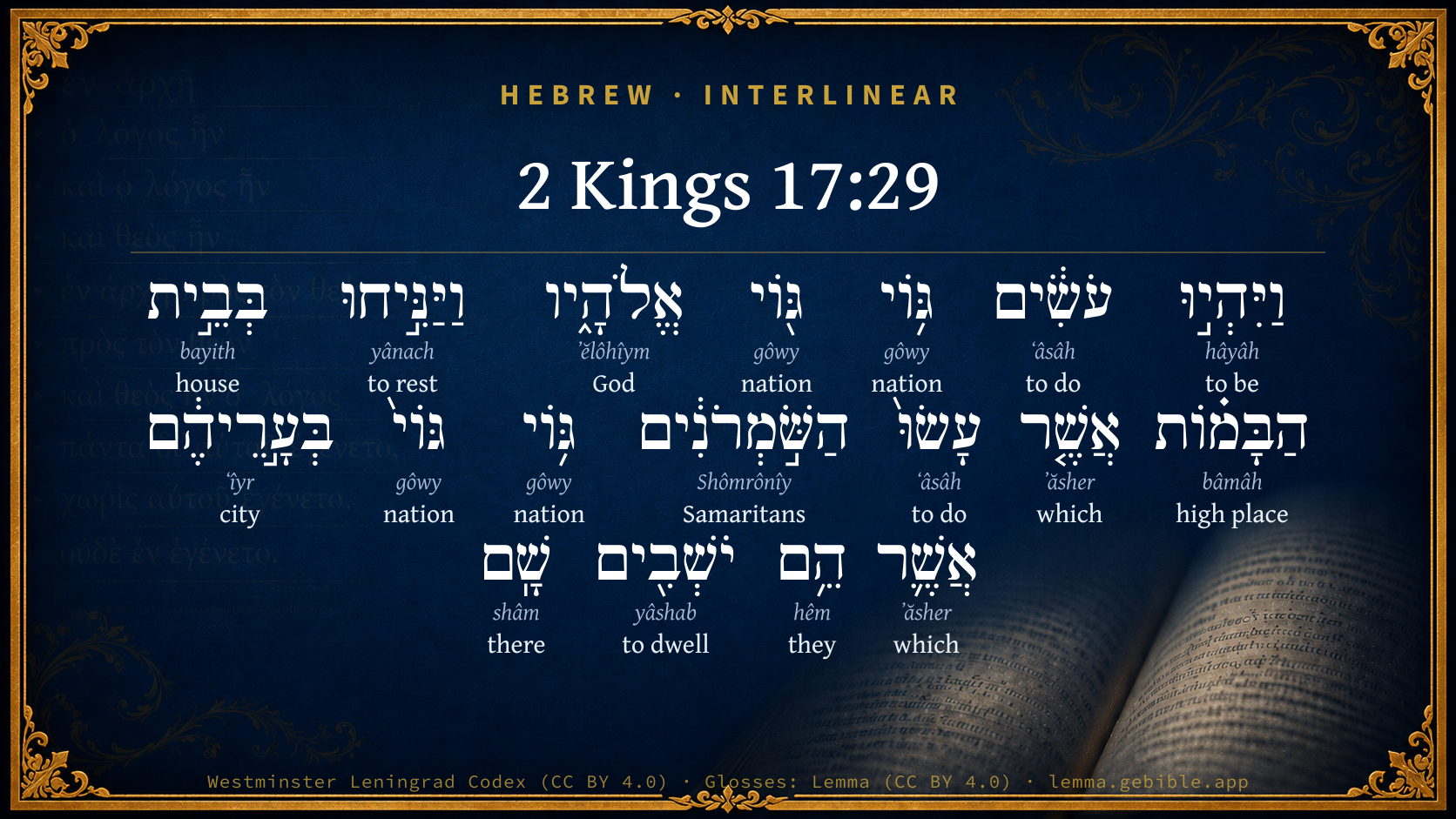
Hebrew (Westminster Leningrad Codex) 2 Kings 17:29 appears in the Hebrew Old Testament. The text above is from the Westminster Leningrad Codex. Each word links to its Strong’s number, a concise gloss, and parsing drawn from the Open Scriptures Hebrew Bible morphology. Click any word for its full Brown-Driver-Briggs (BDB) entry.
Download image
Cite this verse

2 Kings 17:29 (World English Bible). Public Domain. Lemma interlinear Bible study tool, https://lemma.gebible.app/v/2-kings/17/29.

Show BibTeX & RIS
BibTeX
RIS
English Translation
However every nation made gods of their own, and put them in the houses of the high places which the Samaritans had made, every nation in their cities in which they lived.
World English Bible · Public Domain
Highlights
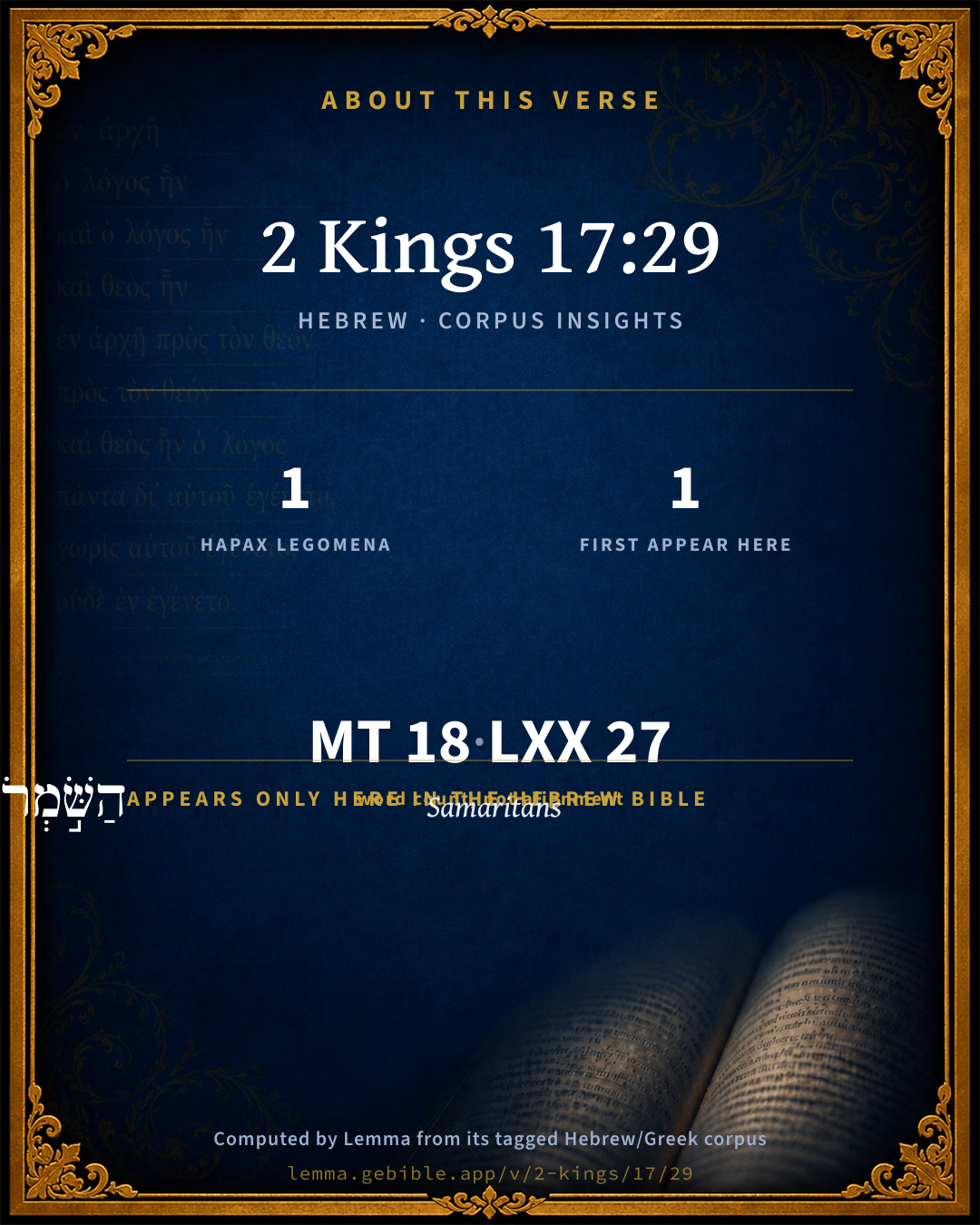
  • 1 hapax legomenon — only here in the Hebrew Bible
  • 1 first appearance in the Hebrew Bible
Full analysis ↓
Download a study sheet

One document with this verse’s original text, its word-by-word gloss line, the meaning frame, cross-references with their text, attributed commentary, and full source and license credits — printable, and it pastes into notes with its structure intact.

This verse Autodidact and up

Study sheet (.html) Plain text (.txt)

A passage Seminary Student

Up to 50 verses in one chapter. A passage sheet keeps up to 6 commentary sources and 12 cross-references per verse, in the order this page ranks them, and says so on the sheet whenever that leaves anything out. Ask for a single verse and you get the Autodidact verse sheet above.

Everything on this page stays free to read, with no account — the sheet is a download of what is already on screen, not access to it.

Want to remove ads? Support Godless Engineer
Compare translations 3

The same verse in 3 English versions, stacked beneath the original-language interlinear above. Click any original word for its lexicon entry.

Each is an independent rendering of the whole verse — the interlinear is not word-aligned to these translations.

Highlighted words mark where these versions differ — a whole-verse word diff, not a word-by-word alignment.

  • World English Bible Public Domain
    However every nation made gods of their own, and put them in the houses of the high places which the Samaritans had made, every nation in their cities in which they lived.
  • King James Version Public Domain
    Howbeit every nation made gods of their own, and put them in the houses of the high places which the Samaritans had made, every nation in their cities wherein they dwelt.
  • unfoldingWord Literal Text CC BY-SA 4.0
    And they were making, a nation, a nation, its gods, and they put in the house of the high places that the Samaritans had made, a nation, a nation, in their cities where they were settling there.

unfoldingWord Literal Text — © unfoldingWord, licensed CC BY-SA 4.0. Word-aligned USFM3 via Door43 (git.door43.org/unfoldingWord/en_ult).

Versions to compare (up to 4)

3 of 4 selected

Show all 18 translations

Every available English version of this verse, each an independent rendering of the whole verse.

  • World English Bible Public Domain
    However every nation made gods of their own, and put them in the houses of the high places which the Samaritans had made, every nation in their cities in which they lived.
  • Berean Standard Bible Public Domain
    Nevertheless, the people of each nation continued to make their own gods in the cities where they had settled, and they set them up in the shrines that the people of Samaria had made on the high places.
  • Majority Standard Bible Public Domain
    Nevertheless, the people of each nation continued to make their own gods in the cities where they had settled, and they set them up in the shrines that the people of Samaria had made on the high places.
  • King James Version Public Domain
    Howbeit every nation made gods of their own, and put them in the houses of the high places which the Samaritans had made, every nation in their cities wherein they dwelt.
  • American Standard Version (1901) Public Domain
    Howbeit every nation made gods of their own, and put them in the houses of the high places which the Samaritans had made, every nation in their cities wherein they dwelt.
  • Revised Version (1885) Public Domain
    Howbeit every nation made gods of their own, and put them in the houses of the high places which the Samaritans had made, every nation in their cities wherein they dwelt.
  • Geneva Bible (1599) Public Domain
    Howbeit euery nation made their gods, and put them in the houses of the hie places, which the Samaritanes had made, euery nation in their cities, wherein they dwelt.
  • Douay-Rheims (1899) Public Domain
    And every nation made gods of their own, and put them in the temples of the high places, which the Samaritans had made, every nation in their cities where they dwelt.
  • Young's Literal Translation Public Domain
    and they are making each nation its gods, and place `them' in the houses of the high places that the Samaritans have made, each nation in their cities where they are dwelling.
  • Literal Standard Version CC BY-SA 4.0
    and each nation is making its gods, and they place [them] in the houses of the high places that the Samaritans have made—each nation in their cities where they are dwelling.
  • Unlocked Literal Bible CC BY-SA 4.0
    Every ethnic group made gods of their own, and put them in the high places that the Samaritans had made—every ethnic group in the cities where they lived.
  • unfoldingWord Literal Text CC BY-SA 4.0
    And they were making, a nation, a nation, its gods, and they put in the house of the high places that the Samaritans had made, a nation, a nation, in their cities where they were settling there.
  • Darby Bible Public Domain
    And every nation made gods of their own, and put them in the houses of the high places that the Samaritans had made, every nation in their cities in which they dwelt.
  • World Messianic Bible Public Domain
    However every nation made gods of their own, and put them in the houses of the high places which the Samaritans had made, every nation in their cities in which they lived.
  • Webster's Bible Public Domain
    Yet, every nation made gods of their own, and put them in the houses of the high places which the Samaritans had made, every nation in their cities in which they dwelt.
  • Free Bible Version CC BY-SA 4.0
    But the people of the different nations went on making their own gods in the towns where they had settled, and they placed them in the shrines of the high places that the people of Samaria had made.
  • Bible in Basic English Public Domain
    And every nation made gods for themselves, and put them in the houses of the high places which the Samaritans had made, every nation in the towns where they were living.
  • JPS Tanakh (1917) Public Domain
    Howbeit every nation made gods of their own, and put them in the houses of the high places which the Samaritans had made, every nation in their cities wherein they dwelt.

Literal Standard Version (2020), Covenant Press — licensed CC BY-SA 4.0. Text via the HelloAO Bible API (eBible.org). Unlocked Literal Bible (unfoldingWord) — licensed CC BY-SA 4.0. Text via the HelloAO Bible API (eBible.org). unfoldingWord Literal Text — © unfoldingWord, licensed CC BY-SA 4.0. Word-aligned USFM3 via Door43 (git.door43.org/unfoldingWord/en_ult). Free Bible Version, Dr. Jonathan Gallagher — licensed CC BY-SA 4.0. Text via the HelloAO Bible API (eBible.org).

Word by word

More ways to search: Search by grammar → Find every occurrence → Compare this word →

Practice this passage: Drill this verse → Learn its vocabulary →

הַשֹּׁ֣מְרֹנִ֔ים
Shômrônîy
H8118
“the · Samaritans”
Particle, Definite Article + Noun, Gentilic, Masculine, Plural, Absolute
Part of Speech
Particle + Noun
Type
Gentilic
Gender
Masculine
Number
Plural
State
Absolute
Full BDB Definition

Origin: patrial from H8111

TWOT: None

Samaritans = "of Samaria" - inhabitants of Samaria
  1. וַיִּהְי֣וּ hâyâh H1961 “and · to be” Conjunction + Verb, Qal, Sequential Imperfect, 3rd Person, Masculine, Plural
  2. עֹשִׂ֔ים ʻâsâh H6213 “doing” Verb, Qal, Participle Active, Masculine, Plural, Absolute
  3. גּ֥וֹי gôwy H1471 “nation” Noun, Common, Masculine, Singular, Absolute
  4. גּ֖וֹי gôwy H1471 “nation” Noun, Common, Masculine, Singular, Absolute
  5. אֱלֹהָ֑יו ʼĕlôhîym H430 “God(s) · his” Noun, Common, Masculine, Plural, Construct + Suffix, Personal, 3rd Person, Masculine, Singular
  6. וַיַּנִּ֣יחוּ yânach H3240 “and · to rest” Conjunction + Verb, Hiphil, Sequential Imperfect, 3rd Person, Masculine, Plural
  7. בְּבֵ֣ית bayith H1004 “in/at · house of” Preposition + Noun, Common, Masculine, Singular, Construct
  8. הַבָּמ֗וֹת bâmâh H1116 “the · high places” Particle, Definite Article + Noun, Common, Feminine, Plural, Absolute
  9. אֲשֶׁ֤ר ʼăsher H834 “which” Particle, Relative
  10. עָשׂוּ֙ ʻâsâh H6213 “to do” Verb, Qal, Perfect, 3rd Person, Common, Plural
  11. גּ֥וֹי gôwy H1471 “nation” Noun, Common, Masculine, Singular, Absolute
  12. גּוֹי֙ gôwy H1471 “nation” Noun, Common, Masculine, Singular, Absolute
  13. בְּעָ֣רֵיהֶ֔ם ʻîyr H5892 “in/at · cities · their” Preposition + Noun, Common, Feminine, Plural, Construct + Suffix, Personal, 3rd Person, Masculine, Plural
  14. אֲשֶׁ֛ר ʼăsher H834 “which” Particle, Relative
  15. הֵ֥ם hêm H1992 “they” Pronoun, Personal, 3rd Person, Masculine, Plural
  16. יֹשְׁבִ֖ים yâshab H3427 “dwelling” Verb, Qal, Participle Active, Masculine, Plural, Absolute
  17. שָֽׁם shâm H8033 “there” Adverb

About this verse

These counts appear in no published source. They are computed here, from the morphology-tagged text and Lemma’s own curated glosses. What Lemma adds →

18
words
13
distinct lemmas
Historical
section

Notable vocabulary

1 hapax legomenon — a word that appears only here in the entire Hebrew Bible:

  • הַשֹּׁ֣מְרֹנִ֔ים Samaritans H8118

First appearance in Scripture

This word makes its first canonical appearance in the Hebrew Bible here:

  • הַשֹּׁ֣מְרֹנִ֔ים Samaritans H8118

Grammatical profile

  • 5 verbs
  • 9 nouns
  • 1 pronoun
  • 1 adverb
  • 2 particles

Verb forms

  • וַיִּהְי֣וּ Qal · Sequential Imperfect
  • עֹשִׂ֔ים Qal · Participle Active
  • וַיַּנִּ֣יחוּ Hiphil · Sequential Imperfect
  • עָשׂוּ֙ Qal · Perfect
  • יֹשְׁבִ֖ים Qal · Participle Active

Repetition

Words recur within this verse — often emphatic in Hebrew:

  • גּ֥וֹי nation H1471 ×4
  • עֹשִׂ֔ים to do H6213 ×2
  • אֲשֶׁ֤ר which H834 ×2

Hebrew & Septuagint length

In English translation the verse runs 32 words from the Hebrew and 32 from the Septuagint (LXX English) — the same length.

A rough comparison of the two English renderings, which tokenize alike — not a word-level alignment.

Word counts can differ between the Hebrew and the Greek without any difference in meaning — e.g. the Hebrew direct-object marker אֵת has no separate Greek word, and Greek often adds the article ὁ.

In the original languages it is 18 Hebrew tokens and 27 Greek tokens — but the two are counted differently (Hebrew bundles its prefixes and suffixes into one token; the Greek is in lemma form), so that isn’t a like-for-like length.

Cross-references

9

Topical passages linked to 2 Kings 17:29 in the Treasury of Scripture Knowledge — connected by theme and wording, ordered by reader-vote popularity; previews shown in the World English Bible.

  • 1 Kings 12:31 He made houses of high places, and made priests from among all the people, who were not of the sons of Levi.
  • Micah 4:5 Indeed all the nations may walk in the name of their gods; But we will walk in the name of Yahweh our God forever and ever.
  • 1 Kings 13:32 For the saying which he cried by the word of Yahweh against the altar in Bethel, and against all the houses of the high places which are in the cities of Samaria, shall surely happen.
  • Psalms 115:4–8 Their idols are silver and gold, The work of men's hands.
  • Psalms 135:15–18 The idols of the nations are silver and gold, The work of men's hands.
  • Isaiah 44:9–20 Those who fashion an engraved image are all of them vanity; and the things that they delight in shall not profit; and their own witnesses don't see, nor know: that they may be disappointed.
  • Jeremiah 10:3–5 For the customs of the peoples are vanity; for one cuts a tree out of the forest, the work of the hands of the workman with the axe.
  • Hosea 8:5–6 Let Samaria throw out his calf-idol! My anger burns against them! How long will it be before the are capable of purity?
  • Romans 1:23 and traded the glory of the incorruptible God for the likeness of an image of corruptible man, and of birds, and four-footed animals, and creeping things.

Cross-references courtesy of OpenBible.info (CC BY 4.0).

Hebrew and Greek witnesses Masoretic Hebrew ↔ Greek Septuagint

The same verse in the two great witnesses to the Old Testament, shown verse-for-verse.

These are two independent witnesses, not word-aligned to each other, and the Septuagint is shown in lemma (dictionary) form.

Hebrew 2 Kings 17:29 Masoretic · Westminster Leningrad Codex

וַיִּהְי֣וּ עֹשִׂ֔ים גּ֥וֹי גּ֖וֹי אֱלֹהָ֑יו וַיַּנִּ֣יחוּ בְּבֵ֣ית הַבָּמ֗וֹת אֲשֶׁ֤ר עָשׂוּ֙ הַשֹּׁ֣מְרֹנִ֔ים גּ֥וֹי גּוֹי֙ בְּעָ֣רֵיהֶ֔ם אֲשֶׁ֛ר הֵ֥ם יֹשְׁבִ֖ים שָֽׁם

However every nation made gods of their own, and put them in the houses of the high places which the Samaritans had made, every nation in their cities in which they lived.

World English Bible · Public Domain

Greek LXX 2 Kings 17:29 Septuagint · lemma form

καί εἰμί ποιέω ἔθνος ἔθνος θεός αὐτός καί τίθημι ἐν οἶκος ὁ ὑψηλός ὅς ποιέω ὁ σαμαρίτης ἔθνος ἐν ὁ πόλις αὐτός ἐν ὅς καταοἰκέω ἐν αὐτός

But the nations made each their own gods, and put them in the house of the high places which the Samaritans had made, each nation in the cities in which they lived.

LXX2012 (modern English Septuagint) · Public Domain

Hebrew: Westminster Leningrad Codex (CC BY 4.0). Greek: Septuagint (public domain); English from LXX2012 (modern English Septuagint) (Public Domain). How the Septuagint differs from the Hebrew →

Targum (Aramaic paraphrase)

1

The Targum is the ancient Jewish Aramaic paraphrase of the Hebrew Scriptures — an interpretive translation, not the Hebrew text itself. Onkelos (literal) and Pseudo-Jonathan (expansive) render the Torah, and Jonathan the Prophets. Coverage is partial: where no permissively-licensed English translation exists for a verse, only the Aramaic is shown. This is verse-level text, not a word-by-word alignment to the Hebrew.

  1. Targum Jonathan Prophets (Joshua–Malachi)
    וַהֲווֹ עָבְדִין עַמָא עַמָא טַעֲוָתֵיהוֹן וַאֲחִיתוּ בְּבֵית בְּמָתָא דַעֲבָדוּ שֹׁמְרוֹנָאֵי עַמָא עַמָא בְּקִירְוֵיהוֹן דְאִינוּן יַתְבִין תַּמָן:

    (no public-domain English translation for this verse)

    Targum Jonathan — Aramaic: “Mikraot Gedolot” (public domain). English: “Sefaria Community Translation” (CC0 1.0 (public-domain dedication)); “London "Chaldee Paraphrase," 1871” (public domain). Text via Sefaria.

Commentary

Notes on 2 Kings 17:29 from classic Christian and Jewish commentators (each source and its license shown beneath its notes). The classic Christian expositions comment on the surrounding passage and are grouped to its opening verse, so a note may address several verses; the Jewish commentaries on the Tanakh (Rashi and others) are per-verse, so they appear only where the commentator wrote on this verse.

Lemma curates 59 commentaries, every one of them public domain or Creative Commons licensed, each selected and text-cleaned for this edition rather than reprinted as found. About our sources →

Trapp's Complete Commentary

John Trapp

2Ki 17:29 Howbeit every nation made gods of their own, and put [them] in the houses of the high places which the Samaritans had made, every nation in their cities wherein they dwelt.

Ver. 29. Made gods of their own.] Goodly gods, that were made of men. Olim truncus eram ficulnus, &c. God made man after his own image, and men, to be even with him, will needs make gods after their image. See Rom 1:23 2Co 8:5.

Every nation in the cities.] So each city had its own god, and lest they should miss of the right, they closed their petitions with that general Diique deaeque omnes; or, as Medics doth in the tragedy, O Deus quisquis es, vel in caelo vel in terra; O God, whoever thou art in heaven or earth. {a} But God requireth that we be at a better certainty. {Heb 11:6 Mat 16:15}

{a} Servius in Georgic, lib. i.

John Trapp, A Commentary or Exposition upon All the Books of the Old and New Testament (1647–1656) — public domain. Text from a community e-Sword module.

Joseph Benson's Commentary

2Ki 17:29. Howbeit, every nation made gods of their own — Or, worshipped, as the Hebrew word here used sometimes means; of which see Exo 32:35. That is, they worshipped the gods which they had served in the places from whence they came. And put them in the high places which the Samaritans — That is, which the former inhabitants of the city and kingdom had made.

Joseph Benson's Commentary on the Old and New Testaments (1811–1818) — public domain. Text from a community e-Sword module.

Jamieson, Fausset & Brown

Robert Jamieson, A. R. Fausset & David Brown

Howbeit every nation made gods of their own--These Assyrian colonists, however, though instructed in the worship, and acknowledging the being of the God of Israel, did not suppose Him to be the only God. Like other heathens, they combined His worship with that of their own gods; and as they formed a promiscuous society from different nations or provinces, a variety of idols was acknowledged among them.

Jamieson, Fausset & Brown — Commentary Critical and Explanatory on the Whole Bible (1871) — public domain (CC PDM 1.0). Text via the HelloAO Bible API.

Adam Clarke's Commentary

Verse 29. Every nation made gods of their own] That is, they made gods after the fashion of those which they had worshipped in their own country.

Adam Clarke's Commentary on the Bible (1810–1826) — public domain. Text from a community e-Sword/MySword module.

Ellicott's Commentary for English Readers

(29) Howbeit.—And. The colonists did not fear Jehovah in a monotheistic sense; they simply added his cultus to that of their ancestral deities.

The houses of the high places.—The temples or chaples which constituted the sanctuaries of the different cities in the Samaritan territory.

The Samaritans—i.e., the people of northern Israel. (Comp. Samaria in 2Ki_17:24.)

Dwelt.—Were dwelling.

A Bible Commentary for English Readers, edited by Charles John Ellicott (1878–1897) — public domain. Text from a community e-Sword module.

The Cambridge Bible for Schools and Colleges

gen. ed. J. J. S. Perowne

29. Howbeit every nation made gods of their own] When they beheld the calves of Dan and Bethel, they would see nothing higher in them than in their own objects of worship. So the adoption of the new form of worship would not draw them from the attachment to their earlier divinities.

the high places which the Samaritans] All was ready for the strangers to set up their idols in every place to which they came.

The Cambridge Bible for Schools and Colleges (gen. ed. J. J. S. Perowne; Cambridge University Press, 1878–1918) — public domain. Text from a community e-Sword module.

John Gill's Exposition

Howbeit, every nation made gods of their own,.... Served and worshipped those they brought with them, and which were the work of their own hands, even the nations, or those out of the nations, mentioned Kg2 17:24 these, notwithstanding the instructions they had about the worship of the God of Israel, retained and served their own deities: and put them in the houses of the high places which the Samaritans had made, every nation in their cities wherein they dwelt; as the Israelites had built high places everywhere for idolatry, and put images in them, Kg2 17:9 these Heathens placed their gods there in the room of them, which were as follow.

these Heathens placed their gods there in the room of them, which were as follow.

2 Kings 17:30

kg2 17:30

kg2 17:30

kg2 17:30And the men of Babylon made Succothbenoth,.... That is, those that came from Babylon made and served an idol of this name, which, according to the Jewish writers (u), were the figures of an hen and chickens; but others suppose them to be the Pleiades, or seven stars, the stars being had in great veneration by the Babylonians; though others rather think those Succothbenoth, "tabernacles", or "booths of the daughters", as the words may be rendered, have respect to the apartments in the temple of Venus, or Mylitta with the Babylonians and Assyrians, in which women once in their lives prostituted themselves to whomsoever asked them, in honour of Venus; of which filthy practice of theirs Herodotus (w) makes mention; and Valerius Maximus speaks (x) of a temple of Sicca Venus, which is near in sound to this, where the like impurities were committed:

and the men of Cuth made Nergal; which, according to the Jews, was in the likeness of a cock; but others, because the first part of the word signifies a lamp, suppose fire is meant, worshipped by the Persians, from whom it is thought these men came; but rather the word signifies, as Hillerus (y) observes, the fountain of light, and denotes the sun, worshipped by the Babylonians, Cuth being a province of theirs; from hence one of the princes of Babylon had part of his name, Jer 39:3.

and the men of Hamath made Ashima; which, the Jews say, was in the form of a goat, without any wool on it, or an ape (z); but according to Hillerus (a), with the Arabs, Ashima is the name of a lion, a symbol of the sun, under which form it might be worshipped; unless Ashima is the same with Shamaim, the heavens, worshipped by the Heathens; we read of the Ashemath of Samaria, by which they swore, Amo 8:14, though that was before these men came thither.

(u) T. Bab. Sanhedrin, fol. 63. 2. (w) Clio, sive, l. 1. c. 199. (x) L. 2. c. 6. sect. 15. (y) Onomastic. Sacr. p. 601. (z) David de Pomis Lexic. fol. 17. 2. (a) Onomast. Sacr. p. 609.

John Gill's Exposition of the Whole Bible (1746–1763) — public domain (CC PDM 1.0). Text via the HelloAO Bible API.

Albert Barnes' Notes on the Bible

The “Samaritans” here are the Israelites. The temples built by them at the high places 1Ki 12:31; 1Ki 13:32 had remained standing at the time of their departure. They were now occupied by the new-comers, who set up their own worship in the old sanctuaries.

Albert Barnes' Notes on the Bible (1834–1885) — public domain. Text from a community e-Sword/MySword module.

Haydock's Catholic Bible Commentary

Dwelt. This impure service did not deserve a mitigation of the late chastisement. But God often punishes in this world (Haydock) to manifest his glory, (John ix. 3.) and spares to display his power (Calmet) and goodness. (Haydock) --- He had sufficiently convinced these nations of his dominion over all.

George Leo Haydock (1774–1849), Haydock's Catholic Family Bible and Commentary, 1859 edition — public domain. Excludes Psalms (Douay-Rheims chapter numbering differs from Protestant) and Deuterocanonical books (Catholic canon only).

Matthew Poole's English Annotations

Made gods of their own or, worshipped, (as that verb is sometimes used; of which see Exo 32:35) i.e. those whom they worshipped in the places from whence they came, whose names here follow.

The Samaritans, i.e. the former people, or inhabitants, not of the city, but of the kingdom of Samaria.

Matthew Poole's English Annotations on the Holy Bible (1683–1685) — public domain. Text from a community e-Sword/MySword module.

Whedon's Commentary on the Bible

Daniel D. Whedon

29. Every nation made gods of their own — While trying to observe the manner of the god of their new country they did not reject or neglect their old divinities. This was no inconsistency for a heathen, for none of these idolaters supposed that the gods of his own land were the only true divinities.

Houses of the high places — Which the exiled Israelites had built, and which had been left standing in the various cities of Samaria. The Samaritans in this verse are not the new colonists, but the former Israelitish population, called Samaritans from the name of their capital city.

Daniel D. Whedon (gen. ed.), Commentary on the Old and New Testaments (1874–1909) — public domain. Text from a community e-Sword module.

The Pulpit Commentary

Howbeit every nation made gods of their own, and put them in the houses of the high places which the Samaritans had made, every nation in their cities wherein they dwelt. The several bands of settlers found in the cities assigned to them "houses of the high places," or high-place temples (ver. 9), which had been left standing when the inhabitants were carried off. These "houses" they converted to their own use, setting up in them their several idolatries.

The Pulpit Commentary (1880–1919), ed. H.D.M. Spence-Jones & Joseph S. Exell — public domain. Text from a community e-Sword module.

unfoldingWord translationNotes

Door43 World Missions Community

Succoth Benoth ... Nergal ... Ashima ... Nibhaz ... Tartak ... Adrammelek ... Anammelek

These are the names of gods, both male and female. (See: How to Translate Names)

Kuthah ... Hamath

These are the names of places. (See: How to Translate Names)

Avvites ... Sepharvites

These are the names of people groups. (See: How to Translate Names)

burned their children in the fire

"sacrificed their own children" or "burned their children in fire as an offering"

translationWords

high place

people group

Babylon

Hamath

unfoldingWord translationNotes — © Distant Shores Media and the Door43 World Missions Community, licensed CC BY-SA 4.0. Source: git.door43.org/Door43/en_tn.

Rashi

Rabbi Shlomo Yitzchaki (Rashi)

That the citizens of Shomron had made. [I.e.,] the [Bnei] Yisroel while they were still there.

Each nation … its own god. [I.e.,] each nation, [placed] the deity they had worshiped in their land, here, too, each nation did so in the city which Sancheiriv had given them as a possession there in the cities of Yisroel.

Rashi on the Tanakh — English translations: “The Judaica Press complete Tanach with Rashi, translated by A. J. Rosenberg” (CC BY 4.0); “Pentateuch with Rashi's commentary by M. Rosenbaum and A.M. Silbermann, 1929-1934” (public domain); “The Metsudah Tanach series, Lakewood, N.J” (CC BY 4.0); and “The Book of Joshua, Metsudah Publications, 1997” (CC BY 4.0). Text via Sefaria.

Lesson kit

Teaching starters — assembled from the data on this page, not authored interpretation. Every prompt links to the verse data it draws on. Edit before teaching.

2 Kings, in the Historical, opens this verse with 18 words (13 distinct Hebrew lemmas). Its most distinctive word is Shômrônîy (“Samaritans”). A historical commentator’s framing appears above. Read the whole chapter for the surrounding context.

Discussion questions

  1. How does “Samaritans” (Shômrônîy) shape what this verse is saying?
  2. 1 word here appears nowhere else in the Hebrew Bible. Why might the author reach for such rare wording?
  3. This is the first place “Samaritans” appears in Scripture (first appears here). What does its debut here establish?
  4. How does 1 Kings 12:31, which shares this passage’s theme, read alongside this verse?
  5. What does the repetition of “nation” (4× in this one verse) do in this verse?
  6. The translations on this page render this verse differently — a whole-verse word diff, not a word-by-word alignment. What might account for the different wordings?
  7. «וַיִּהְי֣וּ» is a Qal Sequential Imperfect verb. How does that grammatical form shape the action described?
  8. Compare how Trapp's Complete Commentary and Joseph Benson's Commentary read this verse. Where do they agree or differ?

Things to notice

  • 1 word in this verse appears nowhere else in the Hebrew Bible.
  • 1 word makes its first canonical appearance in Scripture here.
  • This verse counts 18 Hebrew ↔ 27 Greek words.
  • These translations choose different wording for 14 words in this verse.
  • “nation” occurs 4× in this single verse.

Reading settings

Reading text

Shown beneath each verse's original-language words.

Old Testament
Old Testament edition

Read the OT as the Masoretic Hebrew (MT) or the Greek Septuagint (LXX).

English shown for the Greek Septuagint (in the Hebrew ↔ Greek comparison).

Comparing translations? Open the Compare panel on any verse page to stack up to four side by side.