Deuteronomy 4:7

Hebrew (Westminster Leningrad Codex) Deuteronomy 4:7 appears in the Hebrew Old Testament. The text above is from the Westminster Leningrad Codex. Each word links to its Strong’s number, a concise gloss, and parsing drawn from the Open Scriptures Hebrew Bible morphology. Click any word for its full Brown-Driver-Briggs (BDB) entry.
Download image
Cite this verse

Deuteronomy 4:7 (World English Bible). Public Domain. Lemma interlinear Bible study tool, https://lemma.gebible.app/v/deuteronomy/4/7.

Show BibTeX & RIS
BibTeX
RIS
English Translation
For what great nation is there, that has a god so near to them, as Yahweh our God is whenever we call on him?
World English Bible · Public Domain
Download a study sheet

One document with this verse’s original text, its word-by-word gloss line, the meaning frame, cross-references with their text, attributed commentary, and full source and license credits — printable, and it pastes into notes with its structure intact.

This verse Autodidact and up

Study sheet (.html) Plain text (.txt)

A passage Seminary Student

Up to 50 verses in one chapter. A passage sheet keeps up to 6 commentary sources and 12 cross-references per verse, in the order this page ranks them, and says so on the sheet whenever that leaves anything out. Ask for a single verse and you get the Autodidact verse sheet above.

Everything on this page stays free to read, with no account — the sheet is a download of what is already on screen, not access to it.

Want to remove ads? Support Godless Engineer
Compare translations 3

The same verse in 3 English versions, stacked beneath the original-language interlinear above. Click any original word for its lexicon entry.

Each is an independent rendering of the whole verse — the interlinear is not word-aligned to these translations.

Highlighted words mark where these versions differ — a whole-verse word diff, not a word-by-word alignment.

  • World English Bible Public Domain
    For what great nation is there, that has a god so near to them, as Yahweh our God is whenever we call on him?
  • King James Version Public Domain
    For what nation is there so great, who hath God so nigh unto them, as the LORD our God is in all things that we call upon him for?
  • unfoldingWord Literal Text CC BY-SA 4.0
    For which great nation that has a god near to it, as Yahweh our God whenever we call on him?

unfoldingWord Literal Text — © unfoldingWord, licensed CC BY-SA 4.0. Word-aligned USFM3 via Door43 (git.door43.org/unfoldingWord/en_ult).

Versions to compare (up to 4)

3 of 4 selected

Show all 18 translations

Every available English version of this verse, each an independent rendering of the whole verse.

  • World English Bible Public Domain
    For what great nation is there, that has a god so near to them, as Yahweh our God is whenever we call on him?
  • Berean Standard Bible Public Domain
    For what nation is great enough to have a god as near to them as the LORD our God is to us whenever we call on Him?
  • Majority Standard Bible Public Domain
    For what nation is great enough to have a god as near to them as the LORD our God is to us whenever we call on Him?
  • King James Version Public Domain
    For what nation is there so great, who hath God so nigh unto them, as the LORD our God is in all things that we call upon him for?
  • American Standard Version (1901) Public Domain
    For what great nation is there, that hath a god so nigh unto them, as Jehovah our God is whensoever we call upon him?
  • Revised Version (1885) Public Domain
    For what great nation is there, that hath a god so nigh unto them, as the LORD our God is whensoever we call upon him?
  • Geneva Bible (1599) Public Domain
    For what nation is so great, vnto whome the gods come so neere vnto them, as the Lord our God is neere vnto vs, in all that we call vnto him for?
  • Douay-Rheims (1899) Public Domain
    Neither is there any other nation so great, that hath gods so nigh them, as our God is present to all our petitions.
  • Young's Literal Translation Public Domain
    `For which `is' the great nation that hath God near unto it, as Jehovah our God, in all we have called unto him?
  • Literal Standard Version CC BY-SA 4.0
    For which [is] the great nation that has God [so] near to it, as our God YHWH, in all we have called to Him?
  • Unlocked Literal Bible CC BY-SA 4.0
    For what other great nation is there that has a god so near to them, as Yahweh our God is whenever we call upon him?
  • unfoldingWord Literal Text CC BY-SA 4.0
    For which great nation that has a god near to it, as Yahweh our God whenever we call on him?
  • Darby Bible Public Domain
    For what great nation is there that hath God near to them as Jehovah our God is in everything we call upon him for?
  • World Messianic Bible Public Domain
    For what great nation is there that has a god so near to them as the LORD our God is whenever we call on him?
  • Webster's Bible Public Domain
    For what nation is there so great, which hath God so nigh to them, as the LORD our God is in all things that we call upon him for?
  • Free Bible Version CC BY-SA 4.0
    What nation is as great as us, having a god so close to them as the Lord our God is to us whenever we call on him?
  • Bible in Basic English Public Domain
    For what great nation has a god so near to them as the Lord our God is, whenever we are turned to him in prayer?
  • JPS Tanakh (1917) Public Domain
    For what great nation is there, that hath God so nigh unto them, as the LORD our God is whensoever we call upon Him?

Literal Standard Version (2020), Covenant Press — licensed CC BY-SA 4.0. Text via the HelloAO Bible API (eBible.org). Unlocked Literal Bible (unfoldingWord) — licensed CC BY-SA 4.0. Text via the HelloAO Bible API (eBible.org). unfoldingWord Literal Text — © unfoldingWord, licensed CC BY-SA 4.0. Word-aligned USFM3 via Door43 (git.door43.org/unfoldingWord/en_ult). Free Bible Version, Dr. Jonathan Gallagher — licensed CC BY-SA 4.0. Text via the HelloAO Bible API (eBible.org).

Word by word

More ways to search: Search by grammar → Find every occurrence → Compare this word →

Practice this passage: Drill this verse → Learn its vocabulary →

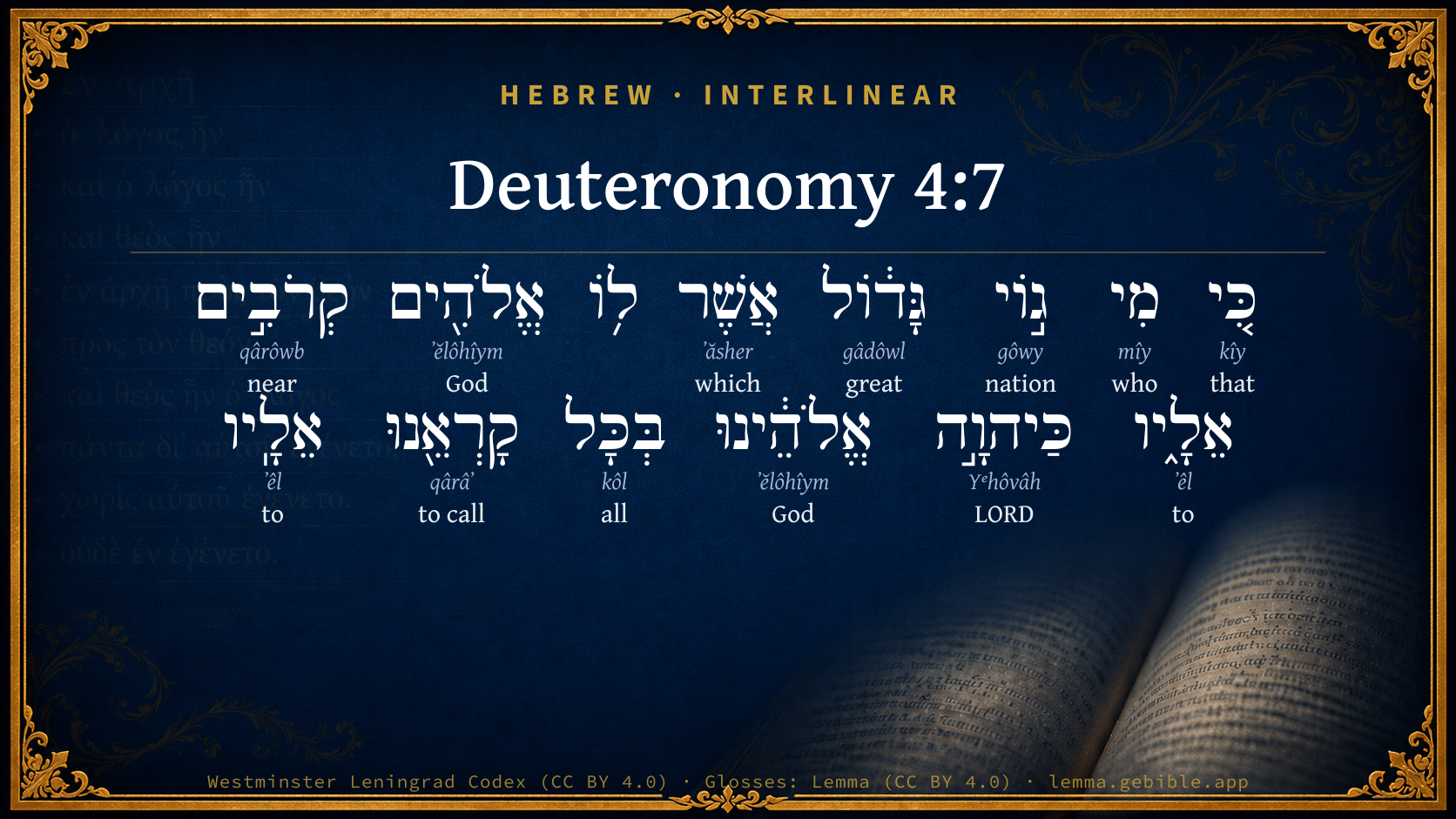
קְרֹבִ֣ים
qârôwb
H7138
“near”
Adjective, Adjective, Masculine, Plural, Absolute
Part of Speech
Adjective
Type
Adjective
Gender
Masculine
Number
Plural
State
Absolute
Full BDB Definition

Origin: from H7126

TWOT: 2065d

near - of place - of time - of personal relationship - kinship
  1. כִּ֚י kîy H3588 “that” Conjunction
  2. מִי mîy H4310 “who” Particle, Interrogative
  3. ג֣וֹי gôwy H1471 “nation” Noun, Common, Masculine, Singular, Absolute
  4. גָּד֔וֹל gâdôwl H1419 “great” Adjective, Adjective, Masculine, Singular, Absolute
  5. אֲשֶׁר ʼăsher H834 “which” Particle, Relative
  6. אֱלֹהִ֖ים ʼĕlôhîym H430 “God(s)” Noun, Common, Masculine, Plural, Absolute
  7. אֵלָ֑יו ʼêl H413 “to · him” Preposition + Suffix, Personal, 3rd Person, Masculine, Singular
  8. כַּיהוָ֣ה Yᵉhôvâh H3068 “like/as · LORD” Preposition + Noun, Proper
  9. אֱלֹהֵ֔ינוּ ʼĕlôhîym H430 “God(s) · our” Noun, Common, Masculine, Plural, Construct + Suffix, Personal, 1st Person, Common, Plural
  10. בְּכָּל kôl H3605 “in/at · all of” Preposition + Noun, Common, Masculine, Singular, Construct
  11. קָרְאֵ֖נוּ qârâʼ H7121 “to call · us” Verb, Qal, Infinitive Construct + Suffix, Personal, 1st Person, Common, Plural
  12. אֵלָֽיו ʼêl H413 “to · him” Preposition + Suffix, Personal, 3rd Person, Masculine, Singular

About this verse

These counts appear in no published source. They are computed here, from the morphology-tagged text and Lemma’s own curated glosses. What Lemma adds →

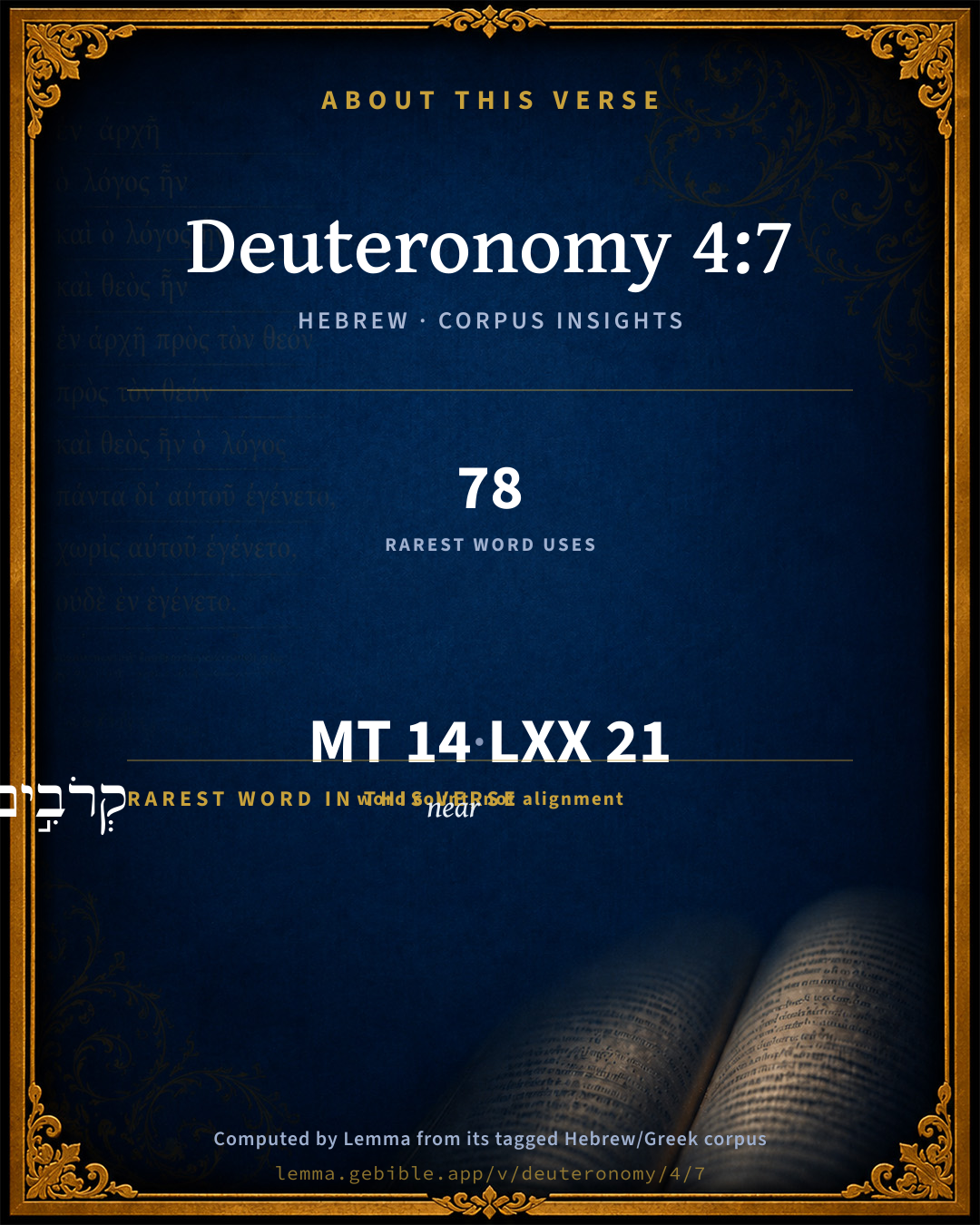
14
words
11
distinct lemmas
Pentateuch
section

Grammatical profile

  • 1 verb
  • 5 nouns
  • 2 adjectives
  • 3 prepositions
  • 1 conjunction
  • 2 particles

Verb forms

  • קָרְאֵ֖נוּ Qal · Infinitive Construct

Repetition

Words recur within this verse — often emphatic in Hebrew:

  • אֱלֹהִ֖ים God H430 ×2
  • אֵלָ֑יו to H413 ×2

Hebrew & Septuagint length

In English translation the verse runs 24 words from the Hebrew and 31 from the Septuagint (LXX English) — closely comparable.

A rough comparison of the two English renderings, which tokenize alike — not a word-level alignment.

Word counts can differ between the Hebrew and the Greek without any difference in meaning — e.g. the Hebrew direct-object marker אֵת has no separate Greek word, and Greek often adds the article ὁ.

In the original languages it is 14 Hebrew tokens and 21 Greek tokens — but the two are counted differently (Hebrew bundles its prefixes and suffixes into one token; the Greek is in lemma form), so that isn’t a like-for-like length.

Cross-references

13

Topical passages linked to Deuteronomy 4:7 in the Treasury of Scripture Knowledge — connected by theme and wording, ordered by reader-vote popularity; previews shown in the World English Bible.

  • Psalms 145:18 Yahweh is near to all those who call on him, To all who call on him in truth.
  • 2 Samuel 7:23 What one nation in the earth is like your people, even like Israel, whom God went to redeem to himself for a people, and to make him a name, and to do great things for you, and awesome things for your land, before your people, whom you redeem to you out of Egypt, [from] the nations and their gods?
  • Psalms 34:18 Yahweh is near to those who have a broken heart, And saves those who have a crushed spirit.
  • Psalms 73:28 But it is good for me to come close to God. I have made the Lord Yahweh my refuge, That I may tell of all your works.
  • James 4:8 Draw near to God, and he will draw near to you. Cleanse your hands, you sinners; and purify your hearts, you double-minded.
  • Isaiah 55:6 Seek you Yahweh while he may be found; call you on him while he is near:
  • Psalms 46:1 God is our refuge and strength, A very present help in trouble.
  • Psalms 148:14 He has lifted up the horn of his people, The praise of all his saints; Even of the children of Israel, a people near to him. Praise Yah!
  • Isaiah 43:4 Since you have been precious in my sight, [and] honorable, and I have loved you; therefore will I give men in your place, and peoples instead of your life.
  • Deuteronomy 5:26 For who is there of all flesh, that has heard the voice of the living God speaking out of the midst of the fire, as we have, and lived?
  • Ephesians 2:12–22 that you were at that time separate from Christ, alienated from the commonwealth of Israel, and strangers from the covenants of the promise, having no hope and without God in the world.
  • Numbers 23:9 For from the top of the rocks I see him, From the hills I see him: behold, it is a people that dwells alone, And shall not be reckoned among the nations.
  • Numbers 23:21 He has not saw iniquity in Jacob; Neither has he seen perverseness in Israel: Yahweh his God is with him, The shout of a king is among them.

Cross-references courtesy of OpenBible.info (CC BY 4.0).

Hebrew and Greek witnesses Masoretic Hebrew ↔ Greek Septuagint

The same verse in the two great witnesses to the Old Testament, shown verse-for-verse.

These are two independent witnesses, not word-aligned to each other, and the Septuagint is shown in lemma (dictionary) form.

Hebrew Deuteronomy 4:7 Masoretic · Westminster Leningrad Codex

כִּ֚י מִי ג֣וֹי גָּד֔וֹל אֲשֶׁר ל֥וֹ אֱלֹהִ֖ים קְרֹבִ֣ים אֵלָ֑יו כַּיהוָ֣ה אֱלֹהֵ֔ינוּ בְּכָּל קָרְאֵ֖נוּ אֵלָֽיו

For what great nation is there, that has a god so near to them, as Yahweh our God is whenever we call on him?

World English Bible · Public Domain

Greek LXX Deuteronomy 4:7 Septuagint · lemma form

ὅτι ποῖος ἔθνος μέγας ὅς εἰμί αὐτός θεός ἐγγίζω αὐτός ὡς κύριος ὁ θεός ἐγώ ἐν πᾶς ὅς ἐάν αὐτός ἐπικαλέω

For what manner of nation is so great, which has God so near to them as the Lord our God is in all things in whatever we may call upon him?

LXX2012 (modern English Septuagint) · Public Domain

Hebrew: Westminster Leningrad Codex (CC BY 4.0). Greek: Septuagint (public domain); English from LXX2012 (modern English Septuagint) (Public Domain). How the Septuagint differs from the Hebrew →

Targum (Aramaic paraphrase)

2

The Targum is the ancient Jewish Aramaic paraphrase of the Hebrew Scriptures — an interpretive translation, not the Hebrew text itself. Onkelos (literal) and Pseudo-Jonathan (expansive) render the Torah, and Jonathan the Prophets. Coverage is partial: where no permissively-licensed English translation exists for a verse, only the Aramaic is shown. This is verse-level text, not a word-by-word alignment to the Hebrew.

  1. Targum Onkelos Torah (Genesis–Deuteronomy)
    אֲרֵי מָן עַם רַב דִי לֵהּ אֱלָהָא קָרִיב לֵהּ לְקַבָּלָא צְלוֹתֵהּ בְּעִדַן עַקְתֵהּ כַּייָ אֱלָהָנָא בְּכָל עִדָן דַאֲנַחְנָא מְצַלִין קֳדָמוֹהִי

    (no public-domain English translation for this verse)

    Targum Onkelos — Aramaic: “Onkelos Genesis” (public domain); “Onkelos Exodus” (public domain); “Onkelos Leviticus” (public domain); “Onkelos Numbers” (public domain); “Onkelos Deuteronomy” (public domain). English: “Sefaria Community Translation” (CC0 1.0 (public-domain dedication)); “J.W. Etheridge. The Targums of Onkelos and Jonathan Ben Uzziel on the Pentateuch. London: Longmans, Green, 1862” (public domain). Text via Sefaria.

  2. Targum Pseudo-Jonathan Torah (Genesis–Deuteronomy)
    אֲרוּם הֵידָא אוּמָא רַבָּא דְּאִית לֵיהּ אֱלָהָא קָרִיב לְוָתֵיהּ בְּשׁוּם מֵימְרָא דַיְיָ אֱלָהֵן אוֹרְחֵיהוֹן דְּעַמְמַיָא נַטְלִין דְחַלְתְּהוֹן עַל כַּתְפֵיהוֹן וְדַמְיַין קְרִיבִין לְהוֹן וְהִינוּן רְחִיקִין מְטוֹל דְּלָא שְׁמָעִין בְּאוּדְנֵיהוֹן בְּרַם מֵימְרָא דַיְיָ יָתִיב עַל כּוּרְסֵיהּ רָם וּמְנַטֵּל וְשָׁמַע צְלוֹתָנָא בְּכָל עִידַן דַּאֲנַן מְצַלְיַין קַמֵיהּ וְעָבִיד בָּעוּתָן

    For what people so great, to whom the Lord is so nigh in the Name of the Word of the Lord? But the custom of (other) nations is to carry their gods upon their shoulders, that they may seem to be nigh them; but they cannot hear with their ears, (be they nigh or) be they afar off; but the Word of the Lord sitteth upon His throne high and lifted up, and heareth our prayer what time we pray before Him and make our petitions.

    Targum Pseudo-Jonathan — Aramaic: “Targum Jonathan on Genesis” (public domain); “Targum Jonathan on Exodus” (public domain); “Targum Jonathan on Leviticus” (public domain); “Targum Jonathan on Numbers” (public domain); “Targum Jonathan on Deuteronomy” (public domain). English: “The Targum of Jonathan ben Uzziel, trans. J. W. Etheridge, London, 1862” (public domain). Text via Sefaria.

Commentary

Notes on Deuteronomy 4:7 from classic Christian and Jewish commentators (each source and its license shown beneath its notes). The classic Christian expositions comment on the surrounding passage and are grouped to its opening verse, so a note may address several verses; the Jewish commentaries on the Tanakh (Rashi and others) are per-verse, so they appear only where the commentator wrote on this verse.

Lemma curates 59 commentaries, every one of them public domain or Creative Commons licensed, each selected and text-cleaned for this edition rather than reprinted as found. About our sources →

Jamieson, Fausset & Brown

Robert Jamieson, A. R. Fausset & David Brown

what nation is there so great--Here he represents their privileges and their duty in such significant and comprehensive terms, as were peculiarly calculated to arrest their attention and engage their interest. The former, their national advantages, are described (Deu 4:7-8), and they were twofold: 1. God's readiness to hear and aid them at all times; and 2. the excellence of that religion in which they were instructed, set forth in the "statutes and judgments so righteous" which the law of Moses contained. Their duty corresponding to these pre-eminent advantages as a people, was also twofold: 1. their own faithful obedience to that law; and 2. their obligation to imbue the minds of the young and rising generation with similar sentiments of reverence and respect for it.

Jamieson, Fausset & Brown — Commentary Critical and Explanatory on the Whole Bible (1871) — public domain (CC PDM 1.0). Text via the HelloAO Bible API.

Trapp's Complete Commentary

John Trapp

Deu 4:7 For what nation [is there so] great, who [hath] God [so] nigh unto them, as the LORD our God [is] in all [things that] we call upon him [for]?

Ver. 7. Who hath God so nigh unto them.] Yea, this was it that made them so great a nation, who otherwise were but methe mispar, few in number. This made Moses so passionately cry out, "Happy art thou, O Israel! who is like unto thee, O people, saved by the Lord!" {Deu 33:29}

John Trapp, A Commentary or Exposition upon All the Books of the Old and New Testament (1647–1656) — public domain. Text from a community e-Sword module.

The Biblical Illustrator

Joseph S. Exell

Deu_4:7-8

And what nation is there so great, that hath statutes and Judgments so righteous?

A righteous Bible

The appeal of Moses is the eternal appeal of the Bible. That is the appeal to common sense and to common honesty. The commandments are not described as eloquent, marvellous intellectual conceptions, great advances in ethical thinking. Moses asks, What other nation can produce a Bible so righteous! Any Bible must go down that is not righteous above all other things, how high soever the varied attributes by which any book may be characterised. What is the moral tone of the Bible? Pure, righteous, true, holy. What are the great commandments of the Book? Love, love,--twice love. The first object?--God; the second?--thy neighbour. This is the strength of the Bible; and we can all begin at this point to inquire into the remainder of the Book. Men may ask bewildering questions about the archaeology and the so called science of the Bible, and may even puzzle the uncultured reader with many a question relating to spiritual mysteries; but taken from end to end, the Bible is charged with righteousness: it will have the neighbour loved as the man himself; it will have the harvest like the seed time; it will insist upon right balances and full weights; it will have no concealed iniquities; it carries its candle of flame with fire never kindled upon earth into the secrets of the mind and the chambers of the soul and the hidden places of motive and purpose and ultimate, but unexpressed, intent. The Word of God is sharp, sharper than any two-edged sword, piercing to the dividing asunder of the joints and marrow. It is a righteous Word. The Bible has a thousand weapons in its armoury: not the lightest, not the weakest is its magnificent morality, its heavenly righteousness, its incorruptible integrity. It shakes off the wicked man; it will have no communion with darkness; it strikes the liar on the mouth; it avoids the unholy follower. This is--let us repeat--the argument of Moses, and it is the eternal argument of Christianity. (J. Parker, D. D.)

The Bible and civilisation

Wendell Phillips once said: The answer to the Shaster is India; the answer to Confucianism is China; the answer to the Koran is Turkey; the answer to the Bible is the Christian civilisation of Protestant Europe and America. (J. S. Gilbert, M. A.)

The national utility of the Bible

It is impossible to estimate the amount of evil which mankind would experience in their civil capacity were the Scriptures no longer considered of Divine origin, nor constituted the ultimate standard of all moral and political obligation. All reverence for the laws would cease, for the lawgiver would have only his own authority, or the mere glimmerings of the law of nature, to enforce his commands; while those who had to obey the laws would soon have every just and equitable principle banished from their minds, and every sacred feeling obliterated from their bosoms. The whole fabric of society would soon go to pieces if men were removed beyond the sphere of the public and private sanctions of scriptural morality. (J. Blakey.)

The glory of Israel

Moses reminds the people that God has chosen them as His special possession, and that this had been shown during forty years, and that if they would remain a people forever blessed it must be under the protection and blessing of God. They were highly favoured above all other peoples--for Jehovah the true God was theirs, and would be known among His people by this gracious name. And all the peoples around saw how great things God had done for Israel--how gloriously and graciously He had led His people. This was one reason why Israel should cleave to the Lord, who would plainly thus reveal Himself as the true God, the Holy One of Israel. From all this Israel should have learned--

I. To prize highly their relation to God.

1. They should have learned to realise what it was to be under the peculiar care of God, and how great and glorious was their fellowship with Him. Theirs was not merely to be a great and glorious history in the past. God was not merely to be the God who had mightily manifested Himself to their fathers, and then withheld His presence. Rather there was the promise that if they continued to call upon Him wonderful manifestations of grace and help would be given.

2. How blessed Israel was so long as they continued to call on God, prayed for His protection in faith, and kept in the way of His commandments! It was no hard thing to draw near to God. Priest and prophet were given to prepare the way, and each Israelite might experience the truth of the text for himself. But it was otherwise with Israel. In them we see--

II. The danger of neglecting to call upon God.

1. Israel went on their own way, according to their own will; and in order that they might not be stopped by listening to the voice of reason they no longer called upon God; they no longer sought His near presence.

2. Therefore, however He would have been pleased to draw near to them, He could do so no more, because they desired it not. Thus did Israel, and even when they inquired of His way they did not follow it.

3. How speedily, therefore, were they brought low; for all depended on their calling on God, and Him alone.

III. The spiritual Israel must call on God.

1. Even among the early believers to whom with visible manifestation the Holy Ghost came, whose voice and counsel they might ever hear, there was the temptation to walk more according to the flesh than according to the Spirit. Some neglected to hear His voice, and gave themselves up to the lusts of the flesh.

2. Then true believing calling on God ceased, the Lord came no more nigh to them, and the Holy Ghost was grieved.

3. Let us learn in simple faith to pray to and call upon Him. Then should we hope that all things would again become new in us, would be otherwise with us; and how glorious could our lives become! (J. C. Blumhardt.)

The Biblical Illustrator, edited by Joseph S. Exell (c. 1880s–1900s) — public domain. Text from a community e-Sword module.

Joseph Benson's Commentary

Deu 4:7-8. So nigh — By glorious miracles, by the pledges of his special presence, by the operations of his grace, and particularly by his readiness to hear our prayers, and to give us those succours which we call upon him for. So righteous — Whereby he implies that the true greatness of a nation doth not consist in pomp and power, or largeness of empire, as commonly men think, but in the righteousness of its laws.

Joseph Benson's Commentary on the Old and New Testaments (1811–1818) — public domain. Text from a community e-Sword module.

Geneva Bible (1599)

Geneva Bible translators

Helping us, and delivering us out of all dangers, as 2 Sam. 7:23.

Geneva Bible (1599) marginal notes — public domain. Text via Bolls.life.

The Cambridge Bible for Schools and Colleges

gen. ed. J. J. S. Perowne

7. For what great nation … hath a god so nigh] Both noun, élohím, and adj., ḳerobim, are plural. Elohîm may signify a god, or gods, as Deu_6:14 and elsewhere; or the general idea of Deity, this chiefly but not always in the mouth of, or addressed to, the heathen, e.g. Deu_5:24, Gen_20:13, Exo_31:18; or may stand for the God of Israel (cp. the deuteronomic 2Sa_7:23). Here it is either of the first three—a god, gods or God (R.V. marg.). The rest of the verse explains what is meant by nigh: He hears prayer and answers it by actual deeds. The prophets’ contrast of Israel’s experience of God with that of other nations is constant and remarkable—a proof of the experimental, practical quality of their religion. Jeremiah insists that the gods of the heathen are vanities and do not profit them (Deu_2:8; Deu_2:11; Deu_2:13 : broken cisterns, 28, Deu_16:19 f. etc.); cp. the Prophet of the Exile (Isa_44:9 f., Isa_47:12, Isa_48:17) and his argument that Jehovah alone promises and fulfils (Isa_41:21 ff.). To all the prophets, but especially to Isaiah, God; is not only the infinitely sublime, but the infinitely near, hearing prayer, ready to help, interested, vigilant and active in all the details of their everyday life. Legal Judaism lost this sense of the constant nearness of God, and did not compensate for the loss by its apocalypses.

The Cambridge Bible for Schools and Colleges (gen. ed. J. J. S. Perowne; Cambridge University Press, 1878–1918) — public domain. Text from a community e-Sword module.

John Gill's Exposition

Not so much for their number, for they were the fewest of all people; nor for the largeness of their territories, for the land they were going to possess was but a small country; nor for their wealth and riches, and warlike exploits, though they were not contemptible in either; but for their happy constitution in church and state, being directed and governed in both by laws which came immediately from God himself; for their knowledge of divine things, and for spiritual blessings and privileges they were favoured with, of which a special instance is given:

who hath God so nigh unto them as the Lord our God is, in all things that we call upon him for? God was nigh unto them in respect of relation, being their covenant God and Father, and they his sons and daughters, to whom the adoption belonged; and with respect to place and presence, his tabernacle being in the midst of them, the seat of his Shechinah, or divine Majesty, being in the most holy place, between the cherubim over the mercy seat; and he going before them in the pillar of cloud by day, and in the pillar of fire by night, and who might be applied unto at all times for whatsoever they stood in need of; and who was always near unto them, to give them advice and counsel, help and assistance; to hear their prayers, and communicate unto them things temporal and spiritual they stood in need of: and so the Lord is nigh to all that call upon him in faith, with fervency, and in sincerity and truth; and herein the glory and greatness of a people, as of Israel, lies, in being nearly related to God, a people near unto him, both as to union and communion; and in having a communication of good things from him. God is both a God at hand and afar off, Jer 23:23.

John Gill's Exposition of the Whole Bible (1746–1763) — public domain (CC PDM 1.0). Text via the HelloAO Bible API.

Haydock's Catholic Bible Commentary

Gods. Supposing they deserved that title, which of them has the power to shew their votaries such favours as the true God hath shewn to us? The idols are nothing but devils, which seek to destroy. (Calmet) --- But God had manifested his power and love to the Hebrews in the most astonishing manner. He seemed to choose his residence among them, in the tabernacle. (Haydock) --- This Jesus does in a still more wonderful manner, with respect to Christians, remaining with them in the sacrament of love. The other sacraments which he has instituted are more noble and efficacious than those of the old law. He was pleased to take our nature, (Calmet) and to dwell among us, John i. The providence of God pervades all things; and, though all live in Him, (Acts xvii. 28,) yet he shews the marks of the most paternal tenderness to his elect. (Haydock)

George Leo Haydock (1774–1849), Haydock's Catholic Family Bible and Commentary, 1859 edition — public domain. Excludes Psalms (Douay-Rheims chapter numbering differs from Protestant) and Deuterocanonical books (Catholic canon only).

Matthew Poole's English Annotations

God nigh unto them, by glorious miracles, by the pledges of his special presence, by the operations of his grace, and particularly, as it here follows, by his readiness to hear our prayers, and to give us those succours which we call upon him for.

Matthew Poole's English Annotations on the Holy Bible (1683–1685) — public domain. Text from a community e-Sword/MySword module.

The Pulpit Commentary

Vers. 7, 8. Translate, For what great nation is there that hath gods that draft near to it, as Jehovah our God whenever we call upon him? And what great nation is there that hath righteous statutes and ordinances like this whole Law which I am giving before you this day? (comp. Deu_33:29; Psa_34:17-20 Psa_145:18; 1Sa_14:36 1Ki_18:26-29, 1Ki_18:37; Jam_4:8) "True right has its roots in God; and with the obscuration of the knowledge of God, law and right, with their divinely established foundations, are also shaken and obscured" (cf. Rom_1:26-32) (Keil).

The Pulpit Commentary (1880–1919), ed. H.D.M. Spence-Jones & Joseph S. Exell — public domain. Text from a community e-Sword module.

John Wesley's Explanatory Notes

So nigh - By glorious miracles, by the pledges of his special presence, by the operations of his grace, and particularly by his readiness to hear our prayers, and to give us those succors which we call upon him for.

John Wesley, Explanatory Notes Upon the Whole Bible (1754–1765) — public domain. Text via the GEBible commentary corpus.

unfoldingWord translationNotes

Door43 World Missions Community

General Information:

Moses continues to speak to the people of Israel.

For what other great nation is there ... him? What other great nation is there ... today?

These rhetorical questions can be translated as statements. AT: "For there is no other great nation ... him. There is no other great nation ... today." (See: Rhetorical Question)

translationWords

nation

false god

Yahweh

God

call

decree

righteous

unfoldingWord translationNotes — © Distant Shores Media and the Door43 World Missions Community, licensed CC BY-SA 4.0. Source: git.door43.org/Door43/en_tn.

Sforno

Rabbi Ovadia Sforno

That has Hashem close to it. The reason that it is important to be particular that they should be considered clever and wise in the eyes of the nations is because Hashem is close to us in everything that we do. This will show that He chose us from all the nations. However if the nations consider you to be foolish it will profane Hashem’s name, when they say, “Are these Hashem’s people?”

Sforno on the Tanakh — English translation: “Yalkut, Sifsei Chachomim Chumash, Metsudah Publications, 2009” (CC BY 4.0). Text via Sefaria.

Lesson kit

Teaching starters — assembled from the data on this page, not authored interpretation. Every prompt links to the verse data it draws on. Edit before teaching.

Deuteronomy, in the Pentateuch, opens this verse with 14 words (11 distinct Hebrew lemmas). Its most distinctive word is qârôwb (“near”). A historical commentator’s framing appears above. Read the whole chapter for the surrounding context.

Discussion questions

  1. What does “near” (qârôwb) contribute to the verse as a whole?
  2. Psalms 145:18 shares this passage’s theme. How do the two illuminate each other?
  3. “God” occurs 2× in this one verse. What is the effect of the repetition?
  4. The translations on this page render this verse differently — a whole-verse word diff, not a word-by-word alignment. What might account for the different wordings?
  5. The verb «קָרְאֵ֖נוּ» is Qal Infinitive Construct. How does its form color the action?
  6. Reading how Jamieson, Fausset & Brown and Trapp's Complete Commentary read this verse, where do the two commentators agree and where do they part?

Things to notice

Reading settings

Reading text

Shown beneath each verse's original-language words.

Old Testament
Old Testament edition

Read the OT as the Masoretic Hebrew (MT) or the Greek Septuagint (LXX).

English shown for the Greek Septuagint (in the Hebrew ↔ Greek comparison).

Comparing translations? Open the Compare panel on any verse page to stack up to four side by side.