Psalms 86:9

Hebrew (Westminster Leningrad Codex) Psalms 86:9 appears in the Hebrew Old Testament. The text above is from the Westminster Leningrad Codex. Each word links to its Strong’s number, a concise gloss, and parsing drawn from the Open Scriptures Hebrew Bible morphology. Click any word for its full Brown-Driver-Briggs (BDB) entry.
Download image
Cite this verse

Psalms 86:9 (World English Bible). Public Domain. Lemma interlinear Bible study tool, https://lemma.gebible.app/v/psalms/86/9.

Show BibTeX & RIS
BibTeX
RIS
English Translation
All nations you have made will come and worship before you, Lord. They shall glorify your name.
World English Bible · Public Domain
Download a study sheet

One document with this verse’s original text, its word-by-word gloss line, the meaning frame, cross-references with their text, attributed commentary, and full source and license credits — printable, and it pastes into notes with its structure intact.

This verse Autodidact and up

Study sheet (.html) Plain text (.txt)

A passage Seminary Student

Up to 50 verses in one chapter. A passage sheet keeps up to 6 commentary sources and 12 cross-references per verse, in the order this page ranks them, and says so on the sheet whenever that leaves anything out. Ask for a single verse and you get the Autodidact verse sheet above.

Everything on this page stays free to read, with no account — the sheet is a download of what is already on screen, not access to it.

Want to remove ads? Support Godless Engineer
Compare translations 3

The same verse in 3 English versions, stacked beneath the original-language interlinear above. Click any original word for its lexicon entry.

Each is an independent rendering of the whole verse — the interlinear is not word-aligned to these translations.

Highlighted words mark where these versions differ — a whole-verse word diff, not a word-by-word alignment.

  • World English Bible Public Domain
    All nations you have made will come and worship before you, Lord. They shall glorify your name.
  • King James Version Public Domain
    All nations whom thou hast made shall come and worship before thee, O Lord; and shall glorify thy name.
  • unfoldingWord Literal Text CC BY-SA 4.0
    All of the nations that you have made will come and bow down to your face, Lord, and they will glorify your name.

unfoldingWord Literal Text — © unfoldingWord, licensed CC BY-SA 4.0. Word-aligned USFM3 via Door43 (git.door43.org/unfoldingWord/en_ult).

Versions to compare (up to 4)

3 of 4 selected

Show all 18 translations

Every available English version of this verse, each an independent rendering of the whole verse.

  • World English Bible Public Domain
    All nations you have made will come and worship before you, Lord. They shall glorify your name.
  • Berean Standard Bible Public Domain
    All the nations You have made will come and bow before You, O Lord, and they will glorify Your name.
  • Majority Standard Bible Public Domain
    All the nations You have made will come and bow before You, O Lord, and they will glorify Your name.
  • King James Version Public Domain
    All nations whom thou hast made shall come and worship before thee, O Lord; and shall glorify thy name.
  • American Standard Version (1901) Public Domain
    All nations whom thou hast made shall come and worship before thee, O Lord; And they shall glorify thy name.
  • Revised Version (1885) Public Domain
    All nations whom thou hast made shall come and worship before thee, O Lord; and they shall glorify thy name.
  • Geneva Bible (1599) Public Domain
    All nations, whome thou hast made, shall come and worship before thee, O Lord, and shall glorifie thy Name.
  • Douay-Rheims (1899) Public Domain
    All the nations thou hast made shall come and adore before thee, O Lord: and they shall glorify thy name.
  • Young's Literal Translation Public Domain
    All nations that Thou hast made Come and bow themselves before Thee, O Lord, And give honour to Thy name.
  • Literal Standard Version CC BY-SA 4.0
    All nations that You have made || Come and bow themselves before You, O Lord, || And give honor to Your Name.
  • Unlocked Literal Bible CC BY-SA 4.0
    All the nations that you have made will come and bow before you, Lord. They will honor your name.
  • unfoldingWord Literal Text CC BY-SA 4.0
    All of the nations that you have made will come and bow down to your face, Lord, and they will glorify your name.
  • Darby Bible Public Domain
    All nations whom thou hast made shall come and worship before thee, O Lord, and shall glorify thy name.
  • World Messianic Bible Public Domain
    All nations you have made will come and worship before you, Lord. They shall glorify your name.
  • Webster's Bible Public Domain
    All nations whom thou hast made shall come and worship before thee, O Lord; and shall glorify thy name.
  • Free Bible Version CC BY-SA 4.0
    You created all the nations, and they will come and bow down before you, Lord. They will declare how wonderful you are.
  • Bible in Basic English Public Domain
    Let all the nations whom you have made come and give worship to you, O Lord, giving glory to your name.
  • JPS Tanakh (1917) Public Domain
    All nations whom Thou hast made shall come and prostrate themselves before Thee, O Lord; and they shall glorify Thy name.

Literal Standard Version (2020), Covenant Press — licensed CC BY-SA 4.0. Text via the HelloAO Bible API (eBible.org). Unlocked Literal Bible (unfoldingWord) — licensed CC BY-SA 4.0. Text via the HelloAO Bible API (eBible.org). unfoldingWord Literal Text — © unfoldingWord, licensed CC BY-SA 4.0. Word-aligned USFM3 via Door43 (git.door43.org/unfoldingWord/en_ult). Free Bible Version, Dr. Jonathan Gallagher — licensed CC BY-SA 4.0. Text via the HelloAO Bible API (eBible.org).

Word by word

More ways to search: Search by grammar → Find every occurrence → Compare this word →

Practice this passage: Drill this verse → Learn its vocabulary →

וִֽיכַבְּד֣וּ
kâbad
H3513
“and · to be heavy”
Conjunction + Verb, Piel, Imperfect, 3rd Person, Masculine, Plural
Part of Speech
Conjunction + Verb
Stem
Piel
Form
Imperfect
Person
3rd Person
Gender
Masculine
Number
Plural
Full BDB Definition

Origin: a primitive root

TWOT: 943

to be heavy, be weighty, be grievous, be hard, be rich, be honourable, be glorious, be burdensome, be honoured - (Qal) - to be heavy - to be heavy, be insensible, be dull - to be honoured - (Niphal) - to be made heavy, be honoured, enjoy honour, be made abundant - to get oneself glory or honour, gain glory - (Piel) - to make heavy, make dull, make insensible - to make honourable, honour, glorify - (Pual) to be made honourable, be honoured - (Hiphil) - to make heavy - to make heavy, make dull, make unresponsive - to cause to be honoured - (Hithpael) - to make oneself heavy, make oneself dense, make oneself numerous - to honour oneself

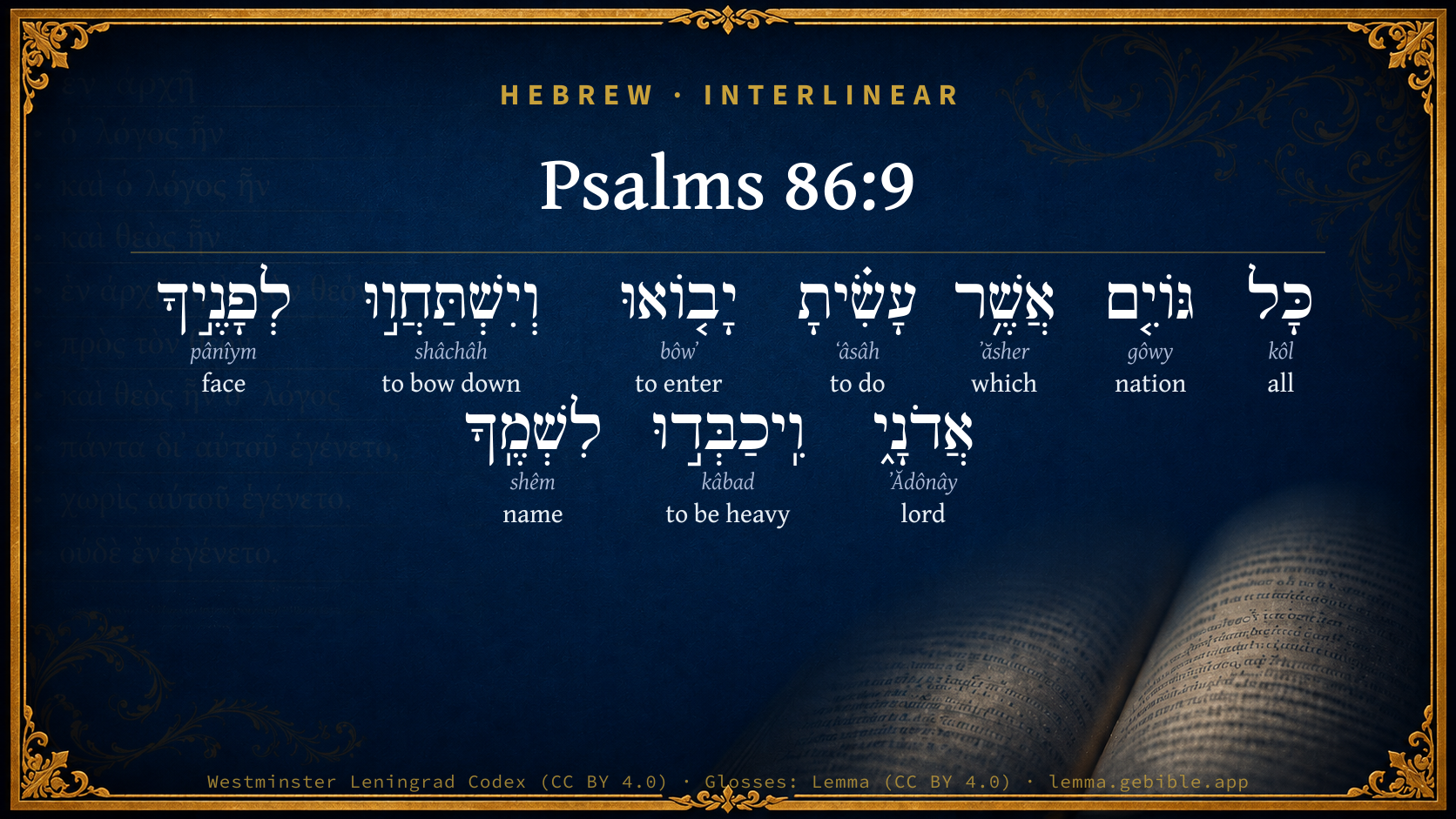
  1. כָּל kôl H3605 “all of” Noun, Common, Masculine, Singular, Construct
  2. גּוֹיִ֤ם gôwy H1471 “nations” Noun, Common, Masculine, Plural, Absolute
  3. אֲשֶׁ֥ר ʼăsher H834 “which” Particle, Relative
  4. עָשִׂ֗יתָ ʻâsâh H6213 “to do” Verb, Qal, Perfect, 2nd Person, Masculine, Singular
  5. יָב֤וֹאוּ bôwʼ H935 “to enter” Verb, Qal, Imperfect, 3rd Person, Masculine, Plural
  6. וְיִשְׁתַּחֲו֣וּ shâchâh H7812 “and · to bow down” Conjunction + Verb, Hishtaphel, Imperfect, 3rd Person, Masculine, Plural
  7. לְפָנֶ֣יךָ pânîym H6440 “to/for · face(s) · your” Preposition + Noun, Common, Both, Plural, Construct + Suffix, Personal, 2nd Person, Masculine, Singular
  8. אֲדֹנָ֑י ʼĂdônây H136 “Lord · my” Noun, Common, Masculine, Plural, Construct + Suffix, Personal, 1st Person, Common, Singular
  9. לִשְׁמֶֽךָ shêm H8034 “to/for · name · your” Preposition + Noun, Common, Masculine, Singular, Construct + Suffix, Personal, 2nd Person, Masculine, Singular

About this verse

These counts appear in no published source. They are computed here, from the morphology-tagged text and Lemma’s own curated glosses. What Lemma adds →

10
words
10
distinct lemmas
Wisdom
section

Grammatical profile

  • 4 verbs
  • 5 nouns
  • 1 particle

Verb forms

  • עָשִׂ֗יתָ Qal · Perfect
  • יָב֤וֹאוּ Qal · Imperfect
  • וְיִשְׁתַּחֲו֣וּ Hishtaphel · Imperfect
  • וִֽיכַבְּד֣וּ Piel · Imperfect

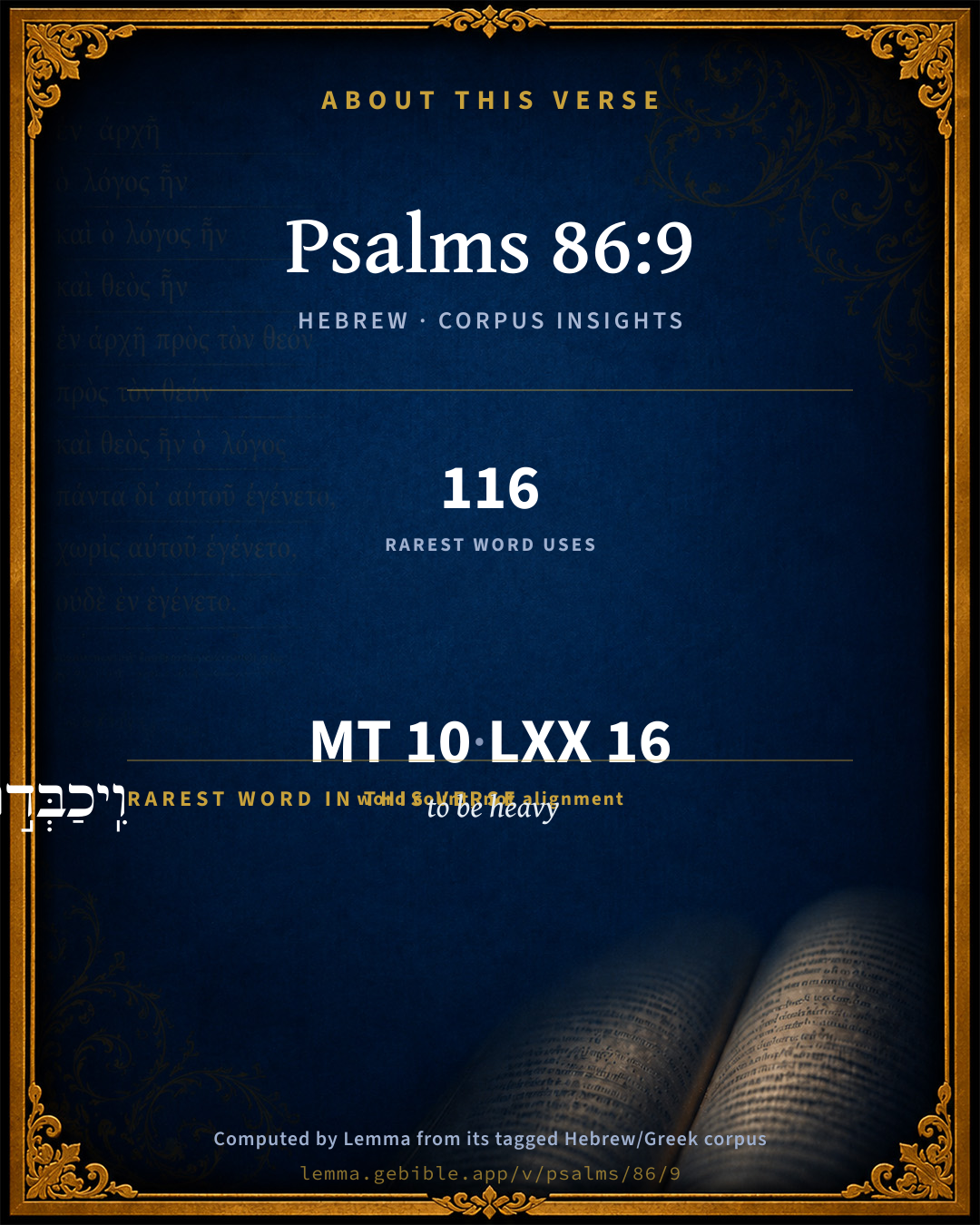
Hebrew & Septuagint length

In English translation the verse runs 17 words from the Hebrew and 20 from the Septuagint (LXX English) — closely comparable.

A rough comparison of the two English renderings, which tokenize alike — not a word-level alignment.

Word counts can differ between the Hebrew and the Greek without any difference in meaning — e.g. the Hebrew direct-object marker אֵת has no separate Greek word, and Greek often adds the article ὁ.

In the original languages it is 10 Hebrew tokens and 16 Greek tokens — but the two are counted differently (Hebrew bundles its prefixes and suffixes into one token; the Greek is in lemma form), so that isn’t a like-for-like length.

Cross-references

20

Topical passages linked to Psalms 86:9 in the Treasury of Scripture Knowledge — connected by theme and wording, ordered by reader-vote popularity; previews shown in the World English Bible.

  • Revelation 15:4 Who wouldn't fear you, Lord, And glorify your name? For you only are holy. For all the nations will come and worship before you. For your righteous acts have been revealed."
  • Isaiah 66:23 It shall happen, that from one new moon to another, and from one Sabbath to another, shall all flesh come to worship before me, says Yahweh.
  • Psalms 66:4 All the earth will worship you, And will sing to you; They will sing to your name." Selah.
  • Isaiah 2:2–4 It shall happen in the latter days, that the mountain of Yahweh's house shall be established on the top of the mountains, And shall be raised above the hills; And all nations shall flow to it.
  • Revelation 11:15 The seventh angel sounded, and great voices in heaven followed, saying, "The kingdom of the world has become the Kingdom of our Lord, and of his Christ. He will reign forever and ever!"
  • Psalms 102:15 So the nations will fear the name of Yahweh; All the kings of the earth your glory.
  • Psalms 22:27–31 All the ends of the earth shall remember and turn to Yahweh. All the relatives of the nations shall worship before you.
  • Psalms 67:7 God will bless us. All the ends of the earth shall fear him.
  • Psalms 72:19 Blessed be his glorious name forever! Let the whole earth be filled with his glory! Amen and amen.
  • Psalms 102:18 This will be written for the generation to come. A people which will be created will praise Yah.
  • Isaiah 11:9 They shall not hurt nor destroy in all my holy mountain; for the earth shall be full of the knowledge of Yahweh, as the waters cover the sea.
  • Isaiah 43:7 everyone who is called by my name, and whom I have created for my glory, whom I have formed, yes, whom I have made.
  • Isaiah 59:19 So shall they fear the name of Yahweh from the west, and his glory from the rising of the sun; for he will come as a rushing stream, which the breath of Yahweh drives.
  • Zechariah 14:9 Yahweh will be King over all the earth. In that day Yahweh will be one, and his name one.
  • Romans 11:25 For I don't desire, brothers, to have you ignorant of this mystery, so that you won't be wise in your own conceits, that a partial hardening has happened to Israel, until the fullness of the Gentiles has come in,
  • Romans 15:9 and that the Gentiles might glorify God for his mercy. As it is written, "Therefore will I give praise to you among the Gentiles, And sing to your name."
  • Psalms 72:8 He shall have dominion also from sea to sea, From the River to the ends of the earth.
  • Ephesians 1:12 to the end that we should be to the praise of his glory, we who had before hoped in Christ:
  • 1 Peter 2:9 But you are a chosen race, a royal priesthood, a holy nation, a people for God's own possession, that you may show forth the excellencies of him who called you out of darkness into his marvelous light:
  • Revelation 20:3 and cast him into the abyss, and shut it, and sealed it over him, that he should deceive the nations no more, until the thousand years were finished. After this, he must be freed for a short time.

Cross-references courtesy of OpenBible.info (CC BY 4.0).

Hebrew and Greek witnesses Masoretic Hebrew ↔ Greek Septuagint

The same verse in the two great witnesses to the Old Testament, shown verse-for-verse.

You’re reading Greek Psalm 85 (Hebrew Psalm 86). The Septuagint counts the superscription, so verse numbers can differ from the Hebrew — chapter-level alignment, not verse-by-verse. Numbering follows Rahlfs.

These are two independent witnesses, not word-aligned to each other, and the Septuagint is shown in lemma (dictionary) form.

Hebrew Psalms 86:9 Masoretic · Westminster Leningrad Codex

כָּל גּוֹיִ֤ם אֲשֶׁ֥ר עָשִׂ֗יתָ יָב֤וֹאוּ וְיִשְׁתַּחֲו֣וּ לְפָנֶ֣יךָ אֲדֹנָ֑י וִֽיכַבְּד֣וּ לִשְׁמֶֽךָ

All nations you have made will come and worship before you, Lord. They shall glorify your name.

World English Bible · Public Domain

Greek LXX Greek Psalm 85:9 Septuagint · lemma form

πᾶς ὁ ἔθνος ὅσος ποιέω ἥκω καί προςκυνέω ἐνώπιον σύ κύριος καί δοξάζω ὁ ὄνομα σύ

All nations whom you have made shall come, and shall worship before you, O Lord; and shall glorify your name.

LXX2012 (modern English Septuagint) · Public Domain

Hebrew: Westminster Leningrad Codex (CC BY 4.0). Greek: Septuagint (public domain); English from LXX2012 (modern English Septuagint) (Public Domain). How the Septuagint differs from the Hebrew →

Commentary

Notes on Psalms 86:9 from classic Christian and Jewish commentators (each source and its license shown beneath its notes). The classic Christian expositions comment on the surrounding passage and are grouped to its opening verse, so a note may address several verses; the Jewish commentaries on the Tanakh (Rashi and others) are per-verse, so they appear only where the commentator wrote on this verse.

Lemma curates 59 commentaries, every one of them public domain or Creative Commons licensed, each selected and text-cleaned for this edition rather than reprinted as found. About our sources →

Trapp's Complete Commentary

John Trapp

Psa 86:9 All nations whom thou hast made shall come and worship before thee, O Lord; and shall glorify thy name.

Ver. 9. All nations whom thou hast made shall come, &c.] It were fit they should, Rev 4:11; it is to be hoped they shall, Isa 11:10; Isa 43:9; not by change of place, but of heart, renouncing their irreligions, and yielding unto Christ the obedience of faith. Some understand this text of that general assembly at the last day.

John Trapp, A Commentary or Exposition upon All the Books of the Old and New Testament (1647–1656) — public domain. Text from a community e-Sword module.

The Biblical Illustrator

Joseph S. Exell

Psa_86:9

All nations whom Thou hast made shall come and worship before Thee, O Lord; and shall glorify Thy name.

The golden age that is coming

When all the nations fall down in practical worship before the One all-holy, all-wise, and all-strong, then the golden age will have come, the millennium of the world. Three remarks about this event.

I. To all human experience it is most unlikely. See what the nations have been through all the ages that are past, and see what they are now. How far away from, and how hostile to, the great God. Judging from our own experience it seems an impossibility.

II. To all true reason it is most proper.

1. Because all nations are His, and they are morally bound to serve Him.

2. Because all nations must worship Him if they would be virtuous and happy.

III. To all scripture it is most certain.

1. Scripture teems with Divine promises of such an event.

2. It is the nature of Divine promises that they must be fulfilled. (Homilist.)

The hope of David

I. The origin of this hope. It grows directly out of his reverence for God. He feels his God has charms that must win the hearts of men; that He has activities which lead Him to seek and to save the lost; that His Spirit is breathing everywhere upon the face of the great world; that God is not content to be without His children or to leave them in the far country, and accordingly, believing in God he believes in man; and his eye, filled with Divine light when it looks on man, catches some Divine features in man, traces a family likeness; and he speaks of man whom God has made. If you despair of the success of the Gospel in heathen lands, it is not because you know man, it is because you do not know God. If you knew Him--that His heart is as large as all His attributes, that in His vast family there is no one beneath His care, or thought, or love, that His love touches all, and His kingdom rules over all--that knowledge of God would dispel doubt and loose your neck from the bands of poorer fears: and, revering God, you would hope for man--I have not yet done with the question of the origin of the hope, because there is a little more shown us by the psalm itself. For both this reverence for God and this hope for man have again their root in the psalmists penitence; and we do not get at the bottom of the matter till we get to the broken spirit and the contrite heart; that gives him reverence for his Maker and faith in his brother man. Looking up he sees a Father, and looking round he sees the golden age coming on apace, mankind waking to truth, ready to accept it, erring only because they do not know it. He sees no gulf fixed between man and God here, and no despair necessary or inevitable. He lives in adoration and in hope.

II. The hope itself. It is a hope that there will be one universal religion; that however diverse in constitution, temperament, training, experience, sooner or later truth will dominate over all error, and grace rule all hearts, and mankind belong to Christ. It is a great hope. Even the philosopher, the historian, the man of science might rejoice in that; much more we who know the value of each individual spirit in the sight of its Maker. Let us look at it.

1. All the holiest men in all ages have cherished this hope. The devout has never been a narrow heart--never. It enlarges all thoughts when we get into the realm of communion with our God. Moses had breadth of view when he said, There shall be one law to you and to the sojourner that dwelleth with you, and taught that God was the God of the stranger. David had no narrowness. Again and again in all his psalms you see precisely the same feeling as is exhibited here. You know how Isaiah dwelt in expectation of the distant isles coming to Jehovah, the rams of Nebaioth coming up on His altar, people coming from the north and the south, and the land of Sinim pressing into the house of His glory. You know how Ezekiel had the missionary spirit in him, how he describes the river of the water of life deepening as it flowed, and carrying to every land the life of healing with which it was charged. You know how Paul argued. Through all his epistles there is but one great argument advanced, that the Gospel is to be a world-wide message, that Christ is not second Abraham, but second Adam--head of mankind, and that as death has come upon all men, so the grace of God through Jesus Christ will come upon all men unto salvation. You know Johns vision: I beheld, and lo, a great multitude out of every nation, etc.

2. This hope has been justified largely by past experience. That creed of Israel was once the creed of a single man. It lay in the heart of Abraham, who found it. Although trained as a heathen, as an idolater, as a worshipper of other gods, following the inward voice he found the great God. He gave the creed to Isaac, Isaac to Jacob, and these to a few others. In two or three centuries it had received sufficient acceptance to become the living thing about which a nation crystallizes, and which can be embodied in a marvellous law infinitely ahead of anything then existing. It finds more adherence still, better acceptance in the days of David, still more in the times of the prophets, and still larger acceptance amidst the discipline and the furnace of the Babylonish captivity, till in the time of Christ it was the creed of a great people scattered throughout the world, and leavening all nations where they were scattered. That is an instance only; from one man, this creed spread till it animated a people. And the same thing has been going on ever since. The creed of the Church of Christ--that God is love and man should be--is brief and clear. There seemed but little hope of its being accepted. All nations resisted, as you and I did when it first came to us. It was too good news to be true. The Jew despised it, the Roman tried to crush it, and the warlike tribes of the nations turned away from it as something that would enfeeble their manhood. But it passed from heart to heart, from city to city, till it became the creed of the great Roman Empire, and has gone on and on until to-day it is the creed of three hundred millions of people, and these three hundred millions the strongest part of the earths inhabitants.

3. The welfare of mankind is bound up in its realization. Raise the man and you raise his whole condition. Reform from the heart outward, and you secure an effective reform which you cannot secure if you begin at the other end. All good work is Gods work, and will win His reward. But still the great work is that which gives the man his manhood, which sets him free, which gives him an immortal hope. Give him that, and you give him thrift and self-respect, and civil liberty, and the power of mastering everything that is adverse in his condition. The welfare of mankind is bound up in this hope.

4. The realization of this great hope tarries because of our indifference. We decline to be our brothers keeper. We eat our morsel of the bread of life alone. (R. Glover.)

The Biblical Illustrator, edited by Joseph S. Exell (c. 1880s–1900s) — public domain. Text from a community e-Sword module.

Joseph Benson's Commentary

Psa 86:9-10. All nations whom thou hast made — For, as thou hast made them, thou canst easily convince and convert them to thyself; shall come and worship before thee — Shall forsake their impotent idols, and shall worship thee alone: being enlightened by thy word and Spirit to see, and induced to own, that there is none like thee. This was, in part, fulfilled in the multitude of proselytes to the Jewish religion, in the days of David and Solomon, but it was to have its full accomplishment in the days of the Messiah, when some out of every kingdom and nation should be effectually brought to praise God, Rev 7:9. It was by Christ that God made all nations, for without him was not any thing made that was made, and therefore, through Christ, and by the power of his gospel and grace, all nations shall be brought to worship before God, Isa 66:23. For thou art great — Therefore shall all nations worship before thee, because, as king of all nations, thou art great; thy sovereignty absolute and incontestable; thy majesty terrible and insupportable; thy power universal and irresistible; thy riches vast and inexhaustible; thy dominion boundless and unquestionable; and, as a proof of this, thou doest wondrous things — Which all nations admire, and from whence they may easily infer that thou art God alone, and that not only there is none like thee, but none besides thee. They shall see thy wonderful works, and hence shall be led to acknowledge both that thou art infinitely great, and that thou art the only true God. Or, this may be alleged as a reason why it was not incredible, that all nations should be converted from idolatry to the worship of the true God. As if he had said, God doth wondrous things, and he will do this among the rest: The idols he will utterly abolish, and he alone shall be exalted, as king over all the earth. In that day shall there be one Lord, and his name one.

Joseph Benson's Commentary on the Old and New Testaments (1811–1818) — public domain. Text from a community e-Sword module.

J. A. Alexander on Psalms

Joseph Addison Alexander

9. (Psa 86:9) All nations which thou hast made shall come and worship before thee, O Lord, and give honour to thy name. The common relation of Jehovah to all men as their Maker, although now denied by most nations, shall be one day universally acknowledged, not in word merely, but in act, the most expressive act of worship, involving a believing recognition of the previous display of God's perfections, in the language of the Scriptures called his name. This prospective view of the conversion of the world to the belief and service of its Maker shews how far the Old Testament writers were from a cherishing or countenancing, the contracted nationality of the later and the less enlightened Jews. See above, on Psa 22:27-28; Psa 45:12-16; Psa 47:9, and compare Jer 16:19, Zep 2:11, Zec 14:9; Zec 14:16.

Joseph Addison Alexander, The Psalms Translated and Explained (1850) — public domain. Text from a community e-Sword module.

Geneva Bible (1599)

Geneva Bible translators

This proveth that David prayed in the Name of Christ the Messiah, of whose kingdom he doth here prophesy.

Geneva Bible (1599) marginal notes — public domain. Text via Bolls.life.

Adam Clarke's Commentary

Verse 9. All nations] Thy word shall be proclaimed among all the Gentiles: they shall receive thy testimony, and worship thee as the only true and living God.

Adam Clarke's Commentary on the Bible (1810–1826) — public domain. Text from a community e-Sword/MySword module.

John Calvin's Commentaries

9 All nations which thou hast made shall come. If any would rather limit what is here stated to David’s present case, this view does not seem liable to any material objection. He, in fact, often enhances the Divine goodness of which he himself had experience by the like magnificent strain. It may, however, be fitly extended to the universal power of God; but whether he speaks of the grace that was bestowed upon himself alone, or treats, in general, of the works of God, we must bear in mind what has been observed in another place, that whenever he celebrates the prevalence of true godliness among the heathen, he has an eye to the kingdom of Christ, prior to whose coming God gave only the initial or dawning manifestation of his glory, which at length was diffused through the whole world by the preaching of the Gospel. David was not ignorant of the future calling of the Gentiles; but this being a doctrine with which Jewish ears were not familiar, that people would have felt it a disagreeable announcement, to have been told that the Gentiles should come to worship God indiscriminately with the children of Abraham, and, all distinction being removed, become partakers with them of heavenly truth. To soften the announcement, he asserts that the Gentiles also were created by God, so that it ought not to be accounted strange if they, being enlightened also, should at length acknowledge Him who had created and fashioned them.

John Calvin's Commentaries (1540-1563) — public domain. Text from the Calvin Translation Society English edition (1840s-50s) via the Christian Classics Ethereal Library (ccel.org). Calvin's coverage is partial (roughly two-thirds of the Bible); uncommented books and verses are honest gaps, never fabricated. The 19th-century editor's footnotes and remarks are omitted so the notes are faithfully Calvin's own voice.

Ellicott's Commentary for English Readers

(9) For this wide prospect of Divine dominion see Psa_22:31; Isa_43:7.

A Bible Commentary for English Readers, edited by Charles John Ellicott (1878–1897) — public domain. Text from a community e-Sword module.

The Cambridge Bible for Schools and Colleges

gen. ed. J. J. S. Perowne

9. Apparently a reminiscence of Psa_22:27, combined possibly with Isa_24:15 (‘glorify ye … the name of Jehovah’) and other passages. But the verse is remarkable for the distinctness and fulness of its Messianic hope, and for the thought implied in the words whom thou hast made, that the nations cannot fail ultimately to fulfil the will of their Creator (Rev_4:11). It is taken up and expanded in Rev_15:3-4.

The Cambridge Bible for Schools and Colleges (gen. ed. J. J. S. Perowne; Cambridge University Press, 1878–1918) — public domain. Text from a community e-Sword module.

John Gill's Exposition

All nations whom thou hast made,.... All nations, or the inhabitants of all nations, are made by the Lord, and of the blood of one man, Act 17:26, and which as it shows the obligation of all men to come and worship, as is said should be; so likewise that the Lord, who has made them, is able to make them come to do homage to him, as follows:

shall come and worship before thee, O Lord; "come", spiritually, by faith and repentance, to the Lord himself, being drawn by the power of his efficacious grace through the ministry of the word; and, locally, to the house and ordinances of God, to attend upon them, and wait on him in them; and "worship" both externally, according to his revealed will; and internally in the exercise of grace, in spirit and in truth: this is prophetically said of the conversion of the Gentiles in Gospel times, especially in the latter day; see Rev 15:4. Kimchi and Arama say this will be in the time of the Messiah:

and shall glorify thy name; the Lord himself, with their bodies and spirits, which are his; and ascribe the glory of their salvation to him, and glorify him for his mercy towards them in their redemption and conversion; glorify that and every perfection of his, displayed in their salvation; and also his Gospel, which brings them the news of it; see Rom 15:9.

John Gill's Exposition of the Whole Bible (1746–1763) — public domain (CC PDM 1.0). Text via the HelloAO Bible API.

Albert Barnes' Notes on the Bible

All nations whom thou hast made shall come ... - In this verse the psalmist expresses his belief that the conviction which he entertained about the ability of God to save - about his being the only true God - would yet pervade all the nations of the earth; that they all would yet be convinced that he was the true God, and would come and worship him alone. So clear to him seemed to be the evidence of the existence and perfections of God that he did not doubt that all people would come yet to see it also, and to acknowledge him. Compare Isa 2:2-3; Isa 60:3-14; Psa 2:8; Psa 72:17.

And shall glorify thy name - Shall honor thee as the true God. They will renounce their idols; they will come and worship thee. This belief - this hope - is held out through the entire volume of revealed truth. It cheered and encouraged the hearts of the saints of the Old Testament and the New; and it may and should cheer and encourage our hearts. It is not less certain because it seems to be long delayed. To the view of man this is all that is certain in the future. No man can predict what will occur in regard to any of the existing political institutions on the earth - either the monarchies of the old world, or the republics of the new. No man can tell in reference to the arts; to the sciences; to social life; to manners; to the cities and towns which now exist on the earth, what they will be in the far distant future. Only one thing is certain in that future - that the kingdom of God will be set up, and that the Redeemer’s throne will be established over all the earth; that the time is to come when “all nations shall come and worship before God, and shall glorify his name.”

Albert Barnes' Notes on the Bible (1834–1885) — public domain. Text from a community e-Sword/MySword module.

Matthew Poole's English Annotations

So true is that which I have now said of thee, Psa 86:8, that the time is coming when all the nations of the earth shall acknowledge it, and, forsaking their impotent idol, shall worship thee alone; which being a work of thy power and grace, clearly proves that no God is like to thee and no works like thine. And those words,

whom thou hast made, are added to prevent or remove objections concerning the insuperable difficulty and incredibility of this work. The God, saith he, that made them can easily convince and convert them to himself.

Matthew Poole's English Annotations on the Holy Bible (1683–1685) — public domain. Text from a community e-Sword/MySword module.

The Treasury of David

Charles H. Spurgeon

Ver. 9. All nations whom thou hast made, and these include all mankind, since they all come of the first Adamthy creature, and their lives are all distinct creations of thine omnipotence. All these shall come with penitent hearts, in thine own way, to thine own self, and worship before thee, O Lord. Because thou art thus above all gods, the people who have been so long deceived shall at last discover thy greatness, and shall render thee the worship which is thy due: thou hast created them all, and unto thee shall they all yield homage. This was David's reason for resorting to the Lord in trouble, for he felt that one day all men would acknowledge the Lord to be the only God. It makes us content to be in the minority today, when we are sure that the majority will be with us tomorrow, ay, and that the truth will one day be carried unanimously and heartily. David was not a believer in the theory that the world will grow worse and worse, and that the dispensation will wind up with general darkness, and idolatry. Earth's sun is to go down amid tenfold night if some of our prophetic brethren are to be believed. Not so do we expect, but we look for day when the dwellers in all lands shall learn righteousness, shall trust in the Saviour, shall worship thee alone, O God, and shall glorify thy name. The modern notion has greatly damped the zeal of the church for missions, and the sooner it is shown to be unscriptural the better for the cause of God. It neither consorts with prophecy, honours God, nor inspires the church with ardour. Far hence be it driven.

Ver. 9-10. All nations shall worship before thee, because as King of Nations, thou art great, thy sovereignty absolute and incontestable, thy Majesty terrible and unsupportable, thy power universal and irresistible, thy riches vast and inexhaustible, thy dominion boundless and unquestionable; and for the proof of this, thou doest wondrous things, which all nations admire, and from whence they might easily infer that thou art God alone; not only none like thee, but none beside thee. Matthew Henry.

Ver. 9. The certain conversion of the world as opposed to modern theories.

Psalms 86:10*

Charles H. Spurgeon's The Treasury of David (1869–1885) — public domain. Psalms only. Text from a community e-Sword/MySword module.

Whedon's Commentary on the Bible

Daniel D. Whedon

9. All nations… shall come and worship, etc.—They shall, whether from constraint or choice, bow before Jehovah and confess him the only true and living God. So Psa_86:10.

Whom thou hast made—Thou hast made them, though they are now ignorant of thee, (compare Joh_1:10;) but they shall glorify thy name, by confessing thee to be the Creator of all—a clear prediction of Rev_15:4

Daniel D. Whedon (gen. ed.), Commentary on the Old and New Testaments (1874–1909) — public domain. Text from a community e-Sword module.

The Pulpit Commentary

All nations whom thou hast made shall come and worship before thee, O Lord. (comp. Psa_72:11, 17 82:8, etc.) Since God had made all nations, (Act_17:26) it was safe to conclude that they would all one day worship him. The prophecy, however, still remains unfulfilled. And shall glorify thy Name. Either with their lips, or in their lives, or in both ways. Compare the anticipations of Isaiah, (Isa_66:23) Zephaniah, (Zep_2:10) and Zechariah. (Zec_14:9, Zec_14:16)

Grace triumphant.

The declaration of God"s ultimate possession of all hearts, which is involved in this verse, is found not here alone; (cf. Psa_22:27 Psa_66:4 Isa_66:18, 23Jo 12:32 Php_2:10, 11, etc.) and, assuredly, it is the spirit of the whole Scripture. And such considerations as the following sustain such blessed belief.

I THAT IT IS A FAITH WHICH SO COMMENDS ITSELF TO THE CONSCIENCE OF MEN. It is what ought to be, what we cannot help hoping may be, that God"s will may be done everywhere and by all.

II THE OPPOSITE BELIEF IS PRACTICALLY ATHEISTICAL. For it necessitates that we believe

(1) that either God would save all men, but could not in which case he would not be God, because some other had evidently greater power than he; or

(2) that God could save, but would not, which is plainly contradictory of the whole Scripture, and, were it true, God would be no longer God. Either theory leads direct to atheism.

III IT IS INCREDIBLE THAT GOD WOULD HAVE CONTINUED TO CREATE BEINGS WHOM HE KNEW MUST ETERNALLY SIN AND SUFFER. Creation involves redemption. Had he been unable to redeem, he would not have created.

IV CHRIST WAS MANIFESTED TO DESTROY THE WORKS OF THE DEVIL. But if any are forever unsaved, then Christ has not accomplished the work he came to do, and the victory belongs not to him, but to Satan.

V THE WORTH OF CHRIST"S ATONEMENT. It is the propitiation for the sins of the whole world. But some may say, "It is of no use to any one unless he trusts it." That is so; but our contention is that the resources of God are adequate to bring men to give up their own evil will, and to cast themselves in penitence and trust on God. Has he not already brought round the most stubborn of human wills? He knows how to make the prodigal come to himself, and to say, "I will arise," etc.

VI HE HAS TAUGHT US TO PRAY, "THY WILL BE DONE ON EARTH AS," ETC. But this is what our text predicts; and he would not have bidden us pray that prayer if it was never to be fulfilled. All this is no encouragement to sin, for it teaches that God will leave no means untried, no matter how terrible they may be, and for the hardened sinner they will be terrible, to subdue to himself the perverse and unruly will of man. S.C.

God glorifying his own Name.

By letting that Name be known among the Gentiles, so that they glorify him. At last all the world shall unite in lifting up holy hands and loving hearts to God, and unite in singing, "Praise God, praise God; This conception of the universal acknowledgment of Jehovah is strange for an exclusive Jew, and is a foreshadowing of Christian ideas. We are to think of God as seeking the glorifying of his Name in this that every creature made in his image unites in the glorifying. "All nations shall come and worship." "The Gentile deities being obviously inferior to Jehovah, the psalmist foresees that one day the Creator will become known to the Gentiles, and the Church of God be extended without limit." "The pious Jews believed that God"s common relation to all would be ultimately acknowledged by all men." The name of God is usually and properly regarded as any term which gathers up and expresses the attributes and characteristics of God. Illustrate by the way in which a simple term will express a scientific theory.

I THE NAME, OR NAMES, GOD HAS GIVEN US OF HIMSELF. The earliest name men knew seems to have been El, which, in a general way, expresses the Creatorship of God. This name is common to the human race. It is found in the singular and plural forms, and in combination with some other name, as El Shaddai. Then, one race knew God in special covenant relations; and as the covenant God he is known as Jahveh, or Jehovah. As if the thing which man pledges to preserve were the truth of the self-origination, unity, and spirituality of God! Then God found a name for himself which would make constant appeal to man"s experience of his dealings, and called himself "the God of Abraham, Isaac, and Jacob." Then God found precise names for himself, suitable for individuals, or for the nation in particular circumstances. Compare the name for Abraham, "I am thy Shield;" for David, "The Lord is my Shepherd;" for the nation, "The Lord our Righteousness." Lead up to the fixing of one name for God by the Lord Jesus Christ Father." If God gives us a name for himself, he pledges himself to all that is involved in the name. In faithfulness to what it demands and involves, he will glorify it.

II THE NAME, OR NAMES, MEN HAVE GIVEN TO GOD OUT OF THEIR EXPERIENCE OF HIS WAYS. The work of a man"s life may be represented as "finding a name of his own for God." It may be the same that some one else has found, and yet be the man"s own. In faithfulness to what each man"s name for God claims, each man glorifies him. Then point out that God"s name is glorified

(1) by being duly sustained;

(2) by being efficiently responded to; and

(3) by being widely made known.

"Tell it out among the heathen that the Lord is King," and they will swell the chorus of his praise. R.T.

The Pulpit Commentary (1880–1919), ed. H.D.M. Spence-Jones & Joseph S. Exell — public domain. Text from a community e-Sword module.

Lesson kit

Teaching starters — assembled from the data on this page, not authored interpretation. Every prompt links to the verse data it draws on. Edit before teaching.

Psalms, in the Wisdom, opens this verse with 10 words (10 distinct Hebrew lemmas). Its most distinctive word is kâbad (“to be heavy”). A historical commentator’s framing appears above. Read the whole chapter for the surrounding context.

Discussion questions

  1. The word kâbad carries the sense “to be heavy.” How does it shape the verse?
  2. How does Revelation 15:4, which shares this passage’s theme, read alongside this verse?
  3. The translations on this page render this verse differently — a whole-verse word diff, not a word-by-word alignment. What might account for the different wordings?
  4. «עָשִׂ֗יתָ» is a Qal Perfect verb. How does that grammatical form shape the action described?
  5. Compare how Trapp's Complete Commentary and The Biblical Illustrator read this verse. Where do they agree or differ?

Things to notice

Reading settings

Reading text

Shown beneath each verse's original-language words.

Old Testament
Old Testament edition

Read the OT as the Masoretic Hebrew (MT) or the Greek Septuagint (LXX).

English shown for the Greek Septuagint (in the Hebrew ↔ Greek comparison).

Comparing translations? Open the Compare panel on any verse page to stack up to four side by side.