Deuteronomy 9:14

Hebrew (Westminster Leningrad Codex) Deuteronomy 9:14 appears in the Hebrew Old Testament. The text above is from the Westminster Leningrad Codex. Each word links to its Strong’s number, a concise gloss, and parsing drawn from the Open Scriptures Hebrew Bible morphology. Click any word for its full Brown-Driver-Briggs (BDB) entry.
Download image
Cite this verse

Deuteronomy 9:14 (World English Bible). Public Domain. Lemma interlinear Bible study tool, https://lemma.gebible.app/v/deuteronomy/9/14.

Show BibTeX & RIS
BibTeX
RIS
English Translation
let me alone, that I may destroy them, and blot out their name from under the sky; and I will make of you a nation mightier and greater than they.
World English Bible · Public Domain
Download a study sheet

One document with this verse’s original text, its word-by-word gloss line, the meaning frame, cross-references with their text, attributed commentary, and full source and license credits — printable, and it pastes into notes with its structure intact.

This verse Autodidact and up

Study sheet (.html) Plain text (.txt)

A passage Seminary Student

Up to 50 verses in one chapter. A passage sheet keeps up to 6 commentary sources and 12 cross-references per verse, in the order this page ranks them, and says so on the sheet whenever that leaves anything out. Ask for a single verse and you get the Autodidact verse sheet above.

Everything on this page stays free to read, with no account — the sheet is a download of what is already on screen, not access to it.

Want to remove ads? Support Godless Engineer
Compare translations 3

The same verse in 3 English versions, stacked beneath the original-language interlinear above. Click any original word for its lexicon entry.

Each is an independent rendering of the whole verse — the interlinear is not word-aligned to these translations.

Highlighted words mark where these versions differ — a whole-verse word diff, not a word-by-word alignment.

  • World English Bible Public Domain
    let me alone, that I may destroy them, and blot out their name from under the sky; and I will make of you a nation mightier and greater than they.
  • King James Version Public Domain
    Let me alone, that I may destroy them, and blot out their name from under heaven: and I will make of thee a nation mightier and greater than they.
  • unfoldingWord Literal Text CC BY-SA 4.0
    Release from me, and I will destroy them and wipe out their name from under the heavens, and I will make you a nation mightier and greater than they.’

unfoldingWord Literal Text — © unfoldingWord, licensed CC BY-SA 4.0. Word-aligned USFM3 via Door43 (git.door43.org/unfoldingWord/en_ult).

Versions to compare (up to 4)

3 of 4 selected

Show all 18 translations

Every available English version of this verse, each an independent rendering of the whole verse.

  • World English Bible Public Domain
    let me alone, that I may destroy them, and blot out their name from under the sky; and I will make of you a nation mightier and greater than they.
  • Berean Standard Bible Public Domain
    Leave Me alone, so that I may destroy them and blot out their name from under heaven. Then I will make you into a nation mightier and greater than they are.”
  • Majority Standard Bible Public Domain
    Leave Me alone, so that I may destroy them and blot out their name from under heaven. Then I will make you into a nation mightier and greater than they are.”
  • King James Version Public Domain
    Let me alone, that I may destroy them, and blot out their name from under heaven: and I will make of thee a nation mightier and greater than they.
  • American Standard Version (1901) Public Domain
    let me alone, that I may destroy them, and blot out their name from under heaven; and I will make of thee a nation mightier and greater than they.
  • Revised Version (1885) Public Domain
    let me alone, that I may destroy them, and blot out their name from under heaven: and I will make of thee a nation mightier and greater than they.
  • Geneva Bible (1599) Public Domain
    Let me alone, that I may destroy them, and put out their name from vnder heaue, and I wil make of thee a mightie nation, and greater then they be.
  • Douay-Rheims (1899) Public Domain
    Let me alone that I may destroy them, and abolish their name from under heaven, and set thee over a nation, that is greater and stronger than this.
  • Young's Literal Translation Public Domain
    desist from Me, and I destroy them, and blot out their name from under the heavens, and I make thee become a nation more mighty and numerous than it.
  • Literal Standard Version CC BY-SA 4.0
    Desist from Me, and I destroy them, and blot out their name from under the heavens, and I make you become a nation more mighty and numerous than it.
  • Unlocked Literal Bible CC BY-SA 4.0
    Let me alone, so that I may destroy them and blot out their name from under heaven, and I will make of you a nation mightier and greater than they.'
  • unfoldingWord Literal Text CC BY-SA 4.0
    Release from me, and I will destroy them and wipe out their name from under the heavens, and I will make you a nation mightier and greater than they.’
  • Darby Bible Public Domain
    Let me alone, that I may destroy them, and blot out their name from under heaven; and I will make of thee a nation mightier and greater than they.
  • World Messianic Bible Public Domain
    Leave me alone, that I may destroy them, and blot out their name from under the sky; and I will make of you a nation mightier and greater than they.”
  • Webster's Bible Public Domain
    Let me alone, that I may destroy them, and blot out their name from under heaven: and I will make of thee a nation mightier and greater than they.
  • Free Bible Version CC BY-SA 4.0
    Leave me, so that I can destroy them and wipe out their name completely. Then I will turn you into a nation even more powerful and more important than them.”
  • Bible in Basic English Public Domain
    Let me send destruction on them till their very name is cut off; and I will make of you a nation greater and stronger than they.
  • JPS Tanakh (1917) Public Domain
    let Me alone, that I may destroy them, and blot out their name from under heaven; and I will make of thee a nation mightier and greater than they.'

Literal Standard Version (2020), Covenant Press — licensed CC BY-SA 4.0. Text via the HelloAO Bible API (eBible.org). Unlocked Literal Bible (unfoldingWord) — licensed CC BY-SA 4.0. Text via the HelloAO Bible API (eBible.org). unfoldingWord Literal Text — © unfoldingWord, licensed CC BY-SA 4.0. Word-aligned USFM3 via Door43 (git.door43.org/unfoldingWord/en_ult). Free Bible Version, Dr. Jonathan Gallagher — licensed CC BY-SA 4.0. Text via the HelloAO Bible API (eBible.org).

Word by word

More ways to search: Search by grammar → Find every occurrence → Compare this word →

Practice this passage: Drill this verse → Learn its vocabulary →

עָצ֥וּם
ʻâtsûwm
H6099
“mighty”
Adjective, Adjective, Masculine, Singular, Absolute
Part of Speech
Adjective
Type
Adjective
Gender
Masculine
Number
Singular
State
Absolute
Full BDB Definition

Origin: pass. part. of H6105

TWOT: 1673d

mighty, vast, numerous - mighty, strong (in number) - numerous, countless
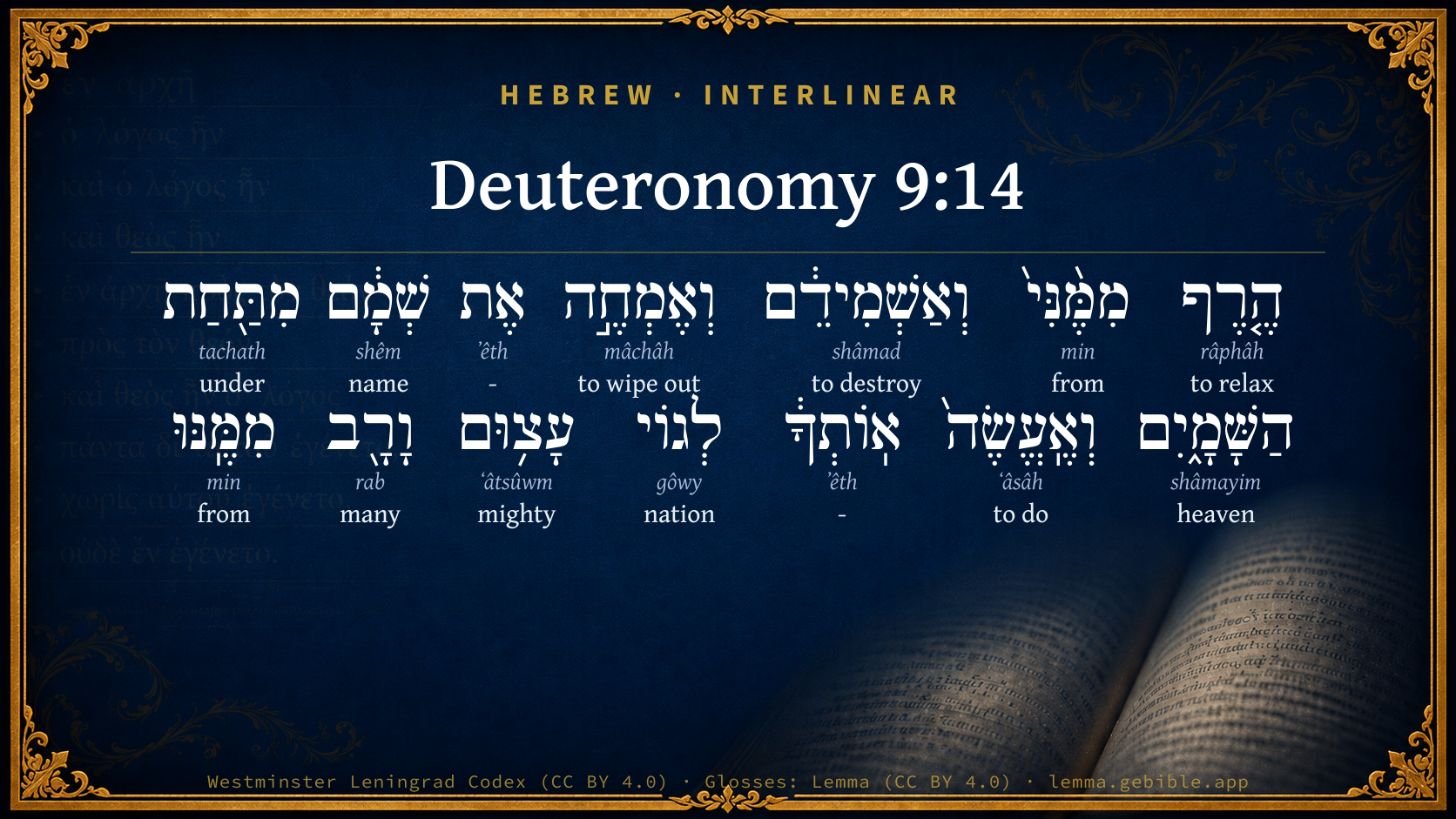
  1. הֶ֤רֶף râphâh H7503 “relax” Verb, Hiphil, Imperative, 2nd Person, Masculine, Singular
  2. מִמֶּ֨נִּי֙ min H4480 “from · me” Preposition + Suffix, Personal, 1st Person, Common, Singular
  3. וְאַשְׁמִידֵ֔ם shâmad H8045 “and · to destroy · them” Conjunction + Verb, Hiphil, Cohortative, 1st Person, Common, Singular + Suffix, Personal, 3rd Person, Masculine, Plural
  4. וְאֶמְחֶ֣ה mâchâh H4229 “and · to wipe out” Conjunction + Verb, Qal, Cohortative, 1st Person, Common, Singular
  5. אֶת ʼêth H853 “-” Particle, Direct Object
  6. שְׁמָ֔ם shêm H8034 “name · their” Noun, Common, Masculine, Singular, Construct + Suffix, Personal, 3rd Person, Masculine, Plural
  7. מִתַּ֖חַת tachath H8478 “from · under” Preposition + Preposition
  8. הַשָּׁמָ֑יִם shâmayim H8064 “the · heaven(s)” Particle, Definite Article + Noun, Common, Masculine, Plural, Absolute
  9. וְאֶֽעֱשֶׂה֙ ʻâsâh H6213 “and · to do” Conjunction + Verb, Qal, Imperfect, 1st Person, Common, Singular
  10. אֽוֹתְךָ֔ ʼêth H853 “- · you” Particle, Direct Object + Suffix, Personal, 2nd Person, Masculine, Singular
  11. לְגוֹי gôwy H1471 “to/for · nation” Preposition + Noun, Common, Masculine, Singular, Absolute
  12. וָרָ֖ב rab H7227 “and · many” Conjunction + Adjective, Adjective, Masculine, Singular, Absolute
  13. מִמֶּֽנּוּ min H4480 “from · him” Preposition + Suffix, Personal, 3rd Person, Masculine, Singular

About this verse

These counts appear in no published source. They are computed here, from the morphology-tagged text and Lemma’s own curated glosses. What Lemma adds →

14
words
12
distinct lemmas
Pentateuch
section

Shared distinctive vocabulary

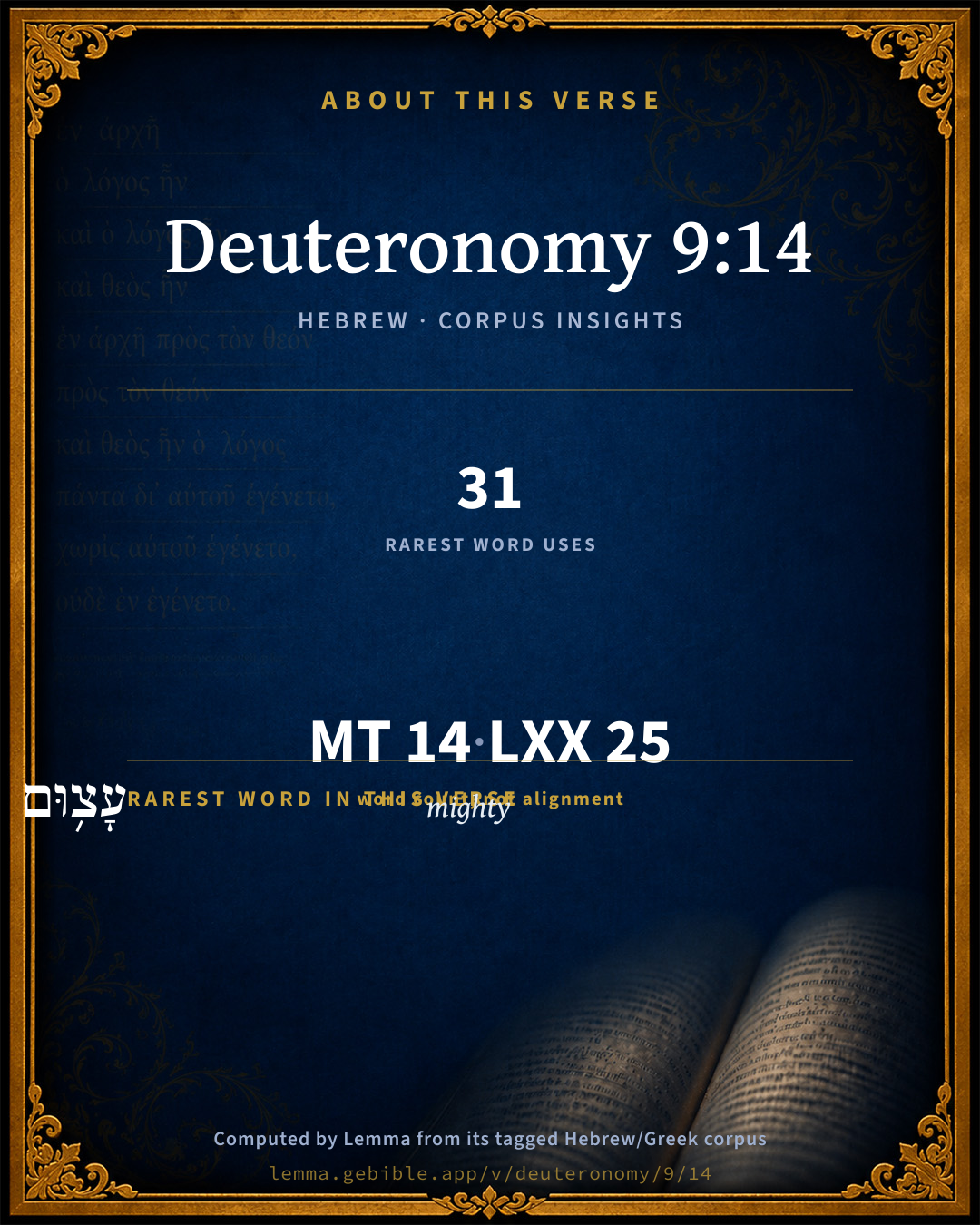
עָצ֥וּם mighty H6099 occurs in 31 verses of the Hebrew Bible. Also found in:

Grammatical profile

  • 4 verbs
  • 3 nouns
  • 2 adjectives
  • 3 prepositions
  • 2 particles

Verb forms

  • הֶ֤רֶף Hiphil · Imperative
  • וְאַשְׁמִידֵ֔ם Hiphil · Cohortative
  • וְאֶמְחֶ֣ה Qal · Cohortative
  • וְאֶֽעֱשֶׂה֙ Qal · Imperfect

Repetition

A word recurs within this verse — often emphatic in Hebrew:

  • מִמֶּ֨נִּי֙ from H4480 ×2

Hebrew & Septuagint length

In English translation the verse runs 30 words from the Hebrew and 33 from the Septuagint (LXX English) — closely comparable.

A rough comparison of the two English renderings, which tokenize alike — not a word-level alignment.

Word counts can differ between the Hebrew and the Greek without any difference in meaning — e.g. the Hebrew direct-object marker אֵת has no separate Greek word, and Greek often adds the article ὁ.

In the original languages it is 14 Hebrew tokens and 25 Greek tokens — but the two are counted differently (Hebrew bundles its prefixes and suffixes into one token; the Greek is in lemma form), so that isn’t a like-for-like length.

Cross-references

14

Topical passages linked to Deuteronomy 9:14 in the Treasury of Scripture Knowledge — connected by theme and wording, ordered by reader-vote popularity; previews shown in the World English Bible.

  • Deuteronomy 29:20 Yahweh will not pardon him, but then the anger of Yahweh and his jealousy will smoke against that man, and all the curse that is written in this book shall lie on him, and Yahweh will blot out his name from under the sky.
  • Exodus 32:10–13 Now therefore leave me alone, that my wrath may burn hot against them, and that I may consume them; and I will make of you a great nation."
  • Psalms 9:5 You have rebuked the nations. You have destroyed the wicked. You have blotted out their name forever and ever.
  • Psalms 109:13 Let his posterity be cut off. In the generation following let their name be blotted out.
  • Luke 11:7–10 and he from within will answer and say, 'Don't bother me. The door is now shut, and my children are with me in bed. I can't get up and give it to you'?
  • Luke 18:1–8 He also spoke a parable to them that they must always pray, and not give up,
  • Acts 7:51 "You stiff-necked and uncircumcised in heart and ears, you always resist the Holy Spirit! As your fathers did, so you do.
  • Revelation 3:5 He who overcomes will be arrayed in white garments, and I will in no way blot his name out of the book of life, and I will confess his name before my Father, and before his angels.
  • Exodus 32:32–33 Yet now, if you will, forgive their sin-- and if not, please blot me out of your book which you have written."
  • Numbers 14:11–12 Yahweh said to Moses, How long will this people despise me? and how long will they not believe in me, for all the signs which I have worked among them?
  • Proverbs 10:7 The memory of the righteous is blessed, But the name of the wicked will rot.
  • Isaiah 62:6–7 I have set watchmen on your walls, Jerusalem; they shall never hold their peace day nor night: you who call on Yahweh, take no rest,
  • Jeremiah 14:11 Yahweh said to me, Don't pray for this people for [their] good.
  • Jeremiah 15:1 Then said Yahweh to me, Though Moses and Samuel stood before me, yet my mind would not be toward this people: cast them out of my sight, and let them go forth.

Cross-references courtesy of OpenBible.info (CC BY 4.0).

Hebrew and Greek witnesses Masoretic Hebrew ↔ Greek Septuagint

The same verse in the two great witnesses to the Old Testament, shown verse-for-verse.

These are two independent witnesses, not word-aligned to each other, and the Septuagint is shown in lemma (dictionary) form.

Hebrew Deuteronomy 9:14 Masoretic · Westminster Leningrad Codex

הֶ֤רֶף מִמֶּ֨נִּי֙ וְאַשְׁמִידֵ֔ם וְאֶמְחֶ֣ה אֶת שְׁמָ֔ם מִתַּ֖חַת הַשָּׁמָ֑יִם וְאֶֽעֱשֶׂה֙ אֽוֹתְךָ֔ לְגוֹי עָצ֥וּם וָרָ֖ב מִמֶּֽנּוּ

let me alone, that I may destroy them, and blot out their name from under the sky; and I will make of you a nation mightier and greater than they.

World English Bible · Public Domain

Greek LXX Deuteronomy 9:14 Septuagint · lemma form

ἐάω ἐγώ ἐκὀλεθρεύω αὐτός καί ἐκἀλείφω ὁ ὄνομα αὐτός ὑποκάτωθεν ὁ οὐρανός καί ποιέω σύ εἰς ἔθνος μέγας καί ἰσχυρός καί πολύς μᾶλλον ἤ οὗτος

And now suffer me utterly to destroy them, and I will blot out their name from under heaven, and will make of you a nation great and strong, and more numerous than this.

LXX2012 (modern English Septuagint) · Public Domain

Hebrew: Westminster Leningrad Codex (CC BY 4.0). Greek: Septuagint (public domain); English from LXX2012 (modern English Septuagint) (Public Domain). How the Septuagint differs from the Hebrew →

Targum (Aramaic paraphrase)

2

The Targum is the ancient Jewish Aramaic paraphrase of the Hebrew Scriptures — an interpretive translation, not the Hebrew text itself. Onkelos (literal) and Pseudo-Jonathan (expansive) render the Torah, and Jonathan the Prophets. Coverage is partial: where no permissively-licensed English translation exists for a verse, only the Aramaic is shown. This is verse-level text, not a word-by-word alignment to the Hebrew.

  1. Targum Onkelos Torah (Genesis–Deuteronomy)
    אַנַח בָּעוּתָךְ מִקֳדָמַי וֶאֱשֵׁצִנוּן וְאֶמְחֵי יָת שִׁמְהוֹן מִתְּחוֹת שְׁמַיָא וְאֶעְבֵּד יָתָךְ לְעַם תַּקִיף וְסַגִי מִנְהוֹן

    (no public-domain English translation for this verse)

    Targum Onkelos — Aramaic: “Onkelos Genesis” (public domain); “Onkelos Exodus” (public domain); “Onkelos Leviticus” (public domain); “Onkelos Numbers” (public domain); “Onkelos Deuteronomy” (public domain). English: “Sefaria Community Translation” (CC0 1.0 (public-domain dedication)); “J.W. Etheridge. The Targums of Onkelos and Jonathan Ben Uzziel on the Pentateuch. London: Longmans, Green, 1862” (public domain). Text via Sefaria.

  2. Targum Pseudo-Jonathan Torah (Genesis–Deuteronomy)
    אֲנַח בָּעוּתָךְ מִן קֳדָמַי וְאֵישֵׁיצִינוּן וְאִמְחֵי יַת שׁוּמְהוֹן מִתְּחוֹת שְׁמַיָא וְאַעֲבֵיד יָתָךְ לְעַם תַּקִּיף וְסַגִּי מִנְהוֹן

    desist from thy prayer to Me, that I may destroy them, and blot out their name from under the heavens; and I will make of thee a people stronger and greater than they.

    Targum Pseudo-Jonathan — Aramaic: “Targum Jonathan on Genesis” (public domain); “Targum Jonathan on Exodus” (public domain); “Targum Jonathan on Leviticus” (public domain); “Targum Jonathan on Numbers” (public domain); “Targum Jonathan on Deuteronomy” (public domain). English: “The Targum of Jonathan ben Uzziel, trans. J. W. Etheridge, London, 1862” (public domain). Text via Sefaria.

Commentary

Notes on Deuteronomy 9:14 from classic Christian and Jewish commentators (each source and its license shown beneath its notes). The classic Christian expositions comment on the surrounding passage and are grouped to its opening verse, so a note may address several verses; the Jewish commentaries on the Tanakh (Rashi and others) are per-verse, so they appear only where the commentator wrote on this verse.

Lemma curates 59 commentaries, every one of them public domain or Creative Commons licensed, each selected and text-cleaned for this edition rather than reprinted as found. About our sources →

Trapp's Complete Commentary

John Trapp

Deu 9:14 Let me alone, that I may destroy them, and blot out their name from under heaven: and I will make of thee a nation mightier and greater than they.

Ver. 14. Let me alone.] {See Trapp on "Exo 32:10"}

John Trapp, A Commentary or Exposition upon All the Books of the Old and New Testament (1647–1656) — public domain. Text from a community e-Sword module.

Joseph Benson's Commentary

Deu 9:14. Let me alone — Stop me not by thy intercession: desist from all prayer and pleading in their behalf.

Joseph Benson's Commentary on the Old and New Testaments (1811–1818) — public domain. Text from a community e-Sword module.

Tyndale Open Study Notes

Tyndale Open Resources

9:14 erase their name: The Lord threatened to destroy Israel’s identity and existence (see study note on 7:24).

Tyndale Open Study Notes — © Tyndale Open Resources, licensed CC BY-SA 4.0. Text via the HelloAO Bible API.

Geneva Bible (1599)

Geneva Bible translators

Signifying that the prayers of the faithful are a bar to stay God’s anger that he consume not all.

Geneva Bible (1599) marginal notes — public domain. Text via Bolls.life.

The Cambridge Bible for Schools and Colleges

gen. ed. J. J. S. Perowne

14. let me alone] desist from me; Exo_32:10 let me rest, give me peace.

destroy] See on Deu_1:27.

blot out their name, etc.] Deu_29:20, Deu_25:19 : cp. synonym in Deu_7:24 q.v. Not in Exo_32:10.

a nation mightier and greater] Expansion of great nation, Exo_32:10. This whole v. is illustrative of the expansive style of D. Bertholet sees the immediate continuation of the v. in Deu_10:10 and points out how excellently Deu_9:15 follows on Deu_9:12. This would account for the omission of Moses’ first intercession while still on the Mount, Exo_32:11-14.

The Cambridge Bible for Schools and Colleges (gen. ed. J. J. S. Perowne; Cambridge University Press, 1878–1918) — public domain. Text from a community e-Sword module.

John Gill's Exposition

Let me alone, that I may destroy them,.... Do not say one word to me on their behalf, or entreat me to spare them, and not destroy them:

and blot out their name from under heaven; that no such nation may be heard of, or known by the name of Israel:

and I will make of thee a nation mightier and greater than they; of his family, whereby the Lord's promise to Abraham would not have been made void, but equally firm and sure, since this mightier and greater nation would have been of his seed; See Gill on Exo 32:10.

John Gill's Exposition of the Whole Bible (1746–1763) — public domain (CC PDM 1.0). Text via the HelloAO Bible API.

Matthew Poole's English Annotations

Let me alone; stop not the course of my fury by thy intercession.

Matthew Poole's English Annotations on the Holy Bible (1683–1685) — public domain. Text from a community e-Sword/MySword module.

John Wesley's Explanatory Notes

Let me alone! - Stop me not by thy intercession.

John Wesley, Explanatory Notes Upon the Whole Bible (1754–1765) — public domain. Text via the GEBible commentary corpus.

Lesson kit

Teaching starters — assembled from the data on this page, not authored interpretation. Every prompt links to the verse data it draws on. Edit before teaching.

Deuteronomy, in the Pentateuch, opens this verse with 14 words (12 distinct Hebrew lemmas). Its most distinctive word is ʻâtsûwm (“mighty”). A historical commentator’s framing appears above. Read the whole chapter for the surrounding context.

Discussion questions

  1. What does “mighty” (ʻâtsûwm) contribute to the verse as a whole?
  2. How does Genesis 18:18, which shares the word «mighty», read alongside this verse?
  3. What does the repetition of “from” (2× in this one verse) do in this verse?
  4. These translations render this verse differently. What is at stake in choosing one wording over another?
  5. «הֶ֤רֶף» is a Hiphil Imperative verb. How does that grammatical form shape the action described?
  6. Compare how Trapp's Complete Commentary and Joseph Benson's Commentary read this verse. Where do they agree or differ?

Things to notice

Reading settings

Reading text

Shown beneath each verse's original-language words.

Old Testament
Old Testament edition

Read the OT as the Masoretic Hebrew (MT) or the Greek Septuagint (LXX).

English shown for the Greek Septuagint (in the Hebrew ↔ Greek comparison).

Comparing translations? Open the Compare panel on any verse page to stack up to four side by side.