
Joshua 5:6

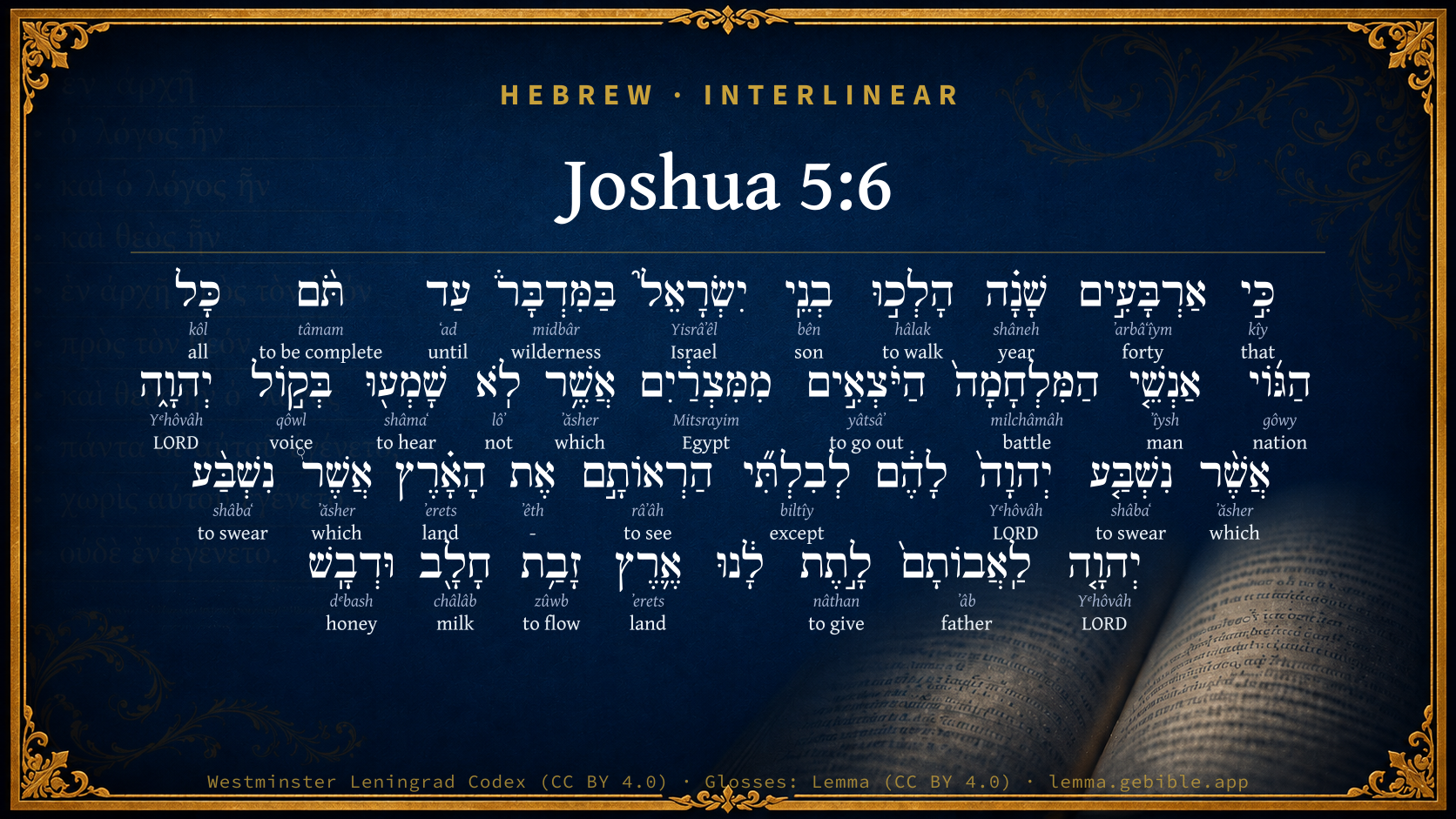
Hebrew (Westminster Leningrad Codex) Joshua 5:6 appears in the Hebrew Old Testament. The text above is from the Westminster Leningrad Codex. Each word links to its Strong’s number, a concise gloss, and parsing drawn from the Open Scriptures Hebrew Bible morphology. Click any word for its full Brown-Driver-Briggs (BDB) entry.
Download image
Cite this verse

Joshua 5:6 (World English Bible). Public Domain. Lemma interlinear Bible study tool, https://lemma.gebible.app/v/joshua/5/6.

Show BibTeX & RIS
BibTeX
RIS
English Translation
For the children of Israel walked forty years in the wilderness, until all the nation, even the men of war who came forth out of Egypt, were consumed, because they didn't listen to the voice of Yahweh: to whom Yahweh swore that he wouldn't let them see the land which Yahweh swore to their fathers that he would give us, a land flowing with milk and honey.
World English Bible · Public Domain
Download a study sheet

One document with this verse’s original text, its word-by-word gloss line, the meaning frame, cross-references with their text, attributed commentary, and full source and license credits — printable, and it pastes into notes with its structure intact.

This verse Autodidact and up

Study sheet (.html) Plain text (.txt)

A passage Seminary Student

Up to 50 verses in one chapter. A passage sheet keeps up to 6 commentary sources and 12 cross-references per verse, in the order this page ranks them, and says so on the sheet whenever that leaves anything out. Ask for a single verse and you get the Autodidact verse sheet above.

Everything on this page stays free to read, with no account — the sheet is a download of what is already on screen, not access to it.

Want to remove ads? Support Godless Engineer
Compare translations 3

The same verse in 3 English versions, stacked beneath the original-language interlinear above. Click any original word for its lexicon entry.

Each is an independent rendering of the whole verse — the interlinear is not word-aligned to these translations.

Highlighted words mark where these versions differ — a whole-verse word diff, not a word-by-word alignment.

  • World English Bible Public Domain
    For the children of Israel walked forty years in the wilderness, until all the nation, even the men of war who came forth out of Egypt, were consumed, because they didn't listen to the voice of Yahweh: to whom Yahweh swore that he wouldn't let them see the land which Yahweh swore to their fathers that he would give us, a land flowing with milk and honey.
  • King James Version Public Domain
    For the children of Israel walked forty years in the wilderness, till all the people that were men of war, which came out of Egypt, were consumed, because they obeyed not the voice of the LORD: unto whom the LORD sware that he would not show them the land, which the LORD sware unto their fathers that he would give us, a land that floweth with milk and honey.
  • unfoldingWord Literal Text CC BY-SA 4.0
    For the sons of Israel had walked in the wilderness 40 years, until the finishing of all of the nation of the men of war having come out from Egypt, because they had not listened to the voice of Yahweh, to whom Yahweh had sworn not to let them see the land that Yahweh had sworn to their fathers to give to us, a land flowing milk and honey.

unfoldingWord Literal Text — © unfoldingWord, licensed CC BY-SA 4.0. Word-aligned USFM3 via Door43 (git.door43.org/unfoldingWord/en_ult).

Versions to compare (up to 4)

3 of 4 selected

Show all 18 translations

Every available English version of this verse, each an independent rendering of the whole verse.

  • World English Bible Public Domain
    For the children of Israel walked forty years in the wilderness, until all the nation, even the men of war who came forth out of Egypt, were consumed, because they didn't listen to the voice of Yahweh: to whom Yahweh swore that he wouldn't let them see the land which Yahweh swore to their fathers that he would give us, a land flowing with milk and honey.
  • Berean Standard Bible Public Domain
    For the Israelites had wandered in the wilderness forty years, until all the nation’s men of war who had come out of Egypt had died, since they did not obey the LORD. So the LORD vowed never to let them see the land He had sworn to their fathers to give us, a land flowing with milk and honey.
  • Majority Standard Bible Public Domain
    For the Israelites had wandered in the wilderness forty years, until all the nation’s men of war who had come out of Egypt had died, since they did not obey the LORD. So the LORD vowed never to let them see the land He had sworn to their fathers to give us, a land flowing with milk and honey.
  • King James Version Public Domain
    For the children of Israel walked forty years in the wilderness, till all the people that were men of war, which came out of Egypt, were consumed, because they obeyed not the voice of the LORD: unto whom the LORD sware that he would not show them the land, which the LORD sware unto their fathers that he would give us, a land that floweth with milk and honey.
  • American Standard Version (1901) Public Domain
    For the children of Israel walked forty years in the wilderness, till all the nation, even the men of war that came forth out of Egypt, were consumed, because they hearkened not unto the voice of Jehovah: unto whom Jehovah sware that he would not let them see the land which Jehovah sware unto their fathers that he would give us, a land flowing with milk and honey.
  • Revised Version (1885) Public Domain
    For the children of Israel walked forty years in the wilderness, till all the nation, even the men of war which came forth out of Egypt, were consumed, because they hearkened not unto the voice of the LORD: unto whom the LORD sware that he would not let them see the land which the LORD sware unto their fathers that he would give us, a land flowing with milk and honey.
  • Geneva Bible (1599) Public Domain
    For the children of Israel walked fourtie yeres in the wildernes, till all the people of the men of warre that came out of Egypt were consumed, because they obeyed not the voyce of the Lord: vnto whome the Lord sware, that he would not shewe them the lande, which the Lord had sworne vnto their fathers, that he would giue vs, euen a land that floweth with milke and hony.
  • Douay-Rheims (1899) Public Domain
    Luring the forty years of the journey in the wide wilderness, were uncircumcised: till all they were consumed that had not heard the voice of the Lord, and to whom he had sworn before, that he would not shew them the land flowing with milk and honey.
  • Young's Literal Translation Public Domain
    for forty years have the sons of Israel gone in the wilderness, till all the nation of the men of war who are coming out of Egypt, who hearkened not to the voice of Jehovah, to whom Jehovah hath sworn not to show them the land which Jehovah sware to their fathers to give to us, a land flowing with milk and honey, are consumed;
  • Literal Standard Version CC BY-SA 4.0
    for forty years the sons of Israel have gone in the wilderness, until all the nation of the men of war who are coming out of Egypt, who did not listen to the voice of YHWH, to whom YHWH has sworn not to show them the land which YHWH swore to their fathers to give to us, a land flowing with milk and honey, are consumed;
  • Unlocked Literal Bible CC BY-SA 4.0
    For the people of Israel walked forty years in the wilderness until all the people, that is, all the men of war who had come out of Egypt, died, because they did not obey the voice of Yahweh. Yahweh swore to them that he would not let them see the land that he had sworn to their ancestors that he would give to us, a land flowing with milk and honey.
  • unfoldingWord Literal Text CC BY-SA 4.0
    For the sons of Israel had walked in the wilderness 40 years, until the finishing of all of the nation of the men of war having come out from Egypt, because they had not listened to the voice of Yahweh, to whom Yahweh had sworn not to let them see the land that Yahweh had sworn to their fathers to give to us, a land flowing milk and honey.
  • Darby Bible Public Domain
    For the children of Israel had walked forty years in the wilderness, till the whole nation of men of war had perished who had come out of Egypt, who had not hearkened to the voice of Jehovah; to whom Jehovah had sworn that he would not show them the land which Jehovah had sworn unto their fathers that he would give us, a land flowing with milk and honey.
  • World Messianic Bible Public Domain
    For the children of Israel walked forty years in the wilderness until all the nation, even the men of war who came out of Egypt, were consumed, because they didn’t listen to the LORD’s voice. The LORD swore to them that he wouldn’t let them see the land which the LORD swore to their fathers that he would give us, a land flowing with milk and honey.
  • Webster's Bible Public Domain
    For the children of Israel walked forty years in the wilderness, till all the people that were men of war who came out of Egypt were consumed, because they obeyed not the voice of the LORD: to whom the LORD swore that he would not show them the land which the LORD swore to their fathers that he would give us, a land that floweth with milk and honey.
  • Free Bible Version CC BY-SA 4.0
    For forty years the Israelites traveled through the wilderness until all the men of fighting age when they left Egypt had died, because they had not done what the Lord had told them to do. So the Lord had vowed that he would not let them see the land he had promised their forefathers to give us, a land flowing with milk and honey.
  • Bible in Basic English Public Domain
    For the children of Israel were wandering in the waste land for forty years, till all the nation, that is, all the fighting-men, who had come out of Egypt, were dead, because they did not give ear to the voice of the Lord: to whom the Lord said, with an oath, that he would not let them see the land which the Lord had given his word to their fathers to give us, a land flowing with milk and honey.
  • JPS Tanakh (1917) Public Domain
    For the children of Israel walked forty years in the wilderness, till all the nation, even the men of war that came forth out of Egypt, were consumed, because they hearkened not unto the voice of the LORD; unto whom the LORD swore that He would not let them see the land which the LORD swore unto their fathers that He would give us, a land flowing with milk and honey.

Literal Standard Version (2020), Covenant Press — licensed CC BY-SA 4.0. Text via the HelloAO Bible API (eBible.org). Unlocked Literal Bible (unfoldingWord) — licensed CC BY-SA 4.0. Text via the HelloAO Bible API (eBible.org). unfoldingWord Literal Text — © unfoldingWord, licensed CC BY-SA 4.0. Word-aligned USFM3 via Door43 (git.door43.org/unfoldingWord/en_ult). Free Bible Version, Dr. Jonathan Gallagher — licensed CC BY-SA 4.0. Text via the HelloAO Bible API (eBible.org).

Word by word

More ways to search: Search by grammar → Find every occurrence → Compare this word →

Practice this passage: Drill this verse → Learn its vocabulary →

זָבַ֥ת
zûwb
H2100
“flowing”
Verb, Qal, Participle Active, Feminine, Singular, Construct
Part of Speech
Verb
Stem
Qal
Form
Participle Active
Gender
Feminine
Number
Singular
State
Construct
Full BDB Definition

Origin: a primitive root

TWOT: 534

to flow, gush, issue, discharge - (Qal) - to flow, gush - to die, pine away (figuratively) - to flow (of issue from woman), have an issue, flux - flowing (participle)
  1. כִּ֣י kîy H3588 “that” Conjunction
  2. אַרְבָּעִ֣ים ʼarbâʻîym H705 “forty” Adjective, Cardinal number, Both, Plural, Absolute
  3. שָׁנָ֗ה shâneh H8141 “year” Noun, Common, Feminine, Singular, Absolute
  4. הָלְכ֣וּ hâlak H1980 “to walk” Verb, Qal, Perfect, 3rd Person, Common, Plural
  5. בְנֵֽי bên H1121 “sons of” Noun, Common, Masculine, Plural, Construct
  6. יִשְׂרָאֵל֮ Yisrâʼêl H3478 “Israel” Noun, Proper
  7. בַּמִּדְבָּר֒ midbâr H4057 “in/at the · wilderness” Preposition, Determined + Noun, Common, Masculine, Singular, Absolute
  8. עַד ʻad H5704 “until” Preposition
  9. תֹּ֨ם tâmam H8552 “to be complete” Verb, Qal, Infinitive Construct
  10. כָּל kôl H3605 “all of” Noun, Common, Masculine, Singular, Construct
  11. הַגּ֜וֹי gôwy H1471 “the · nation” Particle, Definite Article + Noun, Common, Masculine, Singular, Absolute
  12. אַנְשֵׁ֤י ʼîysh H376 “men of” Noun, Common, Masculine, Plural, Construct
  13. הַמִּלְחָמָה֙ milchâmâh H4421 “the · battle” Particle, Definite Article + Noun, Common, Feminine, Singular, Absolute
  14. הַיֹּצְאִ֣ים yâtsâʼ H3318 “the · going out” Particle, Definite Article + Verb, Qal, Participle Active, Masculine, Plural, Absolute
  15. מִמִּצְרַ֔יִם Mitsrayim H4714 “from · Egypt” Preposition + Noun, Proper
  16. אֲשֶׁ֥ר ʼăsher H834 “which” Particle, Relative
  17. לֹֽא lôʼ H3808 “not” Particle, Negative
  18. שָׁמְע֖וּ shâmaʻ H8085 “to hear” Verb, Qal, Perfect, 3rd Person, Common, Plural
  19. בְּק֣וֹל qôwl H6963 “in/at · voice of” Preposition + Noun, Common, Masculine, Singular, Construct
  20. יְהוָ֑ה Yᵉhôvâh H3068 “LORD” Noun, Proper
  21. אֲשֶׁ֨ר ʼăsher H834 “which” Particle, Relative
  22. נִשְׁבַּ֤ע shâbaʻ H7650 “to swear” Verb, Niphal, Perfect, 3rd Person, Masculine, Singular
  23. יְהוָה֙ Yᵉhôvâh H3068 “LORD” Noun, Proper
  24. לְבִלְתִּ֞י biltîy H1115 “to/for · except” Preposition + Conjunction
  25. הַרְאוֹתָ֣ם râʼâh H7200 “to see · them” Verb, Hiphil, Infinitive Construct + Suffix, Personal, 3rd Person, Masculine, Plural
  26. אֶת ʼêth H853 “-” Particle, Direct Object
  27. הָאָ֗רֶץ ʼerets H776 “the · land” Particle, Definite Article + Noun, Common, Both, Singular, Absolute
  28. אֲשֶׁר֩ ʼăsher H834 “which” Particle, Relative
  29. נִשְׁבַּ֨ע shâbaʻ H7650 “to swear” Verb, Niphal, Perfect, 3rd Person, Masculine, Singular
  30. יְהוָ֤ה Yᵉhôvâh H3068 “LORD” Noun, Proper
  31. לַֽאֲבוֹתָם֙ ʼâb H1 “to/for · fathers · their” Preposition + Noun, Common, Masculine, Plural, Construct + Suffix, Personal, 3rd Person, Masculine, Plural
  32. לָ֣תֶת nâthan H5414 “to give” Preposition + Verb, Qal, Infinitive Construct
  33. אֶ֛רֶץ ʼerets H776 “land” Noun, Common, Both, Singular, Absolute
  34. חָלָ֖ב châlâb H2461 “milk” Noun, Common, Masculine, Singular, Absolute
  35. וּדְבָֽשׁ dᵉbash H1706 “and · honey” Conjunction + Noun, Common, Masculine, Singular, Absolute

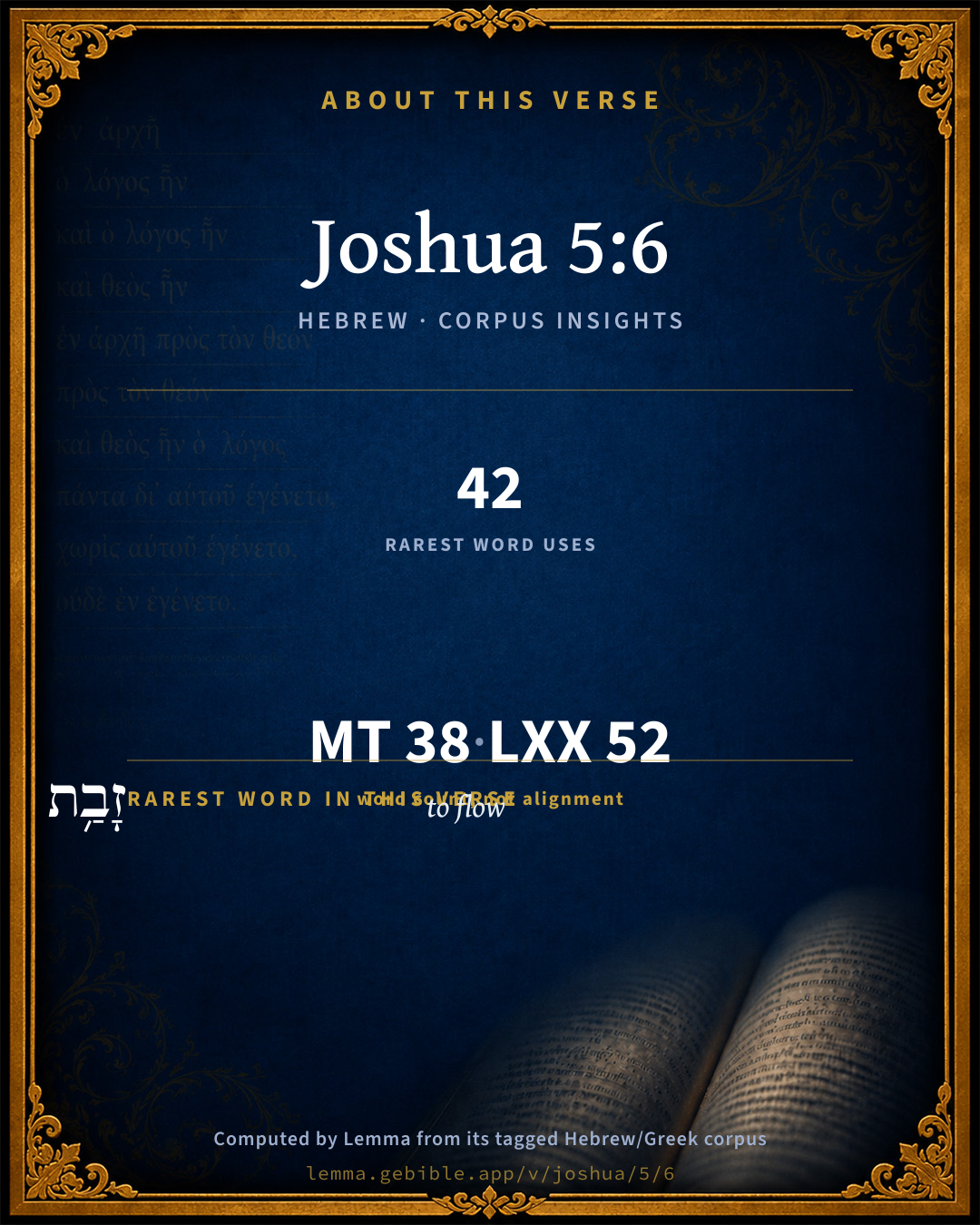
About this verse

These counts appear in no published source. They are computed here, from the morphology-tagged text and Lemma’s own curated glosses. What Lemma adds →

38
words
30
distinct lemmas
Historical
section

Shared distinctive vocabulary

זָבַ֥ת to flow H2100 occurs in 41 verses of the Hebrew Bible. Also found in:

Grammatical profile

  • 9 verbs
  • 18 nouns
  • 1 adjective
  • 3 prepositions
  • 2 conjunctions
  • 5 particles

Verb forms

  • הָלְכ֣וּ Qal · Perfect
  • תֹּ֨ם Qal · Infinitive Construct
  • הַיֹּצְאִ֣ים Qal · Participle Active
  • שָׁמְע֖וּ Qal · Perfect
  • נִשְׁבַּ֤ע Niphal · Perfect
  • הַרְאוֹתָ֣ם Hiphil · Infinitive Construct
  • נִשְׁבַּ֨ע Niphal · Perfect
  • לָ֣תֶת Qal · Infinitive Construct
  • זָבַ֥ת Qal · Participle Active

Repetition

Words recur within this verse — often emphatic in Hebrew:

  • יְהוָ֑ה LORD H3068 ×3
  • נִשְׁבַּ֤ע to swear H7650 ×2
  • הָאָ֗רֶץ land H776 ×2
  • אֲשֶׁ֥ר which H834 ×3

Hebrew & Septuagint length

In English translation the verse runs 67 words from the Hebrew and 51 from the Septuagint (LXX English) — closely comparable.

A rough comparison of the two English renderings, which tokenize alike — not a word-level alignment.

Word counts can differ between the Hebrew and the Greek without any difference in meaning — e.g. the Hebrew direct-object marker אֵת has no separate Greek word, and Greek often adds the article ὁ.

In the original languages it is 38 Hebrew tokens and 52 Greek tokens — but the two are counted differently (Hebrew bundles its prefixes and suffixes into one token; the Greek is in lemma form), so that isn’t a like-for-like length.

Cross-references

14

Topical passages linked to Joshua 5:6 in the Treasury of Scripture Knowledge — connected by theme and wording, ordered by reader-vote popularity; previews shown in the World English Bible.

  • Numbers 14:23 surely they shall not see the land which I swore to their fathers, neither shall any of those who despised me see it:
  • Deuteronomy 2:14 The days in which we came from Kadesh-barnea, until we were come over the brook Zered, were thirty-eight years; until all the generation of the men of war were consumed from the midst of the camp, as Yahweh swore to them.
  • Hebrews 3:11 As I swore in my wrath, 'They will not enter into my rest.'"
  • Deuteronomy 1:3 It happened in the fortieth year, in the eleventh month, on the first day of the month, that Moses spoke to the children of Israel, according to all that Yahweh had given him in commandment to them;
  • Deuteronomy 2:7 For Yahweh your God has blessed you in all the work of your hand; he has known your walking through this great wilderness: these forty years Yahweh your God has been with you; you have lacked nothing.
  • Psalms 95:10–11 Forty long years I was grieved with that generation, And said, "It is a people that errs in their heart. They have not known my ways."
  • Exodus 3:8 I have come down to deliver them out of the hand of the Egyptians, and to bring them up out of that land to a good and large land, to a land flowing with milk and honey; to the place of the Canaanite, the Hittite, the Amorite, the Perizzite, the Hivite, and the Jebusite.
  • Numbers 14:29–35 your dead bodies shall fall in this wilderness; and all who were numbered of you, according to your whole number, from twenty years old and upward, who have murmured against me,
  • Deuteronomy 8:4 Your clothing didn't grow old on you, neither did your foot swell, these forty years.
  • Jeremiah 2:2 Go, and cry in the ears of Jerusalem, saying, Thus says Yahweh, I remember for you the kindness of your youth, the love of your weddings; how you went after me in the wilderness, in a land that was not sown.
  • Ezekiel 20:15 Moreover also I swore to them in the wilderness, that I would not bring them into the land which I had given them, flowing with milk and honey, which is the glory of all lands;
  • Exodus 3:17 and I have said, I will bring you up out of the affliction of Egypt to the land of the Canaanite, the Hittite, the Amorite, the Perizzite, the Hivite, and the Jebusite, to a land flowing with milk and honey."'
  • Ezekiel 20:6 in that day I swore to them, to bring them forth out of the land of Egypt into a land that I had searched out for them, flowing with milk and honey, which is the glory of all lands.
  • Joel 3:18 It will happen in that day, That the mountains will drop down sweet wine, The hills will flow with milk, All the brooks of Judah will flow with waters; And a fountain will come forth from the house of Yahweh, And will water the valley of Shittim.

Cross-references courtesy of OpenBible.info (CC BY 4.0).

Hebrew and Greek witnesses Masoretic Hebrew ↔ Greek Septuagint

The same verse in the two great witnesses to the Old Testament, shown verse-for-verse.

These are two independent witnesses, not word-aligned to each other, and the Septuagint is shown in lemma (dictionary) form.

Hebrew Joshua 5:6 Masoretic · Westminster Leningrad Codex

כִּ֣י אַרְבָּעִ֣ים שָׁנָ֗ה הָלְכ֣וּ בְנֵֽי יִשְׂרָאֵל֮ בַּמִּדְבָּר֒ עַד תֹּ֨ם כָּל הַגּ֜וֹי אַנְשֵׁ֤י הַמִּלְחָמָה֙ הַיֹּצְאִ֣ים מִמִּצְרַ֔יִם אֲשֶׁ֥ר לֹֽא שָׁמְע֖וּ בְּק֣וֹל יְהוָ֑ה אֲשֶׁ֨ר נִשְׁבַּ֤ע יְהוָה֙ לָהֶ֔ם לְבִלְתִּ֞י הַרְאוֹתָ֣ם אֶת הָאָ֗רֶץ אֲשֶׁר֩ נִשְׁבַּ֨ע יְהוָ֤ה לַֽאֲבוֹתָם֙ לָ֣תֶת לָ֔נוּ אֶ֛רֶץ זָבַ֥ת חָלָ֖ב וּדְבָֽשׁ

For the children of Israel walked forty years in the wilderness, until all the nation, even the men of war who came forth out of Egypt, were consumed, because they didn't listen to the voice of Yahweh: to whom Yahweh swore that he wouldn't let them see the land which Yahweh swore to their fathers that he would give us, a land flowing with milk and honey.

World English Bible · Public Domain

Greek LXX Joshua 5:6 Septuagint · lemma form

τεσσαράκοντα γάρ καί δύο ἔτος ἀναστρέφω ἰσραήλ ἐν ὁ ἔρημος ὁ μαδβαρῖτις διό ἀπερίτμητος εἰμί ὁ πολύς αὐτός ὁ μάχιμος ὁ ἐκἔρχομαι ἐκ γῆ αἴγυπτος ὁ ἀπειθέω ὁ ἐντολή ὁ θεός ὅς καί διαὁρίζω μή ὁράω αὐτός ὁ γῆ ὅς ὄμνυμι κύριος ὁ πατήρ αὐτός δίδωμι ἐγώ γῆ ῥέω γάλα καί μέλι

Therefore most of the fighting men that came out of the land of Egypt, were uncircumcised, who disobeyed the commands of God; concerning whom also he determined that they should not see the land, which the Lord swore to give to their fathers, even a land flowing with milk and honey.

LXX2012 (modern English Septuagint) · Public Domain

On this verse, John Gill's Exposition discusses the Septuagint’s reading. Read the note in Commentary ↓

Hebrew: Westminster Leningrad Codex (CC BY 4.0). Greek: Septuagint (public domain); English from LXX2012 (modern English Septuagint) (Public Domain). How the Septuagint differs from the Hebrew →

Targum (Aramaic paraphrase)

1

The Targum is the ancient Jewish Aramaic paraphrase of the Hebrew Scriptures — an interpretive translation, not the Hebrew text itself. Onkelos (literal) and Pseudo-Jonathan (expansive) render the Torah, and Jonathan the Prophets. Coverage is partial: where no permissively-licensed English translation exists for a verse, only the Aramaic is shown. This is verse-level text, not a word-by-word alignment to the Hebrew.

  1. Targum Jonathan Prophets (Joshua–Malachi)
    אֲרֵי אַרְבְּעִין שְׁנִין הֲלִיכוּ בְנֵי יִשְׂרָאֵל בְּמַדְבְּרָא עַד דְסָף כָּל עַמָא גַבְרֵי מְגִיחֵי קְרָבָא דִנְפַקוּ מִמִצְרַיִם דְלָא קַבִּילוּ לְמֵימְרָא דַייָ דְקַיֵם יְיָ לְהוֹן בְּדִיל דְלָא לְאַחֲזָיוּתְהוֹן יַת אַרְעָא דְקַיֵם יְיָ לַאֲבָהַתְהוֹן לְמִתַן לָנָא אַרְעָא עַבְדָא חֲלַב וּדְבָשׁ:

    (no public-domain English translation for this verse)

    Targum Jonathan — Aramaic: “Mikraot Gedolot” (public domain). English: “Sefaria Community Translation” (CC0 1.0 (public-domain dedication)); “London "Chaldee Paraphrase," 1871” (public domain). Text via Sefaria.

Commentary

Notes on Joshua 5:6 from classic Christian and Jewish commentators (each source and its license shown beneath its notes). The classic Christian expositions comment on the surrounding passage and are grouped to its opening verse, so a note may address several verses; the Jewish commentaries on the Tanakh (Rashi and others) are per-verse, so they appear only where the commentator wrote on this verse.

Lemma curates 59 commentaries, every one of them public domain or Creative Commons licensed, each selected and text-cleaned for this edition rather than reprinted as found. About our sources →

Ellicott's Commentary for English Readers

(6) Us.—The first person is used here as in Jos_4:23; Jos_5:7. The whole passage from Jos_4:22 to Jos_5:6 seems intended to be the reply of the fathers to the children.

A Bible Commentary for English Readers, edited by Charles John Ellicott (1878–1897) — public domain. Text from a community e-Sword module.

Trapp's Complete Commentary

John Trapp

Jos 5:6 For the children of Israel walked forty years in the wilderness, till all the people [that were] men of war, which came out of Egypt, were consumed, because they obeyed not the voice of the LORD: unto whom the LORD sware that he would not shew them the land, which the LORD sware unto their fathers that he would give us, a land that floweth with milk and honey.

Ver. 6. For the children of Israel walked forty years.] This way and that way, backward and forward, as if they were treading a maze; and this, for the punishment of their revolt. {Num 14:33}

With milk and honey.] With plenty of dainties.

For they were uncircumcised. Who yet, together with the circumcised, were brought by Joshua into the promised land: so are both sorts by Jesus into the kingdom of heaven. See Eph 2:14 Col 3:11.

John Trapp, A Commentary or Exposition upon All the Books of the Old and New Testament (1647–1656) — public domain. Text from a community e-Sword module.

Joseph Benson's Commentary

Jos 5:6. Till all the people — were consumed — All the six hundred thousand fighting men that came out of Egypt, except Joshua and Caleb. The Hebrew word הגוי, hagoi, here rendered people, commonly signifies the Gentiles, and some have thought it is here used to signify that they were unworthy the name of Israelites. That he would not show them the land — That is, would not give them so much as the sight of it, which he granted to Moses, much less the possession.

Joseph Benson's Commentary on the Old and New Testaments (1811–1818) — public domain. Text from a community e-Sword module.

The Cambridge Bible for Schools and Colleges

gen. ed. J. J. S. Perowne

6. forty years] See Num_14:33; Deu_1:3; Deu_2:7; Deu_2:14.

a land that floweth with milk and honey] For this expression compare Exo_3:8; Exo_3:17; Exo_13:5; Lev_20:24; Num_13:27; Num_16:14; Deu_6:3. “Milk and honey are productions of a land rich in grass and flowers. Both articles were abundantly produced in Canaan, even in a state of devastation. Milk, eaten partly sweet and partly curdled, that of cows as well as of goats and sheep (Deu_32:14), was prominent in the diet of the ancient Hebrews, as in that of the Orientals of the present day. The land yielded great quantities of honey also, especially that from wild bees (Jdg_14:8; 1Sa_14:26; Mat_3:4), and still yields it in its wasted condition.” Keil.

The Cambridge Bible for Schools and Colleges (gen. ed. J. J. S. Perowne; Cambridge University Press, 1878–1918) — public domain. Text from a community e-Sword module.

John Gill's Exposition

For the children of Israel walked forty years in the wilderness,.... Wanting a few days, the round number is given: not forty two, as the Septuagint version:

till all the people that were men of war, which came out of Egypt,

were consumed; all that were above twenty years of age, excepting Joshua and Caleb:

because they obeyed not the voice of the Lord; but murmured against him, and against his servants, and particularly against Aaron, being the high priest; and chiefly because of the report of the spies, and their murmurs then, which so incensed the Lord against them, that he threatened them with an entire consumption of their carcasses, and which accordingly was fulfilled, to which the following clause refers:

unto whom the Lord sware, that he would not show them the land which the Lord sware unto their fathers that he would give us, a land that floweth with milk and honey; see Num 14:23.

John Gill's Exposition of the Whole Bible (1746–1763) — public domain (CC PDM 1.0). Text via the HelloAO Bible API.

Haydock's Catholic Bible Commentary

Forty. Some copies of the Septuagint add, "two," as if the 40 years’ wandering in the desert, were to be dated from the time that the spies discouraged the people, in the second year of their departure from Egypt. But the Hebrew and the best chronologers allow only 40 years in the whole. (Calmet) --- Hebrew, "For the children of Israel walked 40 years in the wilderness, till all the men fit for war, who came out of Egypt, were consumed, because they obeyed not the voice of the Lord, unto whom the Lord swore that he would not shew them the land, which the Lord swore unto their fathers that he would give us, a land flowing with milk and honey; (7) and their children he raised up in their stead, them Josue circumcised." (Haydock) --- The Septuagint is also rather fuller than the Vulgate but gives the same sense. These children who receive, what their rebellious fathers had been refused, are a sensible figure of the Christian Church; as that second circumcision under Josue, represents the spiritual cleansing of the heart, which Jesus Christ has enjoined, Romans ii. 28., and 1 Corinthians vii. 19.

George Leo Haydock (1774–1849), Haydock's Catholic Family Bible and Commentary, 1859 edition — public domain. Excludes Psalms (Douay-Rheims chapter numbering differs from Protestant) and Deuterocanonical books (Catholic canon only).

Matthew Poole's English Annotations

All the people; the Hebrew word commonly signifies the Gentiles; so he calls them, to note that they were unworthy of the name and privileges of Israelites.

He would not show them, i.e. not give them so much as a sight of it, which he granted to Moses, much less the possession and enjoyment of it. Or showing is put for giving, as it is Psa 4:6; 60:3; Ecc 2:24.

Matthew Poole's English Annotations on the Holy Bible (1683–1685) — public domain. Text from a community e-Sword/MySword module.

Whedon's Commentary on the Bible

Daniel D. Whedon

6. Forty years in the wilderness — This verse assigns the reason why circumcision had not been performed, namely, their disobedience and punishment. As the sentence of exclusion from the favour of Jehovah had now expired, the nation is again admitted to the privilege of using the sign of his covenant. While in exile they were the objects of his care, and even of his supernatural providence, but not of his approval, just as sinners under the Gospel dispensation enjoy the bounty of God, but not the covenant of his pardoning grace.

Till all the people… were consumed — The word for people is that which is always used to designate a heathen nation, a Gentile race, in distinction from the peculiar people, Israel. This confirms the explanation that Israel was excluded from covenant relations during the forty years’ wandering.

The Lord sware that he would not show them the land — That is, cause them to see, and hence to enter and enjoy, the land.

A land that floweth with milk and honey — This phrase represents the great fertility and loveliness of the Land of Promise; it was a land rich in grass for herds, hence there was an abundance of milk; it was profuse in flowers, hence bees and wild honey were very plentiful, (Jdg_14:8; Mat_3:4,) and they still are found, in spite of the lack of cultivation and the desolation of Palestine. Milk and its various products constituted the chief sustenance of the ancient Hebrews. In Palestine the bees do actually deposit honey in the holes of the rocks in so great quantities that it flows out and is gathered in vessels placed beneath.

Daniel D. Whedon (gen. ed.), Commentary on the Old and New Testaments (1874–1909) — public domain. Text from a community e-Sword module.

The Pulpit Commentary

Till all the people. The Hebrew here is yWog, not the usual word for people, but that usually applied to the Gentiles (equivalent to eynov , by which word it is usually rendered in the LXX). It is applied to the Israelites in Jos_3:17 Jos_4:1 Isa_1:4 Isa_9:2 Isa_26:2. See also Exo_33:13. In the singular it means a people in the more general sense, a nation, as distinguished from a people in whom one has an interest. In the plural it always means the Gentiles. s. (LXX, laov ), the word usually applied to the people of God, is not used here, because the people who "provoked God in the wilderness" had made themselves in a sense a rejected people. Delitzsch regards this (after Calvin) as a sign that, for the time at least, the covenant between God and Israel was annulled, permanently in the ease of those who were condemned to die in the wilderness, temporarily only in their descendants, who were formally reconciled to God, and restored to their former covenant position by this solemn performance of the covenant rite of circumcision (see note on verse 2). So also Hengstenberg, "Geschichte des Reiches Gottes," p. 205. The difficulty about the passover may be met by supposing that those only who were circumcised a constantly decreasing number, of course were allowed to celebrate that feast. Knobel would understand that in consequence of the "unquiet, unsettled, uncomfortable life" the Israelites led in the wilderness, they could keep very few of the ordained feasts. He continues: "the Elohist knows nothing of any cessation." Nevertheless we read of no passover being kept after the one recorded in Num_9:5, so that if "the Elohist knows of no cessation," he knows as little of any continued observance of the feast. But there is no certainty on the point. Considering the loose way in which the word lko is used in Scripture, (see, for instance, Gen_4:14) we need not press the word to include all who were born after the departure from Egypt, but only those who were born after the rejection of the people recorded in Num_14:26, sqq. This rejection, be it remembered, did not include all the Israelites who were born in Egypt, but only those who were over twenty years of age. (Num_14:29) The view of Kurz (3:323, Clark"s translation), that circumcision was suspended on account of the continual movements of the Israelites, is refuted by Delitzsch"s remark that the Israelites were not continually on the march, but that they often encamped in one place for a long period, a period far longer, in fact, than the time in which they abode in Gilgal. Delitzsch asks why this circumcision did not take place before, why it was not performed as soon as they crossed the brook Zered. The answer is that, until the Jordan was crossed, they had not taken formal possession of their own land. As soon as, under the Divine protection, they had crossed the Jordan, the long-delayed promise was fulfilled. God"s covenant with Abraham was accomplished, and now they, in their turn, had to place themselves once more in the position of God"s covenant people, bound to serve Him with their whole heart. For a fuller discussion of this question see Keil"s Commentary, and Hengstenberg in the passage cited above. We may observe that God fulfils His part of the covenant first, and then it is man"s duty to fulfil his. God, under the Christian dispensation, first places us in the state of salvation. Then it becomes our duty to make that salvation sure by overcoming God"s enemies, by the help which He never fails to afford. Give us. This introduction of the first person into the middle of the sentence is unexpected. Some MSS. and editors read "to them" (see note on ver. 1, and Psa_66:6, where there is a similar change of person). A land that floweth with milk and honey. This, says Keil, "is a standing expression in the Pentateuch to express the great fertility of the land of Canaan. Milk and honey are produced by a land rich in grass and flowers, which were both of them plentiful in Canaan. (see Isa_7:15, Isa_7:22) Milk, not only of cows, but of sheep and goats also, (Deu_32:14) and eaten sometimes sweet, at other times thick or curdled (hamj), was a leading article of food amongst the ancient Hebrews, as it is in the present day in most Eastern countries, and Palestine was peculiarly fitted for the rearing of cattle. Honey also, especially that of wild bees, was found in large quantities, (Jud_1:14:8, sqq.; 1Sa_14:26 Mat_3:4) and is still found, notwithstanding its present desolate condition." Some have thought vbd to mean the newly expressed juice of grapes, which, under the Arabic name of dibs, is largely used at present in Palestine, and is even exported to other countries. But in Deu_32:13,ps Deu 81:16, wild honey is clearly meant, which is to this day deposited by bees, in the clefts of the rock, whence it often overflows and is received into vessels placed beneath. (see Pro_5:3 Son_4:11; Jahn, "Biblical Archaeology;" and Smith"s Dictionary of the Bible)

HOMILIES BY E. DE PRESSENSE Vers. 6-11. The Two Sacraments of the Old Covenant

Circumcision and the passover were the two sacraments of the old covenant. The first set forth the truth that enrolment among the people of God must be accompanied with the putting away of evil. The second represented the past deliverance from the bondage of Egypt, and the future deliverance from all the perils of the wilderness by entrance into Canaan, and the final possession of the land of promise. On the eve of the decisive conflict, God commands His people to make a solemn renewal of these two covenants. Israel must be afresh consecrated to Him by that covenant of circumcision which symbolises holiness by the crucifixion of the flesh, and by that passover feast, which is at once the symbol of past and future deliverances. Thus also should the Christian gird himself for the conflict of the spiritual life. When he enlists under the banner of his God, he ought, as it were, to renew his baptismal vows, by what St. Peter calls "the answer of a good conscience," thus dedicating himself to God in the renunciation of all the defilements of sin, by that circumcision of the heart which was the deep truth signified by the old fleshly rite. And further, by partaking of the Christian passover feast, he should testify his entire trust in redeeming love by receiving this most sacred pledge of love, and deriving from it the needed renewal of spiritual strength. That which is true of the individual Christian is true also of the Church. It requires to be constantly baptized a fresh with the Spirit of God, and to receive the pledges and seals of the grace of redemption, as a preparation for its spiritual conflicts. There is one remarkable feature in the sacred narrative. It is said that on the occasion of this first passover celebrated beyond the Jordan, the Israelites "did eat of the old corn of the land". (Jos_5:10, Jos_5:11) Thus they not only had in this feast a pledge of the promised deliverance, BUT AN EARNEST OF THE GOOD THINGS TO COME. They not only had a fresh guarantee of the promise, but a beginning of its fulfilment. The same thing is true of the Christian sacrament. While it is an essentially spiritual feast, it still gives in part that which it sets forth and symbolises. Faith receives the Holy Spirit in baptism, and feeds upon the invisible Christ in the Lord"s Supper. Christ is to the soul "the living bread which came down from heaven". (Joh_6:31) Thus even before the Jordan is crossed, the Christian soul eats of the corn of the land of promise. E. DE P.

The Pulpit Commentary (1880–1919), ed. H.D.M. Spence-Jones & Joseph S. Exell — public domain. Text from a community e-Sword module.

John Wesley's Explanatory Notes

The people - The Hebrew word commonly signifies the Gentiles; so he calls them, to note that they were unworthy the name of Israelites. Shew them - That is, not give them so much as a sight of it, which he granted to Moses, much less the possession.

John Wesley, Explanatory Notes Upon the Whole Bible (1754–1765) — public domain. Text via the GEBible commentary corpus.

unfoldingWord translationNotes

Door43 World Missions Community

obey the voice of Yahweh

Here "voice" refers to the things that Yahweh spoke. AT: "obey the things that Yahweh commanded them" (See: Metonymy)

a land flowing with milk and honey

God spoke of the land being good for animals and plants as if the milk and honey from those animals and plants were flowing through the land. AT: "a land that is excellent for raising livestock and growing crops" (See: Metaphor and Metonymy)

translationWords

Israel

Egypt

die

obey

voice

Yahweh

oath

honey

unfoldingWord translationNotes — © Distant Shores Media and the Door43 World Missions Community, licensed CC BY-SA 4.0. Source: git.door43.org/Door43/en_tn.

Lesson kit

Teaching starters — assembled from the data on this page, not authored interpretation. Every prompt links to the verse data it draws on. Edit before teaching.

Joshua, in the Historical, opens this verse with 38 words (30 distinct Hebrew lemmas). Its most distinctive word is zûwb (“to flow”). A historical commentator’s framing appears above. Read the whole chapter for the surrounding context.

Discussion questions

  1. What does “to flow” (zûwb) contribute to the verse as a whole?
  2. How does Exodus 3:8, which shares the word «to flow», read alongside this verse?
  3. What does the repetition of “LORD” (3× in this one verse) do in this verse?
  4. These translations render this verse differently; the difference is in the English rendering, not the original. What questions does that raise?
  5. «הָלְכ֣וּ» is a Qal Perfect verb. How does that grammatical form shape the action described?
  6. Compare how Ellicott's Commentary for English Readers and Trapp's Complete Commentary read this verse. Where do they agree or differ?

Things to notice

Reading settings

Reading text

Shown beneath each verse's original-language words.

Old Testament
Old Testament edition

Read the OT as the Masoretic Hebrew (MT) or the Greek Septuagint (LXX).

English shown for the Greek Septuagint (in the Hebrew ↔ Greek comparison).

Comparing translations? Open the Compare panel on any verse page to stack up to four side by side.