
Deuteronomy 15:6

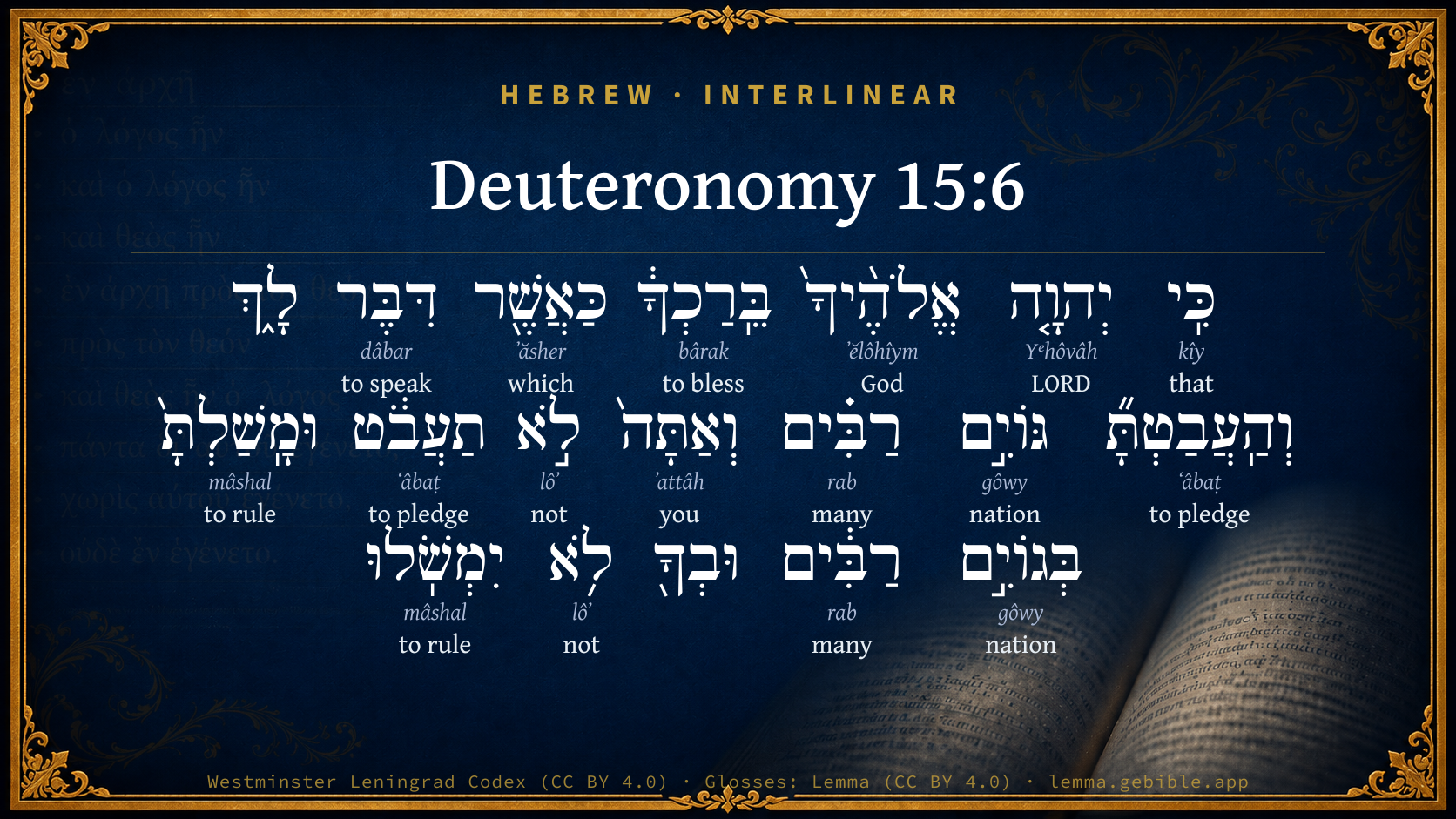
Hebrew (Westminster Leningrad Codex) Deuteronomy 15:6 appears in the Hebrew Old Testament. The text above is from the Westminster Leningrad Codex. Each word links to its Strong’s number, a concise gloss, and parsing drawn from the Open Scriptures Hebrew Bible morphology. Click any word for its full Brown-Driver-Briggs (BDB) entry.
Download image
Cite this verse

Deuteronomy 15:6 (World English Bible). Public Domain. Lemma interlinear Bible study tool, https://lemma.gebible.app/v/deuteronomy/15/6.

Show BibTeX & RIS
BibTeX
RIS
English Translation
For Yahweh your God will bless you, as he promised you: and you shall lend to many nations, but you shall not borrow; and you shall rule over many nations, but they shall not rule over you.
World English Bible · Public Domain
Highlights
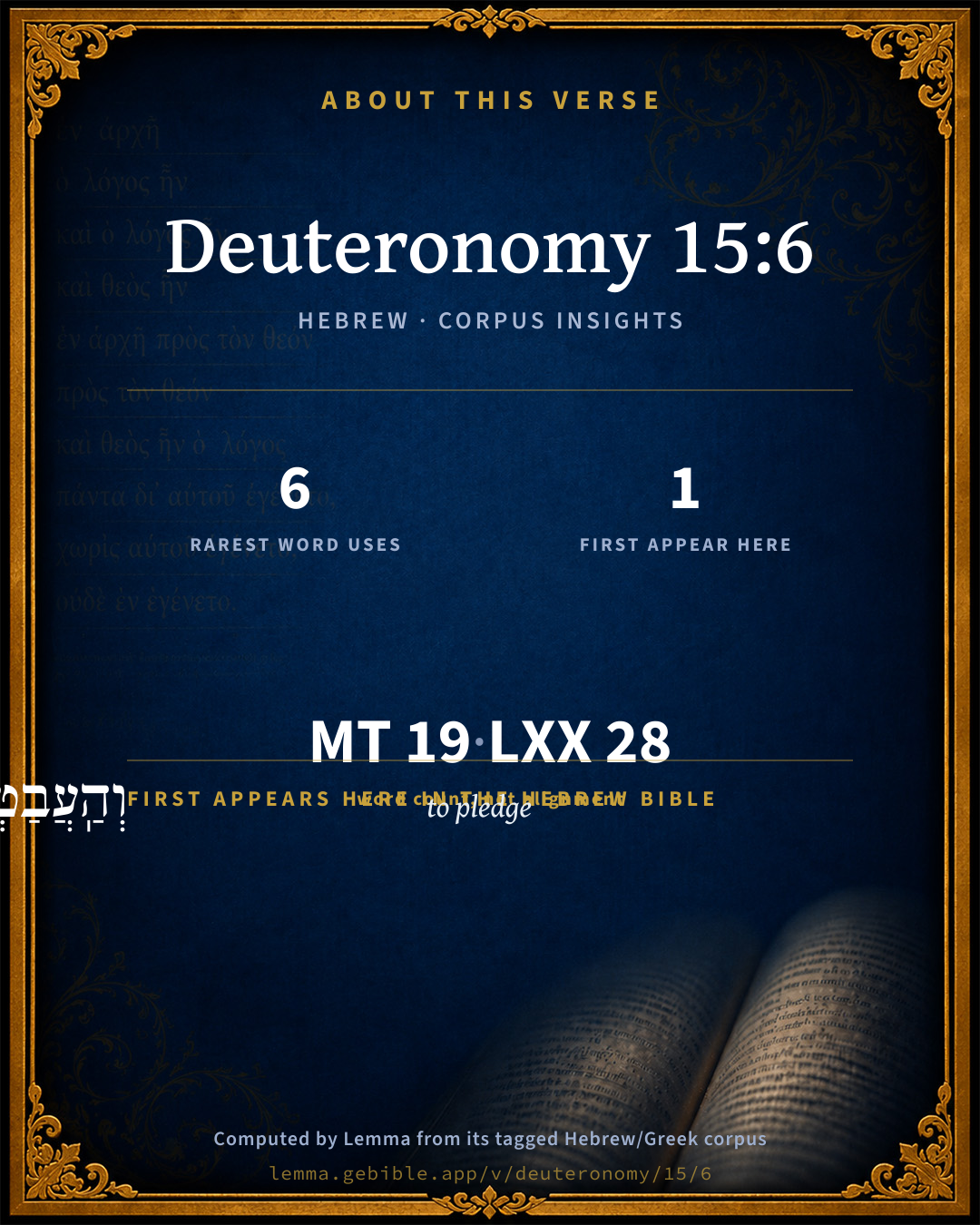
  • 1 first appearance in the Hebrew Bible
Full analysis ↓
Download a study sheet

One document with this verse’s original text, its word-by-word gloss line, the meaning frame, cross-references with their text, attributed commentary, and full source and license credits — printable, and it pastes into notes with its structure intact.

This verse Autodidact and up

Study sheet (.html) Plain text (.txt)

A passage Seminary Student

Up to 50 verses in one chapter. A passage sheet keeps up to 6 commentary sources and 12 cross-references per verse, in the order this page ranks them, and says so on the sheet whenever that leaves anything out. Ask for a single verse and you get the Autodidact verse sheet above.

Everything on this page stays free to read, with no account — the sheet is a download of what is already on screen, not access to it.

Want to remove ads? Support Godless Engineer
Compare translations 3

The same verse in 3 English versions, stacked beneath the original-language interlinear above. Click any original word for its lexicon entry.

Each is an independent rendering of the whole verse — the interlinear is not word-aligned to these translations.

Highlighted words mark where these versions differ — a whole-verse word diff, not a word-by-word alignment.

  • World English Bible Public Domain
    For Yahweh your God will bless you, as he promised you: and you shall lend to many nations, but you shall not borrow; and you shall rule over many nations, but they shall not rule over you.
  • King James Version Public Domain
    For the LORD thy God blesseth thee, as he promised thee: and thou shalt lend unto many nations, but thou shalt not borrow; and thou shalt reign over many nations, but they shall not reign over thee.
  • unfoldingWord Literal Text CC BY-SA 4.0
    For Yahweh your God will bless you, as he spoke to you; you will lend to many nations, and you, you will not borrow, and you will rule over many nations, and they will not rule over you.

unfoldingWord Literal Text — © unfoldingWord, licensed CC BY-SA 4.0. Word-aligned USFM3 via Door43 (git.door43.org/unfoldingWord/en_ult).

Versions to compare (up to 4)

3 of 4 selected

Show all 18 translations

Every available English version of this verse, each an independent rendering of the whole verse.

  • World English Bible Public Domain
    For Yahweh your God will bless you, as he promised you: and you shall lend to many nations, but you shall not borrow; and you shall rule over many nations, but they shall not rule over you.
  • Berean Standard Bible Public Domain
    When the LORD your God blesses you as He has promised, you will lend to many nations but borrow from none; you will rule over many nations but be ruled by none.
  • Majority Standard Bible Public Domain
    When the LORD your God blesses you as He has promised, you will lend to many nations but borrow from none; you will rule over many nations but be ruled by none.
  • King James Version Public Domain
    For the LORD thy God blesseth thee, as he promised thee: and thou shalt lend unto many nations, but thou shalt not borrow; and thou shalt reign over many nations, but they shall not reign over thee.
  • American Standard Version (1901) Public Domain
    For Jehovah thy God will bless thee, as he promised thee: and thou shalt lend unto many nations, but thou shalt not borrow; and thou shalt rule over many nations, but they shall not rule over thee.
  • Revised Version (1885) Public Domain
    For the LORD thy God will bless thee, as he promised thee: and thou shalt lend unto many nations, but thou shalt not borrow; and thou shalt rule over many nations, but they shall not rule over thee.
  • Geneva Bible (1599) Public Domain
    For the Lord thy God hath blessed thee, as he hath promised thee: and thou shalt lend vnto many nations, but thou thy selfe shalt not borow, and thou shalt reigne ouer many nations, and they shall not reigne ouer thee.
  • Douay-Rheims (1899) Public Domain
    Thou shalt lend to many nations, and thou shalt borrow of no man. Thou shalt have dominion over very many nations, and no one shall have dominion over thee.
  • Young's Literal Translation Public Domain
    for Jehovah thy God hath blessed thee as He hath spoken to thee; and thou hast lent `to' many nations, and thou hast not borrowed; and thou hast ruled over many nations, and over thee they do not rule.
  • Literal Standard Version CC BY-SA 4.0
    For your God YHWH has blessed you as He has spoken to you; and you have lent [to] many nations, but you have not borrowed; and you have ruled over many nations, but they do not rule over you.
  • Unlocked Literal Bible CC BY-SA 4.0
    For Yahweh your God will bless you, as he promised you; you will lend to many nations, but you will not borrow; you will rule over many nations, but they will not rule over you.
  • unfoldingWord Literal Text CC BY-SA 4.0
    For Yahweh your God will bless you, as he spoke to you; you will lend to many nations, and you, you will not borrow, and you will rule over many nations, and they will not rule over you.
  • Darby Bible Public Domain
    For Jehovah thy God will bless thee, as he promised thee; and thou shalt lend on pledge to many nations, but thou shalt not borrow; and thou shalt rule over many nations, but they shall not rule over thee.
  • World Messianic Bible Public Domain
    For the LORD your God will bless you, as he promised you. You will lend to many nations, but you will not borrow. You will rule over many nations, but they will not rule over you.
  • Webster's Bible Public Domain
    For the LORD thy God shall bless thee, as he promised thee: and thou shalt lend to many nations, but thou shalt not borrow; and thou shalt reign over many nations, but they shall not reign over thee.
  • Free Bible Version CC BY-SA 4.0
    The Lord your God is going to bless you as he promised. You will lend money to many nations but you won't need to borrow from any of them; you will rule over many nations but you won't be ruled by them.
  • Bible in Basic English Public Domain
    For the Lord your God will give you his blessing as he has said: you will let other nations have the use of your money, but you will not make use of theirs; you will be rulers over a number of nations, but they will not be your rulers.
  • JPS Tanakh (1917) Public Domain
    For the LORD thy God will bless thee, as He promised thee; and thou shalt lend unto many nations, but thou shalt not borrow; and thou shalt rule over many nations, but they shall not rule over thee.

Literal Standard Version (2020), Covenant Press — licensed CC BY-SA 4.0. Text via the HelloAO Bible API (eBible.org). Unlocked Literal Bible (unfoldingWord) — licensed CC BY-SA 4.0. Text via the HelloAO Bible API (eBible.org). unfoldingWord Literal Text — © unfoldingWord, licensed CC BY-SA 4.0. Word-aligned USFM3 via Door43 (git.door43.org/unfoldingWord/en_ult). Free Bible Version, Dr. Jonathan Gallagher — licensed CC BY-SA 4.0. Text via the HelloAO Bible API (eBible.org).

Word by word

More ways to search: Search by grammar → Find every occurrence → Compare this word →

Practice this passage: Drill this verse → Learn its vocabulary →

וְהַֽעֲבַטְתָּ֞
ʻâbaṭ
H5670
“and · to pledge”
Conjunction + Verb, Hiphil, Sequential Perfect, 2nd Person, Masculine, Singular
Part of Speech
Conjunction + Verb
Stem
Hiphil
Form
Sequential Perfect
Person
2nd Person
Gender
Masculine
Number
Singular
Full BDB Definition

Origin: a primitive root

TWOT: 1555

to take a pledge, give a pledge (for a debt) - (Qal) to take a pledge, give a pledge (for a debt) - (Piel) to interchange - (Hiphil) to cause to give a pledge
  1. כִּֽי kîy H3588 “that” Conjunction
  2. יְהוָ֤ה Yᵉhôvâh H3068 “LORD” Noun, Proper
  3. אֱלֹהֶ֨יךָ֙ ʼĕlôhîym H430 “God(s) · your” Noun, Common, Masculine, Plural, Construct + Suffix, Personal, 2nd Person, Masculine, Singular
  4. בֵּֽרַכְךָ֔ bârak H1288 “to bless · you” Verb, Piel, Perfect, 3rd Person, Masculine, Singular + Suffix, Personal, 2nd Person, Masculine, Singular
  5. כַּאֲשֶׁ֖ר ʼăsher H834 “like/as · which” Preposition + Particle, Relative
  6. דִּבֶּר dâbar H1696 “to speak” Verb, Piel, Perfect, 3rd Person, Masculine, Singular
  7. גּוֹיִ֣ם gôwy H1471 “nations” Noun, Common, Masculine, Plural, Absolute
  8. רַבִּ֗ים rab H7227 “many” Adjective, Adjective, Masculine, Plural, Absolute
  9. וְאַתָּה֙ ʼattâh H859 “and · you” Conjunction + Pronoun, Personal, 2nd Person, Masculine, Singular
  10. לֹ֣א lôʼ H3808 “not” Particle, Negative
  11. תַעֲבֹ֔ט ʻâbaṭ H5670 “to pledge” Verb, Qal, Imperfect, 2nd Person, Masculine, Singular
  12. וּמָֽשַׁלְתָּ֙ mâshal H4910 “and · to rule” Conjunction + Verb, Qal, Sequential Perfect, 2nd Person, Masculine, Singular
  13. בְּגוֹיִ֣ם gôwy H1471 “in/at · nations” Preposition + Noun, Common, Masculine, Plural, Absolute
  14. רַבִּ֔ים rab H7227 “many” Adjective, Adjective, Masculine, Plural, Absolute
  15. לֹ֥א lôʼ H3808 “not” Particle, Negative
  16. יִמְשֹֽׁלוּ mâshal H4910 “to rule” Verb, Qal, Imperfect, 3rd Person, Masculine, Plural

About this verse

These counts appear in no published source. They are computed here, from the morphology-tagged text and Lemma’s own curated glosses. What Lemma adds →

19
words
12
distinct lemmas
Pentateuch
section

Notable vocabulary

The rarest word here is וְהַֽעֲבַטְתָּ֞ to pledge H5670 — appearing just 6 times in the whole Hebrew Bible.

First appearance in Scripture

This word makes its first canonical appearance in the Hebrew Bible here:

  • וְהַֽעֲבַטְתָּ֞ to pledge H5670

Shared distinctive vocabulary

וְהַֽעֲבַטְתָּ֞ to pledge H5670 occurs in 4 verses of the Hebrew Bible. Also found in:

Grammatical profile

  • 6 verbs
  • 4 nouns
  • 2 adjectives
  • 1 pronoun
  • 2 prepositions
  • 1 conjunction
  • 3 particles

Verb forms

  • בֵּֽרַכְךָ֔ Piel · Perfect
  • דִּבֶּר Piel · Perfect
  • וְהַֽעֲבַטְתָּ֞ Hiphil · Sequential Perfect
  • תַעֲבֹ֔ט Qal · Imperfect
  • וּמָֽשַׁלְתָּ֙ Qal · Sequential Perfect
  • יִמְשֹֽׁלוּ Qal · Imperfect

Repetition

Words recur within this verse — often emphatic in Hebrew:

  • וְהַֽעֲבַטְתָּ֞ to pledge H5670 ×2
  • גּוֹיִ֣ם nation H1471 ×2
  • רַבִּ֗ים many H7227 ×2
  • וּמָֽשַׁלְתָּ֙ to rule H4910 ×2
  • לֹ֣א not H3808 ×2

Hebrew & Septuagint length

In English translation the verse runs 37 words from the Hebrew and 43 from the Septuagint (LXX English) — closely comparable.

A rough comparison of the two English renderings, which tokenize alike — not a word-level alignment.

Word counts can differ between the Hebrew and the Greek without any difference in meaning — e.g. the Hebrew direct-object marker אֵת has no separate Greek word, and Greek often adds the article ὁ.

In the original languages it is 19 Hebrew tokens and 28 Greek tokens — but the two are counted differently (Hebrew bundles its prefixes and suffixes into one token; the Greek is in lemma form), so that isn’t a like-for-like length.

Cross-references

12

Topical passages linked to Deuteronomy 15:6 in the Treasury of Scripture Knowledge — connected by theme and wording, ordered by reader-vote popularity; previews shown in the World English Bible.

  • Deuteronomy 28:12–13 Yahweh will open to you his good treasure in the sky, to give the rain of your land in its season, and to bless all the work of your hand: and you shall lend to many nations, and you shall not borrow.
  • 1 Kings 4:21 Solomon ruled over all the kingdoms from the River to the land of the Philistines, and to the border of Egypt: they brought tribute, and served Solomon all the days of his life.
  • Luke 6:35 But love your enemies, and do good, and lend, expecting nothing back; and your reward will be great, and you will be children of the Most High; for he is kind toward the unthankful and evil.
  • Nehemiah 9:27 Therefore you delivered them into the hand of their adversaries, who distressed them: and in the time of their trouble, when they cried to you, you heard from heaven; and according to your manifold mercies you gave them saviors who saved them out of the hand of their adversaries.
  • Proverbs 22:7 The rich rule over the poor. The borrower is servant to the lender.
  • Ezra 4:20 There have been mighty kings also over Jerusalem, who have ruled over all [the country] beyond the River; and tribute, custom, and toll, was paid to them.
  • Psalms 37:21 The wicked borrow, and don't pay back, But the righteous give generously.
  • 1 Kings 4:24 For he had dominion over all [the region] on this side the River, from Tiphsah even to Gaza, over all the kings on this side the River: and he had peace on all sides round about him.
  • Psalms 37:26 All day long he deals graciously, and lends. His seed is blessed.
  • Psalms 112:5 It is well with the man who deals graciously and lends. He will maintain his cause in judgment.
  • Deuteronomy 28:44 He shall lend to you, and you shall not lend to him: he shall be the head, and you shall be the tail.
  • 2 Chronicles 9:26 He ruled over all the kings from the River even to the land of the Philistines, and to the border of Egypt.

Cross-references courtesy of OpenBible.info (CC BY 4.0).

Hebrew and Greek witnesses Masoretic Hebrew ↔ Greek Septuagint

The same verse in the two great witnesses to the Old Testament, shown verse-for-verse.

These are two independent witnesses, not word-aligned to each other, and the Septuagint is shown in lemma (dictionary) form.

Hebrew Deuteronomy 15:6 Masoretic · Westminster Leningrad Codex

כִּֽי יְהוָ֤ה אֱלֹהֶ֨יךָ֙ בֵּֽרַכְךָ֔ כַּאֲשֶׁ֖ר דִּבֶּר לָ֑ךְ וְהַֽעֲבַטְתָּ֞ גּוֹיִ֣ם רַבִּ֗ים וְאַתָּה֙ לֹ֣א תַעֲבֹ֔ט וּמָֽשַׁלְתָּ֙ בְּגוֹיִ֣ם רַבִּ֔ים וּבְךָ֖ לֹ֥א יִמְשֹֽׁלוּ

For Yahweh your God will bless you, as he promised you: and you shall lend to many nations, but you shall not borrow; and you shall rule over many nations, but they shall not rule over you.

World English Bible · Public Domain

Greek LXX Deuteronomy 15:6 Septuagint · lemma form

ὅτι κύριος ὁ θεός σύ εὐλογέω σύ ὅς τρόπος λαλέω σύ καί δανείζω ἔθνος πολύς σύ δέ οὐ δανείζω καί ἄρχω σύ ἔθνος πολύς σύ δέ οὐ ἄρχω

(for the Lord your God has blessed you in the way of which he spoke to you,) then you shall lend to many nations, but you shall not borrow; and you shall rule over many nations, but they shall not rule over you.

LXX2012 (modern English Septuagint) · Public Domain

On this verse, The Cambridge Bible for Schools and Colleges discusses the Septuagint’s reading. Read the note in Commentary ↓

Hebrew: Westminster Leningrad Codex (CC BY 4.0). Greek: Septuagint (public domain); English from LXX2012 (modern English Septuagint) (Public Domain). How the Septuagint differs from the Hebrew →

Targum (Aramaic paraphrase)

2

The Targum is the ancient Jewish Aramaic paraphrase of the Hebrew Scriptures — an interpretive translation, not the Hebrew text itself. Onkelos (literal) and Pseudo-Jonathan (expansive) render the Torah, and Jonathan the Prophets. Coverage is partial: where no permissively-licensed English translation exists for a verse, only the Aramaic is shown. This is verse-level text, not a word-by-word alignment to the Hebrew.

  1. Targum Onkelos Torah (Genesis–Deuteronomy)
    אֲרֵי יְיָ אֱלָהָךְ בָּרְכָךְ כְּמָא דִי מַלִיל לָךְ וְתוֹזֵף לְעַמְמִין סַגִיאִין וְאַתְּ לָא תְזוּף וְתִשְׁלוֹט בְּעַמְמִין סַגִיאִין וּבָךְ לָא יִשְׁלְטוּן

    (no public-domain English translation for this verse)

    Targum Onkelos — Aramaic: “Onkelos Genesis” (public domain); “Onkelos Exodus” (public domain); “Onkelos Leviticus” (public domain); “Onkelos Numbers” (public domain); “Onkelos Deuteronomy” (public domain). English: “Sefaria Community Translation” (CC0 1.0 (public-domain dedication)); “J.W. Etheridge. The Targums of Onkelos and Jonathan Ben Uzziel on the Pentateuch. London: Longmans, Green, 1862” (public domain). Text via Sefaria.

  2. Targum Pseudo-Jonathan Torah (Genesis–Deuteronomy)
    אֲרוּם יְיָ אֱלָהָכוֹן בֵּירַכְכוֹן הֵיכְמָא דְמַלֵּיל לְכוֹן וּתְמַשְׁכְּנוּן עַמְמִין סַגִּיאִין וְאַתּוּן לָא תִתְמַשְׁכְּנוּן וְתִשְׁלְטוּן בְּעַמְמִין סַגִּיאִין וּבְכוֹן לָא יִשְׁלְטוּן

    For the Lord your God blesseth you, as He saith to you (that) you shall take from many nations, but they will not take from you; and you will have power over many nations, but they shall not have power over you.

    Targum Pseudo-Jonathan — Aramaic: “Targum Jonathan on Genesis” (public domain); “Targum Jonathan on Exodus” (public domain); “Targum Jonathan on Leviticus” (public domain); “Targum Jonathan on Numbers” (public domain); “Targum Jonathan on Deuteronomy” (public domain). English: “The Targum of Jonathan ben Uzziel, trans. J. W. Etheridge, London, 1862” (public domain). Text via Sefaria.

Commentary

Notes on Deuteronomy 15:6 from classic Christian and Jewish commentators (each source and its license shown beneath its notes). The classic Christian expositions comment on the surrounding passage and are grouped to its opening verse, so a note may address several verses; the Jewish commentaries on the Tanakh (Rashi and others) are per-verse, so they appear only where the commentator wrote on this verse.

Lemma curates 59 commentaries, every one of them public domain or Creative Commons licensed, each selected and text-cleaned for this edition rather than reprinted as found. About our sources →

Tyndale Open Study Notes

Tyndale Open Resources

15:6 You will lend money to many nations: An obedient Israel would become an affluent nation able to provide international aid. This bounty would bear testimony to God’s promise to Abraham that his seed would be a blessing to all nations (Gen 12:2-3; 17:4-6; 26:3-4).

Tyndale Open Study Notes — © Tyndale Open Resources, licensed CC BY-SA 4.0. Text via the HelloAO Bible API.

Ellicott's Commentary for English Readers

(6) As he promised thee.—“1 will bless thee” was said to Abram (Gen_12:2).

Thou Shalt lend.—The root of the word in Hebrew is closely connected with the word for “slave.” “The borrower is servant to the lender” (Pro_22:7).

A Bible Commentary for English Readers, edited by Charles John Ellicott (1878–1897) — public domain. Text from a community e-Sword module.

The Cambridge Bible for Schools and Colleges

gen. ed. J. J. S. Perowne

6. will bless thee] Heb. is stronger, shall have blessed thee.

thou shalt lend unto many nations, but thou shalt not borrow] Heb. shalt take, but shalt not give, pledges; cp. 8, Deu_24:10-13. This promise of a large foreign commerce, repeated Deu_28:12 f. (with the contrast in 43 f.) is peculiar to D among the codes of Israel. It covers, of course, not only the lending of money and bullion (banking proper), but the sale of goods on credit at interest, to other nations. Such a foreign trade appears to have flourished with great profit both to Judah and Israel under the long contemporary reigns of Uzziah and Jeroboam II (Isa_2:7; Hos_12:7). There was large commerce with foreigners under Manasseh: cp. Ezekiel’s name for Jerusalem, the gate of the peoples (Deu_26:2, LXX), and the king of Persia’s refusal to allow the walls of Jerusalem to be rebuilt lest her former power of exacting tolls and customs should revive (Ezr_4:20). It is striking, however, that the fulfilment of D’s promise was most fully realised not while Israel remained on their own land but after their dispersion among the nations, from the Greek period onwards. Strabo’s words (quoted in Jos. XIV. Antt. vii. 2) are a remarkable acknowledgement of the political as well as financial superiority foreseen by D for Israel: ‘These Jews have penetrated to every city and it would not be easy to find a single place in the inhabited world which has not received this race, and where it has not become master.’ See further Jerusalem, i. 370 f., ii. 193 f., 392 ff.

The Cambridge Bible for Schools and Colleges (gen. ed. J. J. S. Perowne; Cambridge University Press, 1878–1918) — public domain. Text from a community e-Sword module.

John Gill's Exposition

For the Lord thy God blesseth thee, as he promised thee,.... He is faithful that has promised, and he always gives the blessing he promises according to the nature of the promise; if absolute, and without conditions, he gives it without respect to any; but if conditional, as the promises of temporal good things to Israel were, he gives according as the condition is performed:

and thou shalt lend unto many nations, but thou shall not borrow; signifying they should be so rich and increased in goods, and worldly substance, that they should be able to lend to their neighbouring nations round about, but should stand in no need of borrowing of any of them. This is sometimes said of the language of these people, the Hebrew language, that it lends to all, but borrows of none, being an original primitive language; see Deu 28:12.

and thou shalt reign over many nations: which was fulfilled in the times of David and Solomon:

but they shall not reign over thee; that is, as long as they observed the commands of God; otherwise, when they did not, they were carried captive into other countries, and other people reigned over them, as at this day.

John Gill's Exposition of the Whole Bible (1746–1763) — public domain (CC PDM 1.0). Text via the HelloAO Bible API.

Haydock's Catholic Bible Commentary

Lend. The Jews give a wrong interpretation to this passage, to authorize usury with regard to strangers. But God can never sanction injustice. He promises such riches to his people, if they be faithful, that they shall be in a condition to lend to many, without wanting themselves. (Calmet) --- Over thee. Hence the Jews submitted to a foreign yoke with so much reluctance. But they should have remembered to keep God’s law. (Haydock)

George Leo Haydock (1774–1849), Haydock's Catholic Family Bible and Commentary, 1859 edition — public domain. Excludes Psalms (Douay-Rheims chapter numbering differs from Protestant) and Deuterocanonical books (Catholic canon only).

Matthew Poole's English Annotations

Thou shalt lend unto many; thou shalt be rich and able to lend not only to thy poor brother, but even to strangers of other nations, yea, to many of them.

Matthew Poole's English Annotations on the Holy Bible (1683–1685) — public domain. Text from a community e-Sword/MySword module.

Rashi

Rabbi Shlomo Yitzchaki (Rashi)

כאשר דבר לך [FOR THE LORD GOD BLESSETH THEE] AS HE PROMISED THEE — and where did He promise you this? In the statement, (Deuteronomy 28:3—12) “Blessed shalt thou be in the city, etc.” (Sifrei Devarim 116:1).

והעבטת AND THOU SHALT LEND ON PLEDGE — In the case of every term that denotes transacting a loan when it refers to the lender, the Hiphil form is appropriate to it (to cause a person to do something: here, “you will make many people to be borrowers” i.e. you will lend to them), as for instance, והעבטת, והלוית; while if it stated וְעָבַטְתָּ (in the Kal), it would apply to the borrower, meaning “thou wilt borrow on pledge”, the same as ולוית (“and thou will borrow”, which in Kal refers to the borrower).

והעבטת גוים AND THOU SHALT LEND ON PLEDGE UNTO [MANY] NATIONS — One might think that you might do this in that you will borrow from one nation and lend to another! Scripture, however, states, “but you shall not borrow” (Sifrei Devarim 116:2).

ומשלת בגוים רבים AND THOU SHALT RULE OVER MANY NATIONS — One might think that at the very same time other nations will be ruling over you! Scripture, however, states, “but they shall not rule over you (Sifrei Devarim 116:3).

Rashi on the Tanakh — English translations: “The Judaica Press complete Tanach with Rashi, translated by A. J. Rosenberg” (CC BY 4.0); “Pentateuch with Rashi's commentary by M. Rosenbaum and A.M. Silbermann, 1929-1934” (public domain); “The Metsudah Tanach series, Lakewood, N.J” (CC BY 4.0); and “The Book of Joshua, Metsudah Publications, 1997” (CC BY 4.0). Text via Sefaria.

Lesson kit

Teaching starters — assembled from the data on this page, not authored interpretation. Every prompt links to the verse data it draws on. Edit before teaching.

Deuteronomy, in the Pentateuch, opens this verse with 19 words (12 distinct Hebrew lemmas). Its most distinctive word is ʻâbaṭ (“to pledge”). A historical commentator’s framing appears above. Read the whole chapter for the surrounding context.

Discussion questions

  1. How does “to pledge” (ʻâbaṭ) shape what this verse is saying?
  2. This is the first place “to pledge” appears in Scripture (first appears here). What does its debut here establish?
  3. How does Deuteronomy 15:8, which shares the word «to pledge», read alongside this verse?
  4. What does the repetition of “to pledge” (2× in this one verse) do in this verse?
  5. The translations on this page render this verse differently — a whole-verse word diff, not a word-by-word alignment. What might account for the different wordings?
  6. «בֵּֽרַכְךָ֔» is a Piel Perfect verb. How does that grammatical form shape the action described?
  7. Compare how Tyndale Open Study Notes and Ellicott's Commentary for English Readers read this verse. Where do they agree or differ?

Things to notice

Reading settings

Reading text

Shown beneath each verse's original-language words.

Old Testament
Old Testament edition

Read the OT as the Masoretic Hebrew (MT) or the Greek Septuagint (LXX).

English shown for the Greek Septuagint (in the Hebrew ↔ Greek comparison).

Comparing translations? Open the Compare panel on any verse page to stack up to four side by side.