Leviticus 25:44

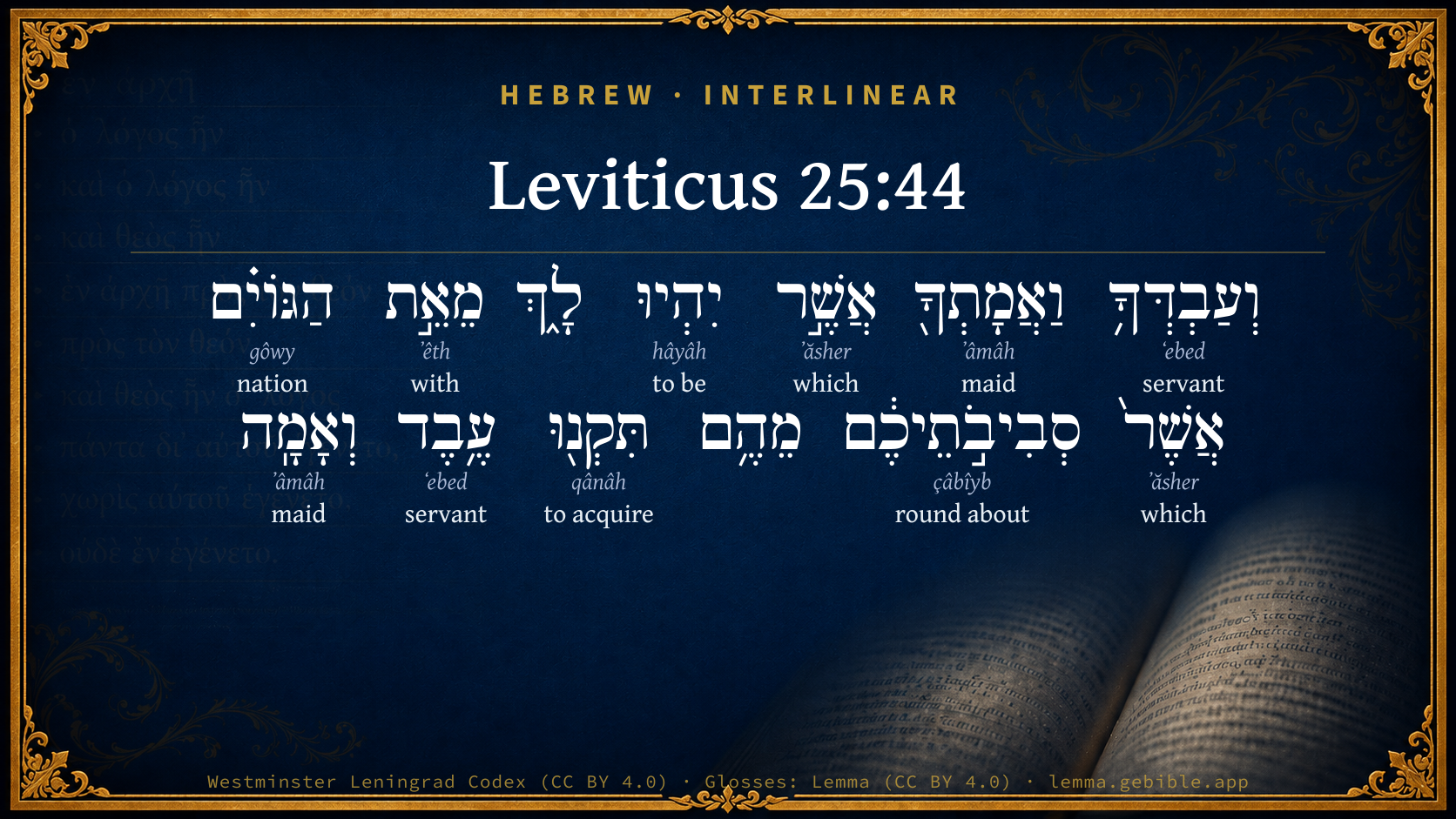
Hebrew (Westminster Leningrad Codex) Leviticus 25:44 appears in the Hebrew Old Testament. The text above is from the Westminster Leningrad Codex. Each word links to its Strong’s number, a concise gloss, and parsing drawn from the Open Scriptures Hebrew Bible morphology. Click any word for its full Brown-Driver-Briggs (BDB) entry.
Download image
Cite this verse

Leviticus 25:44 (World English Bible). Public Domain. Lemma interlinear Bible study tool, https://lemma.gebible.app/v/leviticus/25/44.

Show BibTeX & RIS
BibTeX
RIS
English Translation
"'As for your male and your female slaves, whom you may have; of the nations that are around you, from them you may buy male and female slaves.
World English Bible · Public Domain
Download a study sheet

One document with this verse’s original text, its word-by-word gloss line, the meaning frame, cross-references with their text, attributed commentary, and full source and license credits — printable, and it pastes into notes with its structure intact.

This verse Autodidact and up

Study sheet (.html) Plain text (.txt)

A passage Seminary Student

Up to 50 verses in one chapter. A passage sheet keeps up to 6 commentary sources and 12 cross-references per verse, in the order this page ranks them, and says so on the sheet whenever that leaves anything out. Ask for a single verse and you get the Autodidact verse sheet above.

Everything on this page stays free to read, with no account — the sheet is a download of what is already on screen, not access to it.

Want to remove ads? Support Godless Engineer
Compare translations 3

The same verse in 3 English versions, stacked beneath the original-language interlinear above. Click any original word for its lexicon entry.

Each is an independent rendering of the whole verse — the interlinear is not word-aligned to these translations.

Highlighted words mark where these versions differ — a whole-verse word diff, not a word-by-word alignment.

  • World English Bible Public Domain
    "'As for your male and your female slaves, whom you may have; of the nations that are around you, from them you may buy male and female slaves.
  • King James Version Public Domain
    Both thy bondmen, and thy bondmaids, which thou shalt have, shall be of the heathen that are round about you; of them shall ye buy bondmen and bondmaids.
  • unfoldingWord Literal Text CC BY-SA 4.0
    And your male slave and your female slave who are to you—from the nations who around you, from them you may buy a male slave and a female slave.

unfoldingWord Literal Text — © unfoldingWord, licensed CC BY-SA 4.0. Word-aligned USFM3 via Door43 (git.door43.org/unfoldingWord/en_ult).

Versions to compare (up to 4)

3 of 4 selected

Show all 18 translations

Every available English version of this verse, each an independent rendering of the whole verse.

  • World English Bible Public Domain
    "'As for your male and your female slaves, whom you may have; of the nations that are around you, from them you may buy male and female slaves.
  • Berean Standard Bible Public Domain
    Your menservants and maidservants shall come from the nations around you, from whom you may purchase them.
  • Majority Standard Bible Public Domain
    Your menservants and maidservants shall come from the nations around you, from whom you may purchase them.
  • King James Version Public Domain
    Both thy bondmen, and thy bondmaids, which thou shalt have, shall be of the heathen that are round about you; of them shall ye buy bondmen and bondmaids.
  • American Standard Version (1901) Public Domain
    And as for thy bondmen, and thy bondmaids, whom thou shalt have; of the nations that are round about you, of them shall ye buy bondmen and bondmaids.
  • Revised Version (1885) Public Domain
    And as for thy bondmen, and thy bondmaids, which thou shalt have; of the nations that are round about you, of them shall ye buy bondmen and bondmaids.
  • Geneva Bible (1599) Public Domain
    Thy bond seruant also, and thy bond maid, which thou shalt haue, shalbe of the heathen that are rounde about you: of them shall ye bye seruants and maydes.
  • Douay-Rheims (1899) Public Domain
    Let your bondmen, and your bondwomen, be of the nations that are round about you.
  • Young's Literal Translation Public Domain
    `And thy man-servant and thy handmaid whom thou hast `are' of the nations who `are' round about you; of them ye buy man-servant and handmaid,
  • Literal Standard Version CC BY-SA 4.0
    And your manservant and your handmaid whom you have [are] from the nations who [are] around you; you buy manservant and handmaid from them,
  • Unlocked Literal Bible CC BY-SA 4.0
    As for your male and female slaves, whom you can obtain from the nations who live around you, you may buy slaves from them.
  • unfoldingWord Literal Text CC BY-SA 4.0
    And your male slave and your female slave who are to you—from the nations who around you, from them you may buy a male slave and a female slave.
  • Darby Bible Public Domain
    And as for thy bondman and thy handmaid whom thou shalt have -- of the nations that are round about you, of them shall ye buy bondmen and handmaids.
  • World Messianic Bible Public Domain
    “‘As for your male and your female slaves, whom you may have from the nations that are around you, from them you may buy male and female slaves.
  • Webster's Bible Public Domain
    Both thy bond-men, and thy bond-maids, which thou shalt have, shall be of the heathen that are around you; of them shall ye buy bond-men and bond-maids.
  • Free Bible Version CC BY-SA 4.0
    Buy your male and female slaves from the surrounding nations.
  • Bible in Basic English Public Domain
    But you may get servants as property from among the nations round about; from them you may take men-servants and women-servants.
  • JPS Tanakh (1917) Public Domain
    And as for thy bondmen, and thy bondmaids, whom thou mayest have: of the nations that are round about you, of them shall ye buy bondmen and bondmaids.

Literal Standard Version (2020), Covenant Press — licensed CC BY-SA 4.0. Text via the HelloAO Bible API (eBible.org). Unlocked Literal Bible (unfoldingWord) — licensed CC BY-SA 4.0. Text via the HelloAO Bible API (eBible.org). unfoldingWord Literal Text — © unfoldingWord, licensed CC BY-SA 4.0. Word-aligned USFM3 via Door43 (git.door43.org/unfoldingWord/en_ult). Free Bible Version, Dr. Jonathan Gallagher — licensed CC BY-SA 4.0. Text via the HelloAO Bible API (eBible.org).

Word by word

More ways to search: Search by grammar → Find every occurrence → Compare this word →

Practice this passage: Drill this verse → Learn its vocabulary →

וַאֲמָתְךָ֖
ʼâmâh
H519
“and · maid · your”
Conjunction + Noun, Common, Feminine, Singular, Construct + Suffix, Personal, 2nd Person, Masculine, Singular
Part of Speech
Conjunction + Noun
Type
Common
Gender
Feminine
Number
Singular
State
Construct
Full BDB Definition

Origin: apparently a primitive word

TWOT: 112

maid-servant, female slave, maid, handmaid, concubine - of humility (figuratively)
  1. וְעַבְדְּךָ֥ ʻebed H5650 “and · servant · your” Conjunction + Noun, Common, Masculine, Singular, Construct + Suffix, Personal, 2nd Person, Masculine, Singular
  2. אֲשֶׁ֣ר ʼăsher H834 “which” Particle, Relative
  3. יִהְיוּ hâyâh H1961 “to be” Verb, Qal, Imperfect, 3rd Person, Masculine, Plural
  4. מֵאֵ֣ת ʼêth H854 “from · with” Preposition + Preposition
  5. הַגּוֹיִ֗ם gôwy H1471 “the · nations” Particle, Definite Article + Noun, Common, Masculine, Plural, Absolute
  6. אֲשֶׁר֙ ʼăsher H834 “which” Particle, Relative
  7. סְבִיבֹ֣תֵיכֶ֔ם çâbîyb H5439 “surroundings · your” Noun, Common, Both, Plural, Construct + Suffix, Personal, 2nd Person, Masculine, Plural
  8. תִּקְנ֖וּ qânâh H7069 “to acquire” Verb, Qal, Imperfect, 2nd Person, Masculine, Plural
  9. עֶ֥בֶד ʻebed H5650 “servant” Noun, Common, Masculine, Singular, Absolute
  10. וְאָמָֽה ʼâmâh H519 “and · maid” Conjunction + Noun, Common, Feminine, Singular, Absolute

About this verse

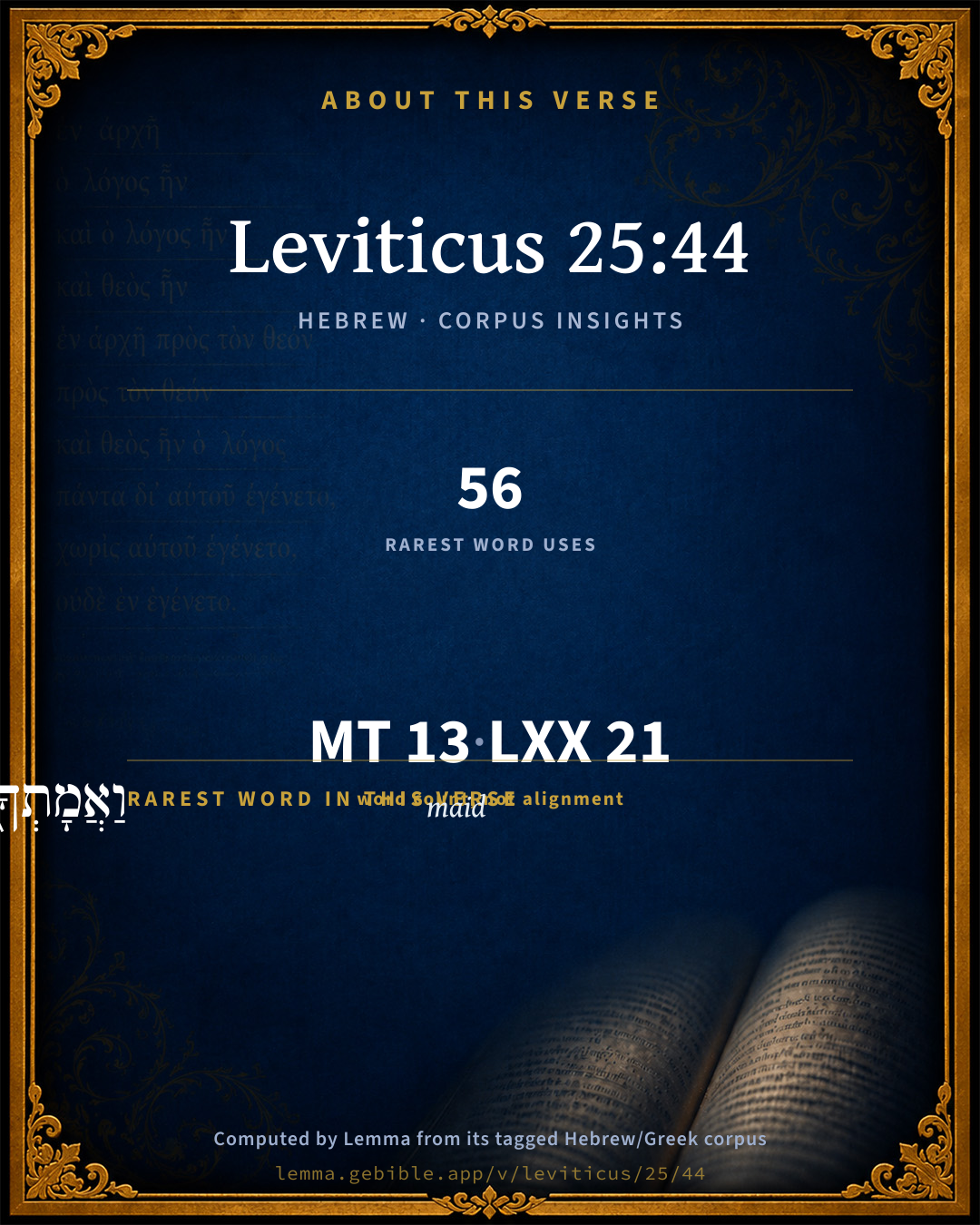
These counts appear in no published source. They are computed here, from the morphology-tagged text and Lemma’s own curated glosses. What Lemma adds →

13
words
8
distinct lemmas
Pentateuch
section

Shared distinctive vocabulary

וַאֲמָתְךָ֖ maid H519 occurs in 49 verses of the Hebrew Bible. Also found in:

Grammatical profile

  • 2 verbs
  • 6 nouns
  • 3 prepositions
  • 2 particles

Verb forms

  • יִהְיוּ Qal · Imperfect
  • תִּקְנ֖וּ Qal · Imperfect

Repetition

Words recur within this verse — often emphatic in Hebrew:

  • וְעַבְדְּךָ֥ servant H5650 ×2
  • וַאֲמָתְךָ֖ maid H519 ×2
  • אֲשֶׁ֣ר which H834 ×2

Hebrew & Septuagint length

In English translation the verse runs 28 words from the Hebrew and 25 from the Septuagint (LXX English) — closely comparable.

A rough comparison of the two English renderings, which tokenize alike — not a word-level alignment.

Word counts can differ between the Hebrew and the Greek without any difference in meaning — e.g. the Hebrew direct-object marker אֵת has no separate Greek word, and Greek often adds the article ὁ.

In the original languages it is 13 Hebrew tokens and 21 Greek tokens — but the two are counted differently (Hebrew bundles its prefixes and suffixes into one token; the Greek is in lemma form), so that isn’t a like-for-like length.

Cross-references

4

Topical passages linked to Leviticus 25:44 in the Treasury of Scripture Knowledge — connected by theme and wording, ordered by reader-vote popularity; previews shown in the World English Bible.

  • Exodus 12:44 but every man's servant who is bought for money, when you have circumcised him, then shall he eat of it.
  • Psalms 2:8–9 Ask of me, and I will give the nations for your inheritance, The uttermost parts of the earth for your possession.
  • Isaiah 14:1–2 For Yahweh will have compassion on Jacob, and will yet choose Israel, and set them in their own land: and the foreigner shall join himself with them, and they shall cleave to the house of Jacob.
  • Revelation 2:26–27 He who overcomes, and he who keeps my works to the end, to him I will give authority over the nations.

Cross-references courtesy of OpenBible.info (CC BY 4.0).

Hebrew and Greek witnesses Masoretic Hebrew ↔ Greek Septuagint

The same verse in the two great witnesses to the Old Testament, shown verse-for-verse.

These are two independent witnesses, not word-aligned to each other, and the Septuagint is shown in lemma (dictionary) form.

Hebrew Leviticus 25:44 Masoretic · Westminster Leningrad Codex

וְעַבְדְּךָ֥ וַאֲמָתְךָ֖ אֲשֶׁ֣ר יִהְיוּ לָ֑ךְ מֵאֵ֣ת הַגּוֹיִ֗ם אֲשֶׁר֙ סְבִיבֹ֣תֵיכֶ֔ם מֵהֶ֥ם תִּקְנ֖וּ עֶ֥בֶד וְאָמָֽה

"'As for your male and your female slaves, whom you may have; of the nations that are around you, from them you may buy male and female slaves.

World English Bible · Public Domain

Greek LXX Leviticus 25:44 Septuagint · lemma form

καί παῖς καί παιδίσκη ὅσος ἄν γίγνομαι σύ ἀπό ὁ ἔθνος ὅσος κύκλος σύ εἰμί ἀπό αὐτός κτάομαι δοῦλος καί δούλη

And whatever number of menservants and maidservants you shall have, you shall purchase male and female servants from the nations that are round about you.

LXX2012 (modern English Septuagint) · Public Domain

Hebrew: Westminster Leningrad Codex (CC BY 4.0). Greek: Septuagint (public domain); English from LXX2012 (modern English Septuagint) (Public Domain). How the Septuagint differs from the Hebrew →

Targum (Aramaic paraphrase)

2

The Targum is the ancient Jewish Aramaic paraphrase of the Hebrew Scriptures — an interpretive translation, not the Hebrew text itself. Onkelos (literal) and Pseudo-Jonathan (expansive) render the Torah, and Jonathan the Prophets. Coverage is partial: where no permissively-licensed English translation exists for a verse, only the Aramaic is shown. This is verse-level text, not a word-by-word alignment to the Hebrew.

  1. Targum Onkelos Torah (Genesis–Deuteronomy)
    וְעַבְדָךְ וְאַמְתָךְ דִי יְהוֹן לָךְ מִן עַמְמַיָא דִי בְסַחֲרָנֵיכוֹן מִנְהוֹן תִּקְנוּן עַבְדִין וְאַמְהָן

    (no public-domain English translation for this verse)

    Targum Onkelos — Aramaic: “Onkelos Genesis” (public domain); “Onkelos Exodus” (public domain); “Onkelos Leviticus” (public domain); “Onkelos Numbers” (public domain); “Onkelos Deuteronomy” (public domain). English: “Sefaria Community Translation” (CC0 1.0 (public-domain dedication)); “J.W. Etheridge. The Targums of Onkelos and Jonathan Ben Uzziel on the Pentateuch. London: Longmans, Green, 1862” (public domain). Text via Sefaria.

  2. Targum Pseudo-Jonathan Torah (Genesis–Deuteronomy)
    בְּרַם עַבְדֵיכוֹן וְאַמְהָתֵיכוֹן דִיהוֹן לְכוֹן מִן אַמְהַתְכוֹן דְמִן עַמְמַיָא דִי בְּחַזְרָנוּתֵיכוֹן מִנְהוֹן תְּזַבְּנוּן עַבְדִין וְאַמְהָן

    But your bondmen and your handmaids which you may have, of the handmaids of the Gentiles, of them you may purchase bondmen and handmaids.

    Targum Pseudo-Jonathan — Aramaic: “Targum Jonathan on Genesis” (public domain); “Targum Jonathan on Exodus” (public domain); “Targum Jonathan on Leviticus” (public domain); “Targum Jonathan on Numbers” (public domain); “Targum Jonathan on Deuteronomy” (public domain). English: “The Targum of Jonathan ben Uzziel, trans. J. W. Etheridge, London, 1862” (public domain). Text via Sefaria.

Commentary

Notes on Leviticus 25:44 from classic Christian and Jewish commentators (each source and its license shown beneath its notes). The classic Christian expositions comment on the surrounding passage and are grouped to its opening verse, so a note may address several verses; the Jewish commentaries on the Tanakh (Rashi and others) are per-verse, so they appear only where the commentator wrote on this verse.

Lemma curates 59 commentaries, every one of them public domain or Creative Commons licensed, each selected and text-cleaned for this edition rather than reprinted as found. About our sources →

Trapp's Complete Commentary

John Trapp

Lev 25:44 Both thy bondmen, and thy bondmaids, which thou shalt have, [shall be] of the heathen that are round about you; of them shall ye buy bondmen and bondmaids.

Ver. 44. Both thy bondmen.] Reprobates might be hereby figured.

John Trapp, A Commentary or Exposition upon All the Books of the Old and New Testament (1647–1656) — public domain. Text from a community e-Sword module.

Whedon's Commentary on the Bible

Daniel D. Whedon

NON-HEBREW SERVANTS, Lev_25:44-46.

44. Of the heathen… shall ye buy bondmen — Literally, man-servants and maid-servants. The “shall” is not mandatory but permissive. “Such purchase and adoption into Hebrew families was an appointed redemption from a worse state. There could not, consequently, be any sentiment of injustice, under this revealed will of God, in regard to the purchase from heathen masters of servants possessed by them as slaves, and treated as such, since they were brought from an irresponsible, unlimited slavery into a system of guardianship, protection, religious instruction, and family and national privileges. The children of such would be circumcised, adopted, and become sons of the house. In no other way than by purchase could the Hebrews redeem them, even if they had started on the emancipation of the nations. If they had been forbidden to buy, and had been restricted to hired servants of their own race alone, they could not have gotten possession of heathen slaves, even to redeem them, except as runaways; and thus multitudes would have been kept in heathen bondage, who, the moment they passed into Hebrew bondage, passed into a state of comparative freedom.” — Dr. Cheever. The Hebrew construction of these words is not “ye shall purchase of the nations,” but of the servants that have come to you from among those nations. A slave-market was never known in Palestine, nor a slave-trader.

Heathen… round about — These words exclude the Canaanite tribes in the land, who had been doomed to complete extermination. Deu_20:16-19. But since this sentence was not executed, the remnants were subjected to compulsory service. Jdg_1:28; Jdg_1:30, note.

Daniel D. Whedon (gen. ed.), Commentary on the Old and New Testaments (1874–1909) — public domain. Text from a community e-Sword module.

Tyndale Open Study Notes

Tyndale Open Resources

25:44-46 Slaves in Mesopotamia and Egypt were little more than chattel, with no protection or rights. Israelites were allowed to purchase non-Israelites as slaves, but they were to be treated well and not abused. Occasionally some slaves were even adopted into childless families (Gen 15:2-4). Slavery continued into New Testament times, but the foundations had been laid for its dissolution in the Old Testament doctrine of the common origins of all humankind through God. Slavery stemmed from the Fall, when relationships based on power replaced those of fellowship and communication (see Gen 3:16). In the New Testament, believers uphold the ideas of fellowship and communication by accepting the title “Christ’s slave” or “servant” (Rom 1:1; Col 4:12; 2 Pet 1:1). In Paul’s doctrine of the body of Christ (1 Cor 12:27; Eph 4:12), all believers acquired a common identity (Gal 3:28; Col 3:11; Phlm 1:16).

Tyndale Open Study Notes — © Tyndale Open Resources, licensed CC BY-SA 4.0. Text via the HelloAO Bible API.

Ellicott's Commentary for English Readers

(44) Both thy bondmen, and thy bondmaids, which thou shalt have, shall be of the heathen.—Rather, As for thy bondmen and bondmaids which thou must have of the heathen, &c. As the Law forbids the Israelites to have their brethren as bondmen, or employ them in menial work which belongs to the slaves, the Lawgiver anticipates a difficulty which the Hebrews might raise against these enactments. If they are not to be engaged in this work, who then is to do it? Hence the reply in the verse before us.

Of the heathen that are round about you.—These are to be purchased to do the necessary work. The Israelites, however, were restricted to the Ammonites, the Moabites, the Edomites, and the Syrians, who were their neighbours, but were not permitted to buy any slaves from the seven nations who were in the midst of them, and whom they were ordered to destroy (Deu_20:16-18).

A Bible Commentary for English Readers, edited by Charles John Ellicott (1878–1897) — public domain. Text from a community e-Sword module.

John Gill's Exposition

Both thy bondmen, and thy bondmaids, which thou shalt have,.... Such it seems were allowed them, if they had need of them; but if they had them, they were to be not of the nation of Israel, but of other nations; this is an anticipation of an objection, as Jarchi observes; if so, who shall I have to minister to me? The answer follows, they

shall be of the heathen that are round about thee, of them shall ye buy bondmen and bondmaids; that is, of the Ammonites, Moabites, Edomites, and Syrians, as Aben Ezra, that were their neighbours, that lived round about them, of any but the seven nations, which they were ordered utterly to destroy; wherefore Jarchi observes it is said, "that are round about thee"; not in the midst of the border of your land, for them they were not to save alive, Deu 20:16.

John Gill's Exposition of the Whole Bible (1746–1763) — public domain (CC PDM 1.0). Text via the HelloAO Bible API.

Albert Barnes' Notes on the Bible

Property in foreign slaves is here distinctly permitted. It was a patriarchal custom Gen 17:12. Such slaves might be captives taken in war (Num 31:6 following; Deu 20:14), or those consigned to slavery for their crimes, or those purchased of foreign slave-dealers. The price of a slave is supposed to have varied from thirty to fifty shekels. See Lev 27:3-4, note; Exo 21:32, note; Zec 11:12-13, note; Mat 26:15, note. It was the object of Moses, not at once to do away with slavery, but to discourage and to mitigate it. The Law would not suffer it to be forgotten that the slave was a man, and protected him in every way that was possible at the time against the injustice or cruelty of his master. See the notes at Exo. 21.

Lev 25:46

Your bondmen forever - i. e. they were not necessarily to be released in the sabbatical year nor at the Jubilee.

Albert Barnes' Notes on the Bible (1834–1885) — public domain. Text from a community e-Sword/MySword module.

The Pulpit Commentary

Vers. 44-46. Slavery is not forbidden in respect to non-Israelites. The world was not yet ready for it, as it was not ready in the days of St. Paul.

The Pulpit Commentary (1880–1919), ed. H.D.M. Spence-Jones & Joseph S. Exell — public domain. Text from a community e-Sword module.

Rashi

Rabbi Shlomo Yitzchaki (Rashi)

ועבדך ואמתך אשר יהיו לך BUT THY MAN-SERVANT AND THY MAID-SERVANT WHO MAY BE THINE [SHALL BE OF THE NATIONS THAT ARE ROUND ABOUT YOU] — If you should say, “But if this be so (that I must treat my Jewish servant with so much regard), by whom shall I be served? Over my Jewish servants I have no power; of the Canaanite people I cannot possess any for You have warned me, (Deuteronomy XX 16) “Thou shalt keep alive any soul"! Who then shall serve me?” Then I reply —

מאת הגוים OF THE OTHER NATIONS — they may be servants to you.

אשר סביבתיכם [THE NATIONS] WHO ARE ROUND ABOUT YOU — not, however, those who live within the boundaries of your land; for with regard to them I have indeed told you, “Thou shalt keep alive no soul” (Sifra, Behar, Section 6 3).

Rashi on the Tanakh — English translations: “The Judaica Press complete Tanach with Rashi, translated by A. J. Rosenberg” (CC BY 4.0); “Pentateuch with Rashi's commentary by M. Rosenbaum and A.M. Silbermann, 1929-1934” (public domain); “The Metsudah Tanach series, Lakewood, N.J” (CC BY 4.0); and “The Book of Joshua, Metsudah Publications, 1997” (CC BY 4.0). Text via Sefaria.

Lesson kit

Teaching starters — assembled from the data on this page, not authored interpretation. Every prompt links to the verse data it draws on. Edit before teaching.

Leviticus, in the Pentateuch, opens this verse with 13 words (8 distinct Hebrew lemmas). Its most distinctive word is ʼâmâh (“maid”). A historical commentator’s framing appears above. Read the whole chapter for the surrounding context.

Discussion questions

  1. The word ʼâmâh carries the sense “maid.” How does it shape the verse?
  2. How does Genesis 20:17, which shares the word «maid», read alongside this verse?
  3. What does the repetition of “servant” (2× in this one verse) do in this verse?
  4. These translations render this verse differently; the difference is in the English rendering, not the original. What questions does that raise?
  5. «יִהְיוּ» is a Qal Imperfect verb. How does that grammatical form shape the action described?
  6. Compare how Trapp's Complete Commentary and Whedon's Commentary on the Bible read this verse. Where do they agree or differ?

Things to notice

Reading settings

Reading text

Shown beneath each verse's original-language words.

Old Testament
Old Testament edition

Read the OT as the Masoretic Hebrew (MT) or the Greek Septuagint (LXX).

English shown for the Greek Septuagint (in the Hebrew ↔ Greek comparison).

Comparing translations? Open the Compare panel on any verse page to stack up to four side by side.