
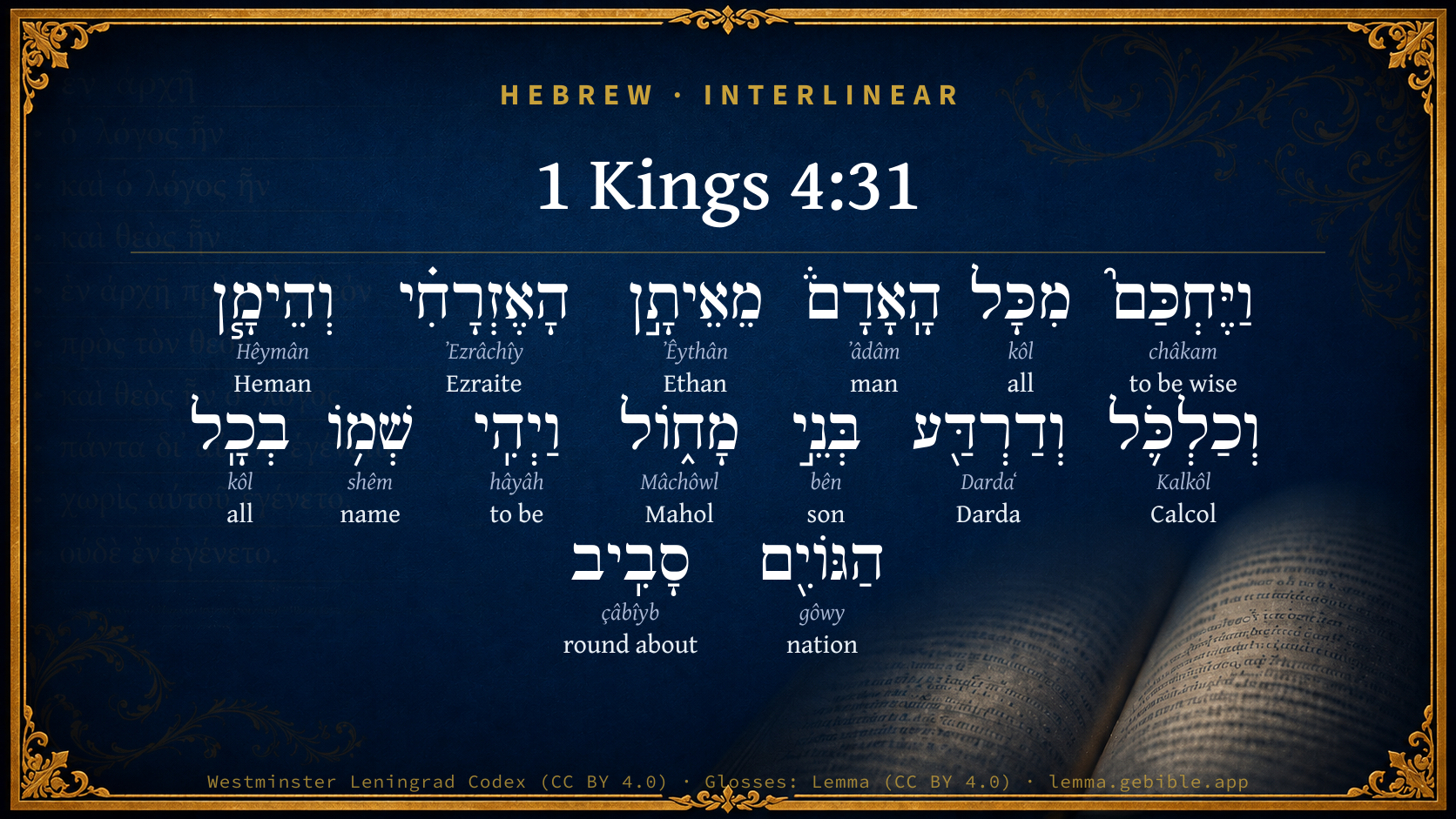
1 Kings 4:31

Hebrew (Westminster Leningrad Codex) 1 Kings 4:31 appears in the Hebrew Old Testament. The text above is from the Westminster Leningrad Codex. Each word links to its Strong’s number, a concise gloss, and parsing drawn from the Open Scriptures Hebrew Bible morphology. Click any word for its full Brown-Driver-Briggs (BDB) entry.
Download image
Cite this verse

1 Kings 4:31 (World English Bible). Public Domain. Lemma interlinear Bible study tool, https://lemma.gebible.app/v/1-kings/4/31.

Show BibTeX & RIS
BibTeX
RIS
English Translation
For he was wiser than all men; than Ethan the Ezrahite, and Heman, and Calcol, and Darda, the sons of Mahol: and his fame was in all the nations round about.
World English Bible · Public Domain
Highlights
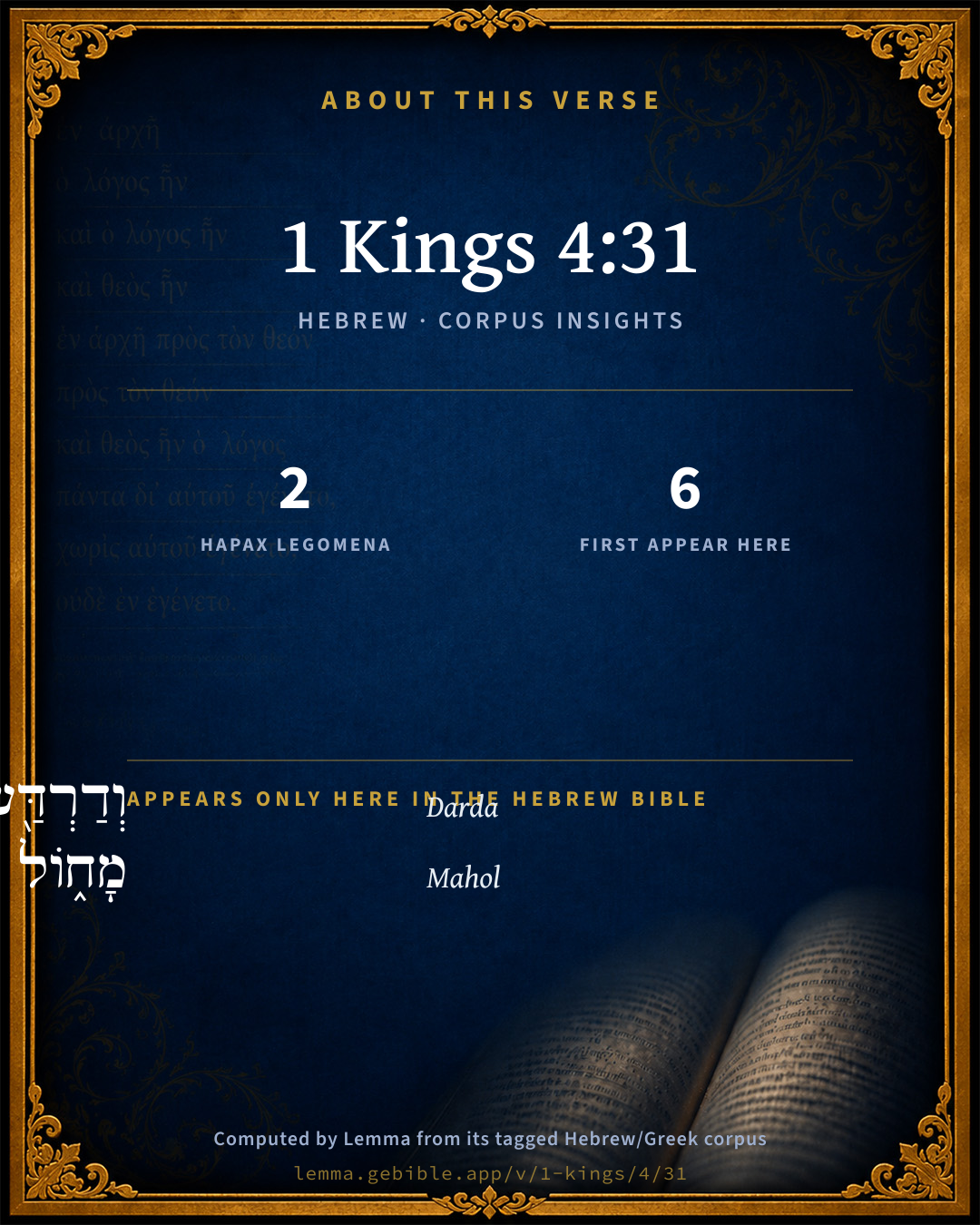
  • 2 hapax legomena — only here in the Hebrew Bible
  • 6 first appearances in the Hebrew Bible
Full analysis ↓
Download a study sheet

One document with this verse’s original text, its word-by-word gloss line, the meaning frame, cross-references with their text, attributed commentary, and full source and license credits — printable, and it pastes into notes with its structure intact.

This verse Autodidact and up

Study sheet (.html) Plain text (.txt)

A passage Seminary Student

Up to 50 verses in one chapter. A passage sheet keeps up to 6 commentary sources and 12 cross-references per verse, in the order this page ranks them, and says so on the sheet whenever that leaves anything out. Ask for a single verse and you get the Autodidact verse sheet above.

Everything on this page stays free to read, with no account — the sheet is a download of what is already on screen, not access to it.

Want to remove ads? Support Godless Engineer
Compare translations 3

The same verse in 3 English versions, stacked beneath the original-language interlinear above. Click any original word for its lexicon entry.

Each is an independent rendering of the whole verse — the interlinear is not word-aligned to these translations.

Highlighted words mark where these versions differ — a whole-verse word diff, not a word-by-word alignment.

  • World English Bible Public Domain
    For he was wiser than all men; than Ethan the Ezrahite, and Heman, and Calcol, and Darda, the sons of Mahol: and his fame was in all the nations round about.
  • King James Version Public Domain
    For he was wiser than all men; than Ethan the Ezrahite, and Heman, and Chalcol, and Darda, the sons of Mahol: and his fame was in all nations round about.
  • unfoldingWord Literal Text CC BY-SA 4.0
    And he was wiser than every man, than Ethan the Ezrahite and Heman and Calcol and Darda, the sons of Mahol. And his name was in all of the surrounding nations.

unfoldingWord Literal Text — © unfoldingWord, licensed CC BY-SA 4.0. Word-aligned USFM3 via Door43 (git.door43.org/unfoldingWord/en_ult).

Versions to compare (up to 4)

3 of 4 selected

Show all 18 translations

Every available English version of this verse, each an independent rendering of the whole verse.

  • World English Bible Public Domain
    For he was wiser than all men; than Ethan the Ezrahite, and Heman, and Calcol, and Darda, the sons of Mahol: and his fame was in all the nations round about.
  • Berean Standard Bible Public Domain
    He was wiser than all men—wiser than Ethan the Ezrahite, and wiser than Heman, Calcol, and Darda, the sons of Mahol. And his fame spread throughout the surrounding nations.
  • Majority Standard Bible Public Domain
    He was wiser than all men—wiser than Ethan the Ezrahite, and wiser than Heman, Calcol, and Darda, the sons of Mahol. And his fame spread throughout the surrounding nations.
  • King James Version Public Domain
    For he was wiser than all men; than Ethan the Ezrahite, and Heman, and Chalcol, and Darda, the sons of Mahol: and his fame was in all nations round about.
  • American Standard Version (1901) Public Domain
    For he was wiser than all men; than Ethan the Ezrahite, and Heman, and Calcol, and Darda, the sons of Mahol: and his fame was in all the nations round about.
  • Revised Version (1885) Public Domain
    For he was wiser than all men; than Ethan the Ezrahite, and Heman, and Calcol, and Darda, the sons of Mahol: and his fame was in all the nations round about.
  • Geneva Bible (1599) Public Domain
    For he was wiser then any man: yea, then were Ethan the Ezrahite, the Heman, then Chalcol, then Darda the sonnes of Mahol: and he was famous throughout all nations round about.
  • Douay-Rheims (1899) Public Domain
    And he was wiser than all men: wiser than Ethan the Ezrahite, and Heman, and Chalcol, and Dorda the sons of Mahol, and he was renowned in all nations round about.
  • Young's Literal Translation Public Domain
    and he is wiser than all men, than Ethan the Ezrahite, and Heman, and Chalcol, and Darda, sons of Mahol, and his name is in all the nations round about.
  • Literal Standard Version CC BY-SA 4.0
    and he is wiser than all men, [wiser] than Ethan the Ezrahite, and Heman, and Chalcol, and Darda, sons of Mahol, and his name is in all the surrounding nations.
  • Unlocked Literal Bible CC BY-SA 4.0
    He was wiser than all men—than Ethan the Ezrahite, Heman, Kalkol, and Darda, the sons of Mahol—and his fame reached all the surrounding nations.
  • unfoldingWord Literal Text CC BY-SA 4.0
    And he was wiser than every man, than Ethan the Ezrahite and Heman and Calcol and Darda, the sons of Mahol. And his name was in all of the surrounding nations.
  • Darby Bible Public Domain
    For he was wiser than all men; than Ethan the Ezrahite, and Heman, and Calcol, and Darda, the sons of Mahol; and his fame was in all the nations round about.
  • World Messianic Bible Public Domain
    For he was wiser than all men—wiser than Ethan the Ezrahite, Heman, Calcol, and Darda, the sons of Mahol; and his fame was in all the nations all around.
  • Webster's Bible Public Domain
    For he was wiser than all men; than Ethan the Ezrahite, and Heman, and Chalcol, and Darda, the sons of Mahol: and his fame was in all the surrounding nations.
  • Free Bible Version CC BY-SA 4.0
    He was wiser than anyone, wiser than Ethan the Ezrahite, wiser than Heman, Calcol, and Darda, sons of Mahol. His reputation spread through the nations around.
  • Bible in Basic English Public Domain
    For he was wiser than all men, even than Ethan the Ezrahite, and Heman and Calcol and Darda, the sons of Mahol; and he had a great name among all the nations round about.
  • JPS Tanakh (1917) Public Domain
    (5-11) For he was wiser than all men: than Ethan the Ezrahite, and Heman, and Calcol, and Darda, the sons of Mahol; and his fame was in all the nations round about.

Literal Standard Version (2020), Covenant Press — licensed CC BY-SA 4.0. Text via the HelloAO Bible API (eBible.org). Unlocked Literal Bible (unfoldingWord) — licensed CC BY-SA 4.0. Text via the HelloAO Bible API (eBible.org). unfoldingWord Literal Text — © unfoldingWord, licensed CC BY-SA 4.0. Word-aligned USFM3 via Door43 (git.door43.org/unfoldingWord/en_ult). Free Bible Version, Dr. Jonathan Gallagher — licensed CC BY-SA 4.0. Text via the HelloAO Bible API (eBible.org).

Word by word

More ways to search: Search by grammar → Find every occurrence → Compare this word →

Practice this passage: Drill this verse → Learn its vocabulary →

וְדַרְדַּ֖ע
Dardaʻ
H1862
“and · Darda”
Conjunction + Noun, Proper
Part of Speech
Conjunction + Noun
Type
Proper
Full BDB Definition

Origin: apparently from H1858 and H1843

TWOT: None

Darda = "pearl of knowledge" - a son of Mahol, one of four men of great fame for their wisdom, but surpassed by Solomon
  1. וַיֶּחְכַּם֮ châkam H2449 “and · to be wise” Conjunction + Verb, Qal, Sequential Imperfect, 3rd Person, Masculine, Singular
  2. מִכָּל kôl H3605 “from · all of” Preposition + Noun, Common, Masculine, Singular, Construct
  3. הָֽאָדָם֒ ʼâdâm H120 “the · man” Particle, Definite Article + Noun, Common, Masculine, Singular, Absolute
  4. מֵאֵיתָ֣ן ʼÊythân H387 “from · Ethan” Preposition + Noun, Proper
  5. הָאֶזְרָחִ֗י ʼEzrâchîy H250 “the · Ezraite” Particle, Definite Article + Noun, Gentilic, Masculine, Singular, Absolute
  6. וְהֵימָ֧ן Hêymân H1968 “and · Heman” Conjunction + Noun, Proper
  7. וְכַלְכֹּ֛ל Kalkôl H3633 “and · Calcol” Conjunction + Noun, Proper
  8. בְּנֵ֣י bên H1121 “sons of” Noun, Common, Masculine, Plural, Construct
  9. מָח֑וֹל Mâchôwl H4235 “Mahol” Noun, Proper
  10. וַיְהִֽי hâyâh H1961 “and · to be” Conjunction + Verb, Qal, Sequential Imperfect, 3rd Person, Masculine, Singular
  11. שְׁמ֥וֹ shêm H8034 “name · his” Noun, Common, Masculine, Singular, Construct + Suffix, Personal, 3rd Person, Masculine, Singular
  12. בְכָֽל kôl H3605 “in/at · all of” Preposition + Noun, Common, Masculine, Singular, Construct
  13. הַגּוֹיִ֖ם gôwy H1471 “the · nations” Particle, Definite Article + Noun, Common, Masculine, Plural, Absolute
  14. סָבִֽיב çâbîyb H5439 “round about” Noun, Common, Both, Singular, Absolute

About this verse

These counts appear in no published source. They are computed here, from the morphology-tagged text and Lemma’s own curated glosses. What Lemma adds →

15
words
14
distinct lemmas
Historical
section

Notable vocabulary

2 hapax legomena — words that appear only here in the entire Hebrew Bible:

  • וְדַרְדַּ֖ע Darda H1862
  • מָח֑וֹל Mahol H4235

First appearance in Scripture

These words make their first canonical appearance in the Hebrew Bible here:

  • מֵאֵיתָ֣ן Ethan H387
  • הָאֶזְרָחִ֗י Ezraite H250
  • וְהֵימָ֧ן Heman H1968
  • וְכַלְכֹּ֛ל Calcol H3633
  • וְדַרְדַּ֖ע Darda H1862
  • מָח֑וֹל Mahol H4235

Shared distinctive vocabulary

וְכַלְכֹּ֛ל Calcol H3633 occurs in 2 verses of the Hebrew Bible. Also found in:

Grammatical profile

  • 2 verbs
  • 13 nouns

Verb forms

  • וַיֶּחְכַּם֮ Qal · Sequential Imperfect
  • וַיְהִֽי Qal · Sequential Imperfect

Repetition

A word recurs within this verse — often emphatic in Hebrew:

  • מִכָּל all H3605 ×2

Hebrew & Septuagint length

In English translation the verse runs 31 words from the Hebrew and 28 from the Septuagint (LXX English) — closely comparable.

A rough comparison of the two English renderings, which tokenize alike — not a word-level alignment.

Word counts can differ between the Hebrew and the Greek without any difference in meaning — e.g. the Hebrew direct-object marker אֵת has no separate Greek word, and Greek often adds the article ὁ.

Cross-references

15

Topical passages linked to 1 Kings 4:31 in the Treasury of Scripture Knowledge — connected by theme and wording, ordered by reader-vote popularity; previews shown in the World English Bible.

  • 1 Chronicles 2:6 The sons of Zerah: Zimri, and Ethan, and Heman, and Calcol, and Dara; five of them in all.
  • 1 Chronicles 15:19 So the singers, Heman, Asaph, and Ethan, [were appointed] with cymbals of brass to sound aloud;
  • 1 Kings 3:12 behold, I have done according to your word: behold, I have given you a wise and an understanding heart; so that there has been none like you before you, neither after you shall any arise like you.
  • 1 Chronicles 6:33 These are those who waited, and their sons. Of the sons of the Kohathites: Heman the singer, the son of Joel, the son of Samuel,
  • Psalms 89:1–52 I will sing of the loving kindness of Yahweh forever. With my mouth, I will make known your faithfulness to all generations.
  • Matthew 12:42 The queen of the south will rise up in the judgment with this generation, and will condemn it, for she came from the ends of the earth to hear the wisdom of Solomon; and behold, someone greater than Solomon is here.
  • Luke 11:31 The Queen of the South will rise up in the judgment with the men of this generation, and will condemn them: for she came from the ends of the earth to hear the wisdom of Solomon; and behold, one greater than Solomon is here.
  • 1 Kings 5:7 It happened, when Hiram heard the words of Solomon, that he rejoiced greatly, and said, Blessed be Yahweh this day, who has given to David a wise son over this great people.
  • 1 Kings 10:1 When the queen of Sheba heard of the fame of Solomon concerning the name of Yahweh, she came to prove him with hard questions.
  • 1 Kings 10:6 She said to the king, It was a true report that I heard in my own land of your acts, and of your wisdom.
  • 1 Chronicles 15:17 So the Levites appointed Heman the son of Joel; and of his brothers, Asaph the son of Berechiah; and of the sons of Merari their brothers, Ethan the son of Kushaiah;
  • 2 Chronicles 9:23 All the kings of the earth sought the presence of Solomon, to hear his wisdom, which God had put in his heart.
  • Psalms 88:1 Yahweh, the God of my salvation, I have cried day and night before you.
  • Matthew 4:24 The report about him went out into all Syria. They brought to him all who were sick, afflicted with various diseases and torments, possessed with demons, epileptics, and paralytics; and he healed them.
  • Colossians 2:3 in whom are all the treasures of wisdom and knowledge hidden.

Cross-references courtesy of OpenBible.info (CC BY 4.0).

Hebrew and Greek witnesses Masoretic Hebrew ↔ Greek Septuagint

The same verse in the two great witnesses to the Old Testament, shown verse-for-verse.

These are two independent witnesses, not word-aligned to each other, and the Septuagint is shown in lemma (dictionary) form.

Hebrew 1 Kings 4:31 Masoretic · Westminster Leningrad Codex

וַיֶּחְכַּם֮ מִכָּל הָֽאָדָם֒ מֵאֵיתָ֣ן הָאֶזְרָחִ֗י וְהֵימָ֧ן וְכַלְכֹּ֛ל וְדַרְדַּ֖ע בְּנֵ֣י מָח֑וֹל וַיְהִֽי שְׁמ֥וֹ בְכָֽל הַגּוֹיִ֖ם סָבִֽיב

For he was wiser than all men; than Ethan the Ezrahite, and Heman, and Calcol, and Darda, the sons of Mahol: and his fame was in all the nations round about.

World English Bible · Public Domain

Greek LXX 1 Kings 4:31 Septuagint · lemma form
And he was wiser than all other men: and he was wiser than Gaethan the Zarite, and than Aenan, and than Chalcad and Darala the son of Mal.

LXX2012 (modern English Septuagint) · Public Domain

Hebrew: Westminster Leningrad Codex (CC BY 4.0). Greek: Septuagint (public domain); English from LXX2012 (modern English Septuagint) (Public Domain). How the Septuagint differs from the Hebrew →

Commentary

Notes on 1 Kings 4:31 from classic Christian and Jewish commentators (each source and its license shown beneath its notes). The classic Christian expositions comment on the surrounding passage and are grouped to its opening verse, so a note may address several verses; the Jewish commentaries on the Tanakh (Rashi and others) are per-verse, so they appear only where the commentator wrote on this verse.

Lemma curates 59 commentaries, every one of them public domain or Creative Commons licensed, each selected and text-cleaned for this edition rather than reprinted as found. About our sources →

Trapp's Complete Commentary

John Trapp

1Ki 4:31 For he was wiser than all men; than Ethan the Ezrahite, and Heman, and Chalcol, and Darda, the sons of Mahol: and his fame was in all nations round about.

Ver. 31. For he was wiser than all men.] Far beyond Socrates, whom Apollo pronounced the wisest of men.

Than Ethan the Ezrahite, and Heman.] These were famous in their generations for wisdom and learning. {Psa 88:1; Psa 89:1, titles} Of these, haply, it was then held and said, as a modern writer saith of Tacitus and Pliny, Literarum nomina sunt, non hominum, they are rather learning itself than learned.

And his fame was in all nations.] As Aristotle’s was in Greece, Varo in Rome, Melanchthon’s in Germany, Dr John Reynolds’s here, whose learning and memory, saith one, were near to a miracle.

And Chalcol, and Darda.] Who lived, likely, in Solomon’s time. Felix proventus sapientum sub aspectu benigno principis sapientissimi. So various learned men flourished in the time of our Henry II, who was for his learning surnamed Beauelerk. {a}

{a} Dan 68

John Trapp, A Commentary or Exposition upon All the Books of the Old and New Testament (1647–1656) — public domain. Text from a community e-Sword module.

Joseph Benson's Commentary

1Ki 4:31. He was wiser than all men — Either of his nation, or of his time: or, of all times and nations, whether of the East, or any other country, excepting only the first and second Adam. Ethan, &c. — Israelites of eminent wisdom, probably the same mentioned 1Ch 2:6; 1Ch 15:19; 1Ch 25:4; Psalms 88., title, and 89., title. Chalcol, &c. — Of whom see 1Ch 2:6.

Joseph Benson's Commentary on the Old and New Testaments (1811–1818) — public domain. Text from a community e-Sword module.

Tyndale Open Study Notes

Tyndale Open Resources

4:31 Ethan and Heman were among the musicians appointed by David (see 1 Chr 6:33-47; 15:16-19; Pss 88, 89). • The sons of Mahol were Temple singers, so Heman, Calcol, and Darda may have participated in the worship services (see 1 Chr 15:17, 19-22).

Tyndale Open Study Notes — © Tyndale Open Resources, licensed CC BY-SA 4.0. Text via the HelloAO Bible API.

Jamieson, Fausset & Brown

Robert Jamieson, A. R. Fausset & David Brown

wiser than all men--that is, all his contemporaries, either at home or abroad.

than Ethan--or Jeduthun, of the family of Merari (Ch1 6:44).

Heman-- (Ch1 15:17-19) --the chief of the temple musicians and the king's seers (Ch1 25:5); the other two are not known.

the sons of Mahol--either another name for Zerah (Ch1 2:6); or taking it as a common noun, signifying a dance, a chorus, "the sons of Mahol" signify persons eminently skilled in poetry and music.

Jamieson, Fausset & Brown — Commentary Critical and Explanatory on the Whole Bible (1871) — public domain (CC PDM 1.0). Text via the HelloAO Bible API.

Adam Clarke's Commentary

Verse 31. He was wiser than all men] He was wiser than any of those who were most celebrated in his time, among whom were the four after mentioned, viz., Ethan, Heman, Chalcol, and Darda. Ethan was probably the same as is mentioned in some of the Psalms, particularly Ps 89:1, title; and among the singers in 1Ch 6:42. There is a Heman mentioned in the title to Ps 88:1. In 1Ch 2:6 we have all the four names, but they are probably not the same persons, for they are there said to be the sons of Zerah, and he flourished long before Solomon's time.

Some suppose that בני מחול beney machol should be rendered masters of dancing or music, as מחול machol signifies not only a dance or choir, but also an instrument of music of the pipe kind. Perhaps a reference is here made to Solomon's skill in music and poetry, as he is compared to persons who appear to have been eminent poets and musicians.

Adam Clarke's Commentary on the Bible (1810–1826) — public domain. Text from a community e-Sword/MySword module.

Ellicott's Commentary for English Readers

(31) He was wiser.—The wisdom of “Heman, Ethan, Chalcol, and Darda,” then rivals of Solomon’s fame, is now only known to us from this passage. In the genealogy of 1Ch_2:6, “Ethan, Heman, Chalcol, and Dara” (or “Darda”) are found as sons of Zerah, the son of Judah; and the coincidence is remarkable enough to suggest identification. But this identification can scarcely hold. This passage evidently implies that these rivals of Solomon were contemporary with him, not belonging, therefore, to a family many generations earlier. Now it happens that we know of a Heman and an Ethan (see 1Ch_6:33; 1Ch_6:44) set by David over the service of song in the Tabernacle, and called “Ezrahites” in the titles of Psalms 88, 89 ascribed to them. Heman is, moreover, designated as “the king’s seer in the words of the Lord” (1Ch_25:5); and his Psalm (Psalms 88) is singularly full of thought, moral speculation, and sense of mystery in life and death. Chalcol and Darda are described as sous of Machol. The word Machol may be a proper name. But it is curious that it signifies “dance,” or “music”; and it is at least possible that they also, like Heman and Ethan, may have been thus designated, as connected with the music of the Temple. However this may be, it can hardly be wrong, in spite of the repetition of the group of names, to refer this passage to this Heman and this Ethan, and hold Chalcol and Darda to be, like them, contemporaries with Solomon.

A Bible Commentary for English Readers, edited by Charles John Ellicott (1878–1897) — public domain. Text from a community e-Sword module.

The Cambridge Bible for Schools and Colleges

gen. ed. J. J. S. Perowne

31. Ethan the Ezrahite, and Heman] Ethan and Heman are among the names of the singers (1Ch_15:19) appointed by David when the ark was brought up to the city of David, but there is no possibility of deciding whether those are the men alluded to here. In 1 Chronicles (1Ki_15:17) Ethan is called the son of Kushaiah, and the son of Kishi (1Ch_6:44), and Heman is, in the latter chapter (1Ki_4:33), called the son of Joel. See the next note.

Chalcol] The better orthography is Calcol which A.V. gives for the same name in 1Ch_2:6. In that passage we find (with a slight modification of the last) the four names of this verse all mentioned as sons of Zerah, the son of Judah. These would therefore be greatgrandsons of Jacob. The difference between the name Darda דרדע and Dara דרע (of 1Ch_2:6) may be due only to a slip of the transcriber. But no tradition has survived which tells of the special wisdom of this family, nor can we connect the name Mahol, as the father of some of them at least is here called, with Zerah. But the occurrence of the four names together in one family inclines to the opinion that these men were the men spoken of here. Their fame, even if not at first great, may have grown so during the time between Judah and Solomon.

in all nations] We know that it had reached the queen of Sheba. See chap. 10.

The Cambridge Bible for Schools and Colleges (gen. ed. J. J. S. Perowne; Cambridge University Press, 1878–1918) — public domain. Text from a community e-Sword module.

John Gill's Exposition

And there came of all people to hear the wisdom of Solomon,

from all kings of the earth,.... Who sent their ambassadors to his court to know the truth of what was reported, and bring them some proofs and specimens, by which they might judge of the truth of the relations that had been told them; which perhaps might seem to them to be beyond all belief:

which had heard of his wisdom; for the fame of it was spread everywhere by merchants and travellers, and such sort of persons, who had been at Jerusalem, and were masters of various anecdotes relating to Solomon; which they industriously spread in the several parts of the world they had dealings in.

Next: 1 Kings Chapter 5

John Gill's Exposition of the Whole Bible (1746–1763) — public domain (CC PDM 1.0). Text via the HelloAO Bible API.

Albert Barnes' Notes on the Bible

It is most probable that the persons with whom Solomon is compared were contemporaries, men noted for “wisdom,” though there is no other mention of them.

His fame was in all nations - See below, 1 Kings 10.

Albert Barnes' Notes on the Bible (1834–1885) — public domain. Text from a community e-Sword/MySword module.

Haydock's Catholic Bible Commentary

All men, of his time (Lyranus) and nation. (Munster) --- But why should we limit these general statements? (Calmet) See chap. iii. 12, 13. (Haydock) --- Ethan is the same as Idithun. The title of Ezrahite does not seem to belong to him; and Chalcol and Dorda seem to be inserted here by some transcriber from 1 Paralipomenon ii. 6., where we read, the sons of Zara....Ethan and Eman, and Chalchal and Dara, of the tribe of Juda. But they were different from these men, who were probably Levites. (Calmet) --- We find Chalcol and Dorda mentioned no where else. Heman was an Ezrahite, (Psalm lxxxvii.) and a seer of the king, presiding over the singers, (1 Paralipomenon xv. 19., and xxv. 4., and 5.; Menochius) who stood in the middle. Ethan’s band surrounded the altar, (1 Paralipomenon vi. 44.) while Asaph’s were on the right hand. --- Mahol was the mother of the four, unless the word denote their profession, as sons of "the choir," singing and playing on musical instruments. (Calmet) --- Solomon was eminent in both respects, as well as in poetry; as he is compared with those who were most noted for compositions and music. (Sanctius)

George Leo Haydock (1774–1849), Haydock's Catholic Family Bible and Commentary, 1859 edition — public domain. Excludes Psalms (Douay-Rheims chapter numbering differs from Protestant) and Deuterocanonical books (Catholic canon only).

Matthew Poole's English Annotations

Wiser than all men; either of his nation, or of his time, or of all times and nations, whether of the east or any other country, excepting only the first and Second Adam.

Ethan the Ezrahite, and Heman; Israelites of eminent wisdom, probably the same mentioned 1Ch 2:6; 15:19; 25:4; Psa 88:1; 89:1.

Chalcol and Dorda of whom see 1Ch 2:6.

The sons of Mahol.

Object. All these four were the sons of Zerah, 1Ch 2:6, or of Ezrah, as others call him.

Answ. Either the same man had two names, Zerah and Mahol, which was common amongst the Jews; and he might be called Mahol from his office or employment; for that signifies a dance, or a pipe; and he was expert in musical instruments, and so were his sons, 1Ch 15:17-19, who possibly may here be called, by a vulgar Hebraism, sons of the musical instrument, from their dexterity in handling it, as upon another account we read of the daughters of music, Ecc 12:4.

Matthew Poole's English Annotations on the Holy Bible (1683–1685) — public domain. Text from a community e-Sword/MySword module.

Whedon's Commentary on the Bible

Daniel D. Whedon

31. Ethan… Heman… Chalcol… Darda — These men were well known and distinguished for wisdom in Solomon’s time, but to what age they belonged, and to what nation, is by no means clear. They would seem to be identical with the sons of Zerah mentioned in 1Ch_2:6. The eighty-ninth Psalm is ascribed to Ethan, the Ezrahite.

Sons of Mahol — This seems to oppose the supposition that these wise men are identical with the names of 1Ch_2:6; but מהול, mahol, often elsewhere means a dance, and some have conjectured that the meaning here is, sons of the dance.

Daniel D. Whedon (gen. ed.), Commentary on the Old and New Testaments (1874–1909) — public domain. Text from a community e-Sword module.

The Pulpit Commentary

For (Heb. and) he was wiser than all men Keil adds "of his time," but we have no right to restrict the words to his contemporaries (see note on chap. 3:12). It is very doubtful whether the names mentioned presently are those of contemporaries than Ethan the Ezrahite, and Heman, and Chalcol, and Darda It is impossible to say whether these are the same persons as the Ethan and Heman and Chalcol and Dara of, 1Ch_2:6, or the Ethan and Heman who were David"s singers. The resemblance is certainly remarkable. Not only are the names practically the same (Dara may well be a clerical error: many MSS., together with the Syr. and Arab., read Darda) but they occur in the same order. Our first impression, consequently, is that the two lists represent the same persons, and if so, these four sages were the "sons" of Zerah, the son of Judah. (Gen_38:30) But against this it is urged that Ethan is here called the Ezrahite, as are both Ethan and Heman in the titles of Psalms 89, and 88. respectively. The resemblance, however, of Ezrahite (ytirza) to Zerahite (ytirz) is so close as to suggest identity rather than difference. There is, perhaps, more weight in the objection that Chalcol and Darda are here distinctly said to be "the sons of Mahol," though here again it has been observed that Mahol (lwOjm;) means pipe or dance, and the "sons of Mahol," consequently, may merely be a synonym, agreeably to Eastern Ecc_12:4, with which (cf., 2Sa_19:35) for "musicians." We may therefore allow that the four names may be those of sons (i.e., descendants) of Zerah. But the question now presents itself: Are Ethan and Heman to be identified with the well known precentors of David? Against their identity are these facts:

1. That Ethan the singer (1Ch_6:31) is described as the son of, (1Ch_6:44) elsewhere called Kushaiah, (1Ch_15:17) and of the family of Merari; as a Levite that is, instead of a descendant of Judah, and that Heman, who is called the singer, or musician, (1Ch_6:33) and the "king"s seer" (1Ch_25:5) is said to be a son of Joel, a grandson of the prophet Samuel, and one of the Kohathite Levites. (1Ch_15:17) The first impression in this case, therefore, is that they must be distinct. But it should be remembered

(1) that the sons in the strict sense of Zerah are nowhere else named for their wisdom, whereas the royal singer and seer probably owed their appointments to their genius, and

(2) that though Levites, they may have been incorporated (possibly like Jair, through marriage (see note on ver. 13 above, and cf. Ezr_2:61) into the tribe of Judah. The Levite in Jud_1:17:7 is spoken of as belonging to the family of Judah, because he dwelt in Bethlehem of Judah, and Elkanah the Levite is called an Ephraimite in. 1Sa_1:1, because in his civil capacity he was incorporated into the tribe of Ephraim" (Keil) It must be admitted, however, that the natural interpretation of 1Ch_2:6 is that the "sons" of Zerah there mentioned were his immediate and actual descendants, and not Levites who long centuries afterwards were somehow incorporated into his family. But the question is one of so much nicety that it is hardly possible to come to a positive conclusion and his fame Heb. name was in all Heb. all the nations round about. (Cf. 10:24, etc.)

The greatest, wisest, meanest of mankind.

It is a spirited and glowing description which the historian here gives of Solomon"s wisdom. We may believe that it was not without a pardonable pride that he recounted the rich endowments and the widespread fame of Israel"s greatest monarch. But it is really one of the saddest chapters in the whole of Scripture and one of the most instrucfive. Manifold as were his gifts, marvellous as was his wisdom, they did not preserve him from falling. It is a strange, shuddering contrast, the record of his singular powers and faculties, (1Ki_4:29-34) and the story of his shameful (1Ki_11:1-14) How came it to pass that a man so highly gifted and blessed of God made such complete shipwreck of faith and good conscience; that over the grave of the very greatest and wisest of men must be written, "Fallen, fallen, fallen, fallen from his high estate"? Let us consider

(1) The character of his wisdom; and

(2) The causes of his fall. As to (1), observe

I IT WAS UNPRECEDENTED AND HAS SINCE BEEN UNEQUALLED. The sages of Hebrew antiquity, the shrewd Arabians, the sagacious Egyptians, he has eclipsed them all. "Wiser than all men," such was the judgment of his contemporaries. And such is also the verdict of posterity. At the present day, among Jews, Christians, and Mohammedans, no fame equals his. Among the wise men of the world Solomon stands facile princeps.

II IT WAS PRODIGIOUS. To the writer it seemed inexhaustible, illimitable. He can only compare it to "the sand that is on the sea shore;" and he could hardly use a more forcible illustration of its boundless and infinite extent.

III IT WAS VARIED AND COMPREHENSIVE. It was both scientific and sententious. He was at once philosopher and poet. Nothing was too great and nothing too small for him. It is seldom that a man excels in more than one or two branches of knowledge, but Solomon was distinguished in all. He could discourse with equal profundity of the cedar and the hyssop, of beast and bird. It was lofty, it was wide, it was deep.

IV IT WAS TRUE WISDOM. Not superficial, and not mere book learning. Book. worms are often mere pedants. Students often know little of the world and know less of themselves. But Solomon knew man ("The proper study of mankind is man") knew himself. He needed not the charge, gnwqi seauton. He was not one of the metewrosofistai whom the Attic poet justly ridicules (Aristoph. Nub. 360). His writings proved that he had studied the world, and was familiar with the heart.

V IT WAS GOD GIVEN WISDOM (ver. 29; cf. 3, 12, 28; Dan_2:21) Not "the wisdom of this world which is foolishness with God", (1Co_3:8) and which "descendeth not from above", (Jam_3:15) but that which the Supreme wisdom teacheth. (Cf. Pro_2:6) Solomon was truly qeodidaktov.

VI IT WAS GOD-FEARING WISDOM. "The fear of the Lord," he says, "is the beginning of wisdom." (Cf. Pro_1:7 Pro_9:10) There is a wisdom (falsely so called) which dishonours and despises God. This did not Solomon"s. The Proverbs point men to the Lord.

VII HIS WISDOM STILL WARNS AND TEACHES THE WORLD. Some of the thousand and five songs (Psa_72:12) are still chanted by the Catholic Church. (It is significant, though, how few of this vast number remain to us. David was not as wise as Solomon, nor so prolific a writer, but his songs have survived in considerable numbers. They are among the greatest treasures of Christendom. Piety is before wisdom. "Knowledge shall vanish away," but "charity never faileth.") Some of his Proverbs are still read to the congregation. Pie still warns the young and the sensual (chs. 2-7.) He is fallen, but his words stand. Now turn we to

(2) The causes of his fall. How came this wisest of men, without fellow before or since, whose wisdom was so profound, so real, so boundless, whose wisdom came from God and led to God, and who though dead yet speaketh, how came he of all men to go astray? Was it not

II BECAUSE THE HEART WAS NOT KEPT. The intellect, i.e., was developed and cultivated at the expense or to the neglect of the spiritual life. "His wives turned away his heart." But how came one of so much wisdom to let his wives turn it away? Because the wisdom had dwarfed and overshadowed the soul; because the moral did not keep pace with the intellectual growth, and it became flaccid and yielding. It is dangerous for wisdom to increase unless piety increases with it. The higher the tower, the broader should be its foundations. If all the weight and width is at the top, it will come to the ground with a crash. Even so, if wisdom is not to destroy its possessor, the basis of love and piety must be broadened. "Knowledge bloweth up, but charity buildeth up." The head of a colossus needs the trunk of a colossus to sustain it.

II BECAUSE HIS OWN PRECEPTS WERE NOT KEPT. It was because he leaned to his own understanding that this giant form fell prostrate. It was because he forgot his warnings against the strange woman that he fell a prey to strange women. The keeper of the vineyards did not keep his own (Song of Son_1:6). He was not true to himself, and he soon proved false to his God. After preaching to others, he himself became a castaway. A solemn warning this to every preacher and teacher that he should not do

As some ungracious pastors do, Show men the steep and thorny road to heaven, While, like a puffed and reckless libertine, Himself the primrose path of dalliance tread And recks not his own rede.

III BECAUSE PRIDE POISONED HIS WISDOM AND PERVERTED HIS GIFTS. There was no decay of mental power; the force was unabated, but it was misdirected. Pride took her place at the helm. It is pride, not sensuality, accounts for his army of wives and concubines. But if pride brought them, pleasure kept them. And when he put his heart into their keeping, they turned him about at their will (c.f. Jam_3:3, Jam_3:4) Theheart carries the intellect along with it. (Here again compare his own Pro_16:18, and 4:23; cf. Dan_5:20) Magnificent Solomon, unequalled in wisdom, how art thou fallen from heaven! Aye, and if we could but draw aside the veil; if we could but visit the spirits in prison, (1Pe_3:19) we might perchance find among them one clothed of yore "in purple and fine linen" (Luk_16:19; cf. 12:27), and who "fared sumptuously every day," and looking into the anguished face might find it was none other than the brilliant and illustrious son of David, the chosen type of the Messiah, the very wisest and greatest of mankind. "The wisest, greatest, meanest of mankind." We know of whom these words were spoken. But their true application is not to England"s greatest chancellor, but to Israel"s greatest king.

The Pulpit Commentary (1880–1919), ed. H.D.M. Spence-Jones & Joseph S. Exell — public domain. Text from a community e-Sword module.

John Wesley's Explanatory Notes

All men - Either of his nation; or, of his time: or, of all times and nations, whether of the east or any other country excepting only the first and second Adam. Ethan, &c. - Israelites of eminent wisdom, probably the same mentioned, 1 Chron. ii, 6; xv, 19; xxv, 4 Psalm 8viii, 1(title,) Psalm lxxxix, 1(title). Chalcol, &c. - Of whom see 1 Chron. ii, 6.

John Wesley, Explanatory Notes Upon the Whole Bible (1754–1765) — public domain. Text via the GEBible commentary corpus.

Lesson kit

Teaching starters — assembled from the data on this page, not authored interpretation. Every prompt links to the verse data it draws on. Edit before teaching.

1 Kings, in the Historical, opens this verse with 15 words (14 distinct Hebrew lemmas). Its most distinctive word is Dardaʻ (“Darda”). A historical commentator’s framing appears above. Read the whole chapter for the surrounding context.

Discussion questions

  1. How does “Darda” (Dardaʻ) shape what this verse is saying?
  2. 2 words here appear nowhere else in the Hebrew Bible. Why might the author reach for such rare wording?
  3. 6 words make their first appearance in Scripture here. What does this debut establish?
  4. How does 1 Chronicles 2:6, which shares the word «Calcol», read alongside this verse?
  5. What does the repetition of “all” (2× in this one verse) do in this verse?
  6. These translations render this verse differently; the difference is in the English rendering, not the original. What questions does that raise?
  7. «וַיֶּחְכַּם֮» is a Qal Sequential Imperfect verb. How does that grammatical form shape the action described?
  8. Compare how Trapp's Complete Commentary and Joseph Benson's Commentary read this verse. Where do they agree or differ?

Things to notice

  • 2 words in this verse appear nowhere else in the Hebrew Bible.
  • 6 words make their first canonical appearance in Scripture here.
  • These translations choose different wording for 10 words in this verse.
  • “all” occurs 2× in this single verse.
  • 14 distinct Hebrew lemmas span 15 words in this verse.

Reading settings

Reading text

Shown beneath each verse's original-language words.

Old Testament
Old Testament edition

Read the OT as the Masoretic Hebrew (MT) or the Greek Septuagint (LXX).

English shown for the Greek Septuagint (in the Hebrew ↔ Greek comparison).

Comparing translations? Open the Compare panel on any verse page to stack up to four side by side.