
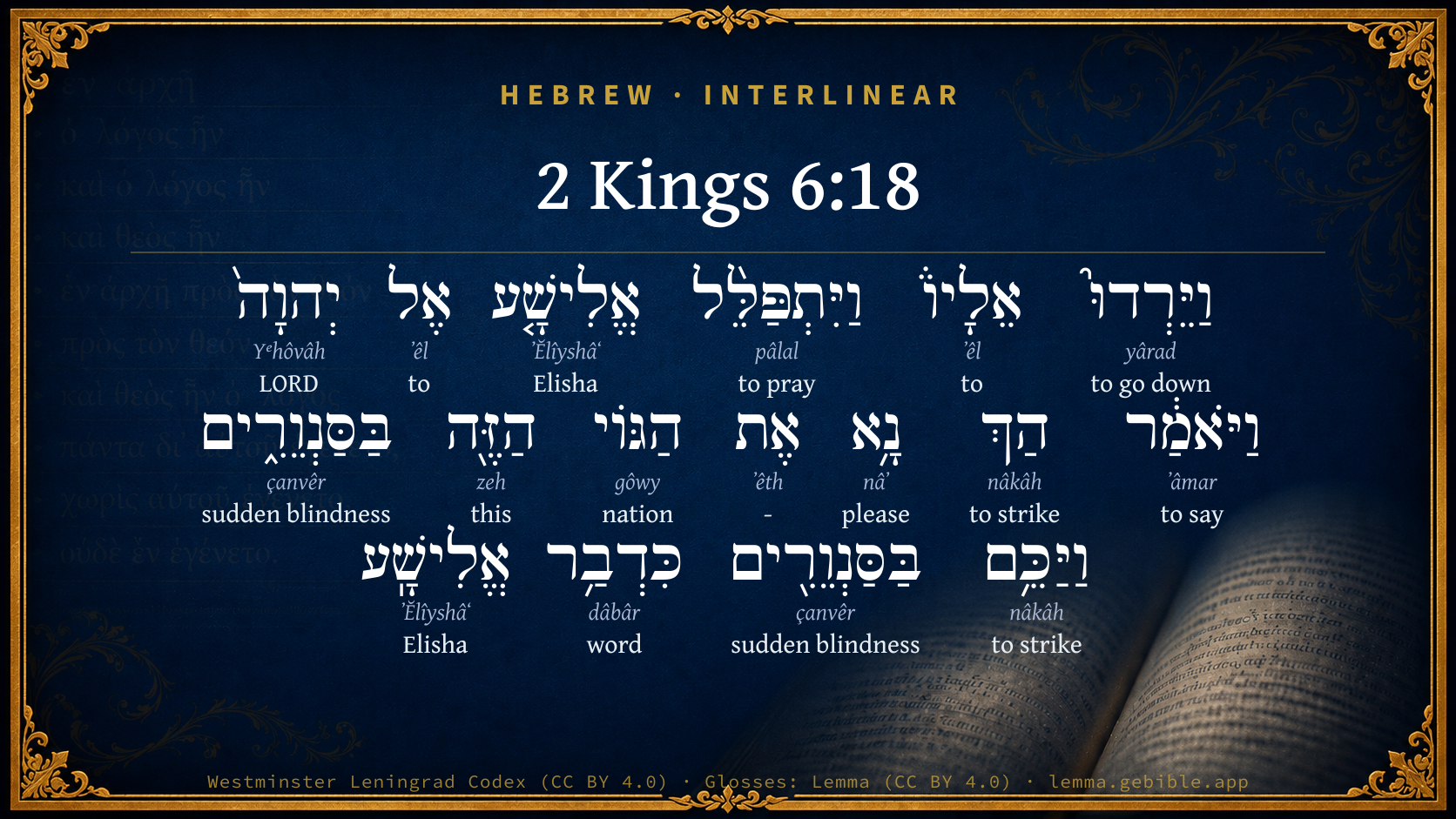
2 Kings 6:18

Hebrew (Westminster Leningrad Codex) 2 Kings 6:18 appears in the Hebrew Old Testament. The text above is from the Westminster Leningrad Codex. Each word links to its Strong’s number, a concise gloss, and parsing drawn from the Open Scriptures Hebrew Bible morphology. Click any word for its full Brown-Driver-Briggs (BDB) entry.
Download image
Cite this verse

2 Kings 6:18 (World English Bible). Public Domain. Lemma interlinear Bible study tool, https://lemma.gebible.app/v/2-kings/6/18.

Show BibTeX & RIS
BibTeX
RIS
English Translation
When they came down to him, Elisha prayed to Yahweh, and said, Please smite this people with blindness. He struck them with blindness according to the word of Elisha.
World English Bible · Public Domain
Download a study sheet

One document with this verse’s original text, its word-by-word gloss line, the meaning frame, cross-references with their text, attributed commentary, and full source and license credits — printable, and it pastes into notes with its structure intact.

This verse Autodidact and up

Study sheet (.html) Plain text (.txt)

A passage Seminary Student

Up to 50 verses in one chapter. A passage sheet keeps up to 6 commentary sources and 12 cross-references per verse, in the order this page ranks them, and says so on the sheet whenever that leaves anything out. Ask for a single verse and you get the Autodidact verse sheet above.

Everything on this page stays free to read, with no account — the sheet is a download of what is already on screen, not access to it.

Want to remove ads? Support Godless Engineer
Compare translations 3

The same verse in 3 English versions, stacked beneath the original-language interlinear above. Click any original word for its lexicon entry.

Each is an independent rendering of the whole verse — the interlinear is not word-aligned to these translations.

Highlighted words mark where these versions differ — a whole-verse word diff, not a word-by-word alignment.

  • World English Bible Public Domain
    When they came down to him, Elisha prayed to Yahweh, and said, Please smite this people with blindness. He struck them with blindness according to the word of Elisha.
  • King James Version Public Domain
    And when they came down to him, Elisha prayed unto the LORD, and said, Smite this people, I pray thee, with blindness. And he smote them with blindness according to the word of Elisha.
  • unfoldingWord Literal Text CC BY-SA 4.0
    And they came down to him, and Elisha prayed to Yahweh and said, “Please strike this nation with blindness.” And he struck them with blindness, according to the word of Elisha.

unfoldingWord Literal Text — © unfoldingWord, licensed CC BY-SA 4.0. Word-aligned USFM3 via Door43 (git.door43.org/unfoldingWord/en_ult).

Versions to compare (up to 4)

3 of 4 selected

Show all 18 translations

Every available English version of this verse, each an independent rendering of the whole verse.

  • World English Bible Public Domain
    When they came down to him, Elisha prayed to Yahweh, and said, Please smite this people with blindness. He struck them with blindness according to the word of Elisha.
  • Berean Standard Bible Public Domain
    As the Arameans came down against him, Elisha prayed to the LORD, “Please strike these people with blindness.” So He struck them with blindness, according to the word of Elisha.
  • Majority Standard Bible Public Domain
    As the Arameans came down against him, Elisha prayed to the LORD, “Please strike these people with blindness.” So He struck them with blindness, according to the word of Elisha.
  • King James Version Public Domain
    And when they came down to him, Elisha prayed unto the LORD, and said, Smite this people, I pray thee, with blindness. And he smote them with blindness according to the word of Elisha.
  • American Standard Version (1901) Public Domain
    And when they came down to him, Elisha prayed unto Jehovah, and said, Smite this people, I pray thee, with blindness. And he smote them with blindness according to the word of Elisha.
  • Revised Version (1885) Public Domain
    And when they came down to him, Elisha prayed unto the LORD, and said, Smite this people, I pray thee, with blindness. And he smote them with blindness according to the word of Elisha.
  • Geneva Bible (1599) Public Domain
    So they came downe to him, but Elisha prayed vnto the Lord, and said, Smite this people, I pray thee, with blindnesse. And he smote them with blindnes, according to the worde of Elisha.
  • Douay-Rheims (1899) Public Domain
    And the enemies came down to him, but Eliseus prayed to the Lord, saying: Strike, I beseech thee, this people with blindness. And the Lord struck them with blindness, according to the word of Eliseus.
  • Young's Literal Translation Public Domain
    And they come down unto it, and Elisha prayeth unto Jehovah, and saith, `Smite, I pray Thee, this nation with blindness;' and He smiteth them with blindness, according to the word of Elisha.
  • Literal Standard Version CC BY-SA 4.0
    And they come down to it, and Elisha prays to YHWH and says, “Please strike this nation with blindness”; and He strikes them with blindness, according to the word of Elisha.
  • Unlocked Literal Bible CC BY-SA 4.0
    When the Arameans came down to him, Elisha prayed to Yahweh and said, “Strike these people blind, I ask you.” So Yahweh made them blind, just as Elisha had asked.
  • unfoldingWord Literal Text CC BY-SA 4.0
    And they came down to him, and Elisha prayed to Yahweh and said, “Please strike this nation with blindness.” And he struck them with blindness, according to the word of Elisha.
  • Darby Bible Public Domain
    And they came down to him; and Elisha prayed to Jehovah and said, Smite this nation, I pray thee, with blindness. And he smote them with blindness according to the word of Elisha.
  • World Messianic Bible Public Domain
    When they came down to him, Elisha prayed to the LORD, and said, “Please strike this people with blindness.” He struck them with blindness according to Elisha’s word.
  • Webster's Bible Public Domain
    And when they came down to him, Elisha prayed to the LORD, and said, Smite this people, I pray thee, with blindness. And he smote them with blindness according to the word of Elisha.
  • Free Bible Version CC BY-SA 4.0
    As the army descended on him, Elisha prayed to the Lord, “Please strike these people with blindness.” So he struck them with blindness, as Elisha had asked.
  • Bible in Basic English Public Domain
    Now when the Aramaeans came down to Elisha, he made a prayer to the Lord saying, Lord, make this people blind. And he made them blind at Elisha's request.
  • JPS Tanakh (1917) Public Domain
    And when they came down to him, Elisha prayed unto the LORD, and said: 'Smite this people, I pray Thee, with blindness.' And He smote them with blindness according to the word of Elisha.

Literal Standard Version (2020), Covenant Press — licensed CC BY-SA 4.0. Text via the HelloAO Bible API (eBible.org). Unlocked Literal Bible (unfoldingWord) — licensed CC BY-SA 4.0. Text via the HelloAO Bible API (eBible.org). unfoldingWord Literal Text — © unfoldingWord, licensed CC BY-SA 4.0. Word-aligned USFM3 via Door43 (git.door43.org/unfoldingWord/en_ult). Free Bible Version, Dr. Jonathan Gallagher — licensed CC BY-SA 4.0. Text via the HelloAO Bible API (eBible.org).

Word by word

More ways to search: Search by grammar → Find every occurrence → Compare this word →

Practice this passage: Drill this verse → Learn its vocabulary →

בַּסַּנְוֵרִ֑ים
çanvêr
H5575
“in/at the · sudden blindness”
Preposition, Determined + Noun, Common, Masculine, Plural, Absolute
Part of Speech
Preposition + Noun
Type
Common
Gender
Masculine
Number
Plural
State
Absolute
Full BDB Definition

Origin: of uncertain derivation

TWOT: 1521

sudden blindness
  1. וַיֵּרְדוּ֮ yârad H3381 “and · to go down” Conjunction + Verb, Qal, Sequential Imperfect, 3rd Person, Masculine, Plural
  2. אֵלָיו֒ ʼêl H413 “to · him” Preposition + Suffix, Personal, 3rd Person, Masculine, Singular
  3. וַיִּתְפַּלֵּ֨ל pâlal H6419 “and · to pray” Conjunction + Verb, Hithpael, Sequential Imperfect, 3rd Person, Masculine, Singular
  4. אֱלִישָׁ֤ע ʼĔlîyshâʻ H477 “Elisha” Noun, Proper
  5. אֶל ʼêl H413 “to” Preposition
  6. יְהוָה֙ Yᵉhôvâh H3068 “LORD” Noun, Proper
  7. וַיֹּאמַ֔ר ʼâmar H559 “and · to say” Conjunction + Verb, Qal, Sequential Imperfect, 3rd Person, Masculine, Singular
  8. הַךְ nâkâh H5221 “strike” Verb, Hiphil, Imperative, 2nd Person, Masculine, Singular
  9. נָ֥א nâʼ H4994 “please” Particle, Exhortation
  10. אֶת ʼêth H853 “-” Particle, Direct Object
  11. הַגּוֹי gôwy H1471 “the · nation” Particle, Definite Article + Noun, Common, Masculine, Singular, Absolute
  12. הַזֶּ֖ה zeh H2088 “the · this” Particle, Definite Article + Pronoun, Demonstrative, Masculine, Singular
  13. וַיַּכֵּ֥ם nâkâh H5221 “and · to strike · them” Conjunction + Verb, Hiphil, Sequential Imperfect, 3rd Person, Masculine, Singular + Suffix, Personal, 3rd Person, Masculine, Plural
  14. בַּסַּנְוֵרִ֖ים çanvêr H5575 “in/at the · sudden blindness” Preposition, Determined + Noun, Common, Masculine, Plural, Absolute
  15. כִּדְבַ֥ר dâbâr H1697 “like/as · word of” Preposition + Noun, Common, Masculine, Singular, Construct
  16. אֱלִישָֽׁע ʼĔlîyshâʻ H477 “Elisha” Noun, Proper

About this verse

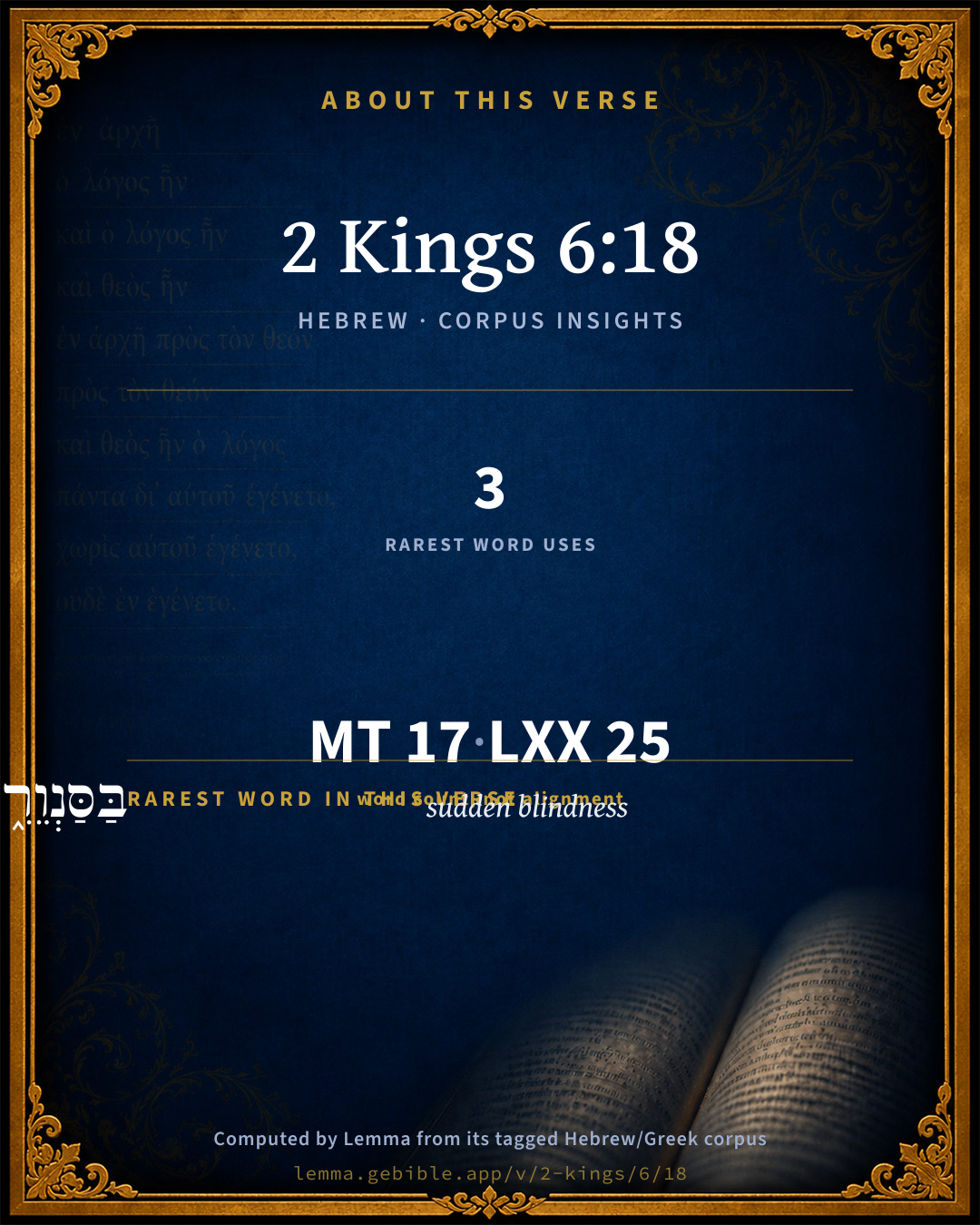
These counts appear in no published source. They are computed here, from the morphology-tagged text and Lemma’s own curated glosses. What Lemma adds →

17
words
13
distinct lemmas
Historical
section

Notable vocabulary

The rarest word here is בַּסַּנְוֵרִ֑ים sudden blindness H5575 — appearing just 3 times in the whole Hebrew Bible.

Shared distinctive vocabulary

בַּסַּנְוֵרִ֑ים sudden blindness H5575 occurs in 2 verses of the Hebrew Bible. Also found in:

Grammatical profile

  • 5 verbs
  • 7 nouns
  • 1 pronoun
  • 2 prepositions
  • 2 particles

Verb forms

  • וַיֵּרְדוּ֮ Qal · Sequential Imperfect
  • וַיִּתְפַּלֵּ֨ל Hithpael · Sequential Imperfect
  • וַיֹּאמַ֔ר Qal · Sequential Imperfect
  • הַךְ Hiphil · Imperative
  • וַיַּכֵּ֥ם Hiphil · Sequential Imperfect

Repetition

Words recur within this verse — often emphatic in Hebrew:

  • אֱלִישָׁ֤ע Elisha H477 ×2
  • הַךְ to strike H5221 ×2
  • בַּסַּנְוֵרִ֑ים sudden blindness H5575 ×2
  • אֵלָיו֒ to H413 ×2

Hebrew & Septuagint length

In English translation the verse runs 29 words from the Hebrew and 34 from the Septuagint (LXX English) — closely comparable.

A rough comparison of the two English renderings, which tokenize alike — not a word-level alignment.

Word counts can differ between the Hebrew and the Greek without any difference in meaning — e.g. the Hebrew direct-object marker אֵת has no separate Greek word, and Greek often adds the article ὁ.

In the original languages it is 17 Hebrew tokens and 25 Greek tokens — but the two are counted differently (Hebrew bundles its prefixes and suffixes into one token; the Greek is in lemma form), so that isn’t a like-for-like length.

Cross-references

8

Topical passages linked to 2 Kings 6:18 in the Treasury of Scripture Knowledge — connected by theme and wording, ordered by reader-vote popularity; previews shown in the World English Bible.

  • Acts 13:11 Now, behold, the hand of the Lord is on you, and you will be blind, not seeing the sun for a season!" Immediately there fell on him a mist and darkness. He went around seeking someone to lead him by the hand.
  • John 12:40 "He has blinded their eyes and he hardened their heart, Lest they should see with their eyes, And perceive with their heart, And would turn, And I would heal them."
  • Genesis 19:11 They struck the men who were at the door of the house with blindness, both small and great, so that they wearied themselves to find the door.
  • John 9:39 Jesus said, "I came into this world for judgment, that those who don't see may see; and that those who see may become blind."
  • Deuteronomy 28:28 Yahweh will strike you with madness, and with blindness, and with astonishment of heart;
  • Job 5:14 They meet with darkness in the day-time, And grope at noonday as in the night.
  • Zechariah 12:4 In that day," says Yahweh, "I will strike every horse with terror, and his rider with madness; and I will open my eyes on the house of Judah, and will strike every horse of the peoples with blindness.
  • Romans 11:7 What then? That which Israel seeks for, that he didn't obtain, but the chosen ones obtained it, and the rest were hardened.

Cross-references courtesy of OpenBible.info (CC BY 4.0).

Hebrew and Greek witnesses Masoretic Hebrew ↔ Greek Septuagint

The same verse in the two great witnesses to the Old Testament, shown verse-for-verse.

These are two independent witnesses, not word-aligned to each other, and the Septuagint is shown in lemma (dictionary) form.

Hebrew 2 Kings 6:18 Masoretic · Westminster Leningrad Codex

וַיֵּרְדוּ֮ אֵלָיו֒ וַיִּתְפַּלֵּ֨ל אֱלִישָׁ֤ע אֶל יְהוָה֙ וַיֹּאמַ֔ר הַךְ נָ֥א אֶת הַגּוֹי הַזֶּ֖ה בַּסַּנְוֵרִ֑ים וַיַּכֵּ֥ם בַּסַּנְוֵרִ֖ים כִּדְבַ֥ר אֱלִישָֽׁע

When they came down to him, Elisha prayed to Yahweh, and said, Please smite this people with blindness. He struck them with blindness according to the word of Elisha.

World English Bible · Public Domain

Greek LXX 2 Kings 6:18 Septuagint · lemma form

καί καταβαίνω πρός αὐτός καί προςεὔχομαι ελισαιε πρός κύριος καί εἶπον πατάσσω δή οὗτος ὁ ἔθνος ἀορασία καί πατάσσω αὐτός ἀορασία κατά ὁ ῥῆμα ελισαιε

And they came down to him; and he prayed to the Lord, and said, Strike, I pray you, this people with blindness. And he struck them with blindness, according to the word of Elisaie.

LXX2012 (modern English Septuagint) · Public Domain

On this verse, Haydock's Catholic Bible Commentary discusses the Septuagint’s reading. Read the note in Commentary ↓

Hebrew: Westminster Leningrad Codex (CC BY 4.0). Greek: Septuagint (public domain); English from LXX2012 (modern English Septuagint) (Public Domain). How the Septuagint differs from the Hebrew →

Targum (Aramaic paraphrase)

1

The Targum is the ancient Jewish Aramaic paraphrase of the Hebrew Scriptures — an interpretive translation, not the Hebrew text itself. Onkelos (literal) and Pseudo-Jonathan (expansive) render the Torah, and Jonathan the Prophets. Coverage is partial: where no permissively-licensed English translation exists for a verse, only the Aramaic is shown. This is verse-level text, not a word-by-word alignment to the Hebrew.

  1. Targum Jonathan Prophets (Joshua–Malachi)
    וּנְחָתוּ לְוָתֵיהּ וְצַלִי אֱלִישָׁע קֳדָם יְיָ וַאֲמַר מְחֵי כְעַן יַת עַמָא הָדֵין בְּשַׁבְרִירַיָא וּמְחָנָן בְּשַׁבְרִירַיָא כְּפִתְגָמָא דֶאֱלִישָׁע:

    (no public-domain English translation for this verse)

    Targum Jonathan — Aramaic: “Mikraot Gedolot” (public domain). English: “Sefaria Community Translation” (CC0 1.0 (public-domain dedication)); “London "Chaldee Paraphrase," 1871” (public domain). Text via Sefaria.

Commentary

Notes on 2 Kings 6:18 from classic Christian and Jewish commentators (each source and its license shown beneath its notes). The classic Christian expositions comment on the surrounding passage and are grouped to its opening verse, so a note may address several verses; the Jewish commentaries on the Tanakh (Rashi and others) are per-verse, so they appear only where the commentator wrote on this verse.

Lemma curates 59 commentaries, every one of them public domain or Creative Commons licensed, each selected and text-cleaned for this edition rather than reprinted as found. About our sources →

Jamieson, Fausset & Brown

Robert Jamieson, A. R. Fausset & David Brown

HIS ARMY SMITTEN WITH BLINDNESS. (Kg2 6:18-23)

Smite this people, I pray thee, with blindness--not a total and material blindness, for then they could not have followed him, but a mental hallucination (see Gen 19:11) so that they did not perceive or recognize him to be the object of their search.

Jamieson, Fausset & Brown — Commentary Critical and Explanatory on the Whole Bible (1871) — public domain (CC PDM 1.0). Text via the HelloAO Bible API.

Trapp's Complete Commentary

John Trapp

2Ki 6:18 And when they came down to him, Elisha prayed unto the LORD, and said, Smite this people, I pray thee, with blindness. And he smote them with blindness according to the word of Elisha.

Ver. 18. And he smote them with blindness.] Scotomate, non αορασια sed ακρισια not with bodily blindness, but a dizziness and defect in their judgments, or a dazzling and deluding their senses, that seeing they saw, and yet perceived not. The like befell those sodomites in Gen 19:11 God who made the senses, can either hold or delude them, at his pleasure.

John Trapp, A Commentary or Exposition upon All the Books of the Old and New Testament (1647–1656) — public domain. Text from a community e-Sword module.

Joseph Benson's Commentary

2Ki 6:18. And when they came down to him — Either in the city, into which they easily got admission, when they declared that the only end of their coming was to take Elisha; or rather, in the field, without the city, whither he went to meet them. Elisha prayed, and said, Smite this people, I pray thee, with blindness — Not of the eyes, or, at least, not with total blindness, for in that case they could not have seen to have followed him; but rather with blindness of the mind, or imagination, which was rendered stupid and confused, or with that dimness and confusion in their sight, which prevented their distinguishing one object from another; the city of Dothan, for instance, from the city of Samaria. We have a similar case Gen 19:11. Thus it happens to several men in their liquor, that though their eyes are open, and they can perceive the several objects which surround them, yet they cannot discern wherein they differ. And if we may suppose that the Syrian army was under the same αορασια, as the Greeks happily term such a degree of blindness or want of distinct vision, we need no more wonder that they readily accepted a guide who offered his service, than that a drunkard, after having lost his way, and found himself bewildered, should be thankful to any hand which should undertake to conduct him safe home — Houbigant and Dodd.

Joseph Benson's Commentary on the Old and New Testaments (1811–1818) — public domain. Text from a community e-Sword module.

Geneva Bible (1599)

Geneva Bible translators

Meaning, the Syrians his enemies, which came down, thinking themselves sure of him.

Geneva Bible (1599) marginal notes — public domain. Text via Bolls.life.

Adam Clarke's Commentary

Verse 18. Smite this people - with blindness] Confound their sight so that they may not know what they see, and so mistake one place for another.

Adam Clarke's Commentary on the Bible (1810–1826) — public domain. Text from a community e-Sword/MySword module.

Ellicott's Commentary for English Readers

(18) And when they came down to him.—This would mean that the Syrians came down to Elisha. But the prophet was, to begin with, in the city, which lay on the top of the hill; and the heavenly host intervened between him and his enemies, so that the latter must have occupied the lower position. The reading of the Syriac and Josephus ύs, “and they (i.e., Elisha and his servant) went down to them”—i.e., to the Syrian force; and this is apparently right. The sight of the heavenly host guarding his master had inspired the prophet’s follower with courage to face any danger in his master’s company.

Elisha prayed.—And Elisha; prayed—mentally, as he approached his foes.

This people.—Perhaps in the sense of multitude.

Blindness.—Sanwçrîm: the term used in Gen_19:11, and nowhere besides. It denotes not so much blindness as a dazing effect, accompanied by mental bewilderment and confusion. “They saw, but knew not what they saw” (Rashi). Ewald pronounces the passage in Genesis the model of the present one.

A Bible Commentary for English Readers, edited by Charles John Ellicott (1878–1897) — public domain. Text from a community e-Sword module.

The Cambridge Bible for Schools and Colleges

gen. ed. J. J. S. Perowne

18. And when they came down to him] As the words stand, ‘they’ must refer to the Syrian troops, and to understand the sentence we must suppose that Elisha and his servant, the latter encouraged by the heavenly vision, had come forth from the city and been able to pass the gate. After this the Syrians followed them, and on their approach Elisha prayed that they might be smitten with blindness. Some have however thought that ‘to him’ is an error for ‘to them’, and have referred the verb to Elisha and his servant. Thus the sense would be: ‘When Elisha and his servant came down to the enemy, as they were emboldened to do, then Elisha prayed &c.’ But there is no such great difficulty in understanding the existing text, as to warrant us in accepting a conjecture which seems only supported by one, the Syriac, version. It was quite in the character of Elisha to go forth with his now courageous servant, and the Syrians at first would let them pass out so far that they might be surrounded directly by the waiting troops.

Smite this people, I pray thee, with blindness] What seems to have been sent upon the men was an illusion which prevented them from seeing correctly what was before them. Josephus explains it as a mist (ἀχλὺς) whereby they were prevented from recognising Elisha. The word, which is plural in form, occurs only here and in Gen_19:11. It denotes the seeing of something unreal instead of the true image. Thus these men could go with Elisha to Samaria, not knowing to what place he was leading them.

The Cambridge Bible for Schools and Colleges (gen. ed. J. J. S. Perowne; Cambridge University Press, 1878–1918) — public domain. Text from a community e-Sword module.

John Gill's Exposition

And it came to pass, when they were come into Samaria, that Elisha said, Lord, open the eyes of these men, that they may see,.... So as to know where they were:

and the Lord opened their eyes, and they saw, and, behold, they were in the midst of Samaria; the gates being thrown open for them, and they led into the very heart of the city; for, no doubt, Elisha sent his servant before, to acquaint the king of Israel with what he was doing; who got a sufficient number of armed men to enclose them, and fall upon them, when put into his hands, as appears by what follows.

John Gill's Exposition of the Whole Bible (1746–1763) — public domain (CC PDM 1.0). Text via the HelloAO Bible API.

Albert Barnes' Notes on the Bible

They came down to him - The Syrians, who had been encamped on rising ground opposite the hill of Dothan, now descended and drew near to the city.

The blindness with which they were smitten was not real - blindness actual loss of sight - but a state of illusion in which a man sees things otherwise than as they are (compare 2Ki 6:20).

Albert Barnes' Notes on the Bible (1834–1885) — public domain. Text from a community e-Sword/MySword module.

Haydock's Catholic Bible Commentary

Blindness. The blindness here spoken of was of a particular kind, which hindered them from seeing the objects that were really before them; and represented other different object to their imagination; so that they no longer perceived the city of Dothan, nor were able to know the person of Eliseus; but were easily led by him, whom they took to be another man, to Samaria. Sot that he truly told them; this is not the way, neither is this the city, &c., because he spoke with relation to the way, and to the city which was represented to them. (Challoner) --- Stratagems in war are lawful. (St. Chrysostom, &c.) (Grotius, Jur. iii. 1, 17.) The words of the prophet might be merely ironical. --- Blindness, Septuagint Greek: aorasia, "not seeing" certain objects, while they could perceive others; as was the case of the men who sought Lot’s door at Sodom; (Genesis xix. 11.; Calmet) and the eyes of the disciples were held, that they might not know our Saviour. Eliseus had left his house, going towards Samaria to meet the soldiers; and when they asked him where the prophet dwelt, he answered truly, This, &c. For he was then near the royal city, and is above was at Dothan. (Salien) (Haydock) --- The reprobate will thus acknowledge their error, when it is too late, at the last day.

George Leo Haydock (1774–1849), Haydock's Catholic Family Bible and Commentary, 1859 edition — public domain. Excludes Psalms (Douay-Rheims chapter numbering differs from Protestant) and Deuterocanonical books (Catholic canon only).

Matthew Poole's English Annotations

When they came down to him; either in the city, into which they easily got admission, when they declared that the only end of their coming was to take Elisha; or in the field without the city, whither he went to meet them.

He smote them with blindness; not with a total blindness, that they could see nothing, for then they would not have followed him; but with a partial blindness, that they could not distinctly discern the man they sought; which might be by some alteration made by God in their brain, or in the air. See Poole "Gen 19:11".

Matthew Poole's English Annotations on the Holy Bible (1683–1685) — public domain. Text from a community e-Sword/MySword module.

Whedon's Commentary on the Bible

Daniel D. Whedon

18. When they came down to him — When the Syrian host came down to Elisha to capture him.

Smote them with blindness — The same Divine power which, in answer to prayer, opened the spiritual eyes of the young man, closed and blinded even the natural eyes of the enemies of Elisha. Jehovah blesses his servants with enlarged visions of his power and glory, but curses his enemies with blindness. Compare Gen_19:11; Act_13:11.

Daniel D. Whedon (gen. ed.), Commentary on the Old and New Testaments (1874–1909) — public domain. Text from a community e-Sword module.

The Pulpit Commentary

And when they came down to him. Keil and others suppose this to mean that the Syrians "came down" to Elisha; hut, if they were in the plain that surrounds the hill whereon Dothan was built, as appears from ver. 15, they would have had to ascend in order to reach Elisha, not to descend. We must, therefore, with F. Meyer, Thenius, and Bahr, translate, "When they Elisha and his servant came down to them the Syrians either changing wyl; ae into as Thenius does, or understanding wylae to refer to the "host" (lyij) of the Syrians. Elisha prayed unto the Lord, and said, Smite this people, I pray thee, with blindness. Not literal blindness, or they could not have followed Elisha"s lead, and marched a distance of twelve miles to Samaria; but a state of confusion and Bewilderment, in which" seeing they saw, but did not perceive". (compare the "blindness" of the men of Sodom, in Gen_19:11) And he smote them with blindness according to the word of Elisha.

The Pulpit Commentary (1880–1919), ed. H.D.M. Spence-Jones & Joseph S. Exell — public domain. Text from a community e-Sword module.

Keil & Delitzsch

C. F. Keil & F. Delitzsch

When the enemy came down to Elisha, he prayed to the Lord that He would smite them with blindness; and when this took place according to his word, he said to them, This is not the way and this is not the city; follow me, and I will lead you to the man whom ye are seeking; and led them to Samaria, which was about four hours' distance from Dothan, where their eyes were opened at Elisha's prayer, so that they saw where they had been led. אליו ויּרדוּ cannot be understood as referring to Elisha and his servant, who went down to the Syrian army, as J. H. Mich., Budd., F. v. Meyer, and Thenius, who wants to alter אליו into אליהם, suppose, but must refer to the Syrians, who went down to the prophet, as is evident from what followed. For the assumption that the Syrians had stationed themselves below and round the mountain on which Dothan stood, and therefore would have had to come up to Elisha, need not occasion an unnatural interpretation of the words. It is true that Dothan stands upon an isolated hill in the midst of the plain; but on the eastern side it is enclosed by a ranger of hills, which project into the plain (see V. de Velde, R. i. p. 273). The Syrians who had been sent against Elisha had posted themselves on this range of hills, and thence they came down towards the town of Dothan, which stood on the hill, whilst Elisha went out of the town to meet them. It is true that Elisha's going out is not expressly mentioned, but in Kg2 6:19 it is clearly presupposed. סנורים is mental blindness here, as in the similar case mentioned in Gen 19:11, that is to say, a state of blindness in which, though a man has eyes that can see, he does not see correctly. Elisha's untruthful statement, "this is not the way," etc., is to be judged in the same manner as every other ruse de guerre, by which the enemy is deceived.

Keil & Delitzsch — Biblical Commentary on the Old Testament (1861–1891) — public domain (CC PDM 1.0). Text via the HelloAO Bible API. (Old Testament only.)

Rashi

Rabbi Shlomo Yitzchaki (Rashi)

And said, “Please strike, etc.” On the curse he did not mention the Name [of God], but for opening [the eyes] he mentioned the Name [of God] on both of them, concerning opening the attendant’s [eyes], and concerning opening the troop’s eyes.

With blindness. A sickness of confusion; one sees, yet does not know what he sees.

Rashi on the Tanakh — English translations: “The Judaica Press complete Tanach with Rashi, translated by A. J. Rosenberg” (CC BY 4.0); “Pentateuch with Rashi's commentary by M. Rosenbaum and A.M. Silbermann, 1929-1934” (public domain); “The Metsudah Tanach series, Lakewood, N.J” (CC BY 4.0); and “The Book of Joshua, Metsudah Publications, 1997” (CC BY 4.0). Text via Sefaria.

Lesson kit

Teaching starters — assembled from the data on this page, not authored interpretation. Every prompt links to the verse data it draws on. Edit before teaching.

2 Kings, in the Historical, opens this verse with 17 words (13 distinct Hebrew lemmas). Its most distinctive word is çanvêr (“sudden blindness”). A historical commentator’s framing appears above. Read the whole chapter for the surrounding context.

Discussion questions

  1. What does “sudden blindness” (çanvêr) contribute to the verse as a whole?
  2. How does Genesis 19:11, which shares the word «sudden blindness», read alongside this verse?
  3. What does the repetition of “Elisha” (2× in this one verse) do in this verse?
  4. These translations render this verse differently; the difference is in the English rendering, not the original. What questions does that raise?
  5. «וַיֵּרְדוּ֮» is a Qal Sequential Imperfect verb. How does that grammatical form shape the action described?
  6. Compare how Jamieson, Fausset & Brown and Trapp's Complete Commentary read this verse. Where do they agree or differ?

Things to notice

Reading settings

Reading text

Shown beneath each verse's original-language words.

Old Testament
Old Testament edition

Read the OT as the Masoretic Hebrew (MT) or the Greek Septuagint (LXX).

English shown for the Greek Septuagint (in the Hebrew ↔ Greek comparison).

Comparing translations? Open the Compare panel on any verse page to stack up to four side by side.