
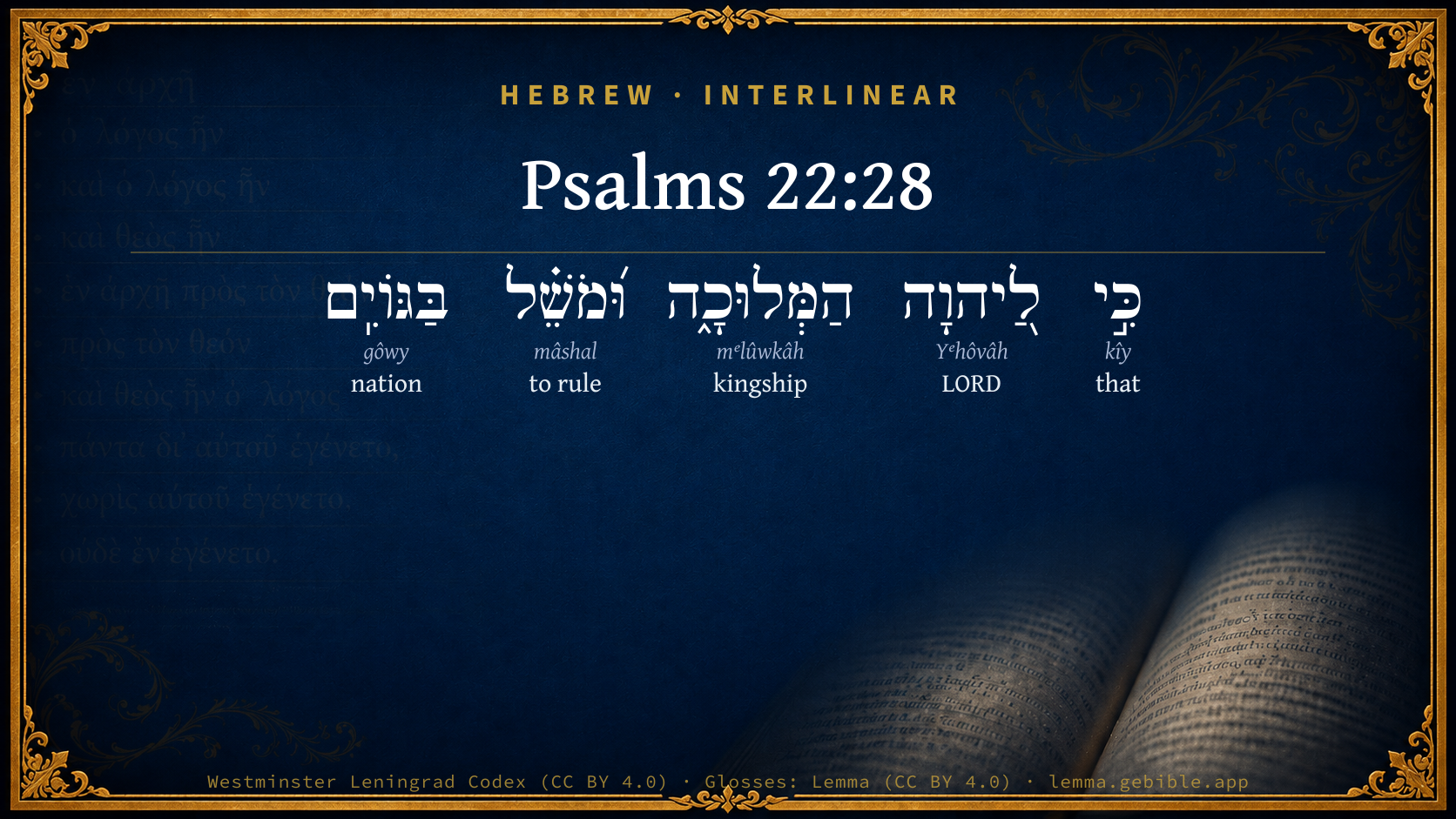
Psalms 22:28

Hebrew (Westminster Leningrad Codex) Psalms 22:28 appears in the Hebrew Old Testament. The text above is from the Westminster Leningrad Codex. Each word links to its Strong’s number, a concise gloss, and parsing drawn from the Open Scriptures Hebrew Bible morphology. Click any word for its full Brown-Driver-Briggs (BDB) entry.
Download image
Cite this verse

Psalms 22:28 (World English Bible). Public Domain. Lemma interlinear Bible study tool, https://lemma.gebible.app/v/psalms/22/28.

Show BibTeX & RIS
BibTeX
RIS
English Translation
For the kingdom is Yahweh's. He is the ruler over the nations.
World English Bible · Public Domain
Download a study sheet

One document with this verse’s original text, its word-by-word gloss line, the meaning frame, cross-references with their text, attributed commentary, and full source and license credits — printable, and it pastes into notes with its structure intact.

This verse Autodidact and up

Study sheet (.html) Plain text (.txt)

A passage Seminary Student

Up to 50 verses in one chapter. A passage sheet keeps up to 6 commentary sources and 12 cross-references per verse, in the order this page ranks them, and says so on the sheet whenever that leaves anything out. Ask for a single verse and you get the Autodidact verse sheet above.

Everything on this page stays free to read, with no account — the sheet is a download of what is already on screen, not access to it.

Want to remove ads? Support Godless Engineer
Compare translations 3

The same verse in 3 English versions, stacked beneath the original-language interlinear above. Click any original word for its lexicon entry.

Each is an independent rendering of the whole verse — the interlinear is not word-aligned to these translations.

Highlighted words mark where these versions differ — a whole-verse word diff, not a word-by-word alignment.

  • World English Bible Public Domain
    For the kingdom is Yahweh's. He is the ruler over the nations.
  • King James Version Public Domain
    For the kingdom is the LORD's: and he is the governor among the nations.
  • unfoldingWord Literal Text CC BY-SA 4.0
    For to Yahweh the kingdom, and he is ruling over the nations.

unfoldingWord Literal Text — © unfoldingWord, licensed CC BY-SA 4.0. Word-aligned USFM3 via Door43 (git.door43.org/unfoldingWord/en_ult).

Versions to compare (up to 4)

3 of 4 selected

Show all 18 translations

Every available English version of this verse, each an independent rendering of the whole verse.

  • World English Bible Public Domain
    For the kingdom is Yahweh's. He is the ruler over the nations.
  • Berean Standard Bible Public Domain
    For dominion belongs to the LORD and He rules over the nations.
  • Majority Standard Bible Public Domain
    For dominion belongs to the LORD and He rules over the nations.
  • King James Version Public Domain
    For the kingdom is the LORD's: and he is the governor among the nations.
  • American Standard Version (1901) Public Domain
    For the kingdom is Jehovah's; And he is the ruler over the nations.
  • Revised Version (1885) Public Domain
    For the kingdom is the LORD’S: and he is the ruler over the nations.
  • Geneva Bible (1599) Public Domain
    For the kingdome is the Lords, and he ruleth among the nations.
  • Douay-Rheims (1899) Public Domain
    All the ends of the earth shall remember, and shall be converted to the Lord: And all the kindreds of the Gentiles shall adore in his sight.
  • Young's Literal Translation Public Domain
    For to Jehovah `is' the kingdom, And He is ruling among nations.
  • Literal Standard Version CC BY-SA 4.0
    For to YHWH [is] the kingdom, || And He is ruling among nations.
  • Unlocked Literal Bible CC BY-SA 4.0
    For the kingdom is Yahweh's; he is the ruler over the nations.
  • unfoldingWord Literal Text CC BY-SA 4.0
    For to Yahweh the kingdom, and he is ruling over the nations.
  • Darby Bible Public Domain
    For the kingdom is Jehovah's, and he ruleth among the nations.
  • World Messianic Bible Public Domain
    For the kingdom is the LORD’s. He is the ruler over the nations.
  • Webster's Bible Public Domain
    \\22:27\\All the ends of the world shall remember and turn to the LORD: and all the kindreds of the nations shall worship before thee.
  • Free Bible Version CC BY-SA 4.0
    For kingly power belongs to the Lord; he is the one who rules over the nations.
  • Bible in Basic English Public Domain
    For the kingdom is the Lord's; he is the ruler among the nations.
  • JPS Tanakh (1917) Public Domain
    (22-29) For the kingdom is the LORD'S; and He is the ruler over the nations.

Literal Standard Version (2020), Covenant Press — licensed CC BY-SA 4.0. Text via the HelloAO Bible API (eBible.org). Unlocked Literal Bible (unfoldingWord) — licensed CC BY-SA 4.0. Text via the HelloAO Bible API (eBible.org). unfoldingWord Literal Text — © unfoldingWord, licensed CC BY-SA 4.0. Word-aligned USFM3 via Door43 (git.door43.org/unfoldingWord/en_ult). Free Bible Version, Dr. Jonathan Gallagher — licensed CC BY-SA 4.0. Text via the HelloAO Bible API (eBible.org).

Word by word

More ways to search: Search by grammar → Find every occurrence → Compare this word →

Practice this passage: Drill this verse → Learn its vocabulary →

About this verse

These counts appear in no published source. They are computed here, from the morphology-tagged text and Lemma’s own curated glosses. What Lemma adds →

5
words
5
distinct lemmas
Wisdom
section

Notable vocabulary

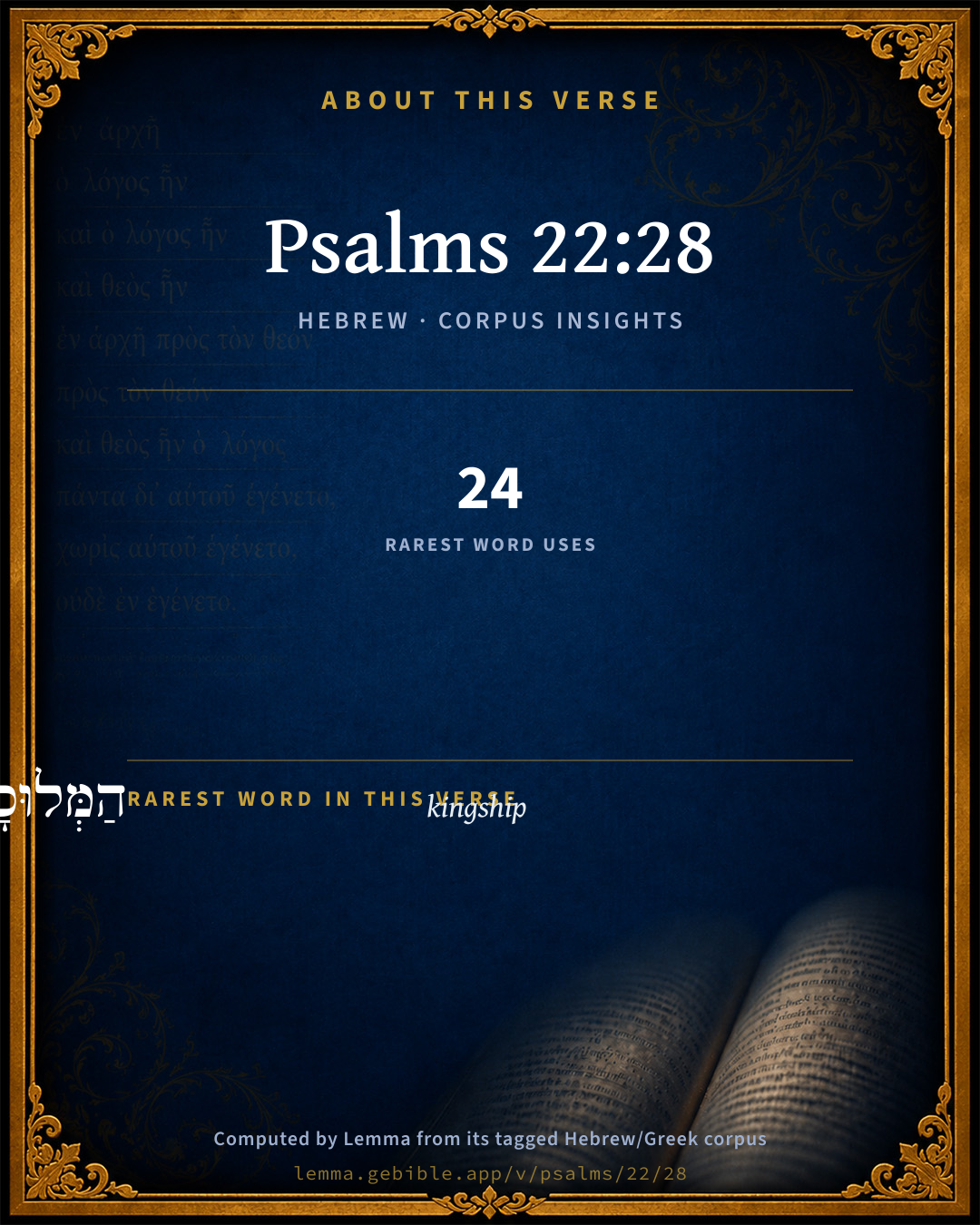
The rarest word here is הַמְּלוּכָ֑ה kingship H4410 — appearing just 24 times in the whole Hebrew Bible.

Shared distinctive vocabulary

הַמְּלוּכָ֑ה kingship H4410 occurs in 23 verses of the Hebrew Bible. Also found in:

Grammatical profile

  • 1 verb
  • 3 nouns
  • 1 conjunction

Verb forms

  • וּ֝מֹשֵׁ֗ל Qal · Participle Active

Hebrew & Septuagint length

In English translation the verse runs 12 words from the Hebrew and 14 from the Septuagint (LXX English) — closely comparable.

A rough comparison of the two English renderings, which tokenize alike — not a word-level alignment.

Word counts can differ between the Hebrew and the Greek without any difference in meaning — e.g. the Hebrew direct-object marker אֵת has no separate Greek word, and Greek often adds the article ὁ.

Cross-references

6

Topical passages linked to Psalms 22:28 in the Treasury of Scripture Knowledge — connected by theme and wording, ordered by reader-vote popularity; previews shown in the World English Bible.

  • Zechariah 14:9 Yahweh will be King over all the earth. In that day Yahweh will be one, and his name one.
  • Psalms 47:7–8 For God is the King of all the earth. Sing praises with understanding.
  • Daniel 7:14 There was given him dominion, and glory, and a kingdom, that all the peoples, nations, and languages should serve him: his dominion is an everlasting dominion, which shall not pass away, and his kingdom that which shall not be destroyed.
  • Revelation 11:15 The seventh angel sounded, and great voices in heaven followed, saying, "The kingdom of the world has become the Kingdom of our Lord, and of his Christ. He will reign forever and ever!"
  • Obadiah 1:21 Saviors will go up on Mount Zion to judge the mountains of Esau, and the kingdom will be Yahweh's.
  • Matthew 6:13 Bring us not into temptation, but deliver us from the evil one. For yours is the Kingdom, the power, and the glory forever. Amen.'

Cross-references courtesy of OpenBible.info (CC BY 4.0).

Hebrew and Greek witnesses Masoretic Hebrew ↔ Greek Septuagint

The same verse in the two great witnesses to the Old Testament, shown verse-for-verse.

You’re reading Greek Psalm 21 (Hebrew Psalm 22). The Septuagint counts the superscription, so verse numbers can differ from the Hebrew — chapter-level alignment, not verse-by-verse. Numbering follows Rahlfs.

These are two independent witnesses, not word-aligned to each other, and the Septuagint is shown in lemma (dictionary) form.

Hebrew Psalms 22:28 Masoretic · Westminster Leningrad Codex

כִּ֣י לַ֭יהוָה הַמְּלוּכָ֑ה וּ֝מֹשֵׁ֗ל בַּגּוֹיִֽם

For the kingdom is Yahweh's. He is the ruler over the nations.

World English Bible · Public Domain

Greek LXX Greek Psalm 21:28 Septuagint · lemma form

μιμνήσκω καί ἐπιστρέφω πρός κύριος πᾶς ὁ πέρας ὁ γῆ καί προςκυνέω ἐνώπιον σύ πᾶς ὁ πατριά ὁ ἔθνος

For the kingdom is the Lord's; and he is the governor of the nations.

LXX2012 (modern English Septuagint) · Public Domain

Hebrew: Westminster Leningrad Codex (CC BY 4.0). Greek: Septuagint (public domain); English from LXX2012 (modern English Septuagint) (Public Domain). How the Septuagint differs from the Hebrew →

Commentary

Notes on Psalms 22:28 from classic Christian and Jewish commentators (each source and its license shown beneath its notes). The classic Christian expositions comment on the surrounding passage and are grouped to its opening verse, so a note may address several verses; the Jewish commentaries on the Tanakh (Rashi and others) are per-verse, so they appear only where the commentator wrote on this verse.

Lemma curates 59 commentaries, every one of them public domain or Creative Commons licensed, each selected and text-cleaned for this edition rather than reprinted as found. About our sources →

Trapp's Complete Commentary

John Trapp

Psa 22:28 For the kingdom [is] the LORD’S: and he [is] the governor among the nations.

Ver. 28. For the kingdom is the Lord’s] The spiritual kingdom over the Church, and the universal kingdom over all the world, belongeth unto Christ, the eternal God.

John Trapp, A Commentary or Exposition upon All the Books of the Old and New Testament (1647–1656) — public domain. Text from a community e-Sword module.

The Biblical Illustrator

Joseph S. Exell

Psa_22:28

The kingdom is the Lords.

An universal religion

The law of Moses was confined, by the terms of its promulgation, to the land of Judaea: and other systems which have been embraced as Divine attempted to ensure their success In some quarters of the globe by an accommodation to local manners which prevented them from spreading to distant regions. But the religion of Christ has all the internal characters of an universal religion. The manner in which the Gospel was introduced corresponds to these characters of an universal religion. Before He ascended to heaven the Founder constituted His apostles witnesses to Him unto the uttermost parts of the earth, and sent them forth to make disciples of all nations . . . We readily recognise in Jesus that illustrious descendant promised to Abraham, in whom all the families of the earth were to be blessed; that Prince of Peace whose universal dominion the prophets have painted by various imagery, in whose reign the righteous were to flourish, and the knowledge of the Lord was to cover the earth. But when we look beyond the destruction of Jerusalem these bright views seem to vanish, and we mark, with wonder and regret a striking inconsistency between the earlier and later history of the Christian Church: This religion was, for many ages, persecuted and despised by the powers of the earth. For a long time it was involved in the superstition and barbarism of the dark ages. The fact is, that, after seventeen hundred years have passed, the religion of Jesus is established in less than a fifth part of the globe. The faith of Mahomet, which has been permitted to overspread a larger portion of the earth, retains undisputed possession of its conquests. What can be said as an answer to the presumption, drawn from present appearances, against the fulfilment of the promise of universality for Christianity?

1. Though the Almighty may do all His pleasure by the word of His mouth, He generally chooses to employ means in accomplishing His purposes, and the operation of those means is so gradual as to admit of a progress ill which one thing not only paves the way for another, but gives notice of its approach. We are not warranted, by the analogy of any part of Divine providence, to expect, in the communication of religious instruction, that haste which to our imaginations may appear desirable.

2. As in natural productions there is a time of maturity to which all the preparation has tended, so the season destined for the appearance of the Gospel, which is called in Scripture the fulness of the time, was produced by a preparation of four thousand years.

3. The partial propagation of Christianity has already diffused a large measure of religious knowledge, which concurs with other circumstances in preparing the world for its being universally received.

4. The partiality, the delay, and the imperfection in the propagation of Christianity are fully accounted for by the nature of those human means which, without a succession of miracles, it was necessary to employ . . . Presumption against the universal propagation of Christianity, which has been drawn from present appearances, is contradicted by the general analogy of the Divine government, by the effects already produced, and the forward tendency of things. (G. Hill, D. D.)

The oldest kingdom and the best government

What can be a more consoling fact, in times of national convulsion, than the one declared here? The Lords kingdom is distinct from all others.

I. The greatest kingdom ever. Known. My text says the Lord is the governor. I much question if He has a kingdom for His own upon the face of the whole earth now. There was a time when He appeared signally to recognise our own dear old England distinctly above all other nations; but now it has gone down, in some instances, to downright infidelity, or, in others, perverted to gross idolatry. Whatever He may please to do with the land of my nativity, I shall rejoice to know we have in it yet more of His own kingdom than any other nation upon earth. Of the Lords kingdom we note--

(1) It is a chosen one: men enter it through a broken and contrite spirit; others who have not known this are not in the kingdom.

(2) Hence it is His by conquest over human hearts. He has subdued them unto Himself.

(3) It is under His own special care. And

(4) He peopled it with the precious souls that He had ordained from everlasting.

(5) And He dwells and abides there.

(6) Its constitution is righteousness, peace, and joy in the Holy Spirit. It is a sacred kingdom and no unclean thing shall enter it.

(7) How vast are its treasures--grace and glory.

II. It has the wisest, holiest, and best of governors.

(1) His sovereignty is absolute over all nations for His own people as well as in them.

(2) It is exercised in the hearts of His subjects. Who ever heard of any other governor who reigned in the heart of every one of his subjects?

(3) He never revokes any of His decrees. My covenant will I not alter. His statutes stand forever, those in His secret statute book and those in the Scripture, the inspired abstract of His will. (Joseph Irons.)

On providence

I. Prove the doctrine. That God presides in every department of nature, and exercises a superintending care over the works of His hand, has been believed in every nation and in every age. The cavils of sceptical men are not to be considered as detracting from its universality. What is providence but the exercise of the Divine attributes? Sound philosophy never supported the atheistical system which would exclude the Almighty from His kingdom, and surrender to blind chance the government of the universe. The Divine government is recognised in the material system, but it is not confined to that. In the moral as in the natural world His pervading energy appears. What are the annals of nations but a continued detail of its operation? The world is a great scene, where from age to age a series of providential interpositions has been displayed. Some invisible power is employed in overruling human affairs. An infinite mind must have access, though we cannot perceive it, in many different ways, to the human heart. But man is conscious all the while that no violence is offered to his will, that he is acting as a moral agent, without any infringement of his freedom.

II. Recommend a becoming trust in divine providence. His perfections demand our veneration and justify our confidence. Infinite goodness, added to Almighty power, constitutes the very character which claims our dependence. (T. Lawrie, D. D.)

The Biblical Illustrator, edited by Joseph S. Exell (c. 1880s–1900s) — public domain. Text from a community e-Sword module.

Joseph Benson's Commentary

Psa 22:28. For the kingdom is the Lord’s — This is added as a reason why the Gentiles should be converted, because God is not only the God and Lord of the Jews, but also of the Gentiles, and of all nations. And, therefore, though for a time he thought fit to confine his kingdom or visible church to Israel, yet he had resolved, in due time, to enlarge it, and to set up his throne and government in the Gentile world, which were no less created and redeemed by him than the Jews, Rom 3:29-30; Zec 14:9.

Joseph Benson's Commentary on the Old and New Testaments (1811–1818) — public domain. Text from a community e-Sword module.

J. A. Alexander on Psalms

Joseph Addison Alexander

29. (Psa 22:28). For unto Jehovah is the kingdom, and (he is) governor among the nations. This will not be a gratuitous extension to the Gentiles of what properly belongs to Israel alone, but a restoration of God's mercies, after ages of restriction, to their original and proper scope. For Jehovah is not the king of Israel only, but of all mankind. See Rom 3:29.—The kingdom, i.e. general ecumenical dominion.—Governor, properly a participle, ruling, the use of which may be intended to suggest that as he has always been their governor de jure, so now he begins to govern them de facto, not with a providential sway, which is invariable as well as universal, but with a spiritual sway, which is hereafter to be co-extensive with the earth itself. Compare the similar expressions, Oba 1:21, Zec 14:9, and the still closer parallels, Psa 96:10; Psa 97:1; Psa 99:1.

Joseph Addison Alexander, The Psalms Translated and Explained (1850) — public domain. Text from a community e-Sword module.

Tyndale Open Study Notes

Tyndale Open Resources

22:28 The universal kingdom belongs to God alone (Obad 1:21).

Tyndale Open Study Notes — © Tyndale Open Resources, licensed CC BY-SA 4.0. Text via the HelloAO Bible API.

Adam Clarke's Commentary

Verse 28. The kingdom is the Lord's] That universal sway of the Gospel which in the New Testament is called the kingdom of God; in which all men shall be God's subjects; and righteousness, peace, and joy in the Holy Ghost, be universally diffused.

Adam Clarke's Commentary on the Bible (1810–1826) — public domain. Text from a community e-Sword/MySword module.

John Calvin's Commentaries

This sense is more fully confirmed by the reason The reason why the Gentiles shall remember, and turn to the Lord.

“He shall judge among the nations, and shall rebuke many people.” (Isaiah 2:4)

Moreover, as God had not subdued the world to himself, prior to the time when those who before were unconquerable were subdued to a willing obedience by the preaching of the gospel, we may conclude that this conversion was effected only under the management and government of Christ. If it is objected, that the whole world has never yet been converted, the solution is easy. A comparison is here made between that remarkable period in which God suddenly became known every where, by the preaching of the gospel, and the ancient dispensation, when he kept the knowledge of himself shut up within the limits of Judea. Christ, we know, penetrated with amazing speed, from the east to the west, like the lightning’s flash, in order to bring into the Church the Gentiles from all parts of the world.

John Calvin's Commentaries (1540-1563) — public domain. Text from the Calvin Translation Society English edition (1840s-50s) via the Christian Classics Ethereal Library (ccel.org). Calvin's coverage is partial (roughly two-thirds of the Bible); uncommented books and verses are honest gaps, never fabricated. The 19th-century editor's footnotes and remarks are omitted so the notes are faithfully Calvin's own voice.

The Cambridge Bible for Schools and Colleges

gen. ed. J. J. S. Perowne

28. The reason for this homage. It is but the recognition of the present fact of Jehovah’s universal sovereignty. Cp. Oba_1:21; Psa_93:1; Psa_96:10; Psa_97:1; Zec_14:16-17.

and he is the governor &c.] R.V., and he is the ruler over the nations. Cp. Psa_66:7; Psa_103:19.

The Cambridge Bible for Schools and Colleges (gen. ed. J. J. S. Perowne; Cambridge University Press, 1878–1918) — public domain. Text from a community e-Sword module.

John Gill's Exposition

For the kingdom is the Lord's,.... Not the kingdom of nature and providence, though that is the Lord Christ's; but the kingdom of grace, the mediatorial kingdom: this was Christ's by the designation and constitution of his Father from eternity; the government of the church was always upon his shoulders during the Old Testament dispensation; when he came into this world, he came as a King; though his kingdom being not of this world, it came not with observation; but upon his ascension to heaven, whither he went to receive a kingdom and return, he was made or declared Lord and Christ, and was exalted as a Prince, as well as a Saviour; and in consequence of his being set down at the right hand of God, he sent forth the rod of his strength, his Gospel, into the Gentile world, which was succeeded to the conversion of multitudes of them, among whom he has had a visible kingdom and interest ever since; and which will more abundantly appear in the latter day, when he shall be King over all the earth; and now this is a reason why so many, in the distant parts of the world, and among all the kindreds of the nations, shall remember, turn to him, and worship him;

and he is the Governor among the nations; he rules in the hearts of some by his Spirit and grace, and over others with a rod of iron.

John Gill's Exposition of the Whole Bible (1746–1763) — public domain (CC PDM 1.0). Text via the HelloAO Bible API.

Albert Barnes' Notes on the Bible

For the kingdom is the Lord’s - The dominion belongs of right to Yahweh, the true God. See Mat 6:13; Psa 47:7-8.

And he is the governor among the nations - He is the rightful governor or ruler among the nations. This is an assertion of the absolute right of Yahweh to reign over the nations of the earth, and the expression of an assurance on the part of the Messiah that, as the consequence of his work, this empire of Yahweh over the nations would be actually established. Compare Dan 7:13-14, note; Dan 7:27, note; and 1Co 15:24-28, notes.

Albert Barnes' Notes on the Bible (1834–1885) — public domain. Text from a community e-Sword/MySword module.

Matthew Poole's English Annotations

This is added as a reason why the Gentiles should be converted, because God is not only the God and Lord of the Jews, but also of the Gentiles, and of all nations, Rom 3:29,30. And therefore though for a time he thought fit to confine his kingdom to Israel, yet he had resolved in due time to enlarge his kingdom, and to set up his throne and government in the Gentile world, which were no less created and redeemed by him than the Jews. Compare Zec 13:2; 14:9.

Matthew Poole's English Annotations on the Holy Bible (1683–1685) — public domain. Text from a community e-Sword/MySword module.

The Treasury of David

Charles H. Spurgeon

Ver. 28. For the kingdom is the Lord's. As an obedient Son the dying Redeemer rejoiced to know that his Father's interests would prosper through his pains. "The Lord reigneth" was his song as it is ours. He who by his own power reigns supreme in the domains of creation and providence, has set up a kingdom of grace, and by the conquering power of the cross that kingdom will grow until all people shall own its sway and proclaim that

he is the governor among the nations. Amid the tumults and disasters of the present the Lord reigneth; but in the halcyon days of peace the rich fruit of his dominion will be apparent to every eye. Great Shepherd, let thy glorious kingdom come.

Ver. 28. The empire of the King of kings as it is, and as it shall be.

Psalms 22:29*

Charles H. Spurgeon's The Treasury of David (1869–1885) — public domain. Psalms only. Text from a community e-Sword/MySword module.

The Pulpit Commentary

For the kingdom is the Lord"s. (comp. Psa_96:10 Psa_97:1) Christ has taken the kingdom, and even now rules on the earth not yet wholly over willing subjects, but over a Church that is ever expanding more and more, and tending to become universal. And he is the Governor among the nations. Not the Governor of one nation only, but of all.

God"s supreme dominion over all nations.

"The kingdom is the Lord"s," etc. The second clause of this verse defines the meaning of the first. God"s supreme dominion, in right and in fact, is over all nations. He reigns and he rules. There is a wide view of God"s kingdom, as embracing the universe. (Psa_103:19 Psa_93:1 Psa_97:1) There is also a spiritual view, in which the kingdom consists of individuals, ruled not by force, but by truth, love, and the Spirit of God. (Luk_17:21Jo Luk_18:36) Nations have no place here. None the less, God"s government of nations is a sublime fact and undoubted truth, holding a prominent place in Scripture. "All authority in heaven and earth" (Mat_28:18) must include this. The nations are promised as Christ"s inheritance, (Psa_2:8) and are to be blessed in him. (Gal_3:8)

I GOD GOVERNS THE NATIONS BY HIS ALL-CONTROLLING, WISE, JUST, AND MERCIFUL PROVIDENCE. This is one main lesson of the whole of Old Testament history specially enforced in Jer_18:7-10 Gen_15:16, etc.; Deu_9:4. The ordered succession of empires, in Nebuchadnezzar"s and Daniel"s visions, emphatically enforces the same truth. (Act_17:26) The history of our own nation is a marvellous example, only second to that of Israel.

II THE AUTHORITY OF NATIONAL GOVERNMENT RESTS ON DIVINE AUTHORITY. (Rom_8:1-6) No human being can claim authority over another human being; no majority, any more than a single despot, over a minority or a single citizen, but by Divine ordinance. This is not merely revealed in Scripture, but imprinted and inwoven in human nature.

III NATIONS, AS MUCH AS INDIVIDUALS, ARE SOUND BY GOD"S LAW. Human laws lack sanction when they contradict justice; they may he enforced, but cannot be reverenced. Government which outrages mercy, virtue, truth, purity, equity, denies the very end of its existence, and forfeits allegiance. On this ground of natural right, the American colonies revolted. "Natural right" is but another name for God"s justice.

IV NATIONAL LIFE AND CHARACTER, which are very far wider than government or state action, are within the province of Divine government; either conform to or disobey God"s Law and revealed will. Private, family, social, morality; religion, trade and industry in every branch; amusement and society; education; literature; art, are all favouring or hindering the formation of a "righteous nation". (Isa_26:2; Psa_144:15) (This touches the great question of state religion. Are the aims and means of the Church and of the state the same? It is possible to have an established Church, yet an irreligious nation; or many Churches, all free, yet a religious nation.)

V THESE WORDS ARE PROPHETIC OF WHAT SHALL YET BE. (Psa_72:8, Psa_72:11, 17 Rev_11:15) Christ holds the sceptre of providence as well as of grace; (Eph_1:22) and "he must reign". (1Co_15:25)

CONCLUSION. Practical lessons.

1. The character of a nation depends on the character of its individual citizens. A truly Christian nation would be one the bulk of whose citizens are personally real Christians. Its laws, institutions, and policy would then be moulded by principles learned from God"s Word.

2. Public duty, political, municipal, etc., far from being inconsistent with the Christian calling (as some teach), is, when rightly performed, religious part of the service we owe to God.

The Pulpit Commentary (1880–1919), ed. H.D.M. Spence-Jones & Joseph S. Exell — public domain. Text from a community e-Sword module.

John Wesley's Explanatory Notes

For - This is added as a reason, why the Gentiles should be converted, because God is not only God and the Lord of the Jews, but also of the Gentiles, and of all nations.

John Wesley, Explanatory Notes Upon the Whole Bible (1754–1765) — public domain. Text via the GEBible commentary corpus.

Scofield Reference Notes

C. I. Scofield

For the kingdom is

CF. Psa 22:30. The kingdom is Jehovah’s. In Psa 22:30 Adonai is in view as ruling on behalf of Jehovah. See Psalms 110, with Mat 22:42-45. The great end and object of the rule of Adonai (Lord) is the restoration of the kingdom to Jehovah (Lord).

See 1Co 15:23; 1Co 15:24. See "Names of Deity,"

1Co 15:23; 1Co 15:24 (See Scofield "Gen 2:4"), See Scofield "Gen 15:2".

The Scofield Reference Bible (1917 edition), notes by C. I. Scofield — public domain. Text from a community e-Sword module.

unfoldingWord translationNotes

Door43 World Missions Community

For the kingdom is Yahweh's

"For the kingdom belongs to Yahweh." Here "kingdom" represents God's rule as king. AT: "For Yahweh is king" (See: Metonymy)

he is the ruler over the nations

Here "nations" represents the people of the nations. AT: "he rules the people of the nations" (See: Metonymy)

will feast

The people will eat together at the feast. AT: "will eat together" or "will eat a festive meal together"

all those who are descending into the dust ... those who cannot preserve their own lives

Both phrases refers to the same group. They both refer to all people because all people will die. (See: Parallelism)

those who are descending into the dust

Here "dust" represents the grave. The phrase "descending into the dust" is a way of referring to someone dying. AT: "those who are dying" or "those who die" (See: Metonymy and Idiom)

those who cannot preserve their own lives

"those who cannot save their own lives" or "those who cannot keep themselves from dying"

translationWords

kingdom

Yahweh

rule

nation

prosper

feast

worship

bow

unfoldingWord translationNotes — © Distant Shores Media and the Door43 World Missions Community, licensed CC BY-SA 4.0. Source: git.door43.org/Door43/en_tn.

Rashi

Rabbi Shlomo Yitzchaki (Rashi)

shall remember and return to the Lord The nations shall remember the evil that befell us when they see the good and return to the Lord.

Rashi on the Tanakh — English translations: “The Judaica Press complete Tanach with Rashi, translated by A. J. Rosenberg” (CC BY 4.0); “Pentateuch with Rashi's commentary by M. Rosenbaum and A.M. Silbermann, 1929-1934” (public domain); “The Metsudah Tanach series, Lakewood, N.J” (CC BY 4.0); and “The Book of Joshua, Metsudah Publications, 1997” (CC BY 4.0). Text via Sefaria.

Radak

Rabbi David Kimhi (Radak)

They shall remember: – The nations (shall remember) the poverty and weakness in which Israel was while in exile; they shall see the great deliverance.

and all the ends of the earth shall turn unto the Lord, and all the kindreds of the nations shall worship before Thee: – The Prophet addresses the Name directly.

Radak on the Tanakh — English translations: “Sefaria Community Translation” (CC0 1.0 (public-domain dedication)); “Eliyahu Munk, HaChut Hameshulash” (CC BY 4.0); “Rabbi Mike Feuer, Jerusalem Anthology” (CC BY 4.0); and “R. David Kimhi on the first book of Psalms, Translated by R.G. Finch, London, 1919” (public domain). Text via Sefaria.

Lesson kit

Teaching starters — assembled from the data on this page, not authored interpretation. Every prompt links to the verse data it draws on. Edit before teaching.

Psalms, in the Wisdom, opens this verse with 5 words (5 distinct Hebrew lemmas). Its most distinctive word is mᵉlûwkâh (“kingship”). A historical commentator’s framing appears above. Read the whole chapter for the surrounding context.

Discussion questions

  1. The word mᵉlûwkâh carries the sense “kingship.” How does it shape the verse?
  2. 1 Samuel 10:16 shares the word «kingship» with this verse. How do the two illuminate each other?
  3. These translations render this verse differently. What is at stake in choosing one wording over another?
  4. The verb «וּ֝מֹשֵׁ֗ל» is Qal Participle Active. How does its form color the action?
  5. Reading how Trapp's Complete Commentary and The Biblical Illustrator read this verse, where do the two commentators agree and where do they part?

Things to notice

Reading settings

Reading text

Shown beneath each verse's original-language words.

Old Testament
Old Testament edition

Read the OT as the Masoretic Hebrew (MT) or the Greek Septuagint (LXX).

English shown for the Greek Septuagint (in the Hebrew ↔ Greek comparison).

Comparing translations? Open the Compare panel on any verse page to stack up to four side by side.