
2 Kings 17:15

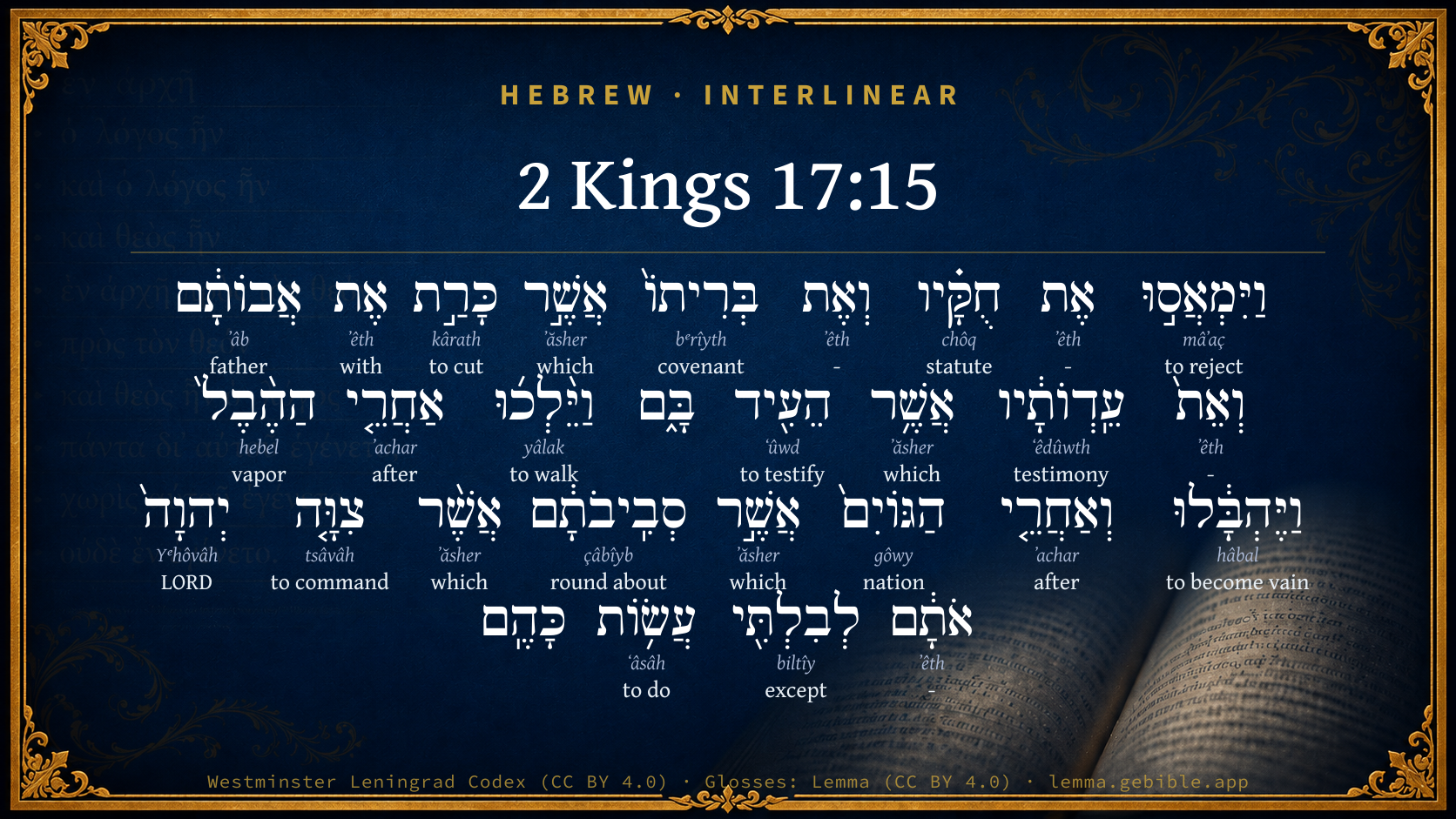
Hebrew (Westminster Leningrad Codex) 2 Kings 17:15 appears in the Hebrew Old Testament. The text above is from the Westminster Leningrad Codex. Each word links to its Strong’s number, a concise gloss, and parsing drawn from the Open Scriptures Hebrew Bible morphology. Click any word for its full Brown-Driver-Briggs (BDB) entry.
Download image
Cite this verse

2 Kings 17:15 (World English Bible). Public Domain. Lemma interlinear Bible study tool, https://lemma.gebible.app/v/2-kings/17/15.

Show BibTeX & RIS
BibTeX
RIS
English Translation
They rejected his statutes, and his covenant that he made with their fathers, and his testimonies which he testified to them; and they followed vanity, and became vain, and [went] after the nations that were round about them, concerning whom Yahweh had charged those who they should not do like them.
World English Bible · Public Domain
Highlights
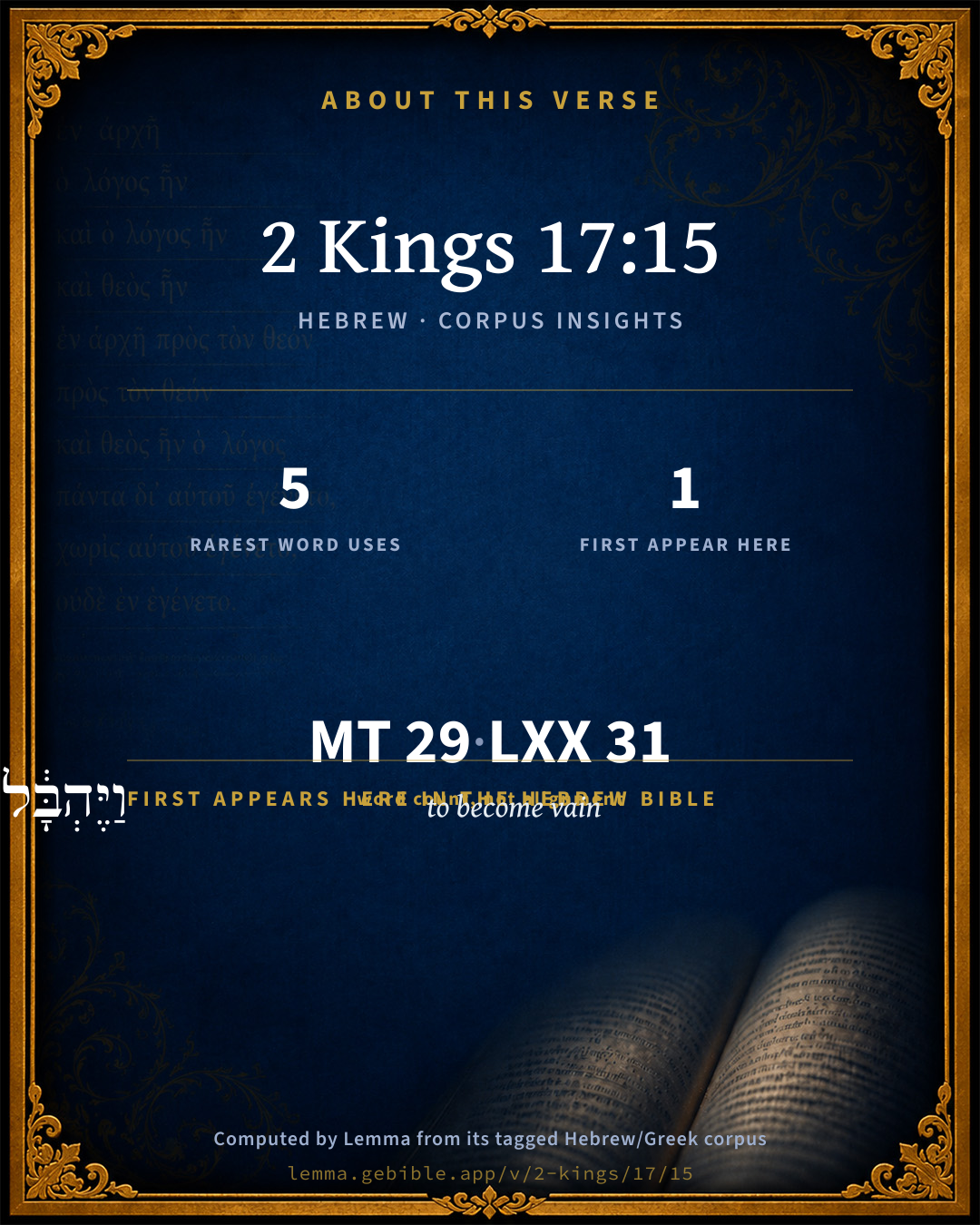
  • 1 first appearance in the Hebrew Bible
Full analysis ↓
Download a study sheet

One document with this verse’s original text, its word-by-word gloss line, the meaning frame, cross-references with their text, attributed commentary, and full source and license credits — printable, and it pastes into notes with its structure intact.

This verse Autodidact and up

Study sheet (.html) Plain text (.txt)

A passage Seminary Student

Up to 50 verses in one chapter. A passage sheet keeps up to 6 commentary sources and 12 cross-references per verse, in the order this page ranks them, and says so on the sheet whenever that leaves anything out. Ask for a single verse and you get the Autodidact verse sheet above.

Everything on this page stays free to read, with no account — the sheet is a download of what is already on screen, not access to it.

Want to remove ads? Support Godless Engineer
Compare translations 3

The same verse in 3 English versions, stacked beneath the original-language interlinear above. Click any original word for its lexicon entry.

Each is an independent rendering of the whole verse — the interlinear is not word-aligned to these translations.

Highlighted words mark where these versions differ — a whole-verse word diff, not a word-by-word alignment.

  • World English Bible Public Domain
    They rejected his statutes, and his covenant that he made with their fathers, and his testimonies which he testified to them; and they followed vanity, and became vain, and [went] after the nations that were round about them, concerning whom Yahweh had charged those who they should not do like them.
  • King James Version Public Domain
    And they rejected his statutes, and his covenant that he made with their fathers, and his testimonies which he testified against them; and they followed vanity, and became vain, and went after the heathen that were round about them, concerning whom the LORD had charged them, that they should not do like them.
  • unfoldingWord Literal Text CC BY-SA 4.0
    And they rejected his statutes and his covenant that he had cut with their fathers and his testimonies that he testified against them. And they walked after vapor, and they became vapor, and after the nations that around them, whom Yahweh had commanded them not to act like them.

unfoldingWord Literal Text — © unfoldingWord, licensed CC BY-SA 4.0. Word-aligned USFM3 via Door43 (git.door43.org/unfoldingWord/en_ult).

Versions to compare (up to 4)

3 of 4 selected

Show all 18 translations

Every available English version of this verse, each an independent rendering of the whole verse.

  • World English Bible Public Domain
    They rejected his statutes, and his covenant that he made with their fathers, and his testimonies which he testified to them; and they followed vanity, and became vain, and [went] after the nations that were round about them, concerning whom Yahweh had charged those who they should not do like them.
  • Berean Standard Bible Public Domain
    They rejected His statutes and the covenant He had made with their fathers, as well as the decrees He had given them. They pursued worthless idols and themselves became worthless, going after the surrounding nations that the LORD had commanded them not to imitate.
  • Majority Standard Bible Public Domain
    They rejected His statutes and the covenant He had made with their fathers, as well as the decrees He had given them. They pursued worthless idols and became worthless themselves, going after the surrounding nations that the LORD had commanded them not to imitate.
  • King James Version Public Domain
    And they rejected his statutes, and his covenant that he made with their fathers, and his testimonies which he testified against them; and they followed vanity, and became vain, and went after the heathen that were round about them, concerning whom the LORD had charged them, that they should not do like them.
  • American Standard Version (1901) Public Domain
    And they rejected his statutes, and his covenant that he made with their fathers, and his testimonies which he testified unto them; and they followed vanity, and became vain, and `went' after the nations that were round about them, concerning whom Jehovah had charged them that they should not do like them.
  • Revised Version (1885) Public Domain
    And they rejected his statutes, and his covenant that he made with their fathers, and his testimonies which he testified unto them; and they followed vanity, and became vain, and went after the nations that were round about them, concerning whom the LORD had charged them that they should not do like them.
  • Geneva Bible (1599) Public Domain
    And they refused his statutes and his couenant, that he made with their fathers, and his testimonies (wherewith he witnessed vnto them) and they followed vanitie, and became vaine, and followed the heathen that were round about them: concerning whome the Lord had charged them, that they should not do like them.
  • Douay-Rheims (1899) Public Domain
    And they rejected his ordinances and the covenant that he made with their fathers, and the testimonies which he testified against them: and they followed vanities, and acted vainly: and they followed the nations that were round about them, concerning which the Lord had commanded them that they should not do as they did.
  • Young's Literal Translation Public Domain
    and reject His statutes and His covenant that He made with their fathers, and His testimonies that He testified against them, and go after the vain thing, and become vain, and after the nations that are round about them, of whom Jehovah commanded them not to do like them;
  • Literal Standard Version CC BY-SA 4.0
    and reject His statutes and His covenant that He made with their fathers, and His testimonies that He testified against them, and go after the vain thing, and become vain, and after the nations that are around them, of whom YHWH commanded them not to do like them.
  • Unlocked Literal Bible CC BY-SA 4.0
    They rejected his statutes and the covenant that he had made with their ancestors, and the covenant decrees that he had given to them. They followed useless practices and they themselves became useless. They followed the pagan nations who were around them, those that Yahweh had commanded them not to imitate.
  • unfoldingWord Literal Text CC BY-SA 4.0
    And they rejected his statutes and his covenant that he had cut with their fathers and his testimonies that he testified against them. And they walked after vapor, and they became vapor, and after the nations that around them, whom Yahweh had commanded them not to act like them.
  • Darby Bible Public Domain
    And they rejected his statutes, and his covenant which he had made with their fathers, and his testimonies which he had testified unto them; and they followed vanity and became vain, and [went] after the nations that were round about them, concerning whom Jehovah had charged them that they should not do like them.
  • World Messianic Bible Public Domain
    They rejected his statutes and his covenant that he made with their fathers, and his testimonies which he testified to them; and they followed vanity, and became vain, and followed the nations that were around them, concerning whom the LORD had commanded them that they should not do like them.
  • Webster's Bible Public Domain
    And they rejected his statutes, and his covenant that he made with their fathers, and his testimonies which he testified against them; and they followed vanity, and became vain, and went after the heathen that were around them, concerning whom the LORD had charged them, that they should not do like them.
  • Free Bible Version CC BY-SA 4.0
    They gave up on his regulations and the covenant he had made with their forefathers, as well as the decrees he had given them. They followed pointless idols and they became pointless themselves, copying the nations around them that the Lord ordered them not to copy.
  • Bible in Basic English Public Domain
    And they went against his rules, and the agreement which he made with their fathers, and his laws which he gave them; they gave themselves up to things without sense or value, and became foolish like the nations round them, of whom the Lord had said, Do not as they do.
  • JPS Tanakh (1917) Public Domain
    and they rejected His statutes, and His covenant that He made with their fathers, and His testimonies wherewith He testified against them; and they went after things of nought, and became nought, and after the nations that were round about them, concerning whom the LORD had charged them that they should not do like them;

Literal Standard Version (2020), Covenant Press — licensed CC BY-SA 4.0. Text via the HelloAO Bible API (eBible.org). Unlocked Literal Bible (unfoldingWord) — licensed CC BY-SA 4.0. Text via the HelloAO Bible API (eBible.org). unfoldingWord Literal Text — © unfoldingWord, licensed CC BY-SA 4.0. Word-aligned USFM3 via Door43 (git.door43.org/unfoldingWord/en_ult). Free Bible Version, Dr. Jonathan Gallagher — licensed CC BY-SA 4.0. Text via the HelloAO Bible API (eBible.org).

Word by word

More ways to search: Search by grammar → Find every occurrence → Compare this word →

Practice this passage: Drill this verse → Learn its vocabulary →

וַיֶּהְבָּ֔לוּ
hâbal
H1891
“and · to become vain”
Conjunction + Verb, Qal, Sequential Imperfect, 3rd Person, Masculine, Plural
Part of Speech
Conjunction + Verb
Stem
Qal
Form
Sequential Imperfect
Person
3rd Person
Gender
Masculine
Number
Plural
Full BDB Definition

Origin: a primitive root

TWOT: 463

to act emptily, become vain, be vain - (Qal) - to become vain - to be utterly vain (with cognate acc) - (Hiphil) - to cause to become vain - to fill with vain hopes
  1. וַיִּמְאֲס֣וּ mâʼaç H3988 “and · to reject” Conjunction + Verb, Qal, Sequential Imperfect, 3rd Person, Masculine, Plural
  2. אֶת ʼêth H853 “-” Particle, Direct Object
  3. חֻקָּ֗יו chôq H2706 “statutes · his” Noun, Common, Masculine, Plural, Construct + Suffix, Personal, 3rd Person, Masculine, Singular
  4. וְאֶת ʼêth H853 “and · -” Conjunction + Particle, Direct Object
  5. בְּרִיתוֹ֙ bᵉrîyth H1285 “covenant · his” Noun, Common, Feminine, Singular, Construct + Suffix, Personal, 3rd Person, Masculine, Singular
  6. אֲשֶׁ֣ר ʼăsher H834 “which” Particle, Relative
  7. כָּרַ֣ת kârath H3772 “to cut” Verb, Qal, Perfect, 3rd Person, Masculine, Singular
  8. אֶת ʼêth H854 “with” Preposition
  9. אֲבוֹתָ֔ם ʼâb H1 “fathers · their” Noun, Common, Masculine, Plural, Construct + Suffix, Personal, 3rd Person, Masculine, Plural
  10. וְאֵת֙ ʼêth H853 “and · -” Conjunction + Particle, Direct Object
  11. עֵֽדְוֺתָ֔יו ʻêdûwth H5715 “testimonies · his” Noun, Common, Feminine, Plural, Construct + Suffix, Personal, 3rd Person, Masculine, Singular
  12. אֲשֶׁ֥ר ʼăsher H834 “which” Particle, Relative
  13. הֵעִ֖יד ʻûwd H5749 “to testify” Verb, Hiphil, Perfect, 3rd Person, Masculine, Singular
  14. וַיֵּ֨לְכ֜וּ yâlak H3212 “and · to walk” Conjunction + Verb, Qal, Sequential Imperfect, 3rd Person, Masculine, Plural
  15. אַחֲרֵ֤י ʼachar H310 “after” Preposition
  16. הַהֶ֨בֶל֙ hebel H1892 “the · vapor” Particle, Definite Article + Noun, Common, Masculine, Singular, Absolute
  17. וְאַחֲרֵ֤י ʼachar H310 “and · after” Conjunction + Preposition
  18. הַגּוֹיִם֙ gôwy H1471 “the · nations” Particle, Definite Article + Noun, Common, Masculine, Plural, Absolute
  19. אֲשֶׁ֣ר ʼăsher H834 “which” Particle, Relative
  20. סְבִֽיבֹתָ֔ם çâbîyb H5439 “surroundings · their” Noun, Common, Both, Plural, Construct + Suffix, Personal, 3rd Person, Masculine, Plural
  21. אֲשֶׁ֨ר ʼăsher H834 “which” Particle, Relative
  22. צִוָּ֤ה tsâvâh H6680 “to command” Verb, Piel, Perfect, 3rd Person, Masculine, Singular
  23. יְהוָה֙ Yᵉhôvâh H3068 “LORD” Noun, Proper
  24. אֹתָ֔ם ʼêth H853 “- · them” Particle, Direct Object + Suffix, Personal, 3rd Person, Masculine, Plural
  25. לְבִלְתִּ֖י biltîy H1115 “to/for · except” Preposition + Conjunction
  26. עֲשׂ֥וֹת ʻâsâh H6213 “to do” Verb, Qal, Infinitive Construct

About this verse

These counts appear in no published source. They are computed here, from the morphology-tagged text and Lemma’s own curated glosses. What Lemma adds →

29
words
20
distinct lemmas
Historical
section

Notable vocabulary

The rarest word here is וַיֶּהְבָּ֔לוּ to become vain H1891 — appearing just 5 times in the whole Hebrew Bible.

First appearance in Scripture

This word makes its first canonical appearance in the Hebrew Bible here:

  • וַיֶּהְבָּ֔לוּ to become vain H1891

Shared distinctive vocabulary

וַיֶּהְבָּ֔לוּ to become vain H1891 occurs in 5 verses of the Hebrew Bible. Also found in:

Grammatical profile

  • 7 verbs
  • 8 nouns
  • 5 prepositions
  • 1 conjunction
  • 8 particles

Verb forms

  • וַיִּמְאֲס֣וּ Qal · Sequential Imperfect
  • כָּרַ֣ת Qal · Perfect
  • הֵעִ֖יד Hiphil · Perfect
  • וַיֵּ֨לְכ֜וּ Qal · Sequential Imperfect
  • וַיֶּהְבָּ֔לוּ Qal · Sequential Imperfect
  • צִוָּ֤ה Piel · Perfect
  • עֲשׂ֥וֹת Qal · Infinitive Construct

Repetition

Words recur within this verse — often emphatic in Hebrew:

  • אַחֲרֵ֤י after H310 ×2
  • אֲשֶׁ֣ר which H834 ×4

Hebrew & Septuagint length

In English translation the verse runs 51 words from the Hebrew and 38 from the Septuagint (LXX English) — closely comparable.

A rough comparison of the two English renderings, which tokenize alike — not a word-level alignment.

Word counts can differ between the Hebrew and the Greek without any difference in meaning — e.g. the Hebrew direct-object marker אֵת has no separate Greek word, and Greek often adds the article ὁ.

In the original languages it is 29 Hebrew tokens and 31 Greek tokens — but the two are counted differently (Hebrew bundles its prefixes and suffixes into one token; the Greek is in lemma form), so that isn’t a like-for-like length.

Cross-references

27

Topical passages linked to 2 Kings 17:15 in the Treasury of Scripture Knowledge — connected by theme and wording, ordered by reader-vote popularity; previews shown in the World English Bible.

  • Deuteronomy 12:30–31 take heed to yourself that you not be ensnared to follow them, after that they are destroyed from before you; and that you not inquire after their gods, saying, How do these nations serve their gods? even so will I do likewise.
  • Deuteronomy 32:21 They have moved me to jealousy with that which is not God; They have provoked me to anger with their vanities: I will move them to jealousy with those who are not a people; I will provoke them to anger with a foolish nation.
  • Jeremiah 2:5 thus says Yahweh, What unrighteousness have your fathers found in me, that they have gone far from me, and have walked after vanity, and are become vain?
  • Romans 1:21–23 Because, knowing God, they didn't glorify him as God, neither gave thanks, but became vain in their reasoning, and their senseless heart was darkened.
  • Exodus 24:6–8 Moses took half of the blood and put it in basins, and half of the blood he sprinkled on the altar.
  • 1 Kings 16:13 for all the sins of Baasha, and the sins of Elah his son, which they sinned, and with which they made Israel to sin, to provoke Yahweh, the God of Israel, to anger with their vanities.
  • Psalms 115:8 Those who make them will be like them; Yes, everyone who trusts in them.
  • Jeremiah 8:9 The wise men are disappointed, they are dismayed and taken: behold, they have rejected the word of Yahweh; and what manner of wisdom is in them?
  • Deuteronomy 6:17–18 You shall diligently keep the commandments of Yahweh your God, and his testimonies, and his statutes, which he has commanded you.
  • Deuteronomy 29:10–15 You stand this day all of you before Yahweh your God; your heads, your tribes, your elders, and your officers, even all the men of Israel,
  • Deuteronomy 29:25–26 Then men shall say, Because they forsook the covenant of Yahweh, the God of their fathers, which he made with them when he brought them forth out of the land of Egypt,
  • Deuteronomy 32:31 For their rock is not as our Rock, Even our enemies themselves being judges.
  • 1 Samuel 12:21 and don't turn aside; for [then would you go] after vain things which can't profit nor deliver, for they are vain.
  • 2 Kings 17:8 and walked in the statutes of the nations, whom Yahweh cast out from before the children of Israel, and of the kings of Israel, which they made.
  • 2 Kings 17:11–12 and there they burnt incense in all the high places, as did the nations whom Yahweh carried away before them; and they worked wicked things to provoke Yahweh to anger;
  • 2 Chronicles 33:2 He did that which was evil in the sight of Yahweh, after the abominations of the nations whom Yahweh cast out before the children of Israel.
  • 2 Chronicles 33:9 Manasseh seduced Judah and the inhabitants of Jerusalem, so that they did evil more than did the nations whom Yahweh destroyed before the children of Israel.
  • 2 Chronicles 36:15–16 Yahweh, the God of their fathers, sent to them by his messengers, rising up early and sending, because he had compassion on his people, and on his dwelling-place:
  • Nehemiah 9:26 Nevertheless they were disobedient, and rebelled against you, and cast your law behind their back, and killed your prophets that testified against them to turn them again to you, and they committed awful blasphemies.
  • Nehemiah 9:29–30 and testified against them, that you might bring them again to your law. Yet they dealt proudly, and didn't listen to your commandments, but sinned against your ordinances, (which if a man do, he shall live in them), and withdrew the shoulder, and hardened their neck, and would not hear.
  • Jeremiah 10:8 But they are together brutish and foolish: the instruction of idols! it is but a stock.
  • Jeremiah 10:15 They are vanity, a work of delusion: in the time of their visitation they shall perish.
  • Jeremiah 31:32 not according to the covenant that I made with their fathers in the day that I took them by the hand to bring them out of the land of Egypt; which my covenant they broke, although I was a husband to them, says Yahweh.
  • Jeremiah 44:4 However I sent to you all my servants the prophets, rising up early and sending them, saying, Oh, don't do this abominable thing that I hate.
  • Jeremiah 44:23 Because you have burned incense, and because you have sinned against Yahweh, and have not obeyed the voice of Yahweh, nor walked in his law, nor in his statutes, nor in his testimonies; therefore this evil is happened to you, as it is this day.
  • 1 Corinthians 8:4 Therefore concerning the eating of things sacrificed to idols, we know that no idol is anything in the world, and that there is no other God but one.
  • John 2:8 He said to them, "Now draw some out, and take it to the ruler of the feast." So they took it.

Cross-references courtesy of OpenBible.info (CC BY 4.0).

Hebrew and Greek witnesses Masoretic Hebrew ↔ Greek Septuagint

The same verse in the two great witnesses to the Old Testament, shown verse-for-verse.

These are two independent witnesses, not word-aligned to each other, and the Septuagint is shown in lemma (dictionary) form.

Hebrew 2 Kings 17:15 Masoretic · Westminster Leningrad Codex

וַיִּמְאֲס֣וּ אֶת חֻקָּ֗יו וְאֶת בְּרִיתוֹ֙ אֲשֶׁ֣ר כָּרַ֣ת אֶת אֲבוֹתָ֔ם וְאֵת֙ עֵֽדְוֺתָ֔יו אֲשֶׁ֥ר הֵעִ֖יד בָּ֑ם וַיֵּ֨לְכ֜וּ אַחֲרֵ֤י הַהֶ֨בֶל֙ וַיֶּהְבָּ֔לוּ וְאַחֲרֵ֤י הַגּוֹיִם֙ אֲשֶׁ֣ר סְבִֽיבֹתָ֔ם אֲשֶׁ֨ר צִוָּ֤ה יְהוָה֙ אֹתָ֔ם לְבִלְתִּ֖י עֲשׂ֥וֹת כָּהֶֽם

They rejected his statutes, and his covenant that he made with their fathers, and his testimonies which he testified to them; and they followed vanity, and became vain, and [went] after the nations that were round about them, concerning whom Yahweh had charged those who they should not do like them.

World English Bible · Public Domain

Greek LXX 2 Kings 17:15 Septuagint · lemma form

καί ὁ μαρτύριον αὐτός ὅσος διαμαρτυρέω αὐτός οὐ φυλάσσω καί πορεύομαι ὀπίσω ὁ μάταιος καί ματαιόω καί ὀπίσω ὁ ἔθνος ὁ περικύκλῳ αὐτός ὅς ἐντέλλομαι αὐτός ὁ μή ποιέω κατά οὗτος

And they kept not any of his testimonies which he charged them; and they walked after vanities, and became vain, and after the nations round about them, concerning which the Lord had charged them not to do accordingly.

LXX2012 (modern English Septuagint) · Public Domain

On this verse, Ellicott's Commentary for English Readers discusses the Septuagint’s reading. Read the note in Commentary ↓

Hebrew: Westminster Leningrad Codex (CC BY 4.0). Greek: Septuagint (public domain); English from LXX2012 (modern English Septuagint) (Public Domain). How the Septuagint differs from the Hebrew →

Targum (Aramaic paraphrase)

1

The Targum is the ancient Jewish Aramaic paraphrase of the Hebrew Scriptures — an interpretive translation, not the Hebrew text itself. Onkelos (literal) and Pseudo-Jonathan (expansive) render the Torah, and Jonathan the Prophets. Coverage is partial: where no permissively-licensed English translation exists for a verse, only the Aramaic is shown. This is verse-level text, not a word-by-word alignment to the Hebrew.

  1. Targum Jonathan Prophets (Joshua–Malachi)
    וְקָצוּ בִקְיָמוֹהִי וּבִגְזֵירָתֵיהּ דִי גְזַר עִם אֲבָהַתְהוֹן וּבְסָהָדְוָתֵיהּ דְאַסְהִיד בְּהוֹן וּטְעוֹ בָּתַר טַעֲוָתָא וַהֲווֹ לִלְמָא וּבָתַר עַמְמַיָא דִי בְסַחְרָנֵיהוֹן דִי פַקֵיד יְיָ יַתְהוֹן בְּדִיל דְלָא לְמֶעְבַּד כְּוַתְהוֹן:

    (no public-domain English translation for this verse)

    Targum Jonathan — Aramaic: “Mikraot Gedolot” (public domain). English: “Sefaria Community Translation” (CC0 1.0 (public-domain dedication)); “London "Chaldee Paraphrase," 1871” (public domain). Text via Sefaria.

Commentary

Notes on 2 Kings 17:15 from classic Christian and Jewish commentators (each source and its license shown beneath its notes). The classic Christian expositions comment on the surrounding passage and are grouped to its opening verse, so a note may address several verses; the Jewish commentaries on the Tanakh (Rashi and others) are per-verse, so they appear only where the commentator wrote on this verse.

Lemma curates 59 commentaries, every one of them public domain or Creative Commons licensed, each selected and text-cleaned for this edition rather than reprinted as found. About our sources →

Trapp's Complete Commentary

John Trapp

2Ki 17:15 And they rejected his statutes, and his covenant that he made with their fathers, and his testimonies which he testified against them; and they followed vanity, and became vain, and went after the heathen that [were] round about them, [concerning] whom the LORD had charged them, that they should not do like them.

Ver. 15. And they rejected his statutes.] With extreme contempt; Non unius tantum sed omnium quae caelestis sapientiae sunt, as one here glosseth.

And went after the heathen that were round about them.] A Lapide here complaineth, but without cause, that in like sort the neighbour kingdoms of Germany, France, Switzerland, Denmark, England, Scotland, &c., were infected with the Lutheran heresy - so he blasphemously calleth the truth according to godliness - from Saxony, by the means of heretical merchants especially.

John Trapp, A Commentary or Exposition upon All the Books of the Old and New Testament (1647–1656) — public domain. Text from a community e-Sword module.

The Biblical Illustrator

Joseph S. Exell

2Ki_17:15

They followed vanity and became vain.

Vanity a deadly sin

May I begin by explaining that these words are used as a summary of the reason why the people of Israel were broken to pieces by the attacks of Shalmaneser, the King of Assyria, and how it came to pass that their glory was destroyed, their prestige was shattered, and they were humbled to a life of captivity and slavery. As a nation they became vain, they followed vanity. That is all the explanation that he offers. Vanity led on to a number of idolatries, and the empty inflated life which, when it was pricked by the sword of Shalmaneser, proved to be a mere bubble; and because there was no enduring foundation the whole edifice crumbled and decayed. Because a nation is prosperous, because its life is inflated, because it is pursuing a vainglorious course, it does not follow that the blessing of God is upon it, and it does follow that if that is its life, when first the keen, sharp edge of trial Comes it will be shown to be what it is. And what applies to nations applies with equal power to individuals. There are some people who quarrel with my title. Vanity, they say, by all means, but not a deadly sin. Vanity is one of the most harmless of our amusements. Vanity is the kind of thing that the schoolboy talks genially about as side, and that the man in the street refers to equally genially as swelled head. Nobody thinks very much about it, and in point of fact a sort of superficial vanity often covers, as we know, substantial and admirable qualities of character. I do not want in denouncing one vice to fall into another, and be guilty of intolerance. I do not want to speak of it in any other way than I think God Himself speaks of it in the pages of Revelation. Everybody knows that this is a vice that has perhaps been more successful than any other in making its way into sacred places. Cromwell, I charge thee, fling away ambition; by that sin fell the angels, was what Shakespeare said, anticipating that argument of Milton that pride wrought division, havoc, and ruin even in a celestial world. You know as well as I do that this has been the vice of the ecclesiastic in all ages, the vice of arrogance, the vice of vanity, the vice of pride. All the resolutions of Convocation, all the seals of your bishops and archbishops can do nothing against this sin. Therefore, if any one here rises up to say this is not a deadly sin I quarrel with him on that ground, that it has attacked what has been most sacred, and ought to be most influential for righteousness in the world. Vanity is the vice of the minister in all ages and in all forms. He need not clothe himself in a mitre with all the pomp and circumstance of ritual, he need not sit upon a throne. Vanity has invaded the Free Church pulpit just as much as it has invaded the home of the higher ecclesiasticism. And when I have said that about the ministry and the temptations inevitable to the ministry, I want to say that so far as I am aware it is also a sin to which young Christians are more particularly susceptible. I say that that affectation of religious superiority is something that makes the sinner outside to scoff, and the saint inside to shudder. And now let me turn from the Church to the outside world. Let me put my question straightly to those who perhaps pride themselves on having nothing to do with the churches. Do you mean that any of you would rise up and tell me that in speaking of the sin of vanity I am not indicating one of the sins of the present day? I do not like to rail against my rage, but is there any one who will not say that I am strictly within the truth when I speak of our present age as pushing, an advertising age, a forward age. Is it or is it not a fact that life all through is being made vicious by this particular sin, that we are victims to-day of the man who is self-opinionated and self-assured, that the man with the loudest tongue and the most brazen front is the man who seems to have the most and the best chances of making his way successfully in the world? Is it or is it not a fact that it is an external age, an age when the outside show counts for more than the internal worth? And is it not a fact that this all springs from certain venomous roots of vanity, that in attacking the immodesty of the age we are putting our finger upon one of its chiefest faults, that this desire for external and outside show is more than something that can be treated as artificial and casual and transient and that will pass away? Now, if I were to say, as I should not hesitate to do, that the greatest of all the apostles felt the insidious character of this vice the most, I believe I should be saying, nothing that Paul himself would not have consented to. Read his letters; see how there he implores himself and others never to think of themselves more highly than they ought to think; how he applies the cross of Jesus Christ to his own life; how he presents himself to people, lest they should begin to flatter him, as the chief of sinners. And if I found there were any of you here, as I should not imagine you would be, adamantine against the reproaches and warnings of the Apostle Paul, then I should say to you there are two other literatures into which I ask you to look. I ask you to take down from your shelves your Pilgrims Progress, to read over line by line that magnificent description, unparalleled in literature, the description of Vanity Fair, and there let Bunyan tell you the truth. The truth about his age is the truth about yours--Vanity Fair, the place where all merchandise was sold: places, honours, preferments, titles, countries, kingdoms, husbands, wives, lives, blood, bodies, souls--all marketable in Vanity Fair. If you could resist that and say, these religious books do not appeal to me, then I should have to ask you to take your Thackeray and read his description of Vanity Fair, and when you had read that, if you had read it in the right spirit, you would know that every word that Bunyan said was true, and you would know that every word that Paul said was true. And the spirit of that, modern Vanity Fair which Thackeray drew is the spirit of the Vanity Fair that prevails to-day. You can keep your decalogue and be a proud man, but you cannot begin to be a Christian and be a proud man. And do you know why? Do you know why Jesus Christ put humility as the foundation of all the virtues? Because, unless it is there, you will not keep any of the virtues. Let me put it to you as strongly as that, virtue cannot embrace vanity and remain virtue. There is nothing of which people so easily become vain as their virtues. I want to put it to you that in the thought of Christ a proud man is further from God, may be further from God, shall I say, than the thief, than the man who has broken the Ten Commandments. Now let me be a little more practical and personal by way of the application of what I am trying to say. I suppose we shall all agree that modern life is the opportunity of the vain man, the democratic life lends itself so easily to positions of prominence. Your modest, retiring man is a man very difficult to persuade to occupy a public position, and indeed only a stern sense of duty, as a rule, will drive him there. But there is the place--places that are multiplied to-day--beckoning and calling to the vain man, the man who believes in himself and always lets you know it. It succeeds, it gets to the top, it occupies the conspicuous position, and therefore I find that young men and young women are quite willing to overlook the voice as being superficial, and to credit virtue which very often does not exist. And even when these ambitions are humbled in our midst, I do not find that with the vain man the humbling goes very deep, because he has always got his vanity to fall back upon. He always says virtue must always suffer. Is there anything more, perhaps, offensive to most people than the intellectually superior person, the person who prides himself upon his intellectual powers? It is so easy to-day to get a reputation of this kind, because this is the day of the little knowledge, and the day of little knowledge is always the day of vanity. Let me take just one further illustration of the pernicious character of this vice in the age in which we live. Some people say that a vain woman is a sad spectacle, but that a vain man is a sadder. I think they are right, but I think also that, perhaps, a vain child is the saddest spectacle of all. And yet how often we find parents misguided enough to encourage and cultivate in their children this particular vice. They repeat the clever and charming sayings of their children before their childrens faces, until in a very little while their children come to hold by the creed that probably they are the cleverest children that the world contains. I should like to put in tonight a very simple, humble plea for the encouragement of the simplicity and humility of childhood. It was not for nothing, surely, that our Lord took a little child, and set him in the midst of his quarrelsome, ambitious, avaricious disciples. I have got to pray you, that you will accompany me and let me take you to where Paul went that he might get back to the foundation of Christian virtue, and I have got to ask you whether you dwell enough in the presence of that cross of Jesus Christ. For mark--if that doesnt break your pride nothing will. If you can turn your back upon that cross, and go away a vain man, the disease is incurable. God set that cross in the centre of the universe to humble men. Oh, men and women, to whom the world appeals in its worldly way to-day, in its loud, aggressive, self-assertive spirit, to join its side, and to take up the spirit of vanity, and to resolve that you will make your way as other people do by self-assertion, I want to plead with you. I know the temptation may be a strong one, but I want to ask you to believe with me that the Lord Christ knows better, and that that which is worth while is the humble and the contrite heart. (C. S. Horne, M. A.)

The Biblical Illustrator, edited by Joseph S. Exell (c. 1880s–1900s) — public domain. Text from a community e-Sword module.

Joseph Benson's Commentary

2Ki 17:15-17. They followed vanity — Idols; so called, because of their unprofitableness, impotency, and nothingness, and to show the folly and madness of idolaters. And became vain — By the long worship of idols they were made like them, vain, sottish, and senseless creatures. And they left all the commandments of the Lord — They grew worse and worse; from a partial disobedience to some of God’s laws, they fell by degrees to a total apostacy from all of them. And worshipped all the host of heaven — The sun, moon, and stars, as Saturn, Jupiter, Mars, Venus, &c.; against which Moses had particularly cautioned them, Deu 14:19. They caused their sons and daughters to pass through the fire — Thus offering or consecrating them to their idols: see on 2Ki 16:3. And used divination and enchantments — Which were the abominable sins of the heathen. And sold themselves to do evil in the sight of the Lord — Wholly addicted themselves to sin, as slaves are addicted to the service of those to whom they are sold; and, by their obstinately persisting in sin, so hardened their own hearts, that at length it was become morally impossible for them to recover themselves, as one that has sold himself has put his liberty beyond recall.

Joseph Benson's Commentary on the Old and New Testaments (1811–1818) — public domain. Text from a community e-Sword module.

Ellicott's Commentary for English Readers

(15) And they followed vanity, and became Vain.—The same expression occurs in Jer_2:5. The word “vanity” (hèbel) has the article. It denotes strictly breath; and then that which is as transient as a breath. (Comp. Job_7:16.) Here the idols and their worship are intended. The cognate verb, “became vain,” means “dealt (or, ‘talked;’ Job_27:12) foolishly.” The LXX. has ἐματαιώθησαν. (Comp. Rom_1:21.)

A Bible Commentary for English Readers, edited by Charles John Ellicott (1878–1897) — public domain. Text from a community e-Sword module.

The Cambridge Bible for Schools and Colleges

gen. ed. J. J. S. Perowne

15. he testified against [R.V. unto] them] See above on verse 13.

they followed vanity] ‘Vanity’ is constantly employed in Scripture of false gods. They are nothing and can do nothing. Therefore to have regard unto them is of no avail, and their worshippers in consequence use prayer in vain to them.

the heathen [R.V. the nations] See above on verse 11.

The Cambridge Bible for Schools and Colleges (gen. ed. J. J. S. Perowne; Cambridge University Press, 1878–1918) — public domain. Text from a community e-Sword module.

John Gill's Exposition

And they rejected his statutes, and his covenant that he made with their fathers,.... At Sinai and Horeb, see Exo 24:8,

and his testimonies which he testified against them; calling heaven and earth to witness what he would do to them if they broke his laws, Deu 4:26, and which were so many testifications of his mind and will what they should do, or otherwise what should be done to them; Ben Gersom also interprets this of the feasts of the passover and tabernacles, which were witnesses of Israel's coming out of Egypt, and of the sanctification and redemption of the firstborn, a testimony of the slaying the firstborn in Egypt:

and they followed vanity; idols, which are vain things for help, can neither hear, see, speak, &c.

and became vain; as sottish and stupid as the idols they worshipped; which is the usual fruit and effect of idolatry, see Rom 1:21.

and went after the heathen that were round about them: imitated them in their idolatrous practices, as the Moabites, Ammonites, Edomites, &c. concerning

whom the Lord had charged them, that they should not do like them; of this charge see Deu 6:13.

John Gill's Exposition of the Whole Bible (1746–1763) — public domain (CC PDM 1.0). Text via the HelloAO Bible API.

Albert Barnes' Notes on the Bible

As idols are “vanity” and “nothingness,” mere weakness and impotence, so idolators are “vain” and impotent. Their energies have been wasted, their time misspent; they have missed the real object of their existence; their whole life has been a mistake; and the result is utter powerlessness. Literally, the word rendered “vanity” seems to mean “breath” or “vapor” - a familiar image for nonentity. It occurs frequently in the prophets, and especially in Jeremiah (e. g. Jer 2:5; Jer 8:19; Jer 14:22, etc.).

Albert Barnes' Notes on the Bible (1834–1885) — public domain. Text from a community e-Sword/MySword module.

Haydock's Catholic Bible Commentary

Testimonies. The ceremonial law was in memory of some great transactions, as the sabbath was of the creation; and the whole law was given with great solemnity, in the presence of witnesses. (Calmet)

George Leo Haydock (1774–1849), Haydock's Catholic Family Bible and Commentary, 1859 edition — public domain. Excludes Psalms (Douay-Rheims chapter numbering differs from Protestant) and Deuterocanonical books (Catholic canon only).

Matthew Poole's English Annotations

They followed vanity, i.e. idols; oft so called, because of their nothingness, impotency, and unprofitableness; and to show the folly and madness of idolaters.

Became vain by the long worship of idols, they were made like them, vain, sottish, and senseless creatures.

Matthew Poole's English Annotations on the Holy Bible (1683–1685) — public domain. Text from a community e-Sword/MySword module.

Whedon's Commentary on the Bible

Daniel D. Whedon

15. Followed vanity, and became vain — Compare Jer_2:5; Rom_1:21. The idol is from the theocratic standpoint a nothing, (הבל, a breath,) compare 1Co_8:4; and therefore devotion to idols can lead only to emptiness — utter spiritual worthlessness.

Daniel D. Whedon (gen. ed.), Commentary on the Old and New Testaments (1874–1909) — public domain. Text from a community e-Sword module.

The Pulpit Commentary

And they rejected his statutes, and his covenant that he made with their fathers. The covenant made at Sinai, first by the people generally, (Exo_19:5-8) and then by their formal representatives, (Exo_24:3-8) was, on their part, a solemn promise that "all which the Lord commanded them they would do." Rejecting the "statutes" of God was thus rejecting the "covenant." And his testimonies which he testified against them. The "testimonies" of God are his commandments, considered as witnessing of him and setting forth his nature. The use of the term is common in Deuteronomy and in the Psalms, but otherwise rare. And they followed vanity, and became vain. False gods are "vanity;" false religions are "vanity;" there is nothing firm or substantial about them; they belong to the realm of futility and nothingness. And the followers of such religions derive weakness from them they "become vain i.e. weak, futile, impotent. Their energies are wasted; they effect nothing of that which they wish to effect; they are completely powerless for good, at any rate; and they are not really powerful for evil. Their plans, for the most part, miscarry; and "their end is destruction." And went after the heathen that were round about them. Upon a neglect to keep God"s commandments follows active revolt from him, and the doing of that which he has forbidden. When they rejected God"s statutes, the Israelites adopted "the statutes of the heathen" (ver. 8), and "walked in them." Concerning whom the Lord had charged them, that they should not do like them (see above, ver. 12, and compare the comment on ver. 8).

The Pulpit Commentary (1880–1919), ed. H.D.M. Spence-Jones & Joseph S. Exell — public domain. Text from a community e-Sword module.

John Wesley's Explanatory Notes

Vanity - Idols; so called because of their nothingness, impotency, and unprofitableness; and by the long worship of idols, they were made like them, vain, sottish, and senseless creatures.

John Wesley, Explanatory Notes Upon the Whole Bible (1754–1765) — public domain. Text via the GEBible commentary corpus.

Lesson kit

Teaching starters — assembled from the data on this page, not authored interpretation. Every prompt links to the verse data it draws on. Edit before teaching.

2 Kings, in the Historical, opens this verse with 29 words (20 distinct Hebrew lemmas). Its most distinctive word is hâbal (“to become vain”). A historical commentator’s framing appears above. Read the whole chapter for the surrounding context.

Discussion questions

  1. The word hâbal carries the sense “to become vain.” How does it shape the verse?
  2. The word “to become vain” first appears here in Scripture. What is being introduced at this debut?
  3. Job 27:12 shares the word «to become vain» with this verse. How do the two illuminate each other?
  4. “after” occurs 2× in this one verse. What is the effect of the repetition?
  5. The translations on this page render this verse differently — a whole-verse word diff, not a word-by-word alignment. What might account for the different wordings?
  6. The verb «וַיִּמְאֲס֣וּ» is Qal Sequential Imperfect. How does its form color the action?
  7. Reading how Trapp's Complete Commentary and The Biblical Illustrator read this verse, where do the two commentators agree and where do they part?

Things to notice

Reading settings

Reading text

Shown beneath each verse's original-language words.

Old Testament
Old Testament edition

Read the OT as the Masoretic Hebrew (MT) or the Greek Septuagint (LXX).

English shown for the Greek Septuagint (in the Hebrew ↔ Greek comparison).

Comparing translations? Open the Compare panel on any verse page to stack up to four side by side.