
Psalms 9:19

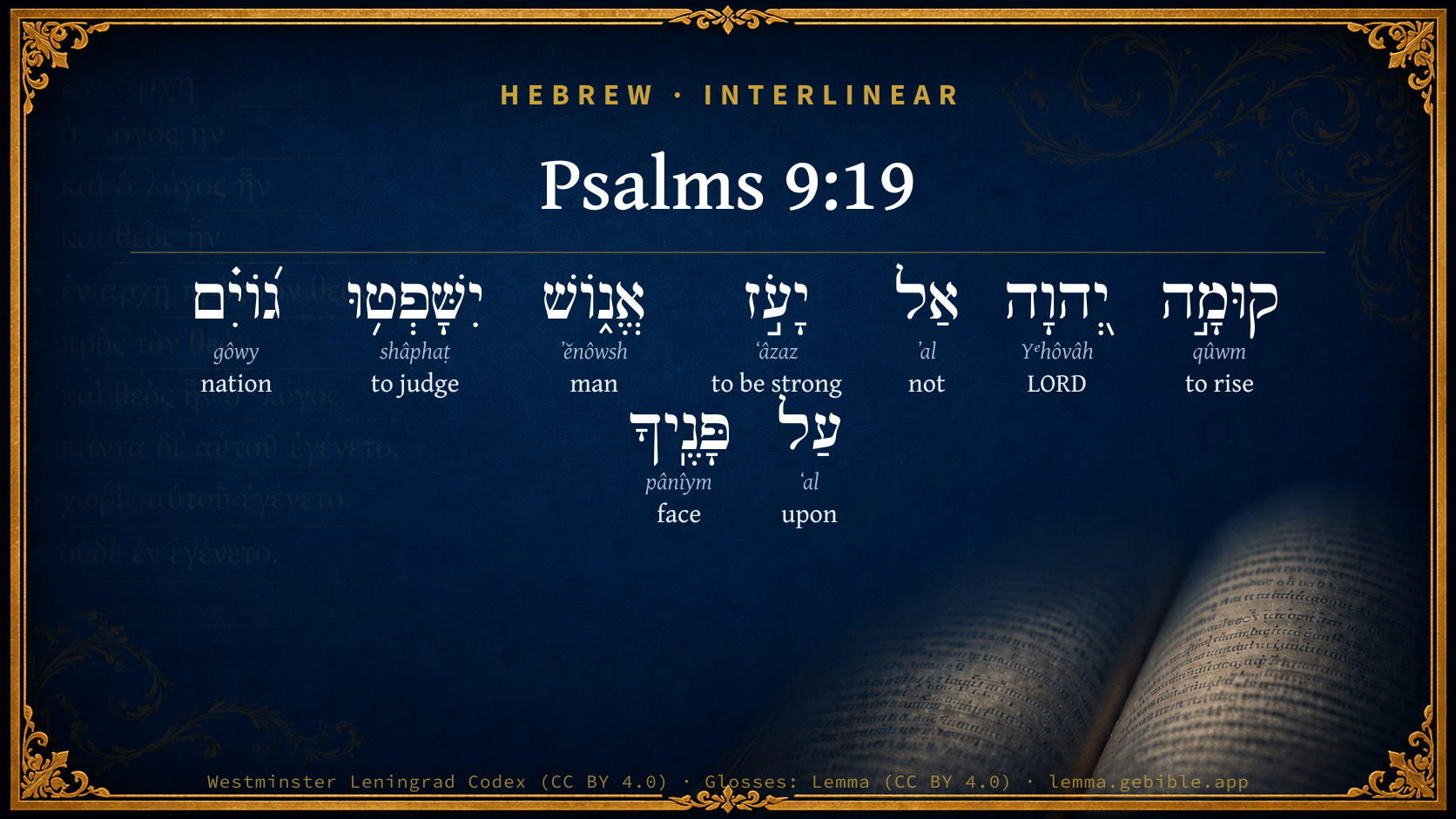
Hebrew (Westminster Leningrad Codex) Psalms 9:19 appears in the Hebrew Old Testament. The text above is from the Westminster Leningrad Codex. Each word links to its Strong’s number, a concise gloss, and parsing drawn from the Open Scriptures Hebrew Bible morphology. Click any word for its full Brown-Driver-Briggs (BDB) entry.
Download image
Cite this verse

Psalms 9:19 (World English Bible). Public Domain. Lemma interlinear Bible study tool, https://lemma.gebible.app/v/psalms/9/19.

Show BibTeX & RIS
BibTeX
RIS
English Translation
Arise, Yahweh! Don't let man prevail. Let the nations be judged in your sight.
World English Bible · Public Domain
Download a study sheet

One document with this verse’s original text, its word-by-word gloss line, the meaning frame, cross-references with their text, attributed commentary, and full source and license credits — printable, and it pastes into notes with its structure intact.

This verse Autodidact and up

Study sheet (.html) Plain text (.txt)

A passage Seminary Student

Up to 50 verses in one chapter. A passage sheet keeps up to 6 commentary sources and 12 cross-references per verse, in the order this page ranks them, and says so on the sheet whenever that leaves anything out. Ask for a single verse and you get the Autodidact verse sheet above.

Everything on this page stays free to read, with no account — the sheet is a download of what is already on screen, not access to it.

Want to remove ads? Support Godless Engineer
Compare translations 3

The same verse in 3 English versions, stacked beneath the original-language interlinear above. Click any original word for its lexicon entry.

Each is an independent rendering of the whole verse — the interlinear is not word-aligned to these translations.

Highlighted words mark where these versions differ — a whole-verse word diff, not a word-by-word alignment.

  • World English Bible Public Domain
    Arise, Yahweh! Don't let man prevail. Let the nations be judged in your sight.
  • King James Version Public Domain
    Arise, O LORD; let not man prevail: let the heathen be judged in thy sight.
  • unfoldingWord Literal Text CC BY-SA 4.0
    Arise, Yahweh! Let not humanity prevail! On your face let nations be judged.

unfoldingWord Literal Text — © unfoldingWord, licensed CC BY-SA 4.0. Word-aligned USFM3 via Door43 (git.door43.org/unfoldingWord/en_ult).

Versions to compare (up to 4)

3 of 4 selected

Show all 18 translations

Every available English version of this verse, each an independent rendering of the whole verse.

  • World English Bible Public Domain
    Arise, Yahweh! Don't let man prevail. Let the nations be judged in your sight.
  • Berean Standard Bible Public Domain
    Rise up, O LORD, do not let man prevail; let the nations be judged in Your presence.
  • Majority Standard Bible Public Domain
    Rise up, O LORD, do not let man prevail; let the nations be judged in Your presence.
  • King James Version Public Domain
    Arise, O LORD; let not man prevail: let the heathen be judged in thy sight.
  • American Standard Version (1901) Public Domain
    Arise, O Jehovah; let not man prevail: Let the nations be judged in thy sight.
  • Revised Version (1885) Public Domain
    Arise, O LORD; let not man prevail: let the nations be judged in thy sight.
  • Geneva Bible (1599) Public Domain
    Vp Lord: let not man preuaile: let the heathen be iudged in thy sight.
  • Douay-Rheims (1899) Public Domain
    For the poor man shall not be forgotten to the end: the patience of the poor shall not perish for ever.
  • Young's Literal Translation Public Domain
    Rise, O Jehovah, let not man be strong, Let nations be judged before Thy face.
  • Literal Standard Version CC BY-SA 4.0
    Rise, O YHWH, do not let man be strong, || Let nations be judged before Your face.
  • Unlocked Literal Bible CC BY-SA 4.0
    Arise, Yahweh; do not let man win against you; may the nations be judged in your sight.
  • unfoldingWord Literal Text CC BY-SA 4.0
    Arise, Yahweh! Let not humanity prevail! On your face let nations be judged.
  • Darby Bible Public Domain
    Arise, Jehovah; let not man prevail: let the nations be judged in thy sight.
  • World Messianic Bible Public Domain
    Arise, LORD! Don’t let man prevail. Let the nations be judged in your sight.
  • Webster's Bible Public Domain
    \\9:18\\For the needy shall not always be forgotten: the expectation of the poor shall not perish for ever.
  • Free Bible Version CC BY-SA 4.0
    Stand up, Lord! Don't let human beings win! Let the nations be brought before you for judgment!
  • Bible in Basic English Public Domain
    Up! O Lord; let not man overcome you: let the nations be judged before you.
  • JPS Tanakh (1917) Public Domain
    (9-20) Arise, O LORD, let not man prevail; let the nations be judged in Thy sight.

Literal Standard Version (2020), Covenant Press — licensed CC BY-SA 4.0. Text via the HelloAO Bible API (eBible.org). Unlocked Literal Bible (unfoldingWord) — licensed CC BY-SA 4.0. Text via the HelloAO Bible API (eBible.org). unfoldingWord Literal Text — © unfoldingWord, licensed CC BY-SA 4.0. Word-aligned USFM3 via Door43 (git.door43.org/unfoldingWord/en_ult). Free Bible Version, Dr. Jonathan Gallagher — licensed CC BY-SA 4.0. Text via the HelloAO Bible API (eBible.org).

Word by word

More ways to search: Search by grammar → Find every occurrence → Compare this word →

Practice this passage: Drill this verse → Learn its vocabulary →

About this verse

These counts appear in no published source. They are computed here, from the morphology-tagged text and Lemma’s own curated glosses. What Lemma adds →

9
words
9
distinct lemmas
Wisdom
section

Notable vocabulary

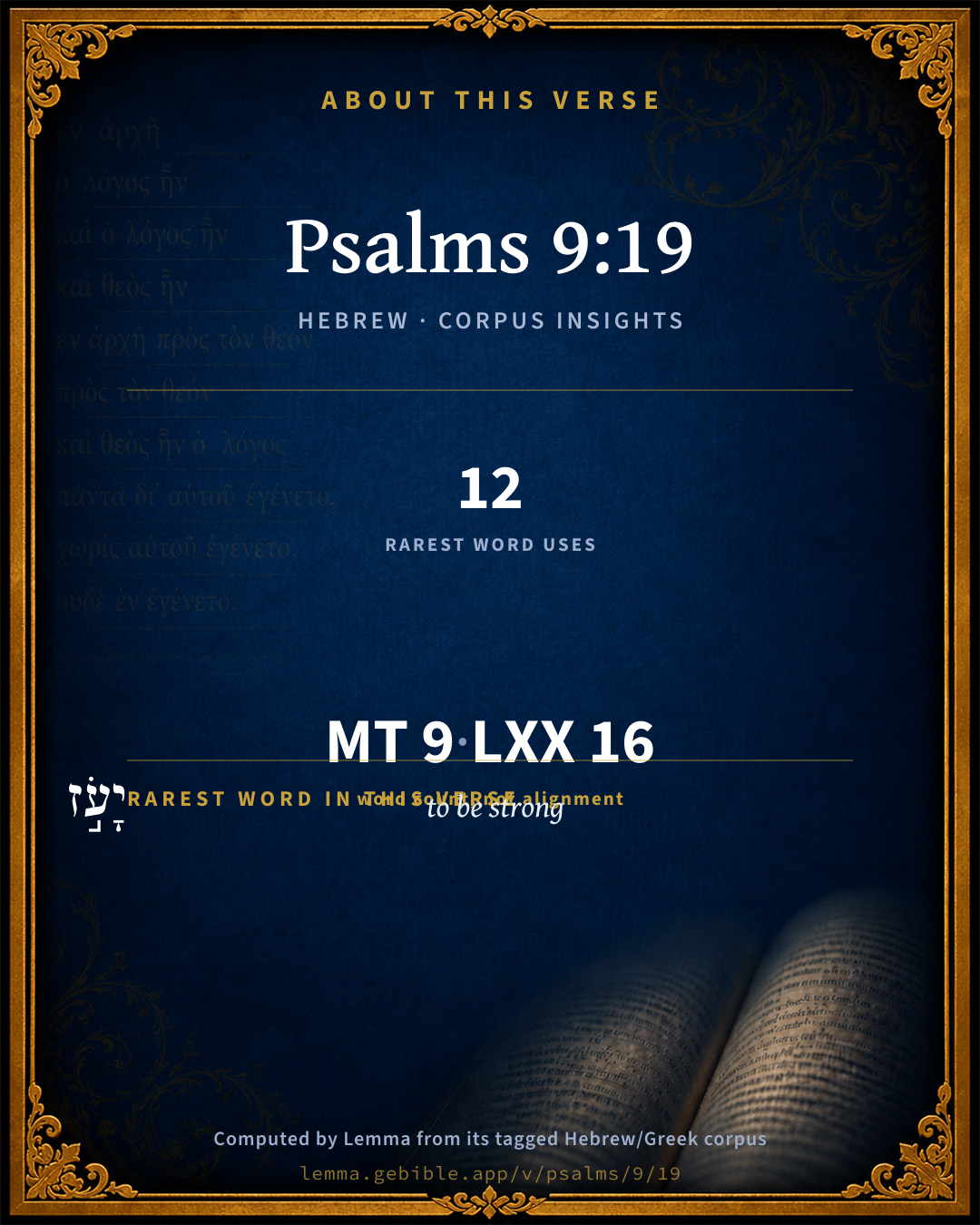
The rarest word here is יָעֹ֣ז to be strong H5810 — appearing just 12 times in the whole Hebrew Bible.

Shared distinctive vocabulary

יָעֹ֣ז to be strong H5810 occurs in 12 verses of the Hebrew Bible. Also found in:

Grammatical profile

  • 3 verbs
  • 4 nouns
  • 1 preposition
  • 1 particle

Verb forms

  • קוּמָ֣ה Qal · Imperative
  • יָעֹ֣ז Qal · Jussive
  • יִשָּׁפְט֥וּ Niphal · Imperfect

Hebrew & Septuagint length

In English translation the verse runs 14 words from the Hebrew and 14 from the Septuagint (LXX English) — the same length.

A rough comparison of the two English renderings, which tokenize alike — not a word-level alignment.

Word counts can differ between the Hebrew and the Greek without any difference in meaning — e.g. the Hebrew direct-object marker אֵת has no separate Greek word, and Greek often adds the article ὁ.

In the original languages it is 9 Hebrew tokens and 16 Greek tokens — but the two are counted differently (Hebrew bundles its prefixes and suffixes into one token; the Greek is in lemma form), so that isn’t a like-for-like length.

Cross-references

23

Topical passages linked to Psalms 9:19 in the Treasury of Scripture Knowledge — connected by theme and wording, ordered by reader-vote popularity; previews shown in the World English Bible.

  • Psalms 3:7 Arise, Yahweh! Save me, my God! For you have struck all of my enemies on the cheek bone. You have broken the teeth of the wicked.
  • Psalms 44:23 Wake up! Why do you sleep, Lord? Arise! Don't reject us forever.
  • Psalms 44:26 Rise up to help us. Redeem us for your loving kindness' sake.
  • Psalms 7:6 Arise, Yahweh, in your anger. Lift up yourself against the rage of my adversaries. Awake for me. You have commanded judgment.
  • Psalms 10:12 Arise, Yahweh! God, lift up your hand! Don't forget the helpless.
  • Psalms 74:22–23 Arise, God! Plead your own cause. Remember how the foolish man mocks you all day.
  • Revelation 19:15 Out of his mouth proceeds a sharp, double-edged sword, that with it he should strike the nations. He will rule them with a rod of iron. He treads the winepress of the fierceness of the wrath of God, the Almighty.
  • Genesis 32:28 He said, "Your name will no longer be called 'Jacob,' but, 'Israel,' for you have fought with God and with men, and have prevailed."
  • Psalms 79:6 Pour out your wrath on the nations that don't know you; On the kingdoms that don't call on your name;
  • Psalms 149:7 To execute vengeance on the nations, And punishments on the peoples;
  • Isaiah 51:9 Awake, awake, put on strength, arm of Yahweh; awake, as in the days of old, the generations of ancient times. Isn't it you who did cut Rahab in pieces, who pierced the monster?
  • Jeremiah 10:25 Pour out your wrath on the nations that don't know you, and on the families that don't call on your name: for they have devoured Jacob, yes, they have devoured him and consumed him, and have laid waste his habitation.
  • Joel 3:12 "Let the nations arouse themselves, And come up to the valley of Jehoshaphat; For there will I sit to judge all the surrounding nations.
  • Zephaniah 3:8 "Therefore wait for me," says Yahweh, "until the day that I rise up to the prey, for my determination is to gather the nations, that I may assemble the kingdoms, to pour on them my indignation, even all my fierce anger, for all the earth will be devoured with the fire of my jealousy.
  • 1 Samuel 2:9 He will keep the feet of his holy ones; But the wicked shall be put to silence in darkness; For by strength shall no man prevail.
  • 2 Chronicles 14:11 Asa cried to Yahweh his God, and said, Yahweh, there is none besides you to help, between the mighty and him who has no strength: help us, Yahweh our God; for we rely on you, and in your name are we come against this multitude. Yahweh, you are our God; don't let man prevail against you.
  • Psalms 2:1–3 Why do the nations rage, And the peoples plot a vain thing?
  • Psalms 68:1–2 Let God arise! Let his enemies be scattered! Let them who hate him also flee before him.
  • Psalms 76:8–9 You pronounced judgment from heaven. The earth feared, and was silent,
  • Psalms 80:2 Before Ephraim and Benjamin and Manasseh, stir up your might! Come to save us!
  • Isaiah 42:13–14 Yahweh will go forth as a mighty man; he will stir up [his] zeal like a man of war: he will cry, yes, he will shout aloud; he will do mightily against his enemies.
  • Micah 5:15 I will execute vengeance in anger, And wrath on the nations that didn't listen."
  • Zechariah 14:18 If the family of Egypt doesn't go up, and doesn't come, neither will it rain on them. This will be the plague with which Yahweh will strike the nations that don't go up to keep the feast of tents.

Cross-references courtesy of OpenBible.info (CC BY 4.0).

Hebrew and Greek witnesses Masoretic Hebrew ↔ Greek Septuagint

The same verse in the two great witnesses to the Old Testament, shown verse-for-verse.

You’re reading Greek Psalm 9 (Hebrew Psalm 9). The Septuagint counts the superscription, so verse numbers can differ from the Hebrew — chapter-level alignment, not verse-by-verse. Numbering follows Rahlfs.

These are two independent witnesses, not word-aligned to each other, and the Septuagint is shown in lemma (dictionary) form.

Hebrew Psalms 9:19 Masoretic · Westminster Leningrad Codex

קוּמָ֣ה יְ֭הוָה אַל יָעֹ֣ז אֱנ֑וֹשׁ יִשָּׁפְט֥וּ ג֝וֹיִ֗ם עַל פָּנֶֽיךָ

Arise, Yahweh! Don't let man prevail. Let the nations be judged in your sight.

World English Bible · Public Domain

Greek LXX Greek Psalm 9:19 Septuagint · lemma form

ὅτι οὐ εἰς τέλος ἐπιλανθάνομαι ὁ πτωχός ὁ ὑπομονή ὁ πένης οὐ ἀποὀλλύω εἰς ὁ αἰών

Arise, O Lord, let not man prevail: let the heathen be judged before you.

LXX2012 (modern English Septuagint) · Public Domain

On this verse, Keil & Delitzsch discusses the Septuagint’s reading. Read the note in Commentary ↓

Hebrew: Westminster Leningrad Codex (CC BY 4.0). Greek: Septuagint (public domain); English from LXX2012 (modern English Septuagint) (Public Domain). How the Septuagint differs from the Hebrew →

Commentary

Notes on Psalms 9:19 from classic Christian and Jewish commentators (each source and its license shown beneath its notes). The classic Christian expositions comment on the surrounding passage and are grouped to its opening verse, so a note may address several verses; the Jewish commentaries on the Tanakh (Rashi and others) are per-verse, so they appear only where the commentator wrote on this verse.

Lemma curates 59 commentaries, every one of them public domain or Creative Commons licensed, each selected and text-cleaned for this edition rather than reprinted as found. About our sources →

Trapp's Complete Commentary

John Trapp

Psa 9:19 Arise, O LORD; let not man prevail: let the heathen be judged in thy sight.

Ver. 19. Arise, O Lord, let not man prevail] Prayers are the Church’s weapons, her bombardae et instrumenta bellica (Luther), whereby she is terrible as an army with banners; she prays down her enemies.

John Trapp, A Commentary or Exposition upon All the Books of the Old and New Testament (1647–1656) — public domain. Text from a community e-Sword module.

Joseph Benson's Commentary

Psa 9:19-20. Arise, O Lord — Stir up thyself, exert thy power: let not man prevail — Consult thine own honour and let not men, Hebrew, weak, miserable, and mortal men, prevail against the kingdom and interest of the almighty and immortal God: shall mortal man be too hard for God, too strong for his Maker? Let the heathen be judged in thy sight — Let them be evidently called to an account for all the dishonour done to thee, and the mischief done to thy people. Impenitent sinners will be punished in God’s sight, and when their day of grace is over, the bowels even of infinite mercy will not relent toward them, Rev 14:10. Put them in fear, O Lord: that the nations may know themselves to be but men — Subdue their proud and insolent spirits, strike a terror upon them, and make them afraid of thy judgments. God knows how to make the strongest and stoutest of men to tremble, and to flee when none pursues. That the nations may know themselves to be but men — Weak, miserable, and mortal men, and therefore altogether unable to oppose the omnipotent and eternal God. He speaks thus because wicked men, when they are advanced to great power and majesty, are very prone to forget their own frailty, and to carry themselves as if they were gods: and because it is much for the glory of God, and the peace and welfare of the world, that all, even the highest and haughtiest, should know and consider themselves to be dependant, mutable, mortal, and accountable creatures.

Joseph Benson's Commentary on the Old and New Testaments (1811–1818) — public domain. Text from a community e-Sword module.

J. A. Alexander on Psalms

Joseph Addison Alexander

20. (Psa 9:19). Arise, Jehovah! Let not man, frail man, be strong. Let nations, or the heathen, be judged, and as a necessary consequence condemned, before thy face, in thy presence, at thy bar. Here again, as in Psa 9:13-14 (12, 13), the expression of strong confidence is made the occasion of an earnest prayer. So far is an implicit trust from leading men to cast off fear and restrain prayer before God. On the exhortation to arise, as from a state of previous inaction, see above, Psa 3:7 (6). For the full sense of the word translated man, see above, on Psa 8:5 (4). Let him not be strong, i. e. let him not, so appear, or so esteem himself. Let him have no occasion, by indulgence or prolonged impunity, to cherish this delusion, or to practise this imposture. The absurdity of making man the stronger party in this strife with God is so preposterous, that God is summoned to arise for the purpose of exploding it. To be judged, in the case of the wicked, is of course to be condemned. To be judged in God's presence, or at his tribunal, is of course to be condemned without appeal.

Joseph Addison Alexander, The Psalms Translated and Explained (1850) — public domain. Text from a community e-Sword module.

Tyndale Open Study Notes

Tyndale Open Resources

9:19-20 The psalmist ends his lament with a prayer for the Lord’s intervention and divine vengeance. • mere mortals . . . merely human: Humans who have received authority and glory sometimes become oppressive and assume glory for themselves (see 8:4; 10:18).

Tyndale Open Study Notes — © Tyndale Open Resources, licensed CC BY-SA 4.0. Text via the HelloAO Bible API.

Jamieson, Fausset & Brown

Robert Jamieson, A. R. Fausset & David Brown

Arise--(compare Psa 4:7).

let not man-- (Psa 8:4).

let . . . be judged--and of course condemned.

Jamieson, Fausset & Brown — Commentary Critical and Explanatory on the Whole Bible (1871) — public domain (CC PDM 1.0). Text via the HelloAO Bible API.

Adam Clarke's Commentary

Verse 19. Arise, O Lord] Let this be the time in which thou wilt deliver thy poor people under oppression and persecution.

Adam Clarke's Commentary on the Bible (1810–1826) — public domain. Text from a community e-Sword/MySword module.

John Calvin's Commentaries

19. Arise, O Jehovah. When David beseeches God to arise, the expression does not strictly apply to God, but it refers to external appearance and to our senses; for we do not perceive God to be the deliverer of his people except when he appears before our eyes, as it were sitting upon the judgment-seat. There is added a consideration or reason to induce God to avenge the injuries done to his people, namely, that man may not prevail; for when God arises, all the fierceness “Toute la fierte et arrogance.” — Fr. “All the pride and arrogance.”

“Leur rage et insolence.” — Fr. “Their rage and insolence.”

“Solo nutu.” - Lat. “Enfaisant signe seulement du bout du doigt.” — Fr.

John Calvin's Commentaries (1540-1563) — public domain. Text from the Calvin Translation Society English edition (1840s-50s) via the Christian Classics Ethereal Library (ccel.org). Calvin's coverage is partial (roughly two-thirds of the Bible); uncommented books and verses are honest gaps, never fabricated. The 19th-century editor's footnotes and remarks are omitted so the notes are faithfully Calvin's own voice.

Ellicott's Commentary for English Readers

(19) Let not man prevail.—Better, let not mere man be defiant.

A Bible Commentary for English Readers, edited by Charles John Ellicott (1878–1897) — public domain. Text from a community e-Sword module.

The Cambridge Bible for Schools and Colleges

gen. ed. J. J. S. Perowne

19, 20. This stanza should begin with Kaph, but (if the text is sound) the similar letter Qoph is substituted for it. [Kaph is prefixed to Psa_9:18 in Dr Scrivener’s text; but this verse belongs to the stanza of Yod.] It is a prayer for further and still more complete judgment upon the nations, that they may be taught to know their human weakness.

Arise, O Jehovah; let not mortal man wax strong:

Let the nations be Judged in thy presence.

Ordain terror for them, O Jehovah,

Let the nations know they are but mortal.

The word for ‘man’ (enôsh) denotes man in his weakness as contrasted with God (2Ch_14:11; Job_4:17; Isa_51:7; Isa_51:12). ‘Strength’ is the prerogative of God (Psa_62:11); though men and nations are apt to think that it is inherent in themselves (Psa_52:7); and therefore the Psalmist prays that the proud antagonism of the nations may receive a salutary lesson. They are to be summoned to Jehovah’s presence and there judged.

The Cambridge Bible for Schools and Colleges (gen. ed. J. J. S. Perowne; Cambridge University Press, 1878–1918) — public domain. Text from a community e-Sword module.

John Gill's Exposition

Put them in fear, O Lord,.... Who are, a bold, impudent, fearless generation of men; who, like the unjust judge, neither fear God nor regard men, therefore the psalmist prays that God would inject fear into them, who only can do it; and this will be done at Babylon's destruction, when the antichristian kings, merchants, and seafaring men, will stand afar off for fear of her torment, Rev 18:10;

that the nations may know themselves to be but men; and not God, and have no power against him; see Isa 31:3; the sense is, that the antichristian nations, who oppose themselves to Christ and his people, may know that they are but frail, mortal, miserable men, as the word (q) signifies; and that he who is at the head of them, the man of sin, is no other, though he exalts himself above all that is called God, Th2 2:4; or these words are a prayer for the conversion of many among the nations, and may be rendered, "put, O Lord, fear in them" (r); that is, the true grace of fear, "that the nations may know" themselves, their sin and guilt and danger, and know God in Christ, and Christ, and the way of salvation by him; for at the word "know" should be a stop, concluding a proposition, since the accent "athnach" is there; and then follows another, "they are men. Selah": destitute of the fear and grace of God, are capable of it, but cannot give it to themselves.

Selah; on this word; see Gill on Psa 3:2.

(q) "mortales esse", Junius & Tremellius, Piscator, Gejerus; "homines miseri", Cocceius, Michaelis; "sorry men", Ainsworth. (r) "pone timorem eis", so Junius and Tremellius, Piscator, Pagninus, Montanus, Cocceius, Ainsworth.

Next: Psalms Chapter 10

John Gill's Exposition of the Whole Bible (1746–1763) — public domain (CC PDM 1.0). Text via the HelloAO Bible API.

Albert Barnes' Notes on the Bible

Arise, O Lord - See the notes at Psa 3:7.

Let not man prevail - Against thee and thy cause. The war waged against the psalmist he regarded as waged against God, and he calls upon him, therefore, to interpose and vindicate his own cause. The word rendered “prevail” is be strong; that is, let not man seem to be stronger than thou art, or let, him not succeed in his efforts in opposing thy cause.

Let the heathen be judged in thy sight - The nations to whom the writer had referred in the psalm, that were arrayed against him and against God. He desired that a just judgment should be passed on them, and that God would vindicate the righteous, and save them from the power of those who oppressed and wronged them.

Albert Barnes' Notes on the Bible (1834–1885) — public domain. Text from a community e-Sword/MySword module.

The Treasury of David

Charles H. Spurgeon

Ver. 19. Prayers are the believer's weapons of war. When the battle is too hard for us, we call in our great ally, who, as it were, lies in ambush until faith gives the signal by crying out,

Arise, O Lord. Although our cause be all but lost, it shall be soon won again, if the Almighty doth but bestir himself. He will not suffer man to prevail over God, but with swift judgments will confound their gloryings. In the very sight of God the wicked will be punished, and he who is now all tenderness will have no bowels of compassion for them, since they had no tears of repentance while their day of grace endured.

Ver. 19. Arise, O Lord, etc. What does this mean? Are we to consider the psalmist as praying for the destruction of his enemies, as pronouncing a malediction, a curse upon them? No; these are not the words of one who is wishing that mischief may happen to his enemies; they are the words of a prophet, of one who is foretelling, in Scripture language, the evil that must befall them on account of their sins. Augustine.

Ver. 19. Let not man prevail. A powerful plea. Cases when employed in Scripture. The reason of its power. Times for its use.

Charles H. Spurgeon's The Treasury of David (1869–1885) — public domain. Psalms only. Text from a community e-Sword/MySword module.

Whedon's Commentary on the Bible

Daniel D. Whedon

19, 20. The closing strophe is an urgent call for hastening the righteous judgments of God.

Know themselves to be but men—That is, that they may understand their true character and condition as mortal and sinful “men,” as the word denotes. When men learn to know themselves truly they will fear and obey God.

Daniel D. Whedon (gen. ed.), Commentary on the Old and New Testaments (1874–1909) — public domain. Text from a community e-Sword module.

The Pulpit Commentary

Arise, O Lord. (comp. Psa_7:6, and the comment ad loc. ) Let not man prevail; or, let not weak man prevail. The word used for "man," enosh, carries with it the idea of weakness. That "weak man" should prevail over God is preposterous. Let the heathen be judged in thy sight. If judged, then, as being wicked, condemned; if condemned, then punished defeated, ruined, brought to nought (see ver. 5).

Vers. 19, 20. An appeal to God.

"Arise, O Lord," etc. The mysteries of life are no modern discovery. They perplexed and oppressed the souls of ancient saints, often well-nigh to the overthrow of faith. They are aggravated and emphasized by the fact, which we perhaps fail sufficiently to grasp, that Israel stood alone among nations as the witness to the unity, holiness, and truth of God. The host of surrounding peoples, some of them at the very summit of worldly greatness, worshipped "gods many and lords many." Hence Israel"s enemies could not but be regarded as God"s enemies; Israel"s cause as God"s cause.

I AN APPEAL TO GOD AS THE LORD OF THE WHOLE WORLD, to manifest his sovereignty. The word for "man" expresses mortal weakness. Q.d.: "Let not weak mortals fancy themselves strong enough, or seem to others strong enough, to defy thy rule, break thy Law, disregard thy displeasure." Ver. 8 shows that the world of mankind is in view, not merely Israel. The broad universal spirit of the Old Testament Scriptures is among the notes of inspiration. In the sacred enclosure of Israel the psalmist saw men sinning against light; in the great outlying world of heathendom he saw them sinning without the light of revelation. (Rom_2:12-14) But in all, the root-mischief is the same human self-will. If all men, instead of pleasing themselves, set themselves to do God"s will, a change would pass over all life, private and public, like the breaking forth of spring out of winter. Faith does not dictate to God how or when men are to be brought to their right senses; to see that God is God, and men "but men weak, frail, ignorant, sinful. But faith longs and pleads that it be done.

II THERE ARE TIMES AND CIRCUMSTANCES which give to this appeal special urgency. In ancient Israel, when idolatry threatened to suppress true religion; or heathen invaders threatened the national existence. For the Christians of the first three centuries, in the deadly persecutions of the Roman emperors. For lovers of God"s pure Word and of freedom, during the dark years before the Reformation, in the gigantic growth of superstition, corruption, and ecclesiastical tyranny. The blood of Albigenses, Lollards, Huguenots, and a great army of martyrs beside, seemed to cry for vengeance. (Rev_6:10) In our own time the frightful prevalence of crime and vice, and of squalid misery in the midst of wasteful luxury; the murderous war-preparations of Christian nations; the slow progress of the gospel where it is matched against the mighty forces of heathenism, Buddhism, Mohammedanism; and the bold and subtle forms of atheism or unbelief that fill the very atmosphere of our age; all these awaken in our hearts this earnest, passionate longing; try our faith with this deep perplexity. (Isa_64:1) Multitudes of earnest Christians find no comfort but in the belief that the second coming of the Lord is near at hand. They echo St. John"s "come quickly". (Rev_22:20)

III THE GOSPEL SHEDS A LIGHT ON THIS MYSTERY, which prophets and kings of old longed for, but could not see. (see 2Pe_3:9 1Ti_2:3) God could crush and stamp out sin, and destroy sinners quickly enough, by his almighty power. But his amazing purpose has been and is to "overcome evil with good;" subdue unbelief and rebellion, not by vengeance, but love. Mercy rejoices against judgment. The cross grace and truth by Jesus Christ-exerts a power impossible before. The prophets show the possibility of the penitent being pardoned. (Isa_1:18 Eze_33:11, etc.) Yet Manasseh"s conversion is almost a solitary instance. The regeneration of a nation as of nations of cannibal savages in our own day by the preaching of the gospel was a thing impossible. Hence inspired psalmists saw no alternative but either the prosperity of the wicked or their destruction. (Luk_9:54 56 24:46, 47) But power will not always sleep, nor judgment tarry. (2Pe_3:7, 10 2Th_1:7, 2Th_1:9)

The Pulpit Commentary (1880–1919), ed. H.D.M. Spence-Jones & Joseph S. Exell — public domain. Text from a community e-Sword module.

Keil & Delitzsch

C. F. Keil & F. Delitzsch

(Heb.: 9:20-21) By reason of the act of judgment already witnessed the prayer now becomes all the more confident in respect of the state of things which is still continually threatened. From י the poet takes a leap to ק which, however, seems to be a substitute for the כ which one would expect to find, since the following Psalm begins with ל. David's קוּמה (Psa 3:8; Psa 7:7) is taken from the lips of Moses, Num 10:35. "Jahve arises, comes, appears" are kindred expressions in the Old Testament, all of which point to a final personal appearing of God to take part in human history from which He has now, as it were, retired into a state of repose becoming invisible to human eyes. Hupfeld and others wrongly translate "let not man become strong." The verb עזז does not only mean to be or become strong, but also to feel strong, powerful, possessed of power, and to act accordingly, therefore: to defy, Psa 52:9, like עז defiant, impudent (post-biblical עזּוּת shamelessness). אנושׁ, as in Ch2 14:10, is man, impotent in comparison with God, and frail in himself. The enemies of the church of God are not unfrequently designated by this name, which indicates the impotence of their pretended power (Isa 51:7, Isa 51:12). David prays that God may repress the arrogance of these defiant ones, by arising and manifesting Himself in all the greatness of His omnipotence, after His forbearance with them so long has seemed to them to be the result of impotence. He is to arise as the Judge of the world, judging the heathen, while they are compelled to appear before Him, and, as it were, defile before Him (על־פּני), He is to lay מורה on them. If "razor" be the meaning it is equivocally expressed; and if, according to Isa 7:20, we associate with it the idea of an ignominious rasure, or of throat-cutting, it is a figure unworthy of the passage. The signification master (lxx, Syr., Vulg., and Luther) rests upon the reading אמת, which we do not with Thenius and others prefer to the traditional reading (even Jerome translates: pone, Domine, terrorem eis); for מורה rof , which according to the Masora is instead of מורא (like מכלה Hab 3:17 for מכלא), is perfectly appropriate. Hitzig objects that fear is not a thing which one lays upon any one; but מורא means not merely fear, but an object, or as Hitzig himself explains it in Mal 2:5 a "lever," of fear. It is not meant that God is to cause them to be overcome with terror (על), nor that He is to put terror into them (בּ), but that He is to make them (ל( m in no way differing from Psa 31:4; Psa 140:6; Job 14:13) an object of terror, from which to their dismay, as the wish is further expressed in Psa 9:20, they shall come to know (Hos 9:7) that they are mortal men. As in Psa 10:12; Psa 49:12; Psa 50:21; Psa 64:6; Gen 12:13; Job 35:14; Amo 5:12; Hos 7:2, ידּעוּ is followed by an only half indirect speech, without כּי or אשׁר. סּלה has Dag. forte conj. according to the rule of the אתי מרחיק (concerning which vid., on Psa 52:5), because it is erroneously regarded as an essential part of the text.

Keil & Delitzsch — Biblical Commentary on the Old Testament (1861–1891) — public domain (CC PDM 1.0). Text via the HelloAO Bible API. (Old Testament only.)

unfoldingWord translationNotes

Door43 World Missions Community

Arise

Getting up represents starting to do something. AT: "Do something" or "Take action" (See: Metonymy)

man

people

be judged

Here judging represents punishing. AT: "be punished" (See: Metonymy)

in your sight

Here sight represents presence. AT: "in your presence" (See: Metonymy)

may the nations be judged in your sight

This can be stated in active form. AT: "judge the nations in your presence" or "take the nations into your presence and punish them" (See: Active or Passive)

translationWords

raise

unfoldingWord translationNotes — © Distant Shores Media and the Door43 World Missions Community, licensed CC BY-SA 4.0. Source: git.door43.org/Door43/en_tn.

Rashi

Rabbi Shlomo Yitzchaki (Rashi)

For the needy shall not be forgotten forever [i.e.,] Israel, the needy, [shall not be forgotten] from visiting upon them as they [the wicked nations] enslaved them, neither shall the hope of the poor be forgotten to eternity.

Rashi on the Tanakh — English translations: “The Judaica Press complete Tanach with Rashi, translated by A. J. Rosenberg” (CC BY 4.0); “Pentateuch with Rashi's commentary by M. Rosenbaum and A.M. Silbermann, 1929-1934” (public domain); “The Metsudah Tanach series, Lakewood, N.J” (CC BY 4.0); and “The Book of Joshua, Metsudah Publications, 1997” (CC BY 4.0). Text via Sefaria.

Radak

Rabbi David Kimhi (Radak)

For not for ever snail the needy be forgotten: – If Israel should continue in trouble because of the Philistines, this will not be for any length of time.

Nor the expectation of the poor perish for ever: – Not is actually written once only, but is understood twice; and such is the usage of the language in many passages. ענוים (meek), the Kethib has waw, but the Keri is עניים with yodh; and the meanings are cognate, for the poor are generally the meek.

Radak on the Tanakh — English translations: “Sefaria Community Translation” (CC0 1.0 (public-domain dedication)); “Eliyahu Munk, HaChut Hameshulash” (CC BY 4.0); “Rabbi Mike Feuer, Jerusalem Anthology” (CC BY 4.0); and “R. David Kimhi on the first book of Psalms, Translated by R.G. Finch, London, 1919” (public domain). Text via Sefaria.

Lesson kit

Teaching starters — assembled from the data on this page, not authored interpretation. Every prompt links to the verse data it draws on. Edit before teaching.

Psalms, in the Wisdom, opens this verse with 9 words (9 distinct Hebrew lemmas). Its most distinctive word is ʻâzaz (“to be strong”). A historical commentator’s framing appears above. Read the whole chapter for the surrounding context.

Discussion questions

  1. The word ʻâzaz carries the sense “to be strong.” How does it shape the verse?
  2. How does Judges 3:10, which shares the word «to be strong», read alongside this verse?
  3. These translations render this verse differently; the difference is in the English rendering, not the original. What questions does that raise?
  4. «קוּמָ֣ה» is a Qal Imperative verb. How does that grammatical form shape the action described?
  5. Compare how Trapp's Complete Commentary and Joseph Benson's Commentary read this verse. Where do they agree or differ?

Things to notice

Reading settings

Reading text

Shown beneath each verse's original-language words.

Old Testament
Old Testament edition

Read the OT as the Masoretic Hebrew (MT) or the Greek Septuagint (LXX).

English shown for the Greek Septuagint (in the Hebrew ↔ Greek comparison).

Comparing translations? Open the Compare panel on any verse page to stack up to four side by side.