
Deuteronomy 18:14

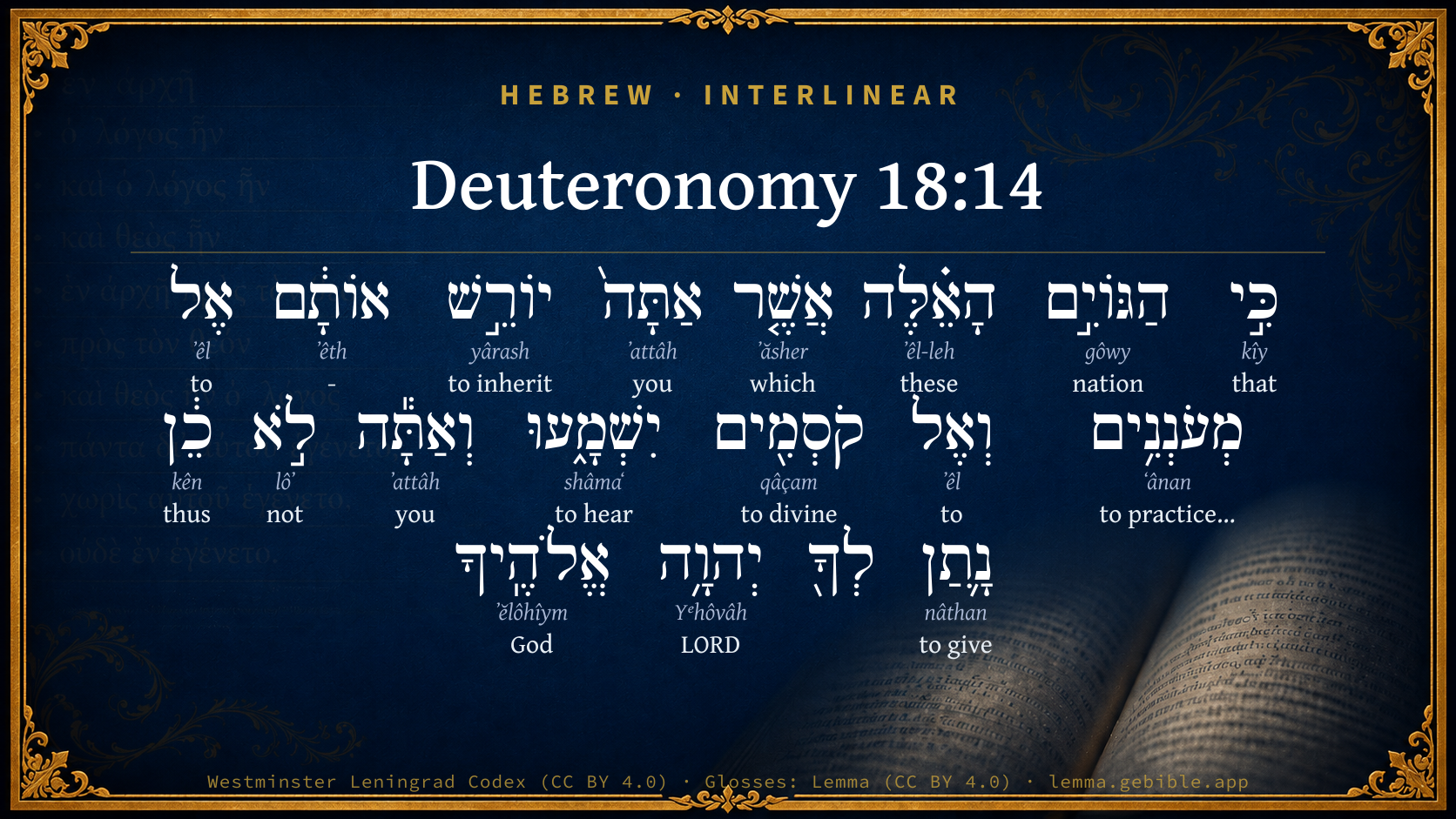
Hebrew (Westminster Leningrad Codex) Deuteronomy 18:14 appears in the Hebrew Old Testament. The text above is from the Westminster Leningrad Codex. Each word links to its Strong’s number, a concise gloss, and parsing drawn from the Open Scriptures Hebrew Bible morphology. Click any word for its full Brown-Driver-Briggs (BDB) entry.
Download image
Cite this verse

Deuteronomy 18:14 (World English Bible). Public Domain. Lemma interlinear Bible study tool, https://lemma.gebible.app/v/deuteronomy/18/14.

Show BibTeX & RIS
BibTeX
RIS
English Translation
For these nations, that you shall dispossess, listen to those who practice sorcery, and to diviners; but as for you, Yahweh your God has not allowed you so to do.
World English Bible · Public Domain
Download a study sheet

One document with this verse’s original text, its word-by-word gloss line, the meaning frame, cross-references with their text, attributed commentary, and full source and license credits — printable, and it pastes into notes with its structure intact.

This verse Autodidact and up

Study sheet (.html) Plain text (.txt)

A passage Seminary Student

Up to 50 verses in one chapter. A passage sheet keeps up to 6 commentary sources and 12 cross-references per verse, in the order this page ranks them, and says so on the sheet whenever that leaves anything out. Ask for a single verse and you get the Autodidact verse sheet above.

Everything on this page stays free to read, with no account — the sheet is a download of what is already on screen, not access to it.

Want to remove ads? Support Godless Engineer
Compare translations 3

The same verse in 3 English versions, stacked beneath the original-language interlinear above. Click any original word for its lexicon entry.

Each is an independent rendering of the whole verse — the interlinear is not word-aligned to these translations.

Highlighted words mark where these versions differ — a whole-verse word diff, not a word-by-word alignment.

  • World English Bible Public Domain
    For these nations, that you shall dispossess, listen to those who practice sorcery, and to diviners; but as for you, Yahweh your God has not allowed you so to do.
  • King James Version Public Domain
    For these nations, which thou shalt possess, hearkened unto observers of times, and unto diviners: but as for thee, the LORD thy God hath not suffered thee so to do.
  • unfoldingWord Literal Text CC BY-SA 4.0
    For these nations, those which you will dispossess, listen to soothsayers and to diviners, but you, thus Yahweh your God has not allowed you.

unfoldingWord Literal Text — © unfoldingWord, licensed CC BY-SA 4.0. Word-aligned USFM3 via Door43 (git.door43.org/unfoldingWord/en_ult).

Versions to compare (up to 4)

3 of 4 selected

Show all 18 translations

Every available English version of this verse, each an independent rendering of the whole verse.

  • World English Bible Public Domain
    For these nations, that you shall dispossess, listen to those who practice sorcery, and to diviners; but as for you, Yahweh your God has not allowed you so to do.
  • Berean Standard Bible Public Domain
    Though these nations, which you will dispossess, listen to conjurers and diviners, the LORD your God has not permitted you to do so.
  • Majority Standard Bible Public Domain
    Though these nations, which you will dispossess, listen to conjurers and diviners, the LORD your God has not permitted you to do so.
  • King James Version Public Domain
    For these nations, which thou shalt possess, hearkened unto observers of times, and unto diviners: but as for thee, the LORD thy God hath not suffered thee so to do.
  • American Standard Version (1901) Public Domain
    For these nations, that thou shalt dispossess, hearken unto them that practise augury, and unto diviners; but as for thee, Jehovah thy God hath not suffered thee so to do.
  • Revised Version (1885) Public Domain
    For these nations, which thou shalt possess, hearken unto them that practise augury, and unto diviners: but as for thee, the LORD thy God hath not suffered thee so to do.
  • Geneva Bible (1599) Public Domain
    For these nations which thou shalt possesse, hearken vnto those that regarde the times, and vnto sorcerers: as for thee, the Lord thy God hath not suffred thee so.
  • Douay-Rheims (1899) Public Domain
    These nations, whose land thou shalt possess, hearken to soothsayers and diviners: but thou art otherwise instructed by the Lord thy God.
  • Young's Literal Translation Public Domain
    for these nations whom thou art possessing, unto observers of clouds, and unto diviners, do hearken; and thou -- not so hath Jehovah thy God suffered thee.
  • Literal Standard Version CC BY-SA 4.0
    for these nations whom you are possessing listen to observers of clouds and to diviners; but you—your God YHWH has not permitted you so.
  • Unlocked Literal Bible CC BY-SA 4.0
    For these nations that you will dispossess listen to those who practice sorcery and divination; but as for you, Yahweh your God has not allowed you to do so.
  • unfoldingWord Literal Text CC BY-SA 4.0
    For these nations, those which you will dispossess, listen to soothsayers and to diviners, but you, thus Yahweh your God has not allowed you.
  • Darby Bible Public Domain
    For these nations, which thou shalt dispossess, hearkened unto those that use auguries, and that use divination; but as for thee, Jehovah thy God hath not suffered thee [to do] so.
  • World Messianic Bible Public Domain
    For these nations that you shall dispossess listen to those who practice sorcery and to diviners; but as for you, the LORD your God has not allowed you so to do.
  • Webster's Bible Public Domain
    For these nations, which thou shalt possess, hearkened to observers of times, and to diviners: but as for thee, the LORD thy God hath not suffered thee so to do.
  • Free Bible Version CC BY-SA 4.0
    Even though these nations, whose land you will occupy, listen to magicians and fortune-tellers, the Lord your God forbids you to do so.
  • Bible in Basic English Public Domain
    For these nations, whose land you are taking, give attention to readers of signs and to those using secret arts: but the Lord your God will not let you do so.
  • JPS Tanakh (1917) Public Domain
    For these nations, that thou art to dispossess, hearken unto soothsayers, and unto diviners; but as for thee, the LORD thy God hath not suffered thee so to do.

Literal Standard Version (2020), Covenant Press — licensed CC BY-SA 4.0. Text via the HelloAO Bible API (eBible.org). Unlocked Literal Bible (unfoldingWord) — licensed CC BY-SA 4.0. Text via the HelloAO Bible API (eBible.org). unfoldingWord Literal Text — © unfoldingWord, licensed CC BY-SA 4.0. Word-aligned USFM3 via Door43 (git.door43.org/unfoldingWord/en_ult). Free Bible Version, Dr. Jonathan Gallagher — licensed CC BY-SA 4.0. Text via the HelloAO Bible API (eBible.org).

Word by word

More ways to search: Search by grammar → Find every occurrence → Compare this word →

Practice this passage: Drill this verse → Learn its vocabulary →

מְעֹנְנִ֥ים
ʻânan
H6049
“practicing sorcery”
Verb, Poel, Participle Active, Masculine, Plural, Absolute
Part of Speech
Verb
Stem
Poel
Form
Participle Active
Gender
Masculine
Number
Plural
State
Absolute
Full BDB Definition

Origin: a primitive root

TWOT: 1655 , 1656

(Piel) to make appear, produce, bring (clouds) - (Poel) to practise soothsaying, conjure - to observe times, practice soothsaying or spiritism or magic or augury or witchcraft - soothsayer, enchanter, sorceress, diviner, fortuneteller, barbarian, Meonenim (participle)
  1. כִּ֣י kîy H3588 “that” Conjunction
  2. הַגּוֹיִ֣ם gôwy H1471 “the · nations” Particle, Definite Article + Noun, Common, Masculine, Plural, Absolute
  3. הָאֵ֗לֶּה ʼêl-leh H428 “the · these” Particle, Definite Article + Pronoun, Demonstrative, Common, Plural
  4. אֲשֶׁ֤ר ʼăsher H834 “which” Particle, Relative
  5. אַתָּה֙ ʼattâh H859 “you” Pronoun, Personal, 2nd Person, Masculine, Singular
  6. יוֹרֵ֣שׁ yârash H3423 “inheriting” Verb, Qal, Participle Active, Masculine, Singular, Absolute
  7. אוֹתָ֔ם ʼêth H853 “- · them” Particle, Direct Object + Suffix, Personal, 3rd Person, Masculine, Plural
  8. אֶל ʼêl H413 “to” Preposition
  9. וְאֶל ʼêl H413 “and · to” Conjunction + Preposition
  10. קֹסְמִ֖ים qâçam H7080 “divining” Verb, Qal, Participle Active, Masculine, Plural, Absolute
  11. יִשְׁמָ֑עוּ shâmaʻ H8085 “to hear” Verb, Qal, Imperfect, 3rd Person, Masculine, Plural
  12. וְאַתָּ֕ה ʼattâh H859 “and · you” Conjunction + Pronoun, Personal, 2nd Person, Masculine, Singular
  13. לֹ֣א lôʼ H3808 “not” Particle, Negative
  14. כֵ֔ן kên H3651 “thus” Adverb
  15. נָ֛תַן nâthan H5414 “to give” Verb, Qal, Perfect, 3rd Person, Masculine, Singular
  16. יְהוָ֥ה Yᵉhôvâh H3068 “LORD” Noun, Proper
  17. אֱלֹהֶֽיךָ ʼĕlôhîym H430 “God(s) · your” Noun, Common, Masculine, Plural, Construct + Suffix, Personal, 2nd Person, Masculine, Singular

About this verse

These counts appear in no published source. They are computed here, from the morphology-tagged text and Lemma’s own curated glosses. What Lemma adds →

19
words
16
distinct lemmas
Pentateuch
section

Notable vocabulary

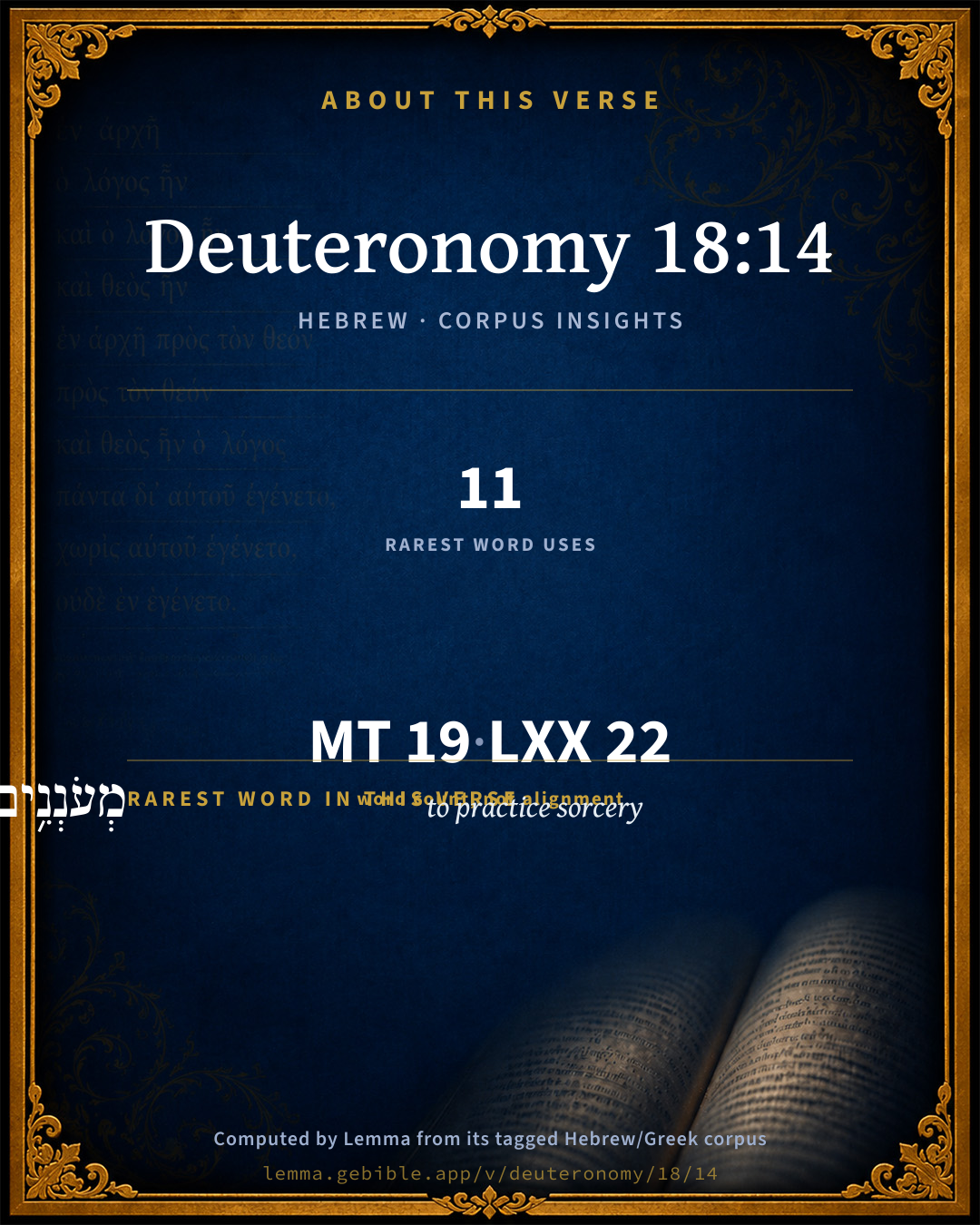
The rarest word here is מְעֹנְנִ֥ים to practice sorcery H6049 — appearing just 11 times in the whole Hebrew Bible.

Shared distinctive vocabulary

מְעֹנְנִ֥ים to practice sorcery H6049 occurs in 11 verses of the Hebrew Bible. Also found in:

Grammatical profile

  • 5 verbs
  • 3 nouns
  • 3 pronouns
  • 3 prepositions
  • 1 conjunction
  • 1 adverb
  • 3 particles

Verb forms

  • יוֹרֵ֣שׁ Qal · Participle Active
  • מְעֹנְנִ֥ים Poel · Participle Active
  • קֹסְמִ֖ים Qal · Participle Active
  • יִשְׁמָ֑עוּ Qal · Imperfect
  • נָ֛תַן Qal · Perfect

Repetition

Words recur within this verse — often emphatic in Hebrew:

  • אַתָּה֙ you H859 ×2
  • אֶל to H413 ×2

Hebrew & Septuagint length

In English translation the verse runs 30 words from the Hebrew and 28 from the Septuagint (LXX English) — closely comparable.

A rough comparison of the two English renderings, which tokenize alike — not a word-level alignment.

Word counts can differ between the Hebrew and the Greek without any difference in meaning — e.g. the Hebrew direct-object marker אֵת has no separate Greek word, and Greek often adds the article ὁ.

In the original languages it is 19 Hebrew tokens and 22 Greek tokens — but the two are counted differently (Hebrew bundles its prefixes and suffixes into one token; the Greek is in lemma form), so that isn’t a like-for-like length.

Cross-references

4

Topical passages linked to Deuteronomy 18:14 in the Treasury of Scripture Knowledge — connected by theme and wording, ordered by reader-vote popularity; previews shown in the World English Bible.

  • Acts 14:16 who in the generations gone by allowed all the nations to walk in their own ways.
  • Genesis 20:6 God said to him in the dream, "Yes, I know that in the integrity of your heart you have done this, and I also withheld you from sinning against me. Therefore I didn't allow you to touch her.
  • Deuteronomy 18:10 There shall not be found with you anyone who makes his son or his daughter to pass through the fire, one who uses divination, one who practices sorcery, or an enchanter, or a sorcerer,
  • Psalms 147:19–20 He shows his word to Jacob; His statutes and his ordinances to Israel.

Cross-references courtesy of OpenBible.info (CC BY 4.0).

Hebrew and Greek witnesses Masoretic Hebrew ↔ Greek Septuagint

The same verse in the two great witnesses to the Old Testament, shown verse-for-verse.

These are two independent witnesses, not word-aligned to each other, and the Septuagint is shown in lemma (dictionary) form.

Hebrew Deuteronomy 18:14 Masoretic · Westminster Leningrad Codex

כִּ֣י הַגּוֹיִ֣ם הָאֵ֗לֶּה אֲשֶׁ֤ר אַתָּה֙ יוֹרֵ֣שׁ אוֹתָ֔ם אֶל מְעֹנְנִ֥ים וְאֶל קֹסְמִ֖ים יִשְׁמָ֑עוּ וְאַתָּ֕ה לֹ֣א כֵ֔ן נָ֛תַן לְךָ֖ יְהוָ֥ה אֱלֹהֶֽיךָ

For these nations, that you shall dispossess, listen to those who practice sorcery, and to diviners; but as for you, Yahweh your God has not allowed you so to do.

World English Bible · Public Domain

Greek LXX Deuteronomy 18:14 Septuagint · lemma form

ὁ γάρ ἔθνος οὗτος ὅς σύ κατακληρονομέω αὐτός οὗτος κληδών καί μαντεία ἀκούω σύ δέ οὐ οὕτως δίδωμι κύριος ὁ θεός σύ

For all these nations whose land you shall inherit, they will listen to omens and divinations; but the Lord your God has not permitted you so to do.

LXX2012 (modern English Septuagint) · Public Domain

Hebrew: Westminster Leningrad Codex (CC BY 4.0). Greek: Septuagint (public domain); English from LXX2012 (modern English Septuagint) (Public Domain). How the Septuagint differs from the Hebrew →

Targum (Aramaic paraphrase)

2

The Targum is the ancient Jewish Aramaic paraphrase of the Hebrew Scriptures — an interpretive translation, not the Hebrew text itself. Onkelos (literal) and Pseudo-Jonathan (expansive) render the Torah, and Jonathan the Prophets. Coverage is partial: where no permissively-licensed English translation exists for a verse, only the Aramaic is shown. This is verse-level text, not a word-by-word alignment to the Hebrew.

  1. Targum Onkelos Torah (Genesis–Deuteronomy)
    אֲרֵי עַמְמַיָא הָאִלֵין דִי אַתְּ יָרֵת יָתְהוֹן מִן מְעָנְנַיָא וּמִן קַסָמַיָא שָׁמְעִין וְאַתְּ לָא כֵן יְהַב לָךְ יְיָ אֱלָהָךְ

    (no public-domain English translation for this verse)

    Targum Onkelos — Aramaic: “Onkelos Genesis” (public domain); “Onkelos Exodus” (public domain); “Onkelos Leviticus” (public domain); “Onkelos Numbers” (public domain); “Onkelos Deuteronomy” (public domain). English: “Sefaria Community Translation” (CC0 1.0 (public-domain dedication)); “J.W. Etheridge. The Targums of Onkelos and Jonathan Ben Uzziel on the Pentateuch. London: Longmans, Green, 1862” (public domain). Text via Sefaria.

  2. Targum Pseudo-Jonathan Torah (Genesis–Deuteronomy)
    אֲרוּם עַמְמַיָא הָאִלֵין דְּאַתּוּן עֲתִידִין לְמֵירוֹת יַתְהוֹן לְחַרוֹרֵי עֵינָא וּלְקִיסוּמֵי קוּסְמַיָא צַיְיתוּן וְאַתּוּן לָא כְוַותְהוֹן אֱלָהֵן כַּהֲנַיָא שַׁיְילוּן אוּרַיָא וְתוּמַיָא וְנָבִיָא תְרִיצַיָא יְהַב לְכוֹן יְיָ אֱלָהָכוֹן

    For these nations which thou art about to dispossess have listened to inspectors of serpents and enchanters. But you are not to be like them the priests shall inquire by Urim and Thummim and a Right Prophet will the Lord your God give you;

    Targum Pseudo-Jonathan — Aramaic: “Targum Jonathan on Genesis” (public domain); “Targum Jonathan on Exodus” (public domain); “Targum Jonathan on Leviticus” (public domain); “Targum Jonathan on Numbers” (public domain); “Targum Jonathan on Deuteronomy” (public domain). English: “The Targum of Jonathan ben Uzziel, trans. J. W. Etheridge, London, 1862” (public domain). Text via Sefaria.

Commentary

Notes on Deuteronomy 18:14 from classic Christian and Jewish commentators (each source and its license shown beneath its notes). The classic Christian expositions comment on the surrounding passage and are grouped to its opening verse, so a note may address several verses; the Jewish commentaries on the Tanakh (Rashi and others) are per-verse, so they appear only where the commentator wrote on this verse.

Lemma curates 59 commentaries, every one of them public domain or Creative Commons licensed, each selected and text-cleaned for this edition rather than reprinted as found. About our sources →

Trapp's Complete Commentary

John Trapp

Deu 18:14 For these nations, which thou shalt possess, hearkened unto observers of times, and unto diviners: but as for thee, the LORD thy God hath not suffered thee so [to do].

Ver. 14. Hath not suffered thee so to do.] He hath showed thee a more excellent way, and kept thee from these devoratory evils, as Tertullian calleth them; so ordering the matter, that "that evil one toucheth them not" with any deadly touch. {1Jn 5:18} For either he suffers not his to be tempted above strength, {1Co 10:13} or else he withholds the occasion, when temptation hath prevailed to procure consent and purpose, &c.

John Trapp, A Commentary or Exposition upon All the Books of the Old and New Testament (1647–1656) — public domain. Text from a community e-Sword module.

Geneva Bible (1599)

Geneva Bible translators

Hebrew, but thou not so.

Hebrew, given or appointed.

Geneva Bible (1599) marginal notes — public domain. Text via Bolls.life.

Ellicott's Commentary for English Readers

(14) The Lord thy God hath not suffered thee so to do.—More literally, As for thee, not so hath Jehovah thy God given unto thee. A prophet from the midst of thee, of thy brethren, like unto me, will Jehovah thy God raise up unto thee. Him shall ye hear. The contrast between the miserable resources of idolatrous nations in their anxiety, and the light and comfort promised to Israel and to us, in the One Mediator, is very marked here. Even Israel was better off than the heathen. As Rashi says upon the words “not so,” &c., “He hath not left thee to hearken to observers of times and enchanters; for behold He hath given Shechinah to rest upon the prophets, and Urim and Thummim.”

A Bible Commentary for English Readers, edited by Charles John Ellicott (1878–1897) — public domain. Text from a community e-Sword module.

John Gill's Exposition

The Lord thy God will raise up unto thee a prophet,.... Not Joshua, as Aben Ezra, not Jeremiah, as Baal Haturim, nor David (o), as others; nor a succession of prophets, as Jarchi; for a single person is only spoken of; and there is a dissimilitude between Moses and anyone of the prophets, and all of them in succession, Deu 34:10, but the Messiah, with whom the whole agrees; and upon this the expectation of a prophet among the Jews was raised, Joh 6:14 and is applied to him, and referred to as belonging to him in Act 3:22, who was a prophet mighty in word and deed, and not only foretold future events, as his own sufferings and death, and resurrection from the dead, the destruction of Jerusalem, and other things; but taught and instructed men in the knowledge of divine things, spake as never man did, preached the Gospel fully and faithfully, so that as the law came by Moses, the doctrine of grace and truth came by him; and he was raised up of God, called, sent, commissioned and qualified by him for the office of a prophet, as well as was raised from the dead as a confirmation of his being that extraordinary person:

from the midst of thee; he was of Israel, according to the flesh, of the tribe of Judah, and of the house of David, born of a virgin in Bethlehem, preached only in Judea, and was raised from the dead in the midst of them, and of which they were witnesses:

of thy brethren; the Israelites, of whom, as concerning the flesh, Christ came, and to whom he was sent as a prophet, and among whom he only preached:

like unto me; the Targum of Jonathan adds,"in the Holy Spirit;''which he received without measure, and in respect of which was superior to Moses, or any of the prophets: he was like to Moses in the faithful discharge of his office, in his familiar converse with God, in the miracles which he wrought; as well as in his being a Mediator, and the Redeemer of his people, as Moses was a mediator between God and the people of Israel, and the deliverer of them out of Egypt; and it is a saying of the Jews (p) themselves,"as was the first redeemer, so is the second:"

unto him ye shall hearken; externally attend on his ministry, internally receive his doctrine, embrace and profess it; do what is heard from him, hear him, and not another, always and in all things; see Mat 17:5.

(o) Herbanus in Disputat. cum Gregent. p. 13. col. 2. (p) Midrash Kohelet, fol. 63. 2.

John Gill's Exposition of the Whole Bible (1746–1763) — public domain (CC PDM 1.0). Text via the HelloAO Bible API.

Haydock's Catholic Bible Commentary

God, who has already informed thee how to proceed in difficult emergencies, (chap. xvii. 8,) by having recourse to the council of priests, and will also, after any death, send in due time a succession of true prophets. Hebrew, "God hath not suffered thee" to imitate those nations; (Haydock) or those prophets, whom the Lord thy God will give thee, shall not resemble these (Calmet) soothsayers (or observers of times) and diviners. (Haydock) --- They shall be filled with my spirit. (Calmet)

George Leo Haydock (1774–1849), Haydock's Catholic Family Bible and Commentary, 1859 edition — public domain. Excludes Psalms (Douay-Rheims chapter numbering differs from Protestant) and Deuterocanonical books (Catholic canon only).

Matthew Poole's English Annotations

Hath not suffered thee to follow thy own vain mind, and these superstitions and diabolical practices, as he hath suffered other nations to do, Act 14:16, but hath instructed thee better by his word and Spirit, and thereby kept thee from such courses, and will more fully instruct thee by a great Prophet, &c. Or, hath not given to thee, to wit, such persons to consult with, but hath given thee prophets to instruct thee, and will in due time give thee an eminent Prophet, as it here follows.

Matthew Poole's English Annotations on the Holy Bible (1683–1685) — public domain. Text from a community e-Sword/MySword module.

Whedon's Commentary on the Bible

Daniel D. Whedon

14. For these nations — The various peoples inhabiting the land of Canaan.

Which thou shalt possess — Whose territory they should possess.

Hearkened unto observers of times, and unto diviners — The prohibitions in other passages lead us to infer how general were those practices among the heathen. Comp. Lev_19:31; Lev_20:6.

But as for thee, the Lord thy God hath not suffered thee so to do — Literally, But do not thou thus: Jehovah thy God doth not permit thee.

Daniel D. Whedon (gen. ed.), Commentary on the Old and New Testaments (1874–1909) — public domain. Text from a community e-Sword module.

The Pulpit Commentary

Though the heathen whose land they were to possess sought to diviners and enchanters, Israel was not to do so; as for them (the hT; aat the beginning of the clause is an emphatic nominative), Jehovah their God had not suffered (tn given, granted, allowed) them to do such things.

The Pulpit Commentary (1880–1919), ed. H.D.M. Spence-Jones & Joseph S. Exell — public domain. Text from a community e-Sword module.

John Wesley's Explanatory Notes

Hath not suffered thee so to do - Hath not suffered thee to follow these superstitious and diabolical practices, as he hath suffered other nations to do, but hath instructed thee better by his word and spirit, and will more fully instruct thee by a great prophet.

John Wesley, Explanatory Notes Upon the Whole Bible (1754–1765) — public domain. Text via the GEBible commentary corpus.

Rashi

Rabbi Shlomo Yitzchaki (Rashi)

לא כן נתן לך ה' אלהיך BUT NOT SO HATH THE LORD THY GOD SUFFERED THEE [TO DO] — i.e. to hearken unto מעוננים and קוסמים, for you see, He has made His Divine Presence dwell upon the prophets and upon the “Urim and Thummim” (and these will, if necessary, inform thee of what God has in store for thee).

Rashi on the Tanakh — English translations: “The Judaica Press complete Tanach with Rashi, translated by A. J. Rosenberg” (CC BY 4.0); “Pentateuch with Rashi's commentary by M. Rosenbaum and A.M. Silbermann, 1929-1934” (public domain); “The Metsudah Tanach series, Lakewood, N.J” (CC BY 4.0); and “The Book of Joshua, Metsudah Publications, 1997” (CC BY 4.0). Text via Sefaria.

Lesson kit

Teaching starters — assembled from the data on this page, not authored interpretation. Every prompt links to the verse data it draws on. Edit before teaching.

Deuteronomy, in the Pentateuch, opens this verse with 19 words (16 distinct Hebrew lemmas). Its most distinctive word is ʻânan (“to practice sorcery”). A historical commentator’s framing appears above. Read the whole chapter for the surrounding context.

Discussion questions

  1. The word ʻânan carries the sense “to practice sorcery.” How does it shape the verse?
  2. How does Genesis 9:14, which shares the word «to practice sorcery», read alongside this verse?
  3. What does the repetition of “you” (2× in this one verse) do in this verse?
  4. These translations render this verse differently; the difference is in the English rendering, not the original. What questions does that raise?
  5. «יוֹרֵ֣שׁ» is a Qal Participle Active verb. How does that grammatical form shape the action described?
  6. Compare how Trapp's Complete Commentary and Geneva Bible (1599) read this verse. Where do they agree or differ?

Things to notice

Reading settings

Reading text

Shown beneath each verse's original-language words.

Old Testament
Old Testament edition

Read the OT as the Masoretic Hebrew (MT) or the Greek Septuagint (LXX).

English shown for the Greek Septuagint (in the Hebrew ↔ Greek comparison).

Comparing translations? Open the Compare panel on any verse page to stack up to four side by side.