
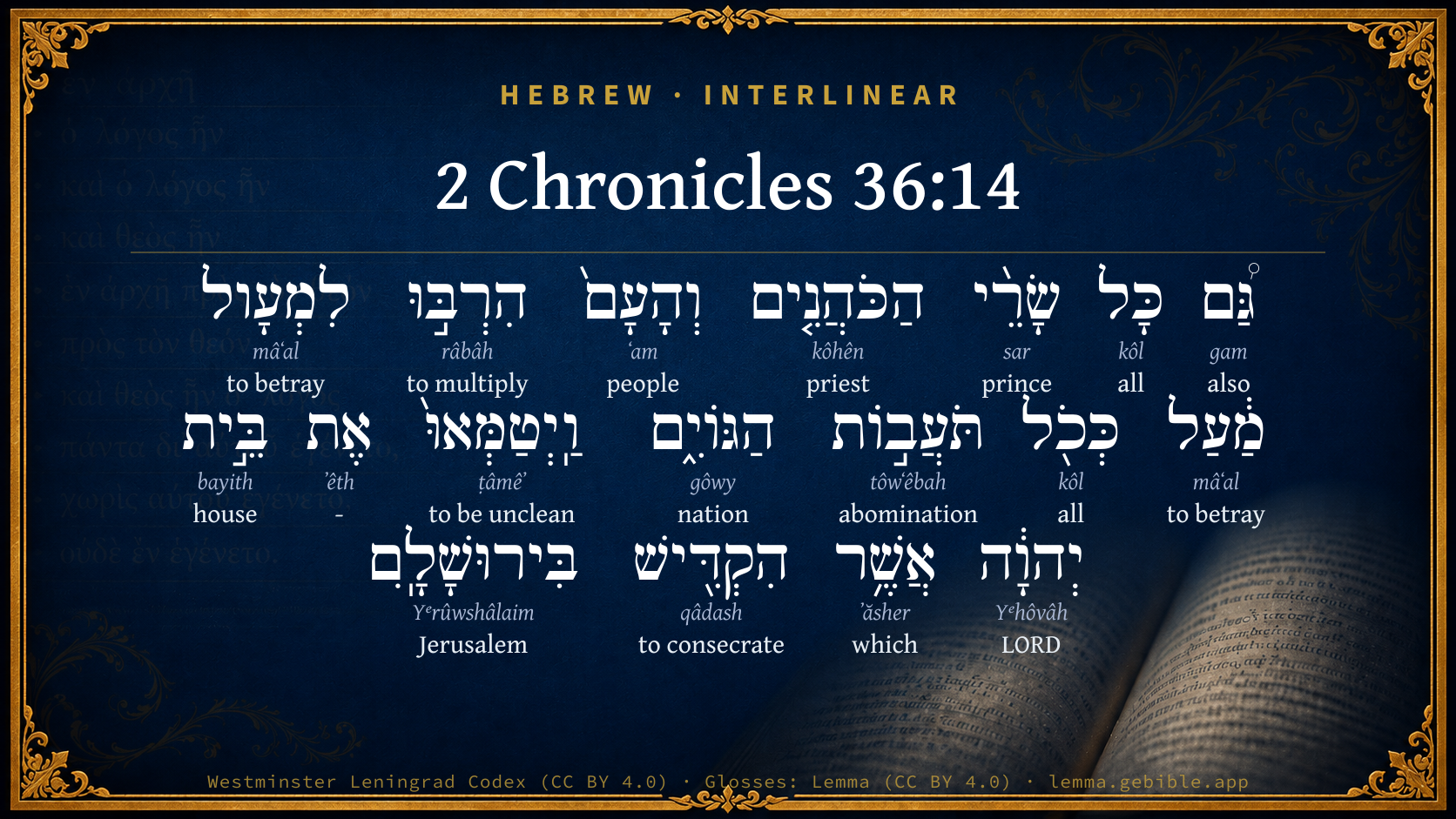
2 Chronicles 36:14

Hebrew (Westminster Leningrad Codex) 2 Chronicles 36:14 appears in the Hebrew Old Testament. The text above is from the Westminster Leningrad Codex. Each word links to its Strong’s number, a concise gloss, and parsing drawn from the Open Scriptures Hebrew Bible morphology. Click any word for its full Brown-Driver-Briggs (BDB) entry.
Download image
Cite this verse

2 Chronicles 36:14 (World English Bible). Public Domain. Lemma interlinear Bible study tool, https://lemma.gebible.app/v/2-chronicles/36/14.

Show BibTeX & RIS
BibTeX
RIS
English Translation
Moreover all the chiefs of the priests, and the people, trespassed very greatly after all the abominations of the nations; and they polluted the house of Yahweh which he had made holy in Jerusalem.
World English Bible · Public Domain
Download a study sheet

One document with this verse’s original text, its word-by-word gloss line, the meaning frame, cross-references with their text, attributed commentary, and full source and license credits — printable, and it pastes into notes with its structure intact.

This verse Autodidact and up

Study sheet (.html) Plain text (.txt)

A passage Seminary Student

Up to 50 verses in one chapter. A passage sheet keeps up to 6 commentary sources and 12 cross-references per verse, in the order this page ranks them, and says so on the sheet whenever that leaves anything out. Ask for a single verse and you get the Autodidact verse sheet above.

Everything on this page stays free to read, with no account — the sheet is a download of what is already on screen, not access to it.

Want to remove ads? Support Godless Engineer
Compare translations 3

The same verse in 3 English versions, stacked beneath the original-language interlinear above. Click any original word for its lexicon entry.

Each is an independent rendering of the whole verse — the interlinear is not word-aligned to these translations.

Highlighted words mark where these versions differ — a whole-verse word diff, not a word-by-word alignment.

  • World English Bible Public Domain
    Moreover all the chiefs of the priests, and the people, trespassed very greatly after all the abominations of the nations; and they polluted the house of Yahweh which he had made holy in Jerusalem.
  • King James Version Public Domain
    Moreover all the chief of the priests, and the people, transgressed very much after all the abominations of the heathen; and polluted the house of the LORD which he had hallowed in Jerusalem.
  • unfoldingWord Literal Text CC BY-SA 4.0
    Also, all the chiefs of the priests and the people multiplied doing acts of unfaithfulness like all the abominations of the nations. And they defiled the house of Yahweh which he had consecrated in Jerusalem.

unfoldingWord Literal Text — © unfoldingWord, licensed CC BY-SA 4.0. Word-aligned USFM3 via Door43 (git.door43.org/unfoldingWord/en_ult).

Versions to compare (up to 4)

3 of 4 selected

Show all 18 translations

Every available English version of this verse, each an independent rendering of the whole verse.

  • World English Bible Public Domain
    Moreover all the chiefs of the priests, and the people, trespassed very greatly after all the abominations of the nations; and they polluted the house of Yahweh which he had made holy in Jerusalem.
  • Berean Standard Bible Public Domain
    Furthermore, all the leaders of the priests and the people multiplied their unfaithful deeds, following all the abominations of the nations, and they defiled the house of the LORD, which He had consecrated in Jerusalem.
  • Majority Standard Bible Public Domain
    Furthermore, all the leaders of the priests and the people multiplied their unfaithful deeds, following all the abominations of the nations, and they defiled the house of the LORD, which He had consecrated in Jerusalem.
  • King James Version Public Domain
    Moreover all the chief of the priests, and the people, transgressed very much after all the abominations of the heathen; and polluted the house of the LORD which he had hallowed in Jerusalem.
  • American Standard Version (1901) Public Domain
    Moreover all the chiefs of the priests, and the people, trespassed very greatly after all the abominations of the nations; and they polluted the house of Jehovah which he had hallowed in Jerusalem.
  • Revised Version (1885) Public Domain
    Moreover all the chiefs of the priests, and the people, trespassed very greatly after all the abominations of the heathen; and they polluted the house of the LORD which he had hallowed in Jerusalem.
  • Geneva Bible (1599) Public Domain
    All the chiefe of the Priestes also and of the people trespassed wonderfully, according to all the abominations of the heathen, and polluted the house of the Lord which he had sanctified in Ierusalem.
  • Douay-Rheims (1899) Public Domain
    Moreover all the chief of the priests, and the people wickedly transgressed according to all the abominations of the Gentiles: and they defiled the house of the Lord, which he had sanctified to himself in Jerusalem.
  • Young's Literal Translation Public Domain
    Also, all the heads of the priests, and the people, having multiplied to commit a trespass according to all the abominations of the nations, and they defile the house of Jehovah that He hath sanctified in Jerusalem.
  • Literal Standard Version CC BY-SA 4.0
    Also, all the heads of the priests and the people have multiplied to commit a trespass according to all the abominations of the nations, and they defile the house of YHWH that He has sanctified in Jerusalem.
  • Unlocked Literal Bible CC BY-SA 4.0
    Moreover, all the leaders of the priests and the people were extremely unfaithful, and they followed the disgusting practices of the nations. They polluted the house of Yahweh which he had consecrated in Jerusalem.
  • unfoldingWord Literal Text CC BY-SA 4.0
    Also, all the chiefs of the priests and the people multiplied doing acts of unfaithfulness like all the abominations of the nations. And they defiled the house of Yahweh which he had consecrated in Jerusalem.
  • Darby Bible Public Domain
    All the chiefs of the priests also, and the people, increased their transgressions, according to all the abominations of the nations; and they defiled the house of Jehovah which he had hallowed in Jerusalem.
  • World Messianic Bible Public Domain
    Moreover all the chiefs of the priests and the people trespassed very greatly after all the abominations of the nations; and they polluted the LORD’s house which he had made holy in Jerusalem.
  • Webster's Bible Public Domain
    Moreover, all the chief of the priests, and the people, transgressed very much after all the abominations of the heathen; and polluted the house of the LORD which he had hallowed in Jerusalem.
  • Free Bible Version CC BY-SA 4.0
    All the leaders of the priests and the people were also totally faithless and sinful, following all the disgusting practices of the heathen nations. They defiled the Lord's Temple that he had set apart as holy in Jerusalem.
  • Bible in Basic English Public Domain
    And more than this, all the great men of Judah and the priests and the people made their sin great, turning to all the disgusting ways of the nations; and they made unclean the house of the Lord which he had made holy in Jerusalem.
  • JPS Tanakh (1917) Public Domain
    Moreover all the chiefs of the priests, and the people, transgressed very greatly after all the abominations of the nations; and they polluted the house of the LORD which He had hallowed in Jerusalem.

Literal Standard Version (2020), Covenant Press — licensed CC BY-SA 4.0. Text via the HelloAO Bible API (eBible.org). Unlocked Literal Bible (unfoldingWord) — licensed CC BY-SA 4.0. Text via the HelloAO Bible API (eBible.org). unfoldingWord Literal Text — © unfoldingWord, licensed CC BY-SA 4.0. Word-aligned USFM3 via Door43 (git.door43.org/unfoldingWord/en_ult). Free Bible Version, Dr. Jonathan Gallagher — licensed CC BY-SA 4.0. Text via the HelloAO Bible API (eBible.org).

Word by word

More ways to search: Search by grammar → Find every occurrence → Compare this word →

Practice this passage: Drill this verse → Learn its vocabulary →

לִמְעָול
mâʻal
H4603
“to betray”
Preposition + Verb, Qal, Infinitive Construct
Part of Speech
Preposition + Verb
Stem
Qal
Form
Infinitive Construct
Full BDB Definition

Origin: a primitive root

TWOT: 1230

to act unfaithfully, act treacherously, transgress, commit a trespass - (Qal) to act unfaithfully or treacherously - against man - against God - against devoted thing - against husband
  1. גַּ֠ם gam H1571 “also” Particle, Accusative
  2. כָּל kôl H3605 “all of” Noun, Common, Masculine, Singular, Construct
  3. שָׂרֵ֨י sar H8269 “princes of” Noun, Common, Masculine, Plural, Construct
  4. הַכֹּהֲנִ֤ים kôhên H3548 “the · priests” Particle, Definite Article + Noun, Common, Masculine, Plural, Absolute
  5. וְהָעָם֙ ʻam H5971 “and · the · people” Conjunction + Particle, Definite Article + Noun, Common, Masculine, Singular, Absolute
  6. הִרְבּ֣וּ râbâh H7235 “to multiply” Verb, Hiphil, Perfect, 3rd Person, Common, Plural
  7. מַ֔עַל mâʻal H4603 “unfaithfulness” Noun, Common, Masculine, Singular, Absolute
  8. כְּכֹ֖ל kôl H3605 “like/as · all of” Preposition + Noun, Common, Masculine, Singular, Construct
  9. תֹּעֲב֣וֹת tôwʻêbah H8441 “abominations of” Noun, Common, Feminine, Plural, Construct
  10. הַגּוֹיִ֑ם gôwy H1471 “the · nations” Particle, Definite Article + Noun, Common, Masculine, Plural, Absolute
  11. וַֽיְטַמְּאוּ֙ ṭâmêʼ H2930 “and · to be unclean” Conjunction + Verb, Piel, Sequential Imperfect, 3rd Person, Masculine, Plural
  12. אֶת ʼêth H853 “-” Particle, Direct Object
  13. בֵּ֣ית bayith H1004 “house of” Noun, Common, Masculine, Singular, Construct
  14. יְהוָ֔ה Yᵉhôvâh H3068 “LORD” Noun, Proper
  15. אֲשֶׁ֥ר ʼăsher H834 “which” Particle, Relative
  16. הִקְדִּ֖ישׁ qâdash H6942 “to consecrate” Verb, Hiphil, Perfect, 3rd Person, Masculine, Singular
  17. בִּירוּשָׁלִָֽם Yᵉrûwshâlaim H3389 “in/at · Jerusalem” Preposition + Noun, Proper

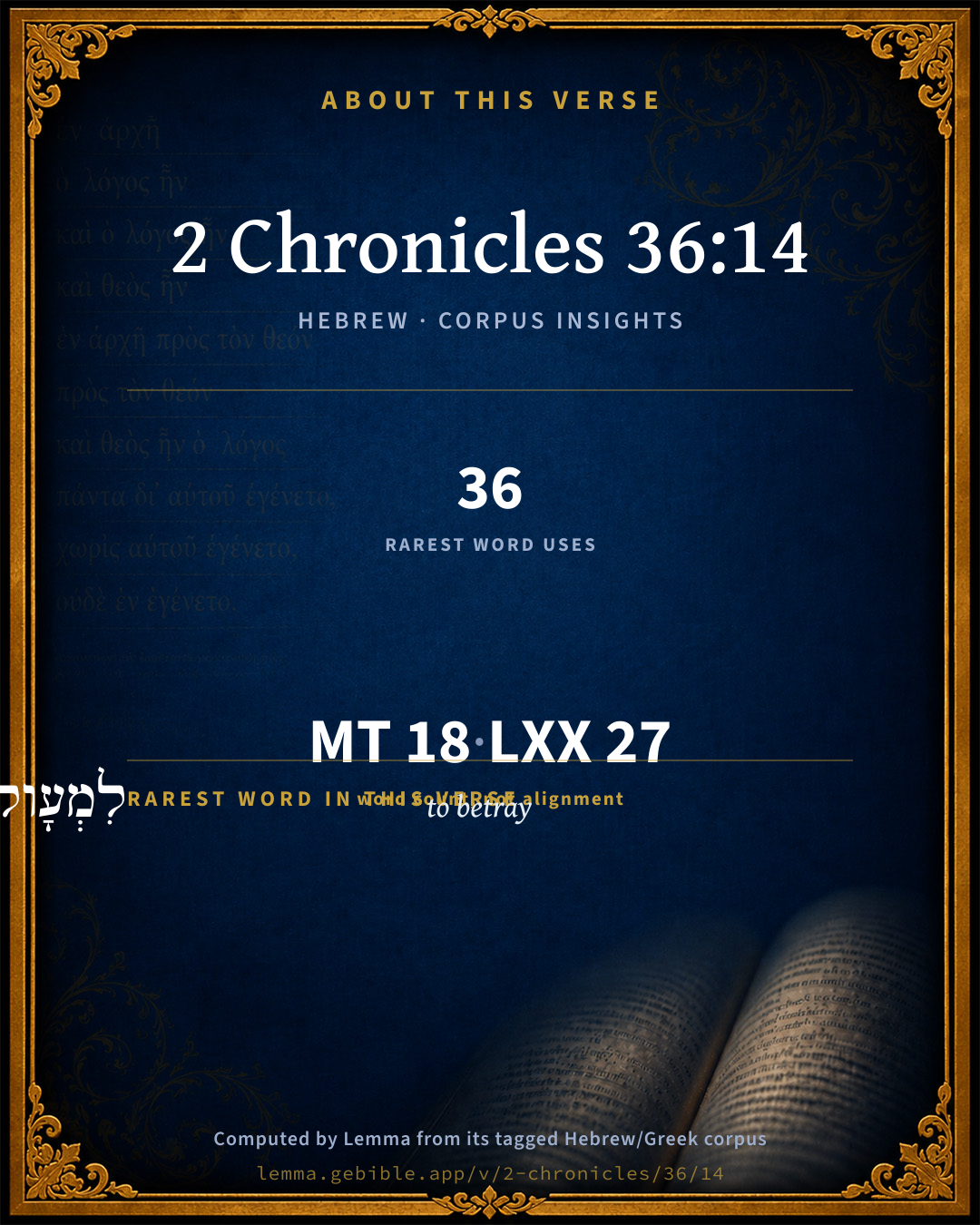
About this verse

These counts appear in no published source. They are computed here, from the morphology-tagged text and Lemma’s own curated glosses. What Lemma adds →

18
words
16
distinct lemmas
Historical
section

Shared distinctive vocabulary

לִמְעָול to betray H4603 occurs in 35 verses of the Hebrew Bible. Also found in:

Grammatical profile

  • 4 verbs
  • 11 nouns
  • 3 particles

Verb forms

  • הִרְבּ֣וּ Hiphil · Perfect
  • לִמְעָול Qal · Infinitive Construct
  • וַֽיְטַמְּאוּ֙ Piel · Sequential Imperfect
  • הִקְדִּ֖ישׁ Hiphil · Perfect

Repetition

Words recur within this verse — often emphatic in Hebrew:

  • כָּל all H3605 ×2
  • לִמְעָול to betray H4603 ×2

Hebrew & Septuagint length

In English translation the verse runs 34 words from the Hebrew and 35 from the Septuagint (LXX English) — closely comparable.

A rough comparison of the two English renderings, which tokenize alike — not a word-level alignment.

Word counts can differ between the Hebrew and the Greek without any difference in meaning — e.g. the Hebrew direct-object marker אֵת has no separate Greek word, and Greek often adds the article ὁ.

In the original languages it is 18 Hebrew tokens and 27 Greek tokens — but the two are counted differently (Hebrew bundles its prefixes and suffixes into one token; the Greek is in lemma form), so that isn’t a like-for-like length.

Cross-references

17

Topical passages linked to 2 Chronicles 36:14 in the Treasury of Scripture Knowledge — connected by theme and wording, ordered by reader-vote popularity; previews shown in the World English Bible.

  • Ezekiel 22:6 Behold, the princes of Israel, everyone according to his power, have been in you to shed blood.
  • Daniel 9:8 Lord, to us belongs confusion of face, to our kings, to our princes, and to our fathers, because we have sinned against you.
  • 2 Kings 16:10–16 King Ahaz went to Damascus to meet Tiglath Pileser king of Assyria, and saw the altar that was at Damascus; and king Ahaz sent to Urijah the priest the fashion of the altar, and the pattern of it, according to all the workmanship of it.
  • 2 Chronicles 28:3 Moreover he burnt incense in the valley of the son of Hinnom, and burnt his children in the fire, according to the abominations of the nations whom Yahweh cast out before the children of Israel.
  • 2 Chronicles 33:4–7 He built altars in the house of Yahweh, of which Yahweh said, In Jerusalem shall my name be forever.
  • 2 Chronicles 33:9 Manasseh seduced Judah and the inhabitants of Jerusalem, so that they did evil more than did the nations whom Yahweh destroyed before the children of Israel.
  • Ezra 9:7 Since the days of our fathers we have been exceeding guilty to this day; and for our iniquities have we, our kings, and our priests, been delivered into the hand of the kings of the lands, to the sword, to captivity, and to plunder, and to confusion of face, as it is this day.
  • Jeremiah 5:5 I will get me to the great men, and will speak to them; for they know the way of Yahweh, and the law of their God. But these with one accord have broken the yoke, and burst the bonds.
  • Jeremiah 37:13–15 When he was in the gate of Benjamin, a captain of the guard was there, whose name was Irijah, the son of Shelemiah, the son of Hananiah; and he laid hold on Jeremiah the prophet, saying, You are falling away to the Chaldeans.
  • Jeremiah 38:4 Then the princes said to the king, Let this man, we pray you, be put to death; because he weakens the hands of the men of war who remain in this city, and the hands of all the people, in speaking such words to them: for this man doesn't seek the welfare of this people, but the hurt.
  • Ezekiel 22:26–28 Her priests have done violence to my law, and have profaned my holy things: they have made no distinction between the holy and the common, neither have they caused men to discern between the unclean and the clean, and have hid their eyes from my Sabbaths, and I am profaned among them.
  • Daniel 9:6 neither have we listened to your servants the prophets, who spoke in your name to our kings, our princes, and our fathers, and to all the people of the land.
  • Micah 3:1–4 I said, "Please listen, you heads of Jacob, And rulers of the house of Israel: Isn't it for you to know justice?
  • Micah 3:9–11 Please listen to this, you heads of the house of Jacob, And rulers of the house of Israel, Who abhor justice, And pervert all equity.
  • Micah 7:2 The godly man has perished out of the earth, And there is no one upright among men. They all lie in wait for blood; Every man hunts his brother with a net.
  • Zephaniah 3:3–4 Her princes in the midst of her are roaring lions. Her judges are evening wolves. They leave nothing until the next day.
  • Ezekiel 8:5–16 Then said he to me, Son of man, lift up your eyes now the way toward the north. So I lifted up my eyes the way toward the north, and see, northward of the gate of the altar this image of jealousy in the entry.

Cross-references courtesy of OpenBible.info (CC BY 4.0).

Hebrew and Greek witnesses Masoretic Hebrew ↔ Greek Septuagint

The same verse in the two great witnesses to the Old Testament, shown verse-for-verse.

These are two independent witnesses, not word-aligned to each other, and the Septuagint is shown in lemma (dictionary) form.

Hebrew 2 Chronicles 36:14 Masoretic · Westminster Leningrad Codex

גַּ֠ם כָּל שָׂרֵ֨י הַכֹּהֲנִ֤ים וְהָעָם֙ הִרְבּ֣וּ לִמְעָול מַ֔עַל כְּכֹ֖ל תֹּעֲב֣וֹת הַגּוֹיִ֑ם וַֽיְטַמְּאוּ֙ אֶת בֵּ֣ית יְהוָ֔ה אֲשֶׁ֥ר הִקְדִּ֖ישׁ בִּירוּשָׁלִָֽם

Moreover all the chiefs of the priests, and the people, trespassed very greatly after all the abominations of the nations; and they polluted the house of Yahweh which he had made holy in Jerusalem.

World English Bible · Public Domain

Greek LXX 2 Chronicles 36:14 Septuagint · lemma form

καί πᾶς ὁ ἔνδοξος ἰουδά καί ὁ ἱερεύς καί ὁ λαός ὁ γῆ πληθύνω ὁ ἀθετέω ἀθέτημα βδέλυγμα ἔθνος καί μιαίνω ὁ οἶκος κύριος ὁ ἐν ἰερουσαλήμ

And all the great men of Juda, and the priests, and the people of the land transgressed abundantly in the abominations of the heathen, and polluted the house of the Lord which was in Jerusalem.

LXX2012 (modern English Septuagint) · Public Domain

Hebrew: Westminster Leningrad Codex (CC BY 4.0). Greek: Septuagint (public domain); English from LXX2012 (modern English Septuagint) (Public Domain). How the Septuagint differs from the Hebrew →

Commentary

Notes on 2 Chronicles 36:14 from classic Christian and Jewish commentators (each source and its license shown beneath its notes). The classic Christian expositions comment on the surrounding passage and are grouped to its opening verse, so a note may address several verses; the Jewish commentaries on the Tanakh (Rashi and others) are per-verse, so they appear only where the commentator wrote on this verse.

Lemma curates 59 commentaries, every one of them public domain or Creative Commons licensed, each selected and text-cleaned for this edition rather than reprinted as found. About our sources →

Ellicott's Commentary for English Readers

SINS OF THE RULING CLASSES WHICH BROUGHT DOWN THE JUDGMENT OF GOD (2Ch_36:14-16). (Comp. with this passage 2Ki_17:7-23.)

(14) The chiefs.—The princes.

Transgressed very much.—Committed manifold unfaithfulness.

After all the abominations . . .—See Eze_8:5-18; where “the princes of the priests and the people” are specially singled out in 2Ch_36:11; 2Ch_36:16. The twenty-five men of the latter verse are the High Priest and the heads of the twenty-four courses of priests. (Comp. also Jer_32:32, sea).

His Messengers.—The prophets (2Ki_17:13).

A Bible Commentary for English Readers, edited by Charles John Ellicott (1878–1897) — public domain. Text from a community e-Sword module.

Trapp's Complete Commentary

John Trapp

2Ch 36:14 Moreover all the chief of the priests, and the people, transgressed very much after all the abominations of the heathen; and polluted the house of the LORD which he had hallowed in Jerusalem.

Ver. 14. Moreover, all the chief priests and the people, &c.] There was a general defection, and, as physicians phrase it, Corruptio totius substantiae, a rabble of rebels fighting against Heaven.

John Trapp, A Commentary or Exposition upon All the Books of the Old and New Testament (1647–1656) — public domain. Text from a community e-Sword module.

Joseph Benson's Commentary

2Ch 36:14-15. The people transgressed very much — They were universally corrupt, and therefore God justly brought upon them a general destruction. Rising up betimes, and sending them — Sending them early and diligently, as a careful householder, who rises betimes about his business. God sent them many prophets and messages, some at the very beginning of their apostacy, and others afterward, till the very day of their captivity.

Joseph Benson's Commentary on the Old and New Testaments (1811–1818) — public domain. Text from a community e-Sword module.

The Cambridge Bible for Schools and Colleges

gen. ed. J. J. S. Perowne

14. the chief] R.V. the chiefs.

transgressed very much] R.V. trespassed very greatly.

polluted the house] Jer_7:9-11; Jer_23:11-14; Eze_8:5-16.

The Cambridge Bible for Schools and Colleges (gen. ed. J. J. S. Perowne; Cambridge University Press, 1878–1918) — public domain. Text from a community e-Sword module.

John Gill's Exposition

And the Lord God of their fathers sent to them by his messengers,.... The prophets of the Lord, to admonish them of their idolatries, and to reprove them for them, to warn them of the wrath of God that would come upon them on that account, unless they repented and reformed; these were at the beginning of their apostasy, and were successively continued unto this time, as Ahijah, Elijah, and others, in the first times of it; Amos, Isaiah, and others, in the middle of it; and Jeremiah, Zephaniah, and Ezekiel, towards the close of it:

rising up betimes, and sending; which is either to be understood of the Lord, and as expressive of his care and diligence, like the master of a family, solicitous for the good of it; or of the messengers, the prophets, who made haste to go or send their prophecies and instructions to reclaim the people; the phrase is often to be met with in the prophecy of Jeremiah; see Gill on Jer 11:7,

because he had compassion on his people, and on his dwellingplace; being unwilling they should come to ruin, and perish, and their city and temple be destroyed where they dwelt.

John Gill's Exposition of the Whole Bible (1746–1763) — public domain (CC PDM 1.0). Text via the HelloAO Bible API.

Albert Barnes' Notes on the Bible

Polluted the house of the Lord - Toward the close of Zedekiah’s reign idolatrous rites of several different kinds were intruded into the sacred precincts of the temple (compare Eze 8:10-16).

Albert Barnes' Notes on the Bible (1834–1885) — public domain. Text from a community e-Sword/MySword module.

Matthew Poole's English Annotations

The people transgressed very much; they were universally corrupt, and therefore God justly brought upon them a general destruction.

Matthew Poole's English Annotations on the Holy Bible (1683–1685) — public domain. Text from a community e-Sword/MySword module.

The Pulpit Commentary

This, with the following three verses, may be regarded as the formal and final indictment of the people of Judah, and may be compared with that of Israel. (2Ki_17:6-23) All the chief of the priests. (see 1Ch_24:1, 1Ch_24:3-19) The heads of the twenty-four courses there spoken of, with the high priest added, sum up the twenty-five men of Eze_8:16, the entire of which chapter may well be read with the present history, and its description of the culminating pitch of wickedness of king, priests, and people.

The Pulpit Commentary (1880–1919), ed. H.D.M. Spence-Jones & Joseph S. Exell — public domain. Text from a community e-Sword module.

Keil & Delitzsch

C. F. Keil & F. Delitzsch

"And all princes of the priests and the people increased faithless transgressions, like to all the abominations of the heathen, and defiled the house of the Lord which He had consecrated in Jerusalem." Bertheau would refer this censure of their idolatry and the profanation of the temple to the guilt incurred by the whole people, especially in the time of Manasseh, because, from all we know from the book of Jeremiah, the reproach of idolatry did not at all, or at least did not specially, attach to the princes of the priests and the people in the time of Zedekiah. But this reason is neither tenable nor correct; for from Ezek 8 it is perfectly manifest that under Zedekiah, not only the people, but also the priesthood, were deeply sunk in idolatry, and that even the courts of the temple were defiled by it. And even though that idolatry did not take its rise under Zedekiah, but had been much practised under Jehoiakim, and was merely a revival and continuation of the idolatrous conduct of Manasseh and Amon, yet the reference of our verse to the time of Manasseh is excluded by the context; for here only that which was done under Zedekiah is spoken of, without any reference to earlier times.

Meanwhile God did not leave them without exhortation, warning, and threatening. - Ch2 36:15. Jahve sent to them by His messengers, from early morning onwards continually, for He spared His people and His dwelling-place; but they mocked the messengers of God, despised His words, and scoffed at His prophets. בּיד שׁלח, to send a message by any one, to make a sending. The object is to be supplied from the verb. ושׁלוח השׁכּם exactly as in Jer 26:5; Jer 29:19. For He spared His people, etc., viz., by this, that He, in long-suffering, again and again called upon the people by prophets to repent and return, and was not willing at once to destroy His people and His holy place. מלעיבים is ἁπ. λεγ., in Syr. it signifies subsannavit; the Hithp. also, מתּעתּעים (from תּעע), occurs only here as an intensive: to launch out in mockery. The distinction drawn between מלאכים (messengers) and נביאים (prophets) is rhetorical, for by the messengers of God it is chiefly prophets who are meant; but the expression is not to be confined to prophets in the narrower sense of the word, for it embraces all the men of God who, by word and deed, censured and punished the godless conduct of the idolaters. The statement in these two verses is certainly so very general, that it may apply to all the times of gradually increasing defection of the people from the Lord their God; but the author of the Chronicle had primarily in view only the time of Zedekiah, in which the defection reached its highest point. It should scarcely be objected that in the time of Zedekiah only Jeremiah is known as a prophet of the Lord, since Ezekiel lived and wrought among the exiles. For, in the first place, it does not hence certainly follow that Jeremiah and Ezekiel were the only prophets of that time; then, secondly, Jeremiah does not speak as an individual prophet, but holds up to the people the witness of all the earlier prophets (cf. e.g., Ch2 26:4-5), so that by him all the former prophets of God spoke to the people; and consequently the plural, His messengers, His prophets, is perfectly true even for the time of Zedekiah, if we always keep in mind the rhetorical character of the style. וגו עלות עד, until the anger of Jahve rose upon His people, so that there was no healing (deliverance) more.

Keil & Delitzsch — Biblical Commentary on the Old Testament (1861–1891) — public domain (CC PDM 1.0). Text via the HelloAO Bible API. (Old Testament only.)

Rashi

Rabbi Shlomo Yitzchaki (Rashi)

Also, all etc. They should have instructed Israel, as it is written (Deut. 24:8): “in accordance with all that the priests, the Levites, instruct you.” This does not refer to simple priests, who have no power to protest, but to the chiefs of the priests, who have the power to protest, but they did not protest.

and they defiled the House of the Lord with their abominations.

which He had hallowed in Jerusalem to cause His glory to rest there forever.

Rashi on the Tanakh — English translations: “The Judaica Press complete Tanach with Rashi, translated by A. J. Rosenberg” (CC BY 4.0); “Pentateuch with Rashi's commentary by M. Rosenbaum and A.M. Silbermann, 1929-1934” (public domain); “The Metsudah Tanach series, Lakewood, N.J” (CC BY 4.0); and “The Book of Joshua, Metsudah Publications, 1997” (CC BY 4.0). Text via Sefaria.

Lesson kit

Teaching starters — assembled from the data on this page, not authored interpretation. Every prompt links to the verse data it draws on. Edit before teaching.

2 Chronicles, in the Historical, opens this verse with 18 words (16 distinct Hebrew lemmas). Its most distinctive word is mâʻal (“to betray”). A historical commentator’s framing appears above. Read the whole chapter for the surrounding context.

Discussion questions

  1. The word mâʻal carries the sense “to betray.” How does it shape the verse?
  2. Leviticus 5:15 shares the word «to betray» with this verse. How do the two illuminate each other?
  3. “all” occurs 2× in this one verse. What is the effect of the repetition?
  4. These translations render this verse differently; the difference is in the English rendering, not the original. What questions does that raise?
  5. The verb «הִרְבּ֣וּ» is Hiphil Perfect. How does its form color the action?
  6. Reading how Ellicott's Commentary for English Readers and Trapp's Complete Commentary read this verse, where do the two commentators agree and where do they part?

Things to notice

Reading settings

Reading text

Shown beneath each verse's original-language words.

Old Testament
Old Testament edition

Read the OT as the Masoretic Hebrew (MT) or the Greek Septuagint (LXX).

English shown for the Greek Septuagint (in the Hebrew ↔ Greek comparison).

Comparing translations? Open the Compare panel on any verse page to stack up to four side by side.