
Psalms 18:49

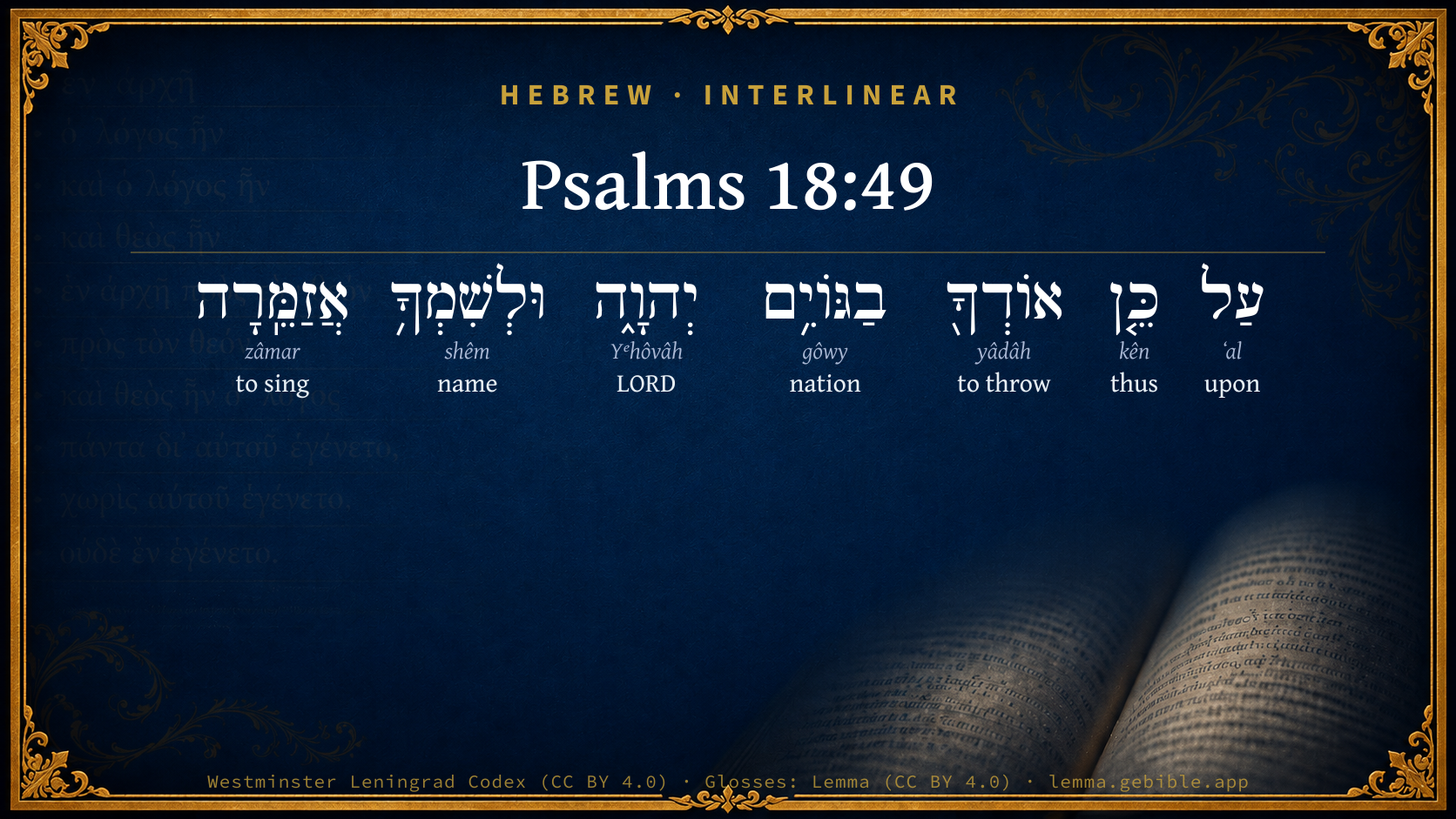
Hebrew (Westminster Leningrad Codex) Psalms 18:49 appears in the Hebrew Old Testament. The text above is from the Westminster Leningrad Codex. Each word links to its Strong’s number, a concise gloss, and parsing drawn from the Open Scriptures Hebrew Bible morphology. Click any word for its full Brown-Driver-Briggs (BDB) entry.
Download image
Cite this verse

Psalms 18:49 (World English Bible). Public Domain. Lemma interlinear Bible study tool, https://lemma.gebible.app/v/psalms/18/49.

Show BibTeX & RIS
BibTeX
RIS
English Translation
Therefore I will give thanks to you, Yahweh, among the nations, And will sing praises to your name.
World English Bible · Public Domain
Download a study sheet

One document with this verse’s original text, its word-by-word gloss line, the meaning frame, cross-references with their text, attributed commentary, and full source and license credits — printable, and it pastes into notes with its structure intact.

This verse Autodidact and up

Study sheet (.html) Plain text (.txt)

A passage Seminary Student

Up to 50 verses in one chapter. A passage sheet keeps up to 6 commentary sources and 12 cross-references per verse, in the order this page ranks them, and says so on the sheet whenever that leaves anything out. Ask for a single verse and you get the Autodidact verse sheet above.

Everything on this page stays free to read, with no account — the sheet is a download of what is already on screen, not access to it.

Want to remove ads? Support Godless Engineer
Compare translations 3

The same verse in 3 English versions, stacked beneath the original-language interlinear above. Click any original word for its lexicon entry.

Each is an independent rendering of the whole verse — the interlinear is not word-aligned to these translations.

Highlighted words mark where these versions differ — a whole-verse word diff, not a word-by-word alignment.

  • World English Bible Public Domain
    Therefore I will give thanks to you, Yahweh, among the nations, And will sing praises to your name.
  • King James Version Public Domain
    Therefore will I give thanks unto thee, O LORD, among the heathen, and sing praises unto thy name.
  • unfoldingWord Literal Text CC BY-SA 4.0
    Therefore, I thank you among the nations, Yahweh; and I will sing praise to your name,

unfoldingWord Literal Text — © unfoldingWord, licensed CC BY-SA 4.0. Word-aligned USFM3 via Door43 (git.door43.org/unfoldingWord/en_ult).

Versions to compare (up to 4)

3 of 4 selected

Show all 18 translations

Every available English version of this verse, each an independent rendering of the whole verse.

  • World English Bible Public Domain
    Therefore I will give thanks to you, Yahweh, among the nations, And will sing praises to your name.
  • Berean Standard Bible Public Domain
    Therefore I will praise You, O LORD, among the nations; I will sing praises to Your name.
  • Majority Standard Bible Public Domain
    Therefore I will praise You, O LORD, among the nations; I will sing praises to Your name.
  • King James Version Public Domain
    Therefore will I give thanks unto thee, O LORD, among the heathen, and sing praises unto thy name.
  • American Standard Version (1901) Public Domain
    Therefore I will give thanks unto thee, O Jehovah, among the nations, And will sing praises unto thy name.
  • Revised Version (1885) Public Domain
    Therefore I will give thanks unto thee, O LORD, among the nations, and will sing praises unto thy name.
  • Geneva Bible (1599) Public Domain
    Therefore I will prayse thee, O Lord, among the nations, and wil sing vnto thy Name.
  • Douay-Rheims (1899) Public Domain
    And thou wilt lift me up above them that rise up against me: from the unjust man thou wilt deliver me.
  • Young's Literal Translation Public Domain
    Therefore I confess Thee among nations, O Jehovah, And to Thy name I sing praise,
  • Literal Standard Version CC BY-SA 4.0
    Therefore I confess You among nations, O YHWH, || And I sing praise to Your Name,
  • Unlocked Literal Bible CC BY-SA 4.0
    Therefore I will give thanks to you, Yahweh, among the nations; I will sing praises to your name!
  • unfoldingWord Literal Text CC BY-SA 4.0
    Therefore, I thank you among the nations, Yahweh; and I will sing praise to your name,
  • Darby Bible Public Domain
    Therefore will I give thanks to thee, Jehovah, among the nations, and will sing psalms to thy name.
  • World Messianic Bible Public Domain
    Therefore I will give thanks to you, LORD, among the nations, and will sing praises to your name.
  • Webster's Bible Public Domain
    \\18:48\\He delivereth me from my enemies: yes, thou liftest me up above those that rise up against me: thou hast delivered me from the violent man.
  • Free Bible Version CC BY-SA 4.0
    That's why I will praise you among the nations, Lord; I will sing praises about who you are.
  • Bible in Basic English Public Domain
    Because of this I will give you praise, O Lord, among the nations, and will make a song of praise to your name.
  • JPS Tanakh (1917) Public Domain
    (18-50) Therefore I will give thanks unto Thee, O LORD, among the nations, and will sing praises unto Thy name.

Literal Standard Version (2020), Covenant Press — licensed CC BY-SA 4.0. Text via the HelloAO Bible API (eBible.org). Unlocked Literal Bible (unfoldingWord) — licensed CC BY-SA 4.0. Text via the HelloAO Bible API (eBible.org). unfoldingWord Literal Text — © unfoldingWord, licensed CC BY-SA 4.0. Word-aligned USFM3 via Door43 (git.door43.org/unfoldingWord/en_ult). Free Bible Version, Dr. Jonathan Gallagher — licensed CC BY-SA 4.0. Text via the HelloAO Bible API (eBible.org).

Word by word

More ways to search: Search by grammar → Find every occurrence → Compare this word →

Practice this passage: Drill this verse → Learn its vocabulary →

About this verse

These counts appear in no published source. They are computed here, from the morphology-tagged text and Lemma’s own curated glosses. What Lemma adds →

7
words
7
distinct lemmas
Wisdom
section

Shared distinctive vocabulary

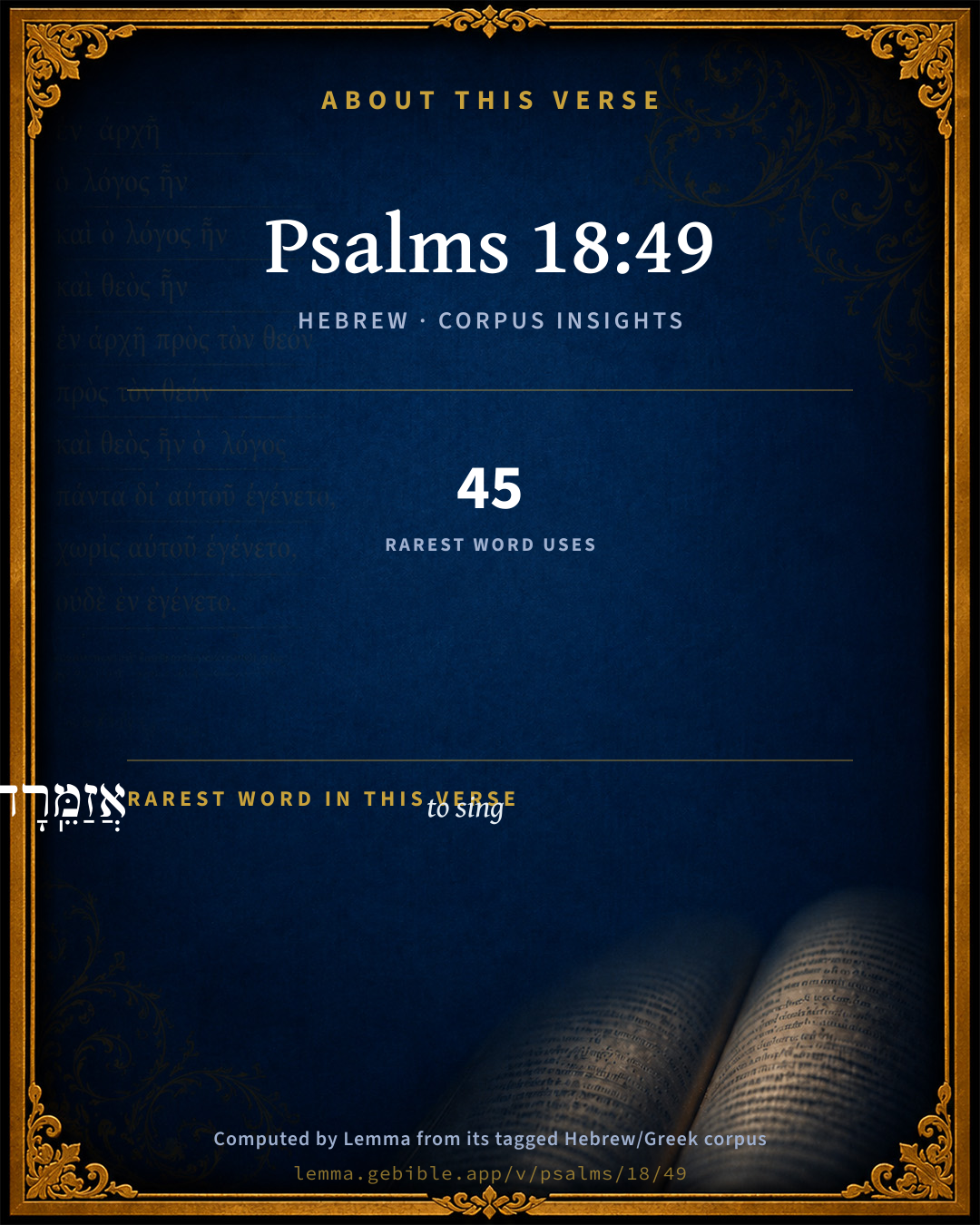
אֲזַמֵּֽרָה to sing H2167 occurs in 41 verses of the Hebrew Bible. Also found in:

Grammatical profile

  • 2 verbs
  • 3 nouns
  • 1 preposition
  • 1 particle

Verb forms

  • אוֹדְךָ֖ Hiphil · Imperfect
  • אֲזַמֵּֽרָה Piel · Cohortative

Hebrew & Septuagint length

In English translation the verse runs 18 words from the Hebrew and 16 from the Septuagint (LXX English) — closely comparable.

A rough comparison of the two English renderings, which tokenize alike — not a word-level alignment.

Word counts can differ between the Hebrew and the Greek without any difference in meaning — e.g. the Hebrew direct-object marker אֵת has no separate Greek word, and Greek often adds the article ὁ.

Cross-references

10

Topical passages linked to Psalms 18:49 in the Treasury of Scripture Knowledge — connected by theme and wording, ordered by reader-vote popularity; previews shown in the World English Bible.

  • Romans 15:9 and that the Gentiles might glorify God for his mercy. As it is written, "Therefore will I give praise to you among the Gentiles, And sing to your name."
  • 2 Samuel 22:50–51 Therefore I will give thanks to you, Yahweh, among the nations, Will sing praises to your name.
  • Psalms 14:7 Oh that the salvation of Israel would come out of Zion! When Yahweh restores the fortunes of his people, Then Jacob shall rejoice, and Israel shall be glad.
  • Psalms 30:12 To the end that my heart may sing praise to you, and not be silent. Yahweh my God, I will give thanks to you forever!
  • Psalms 72:18–19 Praise be to Yahweh God, the God of Israel, Who alone does marvelous deeds.
  • Psalms 108:1 My heart is steadfast, God. I will sing and I will make music with my soul.
  • Psalms 108:3 I will give thanks to you, Yahweh, among the nations. I will sing praises to you among the peoples.
  • Psalms 138:4 All the kings of the earth will give you thanks, Yahweh, For they have heard the words of your mouth.
  • Matthew 26:30 When they had sung a hymn, they went out to the Mount of Olives.
  • 1 Timothy 6:13 I charge you before God, who gives life to all things, and before Christ Jesus, who before Pontius Pilate testified the good confession,

Cross-references courtesy of OpenBible.info (CC BY 4.0).

Hebrew and Greek witnesses Masoretic Hebrew ↔ Greek Septuagint

The same verse in the two great witnesses to the Old Testament, shown verse-for-verse.

You’re reading Greek Psalm 17 (Hebrew Psalm 18). The Septuagint counts the superscription, so verse numbers can differ from the Hebrew — chapter-level alignment, not verse-by-verse. Numbering follows Rahlfs.

These are two independent witnesses, not word-aligned to each other, and the Septuagint is shown in lemma (dictionary) form.

Hebrew Psalms 18:49 Masoretic · Westminster Leningrad Codex

עַל כֵּ֤ן אוֹדְךָ֖ בַגּוֹיִ֥ם יְהוָ֑ה וּלְשִׁמְךָ֥ אֲזַמֵּֽרָה

Therefore I will give thanks to you, Yahweh, among the nations, And will sing praises to your name.

World English Bible · Public Domain

Greek LXX Greek Psalm 17:49 Septuagint · lemma form

ὁ ῥύστης ἐγώ ἐκ ἐχθρός ἐγώ ὀργίλος ἀπό ὁ ἐπι ἀναἱστάνω ἐπί ἐγώ ὑψόω ἐγώ ἀπό ἀνήρ ἄδικος ῥύομαι ἐγώ

Therefore will I confess to you, O Lord, among the Gentiles, and sing to your name.

LXX2012 (modern English Septuagint) · Public Domain

Hebrew: Westminster Leningrad Codex (CC BY 4.0). Greek: Septuagint (public domain); English from LXX2012 (modern English Septuagint) (Public Domain). How the Septuagint differs from the Hebrew →

Commentary

Notes on Psalms 18:49 from classic Christian and Jewish commentators (each source and its license shown beneath its notes). The classic Christian expositions comment on the surrounding passage and are grouped to its opening verse, so a note may address several verses; the Jewish commentaries on the Tanakh (Rashi and others) are per-verse, so they appear only where the commentator wrote on this verse.

Lemma curates 59 commentaries, every one of them public domain or Creative Commons licensed, each selected and text-cleaned for this edition rather than reprinted as found. About our sources →

Trapp's Complete Commentary

John Trapp

Psa 18:49 Therefore will I give thanks unto thee, O LORD, among the heathen, and sing praises unto thy name.

Ver. 49. Therefore I will give thanks, &c.] See how the psalmist in these three last verses endeth as he began.

Among the heathen] This the apostle applieth to Christ and his people, as a prophecy of his kingdom, and of the calling of the Gentiles, Rom 15:9. I, that is, Christ (but yet in the person of his faithful, and especially his ministers), will praise thee, or confess unto thee, &c.

And sing praises unto thy name] Which to have done absurdum fuisset apud surdos, would have been absurd, had not those heathens had their ears opened.

John Trapp, A Commentary or Exposition upon All the Books of the Old and New Testament (1647–1656) — public domain. Text from a community e-Sword module.

The Biblical Illustrator

Joseph S. Exell

Psa_18:49

Therefore will I give thanks unto Thee among the heathen.

Davids deliverance and thanksgiving

I. Of David delivered. The wonder is, how so good a man, so gracious a prince, should have enemies and rebels; should fall into such dangers and afflictions; should need so many deliverances. But even in the best men there is something amiss. All saints are sinners, and sin will be punished in Gods children soonest of all. It is impossible for governors to escape the smart of popular murmurings, tumults, and rebellions; for Moses the meekest, David the best, and Solomon the wisest of kings did not. The best of kings may be under the Cross, and need deliverances.

II. Of God his deliverer. That all deliverance comes from the Lord needs no proof, from Scripture or reason. Philosophers, poets, historians all acknowledge this truth. The heathen everywhere ascribe all good successes to their gods. Among us there are some who will not allow God to govern in His own house, but deny Him any care of things below. As He only brings us into affliction, so He only can remove the afflictions. If we believe this most certain truth, that all deliverance is from the Lord, we must show the fruits of that faith when in distress.

III. Of Davids thankfulness for his deliverance. Here observe--

1. The person performing it. That is, David. I will do it, saith he.

2. The duty itself That is, thanksgiving. I will give thanks.

3. The manner how he will do it, and that is--

(1) publicly,

(2) cheerfully. Gratitude is not the business of a year, but of a whole life. (Gilbert Sheldon, D. D.)

The Biblical Illustrator, edited by Joseph S. Exell (c. 1880s–1900s) — public domain. Text from a community e-Sword module.

J. A. Alexander on Psalms

Joseph Addison Alexander

50. (Psa 18:49). Therefore I will thank thee among the nations, O Jehovah, and to thy name will sing. The first word has reference not merely to the fact of his deliverance and promotion, but to the character in which he had experienced these blessings, and the extent of the divine purpose in bestowing them. "Therefore—because it is God who has done and is to do all this for me, and because it is in execution of a purpose comprehending the whole race—I will not confine my praises and thanksgiving to my own people, but extend them to all nations." The performance of this vow has been going on for ages, and is still in progress wherever this and other psalms of David are now sung or read. The verse before us is legitimately used by Paul, together with Deu 32:43, Isa 11:1; Isa 11:10, and Psa 117:1, to prove that, even under the restrictive institutions of the old economy, God was not the God of the Jews only, but of the Gentiles also. (Rom 3:29, Rom 15:9-12).—The verb in the first clause strictly means I will confess or acknowledge, but is specially applied to the acknowledgment of gifts received or benefits experienced, and then corresponds almost exactly to our thank. The corresponding verb in the last clause means to praise by music. See above, on Psa 7:17 (16), Psa 9:3; Psa 9:12 (2, 11).

Joseph Addison Alexander, The Psalms Translated and Explained (1850) — public domain. Text from a community e-Sword module.

Tyndale Open Study Notes

Tyndale Open Resources

18:49 The psalmist’s vision of praise . . . among the nations motivated Paul in his mission to the Gentiles (Rom 15:9).

Tyndale Open Study Notes — © Tyndale Open Resources, licensed CC BY-SA 4.0. Text via the HelloAO Bible API.

Geneva Bible (1599)

Geneva Bible translators

This prophecy appertaineth to the kingdom of Christ and vocation of the Gentiles, as Rom. 15:9.

Geneva Bible (1599) marginal notes — public domain. Text via Bolls.life.

Jamieson, Fausset & Brown

Robert Jamieson, A. R. Fausset & David Brown

Paul (Rom 15:9) quotes from this doxology to show that under the Old Testament economy, others than the Jews were regarded as subjects of that spiritual government of which David was head, and in which character his deliverances and victories were typical of the more illustrious triumphs of David's greater Son. The language of Psa 18:50 justifies this view in its distinct allusion to the great promise (compare Sa2 7:12). In all David's successes he saw the pledges of a fulfilment of that promise, and he mourned in all his adversities, not only in view of his personal suffering, but because he saw in them evidences of danger to the great interests which were committed to his keeping. It is in these aspects of his character that we are led properly to appreciate the importance attached to his sorrows and sufferings, his joys and successes.

Next: Psalms Chapter 19

Jamieson, Fausset & Brown — Commentary Critical and Explanatory on the Whole Bible (1871) — public domain (CC PDM 1.0). Text via the HelloAO Bible API.

Adam Clarke's Commentary

Verse 49. Will I give thanks unto thee - among the heathen] Quoted by St. Paul, Ro 15:9, to prove that the calling of the Gentiles was predicted, and that what then took place was the fulfilment of that prediction.

But there is a sense in which it applies particularly to David, well observed by Theodoret: "We see," says he, "evidently the fulfilment of this prophecy; for even to the present day David praises the Lord among the Gentiles by the mouth of true believers; seeing there is not a town, village, hamlet, country, nor even a desert, where Christians dwell, in which God is not praised by their singing the Psalms of David."

Adam Clarke's Commentary on the Bible (1810–1826) — public domain. Text from a community e-Sword/MySword module.

John Calvin's Commentaries

49. Therefore will I praise thee, O Jehovah! In this verse he teaches us that the blessings God had conferred upon him, of which he had spoken, are worthy of being celebrated with extraordinary and unusual praises, that the fame of them might reach even the heathen. There is in the words an implied contrast between the ordinary worship of God which the faithful were then accustomed to perform in the temple, and this thanksgiving of which David speaks, which could not be confined within so narrow limits. The meaning, therefore, is, O Lord, I will not only give thee thanks in the assembly of thy people, according to the ritual which thou hast appointed in thy law, but thy praises shall extend to a greater distance, even as thy grace towards me is worthy of being recounted through the whole world. Moreover, from these words we conclude that this passage contains a prophecy concerning the kingdom of Christ, which was to come. Unless the heathen had been allured into the fellowship of the chosen people, and united into one body with them, to praise God among them would have been to sing his praises among the deaf, which would have been foolish work and lost labor. Accordingly, Paul very properly and suitably proves from this text, that the calling of the Gentiles was not a thing which happened by chance, or at a venture, (Romans 15:9.) We shall afterwards see in many places that the Church is appointed to be the sacred dwelling-place for showing forth the praises of God. And, therefore, the name of God could not have been rightly and profitably celebrated elsewhere than in Judea, until the ears of the Gentiles were opened, which was done when God adopted them, and called them to himself by the gospel.

John Calvin's Commentaries (1540-1563) — public domain. Text from the Calvin Translation Society English edition (1840s-50s) via the Christian Classics Ethereal Library (ccel.org). Calvin's coverage is partial (roughly two-thirds of the Bible); uncommented books and verses are honest gaps, never fabricated. The 19th-century editor's footnotes and remarks are omitted so the notes are faithfully Calvin's own voice.

Ellicott's Commentary for English Readers

(49) In Rom_15:9, St. Paul quotes this verse, together with Deu_32:43 and Psa_117:1, as proof that salvation was not in God’s purpose confined to the Jews. It seems almost too magnificent a thought in David, that he could draw the surrounding nations within the circle of the religion as he had drawn them within the dominion of Israel. Nor is it likely that an individual would use such an expression. Israel as a nation might praise God “among the nations.” Therefore this verse is adduced as an argument by those who assign a later date to the psalm. But perhaps we are only to think of the nations as brought (see Psa_18:44) an unwilling audience of the praises which the conqueror raises to his God for the strength that had subdued them.

A Bible Commentary for English Readers, edited by Charles John Ellicott (1878–1897) — public domain. Text from a community e-Sword module.

The Cambridge Bible for Schools and Colleges

gen. ed. J. J. S. Perowne

49. The celebration of Jehovah’s faithfulness to His servant is not to be confined within the narrow limits of Israel. His praise is to be proclaimed among the nations, which, as they are brought under the dominion of His people, may eventually be brought to the knowledge of Jehovah. Cp. Psa_96:3; Psa_96:10. This verse is quoted by St. Paul in Rom_15:9 (together with Deu_32:43; Psa_117:1; Isa_11:10), in proof that the Old Testament anticipated the admission of the Gentiles to the blessings of salvation.

The Cambridge Bible for Schools and Colleges (gen. ed. J. J. S. Perowne; Cambridge University Press, 1878–1918) — public domain. Text from a community e-Sword module.

John Gill's Exposition

Great deliverance giveth he to his king,.... Not that is king over him; for he is King of kings and Lord of lords; but that is made king by him, as David was; who did not usurp the throne, but was anointed king by the appointment of God, and was placed by him upon the throne; to whom he gave great deliverance from his enemies, or "magnified salvations" to him; which were great in kind, and many in number; and as Christ is, whom God has set as his King on his holy hill of Sion, against whom the Heathen raged, and kings and princes set themselves; but he is delivered from them all, and saved from the power of death and the grave, and ever lives to reign over, protect, and defend his people; in Sa2 22:51, it is, he is "the tower of salvation for his king", with which compare Pro 18:10;

and showeth mercy to his anointed, to David, and to his seed for evermore; which may be understood either of David literally, who was the Lord's anointed, and to whom God showed mercy in various instances; and then by his seed is meant the Messiah, who was of his seed according to the flesh; or of the Messiah, whose name signifies Anointed; and who is often called David, Eze 34:23, Hos 3:5; and so some of the Jewish doctors (u) from this verse prove that the name of the Messiah is David: and by his seed are meant his spiritual seed; all the elect of God, who are given him as his children, to whom he stands in the relation of the everlasting Father: and as mercy is kept with him for evermore, Psa 89:28; so it is shown to them in regeneration, in the forgiveness of their sins, and in their everlasting salvation.

(u) Echa Rabbati, fol. 50. 2.

Next: Psalms Chapter 19

John Gill's Exposition of the Whole Bible (1746–1763) — public domain (CC PDM 1.0). Text via the HelloAO Bible API.

Albert Barnes' Notes on the Bible

Therefore will I give thanks unto thee - Margin, confess. The Hebrew word - ידה yâdâh - in the form used here, means properly to profess, to confess, to acknowledge; then especially to acknowledge or recognize blessings and favors; in other words, to give thanks, to praise. The idea here is that he would make a public acknowledgment of those blessings which he had received; or that he would cause the remembrance of them to be celebrated among the nations.

Among the heathen - Among the nations. See the note at Psa 18:43. The meaning here is, that he would cause these blessings to be remembered by making a record of them in this song of praise; a song that would be used not only in his own age and in his own country, but also among other nations, and in other times. He would do all in his power to make the knowledge of these favors, and these proofs of the existence of the true God, known abroad and transmitted to other times. The apostle Paul uses this language Rom 15:9 as expressing properly the fact that the knowledge of God was to be communicated to the “Gentiles:” “As it is written, For this cause will I confess to thee among the Gentiles.” The word “heathen” or nations, in the passage before us, corresponds precisely with the meaning of the word Gentiles; and Paul has used the language of the psalm legitimately and properly as showing that it was a doctrine of the Old Testament that the truths of religion were not to be confined to the Jews, but were to be made known to other nations.

And sing praises unto thy name - Unto thee; the name often being used to denote the person. The meaning is, that he would cause the praises of God to be celebrated among foreign or pagan nations, as the result of what God had done for him. Far, probably, very far beyond what David anticipated when he penned this psalm, this has been done. The psalm itself has been chanted by million who were not in existence, and in lands of which the psalmist had no knowledge; and, connected as it has been with the other psalms in Christian worship, it has contributed in an eminent degree to extend the praises of God far in the earth, and to transmit the knowledge of him to generations as they succeeded one another. What David anticipated is, moreover, as yet only in the progress of fulfillment. Millions not yet born will make use of the psalm, as million have done before, as the medium of praise to God; and down to the most distant times this sacred song, in connection with the others in the Book of Psalms, will contribute to make God known in the earth, and to secure for him the praises of mankind.

Albert Barnes' Notes on the Bible (1834–1885) — public domain. Text from a community e-Sword/MySword module.

Matthew Poole's English Annotations

Among the heathen; or, among the Gentiles or nations; i.e. either,

1. In the great congregations, consisting df the Israelites of all tribes; of whom this very word is used, Jos 3:17; 4:1; Eze 2:3, and elsewhere, as hath been noted before. Or,

2. In the presence of those Gentiles, who resorted to Jerusalem in great numbers, or before others of them, who are either subject to me, or confederate with me, as I have occasion of speaking or writing to any of them. But this was but an uncertain and inconsiderable business. And therefore David is here transported beyond himself, even to his seed for ever, as it is expressed Psa 18:50, and speaks this in special relation to Christ, who was to be his Seed, and of whom he was an eminent type, and by whom alone this was done to any purpose. And therefore this is justly applied to him, and to his preaching to and calling of the Gentiles, Rom 15:9.

Matthew Poole's English Annotations on the Holy Bible (1683–1685) — public domain. Text from a community e-Sword/MySword module.

Whedon's Commentary on the Bible

Daniel D. Whedon

49. Thanks unto thee… among the heathen—Or, among the Gentiles, for the word is translated indifferently nations, Gentiles, and heathen. Co-extensive with David’s victories and fame should be his praise of Jehovah. The language is prophetic of Christ’s triumph over the nations, and is thus quoted and applied, Rom_15:9

Daniel D. Whedon (gen. ed.), Commentary on the Old and New Testaments (1874–1909) — public domain. Text from a community e-Sword module.

The Pulpit Commentary

Therefore will I give thanks unto thee, O Lord, among the heathen. As, in some sense, "the head of the heathen" (ver. 43), David was bound to offer prayer, and praise, and thanksgiving "among them," if it were only to teach them by his example, and lead them on towards the worship of the true God. And sing praises unto thy Name; i.e. to thy Person God being in his Name.

The Pulpit Commentary (1880–1919), ed. H.D.M. Spence-Jones & Joseph S. Exell — public domain. Text from a community e-Sword module.

John Wesley's Explanatory Notes

Heathen - David is here transported beyond himself, and speaks this in special relation to Christ who was to be his seed, and of whom he was an eminent type, and by whom alone this was done. And therefore this is justly applied to him, and to his calling of the Gentiles, Rom. xv, 9.

John Wesley, Explanatory Notes Upon the Whole Bible (1754–1765) — public domain. Text via the GEBible commentary corpus.

Keil & Delitzsch

C. F. Keil & F. Delitzsch

(Heb.: 18:50-51) The praise of so blessed a God, who acts towards David as He has promised him, shall not be confined within the narrow limits of Israel. When God's anointed makes war with the sword upon the heathen, it is, in the end, the blessing of the knowledge of Jahve for which he opens up the way, and the salvation of Jahve, which he thus mediatorially helps on. Paul has a perfect right to quote Psa 18:50 of this Psalm (Rom 15:9), together with Deu 32:43 and Psa 117:1, as proof that salvation belongs to the Gentiles also, according to the divine purpose of mercy. What is said in Psa 18:50 as the reason and matter of the praise that shall go forth beyond Israel, is an echo of the Messianic promises in Sa2 7:12-16 which is perfectly reconcileable with the Davidic authorship of the Psalm, as Hitzig acknowledges. And Theodoret does not wrongly appeal to the closing words עד־עולם against the Jews. In whom, but in Christ, the son of David, has the fallen throne of David any lasting continuance, and in whom, but in Christ, has all that has been promised to the seed of David eternal truth and reality? The praise of Jahve, the God of David, His anointed, is, according to its ultimate import, a praising of the Father of Jesus Christ.

Keil & Delitzsch — Biblical Commentary on the Old Testament (1861–1891) — public domain (CC PDM 1.0). Text via the HelloAO Bible API. (Old Testament only.)

Lesson kit

Teaching starters — assembled from the data on this page, not authored interpretation. Every prompt links to the verse data it draws on. Edit before teaching.

Psalms, in the Wisdom, opens this verse with 7 words (7 distinct Hebrew lemmas). Its most distinctive word is zâmar (“to sing”). A historical commentator’s framing appears above. Read the whole chapter for the surrounding context.

Discussion questions

  1. The word zâmar carries the sense “to sing.” How does it shape the verse?
  2. Judges 5:3 shares the word «to sing» with this verse. How do the two illuminate each other?
  3. These translations render this verse differently; the difference is in the English rendering, not the original. What questions does that raise?
  4. The verb «אוֹדְךָ֖» is Hiphil Imperfect. How does its form color the action?
  5. Reading how Trapp's Complete Commentary and The Biblical Illustrator read this verse, where do the two commentators agree and where do they part?

Things to notice

Reading settings

Reading text

Shown beneath each verse's original-language words.

Old Testament
Old Testament edition

Read the OT as the Masoretic Hebrew (MT) or the Greek Septuagint (LXX).

English shown for the Greek Septuagint (in the Hebrew ↔ Greek comparison).

Comparing translations? Open the Compare panel on any verse page to stack up to four side by side.