Deuteronomy 4:38

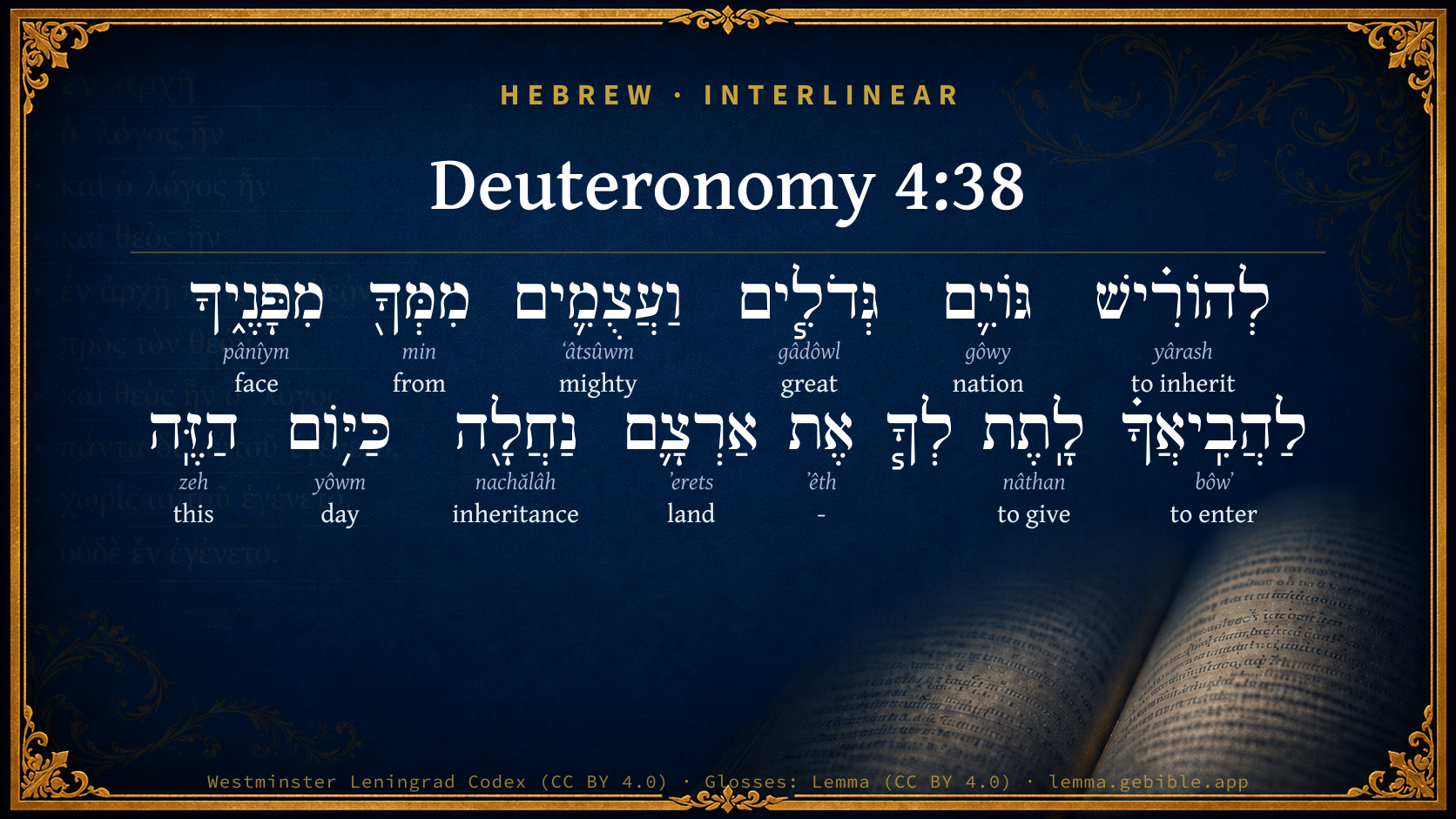
Hebrew (Westminster Leningrad Codex) Deuteronomy 4:38 appears in the Hebrew Old Testament. The text above is from the Westminster Leningrad Codex. Each word links to its Strong’s number, a concise gloss, and parsing drawn from the Open Scriptures Hebrew Bible morphology. Click any word for its full Brown-Driver-Briggs (BDB) entry.
Download image
Cite this verse

Deuteronomy 4:38 (World English Bible). Public Domain. Lemma interlinear Bible study tool, https://lemma.gebible.app/v/deuteronomy/4/38.

Show BibTeX & RIS
BibTeX
RIS
English Translation
to drive out nations from before you greater and mightier than you, to bring you in, to give you their land for an inheritance, as at this day.
World English Bible · Public Domain
Download a study sheet

One document with this verse’s original text, its word-by-word gloss line, the meaning frame, cross-references with their text, attributed commentary, and full source and license credits — printable, and it pastes into notes with its structure intact.

This verse Autodidact and up

Study sheet (.html) Plain text (.txt)

A passage Seminary Student

Up to 50 verses in one chapter. A passage sheet keeps up to 6 commentary sources and 12 cross-references per verse, in the order this page ranks them, and says so on the sheet whenever that leaves anything out. Ask for a single verse and you get the Autodidact verse sheet above.

Everything on this page stays free to read, with no account — the sheet is a download of what is already on screen, not access to it.

Want to remove ads? Support Godless Engineer
Compare translations 3

The same verse in 3 English versions, stacked beneath the original-language interlinear above. Click any original word for its lexicon entry.

Each is an independent rendering of the whole verse — the interlinear is not word-aligned to these translations.

Highlighted words mark where these versions differ — a whole-verse word diff, not a word-by-word alignment.

  • World English Bible Public Domain
    to drive out nations from before you greater and mightier than you, to bring you in, to give you their land for an inheritance, as at this day.
  • King James Version Public Domain
    To drive out nations from before thee greater and mightier than thou art, to bring thee in, to give thee their land for an inheritance, as it is this day.
  • unfoldingWord Literal Text CC BY-SA 4.0
    to drive out from your faces nations greater and mightier than you, to bring you in, to give to you their land an inheritance, as this day.

unfoldingWord Literal Text — © unfoldingWord, licensed CC BY-SA 4.0. Word-aligned USFM3 via Door43 (git.door43.org/unfoldingWord/en_ult).

Versions to compare (up to 4)

3 of 4 selected

Show all 18 translations

Every available English version of this verse, each an independent rendering of the whole verse.

  • World English Bible Public Domain
    to drive out nations from before you greater and mightier than you, to bring you in, to give you their land for an inheritance, as at this day.
  • Berean Standard Bible Public Domain
    to drive out before you nations greater and mightier than you, and to bring you into their land and give it to you for your inheritance, as it is this day.
  • Majority Standard Bible Public Domain
    to drive out before you nations greater and mightier than you, and to bring you into their land and give it to you for your inheritance, as it is this day.
  • King James Version Public Domain
    To drive out nations from before thee greater and mightier than thou art, to bring thee in, to give thee their land for an inheritance, as it is this day.
  • American Standard Version (1901) Public Domain
    to drive out nations from before thee greater and mightier than thou, to bring thee in, to give thee their land for an inheritance, as at this day.
  • Revised Version (1885) Public Domain
    to drive out nations from before thee greater and mightier than thou, to bring thee in, to give thee their land for an inheritance, as at this day.
  • Geneva Bible (1599) Public Domain
    To thrust out nations greater and mightier then thou, before thee, to bring thee in, and to giue thee their land for inheritance: as appeareth this day.
  • Douay-Rheims (1899) Public Domain
    To destroy at thy coming very great nations, and stronger than thou art, and to bring thee in, and give thee their land for a possession, as thou seest at this present day.
  • Young's Literal Translation Public Domain
    to dispossess nations greater and stronger than thou, from thy presence, to bring thee in to give to thee their land -- an inheritance, as `at' this day.
  • Literal Standard Version CC BY-SA 4.0
    to dispossess nations greater and stronger than you from your presence, to bring you in to give their land to you [for] an inheritance, as [at] this day.
  • Unlocked Literal Bible CC BY-SA 4.0
    in order to drive out from before you nations greater and mightier than you, to bring you in, to give you their land as an inheritance, as today.
  • unfoldingWord Literal Text CC BY-SA 4.0
    to drive out from your faces nations greater and mightier than you, to bring you in, to give to you their land an inheritance, as this day.
  • Darby Bible Public Domain
    to dispossess nations from before thee greater and mightier than thou art, to bring thee in, to give thee their land for an inheritance, as it is this day.
  • World Messianic Bible Public Domain
    to drive out nations from before you greater and mightier than you, to bring you in, to give you their land for an inheritance, as it is today.
  • Webster's Bible Public Domain
    To drive out nations from before thee, greater and mightier than thou art, to bring thee in, to give thee their land for an inheritance, as it is this day.
  • Free Bible Version CC BY-SA 4.0
    driving out ahead of you nations that were greater and stronger than you, in order to lead you to their land and give it to you as yours to own, just as you do today.
  • Bible in Basic English Public Domain
    Driving out before you nations greater and stronger than you, to take you into their land and give it to you for your heritage, as at this day.
  • JPS Tanakh (1917) Public Domain
    to drive out nations from before thee greater and mightier than thou, to bring thee in, to give thee their land for an inheritance, as it is this day;

Literal Standard Version (2020), Covenant Press — licensed CC BY-SA 4.0. Text via the HelloAO Bible API (eBible.org). Unlocked Literal Bible (unfoldingWord) — licensed CC BY-SA 4.0. Text via the HelloAO Bible API (eBible.org). unfoldingWord Literal Text — © unfoldingWord, licensed CC BY-SA 4.0. Word-aligned USFM3 via Door43 (git.door43.org/unfoldingWord/en_ult). Free Bible Version, Dr. Jonathan Gallagher — licensed CC BY-SA 4.0. Text via the HelloAO Bible API (eBible.org).

Word by word

More ways to search: Search by grammar → Find every occurrence → Compare this word →

Practice this passage: Drill this verse → Learn its vocabulary →

וַעֲצֻמִ֛ים
ʻâtsûwm
H6099
“and · mighty”
Conjunction + Adjective, Adjective, Masculine, Plural, Absolute
Part of Speech
Conjunction + Adjective
Type
Adjective
Gender
Masculine
Number
Plural
State
Absolute
Full BDB Definition

Origin: pass. part. of H6105

TWOT: 1673d

mighty, vast, numerous - mighty, strong (in number) - numerous, countless
  1. לְהוֹרִ֗ישׁ yârash H3423 “to inherit” Preposition + Verb, Hiphil, Infinitive Construct
  2. גּוֹיִ֛ם gôwy H1471 “nations” Noun, Common, Masculine, Plural, Absolute
  3. גְּדֹלִ֧ים gâdôwl H1419 “great” Adjective, Adjective, Masculine, Plural, Absolute
  4. מִמְּךָ֖ min H4480 “from · you” Preposition + Suffix, Personal, 2nd Person, Masculine, Singular
  5. מִפָּנֶ֑יךָ pânîym H6440 “from · face(s) · your” Preposition + Noun, Common, Both, Plural, Construct + Suffix, Personal, 2nd Person, Masculine, Singular
  6. לַהֲבִֽיאֲךָ֗ bôwʼ H935 “to enter · you” Preposition + Verb, Hiphil, Infinitive Construct + Suffix, Personal, 2nd Person, Masculine, Singular
  7. לָֽתֶת nâthan H5414 “to give” Preposition + Verb, Qal, Infinitive Construct
  8. אֶת ʼêth H853 “-” Particle, Direct Object
  9. אַרְצָ֛ם ʼerets H776 “land · their” Noun, Common, Both, Singular, Construct + Suffix, Personal, 3rd Person, Masculine, Plural
  10. נַחֲלָ֖ה nachălâh H5159 “inheritance” Noun, Common, Feminine, Singular, Absolute
  11. כַּיּ֥וֹם yôwm H3117 “like/as the · day” Preposition, Determined + Noun, Common, Masculine, Singular, Absolute
  12. הַזֶּֽה zeh H2088 “the · this” Particle, Definite Article + Pronoun, Demonstrative, Masculine, Singular

About this verse

These counts appear in no published source. They are computed here, from the morphology-tagged text and Lemma’s own curated glosses. What Lemma adds →

14
words
13
distinct lemmas
Pentateuch
section

Shared distinctive vocabulary

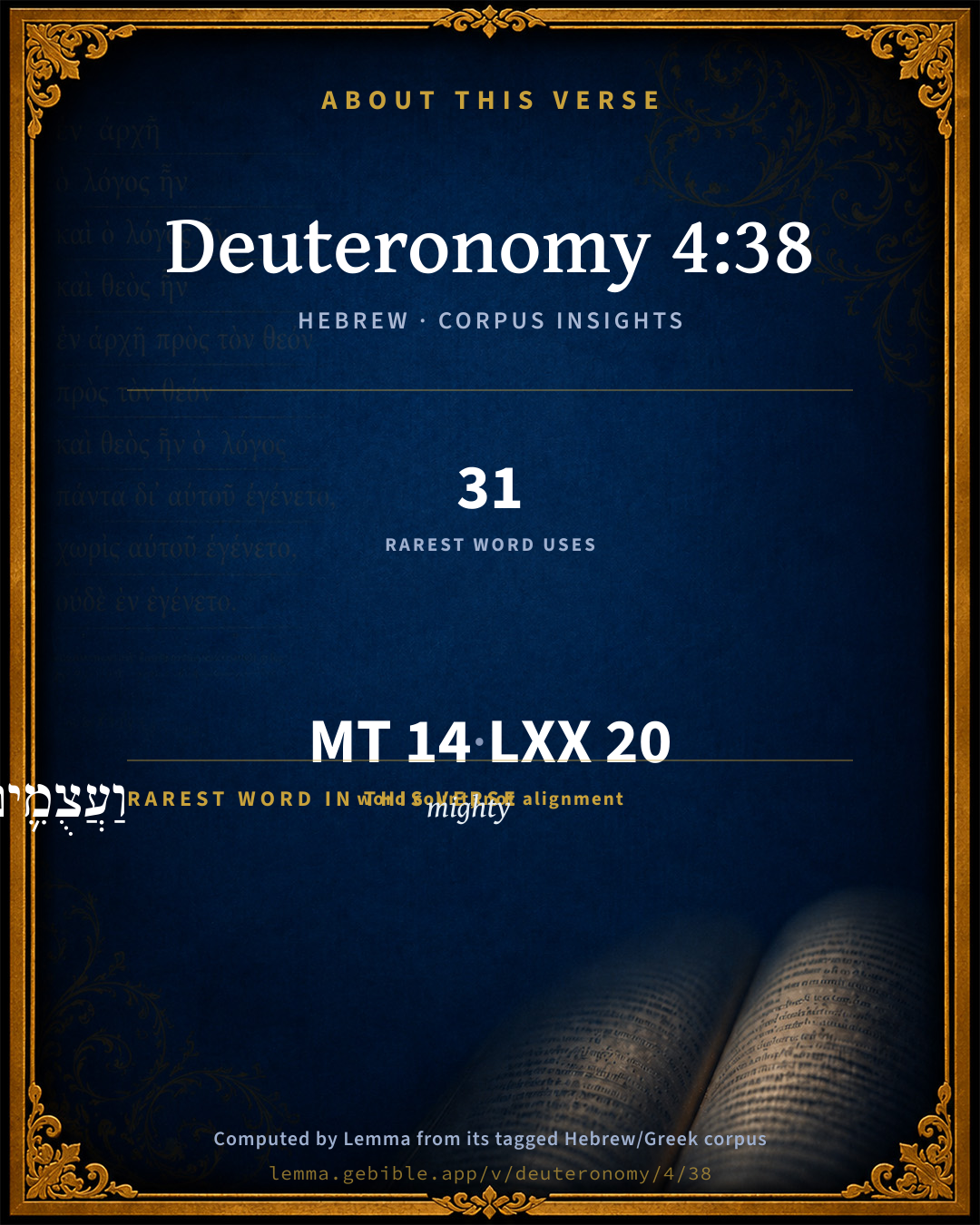
וַעֲצֻמִ֛ים mighty H6099 occurs in 31 verses of the Hebrew Bible. Also found in:

Grammatical profile

  • 3 verbs
  • 5 nouns
  • 2 adjectives
  • 1 pronoun
  • 2 prepositions
  • 1 particle

Verb forms

  • לְהוֹרִ֗ישׁ Hiphil · Infinitive Construct
  • לַהֲבִֽיאֲךָ֗ Hiphil · Infinitive Construct
  • לָֽתֶת Qal · Infinitive Construct

Hebrew & Septuagint length

In English translation the verse runs 28 words from the Hebrew and 28 from the Septuagint (LXX English) — the same length.

A rough comparison of the two English renderings, which tokenize alike — not a word-level alignment.

Word counts can differ between the Hebrew and the Greek without any difference in meaning — e.g. the Hebrew direct-object marker אֵת has no separate Greek word, and Greek often adds the article ὁ.

In the original languages it is 14 Hebrew tokens and 20 Greek tokens — but the two are counted differently (Hebrew bundles its prefixes and suffixes into one token; the Greek is in lemma form), so that isn’t a like-for-like length.

Cross-references

8

Topical passages linked to Deuteronomy 4:38 in the Treasury of Scripture Knowledge — connected by theme and wording, ordered by reader-vote popularity; previews shown in the World English Bible.

  • Deuteronomy 7:1 When Yahweh your God shall bring you into the land where you go to possess it, and shall cast out many nations before you, the Hittite, and the Girgashite, and the Amorite, and the Canaanite, and the Perizzite, and the Hivite, and the Jebusite, seven nations greater and mightier than you;
  • Exodus 23:27–28 I will send my terror before you, and will confuse all the people to whom you come, and I will make all your enemies turn their backs to you.
  • Deuteronomy 2:31–3:16 Yahweh said to me, Behold, I have begun to deliver up Sihon and his land before you: begin to possess, that you may inherit his land.
  • Deuteronomy 9:1–5 Hear, Israel: you are to pass over the Jordan this day, to go in to dispossess nations greater and mightier than yourself, cities great and fortified up to the sky,
  • Deuteronomy 11:23 then will Yahweh drive out all these nations from before you, and you shall dispossess nations greater and mightier than yourselves.
  • Psalms 44:2–3 You drove out the nations with your hand, But you planted them. You afflicted the peoples, But you spread them abroad.
  • Deuteronomy 8:18 But you shall remember Yahweh your God, for it is he who gives you power to get wealth; that he may establish his covenant which he swore to your fathers, as at this day.
  • Joshua 3:10 Joshua said, Hereby you shall know that the living God is among you, and that he will without fail drive out from before you the Canaanite, and the Hittite, and the Hivite, and the Perizzite, and the Girgashite, and the Amorite, and the Jebusite.

Cross-references courtesy of OpenBible.info (CC BY 4.0).

Hebrew and Greek witnesses Masoretic Hebrew ↔ Greek Septuagint

The same verse in the two great witnesses to the Old Testament, shown verse-for-verse.

These are two independent witnesses, not word-aligned to each other, and the Septuagint is shown in lemma (dictionary) form.

Hebrew Deuteronomy 4:38 Masoretic · Westminster Leningrad Codex

לְהוֹרִ֗ישׁ גּוֹיִ֛ם גְּדֹלִ֧ים וַעֲצֻמִ֛ים מִמְּךָ֖ מִפָּנֶ֑יךָ לַהֲבִֽיאֲךָ֗ לָֽתֶת לְךָ֧ אֶת אַרְצָ֛ם נַחֲלָ֖ה כַּיּ֥וֹם הַזֶּֽה

to drive out nations from before you greater and mightier than you, to bring you in, to give you their land for an inheritance, as at this day.

World English Bible · Public Domain

Greek LXX Deuteronomy 4:38 Septuagint · lemma form

ἐκὀλεθρεύω ἔθνος μέγας καί ἰσχυρός σύ πρό πρόσωπον σύ εἰςἄγω σύ δίδωμι σύ ὁ γῆ αὐτός κληρονομέω καθώς ἔχω σήμερον

to destroy nations great and stronger than you before your face, to bring you in, to give you their land to inherit, as you have it this day.

LXX2012 (modern English Septuagint) · Public Domain

Hebrew: Westminster Leningrad Codex (CC BY 4.0). Greek: Septuagint (public domain); English from LXX2012 (modern English Septuagint) (Public Domain). How the Septuagint differs from the Hebrew →

Targum (Aramaic paraphrase)

2

The Targum is the ancient Jewish Aramaic paraphrase of the Hebrew Scriptures — an interpretive translation, not the Hebrew text itself. Onkelos (literal) and Pseudo-Jonathan (expansive) render the Torah, and Jonathan the Prophets. Coverage is partial: where no permissively-licensed English translation exists for a verse, only the Aramaic is shown. This is verse-level text, not a word-by-word alignment to the Hebrew.

  1. Targum Onkelos Torah (Genesis–Deuteronomy)
    לְתָרָכָא עַמְמִין רַבְרְבִין וְתַקִיפִין מִנָךְ מִן קֳדָמָךְ לְאָעָלוּתָךְ לְמִתַּן לָךְ יָת אַרְעֲהוֹן אַחֲסָנָא כְּיוֹמָא הָדֵין

    (no public-domain English translation for this verse)

    Targum Onkelos — Aramaic: “Onkelos Genesis” (public domain); “Onkelos Exodus” (public domain); “Onkelos Leviticus” (public domain); “Onkelos Numbers” (public domain); “Onkelos Deuteronomy” (public domain). English: “Sefaria Community Translation” (CC0 1.0 (public-domain dedication)); “J.W. Etheridge. The Targums of Onkelos and Jonathan Ben Uzziel on the Pentateuch. London: Longmans, Green, 1862” (public domain). Text via Sefaria.

  2. Targum Pseudo-Jonathan Torah (Genesis–Deuteronomy)
    לְתַרְכָא עַמְמִין רַבְרְבִין וְתַקִּיפִין מִנְכוֹן מִן קֳדָמֵיכוֹן לְאַעֲלוּתְכוֹן לְמִתַּן לְכוֹן יַת אַרְעֲהוֹן אַחְסָנָא כְּיוֹמָא הָדֵין

    to drive out nations greater and stronger than you from before you, and give you their land to inherit as at this day.

    Targum Pseudo-Jonathan — Aramaic: “Targum Jonathan on Genesis” (public domain); “Targum Jonathan on Exodus” (public domain); “Targum Jonathan on Leviticus” (public domain); “Targum Jonathan on Numbers” (public domain); “Targum Jonathan on Deuteronomy” (public domain). English: “The Targum of Jonathan ben Uzziel, trans. J. W. Etheridge, London, 1862” (public domain). Text via Sefaria.

Commentary

Notes on Deuteronomy 4:38 from classic Christian and Jewish commentators (each source and its license shown beneath its notes). The classic Christian expositions comment on the surrounding passage and are grouped to its opening verse, so a note may address several verses; the Jewish commentaries on the Tanakh (Rashi and others) are per-verse, so they appear only where the commentator wrote on this verse.

Lemma curates 59 commentaries, every one of them public domain or Creative Commons licensed, each selected and text-cleaned for this edition rather than reprinted as found. About our sources →

The Cambridge Bible for Schools and Colleges

gen. ed. J. J. S. Perowne

38. to drive out nations from before thee] Heb. to dispossess … from before thee; Deu_9:4-5, Deu_11:23, Deu_18:12 (and the probably editorial Exo_34:24); cp. Deu_7:17, Deu_9:3; Deu_9:5. For another form of same vb also with obj. of person see on Deu_9:1. Both are characteristic of D and occur both with Sg. and Pl.

greater and mightier than thou] Deu_7:6. See Deu_9:1.

to give thee their land for an inheritance] See on Deu_1:38, Deu_5:31.

as at this day] ‘The reference may be either to the territory E. of Jordan, or (by an anachronism) to Palestine generally; the similar language of Deu_7:1 end, Deu_9:1, Deu_11:23 favours the latter interpretation’ (Driver).

The Cambridge Bible for Schools and Colleges (gen. ed. J. J. S. Perowne; Cambridge University Press, 1878–1918) — public domain. Text from a community e-Sword module.

John Gill's Exposition

To drive out nations from before thee, greater and mightier than thou art,.... The seven nations of the land of Canaan, which were more in number and mightier in power and strength than they, and particularly the Amorites, who were already driven out and dispossessed of their country, even the kingdoms and nations of Sihon and Og:

to bring thee in to give thee their land for an inheritance, as it is this day; referring, as Aben Ezra observes, to the inheritance of the land of the two kings of the Amorites, which the tribes of Reuben and Gad, and the half tribe of Manasseh, were put into the possession of already.

John Gill's Exposition of the Whole Bible (1746–1763) — public domain (CC PDM 1.0). Text via the HelloAO Bible API.

Haydock's Catholic Bible Commentary

Day. They had already conquered the mighty kingdoms of Sehon and of Og. (Menochius)

George Leo Haydock (1774–1849), Haydock's Catholic Family Bible and Commentary, 1859 edition — public domain. Excludes Psalms (Douay-Rheims chapter numbering differs from Protestant) and Deuterocanonical books (Catholic canon only).

The Pulpit Commentary

As it is this day; as this day has shown, or as it has come to pass this day, in the overthrow, namely, of Sihon and Og.

The Pulpit Commentary (1880–1919), ed. H.D.M. Spence-Jones & Joseph S. Exell — public domain. Text from a community e-Sword module.

Rashi

Rabbi Shlomo Yitzchaki (Rashi)

ממך מפניך — Invert it (the order of the words) and then explain it accordingly: to dispossess from before thee (מפניך) nations greater and mightier than thee (ממך)

כיום הזה AS AT THIS DAY — i.e., As you see today.

Rashi on the Tanakh — English translations: “The Judaica Press complete Tanach with Rashi, translated by A. J. Rosenberg” (CC BY 4.0); “Pentateuch with Rashi's commentary by M. Rosenbaum and A.M. Silbermann, 1929-1934” (public domain); “The Metsudah Tanach series, Lakewood, N.J” (CC BY 4.0); and “The Book of Joshua, Metsudah Publications, 1997” (CC BY 4.0). Text via Sefaria.

Lesson kit

Teaching starters — assembled from the data on this page, not authored interpretation. Every prompt links to the verse data it draws on. Edit before teaching.

Deuteronomy, in the Pentateuch, opens this verse with 14 words (13 distinct Hebrew lemmas). Its most distinctive word is ʻâtsûwm (“mighty”). A historical commentator’s framing appears above. Read the whole chapter for the surrounding context.

Discussion questions

  1. The word ʻâtsûwm carries the sense “mighty.” How does it shape the verse?
  2. Genesis 18:18 shares the word «mighty» with this verse. How do the two illuminate each other?
  3. The translations on this page render this verse differently — a whole-verse word diff, not a word-by-word alignment. What might account for the different wordings?
  4. The verb «לְהוֹרִ֗ישׁ» is Hiphil Infinitive Construct. How does its form color the action?
  5. Reading how The Cambridge Bible for Schools and Colleges and John Gill's Exposition read this verse, where do the two commentators agree and where do they part?

Things to notice

Reading settings

Reading text

Shown beneath each verse's original-language words.

Old Testament
Old Testament edition

Read the OT as the Masoretic Hebrew (MT) or the Greek Septuagint (LXX).

English shown for the Greek Septuagint (in the Hebrew ↔ Greek comparison).

Comparing translations? Open the Compare panel on any verse page to stack up to four side by side.